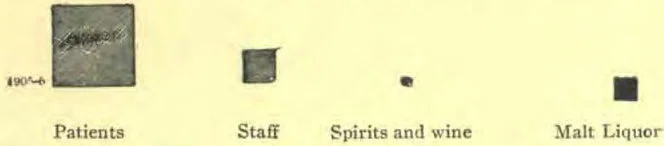
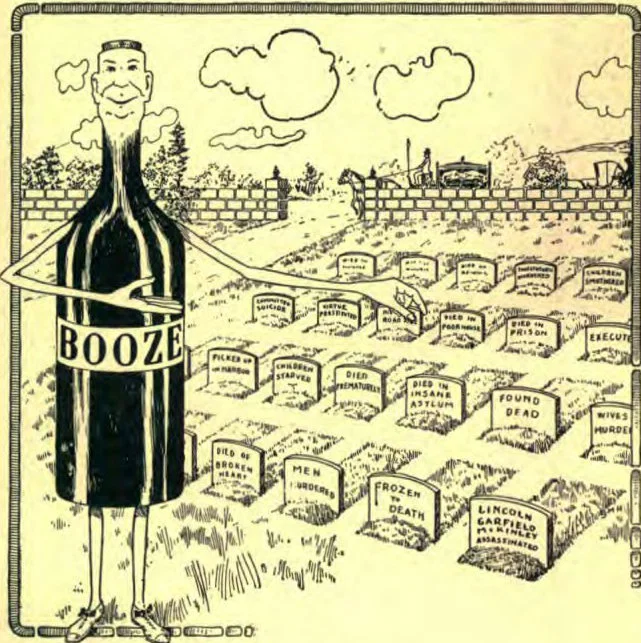
ONCE, as shown by the accompanying diagram, used by courtesy of the National Temperance League of England, alcohol held no small place as a supposed remedial agent. But that was before the scientific experimenter and observer had begun his work. Under the light of modern scientific investigation, alcohol as a medicine has been constrained to resign its former position. It has been branded an impostor and deceiver.
An inquiry among hospitals shows that the use of alcoholic liquors is decreasing materially. Most report from a half to two thirds less used than ten years ago. Practically none is prescribed by some staffs.
Dr. W. H. Waugh, editor of Clinical Medicine, Chicago, says:—
I do not know a solitary use or a solitary case occurring in the widest range of medical practise in which alcohol is the best remedy that can be applied.
Dr. Howard A. Kelly, of Johns Hopkins Hospital, Baltimore, says:—
Had alcohol never been discovered, and were it then in my power to portray the effects of such a discovery all men, without exception, would declare it impossible for the very fiends of hell to conceive any more diabolical plan for the degradation and destruction of the human race. Our greatest foes are the manufacturers and the distributors of alcohol. The story of injuries done by drink are so written in the sad life history of many of our greatest men; are so evident throughout our land in squalor, poverty, misery, and crime, and replete in prisons, workhouses, and asylums, as well as in domestic infelicity, learned in the confessional and by the physician, that it is inconceivable that any intelligent, rational man can deny the necessity for strong, united action to rid the land of both manufacturer and distributor.
Diagram showing consumption of alcoholic liquor in the London county insane hospitals in 1889
I have no further arguments, still less new ones. I simply leave the palpable appalling facts to him who would defend the traffic, and for him can entertain only a feeling of astonishment and pity.
These conclusions are, I believe, in the light of experience, unassailable:—
Alcohol is non-efficient as a food, a most condemnable, wasteful substitute.
It may be classed as a drug and a poison, all the more dangerous because insidious and often delayed in its visible effects.
It has no recognized position as a medicine; there is no disease of all the thousand known of which we can say that alcohol or an alcoholic beverage will cure it.
It destroys individual, domestic, and civic felicity.
It increases taxation by filling prisons, madhouses, and poorhouses.
It is the greatest foe to civilization at home and in heathen lands, by corrupting the higher spiritual perceptions. If Christianity is the ideal of our modern life, then alcohol is its most deadly foe.
Diagram showing decrease in consumption of alcoholic liquor in the London county insane hospitals in 1905
Alcohol therefore could be wholly abolished with profit.
Therefore, as one of the human family, responsible for my neighbor as well as for myself, I have no right to introduce into the household or use for my own pleasure, even moderately, that which may hurt other members of the family, or set at work evil influences I have no well-grounded hope of controlling.
This attitude of the medical profession toward alcohol has had an incalculable influence in promoting the present wide-spread demand for its prohibition.
Municipal Posters on Alcoholism and Physical Degeneracy
In one hundred British cities, by order of the city councils, “municipal posters have been put up, headed in large letters, “ALCOHOLISM AND PHYSICAL DEGENERACY,” with this declaration on them:—
Alcohol is an insidious poison, and should be subject to the same strict limitation as opium, morphia, or strychnine. Its supposed stimulating effects are delusive.
Bartenders Convention at Euclid Beach Park
A CONVENTION of bartenders was held at Euclid Beach Park, one of the very few “dry” pleasure resorts in Cleveland. One of the men when asked, “Why did you fellows pick out Euclid Beach Park, a temperance resort, for your convention?” replied, “Because we are up against the bums every working day of our lives, and when we take a day off we want to get clear of the crowd.” Why, then, should the liquor men object so strenuously because temperance people are working to free every day from the “crowd”?
The Old Story
By Dennis A. McCarthy
“To-morrow,” he promised his conscience, “to-morrow I mean to be good;
To-morrow I’ll think as I ought to; to-morrow I’ll do as I should;
To-morrow I’ll conquer the habits that hold me from heaven away.”
But ever his conscience repeated one word, and one only, “Today.”
To-morrow, to-morrow, to-morrow, thus day after day it went on;
To-morrow, to-morrow, to-morrow—till youth like a vision was gone;
Till age and his passions had written the message of fate on his brow,
And forth from the shadows came Death, with the pitiless syllable, “Now.”
— Dennis A. McCarthy, in Christian Endeavor World.
Let the Babies Live
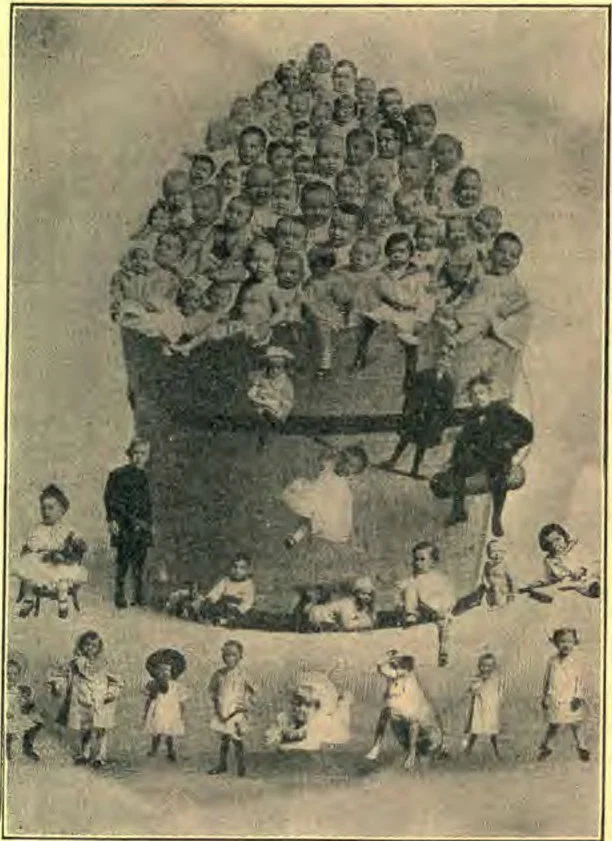
The Circle. A bucketful of children who want to live
The sweetest gift of God to the world is the baby. And yet this treasure is not always as carefully guarded and protected as its worth demands; for somewhere in the civilized world a baby dies every ten seconds; 360 are laid in the cold ground every hour, 8,640 every day, and more than 3,000,000 every year,—a funeral train of dead babies nearly four hundred miles long! Your darling and that of your neighbor may have been among this number.
Men who have given profound study to the conditions that produce this appalling annual death-roll among the babies of our land, claim that one half, or 1,526,800, of these deaths are preventable. If so, then these million and a half were murdered through neglect, ignorance, and culpability. King Herod of old in his jealous frenzy slaughtered only a few score at most, and still the story of his crime is sounding down the ages—and rightly, too; but what do we deserve who sit quietly by and allow nearly two million innocent babes to be ruthlessly slaughtered every year by unfortunate conditions that might with effort be remedied?
In most cities, according to the report of the Society for Prevention of Infant Mortality, eighty per cent of the children that die under one year of age are bottle-fed babies; and ninety per cent of those that die from digestive troubles are bottle-fed. If the mothers could have nursed these, a very large percentage would have been saved; for “one ounce of mother’s milk is better than one quart of cow’s milk for baby.”
Professor Bunge, of Germany, spent thirty years in chemical researches on the composition of milk. He found that this composition is adapted, by the God of nature, to the needs of each species of mammal, and is different in the different species. Human milk Professor Bunge found to be more complex than the milk of any other mammal. He also found that it is especially rich in lecithin, which serves for the construction of the brain, because the weight of that of the child’s is relatively the highest.
There are several reasons offered why women do not effectively suckle their infants. One is, they are physically incapable of doing so. And this incapability is on the increase. “In the towns of Germany and Switzerland more than half of the women are already attacked by this inability,” says Professor Bunge. Heredity plays a large part in thus incapacitating women. Usually if the mother can suckle her child, her daughter has the same ability. This is not always so, but Professor Bunge found that in seventy-eight per cent of such cases of incapacity the father of the daughter was an immoderate drinker. In families where the mothers and daughters can suckle their infants, drunkenness is rare, but in a very large proportion of those families thus incapacitated, alcohol has played no inconsiderable part.
But alcohol does not strike at the baby alone through its mother’s breast. It makes the mother indifferent in every way to the needs of her child. It also makes her cruel and brutal, so disease and semi-starvation often result. And the stupor of the drunken mother is a frequent cause of the overlying, or smothering, of infants. Twenty-five hundred babies perish annually in this country from this cause. Out of 461 cases that came under the direct observation of one surgeon of police, 219 occurred on Saturday night, which fact connects their death unmistakably with alcoholism.
Scientific observation in both Europe and America reveals the fact that alcoholism in parents or grandparents is responsible annually for by far the larger share of the deformed, epileptic, idiotic, and incorrigible children that are brought into the world. Besides this, the children of alcoholics are especially predisposed to tuberculosis and insanity. And many of these children inherit a craving for alcoholic liquor. Mönkemöller found in one reformatory school hereditary taint due to parental alcoholism in 67.2 per cent of all the pupils. The family histories of 3,711 children have been traced by scientists through three generations.
Of the children of abstaining parents and abstaining grandparents only 4 per cent were dullards, whereas, the children of abstaining parents but drinking grandparents, 78 per cent were dullards. Dividing the 3,711 children into the following classes, we note striking contrasts:—
1. Of those free from hereditary alcoholic taint—
96 per cent were proficient.
4 per cent were dullards.
18 per cent suffered from some neurosis or organic disease.
2. Of those with hereditary alcoholic taint—
23 per cent were proficient.
77 per cent were dullards.
76 per cent suffered from some neurosis or organic disease.
“At a discussion on this subject at the Vienna congress against alcoholism, a medical man stated that the teachers in wine-growing districts of Lower Austria know that a supply of very bad scholars in any one year denotes a good vintage six years previously.”
Science and practical observation no longer hesitate to hold alcoholic ancestry largely responsible for our hosts of feeble-minded, epileptic, insane, tuberculous, and crippled children. The State recognizes its responsibility to provide homes of isolation for these; but, strange as it may seem, it hesitates to provide preventive and remedial measures, which course, from every view-point, would be wiser and more generous.
Temperance Judge Confronts Youthful Offender on Drink Profits
“We will stamp out this evil of drink,” said a temperance judge to a youthful offender. The victim of drink responded, “You can never do it, judge, as long as there is an eight-cent profit in every ten-cent drink.”
An Auto and a Boy
By Joseph Henry Crooker
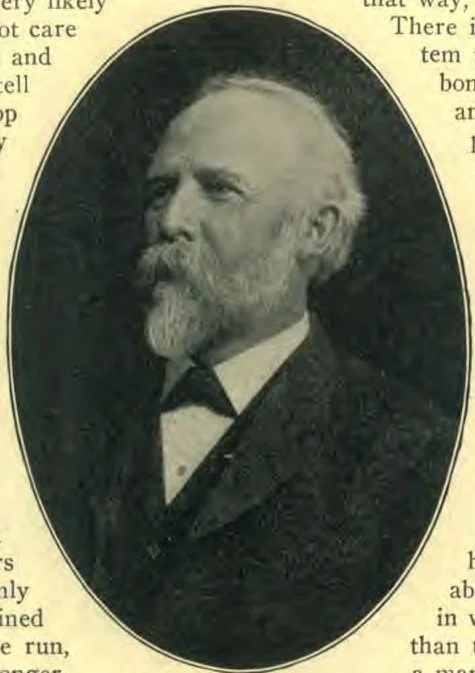
Joseph Henry Crooker, D. D.
WRITER, LECTURER, AND PRESIDENT OF THE UNITARIAN TEMPERANCE SOCIETY
WANT to have a frank conference with my earnest young readers about a very important matter, the subject of temperance, as important to girls as to boys, but obviously in a somewhat different way. Let us assume, by way of illustration, that some one has given your best boy friend a fine auto. And let us suppose that when he fills its gasoline tank, he also pours into it some other substance that will interfere with the action of the gasoline and lower the speed of the machine; that will injure the delicate parts of the engine, making necessary more frequent repair; and that also will greatly increase the danger of accidents. What would you say about such a boy? You would probably call him some pretty hard names. And you would very likely come to the conclusion that you did not care to associate longer with such a foolish and reckless lad. You would certainly tell him very sharply that if he did not stop it, you would not ride with him any more. The foolishness of such a boy would surely be very plain. But it is something even more foolish that the fellow does who drinks any form of liquor,—beer, whisky, or wine. The human body is not made to be fed with alcohol any more than the auto with the alien substance to which I have referred. The auto is built to be run with gasoline alone. Our bodies are created to be sustained by various foods, and scientists now agree that alcohol is no real food. In years past, even good and intelligent people believed that liquors were beneficial and necessary, not only as food but as medicine. They imagined that alcohol made the human machine run, not only smoother, but faster and longer. They taught that if a man used it, his brain would think quicker, his muscles would be stronger, his body would resist disease better, his heart would be merrier, and if sick he would recover more quickly. But all these old notions have been proved absolutely false. Drinking alcoholic liquors, mild or strong, affects a man precisely as the mixture of the gasoline would affect the auto. The momentary result may be an apparent, and in some cases a real quickening of thought and action. But in a given period he will not have accomplished so much as the total abstainer. He can not set so much type, or lay so many brick, or walk so many miles, or read so many pages, or commit so long a lesson, as if he had let the stuff alone. In adding figures, in reciting a lesson, in playing a musical instrument, or in running any kind of machine, he will make more mistakes. His body will not respond so quickly or faithfully to his will, but will hesitate and blunder, just as the auto, treated as described, would wobble along the road and frequently stop.
Joseph Henry Crooker
Again, as such an auto would frequently break down and need expensive repairs, so the man who pours liquor into his system is more often sick than the total abstainer. This repeated disability wastes his wages, burdens his family, and finally throws him out of work. He more easily catches diseases; and when sick, medicines do him less good, so that he is ill longer with less probability of recovery.
As the abused auto would often stop when half-way up a hill, so, too, the drinking man when he faces misfortune is less likely to meet it bravely and successfully. He goes to pieces quicker under the stress and strain of life. Whisky may make men rash, but never brave. It was once thought otherwise; but the facts are as here stated. A few topers who live to old age no more commend alcohol than does the fatness of a pig in a filthy pen commend dirt.
Once more: The auto, so misused, would wear out much sooner than if run as the maker intended that it should be. It would soon go to the scrap-heap. Everybody would be saying, just as they speak about certain young men who take to drink: “How soon that machine has gone to pieces! It was a fine auto, and it ought to have lasted that boy a long time; but it is now a complete wreck.”
Things do go to pieces very soon when used contrary to the law of their being, contrary to the purpose for which they were made. Autos are not made to be run in that way, and men are not made to use alcohol.
There is demand and need in the human system for water, and salt, and lime, and carbon, but none whatever for alcohol. It is an unnatural intrusion, like the substance poured into the gasoline tank of the auto. It can do nothing but harm. In several respects, the abused auto does not fully illustrate the misfortunes of the drinker. That is a mere lifeless machine, which does not keep demanding more and more of the unlawful stuff. But just this is the case with the drinker. The habit grows. The more liquor one uses, the greater the demand for it becomes; and this constant increase means less efficiency, more danger, and greater misfortunes. If the boy, then, is foolish who misuses his auto, how much more so the young man who abuses his body. There is another way in which the drinker is more at a discount than the ill-treated auto. The liquor which a man uses induces a condition in which he thinks he is stronger and brighter because he uses it, but this feeling is only a part of the various deceptions connected with the drink habit. If an auto driver, he may imagine he is going swiftly up a steep hill, when in fact the wheels are merely revolving without making any progress, and soon his auto is seriously injured, while he is not at the end of his journey. Thousands are thus wrecked on life's highway every year, they meanwhile supposing that all was going well with them. They drank to spur the jaded body or give the mind new energy; but ruin follows surely and quickly. Drinkers imagine that the glass of beer or whisky rests and strengthens them, but our scientists have shown that this is a mistake. They are really numbed and weakened.
This important fact also ought to be kept in mind: The boy who misuses his auto, as indicated, will miss many precious opportunities. For instance: A man who is looking for some one to take a message quickly in a time of distress, or carry a doctor to a patient, or compete in a race, will not select him; for any sensible man will say: “He has put dangerous stuff in his gasoline tank, and such an auto is too uncertain. The risk is too great.” So it is in life everywhere to-day. The bar is being constantly put up a little higher and a little higher every year against even the so-called moderate drinker. He is putting into his system something which does not belong there, something that makes him a less desirable11clerk or laborer. The employer is saying, “I can not afford to take such chances; for these persons make more mistakes; they accomplish less; they are more frequently sick; they are less obliging and less trustworthy,—in short, in every way less efficient.” So when a hundred young men go down the line of open doors seeking positions, what happens?—The known drinker will find few places where he will be accepted.
Let us for a moment consider how these facts apply in a special way to girls and women. If a young man who so abuses his auto should ask a young lady to take a ride with him, would she not be justified in saying: “I can not accept your invitation. By turning that stuff into the gasoline tank of your machine, you have decreased the pleasure and increased the danger of such a trip. The risk is too great. You are liable to have an explosion. You may break down, and I may have to walk home.”
So, too, is not a woman warranted in saying to any drinker who asks her to be his wife: “By pouring liquor into your system, where it is wholly out of place, you increase the probability of sickness, and waste your wages; lessen your efficiency, and loosen your hold on your job; shorten your life, and injure your disposition; and in these and many other ways involve my life in risk and hardship. I can not bind myself to make the journey of life with one who indulges such a harmful and expensive habit, increasing the danger of being left homeless and disgraced.” Such a stand on her part is justified by common experience. In the end, as a rule, the man who abuses his body is likely to neglect his wife.
Adapted from Commercial Advertiser
Continue my license, and I will continue my work
Now, the insurance companies have been finding all this out in a most forcible way during the last fifty years; and this is a matter which I wish to make very clear and emphatic. With them human life is not a matter of poetry or sentiment, but of cold business policy. The crucial question is: What lives make good risks? What kind of men can we afford to insure? What does the world's experience with the death-rate, the problem of the actuary, demonstrate? The answer to this question is clear and decisive. The total abstainer, according to the wide and long experience of insurance companies, lives on the average much longer than the drinker. At the age of twenty, a man, if an habitual drinker, can not expect to live more than some fifteen years; if a moderate drinker, he may last for thirty years; but if a total abstainer, he may expect to live forty-four years. Can any young man afford to cut his life short fifteen or thirty years by the drink habit, which also harms him in many other ways? Moreover, can any woman afford to marry such a man?
In view of these and other startling facts of a similar character, all insurance companies are discriminating more and more against all classes of drinkers. Some companies in Great Britain and America grant total abstainers either lower rates or other important advantages. The vitally important problem which every young man confronts is this: Can I afford to indulge in a custom which discredits me in the eyes of all insurance companies; which makes my insurance more expensive, whether life or accidental; which, according to insurance experience, lessens my expectation of life; and which surely shuts many doors of opportunity, wastes resources, and multiplies the risks of disease, disaster, and disgrace?
In this discussion, I have purposely left untouched the moral and religious aspects of the drink habit, although these are important matters for consideration. May my young readers decide the question promptly and wisely, and join the increasing host of total abstainers.
The World Evangel
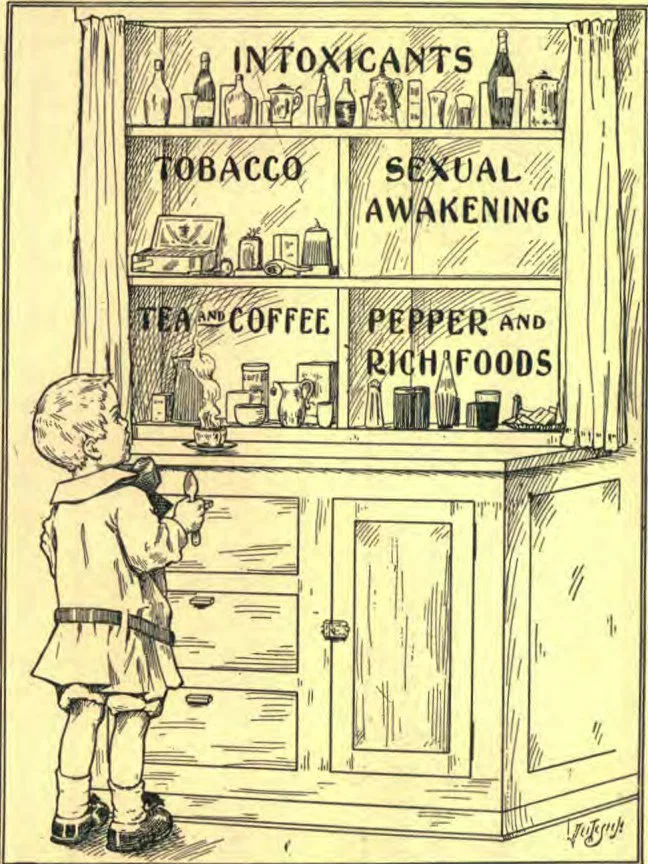
Johnny is given nerve irritants, such as tea, coffee, pepper, spices, and highly seasoned foods, which create a demand for stronger things later in life
The Red Flag
An engineer gave his little girl a small red flag to play with, and explained that on the road the red flag signifies danger. “Would you stop your train if you saw a red flag on the track?” she asked. “Yes,” he said, “or there might be an accident.” After her papa had left, the little one found her mama crying. “Why are you crying, mama?” she asked. The mother gave no answer. But as the child saw the decanter on the sideboard, she said: “Is it because papa drank some of that nasty brandy before he went to work?” “Yes, dear, you see he is getting worse, and will surely lose his place. He thinks the people do not notice, but they must notice it. And he will, I fear, completely wreck his life.”
The child did not forget her mother’s worry. All day long she thought of what she might do to help, and at last she thought of the red flag, and what her papa had told her it stands for. Going to the sideboard, she firmly fastened the flag to the decanter, and then went to bed satisfied. The father came home, went to the sideboard for the usual nightcap, but saw the flag, and understood and heeded the warning.—Selected.