Your ShelfYour Projects

Review and Herald, Harvest Ingathering Number

The Missionary Movement of 1913
Earlier text: Suffering and Triumphing
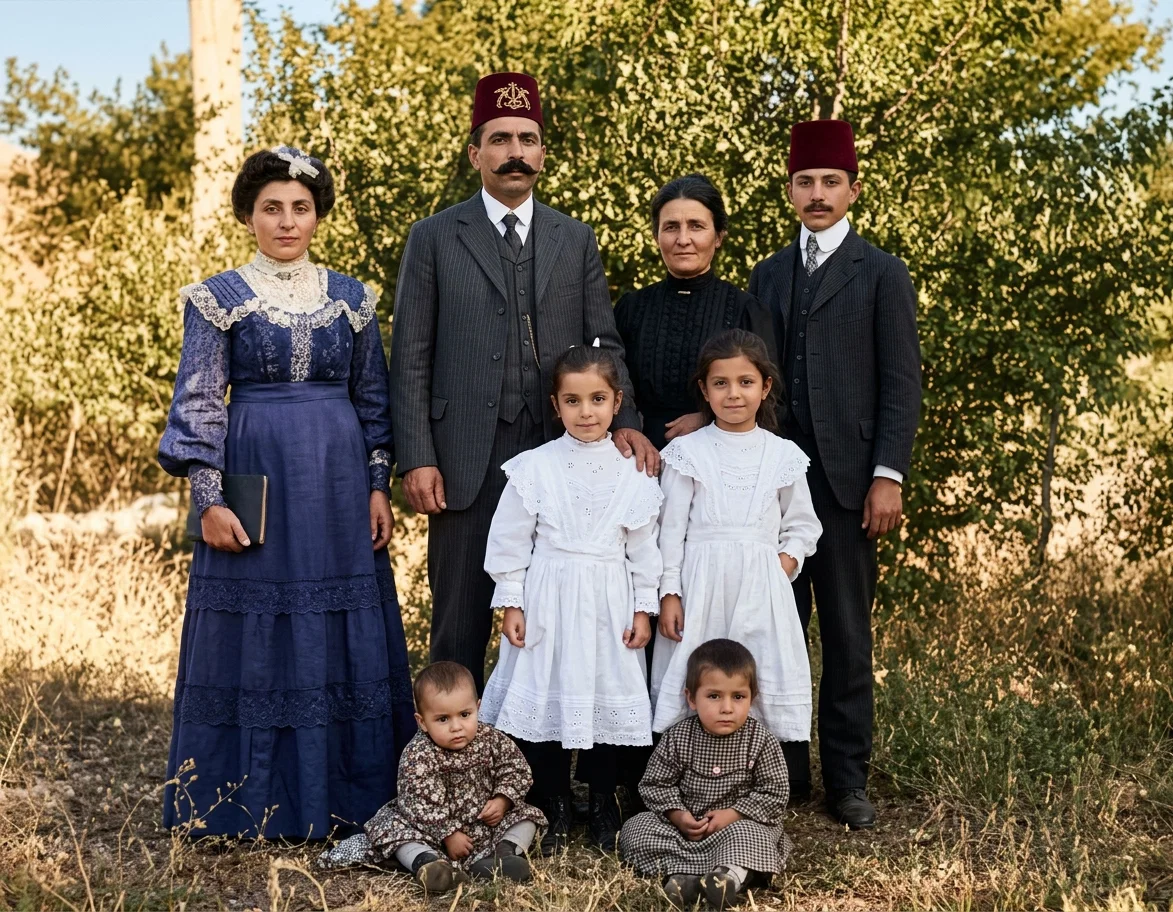
A SEVENTH-DAY ADVENTIST FAMILY OF ANTIOCH OF PISIDIA (A CITY MENTIONED IN ACTS 13:14)

The Moslem Outlook in Persia

IT is truly wonderful how the Moslem attitude toward Christianity has changed during recent years. Only five or six years ago it was quite impossible to do very active missionary work among the Moslems without incurring great danger to one's life. To have open discussions in the bazaar was out of the question. Now all this is changed. Go where you may, you will find hearers who will gladly listen to the gospel of mercy and salvation through Christ Jesus.
The music director of the Russian army, with his family, has taken his stand upon God's commandments. There is also a Russian under officer obeying the Lord. The young Moslem who was so interested in Bible study has returned from Russia and he comes often to study the Bible with me. I have an entrance also among the Jews. Three congregations have permitted me to preach to them.
On a recent trip to some Moslem villages, they invited me again and again to remain and be their guest. From seventy to eighty men would listen for over an hour to the straight gospel. While traveling in company with a mullah of Maragha, I read to him the thirteenth chapter of First Corinthians, and part of the Sermon on the Mount. He listened with rapt attention, and then asked for the book and read for over an hour, until we reached our destination; and when he had finished, he said, “It is indeed a wonderful book.”
F. F. OSTER.
Maragha.

“He Knoweth Our Frame; He Remembereth”

WE had before us the old, old picture which never loses its beautiful pathos and tenderness—the sweet Babe of Bethlehem, born in a stable.
My pupil, a gentle, graceful Mohammedan girl of some fifteen years, was seated at my feet, gazing earnestly, and listening most intelligently as the familiar story in all its sweet simplicity was unfolded to her. Then we had a little talk about the wonder of it, that the Saviour should leave his home of glory and be born in the greatest poverty and humility, and live a life of trial and sorrow.
After explaining several truths with regard to this, I said, lovingly: “And when you are in want and trouble and sorrow, the dear Jesus knows all about it, and he wants to comfort you, and he sympathizes with you, because—” Here I paused to choose a word that might make it very clear and impressive. In a moment, her beautiful dark eyes were fixed on my face in great eagerness, and she said, so gently and earnestly, completing my unfinished sentence, “because he remembers just what it was like himself.”
“Whosoever hath, to him shall be given.” Can we doubt that to a mind so receptive of this truth in its simplest form, the same grand truth contained in Heb. 4: 15, 16 will be revealed in all its mysterious fullness? “We have not an high priest which cannot be touched with the feeling of our infirmities; but was in all points tempted like as we are. Let us therefore come boldly unto the throne of grace, that we may obtain mercy, and find grace to help in time of need.”
VERA CHILTON.
Lucknow, India.

Our Missionary Debt

ENGLAND and the United States have one preacher to every 800 souls; Japan, one to 100,000; India, one to 140,000; Africa, one to 160,000; South America, one to 227,000. We are debtors to all men.

Persian Women

BEFORE coming to this country I had read much about the seclusion of Mohammedan women, and thought I knew something about it; but no woman in a civilized country, I think, can comprehend the reality simply by reading of it.
No woman of the better class after marriage is supposed to leave her own yard, or, as is usually the case, the yard of her father-in-law. The houses are surrounded with a high wall so as to shut out the view. No windows are allowed in any house save those that open onto its own court. Not long since we had a small window cut into our back wall, that we might have more light and catch a glimpse of the hills beyond. But no sooner was the opening made than an observing neighbor found that it overlooked his house, and he quietly filled the opening with stones and mud and then boarded it up.
A woman near by tells me that she has not been outside of her own yard since her marriage, twelve years ago, and she is one of the thousands. Think of it! Suppose you could never run out to a store, or over to see a neighbor. And the interior of these homes is not so pleasant as you are accustomed to. The great majority of Persian homes consist of but one room, with no furniture; a rug on the floor, a gun in the corner, a pile or two of quilts and blankets, while a round, deep hole in the ground serves as stove for both cooking and heating purposes. Living this simple life, the women have not the pleasant duties of a real home to occupy their minds and hands. Pray that the Sun of Righteousness may penetrate these darkened homes, where so much need is and so little light.
MRS. FLORENCE WHITE-OSTER.
Maragha, Persia.
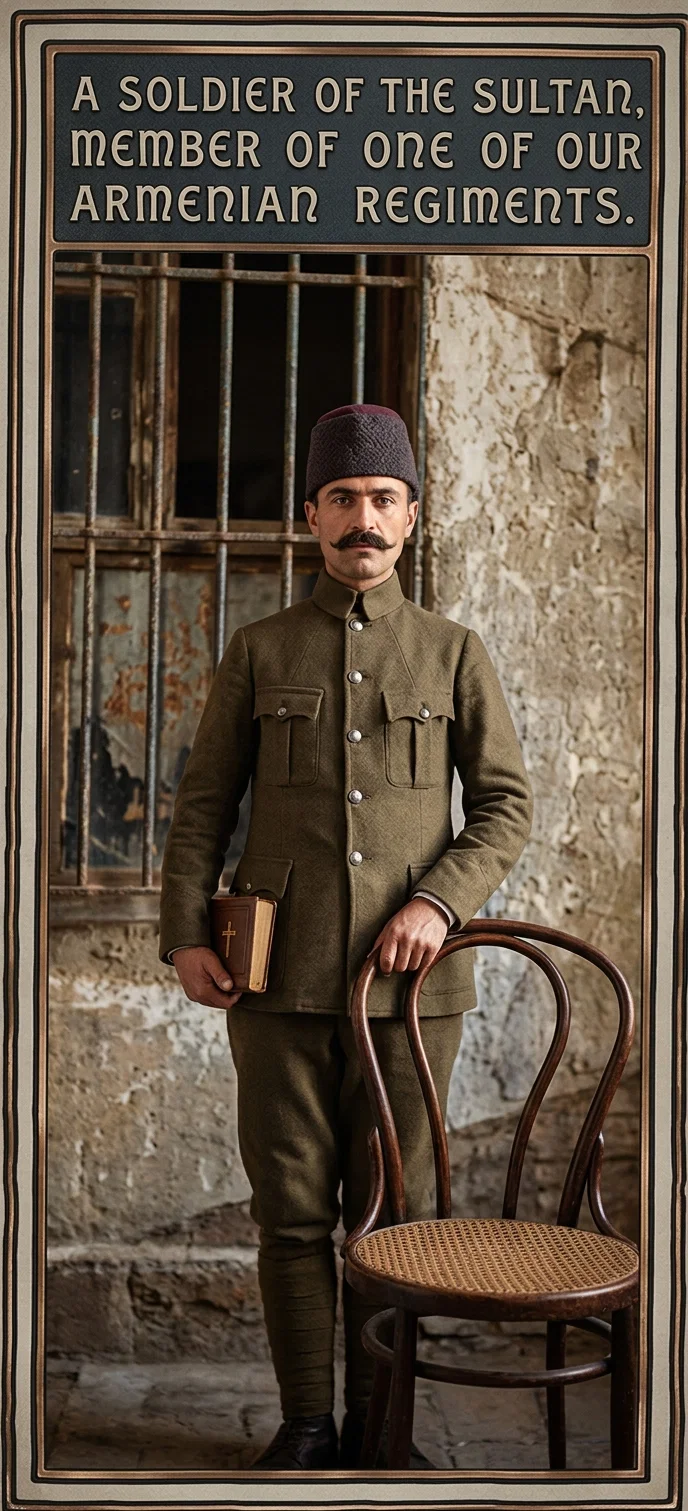
A SOLDIER OF THE SULTAN, MEMBER OF ONE OF OUR ARMENIAN REGIMENTS.

Visit to the Site of Ancient Babylon

LOOKING up inquirers and scattered believers in the Euphrates valley, Brother W. C. Ising, of our Levant Mission, writes of visits to Bagdad, Mosul, doubtless on the site of a suburb of ancient Nineveh, and to the ruins of Babylon of old. Speaking of the good work of the Church Missionary Society Hospital, at Bagdad, where one of our own members is assisting, Brother Ising says:—
“This certainly is most commendable work, and the surest way of breaking down prejudice among the Moslems. On the whole, however, there seems to be little interest in religious topics. I have found even the Jews of this region to be quite generally freethinkers or unbelievers. This is due, I believe, to the influence of French literature, French being generally taught next to the Arabic.
“From Bagdad I visited a family at the Hindia Barrage, who take an interest in our work, two of the children having already united with us, one of whom is in our missionary college in Watford, England, preparing for a part in the Lord’s work. At Hindia Barrage an English company has just completed a great dam across the Euphrates for irrigation purposes, at a cost to the Turkish government of more than two and one-half million dollars.
“Thence I proceeded to Babylon, two days’ journey from Bagdad. Here a German enterprise is carrying forward the work of excavating on a gigantic scale. By invitation of Professor Koldewey, leader of the work, I spent a few days going over the works. Between three and four hundred men have been working at the task, at an expense of about $20,000 annually. The results have been published by Dr. Koldewey. It is certainly interesting to see how the laying bare of these ancient foundations corroborates the facts of the Bible story. Everywhere are the marks of the great work done by King Nebuchadnezzar, who, as the Bible writer says, declared in his pride, ‘Is not this great Babylon, that I have built?’
NEBI JUNAS, THE BURIAL PLACE OF JONAH, OPPOSITE MOSUL, NEAR THE SITE OF ANCIENT NINEVEH. THE MINARET OF THE MOSQUE MARKS THE PLACE. — W. C. ISING.
“Involuntarily one is reminded also of the prophecies of Isaiah 13, and of other scriptures which in the course of time have certainly been fulfilled to the letter. No living soul is abiding on the site of ancient Babylon. Whatever Arabs do stop there temporarily, chiefly helpers in the excavation, have built their mud huts in the bed of the ancient river, which at the present time is shifted half a mile farther west.”

The Weaver of Mosul, and the Sabbath

DURING my stay in Mosul, a town on the Tigris, built on the site of a suburb of Nineveh, I met an old weaver, one of the first converts to Protestantism in that region some forty years ago. This man came across an article about Seventh-day Adventists which appeared in an Arabic magazine published in Beirut, Syria, thirty or thirty-five years ago. It set him to thinking. Six years ago he made a journey to Aleppo, and one day his attention was called by some one to the place where the Sabbath keepers worship. This set him to thinking again of the words of God, “The seventh day is the Sabbath of the Lord thy God.”
Some four years later he was again in Aleppo, and on his way to church on Sunday saw a young boy shining shoes. The boy offered to black his boots, and the man, seeing the lad was a Christian, said, “Why do you shine shoes on Sunday?” The bootblack replied, “Well, you see I am a Sabti” (a Sabbath keeper). As the man was in haste to reach the church, he had no time to inquire further, but the boy opened his box and handed him a few Arabic tracts. These tracts the man took to Mosul, where he and some others studied them carefully.
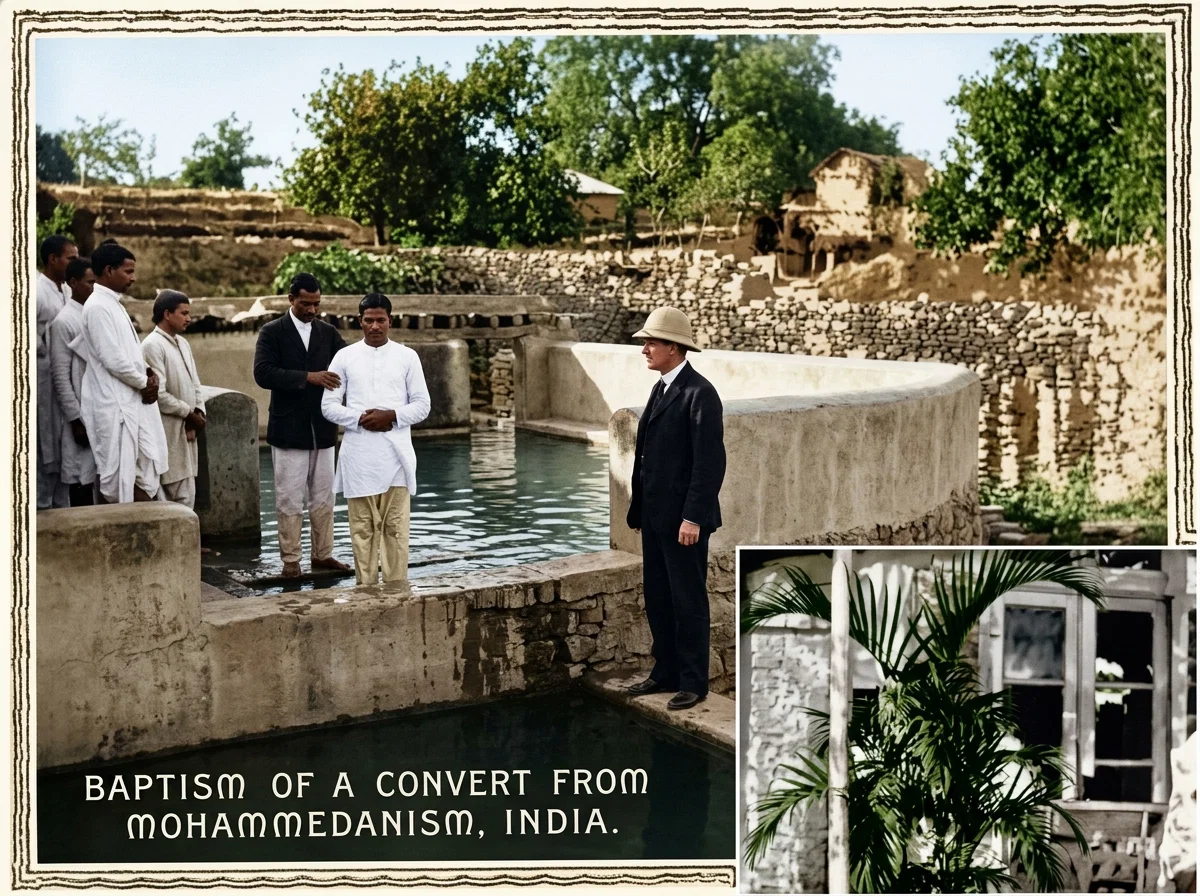
BAPTISM OF A CONVERT FROM MORAMANG BAPTISTS, INDIA.
“Three or four times,” he said, “I took up paper and ink, thinking to refute the arguments of the tracts; but when I compared my own writings with the tracts, I was convinced, every time, that my arguments were too weak, and would not stand the test of the Scriptures.”
Whatever men may say or write, the Lord, who made the Sabbath holy and blessed it, still declares, “The seventh day is the Sabbath of the Lord thy God.”
W. C. ISING.
Beirut, Syria.

Listening Through the Door

My servant is a faithful woman who has come out from Mohammedanism. I have never seen a more true, honest, and upright Christian. She has told me how the light came to her, two years ago. While some of our workers were teaching her mistress, who showed some interest, this servant would come quietly in her bare feet, with the mistress's baby on her arm, and listen through the cracks of the door. The beam of light that pierced its way through the cracks of that door into her darkened heart has become so bright that her face continually shines with the beautiful light of the gospel.
“In the morning sow thy seed, and in the evening withhold not thy hand: for thou knowest not whether shall prosper, either this or that, or whether they both shall be alike good.” Eccl. 11:6. The Lord will give the increase.
(Miss) P. TUNHEIM. Java, East Indies.
THE BOATMAN HEARD JEMIMA AND LISTENED THROUGH THE CRACK IN THE DOOR.

Our Moslem Neighbor

At a missions conference dealing with work among Mohammedan people, Dr. Watson, of Turkey, said:—
“The Turk is a good neighbor. I do not see this any more marked in our own land. I recall now men in Constantinople and other Turkish towns, from whom in every instance after the first acquaintance was formed, little acts of courtesy and confidence were of unfailing recurrence. The Oriental knows how to love, and he knows how to appreciate love, and there, just there, is found the solution of our great problem. We can solve it in the acceptance of our Lord’s own method of teaching and mode of life; can illustrate that before the eyes of all our Mohammedan brothers and sisters, illiterate or literate, official or out of office. They will all respond to sincere love and sympathy. Of that you may be sure; and they will not respond to anything else.”

The Urgent Call of Missions

ONE eighth of the human race is Moslem. The proportion is increased yearly. In Africa, Islam is leaving Christianity far behind in the race. Mohammedanism is absolutely dominant in the Persian Empire. Many more native Indians are becoming Mohammedans than are turning to Christianity. These conditions call urgently for Christian missionaries.
A FEW years mark great changes in some of the mission fields. “Twenty-seven years ago,” writes C. L. Butterfield, superintendent of our Korean Mission, “mission work in Korea was begun. There were then no roads, either wagon or rail, no telephones, no telegraph lines. Mail to that first mission station was delivered once a month by pony. There were no wagons nor carts in the country; in fact, not a wheel turned in all Korea. But here, as elsewhere, ‘the entrance of Thy words giveth light;’ and the coming of the missionary, bearing the glad tidings of salvation through Christ, meant not only spiritual light, but life and joy in Christ; and it also meant that the dawn of a better day had arrived. Now there are nearly a thousand miles of railway in this small country, and more is being built each year.”

Our Missionary Appointments

Following the large increase of missionary appointments in 1913, over 150 appointees being sent out during that year, it was the understanding of the Mission Board that few would be appointed during the current year. However, the pressure of the work is such that a larger number have gone out during 1914 than was anticipated, a number of sailings being reported each month.
The beautiful three-color cover designs for this paper, and the arrangement of the illustrations throughout, are the work of Mr. J. H. Goodrich, of Scotch Plains, N. J., artist, and missionary as well, he having spent some years in our mission fields abroad.

The Blind Beggar’s Gift

To all outward appearances he was only a blind, ragged beggar who had drifted with the crowd into our snug little chapel at Ning Shang, Hunan. Evangelist Li was telling the people that night how Seventh-day Adventists all over the world were donating of their means at the close of the week of prayer, so that God’s work in the earth might not be hindered. He was calling on the people to give until they “felt it,” when up went the blind beggar’s hand, accompanied with the words, “I want to give one string of cash”; (about thirty-five cents, gold). “The Lord does not want your money,” responded Brother Li. “Why not?” said the beggar. “This money is not counterfeit, is it? Why will you not accept my gift?” “We know the tricks of the beggars who give of their money in the contribution boxes, and then plan definitely to come to the preaching hall for free board during the next few weeks,” said Brother Li. “But I want to give because what you said to-night touched my heart, and I assure you that I hope for nothing in return,” replied the beggar.
Grateful to the One of whom he had heard that night, this poor blind man gave of his penury until he indeed “felt it,” and the Lord used this incident to open the hearts of many present to give more liberally. Let us hope that this poor man, with many others in just as great heathen blindness, may, like Bartimeus of old, have it said of him that he “received his sight, and followed Jesus in the way.”
MRS. R. F. COTTRELL.

What an Offering Means to a Black Boy in Africa

“PLEASE, sir,” said Kabaibwai, “here are five pennies from the Lord’s garden which I hoed this year.”
This sum represents one boy’s effort to help the message. To obtain this sum he had to prepare the soil in December, hoe and earth up the crop during the three wettest months, and harvest in May. This was all done in his spare time, which time the native dearly loves to fritter away in idle talk or in searching for wild tomatoes to make a relish for his porridge.
At the current rate of eighteen shillings ($4.38) a ton, he grew about fifty pounds of maize to obtain five pence (ten cents).
The treasurer handed over to the South African Union Conference the goodly sum of £1 11s. 2d. ($7.59), all earned in this way by different ones in sums ranging from twopence to two shillings and one pence, and consecrated to the spread of the gospel.
G. A. ELLINGWORTH.

A Century of Missions

IN the writings of the prophets was described the time when the gospel would be carried to all nations. Many centuries passed, and no such movement was seen. With the last century, however, the time of the prophecy has surely come. Here are some facts of the last century of missions:—
A hundred years ago there were less than one hundred missionaries in the mission fields. Now they number 22,000.
A hundred years ago there were but a few mission schools. Now 29,000 are reported, with a million and a half students.
A century ago but a trifling amount was given for foreign missions. Now the contributions in America and Europe amount to $25,000,000 annually.
These figures show that the sure word of prophecy is fulfilling, the gospel message is speeding to the world, and soon Christ will come.

Second-Class Mailing Notice

[Entered as second-class matter, August 14, 1903, at the post office at Washington, D. C., under the act of Congress of March 3, 1879.]

Growth of the Work in Europe

WE are glad to note from the reports of our European Division that the new accessions in Europe have continued this year at the rate of over a thousand a quarter. Particularly interesting reports have come from Russia.

Sabbath School Offerings for Missions

OUR Sabbath schools are devoting their weekly offerings to the mission fields. Each week the little envelope is passed down the line of every class, and at the present time between five and six thousand dollars a week are being dropped into these envelopes for missions.

TO THE PUBLIC

All the proceeds derived from the distribution of this issue are dedicated to foreign missions. The distributors who carry with them official solicitor's cards are authorized to solicit donations in behalf of the Seventh-day Adventist Mission Board; and we assure the donors that the funds contributed to such persons will be transmitted through the regular denominational agencies to the treasurer of the Mission Board.
Should any one desire at some subsequent time to forward an offering for missions, be the gift large or small, it will be thankfully received and officially acknowledged if sent to—
W. T. KNOX, Treasurer, Takoma Park, Washington, D. C.

Missionaries Sent to Far Fields

THE map on the second page of our cover shows in a striking way how the heralds of the message of the coming of the Lord as preached by Seventh-day Adventists are being pushed out into the far fields from America and Europe and the colonies. During the last five years, 524 missionaries have been sent to the mission fields by this society.

You have reached the end of this edition.

Review and Herald