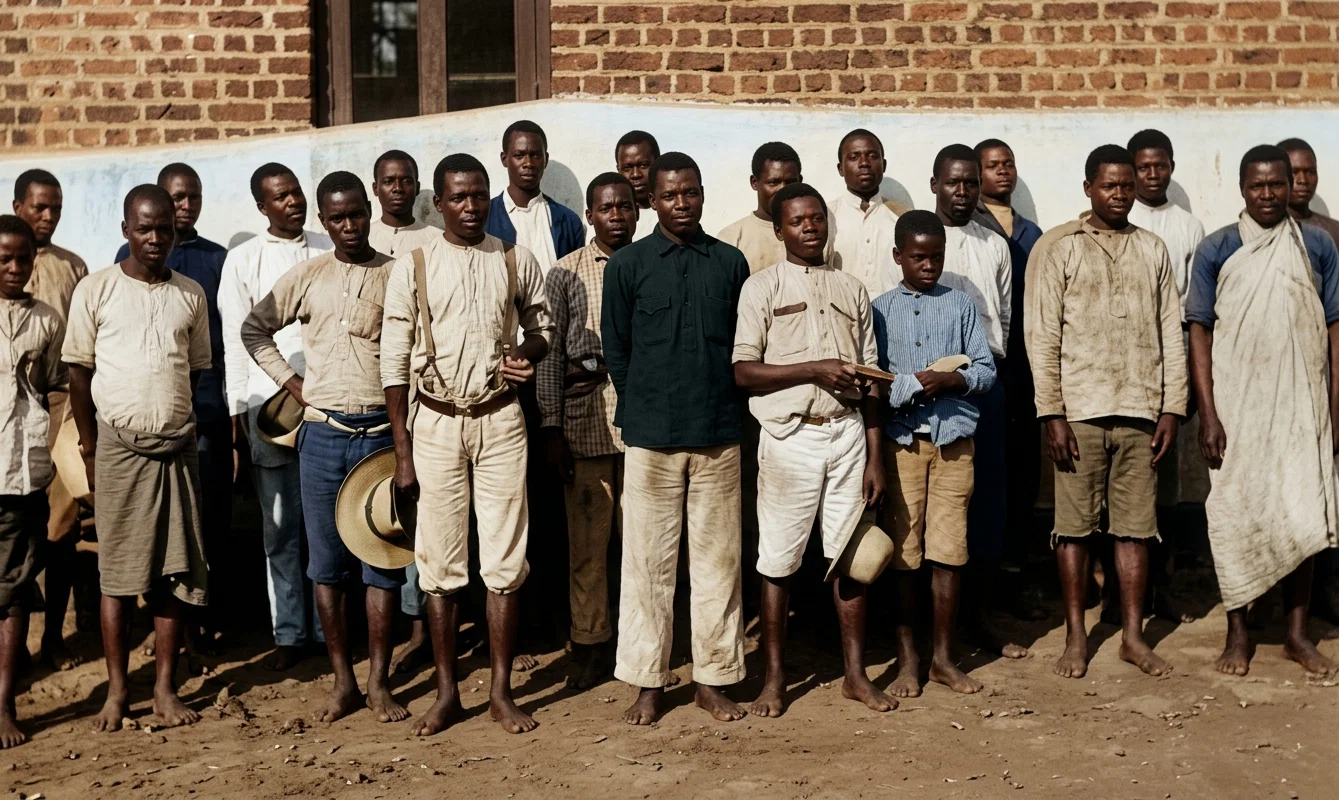
Our work in Africa is thus organized: Algeria and Tunis are under the Latin Union Conference; Egypt, under the Levant Union Conference; East Africa, under the European Division of the General Conference; South Africa, under the South African Union Conference; the West Coast, directly under the Mission Board, report of which appears under “Other Mission Fields.”
South African Union Conference
The territory of this union conference includes the South African colonies up to German East Africa and the Kongo State. Of our English work in the colonial conferences, which are the base of operation for the vast native field, Elder R. C. Porter, the union conference president, says:—
The work has made steady advance in all departments. The financial depression hanging over the country has paralyzed business somewhat, but it has given people more time for serious thought of the eternal inheritance. Our churches have been revived, and five new churches added. Union College, at Kenilworth, near Cape Town, is a real missionary training station. The last year has marked a new era in its history, and an older class of students are preparing definitely for service.
The vigorous growth in the book work may be seen by the record of sales for the last four months of the year: September, $732; October, $1,535; November, $2,215; December, $4,492. When it is remembered that the financial conditions have been most unpromising, it is apparent that the Lord’s blessing enables any department of his work to go forward, regardless of forbidding circumstances.
Our missions have all enjoyed a year of unusual prosperity. Each station has its special aggressive features. The school work has greatly increased in all. The assistant education inspector of government schools visited Solusi while Mrs. Porter and I were at the mission. He said he counted this one of his very best schools. He commended especially the industrial training. Throughout the field the work is encouraging, and the opening providences of God urge us to plan for more aggressive work.
Solusi Mission, Southern Rhodesia
This is our first African station, established in 1894-95, thirty-five miles west of Bulawayo. Elder M. C. Sturdevant, director, says:—
At the close of 1908 we felt somewhat downhearted regarding our school attendance, as the natives are moving back to get farther away from the white man’s advance. Many of the chiefs were unwilling, also, to have the children come to us. But this, we believe, has been providentially overruled, for it has led many young people to break loose from the heathen influence of the home kraals. While 1908 closed with fifty-two in attendance, we thank God that eighty-two have come in 1909, and others are coming; and they are of an older and more serious class. The best spirit has prevailed that we have ever experienced, and we praise God for it.
WINNING SOULS
Our out-schools are seven in number. Christmas day we baptized twenty-four dear souls, twelve being the fruit of our out-schools. Most of the teachers were in with us. It was cheering to see the expression of thankfulness and joy on their faces as we reminded them how God had not forgotten their labors of love. Two old women, mothers of some of our married believers, were baptized, being the first-fruits of our long-continued labors for the old people. The Lord has, of a truth, blessed this mission in 1909. There have been added to our church by baptism thirty-three members, making a total of eighty-seven, three being Europeans, eighty-four natives.
EQUIPMENT AND FARM
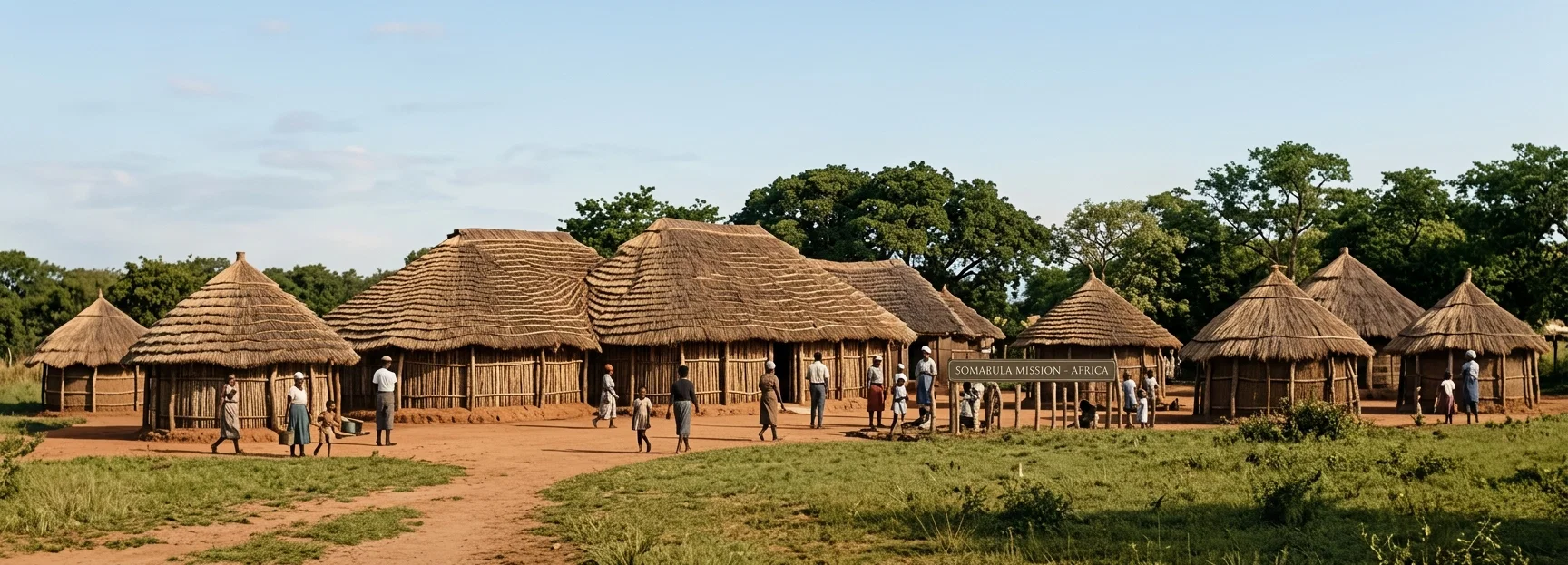
We have on the station two good brick and iron dwelling-houses for Europeans; one brick building for store and storage-room; one brick and iron building for girls’ quarters, dining-room, and night study; a brick schoolhouse and brick33church building, both with iron roofs. Added to these are fourteen native huts for boys, mud-plastered, with grass roofs. Scattered all about, near by, are huts of the same nature, where our native teachers and helpers live. The natives who live close at our door, boarding students and all, number about one hundred. A busy place is Solusi Mission.
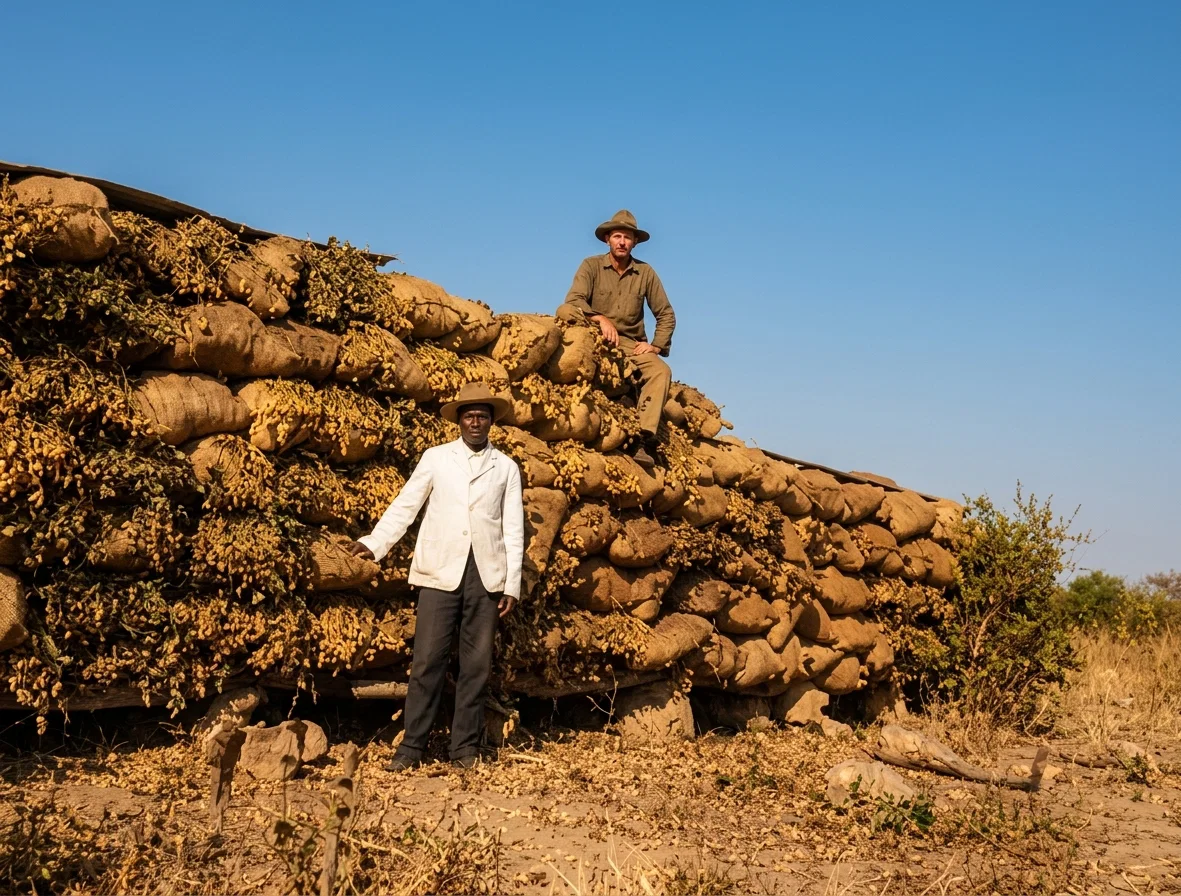
SOLUSI PEANUT CROP: M. C. STURDEVANT SITTING,
V. WILSON STANDING
The missionary staff consists of the superintendent and his wife, and Brother Victor Wilson, who has the special burden of the teaching, with the superintendent’s help. Three native teachers help in the home school, while eleven other native teachers teach our out-schools.
The dear Father has not forgotten our temporal needs. All our wants have been supplied, and the mission has quite a little grain. We raised 820 bags of “mealies” (corn), each bag weighing 200 pounds; 240 bags of peanuts, in the
shell; 44 bags of Kafir peas (200 pounds each); 6 bags of nyauti (Kafir grain); 1,500 pumpkins, and sweet potatoes without measure. However, fruit is something we do not enjoy at this mission. It can not be raised here to any profit, as the
white ants are the enemy of all fruit. We are still experimenting, however.
I am hoping that others will take the charge of this station in 1910, relieving me to go on farther to the north and east, to open a new station.
Somabula Mission
Of this station, at Gwelo, 150 miles northeast of Solusi, Elder W. C. Walston says:—
SCHOOL WORK
We opened the year with our school well filled with students anxious to learn. When our missions begin, they are obliged to do the best they can with the means at hand. Our schoolhouse is made of poles and mud. Its furnishings consisted of seats made of hand-sawed planks, tables made from packing cases, and one blackboard, three by five feet.
Early in the year the government school inspector gave us a grant of $150, and this has helped to improve our facilities—new seats, tables, blackboards, maps, and a globe. The improvements and some new methods in teaching are advertising our school, and the students are crowding in, some from long distances. There are about two hundred gold-mines in this part of Africa, and after the natives brought from up-country have served their contract time, they return. But some hear of our school and come to us. We have students from Portuguese East Africa,34Nyassaland, and other parts.
They are taught the Zulu language, and later English, the simple branches, with Bible; also farming, building, and practical duties. We make the gospel message for this time the great object. It is remarkable how all the natives of this country are in touch with one another. News travels like magic. The sound of the message will go rapidly to this people if we can have the means and workers to establish schools, and train the natives to carry the good news.
SOMABULA MISSION
We have three out-schools, which are prospering beyond expectations. A native teacher is in, as I write, from a school fifty miles away. He says that though it is the busy planting time, the students come to the school at night. A hundred people attended his last Sabbath meeting, and several are keeping the Sabbath and desire baptism. Calls are coming continually for new schools.
We are trying to arrange with the government to start an out-school seventy-five miles to the north. There are two boys at Somabula from that region, and they keep asking: “Teacher, when are you going to start a school for our people?”
THE FARM INDUSTRY
The Lord blesses in our industrial work. The police patrol tell us our crops were the best in this region. We have 425 bags (200 lbs.) of corn, for which we got a good price at a mine only six miles distant. We sold $250 worth of eggs, and the same of butter. I speak of this to show that if we can once get started with our missions, we can do much to help ourselves. We must do all things here, almost any day being called from school or farm to treat the sick, dress sores, pull teeth, or perform some other service. On New-year’s day, 1910, ten of our number were baptized in the stream near our mission buildings, a hundred natives looking on. Others will follow erelong. We are full of hope and courage. The foreign mission staff is the superintendent and wife, and Brother T. J. Gibson and wife.
Basutoland Mission
Basutoland, where the Orange River has its source, is the Switzerland of South Africa. In this rugged country, near Mafeteng, in the southwestern cor-
ner, is our Kolo station, with about five acres of land. Elder M. E. Emmerson writes:—
Early in the year we wanted to start a mission school, with our one helper. But no children came. We went out with our few publications in the Sesuto language, and at once an interest was aroused, and students were offered. It seemed impossible to canvass without my native helper, Brother Murray Kalaka, but we decided to let him start a school, and I would go on with the canvassing, language or no language. And the Lord wonderfully blessed. The publications were scattered far and wide, and thirty young people have been in the school.
As our book work went on, some commercial men claimed it was “trading” with the natives, and illegal without a trader’s license. I laid our case before the commissioner at Mafeteng, explaining the object of our canvassing effort. “Such work has not been done by other missions,” he said; but he saw no reason why we should not be allowed to go on. With thankful heart I started to return to Kolo. Night overtook me, and not being familiar with the roads and hills, I sought a place to stop in a village. The Lord directed me to a place where I became acquainted with a man who has since developed into a good canvasser and an ardent believer. He speaks English, Dutch, Sesuto, Kafir, and Zulu, and now assists in our second station.
This second station is located in the territory of the old and influential chief Jonathan, in the northern part of the country. “You may look over the land,” he said, “and if you find a suitable place, come to me.” Though others opposed, he was steadfast in his purpose, and gave us about forty acres of land in one of the most suitable locations for an industrial school in all the country. The chief welcomed us there. Concerning the opposition of some to our being allowed in this country, he said: “They want to put blinds on the Basuto heads, so they can see but one way, as men do on horses’ bridles. We want our people to be able to see all around.” We praise God for his guiding hand. This new station is superintended by H. C. Olmstead. We plan to have a boarding-school there as soon as we can erect buildings.35
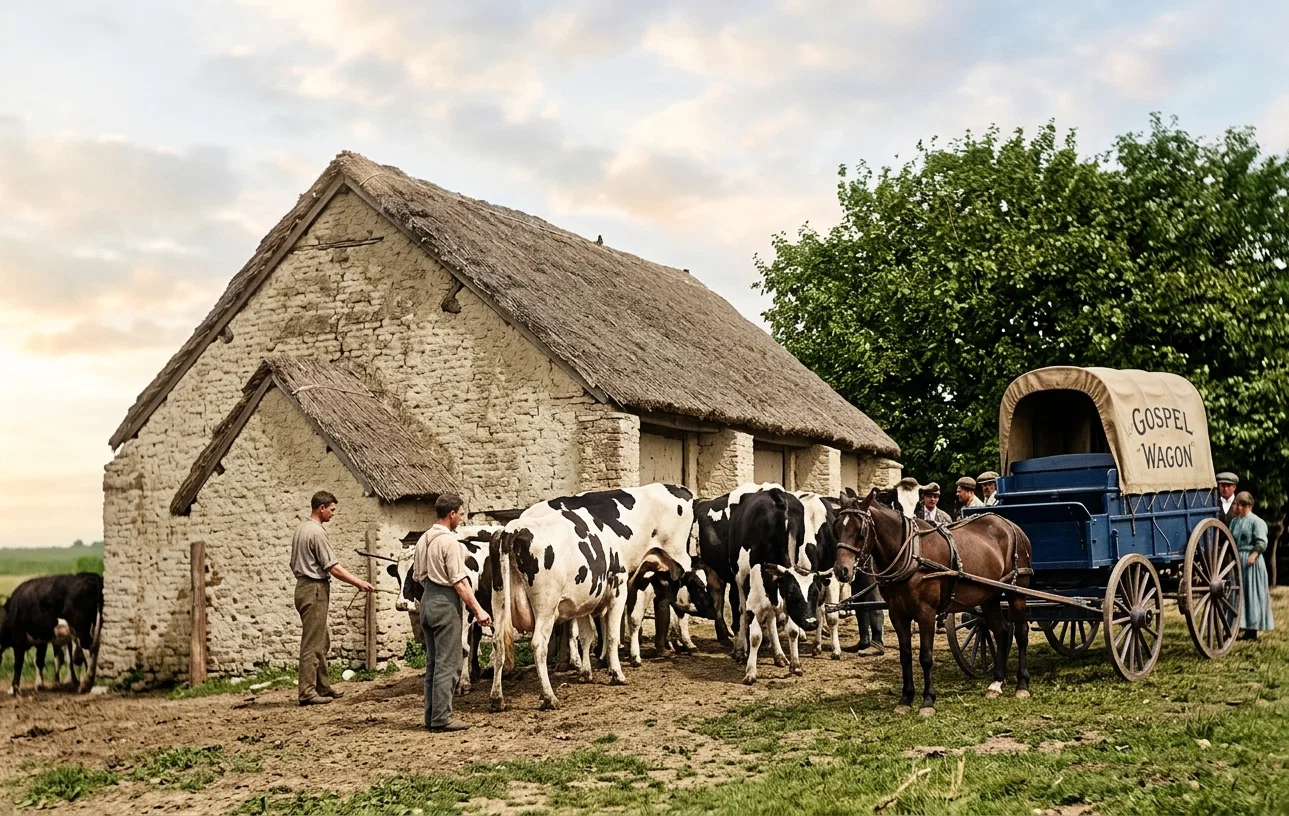
W. S. HYATT, WITH GOSPEL WAGON
As a result of the sale of 3,365 books and tracts, calls for more light are coming to us from many parts. Just the other day a man came from central Basutoland, on foot, saying, “Those tracts you sold me taught me of the true Sabbath and the second coming of Christ.” Two have been baptized during the year.
Maranatha Mission
This mission is on a rented farm at Trumpeter’s Drift, thirty-five miles northeast of Grahamstown, southeastern Cape Colony. It is a mission amid the civilized and semicivilized Kafirs and Fingoes of the colony. Elder F. B. Armitage says:—
STARTING A SCHOOL
In coming here, we had taken with us eight students from our Somabula station, Rhodesia, as a nucleus for a school and to help on the farm. After spending most of 1908 in pushing the work on the farm and in building, we began, near the close of that year, to try to awaken an interest among the parents of the young people whom we wished to have in our school. Elder W. S. Hyatt came to help, and, equipped with the Bible, a magic lantern, a small supply of simple medicines, and some fomentation cloths, we started
with an ox wagon for the native reserve. God gave us the victory. The sick were healed, aches and pains were relieved, and the poor had the gospel preached unto them. Our school was full of children, and the power of God’s Word has wrought many transformations. Parents have marveled at the changes in their children. With God’s blessing, we hope to see a score of young men carrying the message to the thousands of their people.
We are hard at work putting up a boys’ dormitory, a dining-room, and a kitchen. Buildings here are all of stone, with iron roofs. The stones are quarried on the mission farm. Our farm work is all done by the students and those in charge. In this part we can grow almost any kind of vegetable and grain, and a great variety of fruit, such as apples, pears, peaches, guavas, figs, grapes, etc. One great drawback, however, is the uncertainty of rain.
EVANGELISTIC MEDICAL WORK
Of the continuance of the evangelistic medical missionary work among the villages, Elder W. S. Hyatt says:—
It was a common thing to see two hundred people at our services listening to the message with deep interest. Our methods of work were quite new to the natives. They had never seen white men36going about among them and freely assisting them. Often when a white stranger came into a village, the children would hide away; but it was not so when the “little wagon” came. The half-naked children would gather about the wagon, and come to us when we entered the huts. At one place a man came with his little daughter, who had returned from a hospital a few days before, and was rapidly getting worse. We gave her a few treatments, seeking God’s blessing, and he did not disappoint us. One day this father came, saying, “Elder, we have heard of the love of God, and have read of it, but this is the first time we ever saw it.” One native teacher, a bright, devoted girl, said: “I am sure your treatments have saved my life. I have heard of the love of God, but never saw it before.” While often the tears of gratitude flow from thankful hearts, many—the majority, perhaps—are like the nine cleansed lepers, who returned not to give God the glory.
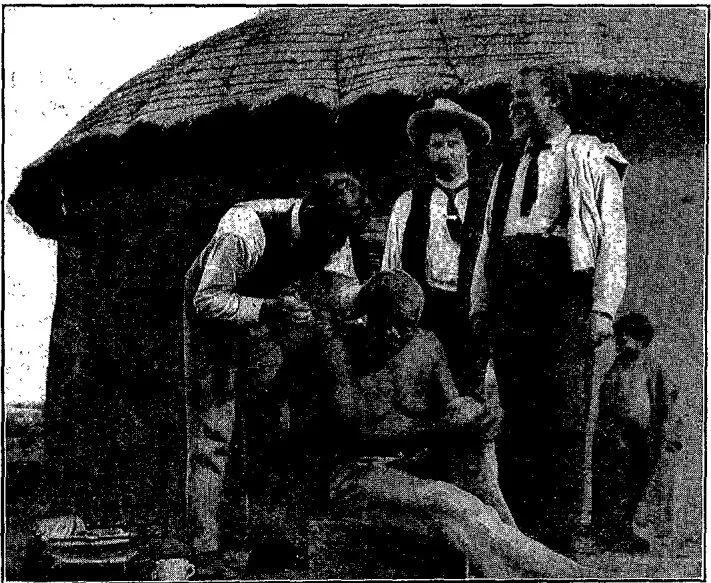
Photo by W. S. Hyatt
BROTHER BURTON TREATING A NATIVE OVER ONE HUNDRED YEARS OLD. ELDER ARMITAGE AND R. MOKO LOOKING ON
The work has not been followed up the last few months as we had hoped. I was laid up a few weeks with some fractured ribs, the result of the capsizing of our wagon. Then, as we were about to start out, we learned that the locusts had devastated this portion of the country, hence no food could be secured for our oxen. But we heard of calls for help in many parts. Brother Moko, our native evangelist, has a call to visit a section away beyond the limits of our work, where the people are searching the Scriptures. The message must be given to the million and a half of Kafir-speaking natives in Cape Colony.
Nyassa Mission
Our work began in Nyassaland, British Central Africa, in 1902, when we took over a station at Cholo, south of Blantyre, by purchase from the Seventh-day Baptists. This station is now called Malamulo. A second station has been established, at Matandane, northwest of Blantyre, on the Portuguese border. Elder J. C. Rogers, superintendent of the Nyassa Mission, writes:—
A BAND OF NATIVE EVANGELISTS
One thousand natives, more or less, hear the message, every man in his own tongue, each Sabbath. This is possible because of our comparatively large force of native evangelists. There are six European workers, and thirty native teachers. Every teacher is a preacher. It is in him. He must preach. As a rule he preaches forcibly, too. These native evangelists are now, and must be more and more, the strong end of our Nyassa work. Look at their faces in the picture,—Simon, in center front, from a village where are many heathen of the heathen, whose chief sells his daughters to the highest bidder, white or black; Moses, by the window, a real warrior of another tribe, who a few years back was catching slaves, and killing those he couldn’t catch; Malinki, at right of Moses, who is our head teacher over four village schools, with two hundred heathen children in them; Enoch, at the extreme left of picture, is chief over ten villages, of which Malinki’s main school is the center; Ezra, at Simon’s right, in shoulder braces and knee trousers, is the fruit of one of our little village schools, a brand snatched from fires of persecution and wickedness. And I would love to go on telling you the story of these teachers; but a little life history of each would fill the whole mission booklet.
REMARKABLE GROWTH
Every feature of our Nyassa work has been strengthened the past year. Every part of the work has grown beyond our hopes. A year ago we had two main schools and six village schools, with eighteen native teachers. Nine village schools have been added, with twelve native teachers. The enrolment last year was 475. Now it is 800. Last year 31 were baptized, and this year over 50 are in the candidates’ classes, and new ones join almost every week. As a rule we find it advisable to instruct them in the truth thoroughly, from one to two years, before baptism.
We have just had a month’s vacation in the schools during the busy planting season. Many of our students went to their homes from one to two hundred miles away. In our first prayer-meeting on their return they told their experiences among their villages. Nearly all held meetings on Sabbaths, some having over three hundred in attendance. These meetings are held in the open space in the village, no shelter being required,—a very easy and inexpensive way of preaching the truth to the heathen.37
Photo by J. C. Rogers
The work is going forward at our Matandane out-station, in charge of Brother and Sister S. M. Konigmacher. We hope this station, on the western Nyassa border, will prove an opening door into Portuguese Central Africa.
During the last school year, ending May 1, 1909, forty-eight were baptized and received into the church. Our classes of candidates for baptism are fuller than ever before, upward of seventy-five being enrolled in them. As I have no report of the Matandane out-station class, and one other large school has not reported, it is probable that the candidates number about one hundred. Without doubt we shall have the largest baptism in April, 1910, of any since the opening of the mission. The occasion is deferred until that date for the counsel of our South African Union Conference president, who is expected to visit us then,—the first such visit in seven years.
Northwest Rhodesia Mission
The headquarters of this mission is at Pemba, six miles from the railway station of Monze, north of Victoria Falls. Elder R. C. Porter, who visited the mission during the year, wrote:—
We were happily surprised to find that, instead of a wild-looking frontier station, the surroundings were such as to remind us of home life and civilization,—a neat brick cottage for the superintendent and helpers, a brick chapel for school and Sabbath services, and a brick building for the natives' dining- and study-room. Another brick cottage was under construction for J. R. Campbell and wife. The native thatched huts for the students' living quarters, and a native cattle kraal, reminded us that we were in the wilds of Africa.
The report of Elder W. H. Anderson, the superintendent, has some how miscarried; but in a letter he says:—
We are now operating seven out-stations in addition to the central home mission, and it keeps us busy looking after it all. Some time ago we published a reader in the Chitonga tongue. The only Chitonga reader was a book of fables and worthless stories; we have told in our book the Bible story. The reader was so helpful that we have just sent to the printers the manuscript for a second book. All we have in the Bible is the Gospel of Mark. In our readers we shall cover much of the Old Testament ground, and I mean to work for the Gospel of John in Chitonga during 1910.
We have now almost filled the Monza district with schools, and next dry season38we shall fill the Mombashi, and so on until all parts of the field are covered. In our appropriations for 1910 we are not asking for all the wages we shall pay out to the workers; so we are forging toward self-support on the old work, and are spending most of the appropriations in opening new schools. Our teachers are developing. Students come from the western and eastern and northern parts, and these young people are catching the spirit of the message, and are ready to go with it to others.
During the present year we have had five cases of malignant black-water fever with our native boys. In the nature of things we have to deal with it on the ground; we have to know how to take care of them. We also have many accidents and emergency cases. About two years ago one of my boys, while out chopping wood to burn bricks, put the ax right through the center of his foot, severing a fair-sized artery. No doctor was there. I got hold of the artery, drew it out, tied it, and dressed the wound. He did not have any infection, strange to say, but got along all right. A year ago one of my boys was gored by a vicious ox, and I had to put his organs back in place. A year ago last July a native, while out hunting, stopped to rest, and put his hands over the muzzle of his gun. The gun was loaded with gravel stones, and it went off, blowing off three fingers of one hand and a thumb and finger on the other. He came to us to be treated. I did not know how to cut the bone, as I had never had a nurse's training. All I could do was to cut away the flesh, and cauterize it with carbolic acid.
We often have to treat snake bites. The natives come rushing in, having been bitten, usually on the feet or leg, the bitten part being badly swollen. Some of the methods we use are rather crude. With my surgical knife, I cut the wound open, cutting it good and deep, so it will bleed profusely, thus washing out considerable of the poison. Then I apply a saturate solution of permanganate of potash, and dress the wound; if I have not that at hand, I cauterize it with carbolic acid. Then the patient is given a liberal cathartic, to cleanse the stomach and bowels. Patients so treated get along all right.
Sometimes I have dental work to do. Many of the natives have very poor teeth. I never learned the art of filling teeth, but I know something about extracting. One time a woman came to me who had nine very bad roots in her jaw. These natives are something like children; as soon as they see a little blood, they get wonderfully scared. You can hurt them as much as necessary, but it does not seem to annoy them until they see a little blood. This woman had some ulcers also, and was in a very bad condition. I saw the only thing to do was to take out all nine of those roots. We do not have any dentist's chair, so I had her kneel down on the ground, and one of my boys held her head between his hands; then I got hold of her head, and took those nine roots out before I let her shut her mouth. She got up on her feet, spit some blood, and then ran.
You see from these experiences something of what is expected from a missionary out in the field. He has to be prepared to deal with anything that comes his way, and he ought to have a training, an education, that will enable him to deal with these things successfully.
At the present time we have seven out-stations that we have to attend to, and that means to travel about two hundred fifty miles every month. Traveling the way we do, one can walk only about twenty-five miles a day; at least that is all I care to stand up under. Then you stop a day, two days, or three days, at the out-station. This means that in order to visit these out-stations, one must spend from sixteen to twenty days traveling. And he must keep it up the year round. There are many hardships and privations to meet in this field. If a man is not willing to endure these things, and go through them cheerfully as a part of his regular experience, and not grumble about them, he should not become a worker in this field.
This mission expects to push ever northward toward the Kongo State border. In his first translating, Elder Anderson had to put the matter first into the language of the Matabeles, which he knew, and then his native boys, who knew both the Tebele and the Chitonga, helped him to put the thought into the Chitonga language.