THE East African missions, under the direction of the European Division, include our work in German East Africa, British East Africa, and Abyssinia.
South Pare Mission, German East Africa
This mission is in the Pare Mountains, south of the great Kilimanjaro peak. Brother B. Ohme, director, says:—
God is teaching us how to take up the work of educating the children of the Pare people. During the year we have opened six new schools, with 350 pupils, under the instruction of baptized missionary helpers. Twenty-six new believers have been baptized.
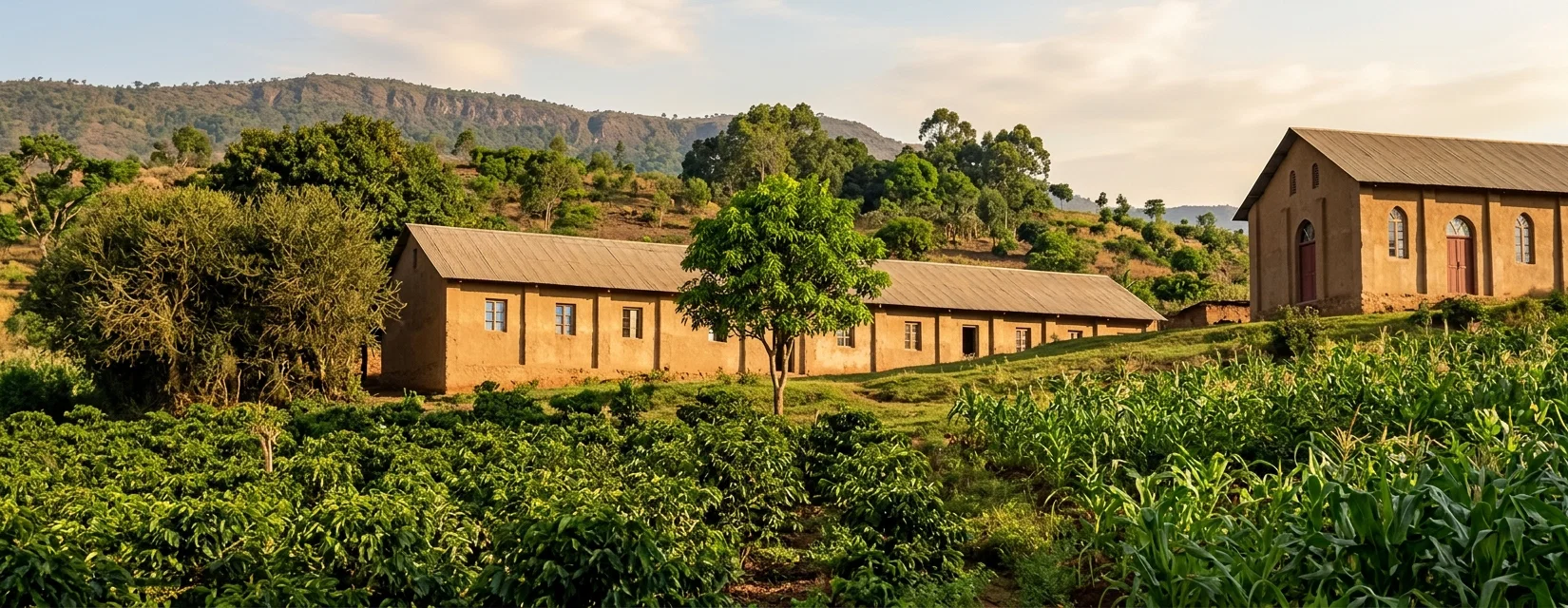
Photo by B. Ohme FRIEDENSTAL MISSION, GERMAN EAST AFRICA
FRIEDENSTAL STATION
In March three chiefs came, saying: “We come to ask you to open a school in Kiranga, so that our children may learn. We know that the Word which is taught them is good.” We visited that place, timber was cut, and in April a school opened, with sixty-seven pupils, in charge of a chief’s son, who was baptized at Friedenstal the year before.
The influence of this school brought chiefs from the large district of Mpinshi, saying: “When are you coming to us?” I promised to go, and on reaching them a week later, to my joy and surprise I found that they had already cut down the timbers so that we could at once erect a school. The building, fourteen by twenty-six feet, cost us about fifty dollars. We dedicated the school with ninety pupils. One of our students, who had been two years at Friedenstal, was from this tribe, and volunteered as a teacher.
VUASU STATION
In June I joined Brethren M. Ponig and M. Kunze, of the Vuasu station, to assist in locating out-schools. Among the high mountains of the Mtai district we planted a school, where sixty-five pupils are now under instruction. Next we visited Ntanda, five hours from Vuasu, and pitched our tent by a village, where the chief greeted us with native hospitality, excusing himself that he could give us no more, as they had a famine in that region. After a council with the chiefs, they were ready to help establish a school, and a site was chosen where we had pitched our tent.
Leaving the brethren there, I visited the district of Mpare, where I had opportunity to preach the message to the chiefs who came to greet me. Steps were taken to start a school, and forty young people were ready to enter. Next morning, as I passed by rich fields and reached the large district of Vergama, a young chief met me, saying: “I have heard you are opening a school at Mpare; do the same here. I myself would gladly take instruction.” O, that these people may learn to honor God! On my return journey I passed Mpinshi, in the Friedenstal district, and was rejoiced at the advancement of the school. Among the villages and while about their work, the pupils are singing the songs of Zion which they have learned in their own language.
KIHURIO STATION
In July and August we sought out three further out-school locations for the Kihurio station, which we expect to occupy in 1910, if money is granted for the purpose. Returning from this trip, I was able to arrange for opening a40school in Lugulu, two and one-half hours’ distant from Friedenstal, on the border between our territory and that of the Leipzig mission. We have sixty-two boys and girls there.
GENERAL NOTES
We have three Christian villages where our converts may till the land daily, and are not compelled to witness the evil works of the heathen. The believers are increasing in wisdom, and the grace of God is with them. Our sisters give special attention to the girls, and we have a girls’ school at each mission station, where they learn to read and write, and are instructed in the Word of God.
At the close of the year we had in our three head stations thirty-two baptized natives, seven out-schools, five more in process of construction, with approximately a thousand pupils. We are eight white workers—one of whom, Brother Kotz, is in Germany on furlough—and ten native teachers. We have a Chassu song-book, a primer, and shall soon have the four Gospels, the final proofs of which Brother Kotz is to read in Europe.
At the close of the year, which had brought so many blessings, we had the grief of laying one of our number away to rest, Sister E. Drangmeister, of Kihurio. After faithfully helping her husband for a year and two months, she now sleeps in Africa, a victim of the dreadful fever. But by the little mound of earth she still witnesses to many souls of the preciousness of the truth for which she gave her life.
Victoria Nyanza Mission
This new mission is on the south-eastern shore of the great inland sea, Victoria Nyanza. Elder A. C. Enns, of the Vuasu station, was commissioned to explore for the new mission. Two stations were established, Busegwe, with forty acres of land, house and kitchen of sun-dried brick, and a school of 130 children (in charge of E. Rassler and wife), and Majita, where mud and wattle huts had been put up during the summer, while prospecting. The real opening of Majita runs over into January and February, 1910, but we must let Elder Enns tell of it here to complete the story of the beginning of this new station. Speaking of his return to the station, at the opening of 1910, he says:—
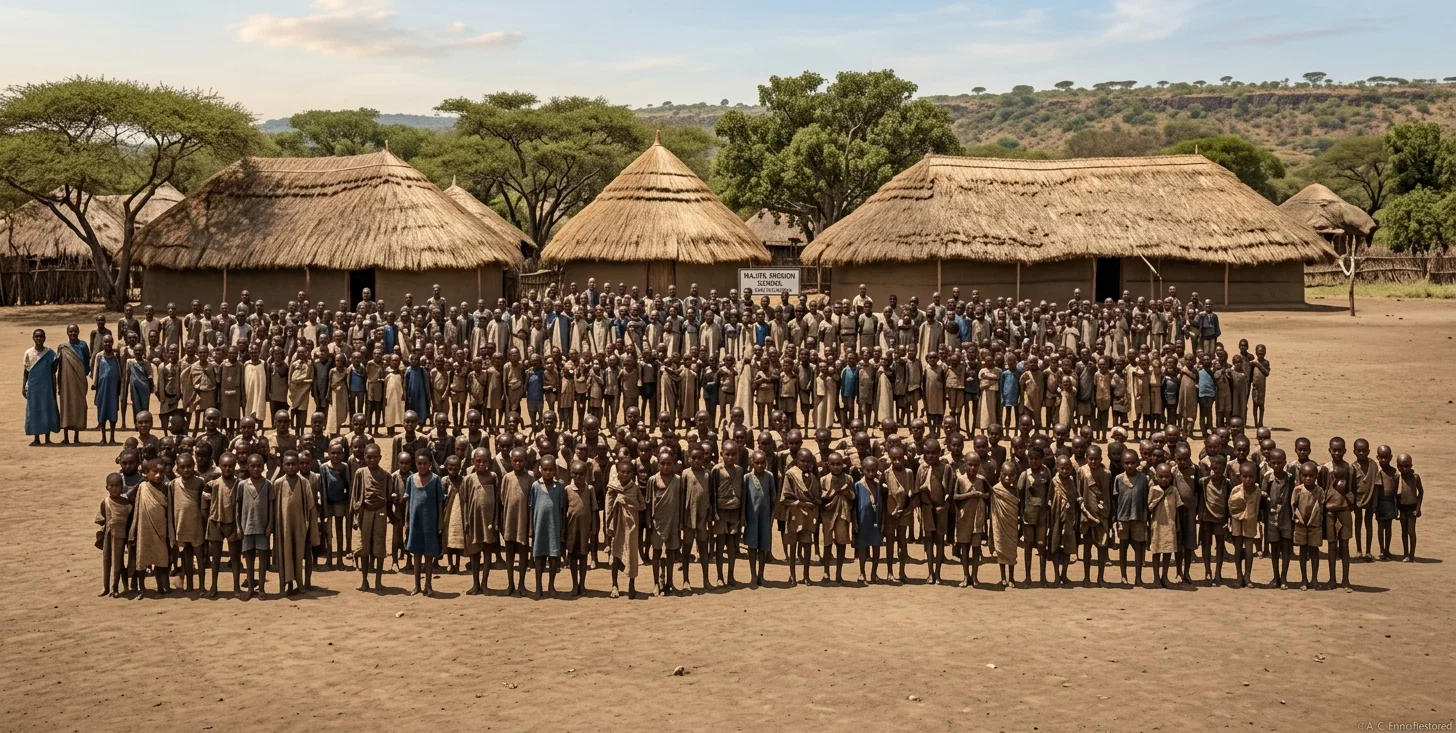
In January, Brother E. Dominick and I reached Majita. As soon as the location was settled, we set out to get plants for fruit trees, and some fast-growing trees for future wood supply, as there was not a bit of wood or brush about the place. I returned from this work with a bad attack of malaria, which kept me down five days. But in February we were able to start the school. The building is about 50 x 16 feet. It holds but 16041children, sitting close together. But I was somewhat startled on the fourth day after opening the school to find that I had applications from 600 boys and 175 girls who wanted to learn. So I had my school filled, and 600 running over.
SIX HUNDRED TURNED AWAY
I photographed these, so that you can see whether you would like to have them turned out of the school, as that is the only thing I could do, promising them that we would build a school which would hold all of them as soon as we possibly could. Look at them standing in orderly columns. Would it not be glorious if these children could at last stand about the great white throne, greeting with loud hallelujahs those who have contributed to their salvation? I can assure you it was with great reluctance that I dismissed the 600 children. But even now we have to hold two sessions with those we have, and can scarcely get other necessary work accomplished. Please remember us in this new station when you pray. It costs money to build here. All lumber must be imported from British East Africa. Water conditions are poor, and I must make a cistern on the station, and build a large tank at a place where the water issues from the rock little faster than by drops. All this we must have in order to avoid sickness and death.
During 1909 we also secured a site for a third station, at Kidzo, with eighty-two acres of land, which we marked off at the corners with stone pyramids.
Kavirondo Mission, British East Africa
Our first station in British East Africa, entered in 1906, was located on Kavirondo Bay, on the eastern shore of the Victoria Nyanza, close by the German East African border. Elder A. A. Carscallen writes:—
At the opening of 1909 we had one station and four workers. Our knowledge of the language was not great. We are glad to report progress. In January work was started on a new station. In March, Brother and Sister J. J. Baker moved into the temporary buildings, and the school at the new station is growing. In March, Brother B. L. Morse joined us at the first station, giving attention to school work. This work has grown, and we have had to turn away more than a hundred boys, as we could not give them work to do. We are on a reserve where only five acres of land can be secured.
INDUSTRIAL DEVELOPMENT
We hope, however, to secure more land for industrial work, and have turned our attention to developing other industries. We have a good carpenter and blacksmith shop, and already some of our boys are becoming handy with the tools.
Four of our boys who have been with us longest have expressed a desire to become Christians, and we feel very thankful for what God is doing for these souls in darkest Africa.
We are getting a few books into the language, which will be a help to those who come from now on. We have a good Kavirondo-English dictionary, and the English-Kavirondo part is quite well along. A primer for use in the school is almost completed, and a grammar of the language is being written.
The Abyssinian Mission
Late in 1907 Brethren P. N. Lindegren and J. Persson, from Scandinavia, located in Asmara, capital of the Italian colony of Eritrea, to begin work among the Abyssinian people, entrance to Abyssinia proper not being open. They gave their attention to the study of the language. Elder L. R. Conradi, who returned from a visit to that field in December, writes:—
The year 1909 marks an important era in the development of our mission work among the Abyssinians. In October, Elder A. Grundset and family arrived at Asmara, followed the next month by Dr. F. W. Vasenius and wife, Brother V. E. Toppenberg, and the writer. Three busy weeks were spent in prayer and counsel and hard work. We sought for a location at some point where there were no other missions, but on account of the unsettled political conditions along the border the governor would consent to grant us a place only at Asmara.
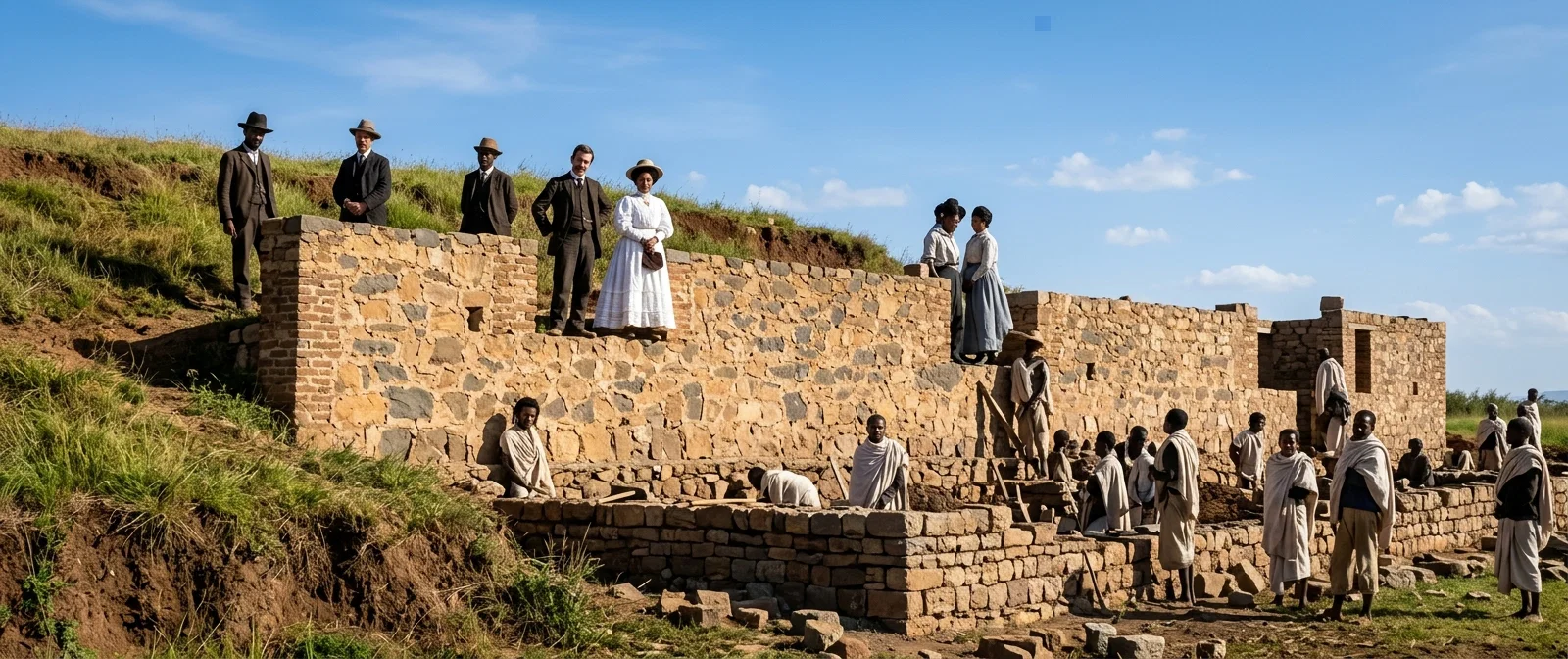
Asmara has a population of 15,000, mostly Abyssinians. The climate is excellent, the elevation being 8,000 feet. There is excellent farming land all about the town. The government reserves the land needed by the natives,42allowing other portions to be taken up by Italian settlers as homesteads. We finally purchased a fine homestead of seventy-five acres, a little over a mile from town. The price was $800. We could judge of the fruitfulness of the land by the fine stack of wheat on it. There are also good water facilities. The title was transferred December 7, and we at once secured a builder and planned two stone buildings, one a dwelling-house for two families, the other having two rooms and a kitchen. A schoolhouse, of two rooms, was also planned, as well as a stable, as the mission has two mules, three oxen, etc.
We can secure Abyssinian young men who are anxious to go to school. The expense for each will be about thirty dollars a year. By the rent which the workers will pay, and returns from the harvest, we expect to realize enough money to keep about fifteen boys. As Brother Persson has a knowledge of the Tigrene and Italian, we can start the school without delay. Elder Grundset and family are studying the Tigrene, Dr. Vasenius and wife the Amharic (the leading language of Abyssinia), and Brother Toppenberg the Galla. Thus the workers are preparing to enter Abyssinia proper as soon as the way opens. We are only fifty miles distant from the border of that country.
Some of the delays in missionary life will be appreciated when I state that although two sisters arrived in October, 1908, to be married to Brethren Persson and Lindegren, the marriages could not take place until December, 1909. The licenses had to be signed by ministers, ambassadors, and counselors in Scandinavia and Rome. But all parties were only the happier when it was finally learned that the last obstacle had been overcome.
On December 4 we organized the little church at Asmara, with nine members. When I left, December 9, all were happy in the assurance that indeed the promise of the Lord had been fulfilled, and that Jesus, the chief of all missionaries, had been with us.
Photo by A. C. Enns
SIX HUNDRED CHILDREN WHO HAD TO BE REFUSED ADMITTANCE TO OUR MISSION
SCHOOL IN MAJITA, VICTORIA NYANZA
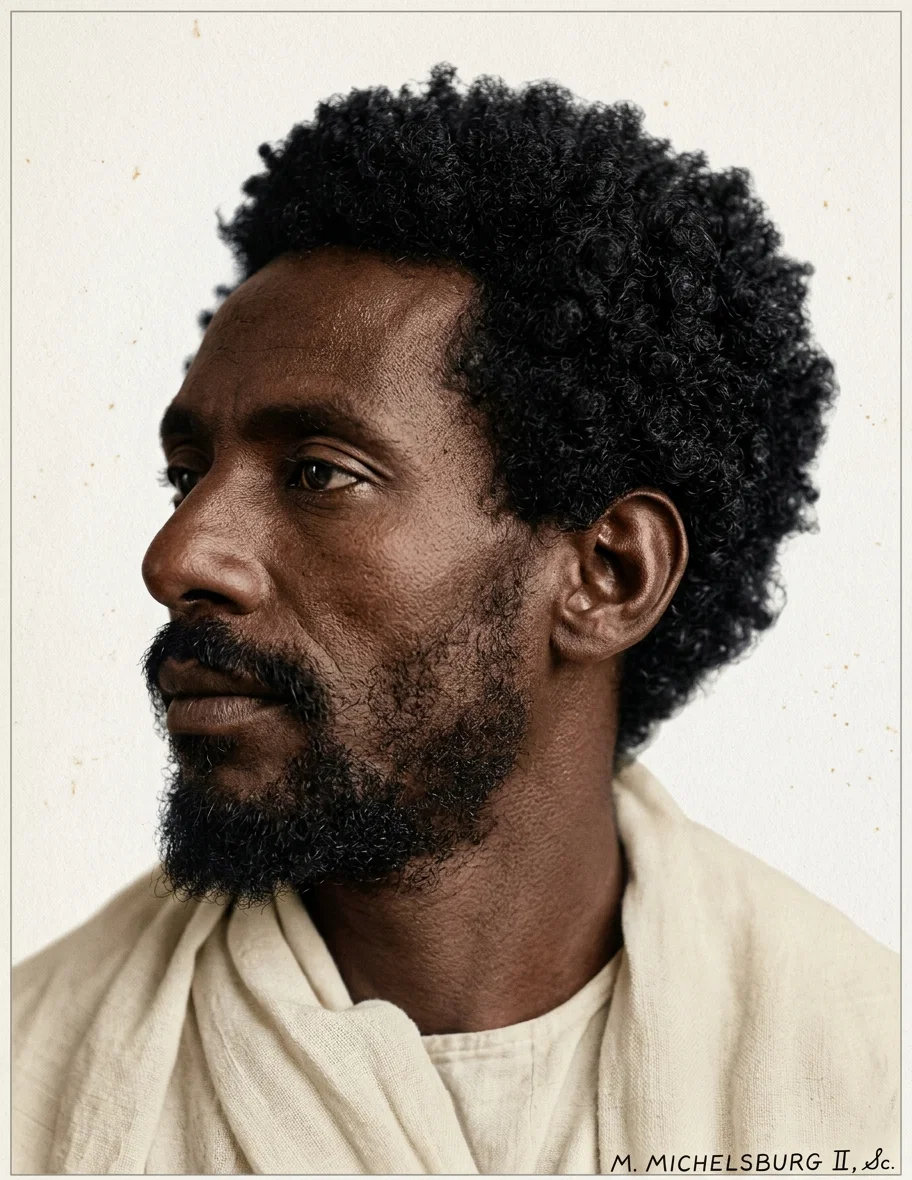
A TYPICAL ABYSSINIAN
BUILDING THE NEW ASMARA MISSION HOUSE, ABYSSINIAN STATION
The Australasian Union Conference
AVONDALE SCHOOL PRESS, WHERE LITERATURE IN DIFFICULT LANGUAGES, FOR THE EAST INDIAN ISLAND FIELD, IS PREPARED
The strong conferences in Australia and New Zealand constitute the base of operations for our work among the forty million in the South Sea Islands and the East Indies. “Australasia’s burden” is the phrase by which our Australasian brethren voice this sacred responsibility. The school at Avondale, near Sydney, and the Sydney Sanitarium and nurses’ school, are their leading training centers. Elder J. E. Fulton, president of the union conference, says that 1909 was “another year of victory.” From various reports we give a brief outline of the year’s advance.
East Indies
Java Mission
WITH its thirty-two millions, this island has had little missionary effort. Many years ago a godly Dutch missionary, Mr. Janz, translated the Bible into Javanese. His daughter carried forward a work after his death, and for some years has been an observer of the Sabbath. Elder Fulton says:— Just about the beginning of 1909, Miss Janz gave to us the oversight of her little colony of two hundred persons. Three of our workers are now located at this place. We hope that some of the young men who have learned of the religion of Jesus through her efforts will carry the message to other parts of this great field. Small leaflets are to be printed in the many languages spoken in Java, so that our native laborers will have a tract for every man they meet. Elder R. W. Munson has returned to Java from Australia, to work in translating, settling at Soekaboemi. Elder J. W. Hofstra, of Michigan, who speaks the Dutch, the government language, arrived this year. He will doubtless locate near the Soember Wekas health home. Here in the mountains will be our Java headquarters. Two other workers were also added,—Brother Woods, a trained nurse, and Miss Knight, a Bible worker. The centers of our work are Batavia, Surabaya, Soember Wekas, and Pangoensen.
Sumatra Mission
Sumatra has three millions of people; and we have there three workers. Brother Bernard Judge gives us a glimpse of the complex conditions:—
As there are many different nationalities of the Caucasian race, so there are many subdivisions of the Malay race. In Padang we have the Malay proper, some Battaks from north Sumatra, and the Nias, from the islands of Nias and Paga. The inhabitants of Paga, a few months ago, literally hacked to pieces one of the German missionaries stationed there. This was brought about44by the missionary calling for some soldiers from the government, and then using them to compel the natives to attend his meetings. The Chinese are well represented. There are two classes, the immigrant Chinese, who speak Hokkien or some other Chinese dialect, and those who are born here of Chinese fathers and Malay mothers. These speak Malay as their mother tongue, and are called Babas.
We have two Chinese sisters in Padang, faithful believers, from the days of Elder R. W. Munson’s former labors here. A young Battak, in the Singapore school, is preparing publications for his people in Battakland (northern Sumatra), where, during the year, there has been considerable stir over the message. The laws prohibit any of our white missionaries going there, but out of the agitation and by the use of literature, we expect to see the truths for these last days making progress. The workers are studying Malay.
Borneo and Beyond
These islands of the East Indies are off the beaten track. Elder Fulton says:—
Brother Lee Chong Miow made a canvassing trip into Borneo, and remained a short time. With this exception, nothing has been done in this land of Dyaks and wild men. From travelers we learn that the moral standing among some of these heathen tribes is far above many in more favored parts of the island world. And all the way east of Java and Borneo are thousands of islands, great and small, with millions of people waiting to hear this message. “O, where are the reapers?”
We can not but express our gratitude to God for his favor to us in the Dutch Indies. The Lord has given us favor with the Dutch officials. Here it is necessary to have permits, which, as a rule, are renewed every six months or every year. One of our workers, a sister, had faith to ask for a life permit, which was granted.
New Guinea Mission
It was late in 1908 that our first workers landed in New Guinea, S. W. Carr and wife, formerly with the Fiji work, accompanied by B. Tavode, a Fijian.
A NEW GUINEA HUT
This year they were joined by Gordon Smith and wife, from Australia, and a Rarotongan, Solomona, trained at the Avondale school. After long waiting, land for a school has been secured, among the raw heathen natives, twenty-seven miles inland from Port Moresby. It is being cleared and planted. Elder Fulton writes:—
During the time of waiting Brother Carr has been successful in bringing the truth before some of the traders and planters. One business man has accepted the light, and is sending his children to our Avondale school, Australia. And so the message spreads!
Eastern Polynesia, South Pacific
In this mission field are included the Society, Cook, Austral, Gambier, Marquesas, and Tuamotu groups, with the lone but famous island of Pitcairn. The superintendent, Elder B. J. Cady, reports the erection of a new church building on Raiatea, Society Islands, and adds:—
At present we have five meeting-houses45and two mission homes in the Society Islands. Our membership is about seventy. We have seven Sabbath-schools; these are on five different islands, one being on Makatea, of the Tuamotu group. Our mission schooner “Tiare” made one trip to Pitcairn Island, taking mail and such things as the islanders need. This last trip found them well. Brother M. W. Carey, of Tasmania, was doing well in the Pitcairn church and school work. He was expecting Brother H. Thomas and wife to relieve him, as they had come on to Tahiti from Australia, with this in mind. However, as Sister Thomas was able to speak French, it has been thought best to have these new workers continue in Tahiti, which is a French possession. Brother George Sterling and wife, with George Deane and wife, Tahitian helpers, made an evangelistic tour this summer through the islands of Huahine and Raiatea, and then settled on Borabora, which is a comparatively new field.
Cook Islands
Of the religious conditions, Elder F. E. Lyndon, of Rarotonga, reports:— The Maoris of the Pacific were all heathen one hundred years ago. The London Missionary Society sent them faithful missionaries, who gave them the gospel in their own tongue, and then taught them to read it. The Bible, practically speaking, is the only literature the natives have ever had to read. The old natives and middle-aged are quite familiar with the Sacred Book, but the young of the present generation feel quite indifferent to it.
“Thoughts on Daniel,” “Christ Our Saviour,” and several smaller productions have been translated into Rarotongan, and “Thoughts on Revelation” will shortly be out. Our paper, Tuatua Moa (Words of Truth), is widely read. A man from far-away Penrhyn, a coral island in latitude 10° south, came to our mission to ask us for a worker, saying that he and two others are keeping the true Sabbath.
We have a church on Rarotonga, at Titikaveka. Little has been done in other islands, as our workers have been so few. Visiting the island of Aitutaki last September, in response to earnest calls, I found much interest among the people. One leading native accepted the message and is spreading it. He had formerly been intemperate, but his little girl, in dying, begged him to leave his bad habits, so that he might meet her in the kingdom. The father ceased drinking, and having heard Dr. J. E. Caldwell, years ago, explain the evil effects of tobacco, he put that away also. When I found him, he was ready to accept the full light of the message.
RAROTONGA MISSION
Central Polynesia
This mission field includes the Fijian, Tongan, and Samoan groups.
Samoan Mission
Our work in Samoa has been an uphill struggle, but Elder J. E. Fulton, of the union conference, writes, “We are hopeful that we are now getting the work there on a better basis than ever before.” A change was made at the end of the year, J. E. Steed, the director, returning to Australia, on account of failing health, and Brother Howse coming from Australia to take his place. Of the work there Brother Steed writes:—
For a mission home and school our brethren have secured sixty-three acres of land, rising from the sea to several hundred feet elevation at the upper side. This beautiful piece of land has a permanent stream of water, from which it takes its name, Vaiola (vai, water; ola, life); it is also well supplied with cocoanuts, vanilla, bananas, and other things. While many other pieces of land were offered for our work, we had signal evidence that the Lord was reserving this for us.
Among the many blessings that have been our portion, we feel thankful indeed that he placed a bright young half Samoan-Niue woman in our way, with the result that she has been a great help to us in getting out our literature. She is at present at the Avondale school, Australia, the Queensland young people’s societies keeping her there. A young man who has taken his stand with us has also helped in translating; so that we have a number of tracts in the Samoan language, and several in the Niue, the language of the island of Niue, several hundred miles from Samoa.
Fiji Mission
The Fiji Islands are our headquarters for Central Polynesia, and workers trained there are going out to other groups. Elder C. H. Parker writes:—
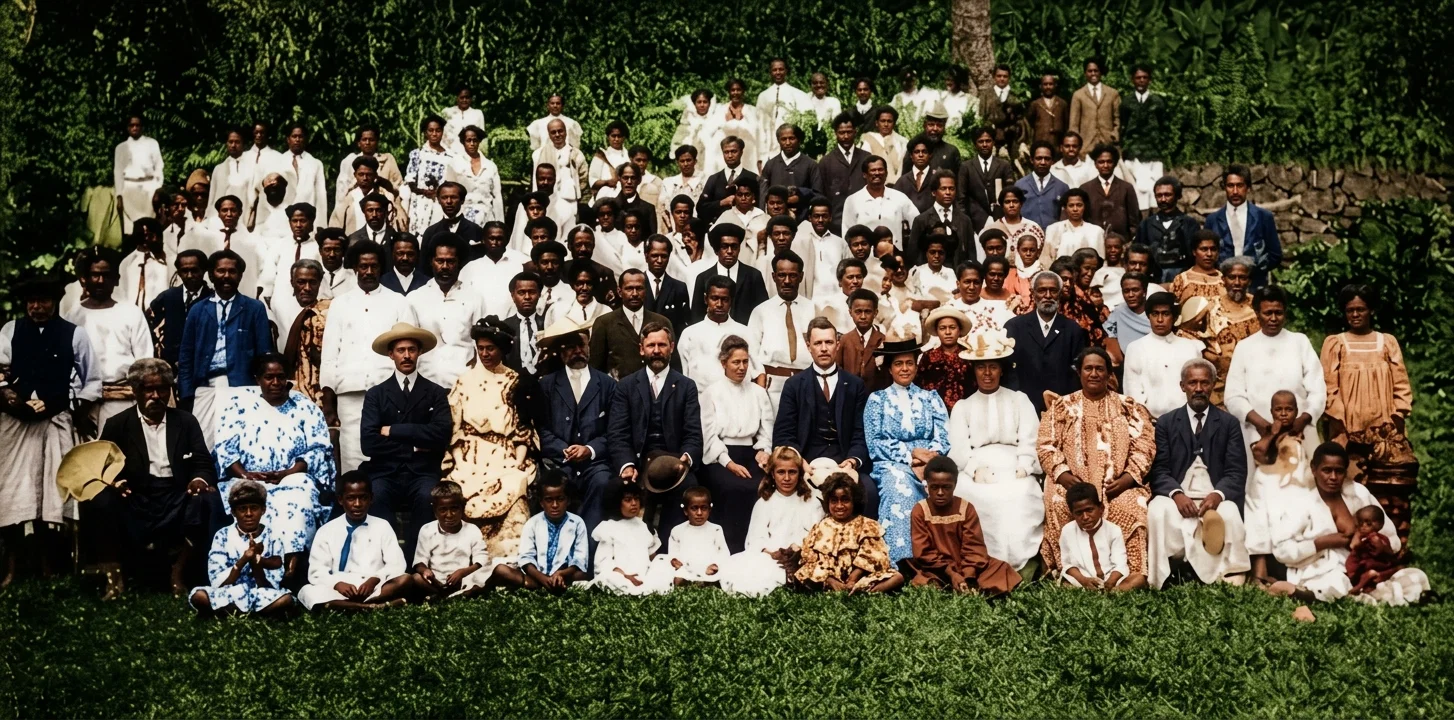
Over fifty have taken their stand with us during the past year. One whole village lately came to us en masse. At our June council about two hundred of our people were in attendance. Our Buresala school, on the island of Ovalau, came in for much thought. Out of their mites the people present gave $150 toward the erection of a new boys’ dormitory. During the year a girls’ home was added to the school, now occupied by nine young women and their European teacher, Miss Williams. We have two ordained ministers, one white, the other Fijian; a licensed minister; fifteen Bible workers, native; and five schoolteachers, two of whom are natives.
We have a printing plant at the school, which prints our monthly paper, Te Maramarama (The Light), and tracts. At the present time a small “Bible Readings” and a partial translation of “Early Writings” are being printed. This press will be utilized also for Tonga and Samoa.
Lately I found one man who had been keeping the Sabbath for two years. He had never come in contact with us as a people. While I was talking with him, another man came in, and said that there were four others, besides himself, who wanted to unite with us. These were entire strangers, but they were acquainted with what their Bibles said. As I left this house, we met the chief of the town on the full run. He was coming to hear me pray. I might relate many such incidents, but these are enough to show that Fiji is ready for the consideration of the advent message.
Tonga Islands
Tonga has had an interesting year of work. A training-school has been built up during the year, and a goodly number of young people gathered in. Some new ones have accepted the blessed truth, and others are interested.
Norfolk Island
Of work in this island, settled by people from Pitcairn long ago, Brother H. Mitchell says:—
We see many encouraging indications of progress in our work in this field. We have a fine mission home, with twenty-eight acres of land, and horses, cattle, and sheep, which we hope in time will defray the expenses of the mission. We are training some young men, whom we hope to see workers in the islands. Three of our young people are in the Avondale school, Australia. There47is little money handled in a place like Norfolk Island, yet our Sabbath-school of forty-one members gave over forty dollars to missions during the year. Tithes and offerings were over $100, and much labor on the church and mission was given by the brethren.
A PROPHECY FULFILLING
Thus, with the East Indies and the South Pacific under its care, the Australasian Union Conference has a vast mission field. As Elder Fulton says:—
In this area are many thousands of fertile and beautiful islands, containing about forty million souls, and while it is true we have done something, yet we have really only touched this great field. But God has said that the isles “wait for his law.” The message of the commandments of God and the faith of Jesus must go to all. Isa. 24:13-15 tells of the gleaning time, when cries of triumph will sound forth from the sea, and the conclusion is, “Wherefore glorify ye the Lord in the east (R. V.), even the name of the Lord, the God of Israel, in the isles of the sea.”
GENERAL MEETING IN FIJI, 1909
In the six organized conferences of Australia and New Zealand we have several thousand loyal Sabbath-keepers who are the backing to this work in the islands. Reports from the conferences show that substantial gains have been made in the camp-meetings, tent efforts, through the circulation of our literature, and by various other means. In the early part of the year we had Elder J. N. Loughborough with us, and his testimony was a great encouragement to our people. The Avondale School for Christian Workers (Cooranbong, N. S. W.) has had a year of spiritual blessing, as well as its most successful year financially. Good work has been done at the smaller schools in New Zealand and West Australia. Workers trained at Avondale and the Sydney Sanitarium are found in all parts of our field. There never was a time in our field when the opportunities for labor were so great. O for more of the spirit and power of the Model Missionary!