(Including the conferences and missions in European Russia, Siberia, Turkestan, and the Caucasus.)
With one sixth of the earth’s surface in the territory of this union conference, and one hundred fifty millions of people of many races and tongues, we can well understand that there are difficulties in organizing and pressing forward the work. Yet the 3,668 Seventh-day Adventists in all this field are earnestly bearing the witness.
DIFFICULTIES TO CONTEND WITH
“Only those in the field,” writes Elder J. T. Boettcher, of Riga, the union conference president, “know under what difficulties the message is making such progress in Russia.” He lists some of these difficulties:—
1. The more widely separated conferences are thousands of miles apart, making it difficult for the workers to meet together in council.
2. The multiplicity of languages for which we have neither literature nor preachers.
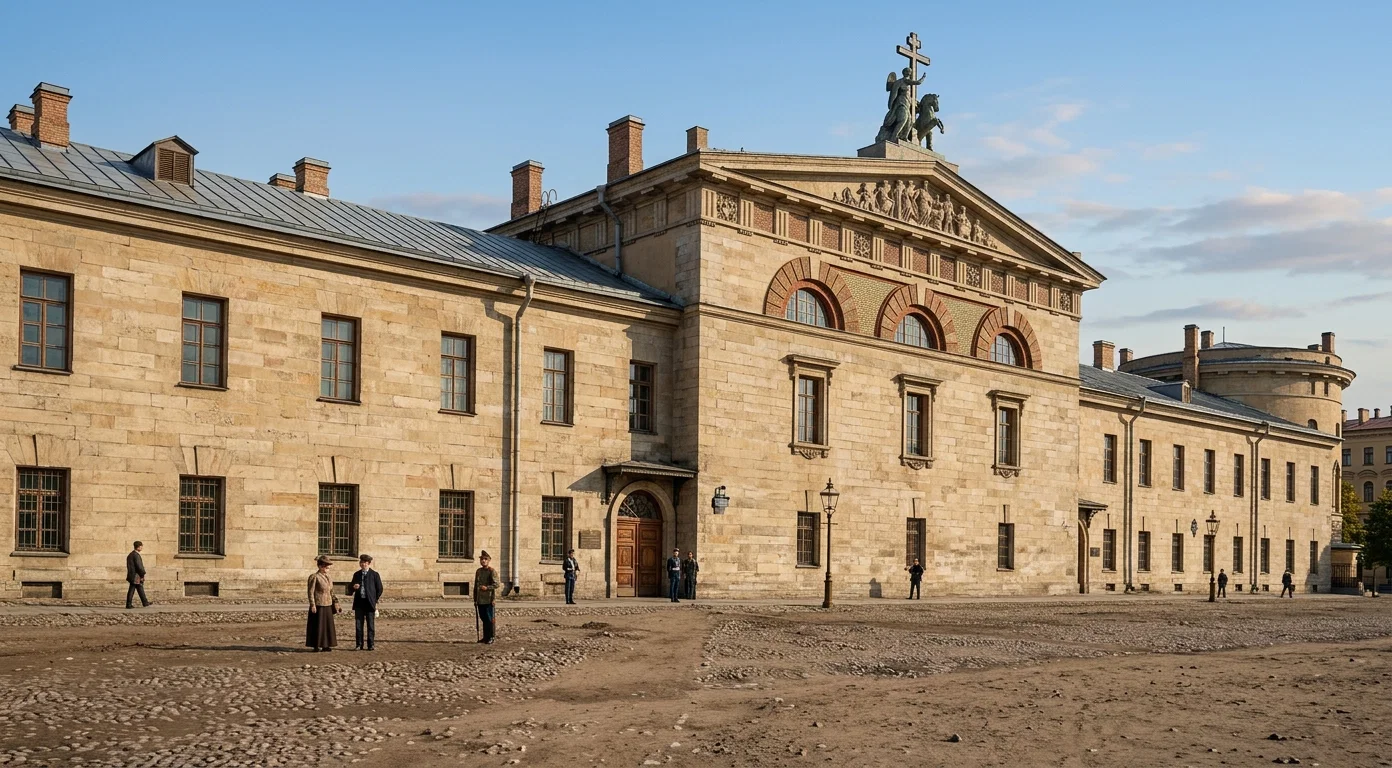
PRISON IN ST. PETERSBURG WHERE TWO OF OUR BRETHREN ARE IMPRISONED FOR REFUSAL TO WORK ON THE SABBATH
3. Eighty per cent of the population neither read nor write. Think of it, only twenty out of every one hundred able to read the Bible! The gospel, therefore, must be given to most
them by word of mouth. We are endeavoring, so far as possible, to have all our members learn to read.
On account of this inability to read, the people have become great debaters. The priests take advantage of this love of debate, attend the meetings of the so-called sects, and get up during the services, trying to force a debate, and denouncing the preacher. The priest usually brings a number of his sort with him. He knows, too, that he has the civil law on his side, and that he can say what he pleases, while the preacher must stand and listen to it all with Christian grace, and afterward go ahead and preach the word.
WORKING IN THE CITIES
The worker rents a large compartment, in which he lives. He circulates our literature among the people. Having in this way created an interest, he invites the people to his home, where, in a quiet way, he can labor with them until enough are brought into the truth to organize a company. This company then asks permission from the governor and police to unite with our church. After this, at times, the worker can hold public lectures, but is not allowed to take up collections, nor is he allowed to advertise his meetings. Nevertheless, the people come until our halls are filled to overflowing. As there are hardly any societies in Russia, there are very few public halls. This forces us to build10meeting-houses. Our people are exerting themselves to the utmost to put our work upon a firm footing.
Little Russian, Siberian, and Central Asian Missions
At the beginning of the year three new mission fields were organized: the Little Russian, in Europe, the Siberian, and the Central Asian. We have held a general meeting in only one of these fields, the Central Asian, or Turkestan.
Turkestan
It is wonderful how the work in Turkestan has opened up. A number of German Sabbath-keepers moved there, and are working as hard as they can, not only with their hands, but also for the cause. One little church had an addition of twenty-one new members. They live right in among the Sartes and Kirghizes, all of whom are Mohammedans. Our young people have learned to speak these languages, and are reading the New Testament with some of the natives.
The truth is going from this field into Persia, as some of our Russian brethren live near Aschabad, which is only three and one-half miles from the Persian border. They have rented large tracts of land from the Persians, and thus come in direct contact with that people. Indeed, an interest has already been awakened. So we are entering Persia from the north.
Siberia
Siberia is a very promising field. In many respects it resembles Canada. Encouraged by the Russian government, there has been a great influx of people from European Russia into Siberia since the war with Japan. For this great field we have only one minister and one Bible worker. Most urgent calls come to us for help. Also from Manchuria calls still come from the believers in Harbin, who have never been visited.
A few months after Elder H. K. Loebsack, superintendent of the Siberian Mission, settled in Omsk, his faithful wife died, following a surgical operation, and with his motherless children in far Siberia, our brother has gone forward, seeking out inquirers and preaching the message.
“Little Russia”
The district known as “Little Russia” lies in the heart of Russia, Kief being the chief city of the territory. The agricultural peasantry in this region are of the poorest, the farmer being the only man who pays taxes. Our brethren barely make a living. Yet it is astonishing what a desire they have to spread the truth. They are willing to suffer banishment or any kind of persecution for the truth’s sake. In the village of — we have a church with two hundred members. This has outgrown any private dwelling, and holds its meetings in the open air. A friend of the cause donated a building lot; from a general fund we have sent one hundred fifty dollars with which to begin a building, which is now in process of erection, the believers to raise the balance needed.
The Baltic Conference
The work in the Baltic Conference, Elder Boettcher says, has advanced more rapidly than elsewhere, owing to the greater educational advancement of the people. With a population of over six millions, the conference has two ordained and two unordained ministers, and six Bible workers, representing, in nationality, Russians, Letts, Esthonians, and Germans. But they are a united band of workers.
IN ST. PETERSBURG
We have a church building in St. Petersburg, the capital, but it is too small for public meetings. The worker there, Brother J. Wilson, reported in a recent letter:—
The Lord has kept his promise of Matt. 28:19, 20. You know that halls are not cheap in St. Petersburg, but through the grace of the Lord we now have, for Sunday nights, a hall seating about five hundred persons, furnished with electric lights, an electric ventilator, and an organ. And this all free of charge. About six hundred attended the opening meetings. After the second meeting, about a hundred men, called “The Black Hundred,” who had been stirred up by priests, made disturbance, intending to flog me. But in the turmoil they got hold of another man. As matters began to look serious, the janitor of the hall fired a revolver in the air, whereupon the men fled.11
Photo by E. Gnedjen
We learned from this experience to issue tickets to our meetings, thus keeping out the disorderly. The mayor gave permission for this on our petition. At the next meeting everything passed off quietly. The police force was strengthened, the chief of police also being present. I could but think of how times have changed. A few years ago we feared the police, and now they come to protect us!
In this great city of nearly two millions, we have two workers, one Russian and the other Lettish, the latter speaking German also.
OTHER CITIES TO BE WORKED
In the city of Libau, on the Baltic, Brother J. Schneider reported crowded meetings in a hall, six hundred people gathering night after night. He has preached practically the same discourse three evenings in succession to accommodate those who could not get in to hear the first night’s presentation.
In Riga, the headquarters of our union conference, is the book depository.
Formerly there was a Lettish church here of one hundred members. Now there are two churches, a Lettish and a German, 160 new members having been added in the last two and one-half years. No special public effort is being put forth, as there is no evangelist for the city. The canvassers are scattering the literature, and when Elder Boettcher is in from his almost constant trips throughout the union conference, he holds evening meetings.
Middle Russian Mission
Moscow, the first capital, a city of about a million inhabitants, is in our Middle Russian Mission, and contains our one church in that mission. Elder O. Wildgrube, the mission director, and F. Gaidischar, a Bible worker, have been working in Moscow. Elder Boettcher says:—
It seems as if the enemy is doing his best to keep us from gaining a foothold in this city. We have been driven out of our place of meeting a number12of times. The priests come and make disturbance in almost every meeting. If any trouble arises, we are blamed for it. The priests have even gone so far as to rent a hall opposite our hall on the same street. They station people at our doors with literature and distribute it free of charge. Brother Wildgrube writes: “A few days ago a Baptist minister had his meeting closed, and I tremble when I think of my own case. We are having fine meetings.”
The Middle Russian territory contains a population of fifty millions, and the mission has three evangelistic workers.
West Russian Mission
This is said to be the most difficult portion of the union conference:—
However, within the last year permission has been granted to hold meetings in the city of Warsaw, and we now have a little company there, with two workers, a German and a Pole. The Roman Catholics have complete control of the city, and the work moves slowly and under great opposition. Wilna, the city where Elder H. J. Loebsack, the director of this mission field, now lives, is the center of the Jewish population of Russia. A hall has been secured, but it is difficult to persuade the Jews to attend a Protestant meeting.
The Caucasian Conference
This conference includes the Trans-Caucasus, touching the Persian border.
During the year 1909 two new churches were taken into the conference—Tiflis, with twenty-three members, and Novorossiisk, with nine members. Tiflis is a stronghold in the Caucasus, and we are glad to have a start there, after many difficulties. At the conference meeting this year Brother E. Gnedjin, a Russian, was ordained to the ministry, the second of our native Russian ministers.
South Russian Conference
This conference has many important cities in its territory. Elder Daniel Isaak, the president, says:—
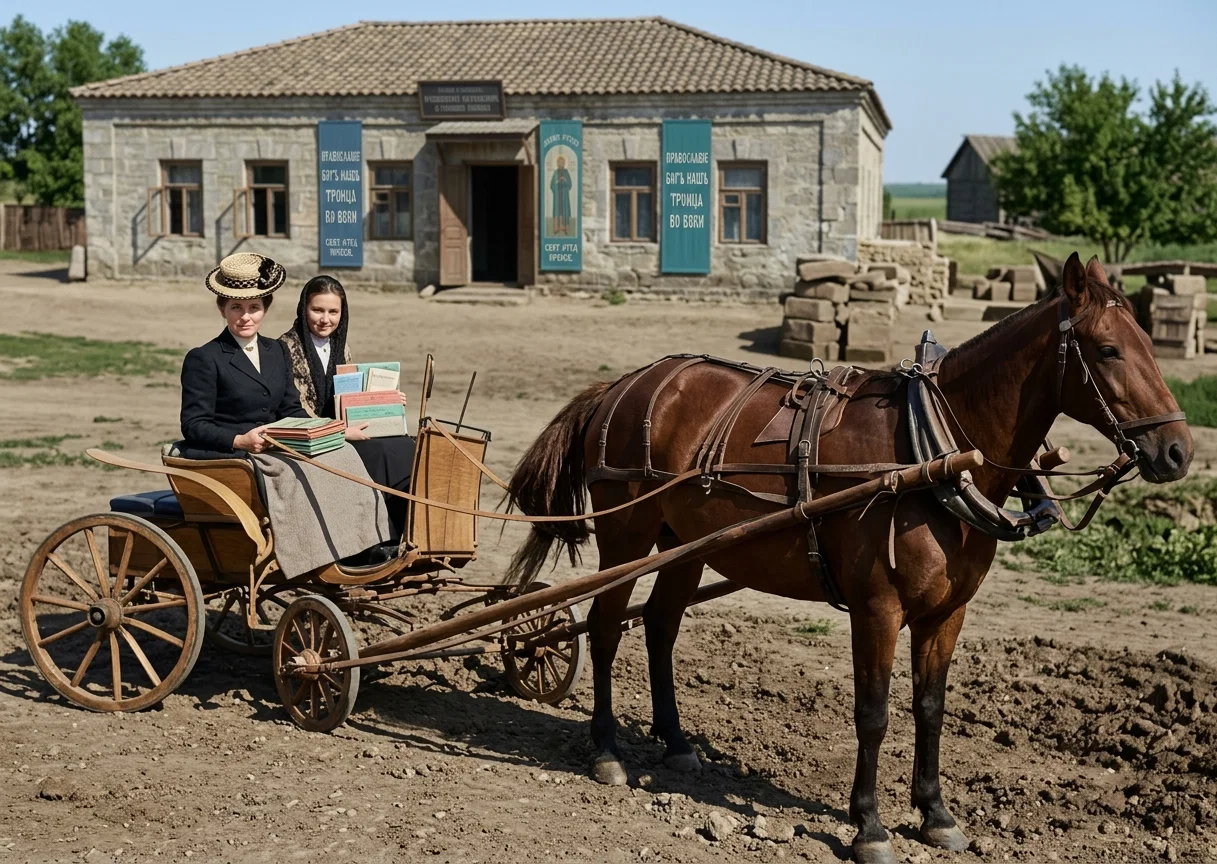
BERTHA OSWALD AND A. PREIKSCHAT, CANVASSING IN SOUTH RUSSIA
Work has been done during the year in the cities of Rostof, Sevastopol, Odessa, Alexandrovsk, and Ekaterinoslaf, besides some work in a number of villages. We have at present two Russian, four German-Russian laborers, and the writer (from America). Besides these we have in the canvassing field13two Russian men, and two German-Russian women. It is quite an unheard-of thing here for women to go canvassing, especially driving from village to village, or even walking with their loads of books. The people seem greatly astonished. Some well-meaning ones said: “O, this shows that the gospel is now being preached everywhere; so that even women have to go to do such work.” Others, who do not like to see our work increase, said: “Well, what is coming next out of that Adventist movement?” These two sisters have many experiences to relate after coming in from a two-months’ trip. They labor entirely in the German villages, where the people in general rejoice to be able to buy such good literature.
One of the great cities is the Black Sea port of Odessa. A native Russian worker tried long and suffered much to get meetings started here. He had been accused of leading some out of the orthodox church; but while judgment on this charge was pending, he applied for permission to hold meetings in a hall. Just here, says Elder Isaak, deliverance came:—
Our worker had just finished two weeks in prison for that former accusation, when there came not only permission to conduct his meeting in his new hall, but also permission to hold our coming conference for 1910 there. Is this not good? We now have also a German laborer and a nurse stationed in Odessa. The interest there is encouraging, and we hope soon to reap as good a harvest at Odessa as we had the year before at Sevastopol, where an entire Russian church of sixty members was organized. Five new churches and companies have been added during the year.
We must close the report of the splendid year in the Russian Union Conference with these words from its president:—
The Russian Union Conference has added about six hundred to its membership during 1909, and it has been a year full of rich experiences for the cause. In 1910 we hope to see our Russian training-school established.
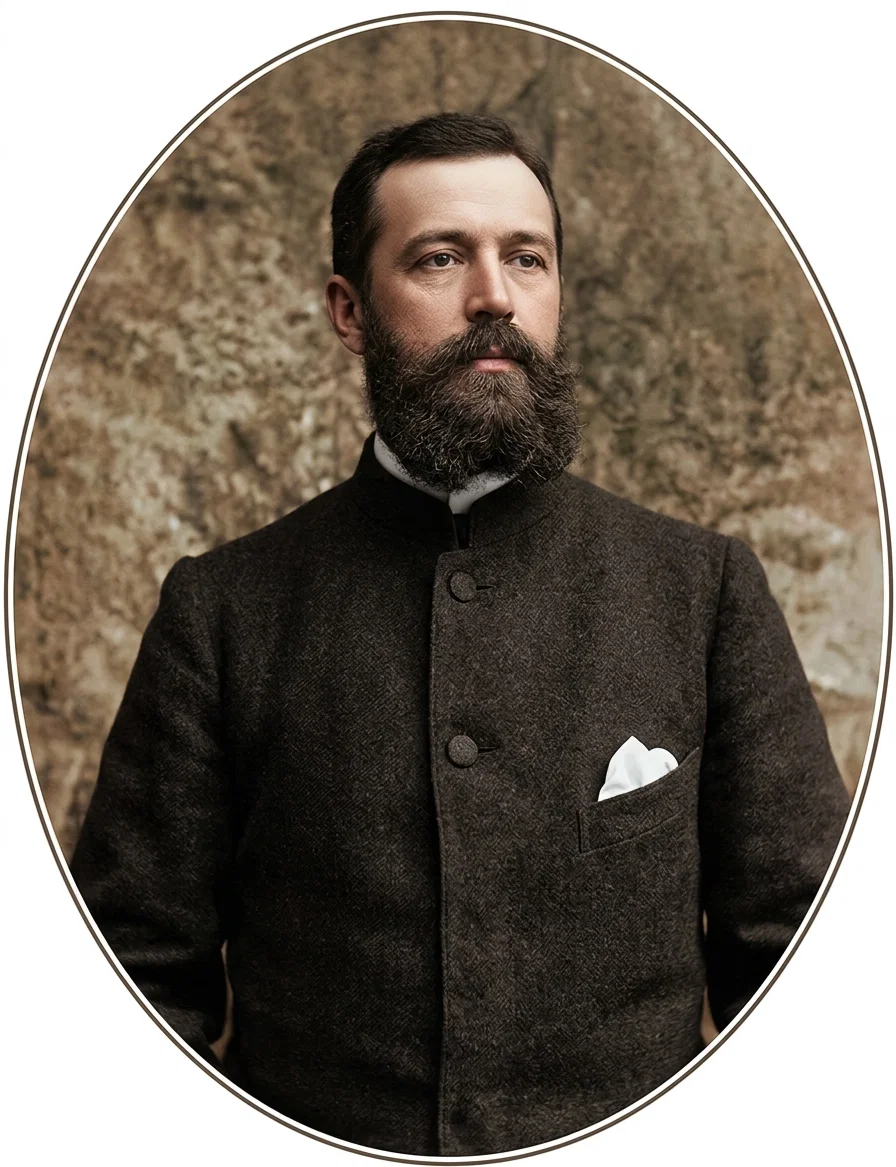
E. GNEDJEN, NATIVE RUSSIAN MINISTER
The Latin Union Conference
This union, which includes Algeria and Tunis, in Africa, represents our work for one hundred ten millions of souls. “We have in our field,” says Elder L. P. Tieche, president of the union, “only one million Protestants, while there are six million Mohammedans and Jews, and more than one hundred million Catholics.” The laborers are few indeed for such a field.
France
Northern France constitutes the Northern France Mission, with Paris as its headquarters, that city being as fruitful a field as we have in France.
The French Conference, which means southern France, is the field where our work for France began in 1876, by Elder D. T. Bourdeau. Elder H. H. Dexter, president of the conference, reports these experiences:—
Last winter with the help of a lady Bible worker, I held a series of meetings in a small hall, on a side street, of the great city of Lyons. The average attendance was but thirty, yet ten of these14are now baptized believers. Among our regular attendants was a man, accompanied by his wife and son. They were indifferent Catholics. Soon they decided to keep the Sabbath. On going to their home, we were surprised to find that they kept a small wholesale liquor business, with a few groceries. “What a strange combination,” thought we, “Sabbath-keeping and liquor selling!” For a while it seemed to us that it was to be seed-sowing on stony ground; that they would not accept the full message. But to our joy, they willingly sacrificed their chief business in order to be in harmony with the Word of God.
For thirteen years the only Sabbath-keeper in this city of five hundred thousand inhabitants was an old gentleman who styled himself “the Solitary of Lyons.” He had prayed during these years for the conversion of his wife, son, and daughter-in-law. The devoted old brother has had the pleasure of seeing his children baptized into Christ. Their store is closed every Sabbath, and though they have sustained temporal losses, their hearts are filled with the love of the truth.
Elder Dexter says that they are now endeavoring to work more in the cities. Elder T. Nussbaum is beginning in Toulouse, selling publications, and holding Bible readings. He writes: “I am meeting with some remarkable cases of Catholics who are anxious to shake off the yoke of Rome.” Lectures are being given in halls in the cities of Grenoble and Bourg, where the people are almost entirely Catholic.
Spanish Mission
The report of Elder Walter G. Bond, of Barcelona, superintendent of this mission, shows that the laborers are few and the work great in the land of the Spanish Inquisition:—
My brother Frank and I are the only ministerial laborers in this field. To help in our work we have two Bible workers, a lady and a gentleman, both Spaniards. Of the thousands of towns and cities in this country, meetings have been held in only four or five. During this year my brother has been working15near Valencia. He has also held some meetings in the mountain town of Rubielos, province of Teruel. It was in this town that the people stoned the house where the workers were stopping on their first visit, and threatened to stone the workers should they again visit the town; but in October, when I visited the town, in company with my brother, we went about unmolested. Four men united with us, and several others profess to keep the Sabbath, who as yet have not discarded wine and pork; but we believe that in time they will fully accept the message.
Here in Barcelona, in spite of uprisings, revolutions, and opposition, the work has also made some progress. We are now holding meetings in three different parts of the city.
In January we published 10,000 copies of the first number of our Spanish paper. The edition of the next number was 15,000 copies, and of the third 25,000. Since Elder N. Z. Town held the canvassers’ institute in Barcelona, in September, during the riots, some of our six canvassers have had special success with the paper.
DELIVERED FROM STONING
Two weeks ago, in the province of Tarragona, two of our colporteurs were arrested and taken before the alcalde of the town, who threatened to burn all their literature if they did not leave at once. When given their liberty, they were surrounded by a great mob, who evidently expected to stone them. But they committed their keeping into the care of our Heavenly Father, and not a hand was raised against them. They believe it to be a special deliverance. Nineteen good members have been added to the list of believers this year, and several others are awaiting baptism. Five of our young people have gone to the school in Switzerland.
Portuguese Mission
Our Year Book shows only Elder C. E. Rentfro and his wife, of Lisbon, as experienced workers in Portugal. No wonder Brother Rentfro writes, “Many times I have wished for a fellow worker with whom I could counsel and plan.” From Elder Rentfro’s report we give these interesting items:—
Previous to this year we had held only cottage meetings; but with the transfer of meetings to a small hall, the interest has increased. Thirteen have been baptized during the year. I would it were possible to say that all our members had been able to endure the tests that come severely in this land; but a number have faltered and fallen out, so that our year ends with only twenty-three members. Six others have only lately accepted the Sabbath and are being further instructed. The custom of wearing jewelry is a difficult one to abandon here.
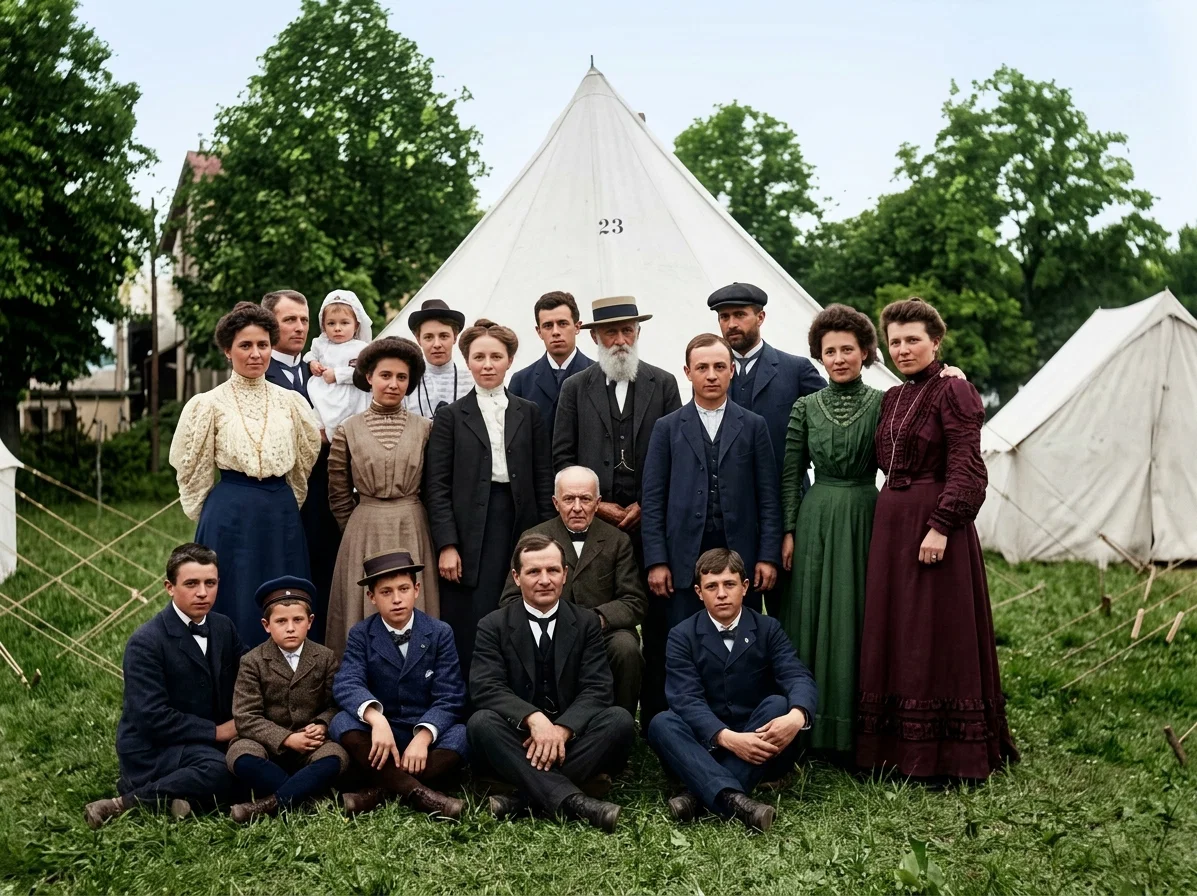
ONE FAMILY, GRANDPARENTS AND CHILDREN, ALL SABBATH-KEEPERS, IN ATTENDANCE AT THE FRENCH CAMP-MEETING
Three brethren have gone to Africa to gain a livelihood, and expect to hold up the light there.
In June I visited interested persons in Oporto, and made a trip into the mountains, by stage and “burro,” in the extreme north of Portugal, where a family of three are holding up the light. They suffer persecution, and if the brother was not a native of the place, he would be driven out of the village. This brother has his family Sabbath-school,16and pays his tithe, seeking to walk in all the light.
Following the earthquake of April 23, we began a paper called Os Signaes dos Tempos (Signs of the Times). It was a risk to begin with four thousand copies, for generally books and papers here have but a small circulation, and the majority do their selling in Brazil. But the colporteur can find readers by going to them. The canvassing work has been represented by one young man of eighteen years. He is beset by many temptations, but clings to the work.
C. E. RENTRO AND FAMILY, A COLPORTEUR AT RIGHT, LISBON, PORTUGAL.
The Levant Union Mission
This union comprises the countries around the eastern Mediterranean. Our work is yet small. The population of fifty-two million is mostly Mohammedan.
Syrian-Egyptian Mission
Of the little band of workers in this mission, Elder W. C. Ising, of Beirut, the superintendent, says:—
We have ten evangelistic and Bible workers in all,—one native, a Copt, of Egypt, and nine foreigners, including four lady nurses. This little force is located at Beirut, Haifa, Joppa, and Jerusalem, in Syria; and in Cairo and Luxor, in Egypt.
This autumn (1909) we have started on a campaign of public lecturing at Haifa, Jerusalem, and Luxor (the ancient Thebes, or No-Amon of Nahum 3:8, margin). This is the first effort of this kind, to my knowledge. Unfortunately the work among the Germans at Haifa could not be brought to the desired close, for the brother who had come from Germany just a year previous felt that he must return on account of his health. We hope that these efforts will be crowned with some precious souls embracing the truth.
JERUSALEM
Our small sanitarium at Jerusalem is to be transferred to better quarters in 1910. Of this year's work, Brother L. Krug says:—
Our institution has been the means of acquainting a number of persons with this message. Among the persons taking treatments we have counted not less than twenty-one different nationalities. We have had to meet many interesting17questions pertaining to our faith as Sabbath-keepers; even many Jews who have relaxed in observing this day of rest having been put to shame by our practical testimony. Also financially we have had a good year, better than the last.
DAMASCUS
IN ANCIENT DAMASCUS
Of the manner in which a man of ancient Damascus found the truth, Elder Ising says:—
Two young Armenians had come to Cairo, one from Persia, the other from Bagdad. When standing in the zoological garden one day, they were addressed by our Armenian brother, Beserdian. This acquaintance resulted in their acceptance of the third angel's message. During the time of my visit to Cairo, in April, I baptized them in a canal of the Nile. Soon after, one of these new brethren returned to Bagdad, a city of about two hundred thousand inhabitants. Thus he has become the first messenger of truth in the central part of Mesopotamia, the native land of Abraham. He writes: “There are many here who believe the Sabbath is true, and say, ‘When the Seventh-day Adventists send missionaries here, we will join them.’ There is much field here, but the workers are not only few but are none. God cares.”
Returning from the General Conference, I was accompanied by Sister E. Z. Simons, formerly of the West Indies, who visited various parts of the field. I hope that her efforts in selling some fifteen thousand pages of literature in Damascus will bear fruit in due season, as well as her distribution of tracts in parts of the Lebanon Mountains.
Turkish Mission
Early in the year 1909 Elder C. D. AcMoody was compelled to lay down the superintendency of this field, on account of poor health. In the spring came the massacres in the Adana district, in which some of our Armenian brethren lost their lives. Elder Z. G. Baharian and his Armenian associates have pushed forward with the work, however. Some of the believers in Tarsus have endured much persecution. About the middle of the year, Elder E. E. Frauchiger, of Germany, was appointed superintendent, and a publishing depository has been established in Constantinople. Considerable stir was made by the energy with which one of our native colporteurs sold tracts in Turkish. Elder Frauchiger wrote:—
In one of the papers a whole column was devoted to this house-to-house effort to sell Turkish publications. Indeed, we are the first Christian society to canvass with purely Turkish tracts. The future may teach us more about this.
At any rate it has strained the tolerance of the Turkish authorities, under even the new régime, and after several police experiences and the confiscation of considerable literature at various times, the brethren have counseled greater caution. They are working on “Steps to Christ” in Armenian and also in Arabic.
From Smyrna, where he is located with a company of Greek believers, Elder R. S. Greaves has made trips to Macedonia, now Albania, where believers have also sprung up. In November a general meeting was held in Constantinople, Elder Conradi reporting: “The presence of a number of new workers seemed to indicate that a new era is dawning in our Turkish Mission.”
In the Asiatic Division
This division was formed at the 1909 General Conference, Elder I. H. Evans being elected vice-president for the division, which includes China, Japan, Korea, the Philippines, Singapore, Burma, and India.
The China Union Mission
THE second biennial council of our workers in China was held at Shanghai, in January (1909), at the close of the visit of Elder I. H. Evans to the far East. For effective supervision, the council divided China into ten great mission fields, including Manchuria, Mongolia, Turkestan, and Tibet, and issued a call for twenty families to come to China in the next two years. Nine families sailed in response during 1909, including Elder W. A. Westworth, appointed superintendent, in December.
A GOOD YEAR
In the meantime, 1909 has been a good year, notwithstanding the absence at General Conference and on furlough of a number of our pioneer workers. Dr. H. W. Miller, of Shanghai, says:—
It has not been a strange thing in the history of this message in the past to see the work double in ten years’ time, and in parts of the field the work has doubled in five years. But reports of a doubling in a year’s time have not been common. We believe the facts will justify us in saying that the message has doubled in its extent and effectiveness in the Chinese field during the year 1909. Our mission is young in China, and our workers have had to study the language, with no proper literature to pass out to the inquiring. We have been steadily at work on the foundations; and now we begin to see the structure rising rapidly.
PUBLISHING IN CHINA
Our Chinese paper (the Signs of the Times) has been issued in Mandarin and Wenli, as also have the Sabbath-school quarterlies. The triumphs and trials of our youthful publishing department during 1909 are thus told by Elder R. F. Cottrell:— It is estimated that from the beginning of our work, in 1902, to the close of 1908, the entire circulation of our publications in China was 18,000,000 pages. In 1909 the output was 40,533,400 pages—a very remarkable increase, though an average of only one page to every tenth person. The printing work in Shanghai has been greatly retarded by having no suitable quarters. And to make matters more difficult, half the meager facilities in rented quarters were destroyed by fire in December. Hiring the work done is proving most unsatisfactory. The crying need is the means to build a printing plant to spread the printed page among China’s millions.
Ground for a printing-house and a general headquarters has been purchased in the suburbs of Shanghai.
MOUNTAIN HEALTH RETREAT
This year the mission has added to the little $150 cottage built in 1908 on the mountain of Mokanshan, west of Shanghai, where we have a plot of land, two thousand feet above the sea. This mountain has been a refuge for workers stricken ill on the heated plains. Dr. H. W. Miller writes:—
The need of treatment-rooms was forcibly impressed upon us, and a small two-story stone building was put up at a cost of about six hundred dollars. It is located beside a small stream, just above a cascade, on one of the most beautiful mountains in China. The treatment-rooms are very serviceable, and the sanitarium is nature itself. Those of our workers who were sick last summer made most encouraging progress here. Instead of sending our sick over the sea to a sanitarium, why not carry a sanitarium over to the missionaries, with the necessary medical help, where the institution can stand also amid the darkness of heathenism as a beacon light?