1 Corinthians 8:10
For if any man see thee which hast knowledge sit at meat in the idol’s temple, shall not the conscience of him which is weak be emboldened to eat those things which are offered to idols;
Translations
For if any man see you which have knowledge sit at meat in the idol’s temple, shall not the conscience of him which is weak be emboldened to eat those things which are offered to idols;
King James Version, KJV Cambridge Paragraph Bible
For if any man see thee which hast knowledge sit at meat in the idol’s temple, shall not the conscience of him which is weak be emboldened to eat those things which are offered to idols;
For if any man shall see thee, who hast knowledge, sit eating in the idol's temple, will not the conscience of him who is weak be emboldened to eat those things which are offered to idols;
For if a man see thee which hast knowledge sitting at meat in an idol’ s temple, will not his conscience, if he is weak, be emboldened to eat things sacrificed to idols?
For if a man see thee who hast knowledge sitting at meat in an idol’ s temple, will not his conscience, if he is weak, be emboldened to eat things sacrificed to idols?
for if any one may see thee that hast knowledge in an idol's temple reclining at meat — shall not his conscience — he being infirm — be emboldened to eat the things sacrificed to idols,
For if any one see thee, who hast knowledge, sitting at table in an idol-house, shall not his conscience, he being weak, be emboldened to eat the things sacrificed to the idol?
For, if anyone should see [thee] who hast knowledge, in an idol-temple, reclining, will not, his conscience, being, weak, be built up for the eating of the idol-sacrifices?
Berean Standard Bible, Majority Standard Bible
For if someone with a weak conscience sees you who are well informed eating in an idol’ s temple, will he not be encouraged to eat food sacrificed to idols?
For if a man sees you who have knowledge sitting in an idol’ s temple, won’ t his conscience, if he is weak, be emboldened to eat things sacrificed to idols?
For if a man sees you, who have knowledge, taking food as a guest in the house of an image, will it not give him, if he is feeble, the idea that he may take food offered to images?
For if any man see thee which hast knowledge, sit at table in the idoles temple, shall not the conscience of him which is weake, be boldened to eate those things which are sacrificed to idoles?
Douay-Rheims (Challoner revision)
For if a man see him that hath knowledge sit at meat in the idol’s temple, shall not his conscience, being weak, be emboldened to eat those things which are sacrificed to idols?
Pictures
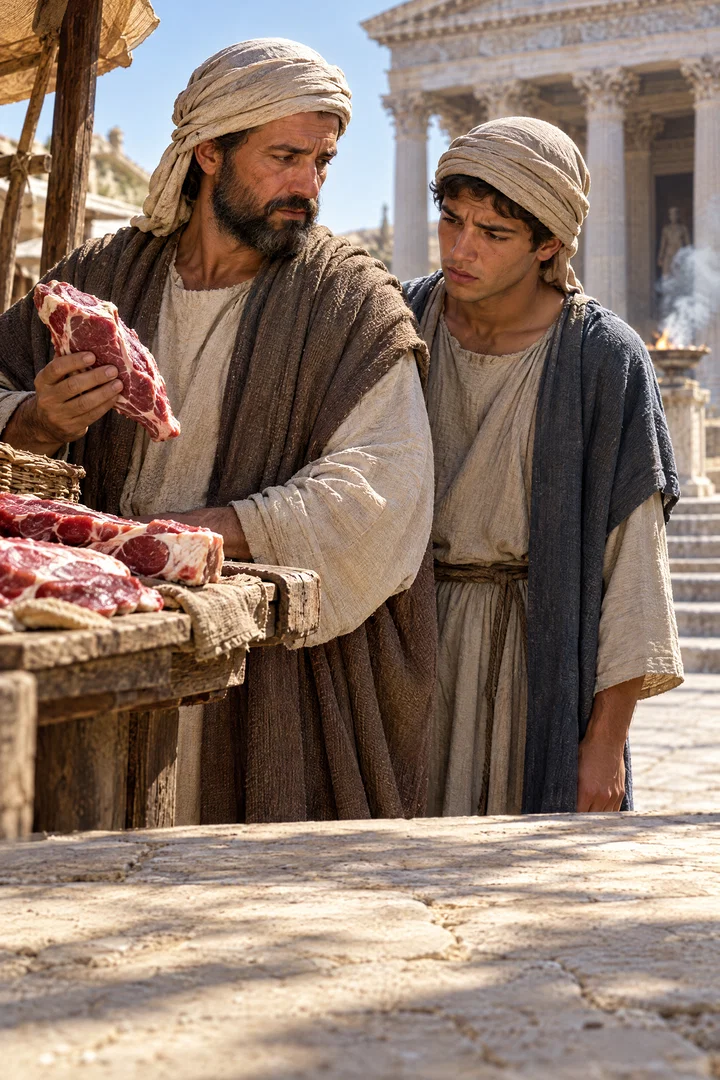
Cross-references
- Romans 14:21
It is good neither to eat flesh, nor to drink wine, nor any thing whereby thy brother stumbleth, or is offended, or is made weak.
Both urge believers to forgo food that would make a fellow believer stumble or become weak.
- Romans 14:7
For none of us liveth to himself, and no man dieth to himself.
Believers’ conduct affects others because they do not live to themselves.
- Romans 14:13
Let us not therefore judge one another any more: but judge this rather, that no man put a stumblingblock or an occasion to fall in his brother’s way.
Both warn believers against putting an obstacle in another’s way.
- 1 Corinthians 8:4
As concerning therefore the eating of those things that are offered in sacrifice unto idols, we know that an idol is nothing in the world, and that there is none other God but one.
An idol is nothing, though eating food offered to it may trouble another’s conscience.
- Romans 14:15
But if thy brother be grieved with thy meat, now walkest thou not charitably. Destroy not him with thy meat, for whom Christ died.
Warns against grieving or destroying a brother through one’s freedom.
- Acts 15:29
That ye abstain from meats offered to idols, and from blood, and from things strangled, and from fornication: from which if ye keep yourselves, ye shall do well. Fare ye well.
The council instructs believers to abstain from meat offered to idols.
- Romans 15:1
We then that are strong ought to bear the infirmities of the weak, and not to please ourselves.
The strong should bear the weaknesses of others rather than please themselves.
- 1 Corinthians 10:25
Whatsoever is sold in the shambles, that eat, asking no question for conscience sake:
Market food may be eaten freely, unlike conduct that pressures a scrupulous believer.
- Romans 14:14
I know, and am persuaded by the Lord Jesus, that there is nothing unclean of itself: but to him that esteemeth any thing to be unclean, to him it is unclean.
Both address food choices and the effect of a weak conscience.
- Romans 14:19
Let us therefore follow after the things which make for peace, and things wherewith one may edify another.
Urges pursuing peace and mutual edification rather than causing another to stumble.
- 1 Corinthians 10:32-33
Give none offence, neither to the Jews, nor to the Gentiles, nor to the church of God:
Avoiding offense and seeking others’ good reflects conduct aimed at their salvation.
- 1 Corinthians 8:1
Now as touching things offered unto idols, we know that we all have knowledge. Knowledge puffeth up, but charity edifieth.
Knowledge without love puffs up and harms others.
- Romans 14:2-3
For one believeth that he may eat all things: another, who is weak, eateth herbs.
These verses are linked to the question of whether eating certain foods is lawful.
- Acts 15:20
But that we write unto them, that they abstain from pollutions of idols, and from fornication, and from things strangled, and from blood.
Both address abstaining from food associated with idols.
- Romans 14:22
Hast thou faith? have it to thyself before God. Happy is he that condemneth not himself in that thing which he alloweth.
Both warn that exercising liberty can lead to condemnation.
- 1 Corinthians 10:14-20
Wherefore, my dearly beloved, flee from idolatry.
Paul warns Christians against joining Gentiles in idol worship and eating offerings.
- Romans 14:17
For the kingdom of God is not meat and drink; but righteousness, and peace, and joy in the Holy Ghost.
Contrasts the kingdom with matters of food and drink.
- 1 Corinthians 10:21
Ye cannot drink the cup of the Lord, and the cup of devils: ye cannot be partakers of the Lord’s table, and of the table of devils.
Believers cannot share both the Lord’s table and the table of demons.
Commentary
Each commentary is drawn from primary sources: the writings of Ellen G. White and Adventist pioneers and periodicals. Each commentary is separate. Its own words are not a quotation; follow the references to read the source passages.
Ellen G. White
3 sources
The verse pictures a person who has knowledge being seen sitting at meat in the idol's temple, and warns that this sight emboldens the conscience of one who is weak to eat things offered to idols.ST Jun 26, 1879AA 316.2–317.1Ms 40, 1896, par. 11 Exercising liberty before a weak fellow believer in this way influences him to imitate the act, so that he is emboldened to stumble.ST Jun 26, 1879AA 316.2–317.1Ms 40, 1896, par. 11 The lesson is to consider how one's actions affect others and to refrain even from what is innocent in itself if it appears to support idolatry or violates another person's scruples.ST Jun 26, 1879AA 316.2–317.1 Even buying such offerings can look like approval of idolatrous worship.ST Jun 26, 1879AA 316.2–317.1
Guarding against this requires watching at every point against unwearied temptation by watching words and guarding the spirit that prompts them.Ms 40, 1896, par. 11 It requires standing as faithful sentinels over defective attributes of character.Ms 40, 1896, par. 11 It requires treating with care those for whom Christ died and refusing to make crooked paths for the feet that would turn feet out of the way of life.Ms 40, 1896, par. 11
The stumbling block warned against is a plague spot and rock of offense that wrecks souls.Ms 40, 1896, par. 11 It works especially by the tongue, which though a little member does a weight of mischief by sowing seeds of bitterness and putting suspicious thoughts in minds.Ms 40, 1896, par. 11 A day is coming when every case will be revealed, and those eternally lost through such influence will look with reproach upon those who caused them to stumble.Ms 40, 1896, par. 11
Sources
Pioneers and periodicals
47 sources
One who knows that an idol is nothing may be seen eating food dedicated to it in its temple, and a believer with a weak conscience who sees it is emboldened to eat what has been offered to idols.ST Jul 29, 1897ST Oct 16, 1893 The weak are those only lately out of heathen idolatry whose conscience is still bound by old use, and those trained to strict observance of the Jewish ceremonial law who look on such eating as sharing in idolatry.ST Feb 4, 1903RH Jul 16, 1901ST Mar 19, 1894 The food itself is not changed by being offered and eating it is not sinful in itself, but to the weak person it still seems defiled and its eating seems to honor the idol and make him an idolater.ST Oct 16, 1893ST Mar 27, 1884ST Sep 30, 1886RH Jul 16, 1901ST Oct 16, 1893 To be emboldened to eat against conscience defiles him, weakens and hardens conscience, and draws him back toward idolatry and stumbling unto perishing, though Christ died for him.ST Feb 4, 1903ST Mar 27, 1884ST Feb 22, 1883 Therefore love must limit liberty, refusing even lawful food and surrendering personal right rather than turning freedom into a stumbling-block, since knowledge without love only puffs up while love gives greater weight to influence than to personal desire.ST Feb 4, 1903ST Mar 27, 1884ST Dec 18, 1893ST Feb 4, 1903
Words and Historical Setting
The word idol means the representation of a false god, a human shaping of the conception of Deity, from an image, from eidolon, and its worship is the worship of sense, what is seen and felt and heard.ST Dec 11, 1901 Meat in the verse includes fruits and grains as well as flesh, and the question is food dedicated to idols, not pork or meat alone.ST Sep 30, 1886 The one who has knowledge is one who knows that an idol is nothing in the world and has no real power.ST Jul 29, 1897ST Dec 22, 1887ST Jul 29, 1897ST Jul 29, 1897
The weak are those only lately out of heathen idolatry, including former idolaters, whose conscience is still bound by old use and superstition.ST Feb 4, 1903ST Mar 19, 1894 The weak also include those trained to punctilious observance of the Jewish ceremonial law, who look on such eating as participation in idolatry.RH Jul 16, 1901 The warning was urged specially because eating meats offered to idols was generally practiced among the Gentiles, so Gentile converts were in special danger from it.ST Feb 22, 1883
The food itself is not changed by being offered to an idol but remains ordinary food, so eating it is not sinful in itself.ST Sep 30, 1886RH Jul 16, 1901ST Oct 16, 1893 Those who eat are not better and those who eat not are not worse.RH Jul 16, 1901 The phrase an idol's temple pictures a place unfit for the Holy Spirit to dwell, as with light reading, silly novels, romances, and trifling conversation.RH Oct 20, 1868
How Example Harms Weak
When one who has knowledge is seen sitting at meat in the idol's temple, the conscience of a weak believer who sees it is emboldened to eat things offered to idols.ST Jul 29, 1897ST Oct 16, 1893ST Feb 4, 1903ST Jul 29, 1897 The one with knowledge knows that an idol is nothing and has no real power, yet his eating in the idol's temple can lead one whose conscience is still troubled by idolatry to act against that conscience.ST Jul 29, 1897ST Jul 29, 1897ST Jul 29, 1897 The lesson is to abstain rather than cause a fellow believer to stumble, treating eating food offered to idols as a question of right and wrong in which love must govern mere knowledge.ST Dec 18, 1893 The weak are those only lately out of heathen idolatry whose conscience is still bound by old use, so the example turns liberty into a stumbling-block.ST Feb 4, 1903
The weak person still regards the food as idolatrous, defiled, and unclean to him, even while the knowledgeable person regards it as no different from other food.ST Oct 16, 1893ST Jul 29, 1897 He believes eating it acknowledges or honors the idol, fears that eating it would make him an idolater, and thinks the food is being eaten in honor of the idol.ST Mar 27, 1884ST Oct 16, 1893 The food itself remains ordinary food and eating it is not sinful in itself, but the danger lies in the influence of the act.ST Oct 16, 1893 Seeing someone experienced in the things of God partake can lead the weaker person to act against conscience, harden conscience, and be drawn into further conduct he believes is wrong.ST Jul 29, 1897
The weak person takes the knowledgeable person's eating as permission and as a signal that the act is safe, and follows it even though he falls.ST Oct 16, 1893RH Feb 13, 1866RH Aug 29, 1912 A Christian whose knowledge or strength lets him act without falling can still give a misleading signal about danger, and even a small influence can seriously harm a vulnerable mind.RH Feb 13, 1866 Those with less resistance can be influenced by the conduct and spirit of others, and responsibility requires avoiding the encouragement of error and signaling concern gently when needed.RH Aug 29, 1912
Being emboldened to eat against conscience defiles the weak believer, weakens conscience and Christian character, and puts him in danger of ultimate fall.ST Feb 4, 1903ST Feb 4, 1903 It hardens conscience, draws toward further conduct believed wrong, tends to draw those who eat back into idolatry, and risks spiritual harm and destruction.ST Feb 22, 1883ST Jul 29, 1897ST Jul 29, 1897 Paul's example could lead a brother beyond eating the meat and toward idolatry, hinder others who might otherwise be won from idolatry, and cause a weak brother to stumble and perish though Christ died for him.ST Mar 27, 1884ST Feb 22, 1883ST Nov 4, 1880 Knowledge without love and care for others only increases self-importance and sets a pernicious example, because others may fall where one is able to stand.ST Feb 4, 1903 Liberty must be limited for a neighbor's good, and love requires giving greater weight to influence and its results than to satisfying personal desire, so that even conduct believed harmless to oneself is avoided when others may imitate it to their injury.ST Feb 4, 1903ST Jan 17, 1906RH Feb 7, 1907 Knowledge that food is not changed by being offered to idols does not make it right to eat it before a weak believer, and liberty without charity can become a stumbling-block and contribute to division.ST Feb 4, 1903RH Feb 7, 1907 Knowledge or personal liberty does not justify conduct that leads another to violate conscience, and sensitive consciences are not to be dismissed as mere oversensitivity.ST May 1, 1884
Love Limits Christian Liberty
Christian self-control requires refusing even lawful food rather than turning liberty into a stumbling-block that leads a brother to stumble and perish.ST Feb 4, 1903ST Mar 27, 1884ST Mar 18, 1903 Conduct innocent to one person must be avoided when it risks leading another into sin, for love for a fellow believer takes priority over claiming rights and the lesson is to follow after the things which make for peace.ST Mar 27, 1884ST Dec 22, 1887ST Mar 18, 1903 Abstaining out of regard for the weak is a question of expediency, not of right, a local and temporary rule adapted to conscientious scruples.RH Jul 16, 1901 Eating such flesh is not sinful in itself, for an idol is nothing in the world, and those who eat are not better and those who eat not are not worse, yet those with no scruples are to abstain for brethren trained to punctilious observance of the Jewish ceremonial law who looked on such eating as participation in idolatry, to avoid contention in the church.RH Jul 16, 1901 The same kind of temporary injunction grounded in expediency rather than permanent law is seen in discarding circumcision as binding on Christians yet practicing it on one occasion for the sake of weak brethren, and in the command for women to keep silence in the churches.RH Jul 16, 1901
Gentile Christians should abstain from idol customs to set a good example to fellow Gentiles, so that weak converts are not inclined toward and overcome by those customs.ST Feb 22, 1883ST May 28, 1902 The warning was urged specially because eating meats offered to idols was generally practiced among the Gentiles and Gentile converts were in special danger from it.ST Feb 22, 1883 No good can come from eating but only harm, because it tends to draw those who eat back into idolatry, causes a weak brother to stumble, and hinders others who might otherwise be won from idolatry.ST Feb 22, 1883 Those who have knowledge must knowingly do no overt act that places a stumbling-block in a brother's way and emboldens him to act against his conscience, because no one knows who may be weak.ST Sep 3, 1896 Yet conscience is personal and not to be regulated by another, so no one must demand that a brother live according to another person's conscience.ST Sep 3, 1896
Those who have knowledge must govern liberty by regard for the weak conscience, advancing no faster than those whose consciences and intellects are convinced can be carried along.RH Jan 19, 1905 This means meeting people where they are after long growth and coming as near as possible to those to be reformed in order to lift them to a higher position, rather than pushing as far as possible from other men.RH Jan 19, 1905 In diet and health reform it forbids forcing one unvarying rule on all, since what is wholesome for one may be hurtful to another, and it requires consistency of life, shunning extremes, and making changes with great care, moving cautiously and wisely, so the course taken commends itself to intelligent men and women.RH Jan 19, 1905 Personal freedom or lack of personal harm does not remove responsibility for influence, for Christians are responsible not only for their own safety but for avoiding conduct that may lead another to stumble.ST Sep 4, 1879RH Jul 8, 1875RH Dec 18, 1900 One whose knowledge or strength lets him act without falling can still lead a weaker person into sin by example, for the weaker person may take that example as a signal that the act is safe and follow it even though he falls, as when a pastor's drinking leads one vulnerable to alcohol to drink and become enslaved.ST Sep 4, 1879RH Feb 13, 1866RH Jul 8, 1875 A believer's example can embolden someone with a troubled conscience to do what he doubts is right, and participation in harmful practices can damage the conscience of both those who take part and those whom their example attracts, so Christians are responsible for the influence they lend to such practices and for the harm that influence helps cause, and should avoid conduct that risks misleading or harming weaker believers.ST Sep 4, 1879RH Feb 13, 1866RH Jul 8, 1875RH Feb 6, 1908RH Dec 18, 1900
Applications to Daily Life
The same principle governs the Christmas tree, for those whose knowledge sees no harm in it should refrain from its use when it wounds a weaker believer, since laying it aside harms no one while keeping it may embolden a troubled conscience to act against itself.RH May 22, 1879 In mission work the same caution requires respect for others' religious practices, for violating caste rules can destroy influence and undo good already done by leading the weak to do what troubles conscience in a setting associated with idolatry.ST Apr 10, 1893 Even where drinking wine is regarded as permitted and sanctioned, the right course is total abstinence and surrender of that lawful gratification to keep a weak brother from falling, seeking how much can be given up rather than how far appetite can be followed without sin.ST Apr 22, 1889ST Apr 7, 1881RH Feb 7, 1907 Moderate drinking sets the same snare, for its example can encourage those vulnerable to drunkenness to drink, just as seeing one eat in an idol's temple emboldens the weak to eat.ST Apr 7, 1881RH Feb 7, 1907
A pastor's drinking can lead a man who never tasted alcohol to believe drinking harmless, so that his first drink awakens an enslaving appetite, and the one who drinks is responsible not only for his own safety but for avoiding conduct that makes another stumble.ST Oct 21, 1880RH Jul 8, 1875 Even moderate drinking that seems harmless to the drinker can weaken another, tempt toward ruin, and influence young people to begin drinking and risk ruin, so abstinence is required rather than risking harm to a brother for whom Christ died.ST Dec 2, 1913 Refusing to take a pledge works the same harm, for it can give one struggling to renounce tobacco or wine an excuse to retreat by pointing to a respected believer who has not signed.ST Nov 6, 1879 Personal freedom or lack of personal harm never removes responsibility for influence, since example can embolden one with a troubled conscience to do what he doubts is right.ST Sep 4, 1879
A Christian must therefore judge amusements by their effect on the weaker brother as well as on himself, refusing worldly sports, the dance, the theater, and the first steps in a downward course however slight the deviation appears.ST Sep 4, 1879RH Sep 7, 1911RH Nov 2, 1911 No one lives to himself, and no wrong course can be safely tolerated in the slightest degree, for example can embolden the weak to follow on to undoing and final destruction, so safety lies in avoiding even the appearance of evil.RH Sep 7, 1911RH Nov 2, 1911 Public eating in the idol's temple is to be avoided for the same reason, because joining in can associate the believer with idolatry, appear to express sympathy with it, and weaken the influence that could help others avoid it.RH Jun 11, 1908RH Feb 6, 1913 Abstaining is necessary when eating would draw another into the act, and even buying such offerings can appear to approve idolatrous worship.ST Jun 26, 1879RH Jun 11, 1908
Eating and drinking do not give righteousness, which comes by faith, and freedom to eat all things does not include filth or unclean beasts such as cats, dogs, caterpillars, spiders, and flies, but only what God provided and created to be received with thanksgiving. The Gospel purifies men, not beasts and reptiles, and knowledge of Christ brings carefulness in selecting food rather than willingness to eat things universally held unfit, while the one who fears to eat lest the food was devoted to an idol and would make him an idolater must not be emboldened against conscience. In health reform this regard for the weak conscience forbids forcing one unvarying rule on all, since what is wholesome for one may be hurtful to another.RH Jan 19, 1905 Advance must go no faster than those whose consciences and intellects are convinced can be carried along, meeting people where they are, shunning extremes, refusing to push as far as possible from others, coming as near as possible to those to be reformed in order to lift them higher, and making changes with great care and consistency so the course commends itself to intelligent minds.RH Jan 19, 1905
Christian self-control requires restraining liberty to sit at meat in the idol's temple lest the weak be emboldened, following after the things which make for peace.ST Mar 18, 1903 One's example in smoking or other liberties believed harmless to oneself can lead another acting against a weak conscience into harm, so concern for the weaker calls for restraint, and when needed for giving up a liberty or leaving a harmful setting to protect others from being led astray.RH Jan 8, 1875RH Apr 6, 1916 Participation in harmful practices can damage the conscience of both those who take part and those attracted by their example, and the stronger may become the cause of a brother's undoing without intending it.RH Nov 2, 1911RH Feb 6, 1908 Christians are therefore responsible for the influence they lend to such practices and for the harm that influence helps cause, even when they consider the activity harmless.RH Nov 2, 1911RH Feb 6, 1908
Sources