Romans 14:2
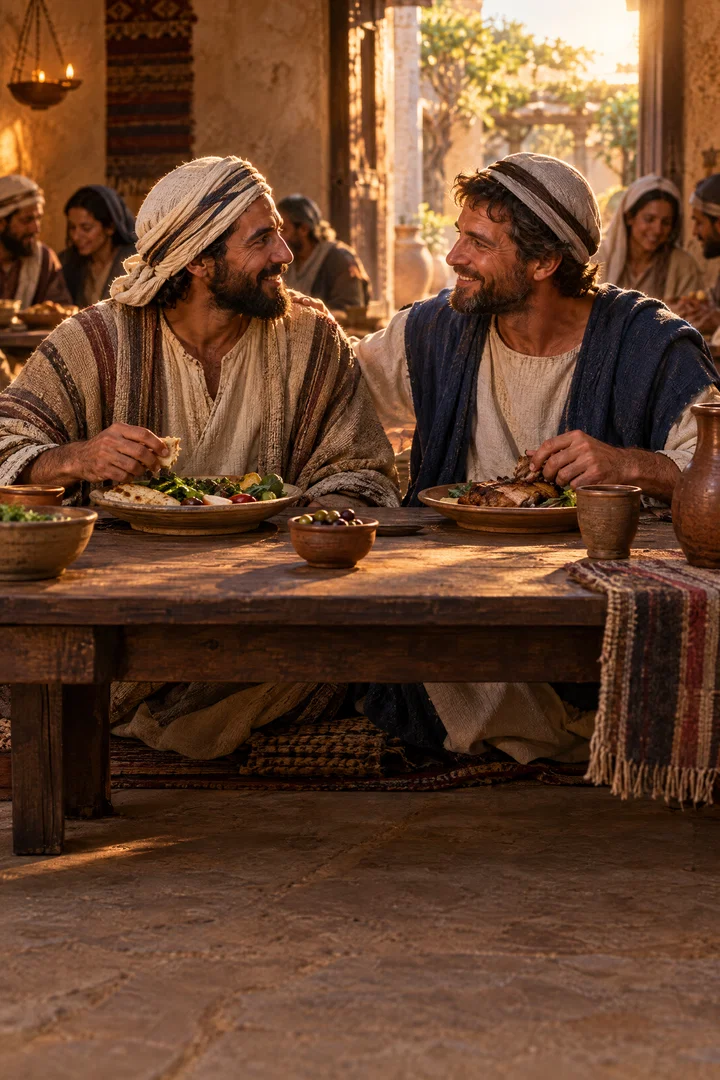
For one believeth that he may eat all things: another, who is weak, eateth herbs.
Translations
For one believes that he may eat all things: another, who is weak, eats herbs.
King James Version, KJV Cambridge Paragraph Bible, Webster Bible
For one believeth that he may eat all things: another, who is weak, eateth herbs.
Revised Version, American Standard Version
One man hath faith to eat all things: but he that is weak eateth herbs.
one doth believe that he may eat all things — and he who is weak doth eat herbs;
One man is assured that he may eat all things; but the weak eats herbs.
One, indeed, hath faith to eat all things, whereas, he that is weak, eateth herbs:
Berean Standard Bible, Majority Standard Bible
For one person has faith to eat all things, while another, who is weak, eats only vegetables.
One man has faith to eat all things, but he who is weak eats only vegetables.
One man has faith to take all things as food: another who is feeble in faith takes only green food.
One beleeueth that he may eate of all things: and another, which is weake, eateth herbes.
Douay-Rheims (Challoner revision)
For one believeth that he may eat all things: but he that is weak, let him eat herbs.
Pictures
Cross-references 20 of 21
- Colossians 2:16
Let no man therefore judge you in meat, or in drink, or in respect of an holyday, or of the new moon, or of the sabbath days:
Both address food observances and the rule against judging believers.
- Romans 14:13
Let us not therefore judge one another any more: but judge this rather, that no man put a stumblingblock or an occasion to fall in his brother’s way.
Believers must not judge one another or cause a brother to stumble.
- 1 Corinthians 8:7-13
Howbeit there is not in every man that knowledge: for some with conscience of the idol unto this hour eat it as a thing offered unto an idol; and their conscience being weak is defiled.
Food choices can wound a weak believer’s conscience and become a stumblingblock.
- Romans 14:17
For the kingdom of God is not meat and drink; but righteousness, and peace, and joy in the Holy Ghost.
God’s kingdom is not defined by eating and drinking.
- Romans 14:14
I know, and am persuaded by the Lord Jesus, that there is nothing unclean of itself: but to him that esteemeth any thing to be unclean, to him it is unclean.
Food is unclean to the person who regards it as unclean.
- 1 Timothy 4:4-5
For every creature of God is good, and nothing to be refused, if it be received with thanksgiving:
Both affirm receiving foods with thanksgiving, with God’s word and prayer sanctifying them.
- Romans 14:6
He that regardeth the day, regardeth it unto the Lord; and he that regardeth not the day, to the Lord he doth not regard it. He that eateth, eateth to the Lord, for he giveth God thanks; and he that eateth not, to the Lord he eateth not, and giveth God thanks.
Both eating and abstaining are done unto the Lord.
- 1 Corinthians 10:25-28
Whatsoever is sold in the shambles, that eat, asking no question for conscience sake:
Explains when believers may eat food without investigating its source and when they should abstain.
- Romans 15:1
We then that are strong ought to bear the infirmities of the weak, and not to please ourselves.
The strong are urged to bear with those who are weak.
- Romans 14:23
And he that doubteth is damned if he eat, because he eateth not of faith: for whatsoever is not of faith is sin.
Eating against one’s faith is condemned.
- Romans 14:21
It is good neither to eat flesh, nor to drink wine, nor any thing whereby thy brother stumbleth, or is offended, or is made weak.
Eating freely should not cause a fellow believer to stumble or become weak.
- Acts 15:28-29
For it seemed good to the Holy Ghost, and to us, to lay upon you no greater burden than these necessary things;
The Jerusalem council lists requirements for Gentile believers, including restrictions on food.
- Leviticus 11
And the LORD spake unto Moses and to Aaron, saying unto them,
God’s instructions distinguish clean from unclean animals, limiting what may be eaten.
- Romans 14:15
But if thy brother be grieved with thy meat, now walkest thou not charitably. Destroy not him with thy meat, for whom Christ died.
not causing a brother to stumble by eating
- Colossians 2:20-23
Wherefore if ye be dead with Christ from the rudiments of the world, why, as though living in the world, are ye subject to ordinances,
Warns against submitting to human food restrictions and ascetic rules.
- Exodus 34:15
Lest thou make a covenant with the inhabitants of the land, and they go a whoring after their gods, and do sacrifice unto their gods, and one call thee, and thou eat of his sacrifice;
Cited as the law behind Jewish scruples about sacrificial meat.
- 1 Corinthians 6:12
All things are lawful unto me, but all things are not expedient: all things are lawful for me, but I will not be brought under the power of any.
Another example of “all things” limited by context.
- 1 Corinthians 10:31
Whether therefore ye eat, or drink, or whatsoever ye do, do all to the glory of God.
Sets eating and drinking under the rule of glorifying God.
- Deuteronomy 14:3-21
Thou shalt not eat any abominable thing.
specific law limiting the general permission
- Genesis 9:3
Every moving thing that liveth shall be meat for you; even as the green herb have I given you all things.
same general all-things language limited to clean
Commentary
Each commentary is drawn from primary sources: the writings of Ellen G. White and Adventist pioneers and periodicals. Each commentary is separate. Its own words are not a quotation; follow the references to read the source passages.
Ellen G. White
3 sources
The verse sets out two contrasting convictions about food, with one person holding that all kinds of food may be eaten while another, called weak, eats only herbs.Lt 331, 1904, par. 11TSSW 117.2 The difference rests in bodily constitution, for not all can eat the same things, and what is palatable and wholesome to one person may be distasteful and even harmful to another.MH 319.2 This is seen in that some cannot use milk while others thrive on it, some cannot digest peas and beans while others find them wholesome, and coarser preparations of grain are good food for some while others cannot use them.MH 319.2 Diet reform therefore calls for common sense studied broadly and deeply, since no unvarying rule can regulate everyone's habits and no one person is the criterion for all.MH 319.2
Such differences are legitimate and give no ground for criticizing others.MH 319.2 They are not to cause disturbance or disunion among believers, but each is to be allowed to follow conscientious conviction even when others do not share it.Lt 331, 1904, par. 11 They call for self-control, forbearance, and sympathy, because people's experiences, duties, and judgments are not alike.TSSW 117.2
Sources
Pioneers and periodicals
72 sources
The verse contrasts one believer who feels free to eat any wholesome food including meat with another called weak who eats only herbs or vegetables.RH Apr 21, 1851RH Apr 20, 1876RH Apr 20, 1876 The weakness is weakness of faith and conscience from upbringing and limited light, seen in Jewish converts still bound to Mosaic distinctions and in scruples over meat offered to idols and over ceremonial feast days, while Gentile believers felt free, and both acted with honest regard for God.RH Apr 20, 1876RH Apr 20, 1876ST Nov 11, 1930ST Dec 30, 1913RH Apr 21, 1851 God has received both, so believers must receive one another without contempt or condemnation over such non-essentials, each answering to Christ as Master, limiting liberty in love so as not to make a brother stumble.RH Apr 20, 1876RH Apr 20, 1876ST Nov 11, 1930ST Aug 20, 1896 The dispute concerns ceremonial meats, drinks and typical days that pointed to Christ, not the moral law, the seventh-day Sabbath or the fourth commandment, which remain binding and unchanged.RH Apr 21, 1851RH Feb 14, 1856RH Mar 11, 1862ST Sep 16, 1875ST Mar 25, 1875 It lays down no rule for or against vegetarianism and makes diet no test of religion, but requires each to be fully persuaded, to live by the light received without violating conscience, and to choose food that glorifies God and preserves health, while some held all things to mean only clean foods and others held the clean and unclean distinction to have ceased.ST Aug 11, 1909ST Apr 11, 1906RH Sep 15, 1910ST May 21, 1902ST Feb 22, 1883
Wording and Historical Setting
The verse sets two believers side by side, one convinced he may eat all things and another called weak who eats only herbs or vegetables.RH Apr 21, 1851ST Jul 12, 1910ST Aug 20, 1896 It describes differing practice within the same fellowship, with some counting all foods permissible and others abstaining from meat altogether, yet sharing the same salvation through Christ.ST Jul 12, 1910ST Aug 11, 1909ST Aug 20, 1896ST Feb 6, 1896 The eating belongs with the chapter's wider discussion of food and feast days kept by some, not with God's commandments or the seventh-day Sabbath.RH Apr 21, 1851ST Dec 8, 1881ST Dec 8, 1881RH May 5, 1851 These are non-essential differences that give no ground for contempt or condemnation, though those who feel free must take care not to set an example that makes another stumble.ST Jul 12, 1910ST Aug 11, 1909ST Aug 20, 1896
The freer side was Gentile Christians who held that any wholesome, nourishing food including meat could be eaten, while the other side was Jewish converts who feared defilement and ate only herbs or vegetables.RH Apr 20, 1876RH Apr 20, 1876RH Apr 21, 1851RH May 23, 1854ST Oct 19, 1888 Their abstinence came from early training and lingering attachment to Mosaic distinctions about food, with reverence and uncertainty about how former observances were fulfilled, and Jewish converts were inclined to bind Gentile converts to their peculiar customs.RH Apr 20, 1876RH Apr 20, 1876RH Apr 21, 1851ST Apr 1, 1889ST Oct 19, 1888 The food choices were to be left without judging or burdening one another with requirements the gospel does not impose.RH Apr 20, 1876RH Apr 20, 1876RH May 23, 1854 That direct division over feast days and eating as it then existed does not now exist in the same form.RH Apr 21, 1851
Weak denotes weakness in faith and conscience through scrupulousness, background, limited light, and different education, not bodily or mental weakness, worthlessness, or proof of unsound faith.RH Apr 20, 1876RH Apr 20, 1876ST Nov 11, 1930ST Feb 20, 1907ST Nov 24, 1909 Both acted with honest regard for God, and God received them.RH Apr 20, 1876RH Apr 20, 1876ST Apr 1, 1889 The strong understood liberty more broadly, while the weak were unsure whether former observances still mattered, and each was to live according to the light received without violating conviction.ST Nov 11, 1930ST Apr 1, 1889ST Feb 20, 1907 Greater knowledge calls for charity that lets conscience develop under the Holy Spirit rather than for criticism or exclusion from fellowship.ST Nov 11, 1930ST Feb 20, 1907ST Nov 24, 1909
One concrete matter was meat and other food offered to idols, since all kinds of food including fruits and grains as well as flesh could be so dedicated.ST Dec 30, 1913ST Sep 30, 1886ST Feb 22, 1883ST Jul 29, 1897ST Feb 4, 1903 The scrupulous ate only herbs to avoid such food, lest eating seem to honor the idol or draw converts back toward idolatry, while others ate without questioning whether food had been offered.ST Dec 30, 1913ST Sep 30, 1886ST Feb 22, 1883ST Jul 29, 1897 An idol has no real power, so dedication does not change the food itself.ST Sep 30, 1886 Eating or abstaining was still to be governed by love that refuses to defile a weak conscience, cause stumbling, or appear to endorse worship, a duty especially urgent for those only recently come out of heathen idolatry.ST Sep 30, 1886ST Feb 22, 1883ST Jul 29, 1897ST Feb 4, 1903
Another concrete matter was ceremonial foods such as bitter herbs eaten with the unleavened bread of the Passover and foods connected with yearly feasts, fasts, new moons, and convocation sabbaths that some continued to observe.ST Apr 1, 1889RH Aug 28, 1853ST Jul 23, 1896RH Oct 7, 1851 Some kept those days while others counted them like other days, and whether one ate or did not eat was not to be judged.RH Aug 28, 1853ST Jul 23, 1896 The holy days and sabbath days in view were Jewish feast days, new moons, and convocation sabbaths classed with meat offerings, sacrifices, and drink offerings of the law of Moses that ceased at the cross, as taught also in Colossians 2:14-17.RH May 5, 1851 The weekly Sabbath comes every seventh day from Creation for the whole race to commemorate God's rest and stands forever with the moral precepts, while the convocation sabbaths were given at Sinai about 2500 years later, fall irregularly with sometimes nine days or four days between them, and originated and ended with the offerings with which they are classed.RH May 5, 1851
All things is limited by context to edible, nourishing things of the kinds and classes God permits as food, including clean beasts set apart by God's word, not literally everything without exception and not filth or creatures unfit for food.ST Dec 8, 1881ST Dec 8, 1881ST Feb 13, 1896ST May 24, 1905 General expressions are limited by specific declarations, so unclean flesh remains excluded.ST Feb 13, 1896 Herbs means cultivated plants and vegetables.ST Feb 6, 1896 The Gospel purifies people, not beasts and reptiles, and eating or avoiding food does not earn salvation.
The whole dispute concerns ceremonial and external observances, meats, drinks, carnal ordinances, and feast days of the Jewish ritual that found their antitype in Christ, not moral commandments or the Sabbath commandment.RH Feb 14, 1856ST Sep 16, 1875ST Mar 25, 1875RH Aug 5, 1852RH Mar 29, 1864 It belongs with the change from that connected ritual system with its yearly sabbaths to spiritual worship, and observing or not observing those meats and days is a matter of indifference so long as they are not used to seek justification apart from the Saviour's sacrifice.RH Feb 14, 1856ST Sep 16, 1875RH Mar 29, 1864 God never spoke with His own voice about those meats and drinks nor wrote them on the tables of stone where the rest-day commandment was engraved, and the Sabbath belongs to an entirely different system to which the chapter makes no reference.RH Mar 29, 1864
Receiving One Another Without Judging
God has received both the one who eats all things and the one who is weak and eats only herbs, so believers must receive the weak without judging his thoughts and must not despise or condemn one another over food and related observances.RH Apr 20, 1876RH Apr 20, 1876ST Aug 20, 1896RH May 9, 1854ST Aug 20, 1896 The difference belongs inside the church among those who acknowledge God as Lord, with both sides acting from honest regard for God, and the abstention reflects lingering scruple from early training rather than proof of unsound faith.RH Apr 20, 1876RH Apr 20, 1876ST Aug 20, 1896 The herb-eating included Jewish converts still partaking of old feasts such as Passover with its bitter herbs and still observing yearly feasts, fasts and sabbaths, while others saw no obligation in those ceremonial days and counted them like other days, yet whether one eats or does not eat is not to be judged.RH May 9, 1854ST Jul 23, 1896 Such differences are non-essentials and matters of indifference for salvation and church fellowship when they are not used to seek justification apart from Christ.ST Jul 12, 1910ST Sep 16, 1875RH Mar 29, 1864ST Jan 2, 1907RH Sep 24, 1872 The mere doing or not doing of a particular food or day is not salvation, which is righteousness and peace and joy in the Holy Spirit through Christ, and teaching a better way is allowed but condemning a fellow believer is not.ST Jan 2, 1907ST Feb 6, 1896 Observing or not observing those meats and days connected with meats, drinks, carnal ordinances and feast days is indifferent so long as people do not seek justification through them and thereby reject the Saviour's sacrifice.ST Sep 16, 1875RH Mar 29, 1864
Each servant answers to his own Master and will stand before Christ's judgment seat to be judged by God's law.ST Jul 12, 1910ST Aug 11, 1909ST Aug 20, 1896ST Feb 6, 1896 Each is responsible to God alone, so neither should pride himself in his virtue nor condemn his brother, and the church has no authority to settle questions of liberty not expressly forbidden in Scripture or to impose petty rules.ST Dec 30, 1913ST Feb 6, 1896 The one who eats is nearer right but must not look with contempt on his brother or set an example that makes him stumble, and the one who eats herbs must not judge the other.RH Aug 11, 1904ST Aug 11, 1909ST Feb 20, 1907ST Feb 6, 1896 The true servant eats and drinks to God's glory, follows peace, limits liberty in love, treats the less informed with charity, allows conscience to develop under the Holy Spirit's guidance, and takes special care toward recent converts from idolatry.ST Nov 11, 1930ST Feb 20, 1907ST Feb 6, 1896 Paul met the trials of his day with forbearance rather than at once removing every clung-to error, becoming all things to all men that by all means he might save some and even having Timothy circumcised for better access to the Jews, while holding that circumcision is nothing and uncircumcision is nothing but keeping the commandments of God is something.RH Apr 21, 1851 That direct feast-day and eating division as it then existed does not now exist in the same form.RH Apr 21, 1851
In matters where others have a right to differ, believers must lay aside stubborn self-will, prejudice and pride.ST Feb 6, 1896 They must receive one another without judging such differences when they concern non-essentials, understanding that the verse does not establish that either person is right merely because others must not judge him and does not excuse following appetite into sin or disobeying God's instructions.ST Feb 11, 1913ST Nov 24, 1909ST May 17, 1910 They may teach a better way without condemning, live according to the light received, and accept such differences as permitted trials of forbearance and submission needed for fitness for the kingdom.ST Nov 11, 1930ST Jan 2, 1907
Sabbath and Law Unchanged
Romans 14 treats differences over food and the feast days connected with food, not the commandments of God or the seventh-day Sabbath of the fourth commandment, and to apply it to the Sabbath contradicts Paul's affirmation of the law's perpetuity in the same epistle.RH Apr 21, 1851RH Feb 14, 1856RH Mar 11, 1862RH Aug 5, 1852 The contrast between believing one may eat all things and eating only herbs belongs to disputes about meats, drinks, and ceremonial practices, with Jewish converts allowed to continue them according to conscience while receiving greater light and others who understood the gospel no longer required them also accepted.RH Feb 14, 1856RH Aug 5, 1852ST Jul 29, 1880 The distinction is about food, not the Sabbath, and identifies those disputes as matters of ceremonial regulation rather than the moral law or Sabbath commandment.RH Mar 11, 1862RH Aug 5, 1852ST Jul 29, 1880
The verse does not mention the Sabbath and gives no plain testimony that the Sabbath law has been abolished, so any use of Romans 14 to set it aside is mere inference.RH Aug 11, 1853RH Aug 13, 1857RH Dec 20, 1853RH Mar 21, 1854RH Dec 27, 1853 Christ and the apostles taught and enforced the commandments of God as standing on their original basis and never removed one of them.RH Aug 11, 1853 Inference carries no weight against law given by God in the plainest language, which can only be set aside by testimony as positive and plain and coming from as high authority, and the verse does not mention the Lord's Sabbath or plainly teach its abolition.RH Aug 11, 1853RH Dec 20, 1853RH Mar 21, 1854RH Apr 11, 1854
The days in view are only the days connected with the meats, drinks, carnal ordinances, feast days, fast days, new moons, and yearly sabbaths of the Jewish ritual system, which were shadows of things to come and ceased with the typical service.RH Mar 29, 1864RH Aug 19, 1851RH Mar 24, 1874 Observing or not observing those meats and days is a matter of indifference so long as people do not seek justification through them and thereby reject the sacrifice of the Saviour, and God never uttered anything with His own voice about those meats and drinks nor wrote anything about them on the tables of stone where He engraved the rest-day commandment.RH Mar 29, 1864RH Aug 19, 1851 The weekly Sabbath belongs to an entirely different system to which the chapter makes no reference whatever, coming every seventh day from Creation before the fall for the entire human race to commemorate God's rest after creating the world in six days and standing forever binding with the nine moral precepts, while the convocation sabbaths were given at Mount Sinai about 2500 years later, fall irregularly with sometimes nine days or four days between them, are of the same nature as the offerings with which they are classed, and had their origin and end with them.RH Mar 29, 1864RH May 5, 1851 The purpose is mutual forbearance between Gentiles and Jews over rituals that find their antitype in Jesus, dissuading over-zealous Jews from forcing ceremonies on Gentile worshippers and dissuading both from trifling with each other's prejudices so that all is done unto edifying, leaving the weekly Sabbath standing by itself on its foundation and as the type of the millennial rest that remains for the people of God.RH Aug 19, 1851RH Aug 19, 1851
The chapter does not overturn the Sabbath's perpetuity, abolish the moral law, make every day alike in holiness, make the Sabbath optional or a matter of indifference, or permit treating Sabbath-keeping as weakness.ST Mar 25, 1875ST Jul 29, 1880RH Aug 4, 1868RH Jun 24, 1852 The Ten Commandments remain binding and are established through faith, and liberty over days concerns only days placed in man's keeping such as the six working days, while the expression every day does not include the Lord's holy Sabbath.ST Jul 23, 1896RH Jun 24, 1852RH Sep 24, 1872 The herb-eating belongs to Jewish converts still partaking of old feasts such as the Passover with its bitter herbs and still observing various yearly feasts, fasts, and sabbaths, while others seeing no obligation in these ceremonial days count them like all other days, and whether one eats or does not eat is not to be judged.RH Aug 4, 1868ST Jul 23, 1896
The same teaching appears in Colossians 2:14-17 about meat and drink and holy days that ceased at the cross, namely the meat-offerings, sacrifices and drink-offerings of the law of Moses and the Jewish feast-days, new moons and convocation sabbaths placed in the midst of the Jewish ordinances, not the Sabbath of the Lord placed in the midst of the Ten Commandments.RH Aug 28, 1853RH May 5, 1851 Paul was talking about Jewish feast-days on which certain meats were eaten with bitter herbs, which were not essential to salvation any more than circumcision, so some observed them while others did not without judging each other, and the chapter gives no permission to disregard the seventh-day Sabbath.RH Aug 28, 1853RH Jan 13, 1852 The fact that disagreement about days is discussed alongside food does not identify the day as the Sabbath or prove that some ate nothing, and if more than feast-days were meant it would equally prove that some people in those days did not eat at all, since those who ate were not to judge those who ate not; those who use Galatians 4:10 to say Paul regarded Sabbath-keeping as dangerous contradict their own use of Romans 14.RH Aug 28, 1853RH Jan 13, 1852
Those who held a different position taught that every person is left free to choose for himself whether to eat only vegetables or to eat flesh meat as well, and whether to keep the Sabbath or not, treating the Sabbath as a Jewish institution each may keep or let alone as he sees fit.ST May 21, 1902RH Nov 8, 1853 In that teaching no man is his judge and God will not compel obedience, each must be fully persuaded in his own mind because to practice Sabbath-keeping or diet while doubting is service from fear, not service to God from choice and love, and Romans 14 does not tell what a man should do morally but what he should not do, namely judge his neighbor.ST May 21, 1902 Freedom of choice in that view does not remove consequences, since the one who chooses to disobey God's Word will reap the wages of sin, which is death, and the one who feeds on what is unwholesome will reap disease, so for his own soul's sake each should choose in harmony with God's Word that he may possess righteousness and peace and joy in the Holy Ghost, for God's Word will judge him in the last day; in this same context the choice to eat all things and the choice to eat only herbs was associated with bearing patiently with Jewish converts who continued to observe the seventh day along with other Jewish celebrations.ST May 21, 1902RH Apr 1, 1873
Conscience Diet and Practice
Romans 14:2 establishes no rule for or against vegetarianism and does not by itself tell what a person should eat morally, but describes differing convictions among believers and forbids judging over them.ST Aug 11, 1909ST Apr 11, 1906ST May 21, 1902 Some eat freely while others, described as weak in faith, eat only herbs, and these differences are not grounds for judging one another since each person is accountable to God.ST Aug 11, 1909ST Apr 11, 1906ST May 21, 1902 God has received both, so believers must avoid setting examples that lead weaker brethren to stumble.ST Aug 11, 1909ST Apr 11, 1906 Freedom of choice does not remove consequences, and the chapter tells what should not be done, namely judging a neighbor, rather than compelling obedience.ST May 21, 1902
Each must be fully persuaded in his own mind and live according to the light received, with those of greater knowledge treating the less informed with charity.ST Feb 20, 1907ST May 21, 1902ST Aug 10, 1915 A person who believes some food is unclean should not violate that conviction, while believers must not judge or condemn one another over the matter since each answers to God.ST Feb 20, 1907ST May 21, 1902 To practice diet or observance while doubting is service from fear rather than service to God from choice and love.ST May 21, 1902 The one who chooses to disobey God's word will reap death as the wages of sin, and the one who feeds on what is unwholesome will reap disease, so for his own soul's sake each should choose in harmony with God's word that he may possess righteousness and peace and joy in the Holy Spirit, for God's word will judge him in the last day.ST May 21, 1902 Dietary choices are not a basis for righteousness or a burden to impose on others, and Christians should choose food wisely and eat to God's glory rather than making petty rules.ST Aug 10, 1915
All things means only things of the kinds and classes permitted by God as food, not literally everything or filth or creatures unfit for food, and general expressions are limited by specific declarations.ST Feb 13, 1896 The clean beasts set apart or permitted under direction of God's word as food for man are meant, and unclean flesh remains excluded, with the duty to heed God's teaching about clean and unclean foods remaining.ST Feb 13, 1896ST Jul 29, 1913 The gospel purifies people, not beasts and reptiles, and eating or avoiding food does not earn salvation, since people are saved by faith through Christ and not by eating and drinking.ST Jul 29, 1913 The counsel about food offered to idols is meant to prevent harm, including drawing converts back toward idolatry or causing a weak brother to stumble.ST Feb 22, 1883 Those who held the opposite position taught that the distinction between clean and unclean meats recognized under the Mosaic and sanctuary system no longer holds.RH May 25, 1876RH Jan 20, 1853
Applied to meat eating, a person who has carefully considered the matter and conscientiously chooses a mixed diet should not be persecuted or judged for that choice, because the decision is between that person and God and each must act according to personal conviction.RH Oct 6, 1904 Whether to eat flesh meat or to eat only herbs must be decided by individual conscience, and Christians must not condemn one another over eating meat or abstaining from it.RH Oct 6, 1904 Though the original diet and the manna diet did not include flesh, good people in all ages and Jesus Himself ate flesh when it was the best food to glorify God. Much flesh food now corrupts the body, dulls spiritual responsiveness, and excites appetite for stimulation, so it is Christian duty to seek purer food that makes the natural man more spiritual and less subject to appetite, and thousands have found a vegetarian diet sufficient, yet there are times and places where flesh is the best obtainable food, and each should seek as to himself to glorify God in what he eats and drinks.
Diet is not a test of religion, and differences over food should not become grounds for quarrels, criticism, judging, or censuring fellow believers.RH Sep 15, 1910RH May 7, 1914 Each person should conscientiously choose a way of eating that supports health and useful service, while respecting the light and guidance received and applying health principles to oneself with brotherly love and Christian charity toward those who differ.RH Sep 15, 1910RH May 7, 1914 No single diet rule suits everyone, because food that is wholesome for one person may harm another.RH Jan 19, 1905 The difference concerns faith and conscience, not bodily or mental strength or worth, for the one who eats all things has freedom the other does not feel able to exercise, and the one called weak is weak in faith and follows a stricter diet because of scruples.ST Mar 10, 1909 Vegetarianism itself does not make a person weak, since physical weakness may result from harm done by an earlier mixed diet, and some who adopt vegetarianism improve in health.ST Mar 10, 1909
The same forbearance governs doubtful inferences such as raising swine for sale, where Scripture gives no direct command, leaving the question to each person's conscience to be fully persuaded in his own mind with no one bound where no command is given.RH Feb 13, 1872RH Aug 6, 1872 Jewish Christians were uncertain about food because God had formerly forbidden certain meats, while the new dispensation suggested that only observances enjoined or recognized under it were required, so the verse concerns differing views about food, not a settled command, and leaves such questions open to individual choice.RH Aug 6, 1872 Applied to Sabbath observance at home, the principles call for teaching the truth and winning the child's heart rather than forcing outward observance, while showing consideration for family members who would be disturbed by the child's conduct.RH Mar 27, 1900 Differences in religious practice are matters of faith for which each is accountable to God, not matters for worldly governments to control, and Christians should respect one another and refrain from interfering with fellow believers who observe the seventh day rather than the first.ST Mar 19, 1894 Instruction for withdrawing from every brother that walks disorderly is addressed to the church, with no fixed rule for every case, seeking God for wisdom and pursuing a course that witnesses for God and wins the sinning soul if possible.ST Oct 12, 1904
Sources