1 Corinthians 8:12
But when ye sin so against the brethren, and wound their weak conscience, ye sin against Christ.
Translations
But when you sin so against the brothers, and wound their weak conscience, you sin against Christ.
King James Version, KJV Cambridge Paragraph Bible
But when ye sin so against the brethren, and wound their weak conscience, ye sin against Christ.
But when ye thus sin against the brethren, and wound their weak conscience, ye sin against Christ.
Revised Version, American Standard Version
And thus, sinning against the brethren, and wounding their conscience when it is weak, ye sin against Christ.
and thus sinning in regard to the brethren, and smiting their weak conscience — in regard to Christ ye sin;
Now, thus sinning against the brethren, and wounding their weak conscience, ye sin against Christ.
But, in thus sinning against the brethren am wounding their conscience, seeing it is weak, against Christ, are ye sinning.
Berean Standard Bible, Majority Standard Bible
By sinning against your brothers in this way and wounding their weak conscience, you sin against Christ.
Thus, sinning against the brothers, and wounding their conscience when it is weak, you sin against Christ.
And in this way, doing evil to the brothers, and causing trouble to those whose faith is feeble, you are sinning against Christ.
Nowe when ye sinne so against the brethren, and wound their weake conscience, ye sinne against Christ.
Douay-Rheims (Challoner revision)
Now when you sin thus against the brethren, and wound their weak conscience, you sin against Christ.
Pictures
Cross-references 20 of 22
- Romans 14:21
It is good neither to eat flesh, nor to drink wine, nor any thing whereby thy brother stumbleth, or is offended, or is made weak.
It teaches giving up a liberty rather than causing a brother to stumble.
- Romans 14:7
For none of us liveth to himself, and no man dieth to himself.
Believers’ lives are not lived for themselves alone.
- Romans 14:19
Let us therefore follow after the things which make for peace, and things wherewith one may edify another.
Believers should pursue peace and build one another up.
- Romans 14:15
But if thy brother be grieved with thy meat, now walkest thou not charitably. Destroy not him with thy meat, for whom Christ died.
Food choices that grieve a fellow believer are uncharitable toward one for whom Christ died.
- 1 Corinthians 10:25
Whatsoever is sold in the shambles, that eat, asking no question for conscience sake:
Market food may be eaten without inquiry, except where another’s conscience is at stake.
- Romans 15:1
We then that are strong ought to bear the infirmities of the weak, and not to please ourselves.
The strong must bear the weak’s infirmities rather than please themselves.
- 1 Corinthians 8:7
Howbeit there is not in every man that knowledge: for some with conscience of the idol unto this hour eat it as a thing offered unto an idol; and their conscience being weak is defiled.
Both describe a weak conscience shadowed by former idolatry.
- 1 Corinthians 8:4
As concerning therefore the eating of those things that are offered in sacrifice unto idols, we know that an idol is nothing in the world, and that there is none other God but one.
An idol is nothing, so food offered to idols is not inherently affected.
- Romans 14:13
Let us not therefore judge one another any more: but judge this rather, that no man put a stumblingblock or an occasion to fall in his brother’s way.
Both forbid putting an occasion to fall before a brother.
- Romans 14:14
I know, and am persuaded by the Lord Jesus, that there is nothing unclean of itself: but to him that esteemeth any thing to be unclean, to him it is unclean.
Both address food-related conduct and its effect on conscience.
- Romans 14:2-3
For one believeth that he may eat all things: another, who is weak, eateth herbs.
Placed alongside 1 Corinthians 8 as addressing food offered to idols and a believer’s freedom to abstain.
- 1 Corinthians 8:1
Now as touching things offered unto idols, we know that we all have knowledge. Knowledge puffeth up, but charity edifieth.
Puffed-up knowledge is contrasted with caring love.
- Matthew 18:6
But whoso shall offend one of these little ones which believe in me, it were better for him that a millstone were hanged about his neck, and that he were drowned in the depth of the sea.
Both warn against harming or discouraging a fellow believer.
- Romans 14:22
Hast thou faith? have it to thyself before God. Happy is he that condemneth not himself in that thing which he alloweth.
Both warn against acting in ways that condemn conscience.
- Acts 15:29
That ye abstain from meats offered to idols, and from blood, and from things strangled, and from fornication: from which if ye keep yourselves, ye shall do well. Fare ye well.
The decree calls believers to abstain from practices that could harm others.
- 1 Corinthians 10:27-28
If any of them that believe not bid you to a feast, and ye be disposed to go; whatsoever is set before you, eat, asking no question for conscience sake.
Food may be eaten freely, but concern for another’s conscience calls for abstaining.
- 1 Corinthians 8:8
But meat commendeth us not to God: for neither, if we eat, are we the better; neither, if we eat not, are we the worse.
Eating or abstaining does not commend believers to God.
- 1 Corinthians 10:32
Give none offence, neither to the Jews, nor to the Gentiles, nor to the church of God:
Both texts warn against offending others through one’s actions.
- Hebrews 12:13
And make straight paths for your feet, lest that which is lame be turned out of the way; but let it rather be healed.
crooked paths turning weak feet aside
- Titus 1:15
Unto the pure all things are pure: but unto them that are defiled and unbelieving is nothing pure; but even their mind and conscience is defiled.
gives defiled conscience in contrast
Commentary
Each commentary is drawn from primary sources: the writings of Ellen G. White and Adventist pioneers and periodicals. Each commentary is separate. Its own words are not a quotation; follow the references to read the source passages.
Ellen G. White
4 sources
To sin against fellow believers and wound their weak conscience is to sin against Christ himself.AA 316.2–317.1Ms 40, 1896, par. 11IRCUP 34.2Ms 3, 1862, par. 16–21 It is sin against Christ because Christ died for that weak brother.Ms 40, 1896, par. 11 To speak evil of a brother and to dishonor him is to wound Christ in the person of His saints.IRCUP 34.2
The verse requires weighing how words and deeds affect others, and refusing even actions that are in themselves innocent if they appear to support idolatry or offend the scruples of those who are weak in faith.AA 316.2–317.1 Careless use of liberty in words, spirit, and character must be guarded at every point against temptation by watching words and the spirit that prompts them and by standing sentinel over defective attributes, so that no liberty taken becomes a stumbling block and no crooked paths are made that turn a weak brother's feet out of the way of life.Ms 40, 1896, par. 11 Unjust censure that wounds brethren and lays obstacles in the way of discouraged ones who are striving to do right also sins against Christ.Ms 3, 1862, par. 16–21
Inconsistent, unwise moves and speaking fragments of truth that are not of vital importance anywhere and everywhere in an unacceptable manner misrepresents the faith and makes it disgusting to unbelievers, injures those outside, wounds the cause of God, and lets souls stumble to destruction.Ms 3, 1862, par. 16–21 The tongue, though a little member, does a weight of mischief by sowing seeds of bitterness and putting suspicious thoughts in minds, becoming a plague spot and rock of offense that wrecks souls.Ms 40, 1896, par. 11 A day is coming when every case will be revealed and the cause of offense will be seen, and many who are eternally lost will in despair look with reproach upon those who led them astray.Ms 40, 1896, par. 11 Such wrongs must be taken back, faults humbly confessed, and a new beginning made.Ms 3, 1862, par. 16–21
Sources
Pioneers and periodicals
53 sources
The verse speaks of a well-taught believer openly eating food known to have been offered to an idol while a brother only lately out of idolatry and still fearful of it is emboldened by the example to eat against his own conscience, so that his conscience is defiled and wounded and he is led toward ruin though Christ died for him.ST Feb 4, 1903ST Feb 4, 1903 The food itself is not changed by being dedicated to an idol, for an idol is nothing in the world and has no power over it, so eating is not in itself sinful or unclean to one who knows this.ST Sep 30, 1886ST Oct 16, 1893 To use liberty in that way so as to wound a fellow believer's weak conscience and draw him into sin is sin against the brother and in that same act sin against Christ.ST Oct 16, 1893ST Jul 29, 1897 What settles right and wrong here is not mere knowledge of what is harmless to oneself but love that refuses to endanger another's salvation, even giving up lawful food forever rather than cause a brother to stumble.ST Feb 4, 1903ST Dec 22, 1887ST Dec 18, 1893ST Jul 29, 1897ST Feb 4, 1903 Conduct carries responsibility for its influence, for the stronger may escape unharmed while the weaker, assured by the example that there is no danger, is emboldened to violate conscience, weakened in character, and led on toward further wrong and destruction.ST Jul 29, 1897ST Oct 21, 1880RH Feb 13, 1866RH Jul 8, 1875ST Dec 29, 1909
Words And Original Setting
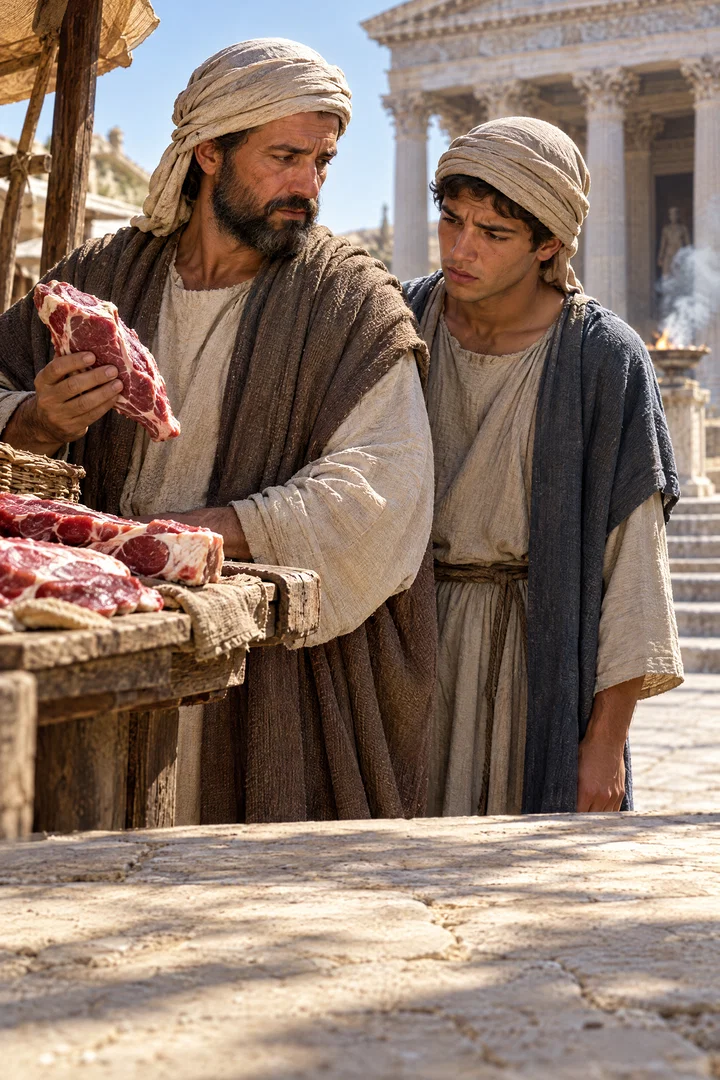
The scene is a person with knowledge sitting at a meal inside an idol's temple and eating food known to have been sacrificed to idols, while a weak brother who has come out of heathen idolatry only a short time before and is still accustomed to the idol watches the example and is emboldened to eat against his own conscience, so that his conscience is defiled and wounded and he falls even though Christ died for him.ST Feb 4, 1903ST Feb 4, 1903
Food dedicated to an idol is not changed by the dedication, for an idol is nothing in the world and has no power over the food, so eating it is not sinful or unclean in itself to one who knows this.ST Sep 30, 1886ST Oct 16, 1893ST Mar 19, 1894 The question at issue is food offered to idols, not whether pork may be eaten.ST Sep 30, 1886 Eating may be lawful yet unwise when a weaker believer regards the food as unclean, and the wrong lies not in the food itself but in the influence of the act when the weaker believer takes it as permission to honor idols or to do what he regards as sinful.ST Oct 16, 1893
A weak conscience is the tender conviction that eating meat offered to idols is acknowledging the idol.ST Mar 27, 1884 It belongs to one still beset by former superstition and a history of idolatry, who fears to eat even what God has given for food lest eating make him an idolater.ST Mar 27, 1884ST Feb 4, 1903ST Mar 19, 1894 One who knows the food is unchanged by offering to idols may eat with no trouble of conscience, but one with this weak conscience sees the example and eats while his conscience is against it.ST Feb 4, 1903
A weak conscience is also a vacillating conscience that results when its voice is heeded only part of the time and neglected part of the time, instead of being kept acute, tender, and responsive by always heeding it.ST Sep 3, 1896 Though conscience is a good gift from God, it may thus be perverted and become weak.ST Sep 3, 1896 The weaker brethren include those trained in punctilious observance of Jewish law who view such eating as idolatry.RH Jul 16, 1901 Idol means the representation of a false god, the shaping of a human conception of the Deity, coming from eidolon meaning an image, and idol-worship means the worship of sense, what is seen and felt and heard.ST Dec 11, 1901
Sin Against Christ
Using liberty in a way that wounds a fellow believer's weak conscience and leads that person to sin is sin against the brethren and in that same act sin against Christ, not merely a wrong against the person.ST Oct 16, 1893ST Jul 29, 1897ST Nov 15, 1910ST Jul 29, 1897ST Jul 29, 1897 Causing a fellow Christian with a weak conscience to stumble, as through eating meat offered to idols, is sin against Christ, and abstaining rather than harming another believer is regard for Christ.ST Oct 16, 1893ST Jul 29, 1897ST Jul 29, 1897 Careless use of Christian liberty that wounds weak conscience through conduct is therefore sinning against that believer and against Christ.ST Oct 16, 1893ST Jul 29, 1897ST Nov 15, 1910ST Jul 29, 1897 Even knowledge that idols are nothing must not be used in a way that endangers another's salvation, for love requires care for those whose consciences remain weak.ST Jul 29, 1897ST Jul 29, 1897
To embolden a brother to eat while his conscience is against it breaks over conscience, weakens conscience and Christian character, and puts him in danger of ultimate fall and destruction, endangering one for whom Christ gave his life.ST Jul 29, 1897ST Feb 4, 1903ST Dec 29, 1909 One who knows food is unchanged by offering to idols may eat with no trouble of conscience, but one with a weak conscience still beset by former superstition sees the example and eats while conscience condemns it.ST Jul 29, 1897ST Feb 4, 1903 A conscience made to yield against what it regards as right may be hardened and led into further wrong, so knowing that an idol is nothing does not excuse conduct that harms another.ST Jul 29, 1897ST Feb 4, 1903 Pressuring someone to act against what is believed right can harm even over food not inherently unclean, and love calls for self-denial rather than freedom that wounds or misleads.ST Jul 29, 1897ST Feb 4, 1903ST Dec 29, 1909
The better-instructed Christian is largely responsible for the result, because conduct carries responsibility for its influence.ST Oct 21, 1880ST Feb 4, 1903RH Jul 8, 1875RH Feb 6, 1908 The stronger person may escape temptation while the weaker falls because the example suggested there was no danger.ST Oct 21, 1880RH Feb 13, 1866RH Jul 8, 1875 Such example can encourage another to begin a harmful practice and become enslaved to it, as when public drinking led one who had never drunk to try wine and awakened an enslaving appetite that ruined his home.ST Oct 21, 1880RH Jul 8, 1875 Even an error may poison a weak mind and cause serious harm, so believers must guard others from harm and avoid encouraging or patronizing demoralizing practices that tempt toward ruin.RH Jul 8, 1875RH Feb 6, 1908 Encouraging youth to begin drinking carries responsibility even when the example-setter drinks moderately and never becomes drunk.ST Oct 21, 1880RH Feb 6, 1908
Sin against another person is also against God because all sin breaks God's law, and it must be confessed to both.ST Nov 22, 1910 A person's forgiveness does not determine whether God forgives, for God may forgive even when the injured person does not, while a person may forgive on words even when God does not, because God weighs motives.ST Nov 22, 1910 Care must be taken not to offend the conscience of weak brethren, since no one knows who may be weak, and no knowing overt act should place a stumbling-block in a brother's way.ST Sep 3, 1896 The verse forbids wounding another's conscience, yet it does not authorize regulating another's conscience or demanding that he live according to one's own conscience, for forcing conscience has shed rivers of blood that wound the Son of God himself.ST Sep 3, 1896
Love Restraining Liberty
Right and wrong in eating meat offered to idols is not settled by knowledge alone but by love that refuses to harm another.ST Dec 18, 1893ST Jul 29, 1897ST Feb 4, 1903 Even correct knowledge that idols are nothing must not be used in a way that endangers another's salvation.ST Jul 29, 1897ST Feb 4, 1903 Knowledge that a thing is harmless to oneself is not sufficient, for greater consideration must be given to influence and its results than to satisfying desire.ST Feb 4, 1903
The verse teaches Christian self-control and self-denial rather than personal innocence alone.ST Feb 4, 1903ST Mar 27, 1884 Liberty must be watched lest it become a stumbling-block to the weak, so that even lawful meat is given up forever rather than cause a brother to stumble, and the things which make for peace are followed.ST Feb 4, 1903ST Dec 22, 1887ST Mar 18, 1903ST Jun 10, 1913 Conscience is to be kept void of offense toward others, and disputed ground that causes contention is to be refused, with no injurious influence exerted over brethren.ST Mar 27, 1884 A personal right, even freedom to eat meat, is to be surrendered when exercising it would offend or harm another or cause a weaker believer to fall.ST Dec 22, 1887ST Jun 10, 1913
Personal freedom must be limited by concern for another's spiritual welfare.ST Apr 22, 1889ST Jan 17, 1906ST Oct 16, 1893RH Feb 7, 1907 Even if an action does no harm to the doer, its example may lead someone else into harmful practice, so no one lives to himself and each is responsible for the influence of example.ST Jan 17, 1906ST Oct 16, 1893 Food offered to an idol remains ordinary food and eating it is not sinful in itself, but the sin lies in the influence of the act when a weaker believer takes it as permission to honor idols or to do something sinful.ST Oct 16, 1893 For this reason a permissible gratification is given up for the sake of one whose conscience is weak rather than personal freedom insisted on, as in taking part in or appearing to approve gambling and alcohol which can sustain habits that injure others.ST Apr 22, 1889ST Jan 17, 1906RH Feb 7, 1907
Abstinence out of regard for weaker brethren trained in punctilious observance of Jewish law who view such eating as idolatry was a question of expediency not of right.RH Jul 16, 1901 It was a local and temporary accommodation to conscientious scruples, of the same kind as circumcising on one occasion after rejecting circumcision as binding and as commanding women to keep silence in the churches.RH Jul 16, 1901 Such abstinence and setting a good example by giving up customs that offend others does not of itself work salvation.ST May 28, 1902 Yet it is essential to harmony with the will of God, spirituality in the church, and religious and social harmony, with the things avoided being prominent Gentile customs to which weak converts incline and by which they may be overcome, customs repugnant to righteousness, making it worthwhile to concede something to Jewish prejudice merely for harmony.ST May 28, 1902
Doctrine And Related Scripture
The chapter runs parallel with Romans 14 and makes its teaching about food plain, showing that righteousness is by faith and not by eating and drinking. It deals with a weak conscience that fears to eat even what God has given for food, lest the food was devoted to an idol and eating it would make the eater an idolater. The all things that one believes he may eat does not include filth but only everything fit to be eaten, what God provided for man and created to be received with thanksgiving. Food offered to idols is not unclean to one who knows an idol is nothing, but a weaker believer may regard it as unclean, so though eating may be lawful it can be unwise when it wounds a weaker conscience and causes stumbling. The statement that all things are lawful is not permission to break God's law or do wrong.
Christians should not eat meats offered to idols because eating brings no good but only harm.ST Feb 22, 1883 Such eating tends to draw believers back into idolatry, causes a weak brother to stumble and wounds his weak conscience, and hinders others who might otherwise be won from idolatry.ST Feb 22, 1883 It joins Gentiles in eating food offered to idols and drinking what is offered to demons.RH Jul 21, 1868 The teaching was applied in the council at Jerusalem, where prominent Gentile customs to which weak converts incline and by which they may be overcome were to be given up.ST May 28, 1902 Those customs are repugnant to righteousness, making it worthwhile to concede something to Jewish prejudice merely for the sake of harmony, while such abstinence does not of itself work salvation but is essential to harmony with the will of God, spirituality in the church, and religious and social harmony.ST May 28, 1902
Eating food dedicated to an idol must be avoided when it would express sympathy with idolatry or entrap another person into that sympathy.RH Jun 11, 1908 Daniel's choice of plain food and water rather than risk such participation, preferring God's approval to the king's favor, illustrates the principle.RH Jun 11, 1908 The claim that people have a right to their own opinions and should not be restrained by oversensitive consciences is challenged by this standard, for opinions are rightfully held only when they are right.ST May 1, 1884 Wounding the weak conscience of brethren over food is sin against Christ, so no unvarying rule can regulate dietetic habits because food that is wholesome and palatable to one person may be hurtful to another.RH Jan 19, 1905
Those who advocate unpopular truth must therefore be most consistent in life and shun extremes.RH Jan 19, 1905 They are to seek not how far to stand from other men but how near to come to those they wish to reform in order to help them to a higher position.RH Jan 19, 1905 They are to go no faster than the consciences and intellects of others are convinced, meeting people where they are.RH Jan 19, 1905 They are to remember that arrival at present light in health reform takes many years, and to make changes with great care, cautiously and wisely, in a course that recommends itself to intelligent men and women.RH Jan 19, 1905
Present Applications Of Principle
The principle reaches such ordinary choices as whether to keep a Christmas tree, for when those with knowledge and strength act in a way that wounds a weaker believer's conscience they sin against Christ, and the strong should therefore refrain when its use hurts a weaker believer rather than insist on personal preference.RH May 22, 1879 The same law governs mission work among caste divisions, where violating what others hold as religiously forbidden wounds conscience and is sin against Christ.ST Apr 10, 1893 Missionaries must therefore respect caste restrictions and act with caution rather than impose help in ways that destroy trust and hinder reception of the gospel, since adapting to the weak belongs to seeking their salvation.ST Apr 10, 1893
Causing a fellow believer to stumble, be offended, or become weak through one's conduct is sin against Christ, and this applies directly to using tobacco, which should be avoided when it may harm, weaken, or offend another.RH May 20, 1858 Even one who believes tobacco does not harm him should oppose its use for the sake of weaker people, because it ruins many physically, mentally, and morally, wounding conscience and sinning against Christ through harmful influence.RH Jan 8, 1875 Refusing to join the temperance pledge can give others an excuse to continue tobacco or alcohol and weaken their resolve to give them up, which is harming a fellow believer through influence and therefore sin against Christ.ST Nov 6, 1879
Leading a weaker person into sin through example is sin against Christ, as seen when a pastor's public drinking led a man who had never drunk to try wine, awakening an enslaving appetite that ruined his home and showing that such conduct carries responsibility for harm done to conscience.ST Oct 21, 1880 Moderate drinking must be given up when it weakens or tempts a brother toward ruin, for concern for the brother for whom Christ died calls for restraint even when the drinker believes no harm will come to himself.ST Dec 2, 1913 Christians refrain from intoxicants because moderate use can encourage others to drink and lead them toward drunkenness, and avoiding it protects those vulnerable to that influence.ST Apr 7, 1881 Encouraging youth to begin drinking carries responsibility for ruin even when the example-setter drinks moderately and never becomes drunk, since setting a harmful example for the vulnerable wounds them and is sin against Christ.
Leading a fellow believer with a weak conscience toward conduct he doubts is right wounds that conscience and is sin against Christ, and a Christian's choice is judged not only by personal harm but by its influence on others.ST Sep 4, 1879 A respected Christian attending the theatre could thus reassure a young man with misgivings that attendance is acceptable and lend approval to what he had doubted.ST Sep 4, 1879 Choosing what wounds a fellow believer's weak conscience is not merely harm to that person but sin against Christ, illustrated by refusal to eat meat offered to idols, so a personally permissible pleasure may be foregone when taking part would associate one with an evil institution or weaken influence and guidance of others, a reason ministers should forgo the theatre.RH Feb 6, 1913
Joining doubtful amusements such as dancing and theater-going and thereby wounding the weak conscience of a weaker brother is sin against Christ, for no one lives to himself and a Christian must consider the effect of conduct on others and not tolerate a wrong course in the slightest degree.RH Sep 7, 1911 Even if a stronger person thinks he could safely attend a worldly amusement without being drawn into continued snares, he must shun what is of doubtful propriety because the weaker one following his example may be led on to final destruction.RH Sep 7, 1911 Faithfulness to avoid the appearance of evil and to refuse the first slight steps aside from right saves from the fateful ending at last.RH Sep 7, 1911 Causing a weaker believer to fall through influence is sin against Christ, so one who joins worldly sports may encourage someone less able to resist their harmful influence to go further into dissipation and become responsible for that brother's undoing.RH Nov 2, 1911
Putting a stumbling-block in a brother's way and wounding his weak conscience is itself sin against Christ, requiring the church to stand on self-denial rather than teach that amusements and indulgences are indifferent and harmless in themselves.ST Mar 13, 1884 Loud excuse joined with only feeble warning to abstain lest self and others be injured deludes young men who are led to look, take, drink, and give until ruined.ST Mar 13, 1884 Setting a harmful example for weaker believers and leading them to follow a spirit of evil wounds conscience and is sin against Christ, and the danger may lie not in an activity itself but in the spirit surrounding it.RH Aug 29, 1912 Taking part can gradually lower standards and encourage those with less resistance to give that spirit wider influence.RH Aug 29, 1912
Harming a weak believer by causing him to stumble is sin against Christ, and the warning applies to discouraging believers and weakening their confidence in what they have been taught.RH Jun 28, 1906 Causing harm to a fellow believer's weak conscience is sin against Christ, so cooperation must not scandalize weaker believers.RH Dec 18, 1900 Wounding a fellow believer's weak conscience is sin not only against that person but against Christ, so concern for weaker believers can require giving up one's own standing or comfort to help protect them.RH Apr 6, 1916
Wounding a fellow believer's weak conscience by sinning against that person is also sinning against Christ, a principle that guides one troubled by food connected with idolatry and by eating flesh to choose a diet consistent with conscience.RH Apr 30, 1901 Such a conscientious choice in diet can lead a schoolmate to follow in health principles.RH Apr 30, 1901
Sources