1 Corinthians 8:13
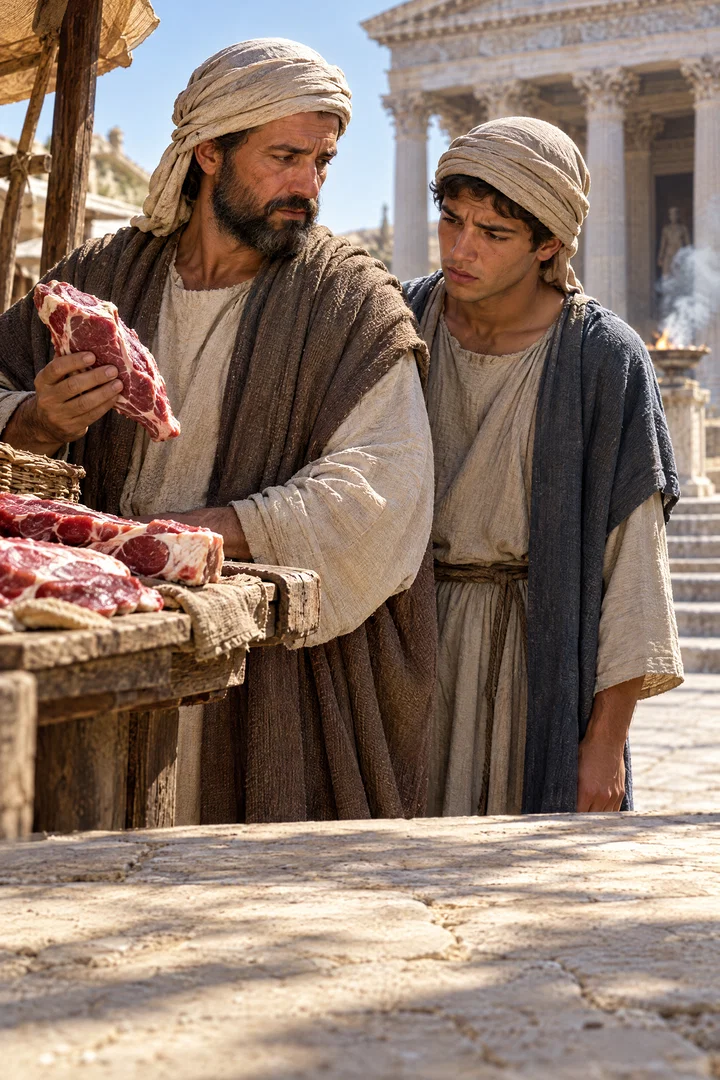
Wherefore, if meat make my brother to offend, I will eat no flesh while the world standeth, lest I make my brother to offend.
Translations
Why, if meat make my brother to offend, I will eat no flesh while the world stands, lest I make my brother to offend.
King James Version, KJV Cambridge Paragraph Bible
Wherefore, if meat make my brother to offend, I will eat no flesh while the world standeth, lest I make my brother to offend.
Wherefore, if food maketh my brother to fall into sin, I will eat no flesh while the world standeth, lest I make my brother to fall into sin.
Wherefore, if meat maketh my brother to stumble, I will eat no flesh for evermore, that I make not my brother to stumble.
Wherefore, if meat causeth my brother to stumble, I will eat no flesh for evermore, that I cause not my brother to stumble.
wherefore, if victuals cause my brother to stumble, I may eat no flesh — to the age — that my brother I may not cause to stumble.
Wherefore if meat be a fall-trap to my brother, I will eat no flesh for ever, that I may not be a fall-trap to my brother.
Therefore, if food is an occasion of stumbling unto my brother, in nowise will I eat flesh unto the age that abideth,—that, I may not occasion, my brother, to stumble.
Berean Standard Bible, Majority Standard Bible
Therefore, if what I eat causes my brother to stumble, I will never eat meat again, so that I will not cause him to stumble.
Therefore, if food causes my brother to stumble, I will eat no meat forever more, that I don’ t cause my brother to stumble.
For this reason, if food is a cause of trouble to my brother, I will give up taking meat for ever, so that I may not be a cause of trouble to my brother.
Wherefore if meate offende my brother, I wil eate no flesh while the world standeth, that I may not offend my brother.
Douay-Rheims (Challoner revision)
Wherefore, if meat scandalize my brother, I will never eat flesh, lest I should scandalize my brother.
Pictures
Cross-references 20 of 24
- Romans 14:21
It is good neither to eat flesh, nor to drink wine, nor any thing whereby thy brother stumbleth, or is offended, or is made weak.
Paul likewise urges abstaining from food or drink that makes a fellow believer stumble or weak.
- Romans 14:7
For none of us liveth to himself, and no man dieth to himself.
Both teach that believers do not live for themselves alone.
- Romans 14:13
Let us not therefore judge one another any more: but judge this rather, that no man put a stumblingblock or an occasion to fall in his brother’s way.
Both urge believers not to put a stumbling block in another’s way.
- 1 Corinthians 10:31-32
Whether therefore ye eat, or drink, or whatsoever ye do, do all to the glory of God.
Conduct should glorify God and avoid offending others.
- 1 Corinthians 8:8-9
But meat commendeth us not to God: for neither, if we eat, are we the better; neither, if we eat not, are we the worse.
Food does not commend us to God, but liberty must not harm the weak.
- Acts 15:29
That ye abstain from meats offered to idols, and from blood, and from things strangled, and from fornication: from which if ye keep yourselves, ye shall do well. Fare ye well.
The council directs Christians to abstain from idol-offered food, reflecting concern not to cause stumbling.
- Romans 14:15
But if thy brother be grieved with thy meat, now walkest thou not charitably. Destroy not him with thy meat, for whom Christ died.
Food should not grieve or spiritually harm a brother for whom Christ died.
- 1 Corinthians 8:1
Now as touching things offered unto idols, we know that we all have knowledge. Knowledge puffeth up, but charity edifieth.
Love builds up and guides the use of knowledge and liberty.
- Romans 15:1
We then that are strong ought to bear the infirmities of the weak, and not to please ourselves.
The strong should bear the weak’s infirmities rather than please themselves.
- Romans 14:19
Let us therefore follow after the things which make for peace, and things wherewith one may edify another.
Calls believers to pursue peace and build one another up.
- 1 Corinthians 10:23-24
All things are lawful for me, but all things are not expedient: all things are lawful for me, but all things edify not.
What is lawful may not be expedient when it harms others; seek another’s good.
- Matthew 18:6
But whoso shall offend one of these little ones which believe in me, it were better for him that a millstone were hanged about his neck, and that he were drowned in the depth of the sea.
Both warn against causing a believer to stumble.
- 1 Corinthians 10:25
Whatsoever is sold in the shambles, that eat, asking no question for conscience sake:
Market food may be eaten without inquiry, unless doing so troubles another’s conscience.
- 1 Corinthians 8:4
As concerning therefore the eating of those things that are offered in sacrifice unto idols, we know that an idol is nothing in the world, and that there is none other God but one.
Idol food is not sinful in itself, though it may trouble a believer with scruples.
- 1 Corinthians 9:22
To the weak became I as weak, that I might gain the weak: I am made all things to all men, that I might by all means save some.
Paul adapts himself for the weak, avoiding offense to help save some.
- 1 Corinthians 10:27-28
If any of them that believe not bid you to a feast, and ye be disposed to go; whatsoever is set before you, eat, asking no question for conscience sake.
Food may be eaten freely, except when doing so would violate conscience or offend another.
- Romans 14:2-3
For one believeth that he may eat all things: another, who is weak, eateth herbs.
Both address refraining from food to avoid offending a fellow believer.
- Romans 14:14
I know, and am persuaded by the Lord Jesus, that there is nothing unclean of itself: but to him that esteemeth any thing to be unclean, to him it is unclean.
Food is not unclean in itself, yet believers should avoid causing offense over food.
- 1 Corinthians 8:9
But take heed lest by any means this liberty of yours become a stumblingblock to them that are weak.
Liberty can become a stumbling block to others.
- Romans 14:17
For the kingdom of God is not meat and drink; but righteousness, and peace, and joy in the Holy Ghost.
God’s kingdom is not defined by food and drink.
Commentary
Each commentary is drawn from primary sources: the writings of Ellen G. White and Adventist pioneers and periodicals. Each commentary is separate. Its own words are not a quotation; follow the references to read the source passages.
Ellen G. White
4 sources
Love and concern for others must govern personal choice, requiring a believer to give up even a permitted, innocent, or otherwise lawful liberty rather than cause a weak brother to stumble to destruction.ST Feb 23, 1882AA 316.2–317.1Ms 40, 1896, par. 11Ms 3, 1862, par. 16–21 This includes giving up participation in dancing parties when, as with a church elder, that conduct wounds fellow believers and places a stumbling block in their way, since conduct must account for its harmful influence on others.ST Feb 23, 1882 This includes also refraining even from something innocent in itself if it could encourage idolatry or trouble someone weak in faith, since Christian conduct considers its effect on others and avoids giving offense.AA 316.2–317.1
The verse requires careful treatment of those for whom Christ died and refusing to make crooked paths that turn feet out of the way of life.Ms 40, 1896, par. 11 This means guarding every point against temptation, watching words and guarding the spirit that prompts them, and standing as faithful sentinels over defective traits of character.Ms 40, 1896, par. 11 Stumbling is caused especially by the tongue, which though a little member does a weight of mischief by sowing seeds of bitterness and putting suspicious thoughts in minds.Ms 40, 1896, par. 11
Laying obstacles in a brother's way, injuring those outside, censuring and wounding and speaking unjust things, dwelling on fragments of God's Word that are not of vital importance, and presenting truth anywhere and everywhere in an unacceptable manner that makes faith disgusting to unbelievers all cause stumbling and violate the verse.Ms 3, 1862, par. 16–21 The verse requires humility, thinking less of self, increased love for the brethren, sound judgment and reason instead of impulse and self-exaltation, and a holy influence upon all around including unbelievers.Ms 3, 1862, par. 16–21 One who has caused stumbling must take it all back and commence anew.Ms 3, 1862, par. 16–21 The plague spot and rock of offense that wrecks souls will be exposed in the day when every case is revealed, when many who are eternally lost will look with reproach upon those who caused them to stumble.Ms 40, 1896, par. 11
Sources
Pioneers and periodicals
51 sources
Flesh here means animal food, including what had been offered to idols, which in itself neither makes a person better nor worse before God.ST Oct 16, 1893ST Sep 30, 1886ST Oct 16, 1893 The danger was to recent converts from heathen worship and to those trained in strict observance, whose weak consciences still regarded such eating as idolatry and could be emboldened to eat against conscience to their ruin.ST Feb 4, 1903ST Feb 22, 1883RH Jul 16, 1901 Therefore even what is lawful, harmless, and indifferent must be given up for life rather than cause a brother to stumble, be wounded, or be lost, for love and care for souls govern liberty and knowledge.ST Oct 16, 1893ST Jul 29, 1897 To eat while a brother is thereby led to violate conscience weakens character, endangers faith, destroys one for whom Christ died, and is sin against the brother and against Christ.ST Oct 16, 1893ST Feb 4, 1903ST Feb 4, 1903 This lifelong self-denial is the true standard of Christian liberty, the same principle taught in Romans 14 and shown when Daniel refused food dedicated to idols, and it still calls for abstinence from intoxicating drink, tobacco, and doubtful amusements when example would lead the weak to fall.ST Apr 16, 1912RH May 20, 1858ST May 28, 1902ST Oct 16, 1893ST Sep 4, 1879
Words and Historical Setting
The term rendered flesh is the specific Greek word for flesh as an article of food, not the broader word for food that can include fruits, grains and vegetables.RH Feb 20, 1872 In this place the English word meat can mean flesh, showing that a word's sense depends on its context and can differ from its meaning elsewhere.ST May 12, 1914
The meat in question is food offered to idols, not pork or the distinction between clean and unclean animals.ST Sep 30, 1886 Meat here includes foods such as fruits and grains as well as flesh.ST Sep 30, 1886 The idol and its dedication have no effect on the food itself.ST Sep 30, 1886ST Feb 4, 1903 Eating such meat does not make a person better or worse before God.ST Oct 16, 1893ST Oct 16, 1893
The Corinthian believers had come out of heathen idolatry only about five years before, so some still ate with old regard for the idol and were easily defiled and emboldened to stumble.ST Feb 4, 1903 Others had weak consciences still shadowed by former superstition and believed eating was wrong, though better-instructed Christians had no condemnation of conscience in eating it because the offering did not change it.ST Feb 4, 1903 Idol sacrifices were generally practiced among the Gentiles, so Gentile converts were in special danger from them.ST Feb 22, 1883 Joining Gentiles in eating food offered to idols could draw believers back into idolatry, and could hinder those still in idolatry from leaving it.ST Feb 22, 1883RH Jul 21, 1868
The weak are also described as those trained to strict observance of the Jewish ceremonial law, who viewed such eating as participation in idolatry and made it a bone of contention in the church.RH Jul 16, 1901 On that view abstaining is a question of expediency, not of right, because such flesh eating is not sinful per se.RH Jul 16, 1901
While the world standeth means for ever, expressing a lifelong resolve to abstain from eating flesh rather than cause a brother to stumble.RH Mar 6, 1855 Brother in the New Testament, especially in the plural, can refer to fellow believers or people of the same nation and not only to one born of the same mother.ST Jun 20, 1911 This wider use allows the brothers of Jesus to be understood as relatives such as cousins, rather than necessarily His mother's other sons.ST Jun 20, 1911
Love Limits Liberty
Even what is lawful and permissible and harmless and indifferent in itself must be surrendered, even for life, rather than cause a brother to stumble or be offended or be made weak or violate conscience.ST Oct 16, 1893ST Jul 29, 1897RH Jul 22, 1902RH Oct 12, 1916 Love and peace and care for another's spiritual welfare and salvation govern personal liberty and rights and knowledge, so that freedom is used only as love directs.ST Oct 16, 1893ST Feb 4, 1903ST Feb 4, 1903ST Dec 2, 1913 Such self-denial for another's good does not compromise God's truth.ST Feb 4, 1903
Mere knowledge that a thing is harmless is not enough to justify doing it, for influence and its results must weigh more than satisfying personal desire.ST Feb 4, 1903ST Oct 16, 1893 If the weak with tender convictions see the better-instructed eating and eat also against their own consciences, that breaking over conscience weakens conscience and weakens Christian character and puts them in danger of ultimate fall.ST Feb 4, 1903 Such liberty then becomes a stumbling-block that wounds a weak conscience and causes the brother for whom Christ died to perish, which is sin against the brother and against Christ.ST Oct 16, 1893ST Feb 4, 1903 For that result the better-instructed Christian is largely responsible, since another's destruction can be traced back to his act.ST Feb 4, 1903ST Feb 4, 1903
The resolve to eat no flesh while the world stands rather than make a brother offend is the only true and safe standard for Christian liberty.ST Oct 16, 1893ST Oct 16, 1893ST Feb 4, 1903 It is an example of settling a matter decisively and permanently through personal sacrifice for others' good, giving up even what one calls innocent when it makes a brother offend.ST Feb 9, 1915ST Feb 4, 1903 It includes the primary duty to live so that if all the world should follow one's example no harm could come from it.ST Mar 12, 1885
The verse teaches the same principle as Romans 14. Daniel illustrated it by choosing simple food and water rather than food dedicated to idols, because he valued God's approval above the king's favor.RH Jun 11, 1908 The requirements of the Jerusalem council are prominent instances of the same conceding for religious and social harmony rather than the whole of Christian duty, and that self-denial is still necessary today because it is essential to harmony with the will of God and to a good example to the world and to spirituality in the church.ST May 28, 1902
Qualifications and Boundaries
The verse does not make every creature fit for food, for what is cleansed is people and not animals, so poisonous plants and cats and dogs and caterpillars and spiders and flies remain unfit, and greater light brings greater carefulness in eating. It concerns food offered to idols rather than pork or the distinction between clean and unclean, and the flesh in view can include fruits and grains as well as animal flesh.ST Sep 30, 1886 Since an idol and its dedication have no effect on the food itself, one who knows the food God made to be received with thanksgiving may eat what is fit to be eaten, yet will eat no such flesh if a brother fears it was devoted to an idol and thinks eating it makes him an idolater, lest the brother be grieved and stumble and be offended and be made weak.ST Sep 30, 1886
The yielding it requires belongs to indifferent matters and does not excuse breaking God's law or doing wrong. It does not require surrendering the sense of right merely to conform to the customs of others or to avoid giving offense, so concern for others must not become an excuse for conduct contrary to principle. Concern for another's health and conscience is likewise no reason to continue a practice harmful to one's own or another's health, for the rule of giving up what is otherwise permissible rather than cause stumbling does not cover what is injurious.ST Mar 13, 1879 Those who press health reform must therefore lay down no single unvarying rule of diet for everyone, since what is wholesome and palatable to one may be hurtful to another, and must be consistent and shun everything like extremes.RH Jan 19, 1905 They must seek not how far to stand from others but how near to come to those they would lift, meeting people where they are and going no faster than convinced conscience and intellect can be taken along, making changes with great care and cautiously and wisely in a way that commends itself to intelligent men and women.RH Jan 19, 1905
The verse gives no license to bully others by dismissing them as oversensitive in conscience, since having a right to one's opinions depends on those opinions being right.ST May 1, 1884 Personal liberty must be restrained by charity when its exercise could become a stumbling block, otherwise liberty leads to division and contention among believers.ST May 1, 1884RH Feb 7, 1907
In matters of food life is not to be made a bondage of anxious questioning, yet a right example must still be set for others.ST Jun 8, 1915 Knowledge that a thing is harmless in itself is not enough to justify doing it, for love gives greater weight to influence and its results than to satisfying personal desire.ST Feb 4, 1903 Food offered to idols is unchanged by the offering, so the better instructed may eat without condemnation of conscience, but the weak still shadowed by former superstition believe it wrong, and if they see the stronger eating and eat against their own consciences, breaking over conscience weakens conscience and Christian character and endangers them in final fall, for which result the better instructed is largely responsible.ST Feb 4, 1903 The same refusal applies where eating would associate the eater with the evil institution of idol worship and weaken influence for good, even when the food would do no personal harm.RH Feb 6, 1913 Doubtful conduct and the first steps in a downward course are to be avoided, and no wrong course is to be tolerated in the slightest degree.RH Sep 7, 1911 Even an otherwise permissible pleasure is to be given up if taking part could lead a fellow believer, especially a young or vulnerable disciple, to fall, choosing self-denial because another might be harmed.RH Sep 7, 1911ST Jun 10, 1913
Applications to Daily Life
For the sake of others the verse calls for total abstinence from intoxicating drink, even when one's own drinking seems harmless, because love for others requires removing temptation from their path and not leading a weaker neighbor into ruin.ST Apr 16, 1912ST Sep 29, 1881 It requires abstaining from alcohol to keep others from temptation and harm, giving up personal comfort when drinking could harm another or hinder that person from coming to Christ, since concern for souls outweighs comfort.ST Sep 29, 1881ST Jan 6, 1881 It means refusing wine and the social customs that serve it rather than lay temptation before a brother, abstaining from drink oneself, refusing to preside where wine is served even at the cost of honor, refusing to join or pay for banquets and entertainments that promote drinking and form bad habits, and refusing to compel others to contribute to drink they abhor.ST Jan 4, 1883 It applies with special force to example, for a pastor should abstain if seeing him drink could lead another to start drinking and become enslaved, and refusing alcohol and not setting it before others protects the weak and vulnerable, with each person responsible before God for the influence of example.ST Apr 16, 1912ST Oct 21, 1880 A father's or moderate drinker's example can reassure the young, awaken appetite in children, uphold society's drinking customs, and lead to ruin, so the safe course is to abstain and take the pledge to set a safe example; if all adopted abstinence the sin, shame, crime, horror, misery and wretchedness from intemperance would largely cease.ST Apr 16, 1912
For the same reason Christian preachers and others should give up tobacco and other harmful appetites, and not condemn others for sins while continuing in habits they should forsake.RH Jun 21, 1864 Love for a fellow believer can require giving up what one may otherwise do rather than causing that person to stumble, be offended, or grow weak, which applied here means avoiding tobacco when its use could harm or mislead another.RH May 20, 1858 Concern for a brother's spiritual welfare must outweigh personal indulgence, so persisting knowingly in tobacco use when it grieves fellow believers is selfish and is sin against Christ.RH Apr 15, 1858 Even a lawful pleasure must be given up rather than cause a fellow believer to stumble, so smoking must be abandoned when it offends Christian brethren, is regarded as vice by many others, imposes fumes on neighbors, undermines influence and Christian example, fosters another's injurious appetite, or makes the good way spoken against.RH Apr 10, 1866ST Feb 1, 1877RH Jan 5, 1860 Even if one believes smoking or tea-drinking does not harm him, he should oppose it for weaker brothers rather than preach against habits while practicing one himself.RH Apr 10, 1866RH Jan 5, 1860
A Christian must decide about amusements such as theater, dancing parties, worldly sports, card playing, and novel-reading not only by personal safety but by influence upon the weaker brother.ST Sep 4, 1879RH Nov 2, 1911RH Sep 7, 1911 Even if a person feels able to attend a worldly amusement without being drawn into continued snares or believes he can remain self-controlled, love requires giving it up lest a weaker believer following the example be led on to final destruction, since example can make harmful influences seem acceptable and help spread a corrupting spirit.RH Sep 7, 1911RH Aug 29, 1912 This means refusing to attend the theatre because presence might reassure a young man with misgivings that attending is right, refusing to lend Christian influence to that choice.ST Sep 4, 1879 It applies to a church elder whose participation in dancing parties wounds his brethren and places a stumbling block in their way, and more broadly forbids tolerating a wrong course in the slightest degree and requires avoiding doubtful conduct and refusing the first steps in a downward course, for its effects go on in lives helped or ruined.ST Feb 23, 1882RH Sep 7, 1911RH Aug 29, 1912
In church and social life the principle means giving up an otherwise permissible act rather than cause a fellow believer to stumble, be offended, violate conscience, or grow weak.RH Apr 13, 1876RH May 22, 1879 It applies to declining to join the Grange when doing so knowingly distresses and offends fellow church members, and to avoiding a Christmas tree when its use hurts a weaker believer.RH Apr 13, 1876RH May 22, 1879 It applies to communion bread, where the church should use unleavened bread for those who could conscientiously partake only of it, since doing so compromised no principle and was not wrong, and to adapting conduct with care and self-denial among the castes of India out of concern for another's conscience and spiritual good.ST Apr 10, 1893 It applies to dress and fashion, requiring plainness and self-denial so as not to be a cause of stumbling to any, especially the young, by countenancing vanity, pride, and worldly extremes, and to shared meals, where when food is known to be unwholesome it should not be eaten and when another may be troubled by what is eaten a stumbling block should not be put in that person's way.ST Feb 4, 1913RH Oct 14, 1858 The same self-denial governs conduct before observant children, leaving a school whose teachings weaken others' faith for the sake of weaker sisters, opposing the saloon to help weaker brothers, and cooperating with others only when it does not risk scandalizing weaker believers, while mere concern for the weak does not excuse knowingly acting against received light.ST Apr 10, 1893ST Feb 4, 1913
Sources