1 Kings 19:21
And he returned back from him, and took a yoke of oxen, and slew them, and boiled their flesh with the instruments of the oxen, and gave unto the people, and they did eat. Then he arose, and went after Elijah, and ministered unto him.
Translations
And he returned back from him, and took a yoke of oxen, and slew them, and boiled their flesh with the instruments of the oxen, and gave to the people, and they did eat. Then he arose, and went after Elijah, and ministered to him.
King James Version, KJV Cambridge Paragraph Bible
And he returned back from him, and took a yoke of oxen, and slew them, and boiled their flesh with the instruments of the oxen, and gave unto the people, and they did eat. Then he arose, and went after Elijah, and ministered unto him.
And he returned back from him, and took a yoke of oxen, and slew them, and boiled their flesh with the instruments of the oxen, and gave to the people, and they ate. Then he arose, and went after Elijah, and ministered to him.
Revised Version, American Standard Version
And he returned from following him, and took the yoke of oxen, and slew them, and boiled their flesh with the instruments of the oxen, and gave unto the people, and they did eat. Then he arose, and went after Elijah, and ministered unto him.
And he turneth back from after him, and taketh the yoke of oxen, and sacrificeth it, and with instruments of the oxen he hath boiled their flesh, and giveth to the people, and they eat, and he riseth, and goeth after Elijah, and serveth him.
And he returned back from him, and took the yoke of oxen, and killed them, and boiled their flesh with the implements of the oxen, and gave to the people, and they ate. And he arose and went after Elijah, and ministered to him.
So he turned back from following him, and took the yoke of oxen, and sacrificed them, and, with the implements of the oxen, boiled their flesh, and gave unto the people, and they did eat,—then he arose, and followed Elijah, and ministered unto him.
So Elisha turned back from him, took his pair of oxen, and slaughtered them. With the oxen’s equipment, he cooked the meat and gave it to the people, and they ate. Then he set out to follow and serve Elijah.
So Elisha turned back from him, took his pair of oxen, and slaughtered them. Using the oxen’s equipment for fuel, he cooked the meat and gave it to the people, and they ate. Then he set out to follow and serve Elijah.
He returned from following him, and took the yoke of oxen, killed them, and boiled their meat with the oxen’s equipment, and gave to the people; and they ate. Then he arose, and went after Elijah, and served him.
And he went back, and took the oxen and put them to death, and cooking their flesh with the yokes of the oxen, he gave the people a feast. Then he got up and went after Elijah and became his servant.
And when he went backe againe from him, he tooke a couple of oxen, and slewe them, and sod their flesh with the instruments of the oxen, and gaue vnto the people, and they did eate: then he arose and went after Eliiah, and ministred vnto him.
Douay-Rheims (Challoner revision)
And returning back from him, he took a yoke of oxen, and killed them, and boiled the flesh with the plough of the oxen, and gave to the people, and they ate: and rising up he went away, and followed Elias, and ministered to him.
Pictures
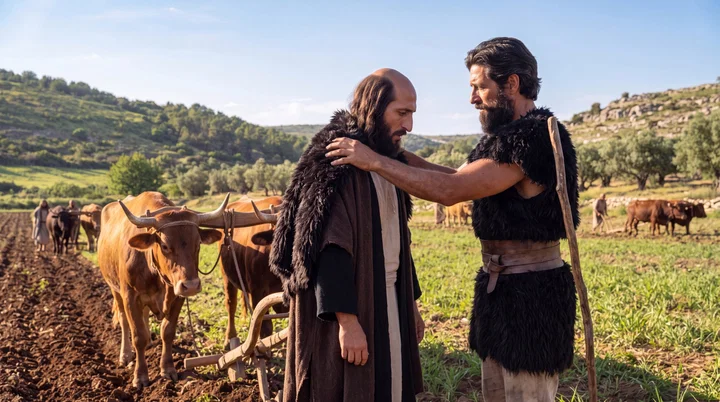
Cross-references
- Matthew 4:18-22
And Jesus, walking by the sea of Galilee, saw two brethren, Simon called Peter, and Andrew his brother, casting a net into the sea: for they were fishers.
Both are called from their daily labor to follow and serve.
- 2 Kings 2:1-15
And it came to pass, when the LORD would take up Elijah into heaven by a whirlwind, that Elijah went with Elisha from Gilgal.
Elisha succeeds Elijah and continues his prophetic work after serving under him.
- Matthew 9:9
And as Jesus passed forth from thence, he saw a man, named Matthew, sitting at the receipt of custom: and he saith unto him, Follow me. And he arose, and followed him.
Both are called while engaged in their everyday work.
- 1 Kings 18:40
And Elijah said unto them, Take the prophets of Baal; let not one of them escape. And they took them: and Elijah brought them down to the brook Kishon, and slew them there.
Both texts recount Elijah’s actions against the prophets of Baal.
- 2 Kings 2:3
And the sons of the prophets that were at Beth-el came forth to Elisha, and said unto him, Knowest thou that the LORD will take away thy master from thy head to day? And he said, Yea, I know it; hold ye your peace.
continues Elijah-Elisha prophetic ministry
- 2 Kings 3:11
But Jehoshaphat said, Is there not here a prophet of the LORD, that we may enquire of the LORD by him? And one of the king of Israel’s servants answered and said, Here is Elisha the son of Shaphat, which poured water on the hands of Elijah.
Elisha’s service to Elijah included pouring water on his hands.
- 1 Kings 19:4
But he himself went a day’s journey into the wilderness, and came and sat down under a juniper tree: and he requested for himself that he might die; and said, It is enough; now, O LORD, take away my life; for I am not better than my fathers.
Elijah’s weariness and discouragement connect with his later service to Elijah.
- Matthew 16:24
Then said Jesus unto his disciples, If any man will come after me, let him deny himself, and take up his cross, and follow me.
Following Christ requires willingness to deny oneself.
- Mark 1:18-20
And straightway they forsook their nets, and followed him.
Both men leave their former work and follow the one who called them.
- James 5:19-20
Brethren, if any of you do err from the truth, and one convert him;
Elijah’s ministry is connected with turning sinners back.
- Matthew 17:11
And Jesus answered and said unto them, Elias truly shall first come, and restore all things.
Jesus connects Elijah with the work of restoring all things.
- Amos 7:14-15
Then answered Amos, and said to Amaziah, I was no prophet, neither was I a prophet’s son; but I was an herdman, and a gatherer of sycomore fruit:
both taken from farm labor to prophesy
- Matthew 19:21
Jesus said unto him, If thou wilt be perfect, go and sell that thou hast, and give to the poor, and thou shalt have treasure in heaven: and come and follow me.
Both texts depict a call to leave possessions behind and follow a prophet or Christ.
Commentary
Each commentary is drawn from primary sources: the writings of Ellen G. White and Adventist pioneers and periodicals. Each commentary is separate. Its own words are not a quotation; follow the references to read the source passages.
Ellen G. White
42 sources
Elisha went back from Elijah, took his yoke of oxen and killed them, boiled the meat with the wood of their yokes and gear, shared it with the people for a farewell meal, then left home to follow Elijah and serve him in humble personal attendance.PK 219.3–220.1Ms 81a, 1901, par. 6–7Lt 60, 1897, par. 1–2Lt 12, 1897, par. 22–23 He was plowing in his field when the call came, and he was given leave to go home to decide for himself before he followed.ED 59.1SG1 128.1–129.1Ms 81a, 1901, par. 6–7 His answer was wholehearted and decisive, without hesitation or turning back to comforts and worldly advantage, because he prized being with Elijah and serving as God's messenger above all else.PK 219.3–220.1ED 59.1PK 221.1–2 The call from the plow shows that the Lord calls men from common work like farming to His appointed service, and that faithful daily labor trains them for it.GW92 316.1CH 425.3GW 332.3–333.19T 170.3STB 434.4 His first work was lowly ministry under Elijah, learning submission and service under God's direction until he was fitted to succeed him, which is the pattern for experienced workers to train younger workers by close companionship and growing responsibility.ED 60.3Ms 81a, 1901, par. 6–7STB 328.1CH 584.1–2Lt 64, 1897, par. 14–15 As Elisha left plow and field to open the mysteries of the kingdom, so William Miller was called to leave his farm to unfold the prophecies to the second advent, and so the Lord still calls ordinary workers and youth from humble daily work to proclaim the truth whatever the sacrifice.SG1 128.1–129.1EW 192.2–193.1GC88 330.2–331.1Lt 123, 1905, par. 3RH Nov 11, 1902
Farewell Meal and Departure
Elisha turned back from following Elijah, took a yoke of oxen and slaughtered them, boiled their flesh using the wooden farm implements as fuel, gave the food to the people and they ate, and then he arose and went after Elijah and ministered to him.PK 219.3–220.1Ms 81a, 1901, par. 6–7Lt 60, 1897, par. 1–2Ms 107, 1902, par. 1 His slaughtering of the oxen, breaking up of the farming equipment to prepare the meat, and sharing of the meal expressed decisive acceptance of the divine call without hesitation and without holding back for worldly advantage.PK 219.3–220.1 His leaving of work with the oxen, preparing a meal for the people, and then following Elijah to serve him shows readiness to leave former work and life and to answer the call of God.Ms 81a, 1901, par. 6–7Lt 60, 1897, par. 1–2Ms 107, 1902, par. 1
His departure began with a feast at home before he entered upon humble personal attendance on Elijah.Lt 12, 1897, par. 22–23 That attendance included pouring water on Elijah's hands, illustrating that work done wholeheartedly for God, however small, is acceptable to Him.Lt 12, 1897, par. 22–23 Such humble, willing service is open to everyone who claims to be a child of God.Lt 12, 1897, par. 22–23
When the call came he was at work plowing and following his oxen in the field of his labor.SG1 128.1–129.1Ms 81a, 1901, par. 6–7GC88 330.2–331.14SP 206.1–207.3 He was given opportunity to return home to decide for himself whether to accept or reject the call.ED 59.1 He valued the opportunity to serve as God's messenger and to be with Elijah more than any worldly advantage.ED 59.1
Wholehearted Acceptance of Call
He slaughtered his oxen and cooked their flesh with the wooden farm implements, shared the meal with the people, and then left his beloved home to go after Elijah and minister to him, accepting the call decisively without hesitation or holding back for worldly advantage.PK 219.3–220.1 In that leaving he did not look back upon the pleasures and comforts he was abandoning.PK 221.1–2 Having been given opportunity to return home and decide for himself, he counted serving as God's messenger and being with Elijah as worth more than any worldly advantage.ED 59.1
His course shows readiness to leave former work and life behind, giving up his occupation with the oxen to enter God's service when called.Lt 60, 1897, par. 1–2Lt 210, 1903, par. 6–7 That readiness was obedience to God rather than acting merely because another man had asked.Lt 12, 1897, par. 19–20 It is the pattern for answering God's call to duty and for leaving ordinary work to proclaim the truth and become His attendant, even when doing so requires sacrifice.RH Nov 11, 1902Ms 126, 1902, par. 59–60
The mantle cast upon him marked his consecration to a solemn work and to the prophetic office.TBC1882 64.3–65.2GC88 330.2–331.1 Called while following his oxen in the field, he left his plow to open to the people the mysteries of the kingdom of God.GC88 330.2–331.1
God Calls Ordinary Workers
Elisha's leaving his work with the oxen to follow Elijah and minister to him shows that the Lord calls people from ordinary occupations into appointed service and guides them in their field of labor and methods of service.CH 425.39T 170.3STB 434.4Lt 48, 1909, par. 10PMMEP 27.4 The call from the plow illustrates that God can call people from ordinary work, including plowing, farming, and vineyard work, to proclaim the truth and carry His message throughout the world.9T 170.3STB 434.4Lt 48, 1909, par. 10PMMEP 27.4Lt 100, 1902, par. 2
His humble labor as a plowman was part of the training that prepared him for service in God's cause, and his leaving the plow to answer God's call and serve Elijah shows that such preparation comes through ordinary work.GW92 316.1GW 332.3–333.1 Active service for God is compatible with humble, everyday occupations done diligently, and God's servants are to be diligent and prepared in the duties they are given.Lt 12, 1897, par. 10 As a plowman trained in agricultural work, he illustrates that Israel's greatest men were trained in practical occupations.MH 184.2–185.2
The call to serve God can come to people of learning and position, but separation from God and yielding to worldly influence can make them unfit for it.TBC1882 64.3–65.25T 82.2–4 Elijah's mantle upon Elisha marked consecration to a solemn work, and in contrast to learned and prominent men who rejected it, God honors those who are humble and trust fully in Him.TBC1882 64.3–65.25T 82.2–4 God instead raises up those taught by His Spirit, since outward education supplies only external qualifications.5T 82.2–4
The plow belongs to the experience of those who seek eternal life, since following God involves practical, living principles carried into daily life.13MR 262.4 The episode reflects the spirituality seen in the schools of the prophets that is to be recovered and brought into schools now.Ms 73, 1912, par. 16–19 That spirituality means the truths of the Bible are earnestly studied, rightly brought before the mind and thoughtfully dwelt upon, giving desire for what is infinitely higher than worldly amusement.Ms 73, 1912, par. 16–19 As students draw near to God and become partakers of the divine nature, earth-born amusements sink into nothingness, their minds take a higher turn, and beholding the character of Jesus they strive to be like Him.Ms 73, 1912, par. 16–19
Trained Under Experienced Mentor
After leaving the plow and the farewell meal, his first work was humble personal ministry to the prophet, by which he became familiar with the work in which he would later have a leading part.Ms 81a, 1901, par. 6–7 His service was different in character from Elijah's, yet both were working for the Lord.Ms 81a, 1901, par. 6–7 His willing service under Elijah was an education in submission and service under God's direction.Lt 64, 1897, par. 14–15 That early training under God's direction prepared him to succeed Elijah and to guide Israel in safe paths.ED 60.3Lt 64, 1897, par. 14–15
Elijah's taking him from the plow is the pattern for an experienced worker giving a younger worker opportunity to learn by accompanying him and working closely with him.STB 328.1CH 584.1–2Ms 125, 1903, par. 20Lt 164, 1901, par. 11–12YGBCOEP 49.1 Inexperienced workers are to learn ministry by close association with experienced servants of God, first being entrusted with small responsibilities and then with greater ones as they gain strength and experience.Lt 164, 1901, par. 11–12 Ministers are thus to train young men to teach the truth and to carry the work forward, educating and preparing them to teach others.STB 328.1CH 584.1–2YGBCOEP 49.1RH Mar 20, 1900
Pattern for Miller and Today
As Elisha left his oxen and the field of his labor to follow Elijah, so William Miller was called by God to leave his farm to unfold to the people the mysteries of the kingdom of God and carry them down through the prophecies to the second advent of Christ.SG1 128.1–129.1EW 192.2–193.1 The call came while Elisha was following his oxen in the field, to receive the mantle of consecration to the prophetic office and to open to the people the mysteries of the kingdom of God.GC88 330.2–331.14SP 206.1–207.3 In the same way Miller was called to leave his plow and lead his hearers step by step through the prophetic periods to the second appearing of Christ.GC88 330.2–331.14SP 206.1–207.3
The same leaving of ordinary work answers the call to proclaim the truth whatever the sacrifice.Lt 123, 1905, par. 3RH Nov 11, 1902 Those so called may be appointed from everyday occupations such as plowing or vineyard work to carry God's message throughout the world.Lt 123, 1905, par. 3Lt 100, 1902, par. 2 Like Elisha they may begin laboring simply and quietly by explaining the Scriptures to others.Lt 123, 1905, par. 3
The Lord still takes men from the plow into His service, as He took Elisha.20MR 350.4Lt 116, 1905, par. 26Lt 330, 1906, par. 13–14 Ordinary working people are called from humble positions and everyday work to have a part in His service and in the closing work.20MR 350.4Lt 116, 1905, par. 26Lt 330, 1906, par. 13–14 Young people are taken from their ordinary work and sent to proclaim the truth with faith in God.20MR 350.4Ms 33, 1906, par. 13–14 A great work must be done in a short time, and the Lord will give those taken from the plow a part in it.20MR 350.4
Sources
Pioneers and periodicals
27 sources
Elisha was diligently plowing with twelve yoke of oxen when Elijah passed by and cast his mantle upon him to call him as his successor in the prophetic office.STST Oct 18, 1877 He then returned, slaughtered a yoke of oxen and cooked their flesh with the wooden farm tools, shared the food with the people in a final farewell feast, and arose to follow Elijah and serve him.RH Nov 9, 1916RH Apr 4, 1871 In doing so he made a prompt, decisive and wholehearted break with his former work, interests and possessions to commit himself willingly to the prophetic work.RH Apr 4, 1871RH Oct 23, 1860 His slaying of the oxen and burning of the tools means offering to God everything that could tempt a return to the old occupation, and his ministering to Elijah, even in the lowliest service, is the pattern that those called from farm, workshop and common labor must answer at once and be ready for any duty.RH Jun 27, 1912RH Jul 20, 1916RH Apr 5, 1906 God thus met him in the commonplaces of faithful daily toil and provided in him both special help and companionship for Elijah and proof that even in widespread apostasy a faithful remnant will respond to the prophet's call.ST May 24, 1905RH Apr 8, 1909
History and Prophetic Setting
1 Kings 19:21 belongs to the history of the two separate kingdoms of Judah and Israel for about eighty years from the revolt of the ten tribes to the death of Jehoshaphat, covering the reigns of several kings of both Judah and Israel.RH May 25, 1916 It is part of the extraordinary ministry of the prophet Elijah.RH May 25, 1916
It belongs to the history of Elijah the Tishbite, the greatest of the Hebrew prophets.RH Nov 7, 1912 He was contemporary with Ahab, the seventh king of Israel and second ruler of the third Israelitish dynasty, reigning twenty-two years early in the ninth century before Christ when Judah and Israel reached the height of power and prosperity.RH Nov 7, 1912 All that is recorded of those days was written for the learning and profit of men and kings of after generations.RH Nov 7, 1912
The verse occurs in a time of widespread apostasy in Israel when Elijah thought he alone served the true God.RH Feb 21, 1865 Despite apostasy that appeared to prevail, a faithful people remained, though hidden from Elijah.RH Feb 21, 1865 The Lord disclosed that seven thousand had not worshiped Baal.RH Feb 21, 1865
The verse is part of Elijah's prophetic ministry, which is linked to a reforming, converting work before the day of the Lord.RH Jul 9, 1901 It shows Elisha leaving his former work and going after Elijah to serve him within that ministry.RH Jul 9, 1901 It is also part of the cases of Elijah and Elisha under whose ministrations many wonderful things occurred.RH Jun 23, 1903
Elijah and Elisha are prophets among more than one hundred and fifty mentioned in the Old Testament besides the sixteen from Isaiah to Malachi whose writings are in Scripture, showing that the Lord multiplied visions by the ministry of the prophets.RH Jun 23, 1903 The verse is cited as part of the history of Ahab's wife Jezebel, whose story supplies the figure used for the corrupting woman in the message to Thyatira in Revelation.RH Jun 17, 1862 The account of Elijah and Elisha to which the verse belongs is a true event rather than a pious legend or myth.ST Jan 24, 1906
Elisha's Call and Response
God made known beforehand to Elijah that Elisha would succeed him in the prophetic office, and Elisha was ordained to the work before Elijah's translation.RH Aug 19, 1915 This revealing of a successor in advance is an exception, for there is no set rule of prophetic succession, the gift never descends from father to son and is never conferred by the voice of the people.RH Aug 19, 1915 God often chooses His messenger from humble, lowly ones, as Elisha was a plowman when called, for He finds His chosen instruments where He will.RH Aug 19, 1915
Elisha was faithfully and diligently working as a husbandman at the plow in peaceful, busy, active secular toil when Elijah came to him.RH Jan 28, 1902 His being engaged in peaceful toil when the call to prophetic work came matches the way Amos was taken from tending cattle and gathering sycamore fruit in Tekoa to be hurried into duty and danger.ST God manifests Himself to such diligent workers and not to idle persons, so the slothful and inactive cannot expect the sweet company of the Saviour.RH Jun 18, 1872 Providence takes special interest in diligent, willing-hearted workers in active labor, choosing, honoring and blessing them, and from the midst of that labor Elisha was called to utter prophecy and save men, along with others called from active occupations to deliver nations, lead armies, utter prophecies and save men.RH Jan 28, 1902 He followed Elijah and ministered to him, and received Elijah's mantle and a double portion of the Spirit.
Elisha was plowing with twelve yoke of oxen when Elijah passed by and cast his mantle upon him, calling him to be his successor and even to receive a double portion of his spirit.ST Oct 18, 1877 This means God calls men to greater honors and more extensive labor while they are simply employed in attending to their everyday concerns.ST Oct 18, 1877 Faithful everyday duties, however trivial and simple, done from a simple desire for God's glory, are fully pleasing to God, and such work is noble because it is what He has given to do.ST Oct 18, 1877
Elisha was hitching his oxen to the plow in his everyday work, not knowing that before the oxen were unyoked in the evening the mantle of God's prophet would be placed on his shoulders.RH Apr 8, 1909 This means God leads by some secular incentive to the place where a blessing of an entirely different nature awaits, and meets people in the commonplaces of life.RH Apr 8, 1909 Honest faithful daily work thus becomes the place of the richest spiritual blessing.RH Apr 8, 1909
After Elijah called him, Elisha returned, took a yoke of oxen and slew them, boiled their flesh with the instruments of the oxen, gave to the people and they ate, then arose, went after Elijah and ministered to him.RH Nov 9, 1916RH Apr 4, 1871 In leaving his former work, worldly interests and possessions, preparing a final feast and sharing it, and following to serve, he made a decisive, wholehearted break with his old life and a willing commitment to the prophetic work.RH Nov 9, 1916RH Apr 4, 1871RH Mar 5, 1908ST Aug 27, 1885ST May 17, 1905 His farewells and the meal shared with the people mark his decisive response to the call and his commitment to take up the prophetic work to which Elijah had called him.RH Mar 5, 1908ST Aug 27, 1885 He responded promptly to the call, without resisting it with objections, leaving his work with the oxen and hastening after the man of God.RH Oct 23, 1860
God in this provided special help and companionship for Elijah as He sent him back to his duty.ST May 24, 1905 The verse also shows a faithful remnant responding to the call of God's prophet during the great apostasy, for while Israel went into backsliding Elisha answered, followed and ministered. This proves God finds those who will respond and that backsliding can be followed by restoration through a prophet. Elisha's labor as a farmer helped prepare him for that ministry and for taking up the work Elijah would leave unfinished.RH Jan 12, 1905 His choice to follow the man of God in faithful humble tasks rather than pursue worldly pleasures and riches prepared him for a higher position.
Pattern for God's Workers
When God calls, a person must respond at once no matter how busy.RH Jul 20, 1916 Killing the yoke of oxen and boiling their flesh with the farm tools and giving the meat to the people means offering to God everything that could tempt a return to a former occupation.RH Jul 20, 1916 Arising to go after Elijah and minister to him, even pouring water on his hands, means workers for God must be ready for any service however lowly.RH Jul 20, 1916 God calls common, uneducated working men from the plow to the work He appoints them.RH Jun 27, 1912 Men will still be called in the same way, with unexpected talent developed in those in the common walks of life, even as the humble, unlearned fishermen were called by the Saviour.RH Jun 27, 1912
They will begin to labor in simplicity and quietness, reading and explaining the Scriptures to others in house-to-house work.RH Jun 27, 1912 They will go forth in humble faith with the Spirit of God upon them and the same love for perishing souls given to the disciples of old.RH Jun 27, 1912 Christ will be with them, angels will respond to their self-sacrificing efforts, Jesus by the power of the Holy Spirit will move upon hearts, God will work miracles in the conversion of sinners, their simple efforts will be successful, and they will be filled with joy as they see souls converted.RH Jun 27, 1912 Elisha recognized God's call while at the plow and left the field, his home and friends at a busy time of the year to enter training for the work of God.RH Apr 5, 1906 His call is the pattern for those called from workshop and plow to gain such speedy preparation as they can in a short course of training and then go forth to their life-work to plant the banners of the cross above the battlements of the enemy.RH Apr 5, 1906 Following the plow had taught him one lesson he carried into that training, not to fail or be discouraged.RH Apr 5, 1906
Providence takes special interest in diligent, willing-hearted workers in busy, active, secular labor, choosing, honoring, and blessing them.RH Jan 28, 1902 From the midst of that labor Elisha was called to utter prophecy and save men, along with others called from active occupations to deliver nations, lead armies, utter prophecies, and save men.RH Jan 28, 1902 God manifests Himself to diligent workers and not to idle persons, so the slothful and inactive cannot expect the sweet company of the Saviour.RH Jun 18, 1872 Elisha was plowing when the Lord called him, one of the great appearances made to eminent saints while they were busy.RH Jun 18, 1872 Elisha following Elijah and serving him after being called illustrates how an experienced worker can educate and prepare a younger person to carry the work forward.RH Mar 20, 1900
It provides the example of an experienced worker giving a younger worker the opportunity to learn through close service, which ministers are to offer young men learning to teach the truth.RH Nov 19, 1903 Leaving work with the oxen to answer Elijah's call and become his attendant applies to people being called from ordinary work to proclaim the truth, whatever the sacrifice.RH Nov 11, 1902
Sources