1 Kings 19:4
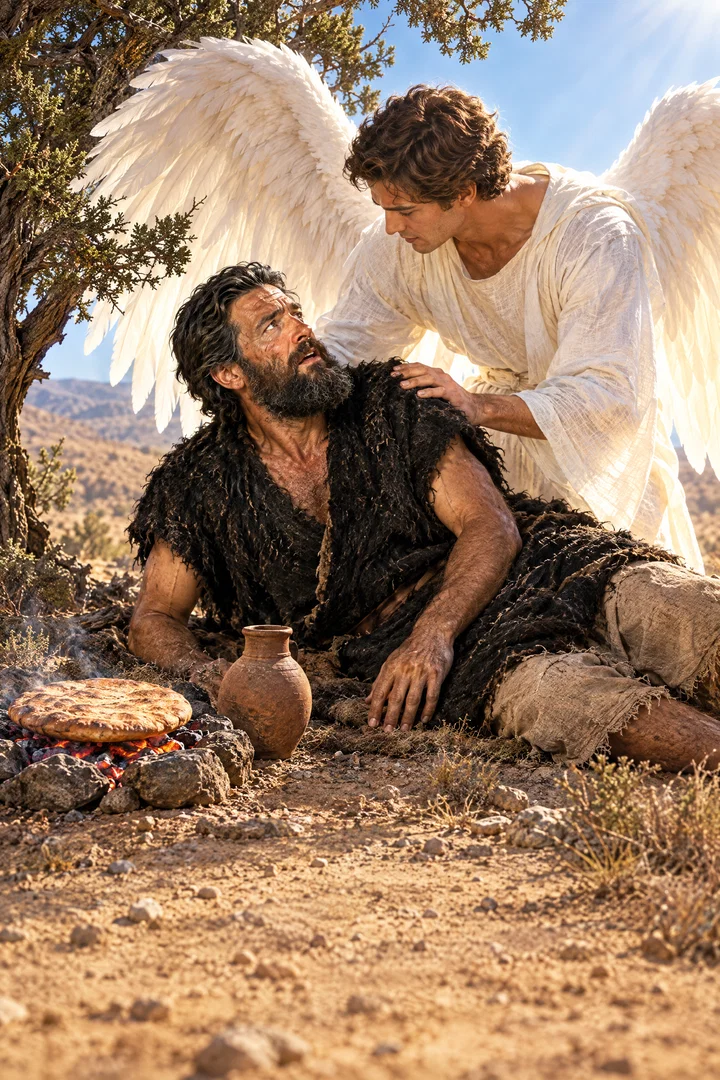
But he himself went a day’s journey into the wilderness, and came and sat down under a juniper tree: and he requested for himself that he might die; and said, It is enough; now, O LORD, take away my life; for I am not better than my fathers.
Translations
American King James Version, King James Version, Revised Version
But he himself went a day’s journey into the wilderness, and came and sat down under a juniper tree: and he requested for himself that he might die; and said, It is enough; now, O LORD, take away my life; for I am not better than my fathers.
But he himself went a day’s journey into the wilderness, and came and sat down under a juniper tree: and he requested for himself that he might die; and said, It is enough; now, O Lord, take away my life; for I am not better than my fathers.
But he himself went a day's journey into the wilderness, and came and sat down under a juniper-tree: and he requested for himself that he might die; and said, It is enough; now, O LORD, take away my life; for I am not better than my fathers.
But he himself went a day’s journey into the wilderness, and came and sat down under a juniper-tree: and he requested for himself that he might die, and said, It is enough; now, O Jehovah, take away my life; for I am not better than my fathers.
and he himself hath gone into the wilderness a day's Journey, and cometh and sitteth under a certain retem-tree, and desireth his soul to die, and saith, 'Enough, now, O Jehovah, take my soul, for I [am] not better than my fathers.'
And he himself went a day's journey into the wilderness, and came and sat down under a certain broom-bush, and requested for himself that he might die; and said, It is enough: now, Jehovah, take my life; for I am not better than my fathers.
But, he himself, went into the wilderness a day’s journey, and came and sat down under a certain shrub,—and asked for his life, that he might die, and said—Enough, now, O Yahweh! take away my life, for, no better, am, I, than, my fathers.
while he himself traveled on a day’s journey into the wilderness. He sat down under a broom tree and prayed that he might die. “ I have had enough, LORD,” he said. “ Take my life, for I am no better than my fathers.”
while he himself went a day’s journey into the wilderness. He sat down under a broom tree and prayed that he might die. “ I have had enough, LORD,” he said. “ Take my life, for I am no better than my fathers.”
But he himself went a day’s journey into the wilderness, and came and sat down under a juniper tree. Then he requested for himself that he might die, and said, “ It is enough. Now, O LORD, take away my life; for I am not better than my fathers.”
While he himself went a day's journey into the waste land, and took a seat under a broom-plant, desiring for himself only death; for he said, It is enough: now, O Lord, take away my life, for I am no better than my fathers.
But he went a dayes iourney into the wildernesse, and came and sate downe vnder a iuniper tree, and desired that he might die, and sayde, It is now ynough: O Lord, take my soule, for I am no better then my fathers.
Douay-Rheims (Challoner revision)
And he went forward, one day’s journey into the desert. And when he was there, and sat under a juniper tree, he requested for his soul that he might die, and said: It is enough for me, Lord, take away my soul: for I am no better than my fathers.
Pictures
Cross-references 20 of 29
- 1 Kings 18:36-40
And it came to pass at the time of the offering of the evening sacrifice, that Elijah the prophet came near, and said, LORD God of Abraham, Isaac, and of Israel, let it be known this day that thou art God in Israel, and that I am thy servant, and that I have done all these things at thy word.
Elijah’s Carmel victory preceded his flight and despair.
- 2 Kings 2:11
And it came to pass, as they still went on, and talked, that, behold, there appeared a chariot of fire, and horses of fire, and parted them both asunder; and Elijah went up by a whirlwind into heaven.
Elijah’s later ascent contrasts with his earlier prayer to die.
- 1 Kings 18:45-46
And it came to pass in the mean while, that the heaven was black with clouds and wind, and there was a great rain. And Ahab rode, and went to Jezreel.
Elijah’s strenuous service after the rain preceded his flight and despair.
- James 5:17
Elias was a man subject to like passions as we are, and he prayed earnestly that it might not rain: and it rained not on the earth by the space of three years and six months.
Elijah’s despair reflects the human passions and weakness he shared with others.
- 1 Kings 19:10
And he said, I have been very jealous for the LORD God of hosts: for the children of Israel have forsaken thy covenant, thrown down thine altars, and slain thy prophets with the sword; and I, even I only, am left; and they seek my life, to take it away.
Elijah’s lament shows his despair and belief that his life is threatened.
- 1 Kings 17:4-6
And it shall be, that thou shalt drink of the brook; and I have commanded the ravens to feed thee there.
The wilderness image is joined to Elijah being fed by ravens and drinking from a brook.
- 1 Kings 19:18
Yet I have left me seven thousand in Israel, all the knees which have not bowed unto Baal, and every mouth which hath not kissed him.
Elijah feels alone, but God tells him seven thousand remain faithful.
- 1 Kings 18:40
And Elijah said unto them, Take the prophets of Baal; let not one of them escape. And they took them: and Elijah brought them down to the brook Kishon, and slew them there.
Elijah’s discouragement follows his execution of the prophets of Baal.
- Matthew 17:3
And, behold, there appeared unto them Moses and Elias talking with him.
Elijah appears with Jesus at the transfiguration.
- 1 Kings 19:9
And he came thither unto a cave, and lodged there; and, behold, the word of the LORD came to him, and he said unto him, What doest thou here, Elijah?
The Lord questions Elijah about hiding at Horeb.
- 1 Kings 19:12
And after the earthquake a fire; but the LORD was not in the fire: and after the fire a still small voice.
Elijah later hears God’s still, small voice in the same wilderness episode.
- 1 Kings 18:46
And the hand of the LORD was on Elijah; and he girded up his loins, and ran before Ahab to the entrance of Jezreel.
God-given strength for duty contrasts Elijah’s later flight and despair.
- Malachi 4:5
Behold, I will send you Elijah the prophet before the coming of the great and dreadful day of the LORD:
Elijah’s work is treated as a pattern for end-time reform.
- 1 Kings 18:18
And he answered, I have not troubled Israel; but thou, and thy father’s house, in that ye have forsaken the commandments of the LORD, and thou hast followed Baalim.
Elijah boldly rebukes Ahab, but later flees in fear.
- 1 Kings 19:16
And Jehu the son of Nimshi shalt thou anoint to be king over Israel: and Elisha the son of Shaphat of Abel-meholah shalt thou anoint to be prophet in thy room.
God directs Elijah to appoint Elisha as prophet in his place.
- 1 Kings 19:8
And he arose, and did eat and drink, and went in the strength of that meat forty days and forty nights unto Horeb the mount of God.
Elijah travels onward in the strength of the food provided.
- Jonah 4:8
And it came to pass, when the sun did arise, that God prepared a vehement east wind; and the sun beat upon the head of Jonah, that he fainted, and wished in himself to die, and said, It is better for me to die than to live.
Both express a wish to die amid despair.
- 1 Kings 18:13
Was it not told my lord what I did when Jezebel slew the prophets of the LORD, how I hid an hundred men of the LORD’s prophets by fifty in a cave, and fed them with bread and water?
both concern Elijah and hidden prophets
- 2 Kings 2:3
And the sons of the prophets that were at Beth-el came forth to Elisha, and said unto him, Knowest thou that the LORD will take away thy master from thy head to day? And he said, Yea, I know it; hold ye your peace.
prophets present at Elijah's translation
- Matthew 11:14
And if ye will receive it, this is Elias, which was for to come.
John the Baptist fulfills the prophecy of Elijah’s coming.
Commentary
Each commentary is drawn from primary sources: the writings of Ellen G. White and Adventist pioneers and periodicals. Each commentary is separate. Its own words are not a quotation; follow the references to read the source passages.
Ellen G. White
37 sources
Elijah fled alone into the wilderness after Jezebel threatened his life, and worn and hungry he sat under a juniper tree and asked God to take his life because he felt he had failed and could bear no more.3T 289.1–2RH Oct 7, 1873Lt 62, 1900, par. 7–8RH Oct 16, 1913RH Oct 7, 1873 It was the low reaction that often follows high faith and success, for after the triumph on Carmel he was disappointed that lasting reform had not come, and in weariness he lost hold on God and let fear overcome him.3T 289.1–2Lt 62, 1900, par. 3–6Lt 62, 1900, par. 7–8RH Oct 16, 19133T 290.2 God in mercy did not grant his rash request to die, but sent an angel to sustain him, for a great work still remained for him before he would be taken to heaven without seeing death.Lt 43, 1892, par. 4ED 151.1–2ST Nov 17, 1909PK 228.1ST Aug 28, 1898 His fall proves that even a prophet of undaunted courage was a man of like passions with others, who will lose courage and fail when tested unless he constantly looks to God and trusts wholly in His power.RH Oct 16, 1913RH Oct 7, 18733T 292.2–293.1 Yet his despondency does not prove God had forsaken him, and his experience brings hope to all in discouragement that God still watches, pities and understands, and that the soul that feels its nothingness and relies wholly on God is truly invincible.RH Oct 30, 19133T 292.2–293.13T 290.3–291.113MR 362.1RH Oct 30, 1913
Elijah's Flight Into Wilderness
Elijah was fleeing for his life after Jezebel threatened to kill him, with no warning from God to flee and no errand from God sending him, moving rashly without waiting for God to speak.RH Oct 7, 1873RH Oct 16, 1913PK 168.1 A messenger roused the weary prophet at night with her vow to do to him as he had done to the prophets of Baal, and he started up from slumber bewildered while rain poured and darkness lay on every side.RH Oct 7, 1873RH Oct 7, 1873 He fled for his life as though the avenger of blood was close behind him, leaving his servant behind at Beersheba on the way until in the morning he went a day's journey alone into a dreary waste far from the homes and habitation of men.RH Oct 7, 1873RH Oct 16, 1913RH Oct 7, 1873 His hasty flight turned him from the work God had commissioned him to do and from his post of duty, the opposite of his former course when God sent him to Samaria with a message to Ahab, to the brook Cherith, to the widow of Sarepta, to stand on Carmel, and then girded him to guide the king's chariot to Jezreel.RH Oct 16, 1913PK 168.1 He should have met the threat by appealing for protection to the God of Heaven who had commissioned him and warned him before when to flee and where to find asylum, telling the messenger that the God in whom he trusted would protect him, and should have stood steadfast making God his refuge and strength while waiting with faith and patience for God to shield him and give another signal victory in judgments upon Jezebel that would have wrought reformation.RH Oct 7, 1873RH Oct 16, 1913RH Oct 7, 1873
The verse finds him worn down, weakened, hungry, weary and prostrate after faithful work for Israel and after a day of toil without food.ED 151.1–23T 290.23T 290.3–291.1 Exhausted and alone he sat down under a juniper tree to rest and fell asleep exhausted.RH Oct 16, 1913PK 159.1–3PK 160.1–161.1 His work of reproving sin had brought danger upon him so that he was hunted from place to place as a weary and travel-worn fugitive.DA 120.2SG1 40.2RH Sep 16, 1873
He was crushed by bitter disappointment because the signal display of God's power on Carmel in fire from heaven, the slaying of the prophets of Baal, and rain had not broken Jezebel's influence over Ahab and brought lasting reform in Israel.RH Oct 7, 1873RH Oct 16, 19133T 290.2 He had expected Israel to remain true and faithful after returning to God, Jezebel's power and influence to end, and a general revolution in the kingdom, and when her threat came he feared the reform would fail and felt he could no longer trust men or put confidence in man.RH Oct 7, 18733T 261.3–262.1RH Sep 16, 1873 Jezebel remained hardened, infuriated and defiant in idolatry after hearing of Jehovah's power, and with Satan and his host opposing and the unconsecrated uniting with the adversary to make the work of God's faithful servants as hard as possible, Elijah as one sent with a message denouncing Israel as sinners deserving judgment was rejected as unnecessarily severe and as having lost his senses.RH Oct 7, 1873RH Sep 16, 1873
In that crisis he forgot that God was the same all-powerful and pitiful God who had granted every request for fire and rain, hidden him three years from Ahab and Jezebel, and watched through three and a half years of famine for repentance while remaining powerful and compassionate.RH Oct 7, 1873RH Oct 16, 19133T 290.2 His faith and courage forsook him, he lost sight of and hold on God, and fear of death overcame him in a moment of weariness and weakness that Satan exploits to shake confidence in God.3T 289.1–2RH Oct 16, 1913DA 120.2 The verse means the reaction that often follows high faith and glorious success and can come after spiritual exaltation had come upon him: exalted to Pisgah's top on Carmel, he was now in the valley, bewildered and wearied, with Satan apparently prevailing through Jezebel.RH Oct 16, 1913PK 159.1–33T 290.3–291.1 His despair followed that period of great faith and success, his courage gave way to depression, and his loss of courage and faith came when he stopped relying on God and forgot God's sustaining care.Lt 62, 1900, par. 3–6Lt 62, 1900, par. 7–8PK 159.1–3PK 160.1–161.1
Alone in the wilderness beneath the juniper tree he requested for himself that he might die, saying it is enough and asking the Lord to take away his life because he was no better than his fathers.3T 289.1–2RH Oct 7, 1873Lt 62, 1900, par. 7–8 The words express despair, a sense of failure and that he had failed to achieve what he hoped through the display of God's power, and a crushed desire to die with hope gone and his life-work seeming threatened with defeat.Lt 62, 1900, par. 3–6RH Oct 30, 1913PK 160.1–161.1 He felt life was no longer desirable and wished never to look upon men again nor face people again.RH Oct 7, 1873PK 160.1–161.13T 290.2
God's Mercy Despite Failure
His plea that he had endured enough was rash and faithless, an unsound direction for God spoken without knowing what he was doing.Lt 43, 1892, par. 4ST Aug 28, 1898DA 301.1–2ST Feb 5, 1902 In mercy God did not take him at his word nor grant the request.ST Aug 28, 1898DA 301.1–2ST Feb 5, 1902 A great work still remained for him to do before he would be translated to heaven.Lt 43, 1892, par. 4PK 228.1ST Aug 28, 1898DA 301.1–2ST Feb 5, 1902
He was not to perish in discouragement and solitude in the wilderness and go down to the tomb or into the dust of the earth.ED 151.1–2ST Nov 17, 1909ST Feb 5, 1902 When worn out and hungry and near death, an angel was sent to him on a mission of mercy.GC88 512.1ST Feb 5, 1902 When his work was finished he did not die alone in the wilderness but ascended in glory with God's angels and a convoy of celestial chariots to the throne on high into His glorious presence.ED 151.1–2ST Nov 17, 1909PK 228.1DA 301.1–2ST Feb 5, 1902 God had marked his heart-service.ST Nov 17, 1909
By that one failure of faith his loss cut short the work he had begun.ED 151.1–2ST Nov 17, 1909 The work he had begun he was not to complete, for God directed him to appoint another prophet in his place and bade him anoint another to be prophet in his stead.ED 151.1–2ST Nov 17, 1909
His despondency does not prove that God had left him, but illustrates the weakness that can follow intense effort and pressure.3T 292.2–293.1 Though he felt broken-hearted and forsaken by God and people, God still watched over and loved him.3T 292.2–293.13T 290.3–291.1 God still pities and loves His servants and understands them, reading the motives and purposes of the heart.RH Oct 30, 1913 His danger when threatened and facing persecution and deprivation is an example of God's care for His people.RH Oct 30, 19134SP 445.2–446.1
In his hour of greatest weakness, when hope was gone and his life-work seemed threatened with defeat, he learned one of the deepest lessons of his life.RH Oct 30, 1913PK 173.1 He learned the need and the possibility of trusting God under the most forbidding circumstances, and that Heaven will never forsake a man while he maintains his integrity.RH Oct 30, 1913PK 173.1 His severe trial exposed natural impulses and passions alongside his spiritual life, bringing impurity to the surface and testing his character.Ms 6, 1889, par. 60 Through God's refining work the lasting good was preserved and the dross consumed.Ms 6, 1889, par. 60
Warning and Comfort Today
Even a prophet of undaunted courage in the contest between life and death, sent with a message denouncing sin, was a man of like passions as others and subject to temptation.RH Oct 16, 1913RH Oct 7, 18733T 292.2–293.1 His strong spirit sank under a fearful trial after intense effort and pressure, when undaunted courage and triumph over king, priests and people gave way to despondency and timidity.RH Oct 7, 18733T 292.2–293.1ST May 31, 19104T 12.1–3 However courageous and successful a man has been in special work for God, and however marked the tokens of divine power he has seen, he will lose courage and fail when tested unless he constantly looks to God and trusts implicitly in Omnipotence.RH Oct 16, 1913 Such sinking after spiritual exaltation and glorious success is nothing strange or new, for discouragement and despair that overwhelm after a day of toil without food and crushed hopes can follow intense exertion.RH Oct 30, 19133T 292.2–293.13T 290.3–291.1 The record stands to teach that even people favored by God can struggle and fall.3T 292.2–293.1ST May 31, 19104T 12.1–3
The collapse proves that Satan assails the soul with his fiercest temptations at the time of greatest weakness, the policy by which he gained many victories and hoped to prevail even over the Son of God.RH Oct 30, 1913 When those impelled to do a special work feel reaction when pressure is removed, when encompassed with doubt, perplexed by circumstances, or afflicted by poverty, distress, and physical and emotional weakness, he seeks his advantage.RH Oct 30, 1913DA 120.2Ms 15, 1908, par. 6 He then seeks to shake confidence in God by arraying mistakes before them and tempting them to distrust God and question His love.RH Oct 30, 1913 His aim is to discourage the soul and break its hold on God, for once separated from the source of strength he is sure of his prey.RH Oct 30, 1913 Long and valiant standing for the right is no exemption, since in a moment of weariness fear of death can overcome faith and weaken will-power until death itself is requested.RH Oct 30, 1913DA 120.2
Trials and pressure do not justify abandoning one's post, fleeing duty, or yielding to what is known to be wrong, so the request for death is an example of a response not to follow.Lt 12, 1892, par. 6–8 God's servants are instruments in His hands, and they are to remain still and trust Him rather than give up their work.Lt 12, 1892, par. 6–8 They must not rely on human wisdom or let fear discourage them, but trust the Lord, remain in the way of duty without giving way to fear, and wait patiently and prayerfully for God to defend them and display His power.13MR 362.1Ms 6, 1889, par. 57 They are warned against taking on burdens God has not assigned or coming between God and those being tested, because doing so can hinder the purposes God is working out in their experience.Ms 6, 1889, par. 57
The words of having endured enough were rash, faithless, unsound direction for God, spoken without knowing what was done in dictating to the Lord.Lt 43, 1892, par. 4ST Aug 28, 1898 The request was not granted because a great work still remained before translation to heaven.Lt 43, 1892, par. 4ST Aug 28, 1898 Though the loyal face trials, disappointments, sickness, sorrow and heavy grief, there is no necessity to become restless, impatient, rebellious or morose.ST Aug 28, 1898 Impatience and unwise speech in suffering, and trying to dictate to God, are therefore warned against.Lt 43, 1892, par. 4ST Aug 28, 1898
Yet the days of discouragement and apparent defeat yield lessons for times of widespread departure from what is right.PK 170.2 The experience on Horeb should bring hope and courage to all tempted to give way to despondency and distrust, in assurance of God's watchful care, love, and power.RH Oct 30, 1913 This comfort belongs especially to those who spend their lives in self-sacrificing labor whose zeal is misunderstood and unappreciated, whose counsels and reproofs are slighted, whose efforts to reform are repaid with hatred and opposition, and who feel their life-work threatened with defeat.RH Oct 30, 1913PK 173.2 Through God's grace believers can regain strength, rise above evil, take heart again and conquer, and encourage others to press past human weakness.ST May 31, 19104T 12.1–3 To wait patiently and trust when everything looks dark is the lesson needed, for nothing is apparently more helpless yet really more invincible than the soul that feels its nothingness and relies wholly on God.RH Oct 30, 1913
Sources
Pioneers and periodicals
84 sources
After God's triumph on Carmel, Elijah fled alone from Jezebel's threat to kill him, leaving his servant at Beersheba and going a day's journey into the desert, where in utter weariness he sank down under a scraggy broom tree and asked the Lord to take his life because he had had enough and had done no better than his fathers.ST Aug 20, 1885ST Aug 17, 1904ST May 13, 1908 His despair was the reaction that often follows great victory and high faith, deepened by exhaustion, hunger, loneliness and bitter disappointment that Carmel had not broken Jezebel's power or reformed Israel, so that feeling alone and a failure he fled on his own without seeking God and left his post of duty.RH Sep 23, 1909ST Sep 7, 1904RH Feb 21, 1865RH Sep 16, 1909 Even a man eminent for faith and courage could thus be overwhelmed by fear and discouragement when he turned from God to the threat and ceased to trust implicitly, which shows that constant dependence is the only strength.RH Oct 16, 1913ST Nov 17, 1909ST Jul 7, 1898RH Oct 12, 1916 God did not grant the rash, dictating prayer, but in tender pity cared first for his body through an angel with food, water and sleep, then strengthened him for the forty-day journey to Horeb, taught him there, and sent him back to his work.ST Aug 19, 1889ST May 13, 1908ST Oct 22, 1902RH Aug 7, 1916 He denied the request in love because Elijah still had work to do and a grander end in store, not to perish discouraged alone but to finish his course and be taken to heaven without dying.ST Aug 28, 1898ST Jan 9, 1912RH Sep 10, 1903
Setting and Wording
The verse belongs to the history of the two separate kingdoms of Judah and Israel for about eighty years from the revolt of the ten tribes to the death of Jehoshaphat, a history comprising the reigns of several kings of both kingdoms.RH May 25, 1916 It belongs to the time of Ahab, seventh king of Israel and second ruler of the third Israelitish dynasty, who reigned twenty-two years early in the ninth century before Christ as contemporary of Jehoshaphat and of Elijah the Tishbite, the greatest of the Hebrew prophets.RH Nov 7, 1912 Ahab sold himself to the worship of heathen deities and enforced it on his people, and after he married Jezebel and brought in Baal sun-worship, she persecuted and killed the prophets of the Lord until all Israel was deceived and captivated by that demoralizing sun-worship.RH Nov 7, 1912 All recorded of Ahab as man and king was written for the learning and profit of men and kings of after generations.RH Nov 7, 1912
After the display of God's power on Carmel and Israel's public acknowledgment that Jehovah was God while their hearts remained unchanged, Jezebel threatened by messenger to make Elijah's life as one of the slain false prophets by the next day.ST May 13, 1908ST Sep 8, 1898 Wearied and worn after his day of anxiety and triumph at Carmel and after running twenty-five miles, at least sixteen miles, ahead of Ahab's chariot from Carmel to Jezreel to the entrance of the city, he lay down by the city gate grieved at Israel's spiritual apathy and then, frightened and unlike his usual fearless manner before dreaded dangers, fled for his life to Beersheba on the southern border of Judah.ST May 13, 1908 There he left his servant and pressed alone another day's journey into the dreary waste far from men, into the wilderness to die, showing that he was subject to human passions and could be overwhelmed by surprise, confusion, fear and discouragement.ST Apr 17, 1907 At the end of the weary day's journey he cast himself down in sheer exhaustion under a juniper, a scraggy broom tree of the desert, to rest, and fell asleep.ST Aug 20, 1885
After the errors of Jezebel's priests were exposed, the true God honored, and king and people rejoiced and honored Elijah and his God, Jezebel's spirit was unchanged and she still sought his life, so he was compelled to a second flight into the wilderness.ST Aug 11, 1909 The word rendered himself corresponds to his life in the margin, for the Hebrew expresses the person, so his requesting for himself that he might die means he requested to die.RH Feb 7, 1856ST Sep 28, 1882 It is an instance of soul or life referring to the whole person or that person's life.RH Feb 7, 1856 His words, It is enough and I am not better than my fathers, express despair and belief that he had reached the end of endurance and of what he could endure.ST Aug 20, 1885ST Aug 17, 1904
They express disappointed hope that his mission, strengthened by the people's chastisement and the display of God's power and sign on Mount Carmel, would achieve more than the work of those before him and of his predecessors.ST Aug 17, 1904ST Aug 17, 1904 They say his work had reached its limit, and feeling his zeal and mighty works had accomplished nothing for Israel's reformation and that he was left alone, he moaned in utter discouragement and asked God to end his life because he was no better than his ancestors.RH Mar 5, 1914 Yet his comparison with his fathers gives no excuse for refusing further light, for people must obey all they know and accept and live by new truth revealed from God's word rather than treating their fathers' practice as the limit of duty.ST Aug 20, 1885
The wilderness journey begun here lasted forty days and nights as he traveled in the strength of food provided by God's angel, food prepared by an angel that sustained him through rugged country.RH Sep 25, 1913 The flight and the experience at Horeb belong about ten years before Elijah's ascension.ST
Causes of Despair
The verse lays bare human weakness in a man of great faith and courage, for though eminent in faith Elijah was subject to like passions as other men and could be overwhelmed by surprise, confusion, fear and discouragement.ST Jul 7, 1898RH Oct 12, 1916ST Aug 7, 1901ST Jun 29, 1904 Caught unprepared by Jezebel's threat he fled in fear, and after reaching Beersheba and leaving his servant he went another day into the wilderness to ask for death as one no better than his fathers.ST Jul 7, 1898RH Oct 12, 1916 Cut off from his source of strength his faith failed, and he showed ordinary weakness and cowardice not unlike that of others, proving that discouragement can seize even one who has seen great victories when God still has great blessings ahead.RH Oct 12, 1916ST Aug 7, 1901ST Jun 29, 1904
He fled without a warning from God to flee and without waiting for God to speak, losing sight of God and forsaking faith and courage.RH Oct 7, 1873RH Oct 7, 1873 Aroused at night from slumber bewildered while rain poured and darkness lay on every side, he started up at the messenger's word and fled for his life as though the avenger of blood was close behind him.RH Oct 7, 1873RH Oct 7, 1873 Instead of meeting the threat with an appeal for protection to the God of heaven who had commissioned him, who had warned him before when to flee and where to find asylum, and who had granted fire from heaven and rain, he forgot that God was the same all-powerful and pitiful God.RH Oct 7, 1873RH Oct 7, 1873 He should have told the messenger that the God in whom he trusted would shield him from hatred and threats, and should have waited with faith and patience for another signal victory in judgments upon Jezebel.RH Oct 7, 1873RH Oct 7, 1873
His going a day's journey was a hasty flight taken on his own initiative to a place of hiding where he had no errand from God, a departure from his charge and from his post of duty.RH Oct 30, 1913RH Sep 16, 1909 It was the opposite of his former course, when God sent him to Samaria with a message to Ahab, sent him to the brook Cherith, sent him afterward to the widow of Sarepta, commissioned him to return and stand before the idolatrous priests on Carmel, and girded him with strength to guide the king's chariot to the gate of Jezreel.RH Oct 30, 1913 Rather than turning to God with his sorrow he fled in fear and despair, turning his attention from God to the threat after standing firm in faith on Carmel.ST Sep 24, 1894
The despair was the reaction that often follows high faith and glorious success, for exalted to Pisgah's top on Carmel he was now in the valley, bewildered and wearied.RH Oct 16, 1913RH Sep 23, 1909ST Sep 7, 1904 Just after victory, when relief and elation leave one off guard with armor laid off and watchfulness lessened, he was seized in an unguarded moment by terror, dismay and confusion, though he had defied Ahab to his face and rebuked false worship before all Israel.RH Oct 16, 1913ST Sep 7, 1904ST Apr 24, 1893 Satan quickly recovers from defeat to prevail through Jezebel at such a moment, and Elijah weakened before the enemy even in prosperity, losing his hold on God and believing God's cause had utterly failed.RH Oct 16, 1913ST Aug 8, 1906ST Apr 24, 1893ST Aug 8, 1906 This teaches eternal vigilance as the price of freedom from Satan's power and constant trust in God as the only source of strength and steadfastness, for however courageous and successful a man has been and however marked the tokens of divine power he has seen, he will lose courage and fail when tested unless he constantly looks to God and trusts implicitly in Omnipotence.RH Oct 16, 1913ST Apr 24, 1893
His despair was deepened by physical strain after hard labor and a long journey, for weary, worn and travel-worn he was overcome by fatigue, hunger, thirst, loneliness, and by grief and fear over wickedness and strife that crushed his spirit and nearly extinguished hope.RH Sep 23, 1909ST May 24, 1905ST Mar 14, 1878 Thinking too much about himself he felt he had failed, and even though devoted and earnest he was overcome by weariness in well-doing.ST May 20, 1913ST May 24, 1905 This was true although as God's great and mighty prophet he had slain the prophets of Baal under God as Israel itself ought to have done and had prayed for rain that the Lord answered by sending it.ST May 20, 1913
He was bitterly disappointed because the miracle on Carmel had not broken Jezebel's influence over Ahab, ended her power, reformed Ahab's court, or brought lasting reform in Israel.RH Oct 16, 1913 Wearied after running ahead of Ahab's chariot from Carmel to Jezreel and grieved at Israel's spiritual apathy, frightened by the message to make his life as one of the slain false prophets by the next day, he felt his zeal and mighty works had accomplished nothing, with counsels slighted and efforts repaid with hatred.RH Oct 16, 1913 Feeling alone as the only one who had not bowed to Baal, believing himself alone and Zion lost and God's cause utterly failed, he withdrew beneath the juniper longing for death.RH Feb 4, 1915ST Jan 9, 1912ST Aug 8, 1906ST Aug 8, 1906 Yet apostasy only made the true church seem lost, for God had preserved a faithful remnant and Zion was still afloat with at least seven thousand aboard, and his work was not a failure but continued through Elijah and Elisha until the chariot of fire.RH Feb 21, 1865ST Jul 1, 1880RH Feb 4, 1915 His asking to die after running to save his life shows how discouragement makes one act inconsistently.
God's Response and Help
God did not grant the impulsive request to die, for it lacked submission and dictated to the Lord, yet His pity, love and care were not lessened.ST Aug 28, 1898ST Feb 5, 1902RH Sep 10, 1903 He dealt gently with the weary fugitive, watching over him while he slept and sending an angel to care for him in the wilderness.RH Apr 28, 1859 The angel met bodily need before speaking to the discouraged heart, baking a cake on the coals for the hungry man and providing water.RH Aug 7, 1916RH Mar 30, 1916RH Apr 28, 1859 He served him twice with rest between, and in the strength of that food Elijah went forty days and nights to sublime manifestations of God's glory.ST Oct 22, 1902 This proves the Lord is not limited in resources nor in ways and means for sustaining His people.ST Oct 22, 1902
The denial was in love, because a great work still remained for Elijah to do and something better was in store for him.ST Aug 28, 1898ST Feb 5, 1902RH Sep 2, 1902 Instead of perishing discouraged and alone in the wilderness and going down into the dust of the earth, he was to finish his work and ascend in glory with a convoy of angels and celestial chariots to dwell forever in God's presence.ST Feb 5, 1902ST Jan 9, 1912ST May 3, 1910 He did not die but was taken up to live forever without passing through the grave or tasting death, a far grander departure than dying as a disappointed man.RH Sep 10, 1903ST May 3, 1910RH Sep 2, 1902 He did not know what he was doing when he spoke those rash, faithless words from discouragement.ST Aug 28, 1898ST Feb 5, 1902 God prepares His servant for such translation by cutting off hurtful foods one by one and simplifying his diet, with flesh and grease entirely removed, to purify him in spirit and in body.
The Lord aroused him and strengthened him for the journey to Horeb, where he learned a wonderful lesson and was sent back to do God's work.ST Aug 19, 1889ST May 13, 1908 God's mercy meets undue sorrow that borders on selfishness by giving the mind other employment in carrying forward His broader plans, showing the blessed privilege of forgetting personal sorrow and disappointment.ST Aug 19, 1889 Elijah was to commune with Him, obey the still, small voice, go and anoint Hazael and Jehu, and join Elisha to himself.ST Aug 19, 1889RH Feb 15, 1912 By that one failure of faith in fleeing before Jezebel's threats he cut short his life-work, so that the work he had begun he was not to complete, for God bade him anoint another to be prophet in his stead.ST Nov 17, 1909 Yet God had marked his heart-service through years of faithful warning, standing alone on Carmel and watching through famine for repentance, and would not let him perish in discouragement and solitude with descent to the tomb, but would lift him with angels to the presence of His glory.ST Nov 17, 1909 Thus after reproving apostasy and calling the people back to God's law, when the authorities sought to kill him, the Lord delivered him.RH Dec 6, 1864
Prophecy and Last Days
Elijah's run into the waste under threat of death foreshadows the experience of God's last-day remnant, who for keeping and teaching the commandments will be persecuted, driven into desolate and solitary places, and there sustained by angels as he was.RH Dec 14, 1905RH Mar 31, 1868 That flight will come when a decree withdraws governmental protection and exposes them to danger from their enemies, forcing them to flee to escape destruction.RH Dec 14, 1905RH Mar 31, 1868 The same withdrawal into obscurity to escape an idolatrous woman who sought to turn the Lord's servants toward images and relics marks the course of the true church.RH Feb 21, 1865 As Jezebel sought Elijah's life and the Lord delivered him, so the dragon makes war on the remnant because they keep God's commandments and have the testimony of Jesus.RH Dec 6, 1864
The history behind his despair identifies Jezebel, who slew the Lord's prophets, led Ahab into idolatry, and supported the prophets of Baal, as a fitting figure for the papal abominations of the church's dark period named Jezebel in the message to Thyatira in Revelation.RH Oct 16, 1856RH Aug 7, 1860RH Feb 12, 1857ST Jan 15, 1880 His exhaustion in the wilderness and cry that he was no better than his fathers belongs to that account of persecution and killing by Ahab's wife.RH Oct 16, 1856RH Aug 7, 1860RH Feb 12, 1857ST Jan 15, 1880 Amid that widespread worship of Baal he believed he was the only servant of the true God left, and his despair shows how apostasy can make the true church seem lost though God has preserved a faithful remnant.RH Feb 21, 1865 In the great backsliding of 1 Kings 16-19 God restored His church through Elijah by finding a faithful remnant who responded to His prophet's call.RH Feb 21, 1865
Believing himself alone and Zion lost, he withdrew and asked to die, but God's answer showed Zion still safely afloat with at least seven thousand aboard, and he returned to the ship to become a trustworthy pilot.RH Feb 4, 1915 As in his time, God's messenger is rejected while the people suffer the consequences of turning from God's commandments, and they wrongly blame the messenger for troubles caused by their own disobedience and think removing him will end them.RH Dec 3, 1901 His prayer of discouragement to take his life was not answered, for God honored him by taking him to heaven without passing through the grave or tasting death.ST May 3, 1910 That translation is a type of the translation of those who will be taken to heaven when Christ comes, and he appeared with Moses on the Mount of Transfiguration.ST May 3, 1910
Doctrine and Parallels
Elijah's plea to die belongs with the longing for the grave as rest from trouble, not with asking to die in order to go to heaven, nor with claiming to deserve to be taken up as his fathers had been.RH Apr 14, 1859 In the desert his condition made securing food by his own labor beyond human power, so God sustained him by direct miracle, showing that God does work direct miracles for the support of His people in such helpless circumstances and will do again what He did for Elijah under similar circumstances because His promise cannot fail.ST Feb 11, 1886 Yet so long as provision is possible by using the means He has ordained, no one is warranted in expecting the Lord to work a direct miracle for support, and such expectation without means is not faith.ST Feb 11, 1886 His asking God to let him die also shows that God may give His servants extraordinary signs to support human weakness, and a request for a sign need not be skepticism, as seen when John's imprisonment is compared with Elijah's discouragement.ST Aug 7, 1901 His flight into the wilderness and despondent request to end his life, though he was eminent for faith, proves that faith differs in degrees at different times and that even the best believers are unbelieving believers whose faith is imperfect and mixed with unbelief.ST Mar 10, 1887
Alone in the wilderness beneath the juniper tree pouring out his despair to God, he gives an example of secret prayer.RH Jul 10, 1860 Weary and disheartened in fleeing from the hate of Jezebel, his hastening to the Mount of God shows that mountains are places of communion with God.ST Sep 10, 1902 His fleeing into the desert to get away from Ahab and Jezebel stands contrasted with Daniel's steady faith in God.RH Dec 29, 1859 Overwhelmed and discouraged he withdrew into the wilderness and asked God to let him die, with which is compared John's imprisonment and confinement in a damp, dreary dungeon, where confinement and loss of accustomed outdoor activity intensified discouragement.ST Nov 19, 1894
Facing a sentence of death and experiencing severe distress, his experience is one example of the Lord's kindness in permitting calamities.ST Jan 31, 1906 A person in deep distress asking God to take his life echoes this despair, as when one overwhelmed by grief, cold, hunger and loneliness asks God to end troubles and let him remain dead until the resurrection day.ST Jun 28, 1899
Counsel for Believers
Even a faithful servant can feel broken-hearted and forsaken, exhausted and overcome by discouragement after hard labor and the collapse of hopes that Israel would return to God, and that collapse can follow a period of great faith and success without lessening divine love and care.RH Oct 30, 1913RH Sep 23, 1909 Even a man of great spiritual power can become discouraged and desponding when pressed beyond measure under trying circumstances, seeing nothing desirable in life and asking to die, as a fugitive fleeing for his life before the rage of an infuriated woman, weary and travel-worn, with bitter disappointment crushing his spirit.RH Oct 30, 1913 That crushing comes when zeal for God's cause is misunderstood and unappreciated, counsels and reproofs are slighted, efforts to reform are repaid with hatred and opposition, and those from whom help and support could rightly be expected add to the burdens, until hope is gone and the life-work seems threatened with defeat, yet such despondency in those who spend their lives in self-sacrificing labor is nothing strange or new.RH Oct 30, 1913 The record that even the favored can struggle and fall, with strong spirit sinking under fearful trial and with the brave and faithful cast down when driven into enforced retirement, is written to show Bible characters were human and to encourage others that through grace they can regain strength, rise above evil, and continue the struggle in their own trials of faith.ST May 31, 1910ST Apr 20, 1882 The Horeb experience should therefore bring hope and courage to all tempted to give way to despondency and distrust, in assurance of watchful care, love, and power, for in his hour of greatest weakness was learned one of the deepest lessons of life, the need and possibility of trusting God under the most forbidding circumstances, and that heaven will never forsake a man while he maintains his integrity.RH Oct 30, 1913
However courageous and successful one has been in God's special work, and however marked the tokens of divine power seen, he will lose courage and fail when tested unless he constantly looks to God and trusts implicitly in Omnipotence.RH Oct 16, 1913 Forgetting protecting care that had hidden him three years from his persecutors, leaving his servant at Beersheba and going a day's journey alone into a dreary waste far from men to sit exhausted under a juniper tree to rest, bitter disappointment because the miracle on Carmel had not broken idolatrous influence and brought lasting reform seized faith and courage until depression took hold.RH Oct 16, 1913 Exalted to Pisgah's top on Carmel and now in the valley, bewildered and wearied with the enemy apparently prevailing, hold on God was lost and death was asked as one no better than his fathers, with desire never to see men again before falling asleep exhausted.RH Oct 16, 1913 After bearing a heavy burden for Israel, warning faithfully against national idolatry, watching through three years and a half of famine for repentance, standing alone for God on Carmel where through faith idolatry was cast down and blessed rain testified of showers of blessing, in weakness and weariness there was flight before threats and prayer alone in the desert to die.ST Nov 17, 1909 By that one yielding to human weakness and letting go of faith was brought shame and loss, unbelief meaning failure and cutting short the life-work so that the work begun was not to be completed but another anointed prophet in his stead, yet heart-service was marked so there was not perishing in discouragement and solitude with descent to the tomb but ascent with angels to the presence of glory, showing mercy reaches the deepest depths and faith lifts the repenting soul to share the adoption of the sons of God.ST Nov 17, 1909
Satan assails the soul with his fiercest temptations at the time of greatest weakness, the policy by which he gained many victories over man and hoped to prevail even over the Son of God, as seen when after standing undaunted before the king and through the terrible day on Carmel before the whole nation as sole witness to the true God, in a moment of weariness fear of death overcame faith and will-power weakened until death was requested after long and valiant standing for the right.RH Oct 30, 1913 So today when those impelled by the Spirit to do a special work feel reaction when pressure is removed, when encompassed with doubt, perplexed by circumstances, or afflicted by poverty or distress, Satan seeks to shake confidence by arraying mistakes and tempting to distrust and question love, hoping to discourage the soul and break hold on God, for once separated from the source of strength he is sure of his prey.RH Oct 30, 1913 Yet motives and purposes of the heart are understood with pity and love still extended, and to wait patiently and trust when everything looks dark is the lesson needed, for nothing is apparently more helpless yet really more invincible than the soul that feels its nothingness and relies wholly on God.RH Oct 30, 1913
Flight from the post of duty should not have happened, but the threat should have been met by appealing for protection, making God refuge and strength and standing steadfast for truth, and then shielding would have been given with another victory in judgment that would have wrought reformation.RH Oct 16, 1913 That Horeb experience should bring hope and courage to all tempted to despondency and distrust, in assurance of watchful care, love, and power, with the lesson of trusting God under the most forbidding circumstances and that heaven never forsakes integrity.RH Oct 30, 1913
Rash, faithless words dictating to the Lord, saying there had been enough of life and asking to die without knowing what was being done, warn that though the loyal face trials, disappointments, sickness, sorrow and heavy grief, there is no necessity to become restless, impatient, rebellious or morose.ST Aug 28, 1898 Such impatience stands contrasted with willingness to remain alive and suffer because others still need the labor, and the request was not taken at face value because a great work still remained before translation to heaven.ST Aug 28, 1898RH Oct 29, 1861
Sorrow over apparent failure is natural and right but, as in casting down under the tree and wishing to die in discouragement, prolonged it borders on selfishness.ST Aug 19, 1889 Mercy meets such undue sorrow by giving the mind other employment, arousing and strengthening for the journey to Horeb and then commissioning to go and anoint Hazael and Jehu, showing the blessed privilege of forgetting personal sorrow and disappointment in carrying forward broader plans.ST Aug 19, 1889
Grief over the church's troubles must not become despair or self-torment as though God Himself is to blame, even when overcome by discouragement amid trouble and asking for life to be taken.RH Nov 13, 1856 Mourning and complaining to God is permitted, but acting as if God is at fault is forbidden.RH Nov 13, 1856
The despair beneath the tree is a lesson to learn from rather than a reason to condemn, contrasting leaving the ship to bemoan a lonely, forlorn condition with remaining aboard.RH Feb 4, 1915 Going a day's journey into the wilderness was a hasty flight never sent on, the opposite of the former course when sent to Samaria with a message, sent to the brook, sent afterward to the widow, commissioned to return and stand before the idolatrous priests on Carmel, and girded with strength to guide the chariot to the gate, so that the question of what is being done there exposes being out of appointed service.RH Oct 30, 1913 That same question addresses every child of God not actively engaged in service whose voice the enemy has succeeded in silencing.RH Oct 30, 1913
Flight into the wilderness under persecution is the pattern for a faithful minister driven into banishment for refusing rich living and for refusing to flatter effeminacy and sensuality, standing in the same line as the persecuted prophets.RH Jan 10, 1871
The request to die is the language of realized weakness and unworthiness in secret aching and weeping and prayer.RH Apr 28, 1874 It is feeling that one's appearing is as nothing, and turning with the meekness and humility and gentleness and sweetness of a child to be carried in the arms of love.RH Apr 28, 1874 This laying of providence's hand on a preacher is the true ordination beyond the ceremony of laying on of hands, without which there is not full ordination to preach, and after which the word becomes blessed.RH Apr 28, 1874
Withdrawing into the wilderness and sitting under the tree shows that a quiet, simple life apart from worldly pleasures is preferable to being consumed by them, because it allows room for spiritual communion and renewal.RH Jun 24, 1873 Needing rest and withdrawing beneath the tree while remaining near to God just as on Carmel illustrates that rest and change of activity can renew for service, which is distinct from seeking pleasure as an end in itself.ST Oct 1, 1885
Deep discouragement and wishing to die exemplify the temporary depression that can come when a faithful servant feels forgotten and sees little appreciation for the work. Being wearied of life from trying to be fair and kind to all while pressed by controversies bringing distress many times can leave an anxious, furtive, hunted look with longing to run away into the wilderness.RH Jul 7, 1910 Feeling overwhelmed and almost ready to give up amid discouragement over the work, as over New England, belongs to that same pattern.RH Aug 13, 1857
Disappointment is the portion of those most eminent in God's service and the lot of all God's people, permitted to show what is in the heart and whether it is steadfast, and the cause needs men who can bear it.RH Jul 6, 1869 After fleeing the threat and being overcome by despair in the wilderness with the request for life to be taken, the depth of disappointment over the apparent failure of Israel to turn was expressed, with hope for reformation of the court left to flight for life.RH Jul 6, 1869 Yet the work was not a failure, for reformation continued through the succeeding prophet and ended at last with the chariot of fire.
Enforced retirement can cast down even the brave and faithful into despair, showing human weakness that can encourage others in trials of faith.ST Apr 20, 1882 Overwhelmed and discouraged withdrawal into the wilderness with request to die is thus compared with imprisonment and confinement in a damp, dreary dungeon, where confinement and loss of accustomed outdoor activity intensified discouragement.ST Nov 19, 1894
Sources