2 Chronicles 33:7
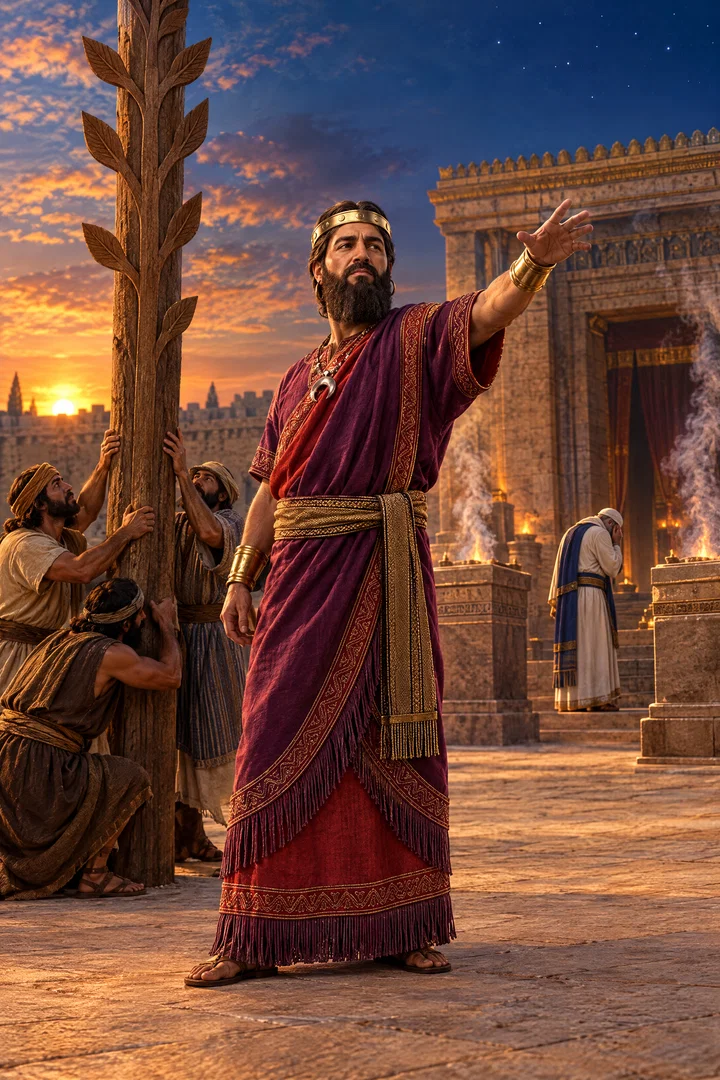
And he set a carved image, the idol which he had made, in the house of God, of which God had said to David and to Solomon his son, In this house, and in Jerusalem, which I have chosen before all the tribes of Israel, will I put my name for ever:
Translations
American King James Version, King James Version, KJV Cambridge Paragraph Bible, Webster Bible
And he set a carved image, the idol which he had made, in the house of God, of which God had said to David and to Solomon his son, In this house, and in Jerusalem, which I have chosen before all the tribes of Israel, will I put my name for ever:
And he set the graven image of the idol, which he had made in the house of God, of which God said to David and to Solomon his son, In this house, and in Jerusalem, which I have chosen out of all the tribes of Israel, will I put my name for ever:
And he set the graven image of the idol, which he had made, in the house of God, of which God said to David and to Solomon his son, In this house, and in Jerusalem, which I have chosen out of all the tribes of Israel, will I put my name for ever:
And he placeth the graven image of the idol that he made in the house of God, of which God said unto David, and unto Solomon his son, 'In this house, and in Jerusalem that I have chosen out of all the tribes of Israel, I put My name to the age,
And he set the graven image of the idol that he had made, in the house of God, of which God had said to David and to Solomon his son, In this house, and in Jerusalem, which I have chosen out of all the tribes of Israel, will I put my name for ever;
and he set a resemblance-image which he had made,—in the house of God, as to which God had said unto David, and unto Solomon his son, In this house and in Jerusalem which I have chosen out of all the tribes of Israel, will I put my Name, unto times age-abiding.
Berean Standard Bible, Majority Standard Bible
Manasseh even took the carved image he had made and set it up in the house of God, of which God had said to David and his son Solomon, “ In this temple and in Jerusalem, which I have chosen out of all the tribes of Israel, I will establish My Name forever.
He set the engraved image of the idol, which he had made, in God’s house, of which God said to David and to Solomon his son, “ In this house, and in Jerusalem, which I have chosen out of all the tribes of Israel, I will put my name forever.
And he put the image he had made in the house of God, the house of which God had said to David and to Solomon his son, In this house, and in Jerusalem, the town which I have made mine out of all the tribes of Israel, will I put my name for ever:
He put also the carued image, which he had made, in the house of God: whereof God had said to Dauid and to Salomon his sonne, In this house and in Ierusalem, which I haue chosen before all the tribes of Israel, will I put my Name for euer,
Douay-Rheims (Challoner revision)
He set also a graven, and a molten statue in the house of God, of which God had said to David, and to Solomon his son: In this house, and in Jerusalem, which I have chosen out of all the tribes of Israel, will I put my name for ever.
Pictures
Cross-references
- 2 Kings 21:4-7
And he built altars in the house of the LORD, of which the LORD said, In Jerusalem will I put my name.
Manasseh placed idols and altars in the temple.
- Psalms 132:13-14
For the LORD hath chosen Zion; he hath desired it for his habitation.
God chose Zion as his dwelling place, where he would dwell forever.
- Exodus 20:4
Thou shalt not make unto thee any graven image, or any likeness of any thing that is in heaven above, or that is in the earth beneath, or that is in the water under the earth:
Forbids making graven images and likenesses.
- 1 Kings 9:3
And the LORD said unto him, I have heard thy prayer and thy supplication, that thou hast made before me: I have hallowed this house, which thou hast built, to put my name there for ever; and mine eyes and mine heart shall be there perpetually.
God declares that his name will remain in the temple.
- Leviticus 26:1
Ye shall make you no idols nor graven image, neither rear you up a standing image, neither shall ye set up any image of stone in your land, to bow down unto it: for I am the LORD your God.
Forbids carved images and idols.
- 2 Samuel 7:13
He shall build an house for my name, and I will stablish the throne of his kingdom for ever.
God promises a house for his name, which he chose to dwell in Jerusalem.
- 2 Chronicles 33:12-13
And when he was in affliction, he besought the LORD his God, and humbled himself greatly before the God of his fathers,
Manasseh was restored after humbling himself despite his wickedness.
- 2 Corinthians 6:16
And what agreement hath the temple of God with idols? for ye are the temple of the living God; as God hath said, I will dwell in them, and walk in them; and I will be their God, and they shall be my people.
Both contrast God’s temple and worship with idols.
- Deuteronomy 17:2-3
If there be found among you, within any of thy gates which the LORD thy God giveth thee, man or woman, that hath wrought wickedness in the sight of the LORD thy God, in transgressing his covenant,
Both condemn serving and worshipping other gods.
- Romans 1:23
And changed the glory of the uncorruptible God into an image made like to corruptible man, and to birds, and fourfooted beasts, and creeping things.
Both describe worship exchanged for an image of created things.
- Deuteronomy 12:31
Thou shalt not do so unto the LORD thy God: for every abomination to the LORD, which he hateth, have they done unto their gods; for even their sons and their daughters they have burnt in the fire to their gods.
Forbids worship practices associated with idols.
- 2 Chronicles 36:19
And they burnt the house of God, and brake down the wall of Jerusalem, and burnt all the palaces thereof with fire, and destroyed all the goodly vessels thereof.
decline ends in temple burned
- 1 Kings 14:21-24
And Rehoboam the son of Solomon reigned in Judah. Rehoboam was forty and one years old when he began to reign, and he reigned seventeen years in Jerusalem, the city which the LORD did choose out of all the tribes of Israel, to put his name there. And his mother’s name was Naamah an Ammonitess.
Cited alongside Manasseh’s episode as evidence of forbidden worship in Israel.
- Ezekiel 8:5-16
Then said he unto me, Son of man, lift up thine eyes now the way toward the north. So I lifted up mine eyes the way toward the north, and behold northward at the gate of the altar this image of jealousy in the entry.
Both describe idolatrous worship in the house of God.
Commentary
Each commentary is drawn from primary sources: the writings of Ellen G. White and Adventist pioneers and periodicals. Each commentary is separate. Its own words are not a quotation; follow the references to read the source passages.
Ellen G. White
1 source
Manasseh set a carved idol that he himself had made inside the house of God.RH Jul 22, 1915 That house was in Jerusalem, which God had chosen before all the tribes of Israel to bear His name forever.RH Jul 22, 1915 Placing the idol there violated the temple's sacred purpose and set aside God's commands.RH Jul 22, 1915 During Manasseh's reign neglect caused the temple copy of the law to be lost, depriving the people of its instruction.RH Jul 22, 1915
Sources
Pioneers and periodicals
17 sources
Manasseh set up a carved idol of his own making inside the house of God, Solomon's temple at Jerusalem.ST Jul 19, 1905ST Sep 13, 1905ST Oct 22, 1894 That house was the place God had promised to David and to Solomon his son, having chosen Jerusalem before all the tribes of Israel to put His name there forever for the worship of the true God.ST Jul 19, 1905ST Jan 14, 1897 The act was a presumptuous profanation that violated the sacred purpose of the sanctuary and set aside God's commands.ST Jul 19, 1905ST Sep 13, 1905 It shows the exceeding wickedness of his apostasy, which brought great trouble on the kingdom, led Judah into sin, and brought severe chastisement in captivity in Babylon.ST Sep 13, 1905ST Jun 2, 1909ST Sep 13, 1905ST Jan 30, 1896 His reign was wicked before his repentance, yet when taken prisoner by the Assyrians he humbled himself, learned to know God, and was converted, and in wonderful mercy God heard him, restored him to his kingdom and accepted him.ST Sep 13, 1905ST May 7, 1912ST Nov 4, 1897
Idol Placed in Temple
Manasseh set a carved image, an idol he himself had made, inside the house of God in Jerusalem, which was Solomon's temple.ST Jul 19, 1905ST Sep 13, 1905ST Oct 22, 1894ST Nov 5, 1912ST Jan 14, 1897 The depth of that act lay in carrying his idolatry into the temple itself, putting the idol he had made in the very place God had chosen for His name and thereby profaning the sanctuary and leading Judah into sin.ST Jul 19, 1905ST Sep 13, 1905ST Oct 22, 1894ST Nov 5, 1912ST Jan 30, 1896 That polluting of Solomon's temple belonged to his idolatrous worship, and Israel's departure from God did not end worship and sacrifice but turned it to the false gods of the surrounding nations.ST Oct 22, 1894ST Nov 5, 1912ST Jan 14, 1897ST Jan 30, 1896 The word image here denotes a physical representation having real shape and form, a carved idol with tangible figure.ST Aug 23, 1877
The house was the one of which God had spoken to David and to Solomon his son, choosing Jerusalem before all the tribes of Israel to put His name there forever.RH Jul 22, 1915ST Jul 19, 1905ST Jan 14, 1897ST Jul 19, 1905ST Jul 19, 1905 It was the place God had chosen for His name to dwell forever in Jerusalem and to bear His name, dedicated to the worship of the true God.RH Jul 22, 1915ST Jul 19, 1905ST Jan 14, 1897ST Jul 19, 1905 The verse thus sets God's chosen sanctuary for His name over against idolatrous worship, underscoring that contrast.RH Jul 22, 1915ST Jul 19, 1905ST Jul 19, 1905 To place his carved idol there was a presumptuous act of idolatry in the very house dedicated to God, profaning the place God had chosen for His name.ST Jul 19, 1905ST Sep 13, 1905ST Jul 19, 1905ST Jul 19, 1905 It violated the temple's sacred purpose and set aside God's commands.RH Jul 22, 1915ST Jul 19, 1905ST Sep 13, 1905ST Jul 19, 1905ST Jul 19, 1905
Manasseh was the son of Hezekiah, born during the fifteen years added to Hezekiah's life after Hezekiah prayed for an extension of life.ST May 7, 1912ST Sep 13, 1905 His reign of fifty-five years was one of the longest, and he was one of the wickedest kings Judah ever had, whose wickedness brought great trouble on the kingdom.ST May 7, 1912ST Sep 13, 1905 The setting of the idol in the house of God belongs to that wicked reign.ST Jul 19, 1905ST Sep 13, 1905ST Oct 22, 1894ST May 7, 1912 His setting of the idol belonged to wider worship of Baal and the heavenly bodies, alongside other idolatrous practices, including sun-worship.ST Oct 22, 1894ST Dec 24, 1896 Israel continued worshiping and sacrificing but turned to the false gods of surrounding nations, and their worship became more elaborate than what God required, with false religious zeal leading even to sacrificing children to idols.ST Oct 22, 1894ST Jan 14, 1897ST Dec 24, 1896
Wickedness, Judgment, and Mercy
The setting of a self-made carved image in the house God had chosen for His name shows the depth and exceeding wickedness of Manasseh's apostasy and backsliding.ST Sep 13, 1905ST Jun 2, 1909ST Jan 30, 1896ST Dec 24, 1896 That profaning of the sanctuary led Judah into sin and brought great trouble on the kingdom, and the sonship to Hezekiah did not prevent that evil course.ST Sep 13, 1905ST Sep 13, 1905ST Jan 30, 1896 His idolatry reaching into the temple itself belonged to Judah's wider idolatrous backsliding, including its turn to sun-worship.ST Jan 30, 1896ST Dec 24, 1896
That backsliding brought severe chastisement and captivity, even to Judah's captivity in Babylon.ST Sep 13, 1905ST Jan 30, 1896ST Dec 24, 1896 The later carrying of the temple vessels to Babylon illustrated the defeat that followed when Israel's religion had become mere ritual and its people rejected light. The contrast between God's chosen sanctuary for His name and idolatrous worship underscores why judgment came.ST Sep 13, 1905
Manasseh's reign was wicked before his repentance and return to the Lord.ST Sep 13, 1905ST May 7, 1912ST Nov 4, 1897 After he was taken prisoner by the Assyrians he humbled himself in captivity, learned to know God, and was converted.ST Sep 13, 1905ST May 7, 1912ST Nov 4, 1897ST Jun 2, 1909 Through God's long patience and wonderful mercy God heard him, restored him to his kingdom and accepted him, and he tried to reform the kingdom.ST Sep 13, 1905ST May 7, 1912ST Jun 2, 1909 During that reign the temple copy of the law was lost through neglect, depriving the people of its instruction, and what is said to be his prayer is found in the Apocrypha.RH Jul 22, 1915ST May 7, 1912
The episode shows Israel practicing forbidden forms of worship despite God's prohibition.ST Aug 27, 1902 What God called abominable then remains abominable.ST Aug 27, 1902 The profanation of a sanctuary dedicated to the worship of the true God stands as a warning against bringing idol worship into a place set apart for God.ST Aug 27, 1902ST Apr 22, 1889
Sources