2 Chronicles 36:19
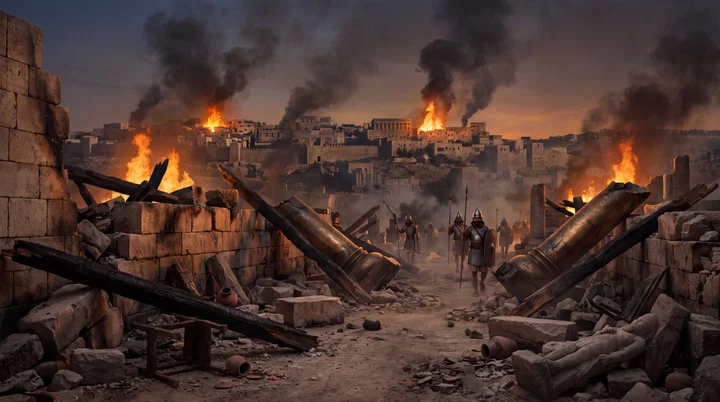
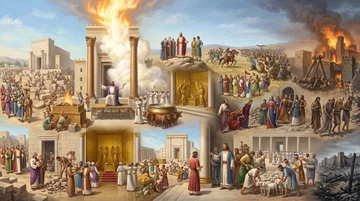
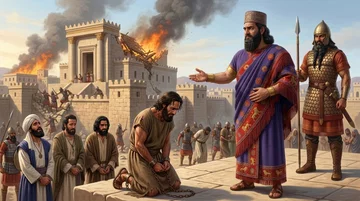
And they burnt the house of God, and brake down the wall of Jerusalem, and burnt all the palaces thereof with fire, and destroyed all the goodly vessels thereof.
Translations
And they burnt the house of God, and broke down the wall of Jerusalem, and burnt all the palaces thereof with fire, and destroyed all the goodly vessels thereof.
King James Version, KJV Cambridge Paragraph Bible, Revised Version, American Standard Version
And they burnt the house of God, and brake down the wall of Jerusalem, and burnt all the palaces thereof with fire, and destroyed all the goodly vessels thereof.
And they burnt the house of God, and broke down the wall of Jerusalem, and burnt all its palaces with fire, and destroyed all its goodly vessels.
And they burn the house of God, and break down the wall of Jerusalem, and all its palaces they have burnt with fire, and all its desirable vessels — to destruction.
And they burned the house of God, and broke down the wall of Jerusalem, and burned all the palaces thereof with fire, and all the precious vessels thereof were given up to destruction.
and they burned the house of God, and threw down the wall of Jerusalem,—and, all the palaces thereof, burned they with fire, and, all the precious vessels thereof, he destroyed;
Berean Standard Bible, Majority Standard Bible
Then the Chaldeans set fire to the house of God and broke down the wall of Jerusalem. They burned down all the palaces and destroyed every article of value.
They burned God’s house, broke down the wall of Jerusalem, burned all its palaces with fire, and destroyed all of its valuable vessels.
And the house of God was burned and the wall of Jerusalem broken down; all its great houses were burned with fire and all its beautiful vessels given up to destruction.
And they burnt the house of God, and brake downe the wall of Ierusalem, and burnt all the palaces thereof with fire, and all the precious vessels thereof, to destroy all.
Douay-Rheims (Challoner revision)
And the enemies set fire to the house of God, and broke down the wall of Jerusalem, burnt all the towers, and whatsoever was precious they destroyed.
Pictures
Cross-references 20 of 51
- Jeremiah 17:27
But if ye will not hearken unto me to hallow the sabbath day, and not to bear a burden, even entering in at the gates of Jerusalem on the sabbath day; then will I kindle a fire in the gates thereof, and it shall devour the palaces of Jerusalem, and it shall not be quenched.
Jeremiah’s warning of unquenched fire consuming Jerusalem’s palaces is fulfilled in their destruction.
- Jeremiah 25:11-12
And this whole land shall be a desolation, and an astonishment; and these nations shall serve the king of Babylon seventy years.
Foretells Jerusalem’s desolation and the seventy-year Babylonian captivity.
- Daniel 9:2
In the first year of his reign I Daniel understood by books the number of the years, whereof the word of the LORD came to Jeremiah the prophet, that he would accomplish seventy years in the desolations of Jerusalem.
Identifies the seventy-year period of Jerusalem’s desolation.
- Isaiah 63:18
The people of thy holiness have possessed it but a little while: our adversaries have trodden down thy sanctuary.
The sanctuary’s treading down is shown in the temple’s ruin.
- 2 Kings 24:1
In his days Nebuchadnezzar king of Babylon came up, and Jehoiakim became his servant three years: then he turned and rebelled against him.
Its account plainly specifies the event by recording Nebuchadnezzar’s invasion and Jehoiakim’s rebellion.
- Daniel 9:17
Now therefore, O our God, hear the prayer of thy servant, and his supplications, and cause thy face to shine upon thy sanctuary that is desolate, for the Lord’s sake.
Daniel prays for the sanctuary destroyed and left desolate.
- Psalms 137:1-2
By the rivers of Babylon, there we sat down, yea, we wept, when we remembered Zion.
The captives weep and mourn as they remember Zion in Babylon.
- 2 Kings 25:13-15
And the pillars of brass that were in the house of the LORD, and the bases, and the brasen sea that was in the house of the LORD, did the Chaldees break in pieces, and carried the brass of them to Babylon.
Also recounts the Chaldeans’ destruction and plunder of Jerusalem and the Temple.
- Isaiah 64:11
Our holy and our beautiful house, where our fathers praised thee, is burned up with fire: and all our pleasant things are laid waste.
Both describe the burning and destruction of the sanctuary.
- Ezra 1:2-3
Thus saith Cyrus king of Persia, The LORD God of heaven hath given me all the kingdoms of the earth; and he hath charged me to build him an house at Jerusalem, which is in Judah.
Cyrus commands the rebuilding of the temple after its destruction.
- Psalms 74:7
They have cast fire into thy sanctuary, they have defiled by casting down the dwelling place of thy name to the ground.
Both describe the sanctuary burned and laid waste.
- Leviticus 26:34-35
Then shall the land enjoy her sabbaths, as long as it lieth desolate, and ye be in your enemies’ land; even then shall the land rest, and enjoy her sabbaths.
The land’s rest during its desolation fulfills this warning.
- Micah 4:10
Be in pain, and labour to bring forth, O daughter of Zion, like a woman in travail: for now shalt thou go forth out of the city, and thou shalt dwell in the field, and thou shalt go even to Babylon; there shalt thou be delivered; there the LORD shall redeem thee from the hand of thine enemies.
Foretells Zion’s anguish, exile to Babylon, and return.
- Psalms 79:1
O God, the heathen are come into thine inheritance; thy holy temple have they defiled; they have laid Jerusalem on heaps.
describes same destruction of sanctuary
- 2 Chronicles 7:19-22
But if ye turn away, and forsake my statutes and my commandments, which I have set before you, and shall go and serve other gods, and worship them;
The temple’s destruction fulfills the warning of judgment for Israel’s disobedience.
- Daniel 1:1-2
In the third year of the reign of Jehoiakim king of Judah came Nebuchadnezzar king of Babylon unto Jerusalem, and besieged it.
Both describe Jerusalem’s capture and the removal of temple vessels to Babylon.
- Isaiah 39:6
Behold, the days come, that all that is in thine house, and that which thy fathers have laid up in store until this day, shall be carried to Babylon: nothing shall be left, saith the LORD.
Foretells Jerusalem’s treasures being carried to Babylon.
- Jeremiah 29:10
For thus saith the LORD, That after seventy years be accomplished at Babylon I will visit you, and perform my good word toward you, in causing you to return to this place.
The destruction and exile occur within the promised seventy years in Babylon.
- 2 Kings 24:10-16
At that time the servants of Nebuchadnezzar king of Babylon came up against Jerusalem, and the city was besieged.
Describes an earlier siege and deportation of Jerusalem’s people and temple valuables.
- Jeremiah 52:10-27
And the king of Babylon slew the sons of Zedekiah before his eyes: he slew also all the princes of Judah in Riblah.
Gives a parallel account of the city’s destruction and the deportations.
Commentary
Each commentary is drawn from primary sources: the writings of Ellen G. White and Adventist pioneers and periodicals. Each commentary is separate. Its own words are not a quotation; follow the references to read the source passages.
Ellen G. White
8 sources
The verse describes the Chaldean devastation of Jerusalem, in which the beautiful house of God that for more than four centuries had crowned the summit of Mount Zion was not spared but was burned with fire, the wall of Jerusalem was broken down, all its palaces were burned, and all its precious vessels and treasures were ruined and destroyed.PK 458.2LS 45.2–3PK 422.21SP 414.2–3 It was God's wrath carried out upon impenitent Judah through Nebuchadnezzar king of Babylon as His instrument.PK 422.2 It came after repeated investments and entries of Jerusalem by his besieging armies, after companies of captives at first few and later thousands and tens of thousands were taken to enforced exile in the land of Shinar, and after Jehoiakim, Jehoiachin, and Zedekiah each in turn became vassals of Babylon and then rebelled, bringing severer and yet more severe chastisements upon the rebellious nation until the entire land became a desolation, Jerusalem was laid waste and burned with fire, the temple Solomon had built was destroyed, and the kingdom of Judah fell never again to occupy its former position among the nations of earth.PK 422.2
It was the fearful penalty for Zedekiah's sinful weakness in refusing to submit to God's just requirements given through Jeremiah.PK 458.2 The resistless enemy devastated the city, drove back the Hebrew armies in confusion, and conquered the nation.PK 458.2 Zedekiah was taken prisoner, his sons were killed before his eyes, his own eyes were put out, and he was led captive from Jerusalem to Babylon where he died miserably.PK 458.2 The destruction fulfilled, some hundreds of years after the temple was built, the calamity God said would come upon the temple if His people departed from Him, whereas He had promised Solomon that if he remained faithful and the people obeyed all His commandments that glorious temple would stand forever in all its splendor as evidence of the prosperity and exalted blessings resting upon Israel for obedience.SG4 114.3–41SP 414.2–3
The underlying cause was Israel's transgression of the commandments and wicked acts, for which God suffered them to go into captivity to humble and punish them and suffered the temple to be destroyed, though the temple was the pride of Israel and they regarded it with idolatry while sinning against God.SG4 114.3–41SP 414.2–3 The people had also failed to serve as God's missionaries and to carry His message, separating themselves from surrounding peoples and building walls of division between themselves and other nations.YGBCOEP 11.3RH Apr 14, 1903Ms 22, 1903, par. 3–4 Before the destruction God made known to a few faithful servants the fate of the temple and the captivity of Israel, and just before the destruction those righteous men removed the sacred ark containing the tables of stone and with mourning and sadness hid it in a cave from the people of Israel because of their sins, never to be restored to them, and that sacred ark is yet hid there and has never been disturbed since.SG4 114.3–41SP 414.2–3
Their defeat, exile, and scattering among heathen lands served to spread the knowledge of God's truth to the world.YGBCOEP 11.3RH Apr 14, 1903Ms 22, 1903, par. 3–4 If they remained loyal, true, submissive, and faithful, God would bring them back to their land, so their return depended on that loyalty and submission.YGBCOEP 11.3RH Apr 14, 1903Ms 22, 1903, par. 3–4 The destruction came eighteen years after Jerusalem was taken by Nebuchadnezzar when the seventy years' captivity commenced, and thirty-five years before Daniel's vision in the third year of Belshazzar in B.C. 553.LS 45.2–3 The city was still prostrate and the temple still ruined and desolate when Daniel, having learned from Jeremiah that the seventy years were drawing near their close and supposing the 2300 days ended with the seventy years of servitude, turned his face toward the ruined city and temple to pray God to cause His face to shine upon His sanctuary which is desolate.LS 45.2–3 The verse stands as an admonition of what happens when God's people fail in their mission.Ms 22, 1903, par. 3–4
Sources
Pioneers and periodicals
87 sources
The Chaldeans under Nebuchadnezzar burned the house of God, broke down the wall of Jerusalem, burned all the palaces with fire and destroyed all the valuable vessels, marking the final overthrow of Judah and the end of its kingdom in B.C. 586 after decline under the kings who followed Josiah.ST Jul 30, 1885ST May 7, 1912ST Jul 23, 1885ST Jul 4, 1911
The Lord had sent His messengers rising up betimes with compassion, but the people mocked them, despised His words and misused His prophets till His wrath arose with no remedy, so He brought the king of the Chaldees against them.ST Sep 29, 1914ST Sep 13, 1905ST Dec 7, 1904
Refusal to keep the Sabbath was the chief cause of the overthrow and captivity, and because the land had not kept its sabbaths for 490 years it lay desolate seventy years to enjoy the rest denied it, fulfilling the word by Jeremiah.ST Sep 29, 1914RH Jul 11, 1912ST Feb 10, 1914ST Sep 26, 1911RH Oct 29, 1914
The fire that devoured the house, the gates and the palaces was the unquenchable fire threatened upon Jerusalem, which no human power could check till it had utterly consumed what it was sent to destroy, then went out for lack of fuel and did not burn forever.ST Jan 6, 1904ST Jan 9, 1907
In this burning God forsook the temple as He forsook the tabernacle at Shiloh, casting off His altar and sanctuary because of idolatry and pollution, and the desolation points forward to a coming thousand years when the earth will rest desolate from tillage under sin.ST Sep 29, 1914RH Jan 20, 1853ST Sep 26, 1911RH Jan 20, 1853
Historical Destruction by Babylon
The Chaldeans or Babylonians under Nebuchadnezzar burned the house of God, broke down the wall of Jerusalem, burned all the palaces with fire, and destroyed all the goodly or valuable vessels thereof.ST Jul 30, 1885ST May 7, 1912RH Jan 21, 1862ST Sep 24, 1902 The temple of God and the houses of the leading men were burned, the city wall was pulled down and demolished, and the temple's valuable vessels were destroyed as the judgment that followed Judah's apostasy, rebellion, persistent disobedience, transgression, rejection of God's messengers and warnings, idolatry and Sabbath-breaking.ST Jul 30, 1885RH Jan 21, 1862ST Sep 24, 1902 The fire fulfilled Jeremiah's warning that Jerusalem's gates and palaces would be consumed by unquenched fire, not a fire that burned forever but one that could not be stopped until its destruction was complete. The city and temple then remained in ruins during the seventy years of captivity in Babylon.ST Sep 24, 1902
This was the final devastation of Judah after its course turned rapidly downward under the declining reigns of the kings who followed Josiah, when the people piled transgression upon transgression and rejected message after message.ST May 7, 1912ST Jul 23, 1885ST Jul 4, 1911 It marked the fall of the Jewish kingdom, the overthrow of its kingdom, the end of its monarchy, and the desolation of the sanctuary, with the city and its sacred and royal buildings destroyed before those who survived the sword were taken captive to Babylon and scattered for seventy years.ST Jul 30, 1885ST Jul 23, 1885ST Nov 7, 1906RH Jul 20, 1911GSAM 47.1–2 The passage belongs to the account of Judah's final kings and their wickedness and to the culmination of repeated efforts to destroy God's people.ST Jul 23, 1885ST Nov 7, 1906RH Jul 20, 1911
The destruction in B.C. 586 was the third captivity, when Jerusalem was completely destroyed, the house of God burned and its vessels destroyed.ST Jul 4, 1911ST Jan 4, 1905ST Aug 9, 1899 It is distinct from the first great captivity in B.C. 606, which began the seventy years' captivity when Daniel and his companions were taken, and from the second captivity in B.C. 598 or 599 when Ezekiel and many others were taken with much treasure and only part of the temple vessels had first been seized.ST Jan 4, 1905ST Nov 28, 1911ST Aug 9, 1899 Jerusalem was captured twice more, in 599 and 588 B.C., with the remaining treasures taken and the temple and city destroyed in the later capture, though some reckon the Chaldean demolition and burning of the walls and house of God in 588 B.C. and some place the final plundering and burning of Solomon's Temple around 584 B.C.RH Nov 10, 1863ST Nov 28, 1911ST Apr 1, 1880 Reckoning Christ's birth four years before the common era, the going away into Babylon in 606 was 602 years before Christ.ST Jan 4, 1905
The utter demolition came eighteen years after Jerusalem was taken by Nebuchadnezzar when the seventy years' captivity commenced, and thirty-five years before Daniel's vision in the third year of Belshazzar in B.C. 553.LS 45.2–3ST Jan 24, 1878RH Dec 31, 1857 The final destruction followed Zedekiah breaking his promised allegiance to Nebuchadnezzar and rebelling, after the city endured a siege of a year and a half and was taken, with Zedekiah and many of the people carried to Babylon.ST Aug 20, 1885RH May 28, 1908 The city was still prostrate and the temple still ruined and desolate when Daniel, having learned from Jeremiah that the seventy years drew near their close and supposing the 2300 days ended with the servitude, turned toward the ruined city and temple to pray God to cause His face to shine upon His sanctuary which is desolate.LS 45.2–3 The devastation was so extensive that only a small poor remnant remained in the land, while those who escaped the slaughter in the siege and the sword, including Daniel and other royal youths, leading people, surviving members of the royal family and priesthood, were carried to Babylon, and some sanctuary vessels were taken there rather than destroyed.ST May 24, 1883ST Aug 20, 1885RH May 28, 1908ST The account of siege and destruction in 2 Chronicles 36 is sufficient evidence that the siege occurred even if 2 Kings does not use the word siege.ST Jan 11, 1916
Causes of Divine Judgment
The Lord had compassion on His people and on His dwelling place and sent to them by His messengers, rising up betimes and sending, but they mocked the messengers of God, despised His words, and misused and scoffed at His prophets until the wrath of the Lord arose against His people till there was no remedy.ST Sep 29, 1914ST Sep 13, 1905ST Dec 7, 1904RH Jan 20, 1853 Therefore He brought upon them the king of the Chaldees, who slew without compassion in the house of the sanctuary, and they burned the house of God, broke down the wall of Jerusalem, burned all the palaces with fire, and destroyed all the goodly vessels.ST Sep 29, 1914ST Dec 7, 1904RH Jan 20, 1853 This destruction followed Judah's persistent rebellion and rejection of God's prophets, with transgression and refusal to heed His words bringing death and exile and leaving city and temple in ruins through the seventy years of captivity in Babylon.RH Jul 14, 1903ST Sep 24, 1902
Growing wickedness, transgression, idolatry and apostasy led God to withdraw His protecting arm and remove the kingdom, after the people polluted the sanctuary with the abominations of the nations and rejected repeated warnings.RH Jul 11, 1912ST Apr 29, 1903ST May 16, 1911ST Oct 8, 1896 Jerusalem was destroyed because the people persisted in sin, and its restoration as a holy mountain and city of truth depended on turning from the wrongdoing that had led God to depart and destroy the city.ST Jun 21, 1883 The calamity that burned temple, walls, palaces and sacred vessels came when God withdrew His protection, following persistent Sabbath-breaking, idolatry and refusal to heed warnings, and it fulfilled the word of the Lord by Jeremiah while the land enjoyed its neglected Sabbaths.RH Jul 11, 1912ST Sep 8, 1909
The people turned from God to Baal, from the Sabbath of the Lord to the sun festivals of Baal, showing the helplessness of human strength apart from Him.ST Nov 15, 1899RH Jan 21, 1904 Their captivity in Babylon followed their captivity to sin, for slavery of soul leads to slavery of body and sin leads to death, while deliverance from sin and captivity rests in the promised Seed, Jesus Christ.RH Jan 21, 1904 The loss of the outward temple when Judah was given into Babylonian power for transgression was meant to teach the real lesson of the temple and its services.RH Oct 14, 1902
Jerusalem was destroyed and its people carried into heathen lands because they had failed to serve as God's missionaries and had built walls of division between themselves and surrounding peoples.RH Apr 14, 1903 This came after they withheld honor and service from God and neglected the Sabbath, and it served as a lesson rather than a permanent judgment, with their scattering carrying knowledge of God's truth to the world.RH Apr 14, 1903ST Apr 15, 1903 If they remained loyal, true and submissive, God would bring them back to their land, while the land's rest during captivity answered their failure to observe the Sabbath.RH Apr 14, 1903ST Apr 15, 1903
God permitted His enemies to destroy Jerusalem and its temple and carry away its treasures, using foreign idolaters to execute judgment and foreign rulers who did not worship Him as instruments of judgment and later restoration.ST Sep 26, 1906RH Dec 1, 1874ST Apr 15, 1903 Their desolation with sanctuary desolated and survivors of the sword taken captive to Babylon did not prevent Him from later commanding the temple to be rebuilt.ST Sep 26, 1906RH Jul 20, 1911 He also punished peoples who mocked Jerusalem and reproved His people for selfishly delaying the work.ST Sep 26, 1906
The burning began the scattering of Israel under a curse for disobedience to the commandments, fulfilling the warning that disobedience would drive them from the land, a process that may have continued through the later Roman destruction.RH Oct 22, 1861 The chiefs of the priests and the people trespassed and polluted the temple with heathen practices, so its holy vessels were safer in Babylon than in the temple at Jerusalem.ST Jul 13, 1904 Their persistent rejection of God's messengers brought the end of Judah's kingdom until the one with the rightful claim, Christ, would come.ST Jul 13, 1904
Sabbath Neglect and Land Rest
Utter refusal to keep the Sabbath and rest from work on the Sabbath day was the primal and chief cause of the overthrow, captivity, and threatened judgment.ST Sep 29, 1914RH Jul 11, 1912ST May 21, 1896ST Jun 11, 1894 The failure was concrete disobedience to the command to remember the Sabbath day to keep it holy, including carrying burdens in the city and transacting business on the holy rest day, and for this the city was destroyed and the people given into the hands of their oppressors.ST Jun 17, 1886RH Oct 29, 1914RH Aug 27, 1914 After mocking the messengers of God, despising His words, polluting the sanctuary, and persisting in transgression until there was no remedy, the house of God was burned, the wall of Jerusalem broken down, all the palaces burned with fire, and all the goodly or valuable vessels destroyed, and those who escaped the sword were carried to Babylon as servants until the reign of Persia.ST Sep 29, 1914RH Jul 11, 1912 God had commanded the Sabbath in memory of His creative works, and when they would not keep it He removed them so the land could rest, fulfilling the word of the Lord by Jeremiah that the land would enjoy her Sabbaths while lying desolate seventy years.ST Sep 29, 1914RH Jul 11, 1912
Israel had turned from God to Baal, from the Sabbath of the Lord to the sun festivals of Baal, chief among which was the sun's day, and so fell into idolatry.ST Nov 15, 1899ST Dec 20, 1899 Keeping the Sabbath as God commanded guards against idolatry by reminding that the Lord is the living Creator.ST May 21, 1896 The Sabbath was His sign that He sanctified Israel, in contrast to Babylonian worship of another god.ST May 21, 1896
Because the people had not allowed the land to keep its sabbaths, including the Sabbath year for the land, it lay largely desolate seventy years and enjoyed the rest denied it from tillage.ST Sep 29, 1914ST Feb 10, 1914RH Mar 19, 1901 This followed disregarding God's Sabbath for 490 years and fulfilled the word by Jeremiah, completing the warning of unquenched fire that would devour the palaces when the Sabbath was profaned.ST Sep 26, 1911ST Nov 5, 1912ST Jun 28, 1877 The fire was unquenchable because nothing stopped it from completing its work of burning temple and palaces, breaking down the wall, and destroying the vessels until the land lay desolate to enjoy its Sabbaths, not because it burned forever.ST Nov 5, 1912
If Israel had hallowed the Sabbath Jerusalem would have remained forever, but profanation brought utter destruction.ST Nov 15, 1899ST Dec 20, 1899RH Jan 21, 1862 Nehemiah understood that Sabbath-breaking caused the destruction and labored to enforce Sabbath-keeping to forestall its recurrence.ST Dec 20, 1899RH Jan 21, 1862 The desolation points forward to a coming thousand years when the earth will rest from its tillage under sin, desolate with no tilling, sowing, or reaping and sinners destroyed out of it, as the earth's seventh millennium counterpart to the Sabbath law and historical pattern of the desolated land, after which there will be no more Sabbath-breaking.ST Sep 29, 1914ST Sep 26, 1911
The verse proves God is particular whether men keep His Sabbath and that the seventh day is the Sabbath.ST Jun 17, 1886 As Sabbath-breaking led Israel after the flesh into Babylon into conquest, seventy years of bondage, and deliverance covering but one generation, so obedience to God's Sabbath brings His children out of Babylon.ST Jun 17, 1886RH May 11, 1916 These things are written for learning for those upon whom the ends of the world are come, as a pattern for the last generation, and those who leave Babylon will live in the generation witnessing Babylon's doom at the second advent of Christ, with God's word of prophecy and God's prophet prominent in deliverance.RH May 11, 1916
The desolation closed the reign of Josiah, the last obedient king of Jerusalem who obeyed the commandments.SMV 22.1–24.1 After B.C. 607 the Jews never kept and could never keep a year of release or Jubilee, because neither kings, nobles, people, nor lands could be redeemed, having kept no more than 21 Jubilees and lacking 23 of the great Jubilee.SMV 22.1–24.1 The land lying desolate while God's people were in their enemies' land began the Jubilee of Jubilees of 49 times 50 years, or 2450 years, which reckoned from 607 leaves A.D. 1843, when the Jubilee of Jubilees comes with return to possession, redemption of the body, and liberty proclaimed throughout the land.SMV 22.1–24.1
Prophecies Fulfilled in Fall
The burning of the house of God, the breaking down of the wall of Jerusalem, and the burning and destroying of all the palaces and goodly vessels completed the overthrow of the Jewish nation under Nebuchadnezzar and fulfilled the word of the Lord by Jeremiah concerning Jerusalem.ST Jun 28, 1877 This desolation came as judgment after persistent transgression, idolatry, refusal to heed warnings, and utter refusal to keep the Sabbath and rest from work, when mocking of God's messengers and despising of His words left no remedy, so those who escaped the sword were carried to Babylon as servants until the reign of Persia.ST Sep 29, 1914ST Sep 8, 1909 In this the land was made to enjoy her Sabbaths, resting from tillage while it lay desolate seventy years, because God had commanded the Sabbath in memory of His creative works and, when the people would not keep it, removed them so the land could rest.ST Sep 29, 1914ST Jun 28, 1877ST Sep 8, 1909 The withdrawing of His protection thus allowed the calamity upon temple, walls, palaces, and sacred vessels, fulfilling Jeremiah's word and giving the neglected Sabbaths to the land.ST Sep 29, 1914ST Sep 8, 1909
The fire that consumed the house, the palaces, and the city was the fulfillment of Jeremiah's warning that profaning the Sabbath would kindle a fire in the gates to devour the palaces which would not be quenched.ST Jul 8, 1875ST Aug 22, 1911ST Mar 31, 1881ST Feb 2, 1882ST Aug 30, 1877 That unquenchable fire was literal fire which no human power could stop or put out before it fully completed its work, yet it did not burn forever but lasted only until it had reduced to ashes the gates and palaces on which it preyed, then died out for lack of fuel.ST Jul 8, 1875ST Aug 22, 1911ST Mar 31, 1881ST Feb 2, 1882ST Aug 13, 1896 Unquenchable therefore means certain and complete destruction that cannot be checked until it has entirely consumed what causes and supports it, not preservation of fuel by immediate renewal.ST Jul 8, 1875ST Aug 22, 1911ST Mar 31, 1881ST Feb 2, 1882ST Aug 30, 1877 Applied to the wicked, the threatened fire will not be quenched until it has entirely devoured them.ST Jul 8, 1875ST Aug 22, 1911
The entering of the heathen into the sanctuaries, with the burning of the house and the destroying of palaces and vessels, fulfilled the predictions of Asaph, Isaiah, and Ezekiel concerning the defiling and burning of the sanctuary.RH Jan 20, 1853 It accomplished God's declared purpose to cast off His altar and abhor His sanctuary, with priest and prophet slain in the sanctuary and the stones of the sanctuary poured out in the streets.RH Jan 20, 1853 It proves the sanctuary itself is distinct from the land of Canaan, which is only the border or place where the typical sanctuary stood, since when God's people were driven out and dispossessed of their inheritance the sanctuary built in that land was also laid in ruins.RH Jan 6, 1853RH Feb 18, 1858RH Apr 4, 1854RH Feb 15, 1870 In particular it gives the historical fulfillment of Isaiah 63:18, spoken in the past tense for the future, that adversaries had trodden down the sanctuary.RH Jan 6, 1853RH Feb 18, 1858RH Apr 4, 1854RH Feb 15, 1870
The sanctuary thus destroyed shared in the seventy years desolations of Jerusalem and lay desolate through the dispersion until the reign of Persia, during which God promised to be as a little sanctuary to His scattered people.RH Jan 20, 1853RH Sep 2, 1852 This is the desolate sanctuary Daniel prayed about near the close of the seventy years captivity, asking God to cause His face to shine upon it, and after the captivity it was rebuilt.RH Jan 20, 1853RH Sep 2, 1852 The utter demolition came eighteen years after Jerusalem was taken when the seventy years captivity commenced, and thirty-five years before Daniel's vision in the third year of Belshazzar in B.C. 553.LS 45.2–3 The city was still prostrate and the temple still ruined when Daniel, having learned from Jeremiah that the seventy years drew near their close and supposing the 2300 days ended with the servitude, turned his face toward the ruined city and temple to pray for the sanctuary that is desolate.LS 45.2–3
Sanctuary Cast Off Ruined
The burning of the house of God fulfilled the declared purpose to forsake the temple as the tabernacle at Shiloh had been forsaken.RH Jan 20, 1853 Because the people mocked the messengers, despised the words, and misused the prophets until wrath arose with no remedy, the king of the Chaldees was brought upon them to burn the house, break down the wall of Jerusalem, burn all the palaces with fire, and destroy all the goodly vessels.RH Jan 20, 1853 That entering of the heathen into the sanctuaries fulfilled the predictions of Asaph, Isaiah, and Ezekiel concerning the defiling and burning of the sanctuary.RH Jan 20, 1853 In it the Lord cast off His altar and abhorred His sanctuary, with priest and prophet slain in the sanctuary and the stones of the sanctuary poured out in the streets.RH Jan 20, 1853
When the people of His holiness were driven out of Canaan and dispossessed of their inheritance, the sanctuary built in that land was laid in ruins with the house burned and destroyed.RH Jan 6, 1853RH Feb 18, 1858RH Apr 4, 1854RH Feb 15, 1870 Loss of the inheritance and ruin of the sanctuary are two separate results, proving the sanctuary is distinct from the land itself.RH Jan 6, 1853RH Apr 4, 1854RH Feb 15, 1870 The land of Canaan is not the sanctuary but only its border or the place where the typical sanctuary stood as a building located in the land.ST May 27, 1880RH Feb 18, 1858RH Aug 11, 1863RH Feb 15, 1870 The breaking down of wall and palaces and destruction of vessels shows the temple burned and laid waste along with Jerusalem.ST May 27, 1880RH Aug 11, 1863 This destruction is the historical fulfillment of the prophecy spoken in the past tense for the future that adversaries had trodden down the sanctuary in Isaiah 63:18.RH Jan 6, 1853RH Feb 18, 1858RH Apr 4, 1854RH Feb 15, 1870
When Jerusalem ceased to be the central place of worship, the house was burned, the wall broken down, the palaces burned, and the valuable vessels destroyed.ST Jan 28, 1886 God permitted the temple to be burned because the people had turned to idols, so that it had become a reproach to Him. They had polluted it with heathen practices, so its holy vessels were safer in Babylon than in the temple at Jerusalem.ST Jul 13, 1904 Their persistent rejection of the messengers ended the kingdom of Judah until He would come whose right it is, Christ.ST Jul 13, 1904
The destruction recorded was the final destruction of Solomon's typical sanctuary because of unfaithfulness, when house and wall were burned or torn down, palaces burned, and valuable vessels destroyed or carried to Babylon.ST Nov 5, 1912RH Sep 2, 1852 The Chaldeans under Nebuchadnezzar finally plundered and burned it and destroyed Jerusalem after earlier profanations and pillages, about 584 B.C.RH Nov 10, 1863 It thus shared in the seventy years desolations of Jerusalem and lay desolate through the dispersion until the reign of Persia.RH Jan 20, 1853RH Sep 2, 1852 During that time God promised to be to His scattered people as a little sanctuary, and near the close of the seventy years Daniel prayed for God to cause His face to shine upon the sanctuary that is desolate, and after the captivity it was rebuilt.RH Jan 20, 1853RH Sep 2, 1852
Unquenchable Fire Consumes Completely
The fire that burned the house of God, broke down the wall of Jerusalem, burned all the palaces with fire, and destroyed all the goodly vessels was the unquenchable fire threatened upon Jerusalem.ST Jan 9, 1907ST Sep 4, 1907ST Nov 20, 1884 It fulfilled the declaration that Jerusalem's fire would not be quenched, and was not stopped until it had completed its work of destruction.ST Jan 9, 1907ST Sep 4, 1907ST Feb 20, 1907 Unquenchable fire is a divine symbol of a destructive agency that cannot be checked or put out till its work of utter and complete destruction is done.ST Feb 20, 1907 It means utter destruction, consuming what it preys upon, and it cannot be quenched until it finishes its work of complete consumption.ST Jan 9, 1907ST Feb 20, 1907ST Nov 20, 1884
Unquenchable means the fire could not be stopped by human power before it fully consumed what it was sent to destroy.ST Jan 6, 1904ST Mar 31, 1881ST Nov 5, 1912ST Feb 2, 1882 After it did its work it went out and did not burn forever, but ended when its work was complete.ST Jan 6, 1904ST Mar 31, 1881ST Nov 5, 1912 It lasted only until it had reduced gates and palaces to ashes, then died out for lack of fuel when there was nothing more to burn.ST Jul 8, 1875ST Mar 31, 1881ST Feb 2, 1882RH Dec 24, 1872ST Mar 17, 1914 It was unquenchable because nothing stopped it from completing its work of destruction, not because it burned forever, and together with the land lying desolate it fulfilled Jeremiah's warning of an unquenched fire and the word that the land would enjoy her Sabbaths.ST Nov 5, 1912ST
That literal natural fire proves unquenchable fire does not preserve its fuel forever by immediate renewal, but entirely consumes what causes and supports it.ST Jul 8, 1875RH Dec 24, 1872ST Mar 17, 1914 It burned only until it had reduced to ashes the gates and palaces on which it preyed, then died out itself because there was nothing more to burn.ST Jul 8, 1875RH Dec 24, 1872ST Mar 17, 1914 Everlasting fire means fire whose effects are everlasting after complete destruction.ST Jul 8, 1875ST Feb 12, 1894 Applied to the wicked, the threatened fire will not be quenched until it has entirely devoured them.ST Jul 8, 1875ST Feb 12, 1894
The burning of Jerusalem illustrates how the wicked likened to chaff will be burned up.ST Jan 6, 1904 It is the example of the nature and work of the unquenchable fire of Mark 9:43-44, and of the figures of the worm that does not die and the unquenchable fire that Jesus used for the fate of the wicked.STST Mar 17, 1914ST Aug 3, 1915ST Dec 5, 1895 That final unquenchable fire means complete annihilation and utter consumption of sin and those identified with it.RH Jan 7, 1915ST Mar 17, 1914ST Aug 3, 1915ST Dec 5, 1895 It proves completed punishment bringing complete destruction, not eternal torture or continual punishing or torment without end.RH Jan 7, 1915ST Mar 17, 1914ST Aug 3, 1915ST Dec 5, 1895
Church Christ and Last Days
Judah's growing wickedness led God to remove His protection and withdraw His protecting arm, and the people were carried away captive to Babylon.ST Apr 29, 1903ST May 16, 1911ST Oct 8, 1896 That Babylonian captivity began the church's anguish and longing for the Deliverer.ST Apr 29, 1903ST May 16, 1911 It marked the church's humiliation and grief over what it had lost as well as its longing, and that period of anguish continued until Jesus was born in Bethlehem.ST May 16, 1911ST Oct 8, 1896
The burning of the temple, breaking down of the wall, burning of the palaces, and destruction of the valuable vessels because of persistent sin illustrates why the later promise of God's protection for Jerusalem depended on the Jews remaining faithful to Him.ST Apr 19, 1883ST Jun 21, 1883 Its restoration as a holy mountain and a city of truth depended on the people turning from the wrongdoing that had led God to depart and destroy the city.ST Jun 21, 1883 Like the history of the kings of Israel and Judah, the account widens the horizon and presents the setting for the events recorded in the Bible, and its precious spiritual lessons are not to be missed.RH Jun 15, 1916 That history was not written to exalt man or to make known the successes and failures of men, but is directly connected with God's historical revelation culminated in Christ.RH Jun 15, 1916
Take Christ out of it and its meaning and message are gone, for from Christ as the central light illuminating rays are shed through the whole of Scripture and as the central sun He holds together all its various parts.RH Jun 15, 1916 The verse testifies of Christ, and searched and respected it makes wise unto salvation because in the Scriptures is eternal life.RH Jun 15, 1916 The defeat and captivity followed the people's rejection of God and showed the helplessness of human strength apart from Him, for their captivity in Babylon followed their captivity to sin, slavery of soul leads to slavery of body, and sin leads to death.RH Jan 21, 1904 The judgment was a necessary final appeal, while deliverance from sin and captivity rests in the promised Seed, Jesus Christ.RH Jan 21, 1904 The account stands as biblical evidence that Christ came to live in harmony with the Father's will and that God's law had not been changed, and violation of the Sabbath as one of the chief causes that led the people into captivity before Jerusalem and its temple were destroyed shows the Sabbath will be a test in the last great reformation.ST Jun 11, 1894ST Oct 29, 1902
Sources