Acts 27:41
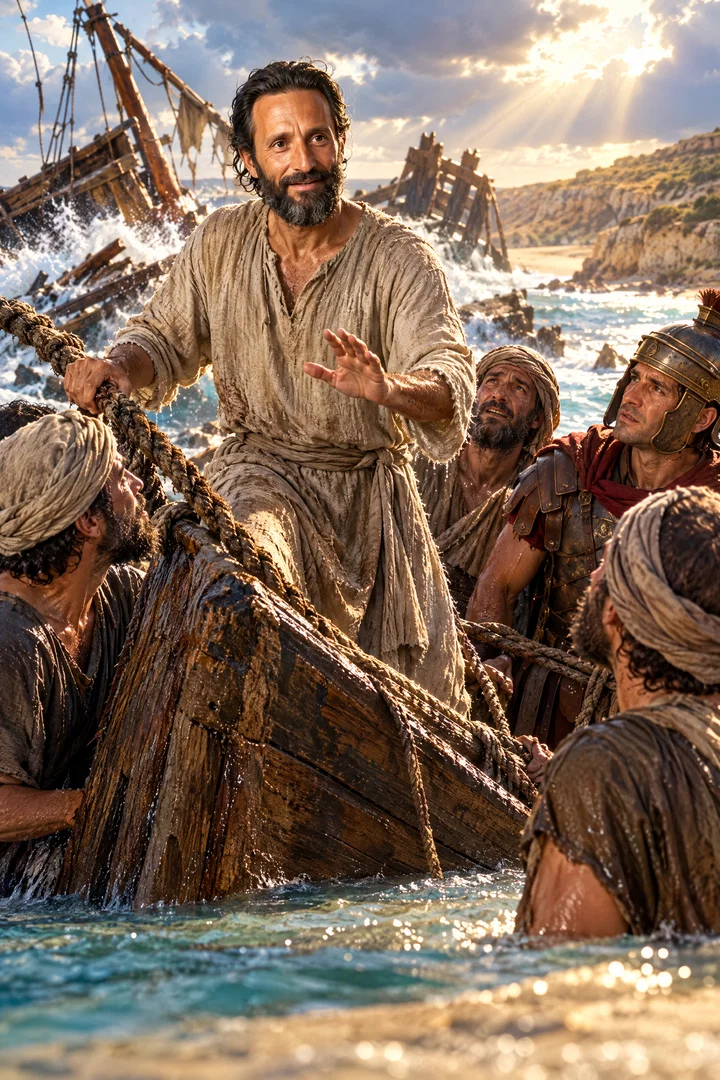
And falling into a place where two seas met, they ran the ship aground; and the forepart stuck fast, and remained unmoveable, but the hinder part was broken with the violence of the waves.
Translations
And falling into a place where two seas met, they ran the ship aground; and the forepart stuck fast, and remained unmovable, but the hinder part was broken with the violence of the waves.
King James Version, KJV Cambridge Paragraph Bible
And falling into a place where two seas met, they ran the ship aground; and the forepart stuck fast, and remained unmoveable, but the hinder part was broken with the violence of the waves.
And falling into a place where two seas met, they ran the ship aground; and the forepart stuck fast, and remained immovable, but the hinder part was broken with the violence of the waves.
Revised Version, American Standard Version
But lighting upon a place where two seas met, they ran the vessel aground; and the foreship struck and remained unmoveable, but the stern began to break up by the violence of the waves.
and having fallen into a place of two seas, they ran the ship aground, and the fore-part, indeed, having stuck fast, did remain immoveable, but the hinder-part was broken by the violence of the waves.
And falling into a place where two seas met they ran the ship aground, and the prow having stuck itself fast remained unmoved, but the stern was broken by the force of the waves.
But, falling into a place where two seas met, they ran the ship aground; and, the foreship sticking fast, remained immoveable, while, the stern, began to break up, from the violence [of the waves].
But the vessel struck a sandbar and ran aground. The bow stuck fast and would not move, and the stern was being broken up by the pounding of the waves.
But the ship struck a sandbar and ran aground. The bow stuck fast and would not move, and the stern was being broken up by the pounding of the waves.
But coming to a place where two seas met, they ran the vessel aground. The bow struck and remained immovable, but the stern began to break up by the violence of the waves.
And coming to a point between two seas, they got the ship to land; and the front part was fixed in the sand and not able to be moved, but the back part was broken by the force of the waves.
And when they fell into a place, where two seas met, they thrust in the ship: and the forepart stucke fast, and could not be moued, but the hinderpart was broken with the violence of the waues.
Douay-Rheims (Challoner revision)
And when we were fallen into a place where two seas met, they run the ship aground; and the forepart indeed, sticking fast, remained unmoveable: but the hinder part was broken with the violence of the sea.
Pictures
Cross-references
- Acts 28:3-5
And when Paul had gathered a bundle of sticks, and laid them on the fire, there came a viper out of the heat, and fastened on his hand.
After the shipwreck, Paul survives a viper bite on Malta.
- Acts 27:22-25
And now I exhort you to be of good cheer: for there shall be no loss of any man’s life among you, but of the ship.
Paul assures the company that God will spare their lives despite the shipwreck.
- Acts 27:29
Then fearing lest we should have fallen upon rocks, they cast four anchors out of the stern, and wished for the day.
The crew casts four anchors before the ship runs aground.
- Acts 27:20
And when neither sun nor stars in many days appeared, and no small tempest lay on us, all hope that we should be saved was then taken away.
The storm leaves the passengers without hope of surviving.
- Acts 27:18
And we being exceedingly tossed with a tempest, the next day they lightened the ship;
The ship was severely tossed by the storm.
- Acts 27:14
But not long after there arose against it a tempestuous wind, called Euroclydon.
A tempestuous wind began the voyage’s danger.
- Acts 27:34
Wherefore I pray you to take some meat: for this is for your health: for there shall not an hair fall from the head of any of you.
It promises that no one on the voyage will lose a hair.
- Acts 27:31
Paul said to the centurion and to the soldiers, Except these abide in the ship, ye cannot be saved.
Remaining in the ship was necessary for their deliverance.
- 2 Corinthians 11:25
Thrice was I beaten with rods, once was I stoned, thrice I suffered shipwreck, a night and a day I have been in the deep;
Paul recounts having suffered shipwreck three times.
Commentary
Each commentary is drawn from primary sources: the writings of Ellen G. White and Adventist pioneers and periodicals. Each commentary is separate. Its own words are not a quotation; follow the references to read the source passages.
Ellen G. White
4 sources
The grounding belongs to Paul's long and tedious voyage to Italy endured as a prisoner in chains, amid trying experiences that fell to his lot.AA 439.3 That hardship was lightened by the permitted companionship of Luke and Aristarchus.AA 439.3 Aristarchus shared Paul's bondage by choice, that he might minister to him in affliction.AA 439.3
It took place in full daylight when no landmarks could tell where they were, after the crew sighted a creek with a shore and decided to drive the ship in there if possible.RH Nov 30, 1911 They readied her by taking up the anchors and committing them to the sea, loosing the rudder bands, and hoisting the mainsail to the wind to make toward shore.RH Nov 30, 1911 Then striking a place where two seas met they ran aground, so that the forepart stuck fast and remained immovable while the hinder part was broken apart by the violence of the waves in a storm.RH Nov 30, 1911ST Nov 6, 1879 In the wreck Paul remained courageous and gave orders to the ship's commander, helping to preserve everyone on board.ST Nov 6, 1879 The sea journey served God's purpose, for the ship's crew witnessed God's power through Paul, and Gentiles heard the name of Jesus, as Paul's teaching and the miracles he performed led many to be converted.EW 172.3
Sources
Pioneers and periodicals
27 sources
The grounding ended Paul's perilous winter voyage to Rome as a chained prisoner to Caesar's court after fourteen days of storm, when in full daylight the crew tried to drive the ship into a creek with a beach.RH Nov 30, 1911ST Mar 30, 1904RH Apr 21, 1903ST Aug 21, 1893 The place where two seas met was a shoal where the current through a narrow channel met the waters of the bay, so the bow stuck fast and remained unmovable while the unsupported stern was broken apart by the violence of the waves.RH Nov 30, 1911ST Mar 26, 1885ST Aug 21, 1893 Though suffering and a prisoner, Paul stood hopeful, calm, and courageous amid the crash, giving orders and cheering his companions, and so helped preserve everyone aboard from death at sea.ST Nov 6, 1879ST Jun 12, 1884ST Jul 23, 1885RH Jan 22, 1857 The storm, grounding, and breaking of the ship were God's way of answering Paul's prayer for a prosperous journey to Rome, prosperous in its outcome because all were preserved and he did reach Rome, though not as a free traveler.ST Oct 24, 1895ST Feb 25, 1889RH Sep 10, 1903 Because the ship was wrecked and destroyed rather than preserved, it cannot serve as a figure of an enduring church that remains intact.ST Dec 28, 1876RH Sep 23, 1873RH Aug 18, 1874
The Shipwreck Account
The verse belongs to Paul's enforced voyage to Rome as a chained prisoner to Caesar's court, a perilous winter passage after fourteen days of storm that ended in shipwreck followed by three months on an island.ST Mar 30, 1904ST Aug 21, 1893ST Feb 16, 1915ST Apr 29, 1903 It was the journey that eventually brought him to his desired destination and gave him opportunities for missionary work along the way.ST Mar 30, 1904 It was a terrifying sea journey endured as a prisoner, and the wreck it describes was the final shipwreck after Paul had already suffered shipwreck three times.RH Apr 21, 1903 It stands among the great trials of his life alongside murderous mobs, testimony before kings and courts, plots of assassins, the viper's bite, and a fearful military tribunal.ST Apr 29, 1903
The grounding happened in full daylight when no landmarks could tell where they were, after the crew at daybreak sighted a creek with a shore, a bay with a beach, and decided to thrust the ship in there if possible.RH Nov 30, 1911ST Aug 21, 1893 To make toward shore they took up the anchors, committed the ship to the sea, cast off the anchors, loosed the rudder-bands, and hoisted the mainsail or foresail to the wind.RH Nov 30, 1911ST Aug 21, 1893 Then striking a place where two seas met, they ran the ship aground.RH Nov 30, 1911ST Aug 21, 1893
That place was a shoal or mud bank where the current through a narrow channel met the waters of the bay, where two currents met.ST Mar 26, 1885ST Aug 21, 1893 The forepart or bow stuck fast and remained unmovable, immovably fast, while the hinder part or stern, left unsupported, was battered and broken apart by the violence of the waves.RH Nov 30, 1911ST Nov 6, 1879ST Mar 26, 1885ST Aug 21, 1893 Paul was on deck amid the crash and storm as the waves broke the rear section apart, and he remained calm and determined.RH Jan 22, 1857
The wreck occurred in waters and past places that could be seen from the ship, in that part of the Mediterranean near southern Italy and Sicily after the Strait of Messina.RH Jul 25, 1907ST Aug 21, 1901 It occurred about November 1, A.D. 60.ST Oct 21, 1897 Its historical details belong to a narrative read alongside the crossing of the Red Sea.RH Jul 25, 1907
The passengers and crew of the storm-tossed vessel were in a hopeless condition.ST Jun 12, 1884 Yet a whole shipload of men escaped death at sea while Paul, God's servant, was aboard, and his presence was a blessing to the others.ST Jul 23, 1885
Providence and Courage
Though physically suffering and a prisoner, Paul remained hopeful, calm, determined and courageous on deck amid the crash and storm where the bow ran aground and the stern was breaking apart.ST Nov 6, 1879ST Jun 12, 1884RH Jan 22, 1857 On that enforced voyage as a chained prisoner to Caesar's court at Rome, when passengers and crew were in a hopeless condition, he gave orders to the ship's commander and became a source of consolation and courage that helped preserve everyone aboard and cheered his discouraged companions.ST Nov 6, 1879ST Jun 12, 1884ST Apr 29, 1903 His sublime faith and courage rising superior to danger in the shipwreck stands alongside murderous mobs, testimony before kings and courts, plots of assassins, the viper's bite, and a fearful military tribunal as one of the great trials of his life.ST Apr 29, 1903
The storm and the running aground and breaking of the ship were God's way of answering Paul's prayer for a prosperous journey by the will of God to visit Rome.ST Oct 24, 1895 Although most would say such a voyage was not prosperous, it was prosperous in its outcome because God preserved Paul and everyone aboard.ST Oct 24, 1895RH Sep 10, 1903 He did reach Rome after Jerusalem, but not as a free traveler as expected, for after being seized by unbelieving Jews in Judea instead of being delivered from them he was kept a prisoner by the Romans for more than two years until his appeal to Caesar sent him to Rome, and the journey was attended with the greatest dangers including shipwreck.ST Feb 25, 1889 That danger and imprisonment do not mean the prayer for a prosperous journey was unheard, for hearing a prayer and answering it are two different things, and God as the best judge grants the request in the way He chooses.ST Feb 25, 1889
What looks disastrous should be counted as prosperous as God sees it, since all things work together for good to them that love God.ST Oct 24, 1895 Paul made no complaint about it, and trusting that God knows far better than men how prayers should be answered would save much mourning.ST Oct 24, 1895 That great trials generally do not discourage the Christian soul is shown in how his faith cheered his companions.ST Apr 29, 1903 The whole voyage was labor and sacrifice and suffering, not a holiday rest or vacation for a clergyman, like working with his hands at Corinth and spending a night and a day in the deep.ST Mar 18, 1889 Ministers of Christ should make capital out of that sacrifice to save souls instead of using his life to justify clerical holidays and seeking political power to bolster a perverted system.ST Mar 18, 1889
The restless, raging, roaring, turbid, angry and enraged sea that drove the ship aground and broke it apart was Satan seeking to destroy Paul.ST Aug 27, 1896 The sea of itself does not convey the comfort, consolation and strength conveyed by the hills and mountains, though the sea is His and He made it and all He made is good, and though it has its useful lessons.ST Aug 27, 1896 The graphic, terrifying account of the wreck shows the Lord's marvelous working with His servant.ST Jul 21, 1909 It stands as one of the dangers through which he remained confident in the faithfulness of the Lord he served, with sublime faith rising superior to danger.RH Nov 16, 1916ST Apr 29, 1903
Scripture Links and Symbols
The running aground where two seas met left the forepart stuck fast and unmovable while the hinder part was broken by the violence of the waves, so the vessel was wrecked, smashed to pieces and destroyed rather than preserved.ST Dec 28, 1876RH Sep 23, 1873RH Aug 18, 1874 A ship so completely broken up cannot consistently serve as a figure or symbol for an enduring church that remains intact.ST Dec 28, 1876RH Sep 23, 1873RH Aug 18, 1874 To make it represent the church would leave no church in existence.RH Aug 18, 1874
The ship trapped between meeting waters, held fast forward while its rear was torn apart by pounding surf, pictures mediums caught between this life and the spirit realm.RH Sep 8, 1874 Their will is destroyed or lulled, their moral sense stupefied, and their bodies and souls attacked and subjugated.RH Sep 8, 1874 Low, wicked spirits enter drunkards and lewd persons to gratify appetites for rum, drink, tobacco, quarrelling and licentious acts carried over from this life.RH Sep 8, 1874
The shipwreck stands as a true New Testament deliverance belonging together with the Old Testament deliverance of Shadrach, Meshach and Abednego in the fiery furnace and with Peter's jail delivery.ST Nov 25, 1889 The Old and New Testaments are one inseparable system with Christ as the product and perfection of Old Testament facts.ST Nov 25, 1889 So the furnace account stands or falls with Paul's shipwreck.ST Nov 25, 1889
The account belongs to a voyage through waters and past places that could be seen from the ship, and it is read alongside the crossing of the Red Sea.RH Jul 25, 1907 Its historical details can be supported by investigation, strengthening confidence in the truth of the biblical narrative and by implication its vital teachings.RH Jul 25, 1907ST Jul 5, 1910
The wreck happened in a storm that broke over this part of the Mediterranean Sea near southern Italy and Sicily after the Strait of Messina.ST Aug 21, 1901 The same Jesus who said to the troubled Sea of Galilee, Peace, be still, speaks peace to the Great Sea for those He calls from the West to go on mission to the East.ST Aug 21, 1901 He bears them safely on its quiet bosom so gently that the vessel seems almost motionless on a glassy, waveless surface, because they do not have Paul's power of endurance.ST Aug 21, 1901
Sources