2 Kings 16:13
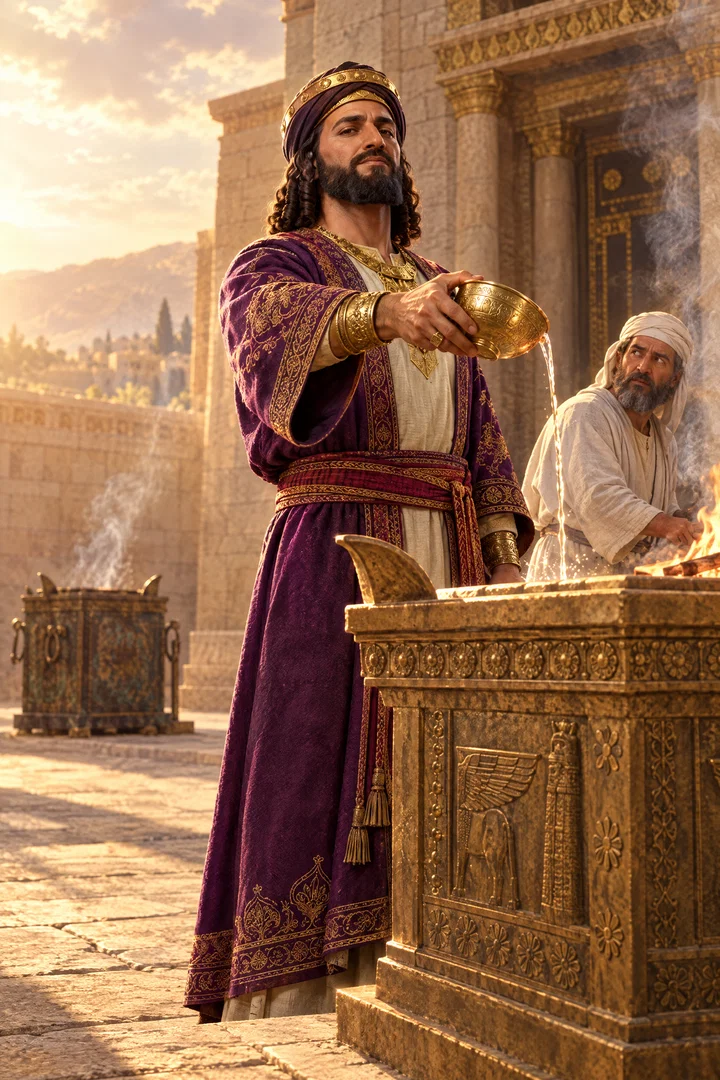
And he burnt his burnt offering and his meat offering, and poured his drink offering, and sprinkled the blood of his peace offerings, upon the altar.
Translations
And he burnt his burnt offering and his meat offering, and poured his drink offering, and sprinkled the blood of his peace offerings, on the altar.
King James Version, KJV Cambridge Paragraph Bible
And he burnt his burnt offering and his meat offering, and poured his drink offering, and sprinkled the blood of his peace offerings, upon the altar.
And he burnt his burnt-offering and his meat-offering, and poured his drink-offering, and sprinkled the blood of his peace-offerings upon the altar.
And he burnt his burnt offering and his meal offering, and poured his drink offering, and sprinkled the blood of his peace offerings, upon the altar.
And he burnt his burnt-offering and his meal-offering, and poured his drink-offering, and sprinkled the blood of his peace-offerings, upon the altar.
and perfumeth his burnt-offering, and his present, and poureth out his libation, and sprinkleth the blood of the peace-offerings that he hath, on the altar.
And he burned his burnt-offering and his oblation, and poured out his drink-offering, and sprinkled the blood of his peace-offering upon the altar.
And he made perfume with his ascending-sacrifice, and with his meal-offering, and poured out his drink-offering,—and dashed the blood of the peace-offerings which he had, upon the altar.
He offered his burnt offering and his grain offering, poured out his drink offering, and sprinkled the blood of his peace offerings on the altar.
He offered his burnt offering and his grain offering, poured out his drink offering, and splattered the blood of his peace offerings on the altar.
He burned his burnt offering and his meal offering, poured his drink offering, and sprinkled the blood of his peace offerings on the altar.
He made his burned offering and his meal offering and his drink offering there, draining out the blood of his peace-offerings on the altar.
And hee burnt his burnt offering, and his meate offring, and powred his drinke offring, and sprinkled the blood of his peace offrings besides the altar,
Douay-Rheims (Challoner revision)
And offered libations and poured the blood of the peace offerings, which he had offered upon the altar.
Pictures
Cross-references
- Leviticus 1:5
And he shall kill the bullock before the LORD: and the priests, Aaron’s sons, shall bring the blood, and sprinkle the blood round about upon the altar that is by the door of the tabernacle of the congregation.
Both describe sprinkling sacrificial blood upon the altar.
- Leviticus 3:2
And he shall lay his hand upon the head of his offering, and kill it at the door of the tabernacle of the congregation: and Aaron’s sons the priests shall sprinkle the blood upon the altar round about.
Both describe sprinkling blood on the altar in a peace-offering ritual.
- 2 Chronicles 29:22
So they killed the bullocks, and the priests received the blood, and sprinkled it on the altar: likewise, when they had killed the rams, they sprinkled the blood upon the altar: they killed also the lambs, and they sprinkled the blood upon the altar.
Both describe sprinkling sacrificial blood on the altar.
- 2 Chronicles 28:24-25
And Ahaz gathered together the vessels of the house of God, and cut in pieces the vessels of the house of God, and shut up the doors of the house of the LORD, and he made him altars in every corner of Jerusalem.
Ahaz’s temple sacrifices accompany his closure of the temple and turn to other gods.
- Leviticus 4:6
And the priest shall dip his finger in the blood, and sprinkle of the blood seven times before the LORD, before the vail of the sanctuary.
Both distinguish sprinkling blood from other sacrificial actions.
Commentary
Each commentary is drawn from primary sources: the writings of Ellen G. White and Adventist pioneers and periodicals. Each commentary is separate. Its own words are not a quotation; follow the references to read the source passages.
Ellen G. White
1 source
The act recorded here stands within the long Jewish history that exposes the future as the direct outcome of the course pursued.Ms 129, 1899, par. 7–8 For thousands of years that people were forging fetters for themselves by the choices they made.Ms 129, 1899, par. 7–8 Those fetters bound them at last in a bondage that no human power could break.Ms 129, 1899, par. 7–8 The history thus lays open beforehand the captivity their own actions were preparing.Ms 129, 1899, par. 7–8
Sources
Pioneers and periodicals
8 sources
The verse belongs to the reign of Ahaz, the weak king of Judah who followed Jotham and came before Hezekiah.ST Jun 3, 1913 It stands within the history from 2 Kings 7 through 2 Kings 23 covering nearly 300 years, from Joram of Israel through Jehu, Jehoahaz, Jehoash, Jeroboam II, Zachariah, Shallum, Menahem, Pekahiah, Pekah and Hoshea, when the kingdom of Israel came to an end by Shalmaneser of Assyria with the conquest completed by Sargon and the tribes carried away into captivity and scattered.ST May 5, 1909 In Judah that same history runs from Ahaziah, Athaliah, Joash, Amaziah, Azariah or Uzziah, Jotham, Ahaz, Hezekiah, Manasseh, Amon, Josiah and Jehoahaz, in the days of Hosea, Jonah and Amos in Israel and Joel, Isaiah, Micah, Jeremiah, Zephaniah and Nahum in Judah.ST May 5, 1909
It belongs to the record that Ahaz of Judah acknowledged Tiglath-pileser king of Assyria as his sovereign and paid him tribute.ST Jul 30, 1885 Tiglath-pileser overthrew the kingdom of Damascus, and his own inscriptions name Ahaz of Judah among those who acknowledged his sovereignty and paid tribute, proving the Bible account true history.ST Jul 30, 1885 The verse describes King Ahaz himself offering his burnt offering and grain offering, pouring his drink offering, and sprinkling the blood of his peace offerings upon a new altar copied from one he saw in Damascus and made after its pattern.RH Jan 19, 1911ST Jan 20, 1898ST Nov 7, 1906
The act of sprinkling the blood of the peace offerings on the altar uses the Hebrew word zah-rak, which means to scatter and hence to sprinkle, and it does not mean to dip or immerse.ST May 6, 1880 Urijah the priest built the copy of the Damascus altar at Ahaz's order, and Ahaz used it with great pleasure when he returned.RH Jan 19, 1911 The act pushed the altar of David into an obscure place and went with a wider rearranging of the temple furniture, including removal of a Sabbath booth to please the king of Assyria.RH Jan 19, 1911
The new altar set pagan worship side by side with the ancient rites and helped paganize the religion of the Jews.RH Jan 19, 1911 It belonged to a course of superstition and neglect that left the great doors closed, the lamps unlit, and no incense offered, while incense was burned to false gods on high places in all the cities of Judah.RH Jan 19, 1911 The verse is part of Judah's spotted record and departure from God in idolatry, following the same sad course as Israel, in which righteous faithful rule always brought prosperity and turning from God to the grossest idolatry brought calamity upon rulers and people, until captivity came to Israel and then to Judah.ST May 5, 1909ST Jun 3, 1913
The altar modeled on the one seen in Damascus was sinful because Ahaz made it for worship, since making a likeness was not wrong by itself but using it as an object of worship was.ST May 18, 1904 The altar serves as an example of leaders turning from God's provision to a human or worldly expedient, like relying on the State to do the church's work.ST Jan 20, 1898 The account of copying a foreign altar's design illustrates how copying elaborate worldly plans can bring worldly methods and spirit into God's work.ST Nov 7, 1906
Sources