2 Kings 18:17
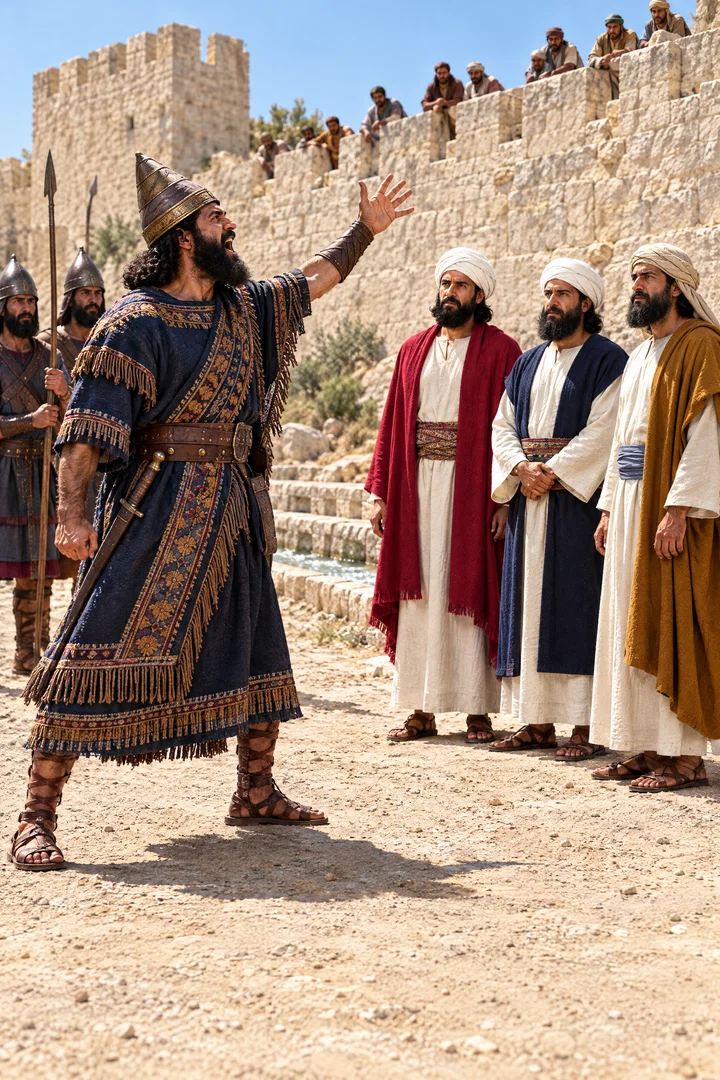
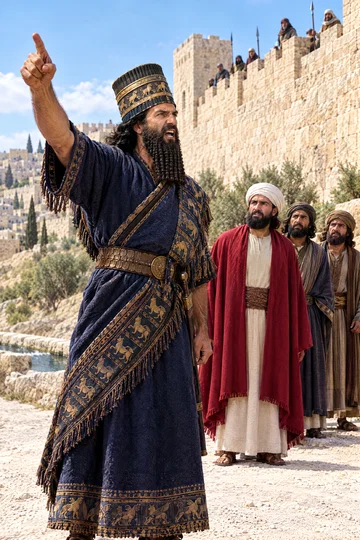
And the king of Assyria sent Tartan and Rabsaris and Rab-shakeh from Lachish to king Hezekiah with a great host against Jerusalem. And they went up and came to Jerusalem. And when they were come up, they came and stood by the conduit of the upper pool, which is in the highway of the fuller’s field.
Translations
And the king of Assyria sent Tartan and Rabsaris and Rabshakeh from Lachish to king Hezekiah with a great host against Jerusalem. And they went up and came to Jerusalem. And when they were come up, they came and stood by the conduit of the upper pool, which is in the highway of the fuller’s field.
King James Version, KJV Cambridge Paragraph Bible
And the king of Assyria sent Tartan and Rabsaris and Rab-shakeh from Lachish to king Hezekiah with a great host against Jerusalem. And they went up and came to Jerusalem. And when they were come up, they came and stood by the conduit of the upper pool, which is in the highway of the fuller’s field.
And the king of Assyria sent Tartan and Rab-saris and Rab-shakeh from Lachish to king Hezekiah with a great army against Jerusalem: and they went up, and came to Jerusalem: and when they had come up, they came and stood by the conduit of the upper pool, which is in the highway of the fuller's field.
Revised Version, American Standard Version
And the king of Assyria sent Tartan and Rab-saris and Rabshakeh from Lachish to king Hezekiah with a great army unto Jerusalem. And they went up and came to Jerusalem. And when they were come up, they came and stood by the conduit of the upper pool, which is in the highway of the fuller’s field.
And the king of Asshur sendeth Tartan, and the chief of the eunuchs, and the chief of the butlers, from Lachish, unto king Hezekiah, with a heavy force, to Jerusalem, and they go up and come in to Jerusalem, and they go up, and come in and stand by the conduit of the upper pool that [is] in the highway of the fuller's field.
And the king of Assyria sent Tartan and Rabsaris and Rab-shakeh from Lachish, with a strong force, against king Hezekiah, to Jerusalem. And they went up and came to Jerusalem. And when they were come up, they came and stood by the aqueduct of the upper pool, which is on the highway of the fuller's field.
And the king of Assyria sent Tartan and Rab-saris and Rab-shakeh, from Lachish unto King Hezekiah, with a heavy force to Jerusalem,—so they came up and drew near to Jerusalem, and took their stand by the upper channel of the pool, which is in the highway of the fuller’s field.
Berean Standard Bible, Majority Standard Bible
Nevertheless, the king of Assyria sent the Tartan, the Rabsaris, and the Rabshakeh, along with a great army, from Lachish to King Hezekiah at Jerusalem. They advanced up to Jerusalem and stationed themselves by the aqueduct of the upper pool, on the road to the Launderer’s Field.
The king of Assyria sent Tartan, Rabsaris, and Rabshakeh from Lachish to King Hezekiah with a great army to Jerusalem. They went up and came to Jerusalem. When they had come up, they came and stood by the conduit of the upper pool, which is in the highway of the fuller’s field.
Then the king of Assyria sent the Tartan and the Rab-saris and the Rab-shakeh from Lachish to Jerusalem, to King Hezekiah, with a strong force. And they went up and came to Jerusalem, and took up their position by the stream of the higher pool, by the highway of the washerman's field.
And the King of Asshur sent Tartan, and Rab-saris, and Rabshakeh from Lachish to King Hezekiah with a great hoste against Ierusalem. And they went vp, and came to Ierusalem, and when they were come vp, they stood by the conduite of the vpper poole, which is by the path of the fullers fielde,
Douay-Rheims (Challoner revision)
And the king of the Assyrians sent Tharthan and Rabsaris, and Rabsaces from Lachis to king Ezechias with a strong army to Jerusalem: and they went up and came to Jerusalem, and they stood by the conduit of the upper pool, which is in the way of the fuller’s field.
Pictures
Cross-references
- Isaiah 36:2
And the king of Assyria sent Rabshakeh from Lachish to Jerusalem unto king Hezekiah with a great army. And he stood by the conduit of the upper pool in the highway of the fuller’s field.
Places Rabshakeh at the Upper Pool during the same siege.
- Isaiah 37
And it came to pass, when king Hezekiah heard it, that he rent his clothes, and covered himself with sackcloth, and went into the house of the LORD.
Records the same Assyrian campaign against Jerusalem and its deliverance.
- 2 Chronicles 32:7-8
Be strong and courageous, be not afraid nor dismayed for the king of Assyria, nor for all the multitude that is with him: for there be more with us than with him:
Hezekiah urges trust in God, who will help and fight for Judah against Assyria.
- 2 Kings 19:35-37
And it came to pass that night, that the angel of the LORD went out, and smote in the camp of the Assyrians an hundred fourscore and five thousand: and when they arose early in the morning, behold, they were all dead corpses.
Records the destruction of the Assyrian army and Sennacherib’s return.
- 2 Chronicles 32:9
After this did Sennacherib king of Assyria send his servants to Jerusalem, (but he himself laid siege against Lachish, and all his power with him,) unto Hezekiah king of Judah, and unto all Judah that were at Jerusalem, saying,
Sennacherib sends his servants from Lachish to attack Jerusalem.
- Isaiah 37:33-35
Therefore thus saith the LORD concerning the king of Assyria, He shall not come into this city, nor shoot an arrow there, nor come before it with shields, nor cast a bank against it.
God promises to defend Jerusalem and turn the Assyrian king back.
- 2 Kings 19:10-13
Thus shall ye speak to Hezekiah king of Judah, saying, Let not thy God in whom thou trustest deceive thee, saying, Jerusalem shall not be delivered into the hand of the king of Assyria.
The Assyrian threat against Jerusalem continues in the message to Hezekiah.
- 2 Kings 19:15-19
And Hezekiah prayed before the LORD, and said, O LORD God of Israel, which dwellest between the cherubims, thou art the God, even thou alone, of all the kingdoms of the earth; thou hast made heaven and earth.
Hezekiah prays for deliverance during the Assyrian crisis.
- 2 Kings 19:36-37
So Sennacherib king of Assyria departed, and went and returned, and dwelt at Nineveh.
Says the king returned to Assyria and died there.
- Isaiah 36:5
I say, sayest thou, (but they are but vain words) I have counsel and strength for war: now on whom dost thou trust, that thou rebellest against me?
The threat challenges Hezekiah over whom he trusts.
- 2 Kings 19:7
Behold, I will send a blast upon him, and he shall hear a rumour, and shall return to his own land; and I will cause him to fall by the sword in his own land.
Supports the claim that the Assyrian king returned to his own land.
Commentary
Each commentary is drawn from primary sources: the writings of Ellen G. White and Adventist pioneers and periodicals. Each commentary is separate. Its own words are not a quotation; follow the references to read the source passages.
Pioneers and periodicals
17 sources
After capturing Judah's fortified cities and exacting tribute from Hezekiah at Lachish, Sennacherib sent Tartan and Rabsaris and Rab-shakeh with a great host to confront Hezekiah at Jerusalem, where they took their stand outside the city by the conduit of the upper pool in the highway of the fuller's field.ST Mar 16, 1876ST Jun 21, 1905RH May 21, 1908ST May 8, 1879 Their arrival opened the Assyrian crisis of Hezekiah's reign, when in distress he brought his trouble before God in prayer and patiently relied on the God of Israel, showing God as a friend to His people in trouble.RH Nov 14, 1912ST Jun 3, 1913RH Aug 6, 1861 When the envoys failed to persuade Hezekiah to surrender and insulting letters against Judah's God were sent, God delivered Jerusalem by miraculous intervention when the angel of the Lord destroyed 185,000 Assyrians in one night, showing the God of heaven mightier than the gods of the nations, after which Sennacherib returned to Nineveh where his own sons killed him while he worshiped his idol.ST Jun 21, 1905RH May 21, 1908RH Jun 11, 1857 Though Jerusalem was the city of the Great King, evil still came to it, for in sending a great host Sennacherib was lifting puny hands against God's mighty plans and setting himself against the Rock of the word, so that Assyria's origin, career and end bear witness to the truth of the Bible.ST May 8, 1879ST Jul 15, 1908
History and Geography
The verse stands in the history of Judah's remaining kingdom after the ten tribes had been swept away.ST Dec 9, 1897 It belongs to the eight-chapter record that hastens from the breakup of Samaria to Judah's Babylonian captivity under Nebuchadnezzar, covering the reigns of Hezekiah, Manasseh, Amon, Josiah, Jehoahaz, Jehoiakim, Jehoiachin, and Zedekiah.
It records the next stage of Sennacherib's invasion of Palestine and Judah and siege of Jerusalem.ST Jun 21, 1905RH May 21, 1908RH Nov 16, 1916 After capturing Judah's principal fortified cities, and after the siege of Lachish and the tribute exacted from Hezekiah, Sennacherib at Lachish sent his officials Tartan, Rabsaris and Rab-shakeh with a great host to confront Hezekiah at Jerusalem.ST Jun 21, 1905RH May 21, 1908RH Jun 11, 1857ST May 8, 1879ST Oct 27, 1898 Their coming from Lachish toward Jerusalem began the direct threat against the city and its people.RH May 21, 1908ST May 8, 1879
The officers took their stand by the conduit of the upper pool, which is in the highway of the fuller's field.ST May 8, 1879ST Oct 27, 1898 That was where Rabshakeh took his position outside Jerusalem.RH Jul 21, 1868 The Upper Pool was a large Jerusalem reservoir, 316 feet long, 218 feet wide and 18 feet deep.ST Mar 16, 1876 It lay near the city's northwest corner, where the Crusaders attacked in 1099.RH Jul 21, 1868
The invasion is corroborated by contemporary Assyrian records.ST Nov 20, 1884RH Nov 16, 1916ST Jan 4, 1916RH Aug 10, 1916 An Assyrian cylinder records Sennacherib's invasion of Palestine and siege of Jerusalem. Sennacherib's own account and inscriptions, and a palace relief depicting his victory and siege at Lachish and his receiving the city's spoils, provide evidence for the campaign against Judah and the cities in the western lands.ST Nov 20, 1884ST Jan 4, 1916RH Aug 10, 1916 The inscriptions record the tribute Hezekiah was forced to pay, whose differing silver totals are reconciled by different-sized talents, and figures of Assyrian officers may include Rab-shakeh.ST Nov 20, 1884RH Aug 10, 1916
Deliverance and Meaning
The verse introduces the Assyrian crisis of Hezekiah's reign and belongs to the account of his remarkable experiences.RH Nov 14, 1912ST Jun 3, 1913 It shows God as a friend to His people in trouble and provides the setting in which Hezekiah brought his distress before God in prayer.RH Nov 14, 1912 When Jerusalem was threatened by the great army sent against Hezekiah, he remained hopeful and patiently relied on God.RH Aug 6, 1861 His trust in the God of Israel led to victory.RH Aug 6, 1861
Their arrival from Lachish began the threat against the city and its people, coming after the conquest of the cities of Judah.ST Jun 21, 1905RH May 21, 1908 When the envoys failed to persuade Hezekiah to surrender, insulting letters attacking Judah's God were sent.ST Jun 21, 1905 God afterward delivered Jerusalem by miraculous intervention, showing that the God of heaven was mightier than the gods of the nations.RH May 21, 1908 The angel of the Lord destroyed 185,000 Assyrians in one night, and Sennacherib returned to Nineveh, where his own sons killed him while he worshiped his idol.RH Jun 11, 1857
The army was not near Jerusalem when the angel killed the 185,000 men, but was with the king of Assyria at Libnah.RH Jun 15, 1869 For that reason the destruction did not fulfill Isaiah's prophecy about Tophet.RH Jun 15, 1869
The threat made clear that Jerusalem's standing as the city of the Great King did not keep evil from coming to it.ST May 8, 1879 Assyria is one of the empires whose origin, career, and end are predicted in the Bible, so its history bears witness to the truth of the Bible.ST Jul 15, 1908 Sennacherib's sending of a great host against Jerusalem was the lifting of puny hands against God's mighty plans and precepts.ST Jul 15, 1908 He set himself against the Rock of the word and now lives only in infamy, while the Rock stands.ST Jul 15, 1908
The verse belongs to the eight-chapter record hastening from the breakup of Samaria to Judah's Babylonian captivity under Nebuchadnezzar, covering the reigns of Hezekiah, Manasseh, Amon, Josiah, Jehoahaz, Jehoiakim, Jehoiachin, and Zedekiah. Five of these chapters are given to the two good kings Hezekiah and Josiah. Hezekiah was a devoted man of God notwithstanding his mistakes. His mistake exalted man, aroused the cupidity of Babylon, and brought captivity upon his own seed. The Assyrian threat to Judah stands within the wider history of Assyria's conquest of Israel and removal of its people, and Judah later went into captivity after following Israel's departure from God.ST Jun 3, 1913
Sources