2 Kings 19:35
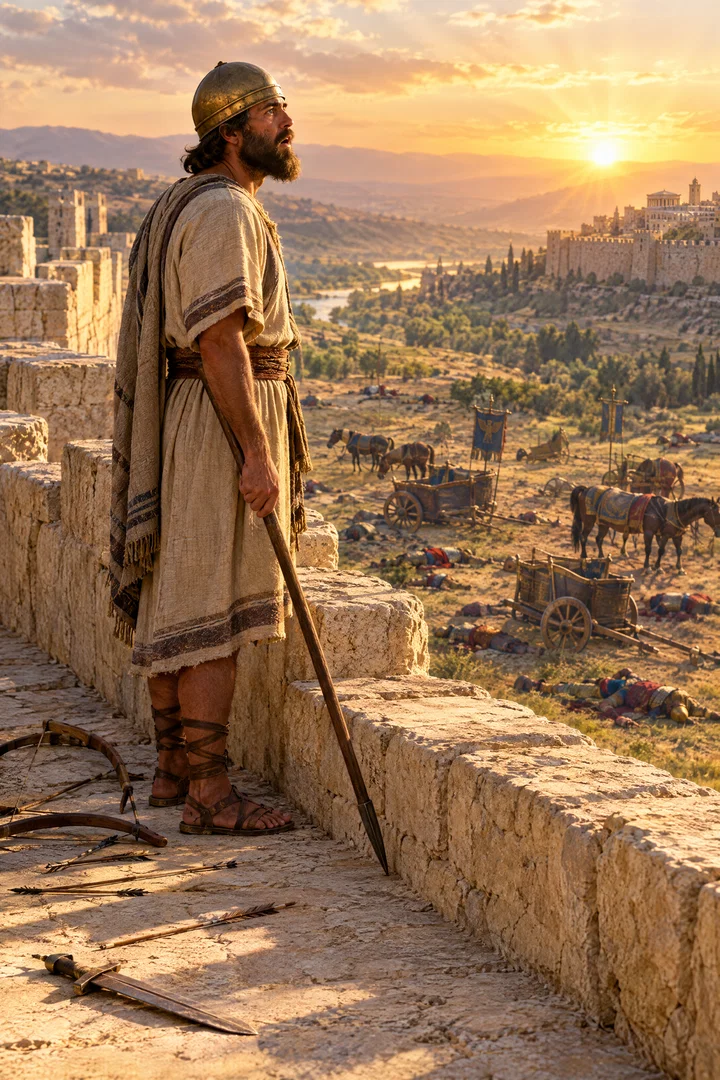
And it came to pass that night, that the angel of the LORD went out, and smote in the camp of the Assyrians an hundred fourscore and five thousand: and when they arose early in the morning, behold, they were all dead corpses.
Translations
American King James Version, King James Version
And it came to pass that night, that the angel of the LORD went out, and smote in the camp of the Assyrians an hundred fourscore and five thousand: and when they arose early in the morning, behold, they were all dead corpses.
And it came to pass that night, that the angel of the Lord went out, and smote in the camp of the Assyrians an hundred fourscore and five thousand: and when they arose early in the morning, behold, they were all dead corpses.
And it came to pass that night, that the angel of the LORD went out, and smote in the camp of the Assyrians a hundred and eighty five thousand: and when they arose early in the morning, behold, they were all dead corpses.
And it came to pass that night, that the angel of the LORD went forth, and smote in the camp of the Assyrians an hundred fourscore and five thousand: and when men arose early in the morning, behold, they were all dead corpses.
And it came to pass that night, that the angel of Jehovah went forth, and smote in the camp of the Assyrians a hundred fourscore and five thousand: and when men arose early in the morning, behold, these were all dead bodies.
And it cometh to pass, in that night, that a messenger of Jehovah goeth out, and smiteth in the camp of Asshur a hundred eighty and five thousand, and they rise early in the morning, and lo, all of them [are] dead corpses.
And it came to pass that night, that an angel of Jehovah went forth, and smote in the camp of the Assyrians a hundred and eighty-five thousand. And when they arose early in the morning, behold, they were all dead bodies.
And it came to pass, during that night, that the messenger of Yahweh went forth, and smote, in the camp of the Assyrians, a hundred and eighty-five thousand. And, when men arose early in the morning, lo! they were all, dead bodies!
Berean Standard Bible, Majority Standard Bible
And that very night the angel of the LORD went out and struck down 185,000 men in the camp of the Assyrians. When the people got up the next morning, there were all the dead bodies!
That night, the LORD’s angel went out and struck one hundred eighty-five thousand in the camp of the Assyrians. When men arose early in the morning, behold, these were all dead bodies.
And that night the angel of the Lord went out and put to death in the army of the Assyrians a hundred and eighty-five thousand men; and when the people got up early in the morning, there was nothing to be seen but dead bodies.
And the same night the Angell of the Lord went out and smote in the campe of Asshur an hundreth foure score and fiue thousande: so when they rose earely in the morning, behold, they were all dead corpses.
Douay-Rheims (Challoner revision)
And it came to pass that night, that an angel of the Lord came, and slew in the camp of the Assyrians a hundred and eighty-five thousand. And when he arose early in the morning, he saw all the bodies of the dead.
Pictures

Cross-references 20 of 26
- Isaiah 37:36
Then the angel of the LORD went forth, and smote in the camp of the Assyrians a hundred and fourscore and five thousand: and when they arose early in the morning, behold, they were all dead corpses.
Records the angel’s overnight destruction of the Assyrian army.
- 2 Chronicles 32:21
And the LORD sent an angel, which cut off all the mighty men of valour, and the leaders and captains in the camp of the king of Assyria. So he returned with shame of face to his own land. And when he was come into the house of his god, they that came forth of his own bowels slew him there with the sword.
Reports the destruction of Sennacherib’s army and his shameful return.
- 2 Kings 19:14-19
And Hezekiah received the letter of the hand of the messengers, and read it: and Hezekiah went up into the house of the LORD, and spread it before the LORD.
Hezekiah prays for deliverance after spreading Sennacherib’s threatening letter before the Lord.
- Psalms 34:7
The angel of the LORD encampeth round about them that fear him, and delivereth them.
The angel of the LORD protects and delivers his people.
- Acts 12:7-11
And, behold, the angel of the Lord came upon him, and a light shined in the prison: and he smote Peter on the side, and raised him up, saying, Arise up quickly. And his chains fell off from his hands.
God answers prayer by sending an angel to deliver Peter from prison.
- Matthew 28:4
And for fear of him the keepers did shake, and became as dead men.
The angel’s presence causes the tomb guards to tremble and become like dead men.
- 2 Kings 18:14-16
And Hezekiah king of Judah sent to the king of Assyria to Lachish, saying, I have offended; return from me: that which thou puttest on me will I bear. And the king of Assyria appointed unto Hezekiah king of Judah three hundred talents of silver and thirty talents of gold.
Reports Hezekiah’s tribute to Sennacherib.
- Exodus 14:27-28
And Moses stretched forth his hand over the sea, and the sea returned to his strength when the morning appeared; and the Egyptians fled against it; and the LORD overthrew the Egyptians in the midst of the sea.
God overthrew Pharaoh’s forces at the Red Sea.
- Isaiah 37:14-20
And Hezekiah received the letter from the hand of the messengers, and read it: and Hezekiah went up unto the house of the LORD, and spread it before the LORD.
Hezekiah prays for Jerusalem’s rescue from the Assyrian threat.
- Isaiah 37:38
And it came to pass, as he was worshipping in the house of Nisroch his god, that Adrammelech and Sharezer his sons smote him with the sword; and they escaped into the land of Armenia: and Esar-haddon his son reigned in his stead.
Sennacherib’s assassination followed his defeat.
- Psalms 53:5
There were they in great fear, where no fear was: for God hath scattered the bones of him that encampeth against thee: thou hast put them to shame, because God hath despised them.
God scatters the encamped enemy, striking them with fear and shame.
- Daniel 6:22
My God hath sent his angel, and hath shut the lions’ mouths, that they have not hurt me: forasmuch as before him innocency was found in me; and also before thee, O king, have I done no hurt.
God’s angel protects Daniel, as an angel brings judgment on the Assyrian camp.
- Isaiah 36
Now it came to pass in the fourteenth year of king Hezekiah, that Sennacherib king of Assyria came up against all the defenced cities of Judah, and took them.
stated to be the same chapter
- Isaiah 37:29
Because thy rage against me, and thy tumult, is come up into mine ears, therefore will I put my hook in thy nose, and my bridle in thy lips, and I will turn thee back by the way by which thou camest.
Gives the parallel hook-and-bridle warning to Sennacherib.
- 2 Kings 19:14
And Hezekiah received the letter of the hand of the messengers, and read it: and Hezekiah went up into the house of the LORD, and spread it before the LORD.
Hezekiah prayed over the letter, and the LORD delivered Jerusalem from Assyria.
- 2 Chronicles 32:7-8
Be strong and courageous, be not afraid nor dismayed for the king of Assyria, nor for all the multitude that is with him: for there be more with us than with him:
Hezekiah encouraged the people before God fought the Assyrians.
- 2 Chronicles 32:1
After these things, and the establishment thereof, Sennacherib king of Assyria came, and entered into Judah, and encamped against the fenced cities, and thought to win them for himself.
Sennacherib invaded Judah after its reform was established.
- 2 Kings 18:33-35
Hath any of the gods of the nations delivered at all his land out of the hand of the king of Assyria?
boast the angel's stroke answered
- 2 Chronicles 32:20
And for this cause Hezekiah the king, and the prophet Isaiah the son of Amoz, prayed and cried to heaven.
Hezekiah and Isaiah prayed, and God defeated Assyria through an angel.
- 2 Kings 19:10-13
Thus shall ye speak to Hezekiah king of Judah, saying, Let not thy God in whom thou trustest deceive thee, saying, Jerusalem shall not be delivered into the hand of the king of Assyria.
The Assyrian threat prompts Hezekiah to seek God’s help.
Commentary
Each commentary is drawn from primary sources: the writings of Ellen G. White and Adventist pioneers and periodicals. Each commentary is separate. Its own words are not a quotation; follow the references to read the source passages.
Ellen G. White
10 sources
The deliverance belongs to the lifetime of Isaiah, who was called to his prophetic mission while still a young man as Uzziah's reign was drawing to a close and Jotham was already bearing many of the burdens of state.RH Mar 4, 1915 It belongs to a time of peculiar peril to the people of God, when divine protection was being removed from the southern kingdom.RH Mar 4, 1915 Assyrian forces were about to overspread the land of Judah, encamping before its chief cities and again and again invading it, while Judah was also invaded by the combined armies of northern Israel and Syria, Samaria fell, and the ten tribes of Israel were scattered among the nations.RH Mar 4, 1915
That very night after God promised to defend Jerusalem, deliverance came as a miraculous interposition that saved Jerusalem from downfall when besieged by the Assyrian armies sent to take it.PK 361.2–3RH Mar 4, 1915 The stroke came after Sennacherib reproached and blasphemed God and threatened Israel.GC88 511.3GC 511.3ST Dec 1, 1909 The angel of the Lord went out and in one night struck down 185,000 in the Assyrian camp, including all the mighty men of valor and the leaders and captains in the camp of the king of Assyria.GC88 511.3PK 361.2–3GC 512.2GC 512.1 The event shows God protecting His people through angels acting under His command, demonstrating their power to carry out God's purposes against His enemies and to act swiftly in judgment.GC 512.2GC 512.1GC 511.3ST Dec 1, 1909DA 698.1–700.5
Tidings of the terrible judgment reached Sennacherib while he was still guarding the approach to Judea from Egypt and struck him with fear, so he hastened to depart and returned with shame of face to his own land, where he had only a short reign.GC88 511.3PK 361.2–3GC 512.1GC 511.3 In harmony with prophecy of his sudden end, he was assassinated by his own household and Esarhaddon his son reigned in his stead.PK 361.2–3 The stroke made the God of the Hebrews prevail over the proud Assyrian and vindicated the honor of Jehovah in the eyes of the surrounding nations. In Jerusalem it filled the people with holy joy because their earnest entreaties mingled with confession of sin and tears and their whole trust in God's power to save in great need had not failed them, so the temple courts resounded with solemn praise to God who breaks the weapons of battle, casts the mighty into dead sleep, saves the meek, and restrains wrath.
It shows how easily angels could have destroyed the tormentors of Jesus, but they did not act because they were not commanded to do so.DA 698.1–700.5 The same divine power that in one night laid low the Assyrians was seen again when a vast invading army fled in supernatural terror before the Hussites, making the verse an example of divine power against an oppressor.GC 116.3–117.1GC88 115.5–117.1 The crusading armies opposing the Bohemians were thus scattered by sudden terror like the Assyrian forces.GC 116.3–117.1GC88 115.5–117.1
Sources
Pioneers and periodicals
60 sources
That night the angel of the Lord struck 185,000 men in the Assyrian camp, so the host full of soldiers at sunset lay as dead corpses without sword or human hand when survivors arose early in the morning.ST Sep 13, 1899ST Oct 27, 1898RH Sep 7, 1905ST Nov 20, 1884 Sennacherib had taken nearly all the fenced cities of Judah and shut up Hezekiah in Jerusalem with blasphemous demands for surrender, and the deliverance answered Hezekiah's earnest prayer when in utter helplessness he spread the boastful letter before the Lord, though those who held that the camp was with the king at Libnah taught it was not against Jerusalem when struck.ST Nov 19, 1885RH Jun 15, 1869RH Sep 7, 1905ST Nov 20, 1884 The angel is a real, mighty heavenly being whose power in killing so many in one night was God's power exercised by His representative under His direction.ST Aug 13, 1874ST Dec 2, 1897PGGC 63.1ST Dec 30, 1913 The Lord thereby defended Jerusalem by direct intervention and not by human strength, vindicating His name and honor against Sennacherib's boast that no god could deliver Jerusalem as the gods of the nations had not delivered their lands.ST Aug 13, 1874ST Oct 27, 1898RH Apr 21, 1868ST Jun 21, 1905RH May 21, 1908 The victory was won by prayer when two faithful men sought God whole-heartedly, showing the greatest victories are gained not by talent or wealth but in the audience chamber with God when frail man takes the King that rules kings as ally.RH Oct 3, 1912RH Nov 14, 1912RH Nov 12, 1914RH Jul 15, 1862RH Dec 8, 1868
Historical Setting and Details
The night stroke belongs to the history of the remaining kingdom of Judah after the ten tribes had been swept away, the period covered in 2 Kings 18-25.ST Dec 9, 1897 It belongs to the record of Hezekiah's reign as a devoted man of God despite his mistakes. It belongs to the lifetime of Isaiah, who was called to the prophetic mission while yet a young man as the reign of Uzziah was drawing to a close and Jotham was already bearing many of the burdens of state.RH Mar 4, 1915 It was a time of peculiar peril when divine protection was being removed from the southern kingdom, when Assyrian forces were about to overspread Judah, encamping before the chief cities and again and again invading, while Judah was also invaded by the combined armies of northern Israel and Syria, Samaria fell, and the ten tribes were scattered among the nations.RH Mar 4, 1915
Sennacherib king of Assyria had taken nearly all the fenced cities of Judah and threatened Jerusalem with blasphemous demands for surrender. Instead of taking Jerusalem he only shut up Hezekiah in the city and exacted tribute.RH Sep 7, 1905 His own account records tribute from Hezekiah but does not claim that he captured Jerusalem.ST Nov 20, 1884 Hezekiah prayed in the house of God and God answered that he should not fear the blasphemy.
The Assyrian camp was not against Jerusalem when struck, but Sennacherib was away near Libnah preparing to fight Tirhakah, and the attack fulfilled Isaiah's assurance that he would not come against the city.ST Nov 19, 1885 The army was with the king at Libnah and not near Jerusalem when struck.RH Jun 15, 1869 That night the angel struck 185,000 in the camp.ST Oct 27, 1898ST Oct 27, 1898 The camp was full of soldiers at sunset but by morning they lay as dead corpses, discovered when survivors arose early.ST Sep 13, 1899ST Oct 27, 1898 The blow came without a sword or visible human hands, leaving silent men and horses, the grief of widows, and the sleep of death revealed by morning.ST Sep 13, 1899ST Oct 27, 1898ST Jun 21, 1905 The battle was short but decisive, for one angel from Heaven's army was sent against all the legions, striking the whole host of 185,000 and leaving them as dead corpses by morning when more than 185,000 valiant warriors and defiant generals trusting false gods had prepared to attack.ST Jan 2, 1907 One account reports the number dead as 184,000 after Isaiah's prayer.RH Aug 1, 1871
The terrible judgment soon reached Sennacherib and struck him with fear so that he hastened to depart and returned with shame to his own land. Though he lived twenty years after this campaign and carried on extensive warfare in other places, he never again campaigned against Judah or returned to Palestine, from dread of again coming in contact with Jehovah the God of Israel.ST Oct 27, 1898RH Sep 7, 1905ST Oct 27, 1898 There in harmony with prophecy he was assassinated by his own household and Esarhaddon his son reigned in his stead. The chapter is alike to Isaiah 37 and is a parallel account with some verbal differences.RH Jan 30, 1908RH Mar 11, 1875ST Sep 12, 1895 Palace slabs recording the earlier successful campaign against the fenced cities and the tribute imposed, now in the British Museum, confirm the Bible account in Kings, Chronicles, and Isaiah, while Sennacherib himself did not record the crushing defeat since such a defeat would not be preserved for successors to read.ST Jan 4, 1916 Hezekiah conquered the host of Sennacherib by wisdom, and after that deliverance also by wisdom averted and stayed the judgments of God for a time.RH May 2, 1865
Angel's Nature and Power
The angel of the Lord who went out by night against the Assyrians was a real, mighty heavenly being and a real agent, not a mere good thought or idea.ST Dec 30, 1913 In the days of Hezekiah king of Judah and Isaiah the prophet, after Sennacherib king of Assyria had taken nearly all the fenced cities of Judah and threatened Jerusalem with blasphemous demands for surrender, Hezekiah prayed in the house of God and God answered that he should not fear the blasphemy. God then sent one angel who in one night smote 185,000 Assyrian soldiers dead in their camp, so that when survivors arose in the morning they were all dead corpses.ST Dec 30, 1913
One single angel passing through the camp killed 185,000 men in one night, and thereby saved Jerusalem when Hezekiah trusted God to deliver it.ST Aug 13, 1874PGGC 63.1ST Jan 17, 1878ST Aug 15, 1916 That deed demonstrates the great power, strength, influence, and goodness of angels working through God.ST Aug 13, 1874PGGC 63.1ST Jan 17, 1878ST Aug 15, 1916RH Apr 9, 1872 In answer to the prayer of Hezekiah the king and Isaiah the prophet, the angel cut off all the mighty men of valor and the leaders and captains in the camp of the king of Assyria, destroying 185,000 in one night.RH Apr 9, 1872 It also vindicated God's authority against Sennacherib's boast that Israel's God could not save the city.ST Aug 13, 1874
The angel's power was God's power, exercised by the angel as God's representative.ST Dec 2, 1897 Good angels act under God's direction and help in the work of salvation, as ministering spirits sent to minister, of which this destruction of 185,000 men in the camp of the Assyrians in one night is an illustration.ST Dec 2, 1897ST Feb 15, 1899RH Feb 27, 1900 The glory of a single angel was enough to destroy the host, acting swiftly in judgment.ST Dec 1, 1909ST Jan 24, 1911 That stroke slew all the mighty men of valor and the leaders and captains in the camp of the king of Assyria after Sennacherib reproached and blasphemed God and threatened Israel.ST Dec 1, 1909
Under God's command an angel can destroy a vast army in one night, for one hundred and eighty-five thousand Assyrians were slain.ST Jan 17, 1900 The angels who watched Christ's trial had power to destroy His adversaries in one night, but they did not do so because they were not commanded.ST Jan 17, 1900 Such angels are wonderful agencies of divine power designed to protect the Lord's people and carry out His designs, and hundreds of millions of such angels wait to know and do His pleasure.
God's Defense and Vindication
The Lord defended Jerusalem by direct intervention and not by human strength, sending His angel to fight for Israel without their help when no human help was nigh.ST Oct 27, 1898RH Apr 21, 1868RH May 21, 1908ST Oct 27, 1898 That night the angel struck 185,000 in the Assyrian camp, and when survivors arose early they found them dead corpses, a complete defeat without visible human hands that showed the God of Israel had acted.ST Oct 27, 1898ST Oct 27, 1898ST Oct 27, 1898 The disaster fulfilled the Lord's word in favor of Hezekiah and Judah, so that Sennacherib, though he lived twenty years afterward, never again campaigned against Judah.ST Oct 27, 1898ST Oct 27, 1898
The stroke fulfilled the promise that Sennacherib would not attack Jerusalem but would return the way he came.ST Oct 27, 1898 Very night after God promised to defend the city, deliverance came when the angel slew all the mighty men of valor and the leaders and captains in the camp of the king of Assyria sent to take Jerusalem. The terrible judgment reached Sennacherib with fear so that he hastened to depart and returned with shame to his own land, where in harmony with prophecy he was assassinated by his own household and Esarhaddon his son reigned in his stead.
God thereby vindicated His name, honor, and authority against Sennacherib's boast that no god, including Jehovah, could deliver Jerusalem.ST Aug 13, 1874ST Jun 21, 1905ST Jan 30, 1901 The king had claimed Jehovah could no more deliver Jerusalem than the gods of Hamath, Arpad, Sepharvaim, Hena, Ivvah and Samaria had delivered their lands, and Jehovah answered by sending His angel to destroy the invader's army.RH Aug 13, 1908 This proved He is mightier than the nations' gods and able to deliver His servants from a boastful earthly king, the same kind of answer Nebuchadnezzar's challenge, Who is that god that shall deliver you out of my hands, would receive if it were to God's glory to deliver Shadrach, Meshach and Abednego from the burning fiery furnace.RH May 21, 1908RH Aug 13, 1908 The event taught Sennacherib and other rulers that God alone is God over every kingdom on earth, and made the God of the Hebrews prevail over the proud Assyrian in the eyes of surrounding nations.ST Jan 30, 1901
Judah had to be preserved from overthrow because the godly line through which the Lion of the tribe of Judah would come was there, so this deliverance protected the continuation of God's eternal purpose.ST Aug 3, 1915 God can use an enemy to chastise His people while still directing events to accomplish His will even when that enemy thinks it is opposing Him, so that human anger serves His purposes.ST Dec 8, 1898 He can rebuke and annul the might of any earthly horn lifted against Israel, Judah and Jerusalem that interferes with His plans, having for every horn of the nations a smith, a workman, an instrumentality to frighten, cast down and despoil it with ease.ST Aug 2, 1910 As the Assyrian army came down like a wolf on the fold with cohorts gleaming in purple and gold, in one hour of the night it felt the withering blast of the glance of God when 185,000 died.ST Aug 2, 1910 To Israel building at Jerusalem under fear of Persia and harassment by the Samaritans, this came as special hope and comfort that God foresaw their perplexity and would check opposition in His own good time.ST Aug 2, 1910
In Jerusalem the deliverance filled the people with holy joy because their earnest entreaties mingled with confession of sin and tears and their whole trust in God's power to save in great need had not failed them. The temple courts resounded with solemn praise to God who breaks the weapons of battle, casts the mighty into dead sleep, saves the meek, and restrains wrath. Yet Hezekiah and his people later turned that revelation of God's salvation and reminder of human weakness and God's greatness into grounds for human pride.RH May 21, 1908
When more than 185,000 valiant warriors were sent to besiege Jerusalem, and defiant generals defied Israel and the God of Israel while trusting in false gods, Hezekiah strengthened his fearful people that more were with them than with Assyria.ST Jan 2, 1907 Assyria had only an arm of flesh while the Lord their God would help them and fight their battles, fulfilling the promise that the angel of the Lord surrounds and delivers those who fear Him.ST Jan 2, 1907 As that godless and bloodthirsty army prepared to attack, God regarded His people as safe as a joyful maiden laughing and shaking her head at a raging foe.ST Jan 2, 1907 The battle was short but decisive, for only one angel from the army of Heaven was sent against all the Assyrian legions, and in one night that single angel struck down the whole host, leaving them as dead corpses by morning.ST Jan 2, 1907
Prayer That Brought Deliverance
The deliverance came in answer to Hezekiah's earnest, confident prayer according to God's will, joined with the prayers of Isaiah.RH Jul 15, 1862RH Dec 8, 1868RH Dec 18, 1913ST Mar 13, 1884ST In utter helplessness he spread Sennacherib's and Rabshakeh's boastful, blasphemous letter before the Lord and pleaded in earnestness of soul that God would vindicate His own cause and put the Assyrian army to flight.RH Dec 18, 1913ST Mar 13, 1884ST It followed thorough repentance and reform, and a humble, earnest, innocent appeal after Sennacherib's insulting demand for surrender.RH Dec 8, 1868ST Nov 12, 1885 After Hezekiah prayed, the Lord sent a destroying angel who in one night smote 185,000 in the camp of the Assyrians and turned Sennacherib back in shame to his own country.RH Jul 15, 1862RH Dec 18, 1913ST Mar 13, 1884STST Nov 12, 1885 It is an example of God answering prayer and caring for those who trust Him.RH Nov 14, 1912RH Jul 15, 1862
The mighty army was turned back to destruction after earnest, united, whole-hearted seeking.RH Oct 3, 1912RH Nov 14, 1912 The victory was won by prayer, in answer to the prayers of two faithful men of God.RH Nov 12, 1914RH Oct 31, 1907 The greatest victories for the church or the individual are not gained by talent or education, by wealth or by favor of men, but in the audience chamber with God when earnest, agonizing prayer lays hold on the mighty arm of power.RH Nov 12, 1914 Frail man by prayer takes for his ally the King that rules kings, and prayer moves the muscles of Omnipotence.ST The power of prayer turns to flight the armies of the aliens.RH Nov 23, 1905
In response to that prayer an angel left the heavenly court on a mission of death.RH Nov 23, 1905 He moved unnoticed with invisible hand through the trenches by night where the army besieged Jerusalem.RH Oct 31, 1907RH Dec 22, 1859RH Nov 23, 1905 In silence he walked through the camp, and when the bugle blew in the morning calling the sleeping soldiers from their slumbers, 185,000 warriors were found sleeping the sleep of death, so the nearly victorious army perished where it besieged Jerusalem.RH Dec 22, 1859RH Nov 23, 1905
Israel's circumstances required reliance on God's power rather than their own efforts, for God sent an angel to fight for Israel without their help.RH Apr 21, 1868 This revealed whether their hearts were submitted to His ways.RH Apr 21, 1868 Dependence on God is safer than dependence on human wisdom or strength, and God's power and providence defend those who trust in Him. Prayer can change the natural course of events while serving God's purpose, as Hezekiah's prayer brought God's angel to defeat Sennacherib's nearly victorious army.
God hearing and answering His people in crisis, when Israel was threatened with utter destruction and the king sought God earnestly, stands as precedent for asking deliverance from danger.RH Nov 27, 1913RH Nov 22, 1906 The striking of the Assyrian camp shows God's care for those who trust Him in trouble.RH Nov 14, 1912 Hezekiah's deliverance is an example of the victories God can accomplish, giving courage to go forward in His work.RH Apr 1, 1902
Sincere return to the good way brings deliverance for people and city, for God saved Jerusalem by turning back Sennacherib's army in confusion.RH Mar 22, 1906 If Judah had asked for the old paths and walked therein, Nebuchadnezzar and his army would have been turned back in confusion in the same way.RH Mar 22, 1906 So it will be in the last days, when great victories will be gained by God's people in the closing of the work in more troublous times than any in past history, by exercising faith in God's promises and walking by faith when no human help is nigh and there are only the promises by which to walk.RH Nov 12, 1914
Records Prophecy and Parallels
The night stroke belongs to Sennacherib's invasion of Palestine and siege of Jerusalem, when 185,000 Assyrian soldiers died in their camp.ST Nov 20, 1884ST Jan 4, 1916 The Assyrian cylinder confirms the invasion and siege and mentions a misfortune in the camp, but does not record the loss. Sennacherib's own account records the tribute taken from Hezekiah yet makes no claim to have captured Jerusalem, and his palace annals, whose slabs of the earlier successful campaign against the fenced cities are now in the British Museum and confirm the Bible account in Kings, Chronicles and Isaiah, omit the crushing defeat because Assyrian kings did not preserve defeats for successors to read.ST Nov 20, 1884ST Jan 4, 1916 An Egyptian tradition also preserves memory of the destruction of an invading army by field mice destroying war equipment, placed by some near the Egyptian border and by others near Jerusalem.ST Jan 4, 1916
The destruction was not the fulfillment of Isaiah 30:33 concerning Tophet prepared for the king.RH Jun 15, 1869 The army was not near Jerusalem when struck but was with the king at Libnah, and the king himself was not destroyed there but returned to his own land and died there.RH Jun 15, 1869
The deliverance fulfills the promise that the angel of the Lord surrounds and delivers those who fear Him.ST Jan 2, 1907 When Sennacherib sent more than 185,000 valiant warriors with defiant generals trusting false gods to besiege Jerusalem, Hezekiah strengthened his fearful people that more were with them than with Assyria, who had only an arm of flesh while the Lord would help and fight their battles, so that God regarded His people as safe as a joyful maiden laughing and shaking her head at a raging foe, and the short decisive battle was won when one angel from Heaven's army struck the whole host into dead corpses by morning.ST Jan 2, 1907 It shows God answering Hezekiah's prayer and directing events to His will, able to use an enemy to chastise His people while human anger still serves His purposes even when the enemy thinks it opposes Him.ST Dec 8, 1898
The display of divine power is an object lesson for earth's proud oppressors that God lives and reigns. In the days of Hezekiah and Isaiah, after Sennacherib had taken nearly all the fenced cities of Judah and threatened Jerusalem with blasphemous demands, Hezekiah prayed in the house of God and was answered not to fear the blasphemy, and one angel smote 185,000 in one night so survivors arising in the morning found all dead corpses, after which Sennacherib went back decimated to be killed by his own sons. It points to the soon coming of the Son of God to earth with all the angels with Him to gather His elect from the four winds to the holy city, with hundreds of millions of such angels waiting to know and do His pleasure to protect His people and carry out His designs. The glory of a single angel being enough to destroy the host in one night illustrates how the wicked are affected by the glory of God's presence, so that when Christ returns in glory those who choose to remain identified with sin will perish with it.ST Jan 24, 1911
The smiting by the angel of destruction, whose breath left the heathen hosts blank in death, is a herald sent by the Ruler of the ages through war and pestilence crying that time shall be no more.RH Feb 25, 1915 So now the flower and pride of Europe and her hopeful youth lie in crimson ruin low in ghastly burial rows at the sounding of God's trumpet call.RH Feb 25, 1915 It threshes out wheat and casts chaff away before the day of wrath with the seven last great woes and the bolts of Armageddon.RH Feb 25, 1915
Doctrine and Present Application
The destruction of the Assyrian army is an instance of punishment in Gehenna, for the host was destroyed there.RH Aug 29, 1871ST Jan 6, 1904 It is associated with the Valley of Hinnom, whose history and use as a place for refuse and carcasses made it a symbol of the destruction of what was corrupt and vile rather than of eternal torment.ST Jan 6, 1904 This historical example supports that Gehenna has been a place of punishment, without meaning that the wicked are being punished there now or will be kept alive there forever.RH Aug 29, 1871
The verse is an example of divine intervention to protect God's people, when God stopped Sennacherib's army by sending an angel to strike it.ST Dec 9, 1913 The Waldenses' deliverance from Cataneo came by a different means, through a cloud and mist that trapped the soldiers.ST Dec 9, 1913 In the same way God answered Hezekiah's cry during Jerusalem's darkness, when the angel of the Lord struck down 185,000 Assyrians and the survivors fled home.RH Aug 21, 1856 Israel's deliverance brought peace and quiet under God's protection.RH Aug 21, 1856 The sudden destruction in the night evokes the fate of Sennacherib's host, to which the many victims of indulgence in wine are compared as a warning against the wine cup.ST Mar 16, 1904
Sources