2 Kings 21:3
For he built up again the high places which Hezekiah his father had destroyed; and he reared up altars for Baal, and made a grove, as did Ahab king of Israel; and worshipped all the host of heaven, and served them.
Translations
American King James Version, King James Version, KJV Cambridge Paragraph Bible
For he built up again the high places which Hezekiah his father had destroyed; and he reared up altars for Baal, and made a grove, as did Ahab king of Israel; and worshipped all the host of heaven, and served them.
For he built again the high places which Hezekiah his father had destroyed; and he reared altars for Baal, and made a grove, as did Ahab king of Israel; and worshiped all the host of heaven, and served them.
Revised Version, American Standard Version
For he built again the high places which Hezekiah his father had destroyed; and he reared up altars for Baal, and made an Asherah, as did Ahab king of Israel, and worshipped all the host of heaven, and served them.
and he turneth and buildeth the high places that Hezekiah his father destroyed, and raiseth altars for Baal, and maketh a shrine, as did Ahab king of Israel, and boweth himself to all the host of the heavens, and serveth them.
And he built again the high places that Hezekiah his father had destroyed; and he reared up altars to Baal and made an Asherah, as did Ahab king of Israel; and worshipped all the host of heaven, and served them.
He again built the high places, which Hezekiah his father had destroyed,—and reared altars to Baal, and made a Sacred Stem, as did Ahab, king of Israel, and bowed down to all the army of the heavens, and served them.
Berean Standard Bible, Majority Standard Bible
For he rebuilt the high places that his father Hezekiah had destroyed, and he raised up altars for Baal. He made an Asherah pole, as King Ahab of Israel had done, and he worshiped and served all the host of heaven.
For he built again the high places which Hezekiah his father had destroyed; and he raised up altars for Baal, and made an Asherah, as Ahab king of Israel did, and worshiped all the army of the sky, and served them.
He put up again the high places which had been pulled down by Hezekiah his father; he made altars for Baal, and an Asherah, as Ahab, king of Israel, had done; he was a worshipper and servant of all the stars of heaven.
For he went backe and built the hie places, which Hezekiah his father had destroyed: and he erected vp altars for Baal, and made a groue, as did Ahab King of Israel, and worshipped all the hoste of heauen and serued them.
Douay-Rheims (Challoner revision)
And he turned, and built up the high places which Ezechias his father had destroyed: and he set up altars to Baal, and made groves, as Achab the king of Israel had done: and he adored all the host of heaven, and served them.
Pictures
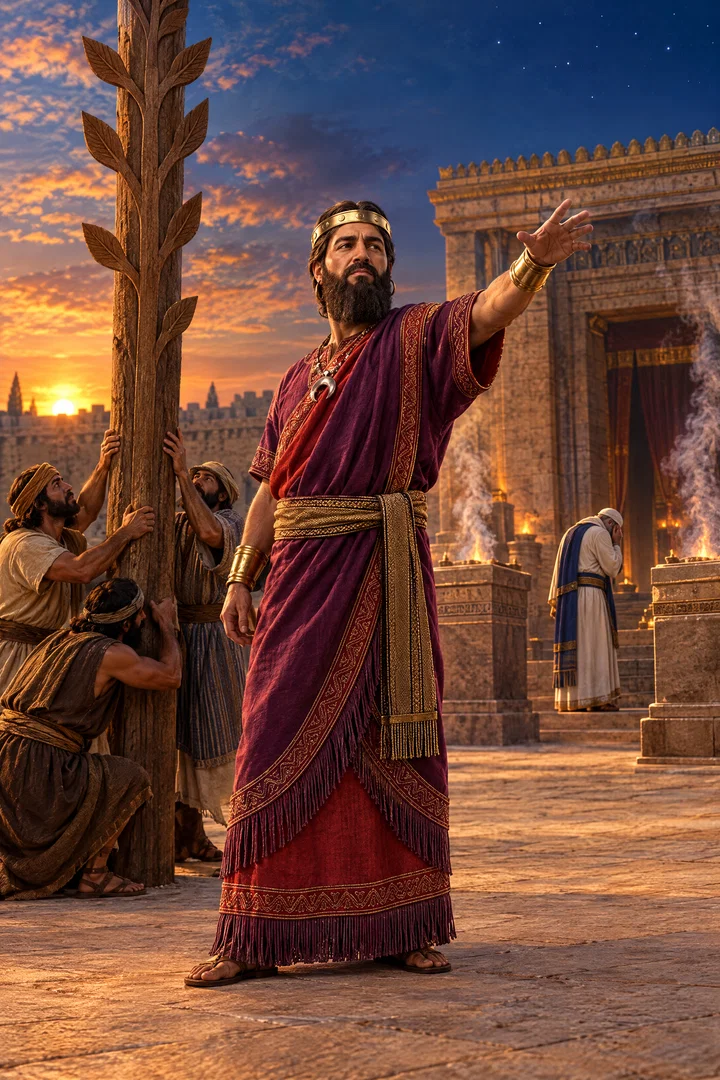
Cross-references
- Ezekiel 8:16
And he brought me into the inner court of the LORD’s house, and, behold, at the door of the temple of the LORD, between the porch and the altar, were about five and twenty men, with their backs toward the temple of the LORD, and their faces toward the east; and they worshipped the sun toward the east.
Describes people worshiping the sun toward the east.
- 2 Chronicles 33:3-6
For he built again the high places which Hezekiah his father had broken down, and he reared up altars for Baalim, and made groves, and worshipped all the host of heaven, and served them.
Gives a parallel account of Manasseh restoring high places and worshiping other gods.
- 2 Kings 18:4
He removed the high places, and brake the images, and cut down the groves, and brake in pieces the brasen serpent that Moses had made: for unto those days the children of Israel did burn incense to it: and he called it Nehushtan.
Manasseh restored the idolatrous practices Hezekiah had removed.
- 2 Kings 21:12-13
Therefore thus saith the LORD God of Israel, Behold, I am bringing such evil upon Jerusalem and Judah, that whosoever heareth of it, both his ears shall tingle.
evil threatened on Jerusalem because of this
- Deuteronomy 4:19
And lest thou lift up thine eyes unto heaven, and when thou seest the sun, and the moon, and the stars, even all the host of heaven, shouldest be driven to worship them, and serve them, which the LORD thy God hath divided unto all nations under the whole heaven.
Both warn against worshiping and serving the host of heaven.
- 2 Chronicles 33:10-11
And the LORD spake to Manasseh, and to his people: but they would not hearken.
Assyrian captivity for not hearkening
- 2 Kings 21:9
But they hearkened not: and Manasseh seduced them to do more evil than did the nations whom the LORD destroyed before the children of Israel.
Manasseh seduced Judah to greater evil
- 2 Kings 21:16
Moreover Manasseh shed innocent blood very much, till he had filled Jerusalem from one end to another; beside his sin wherewith he made Judah to sin, in doing that which was evil in the sight of the LORD.
Manasseh shed innocent blood and led Judah into sin.
- 1 Kings 13:2
And he cried against the altar in the word of the LORD, and said, O altar, altar, thus saith the LORD; Behold, a child shall be born unto the house of David, Josiah by name; and upon thee shall he offer the priests of the high places that burn incense upon thee, and men’s bones shall be burnt upon thee.
Josiah fulfilled the prophecy after Manasseh and Amon.
- 2 Kings 23:5
And he put down the idolatrous priests, whom the kings of Judah had ordained to burn incense in the high places in the cities of Judah, and in the places round about Jerusalem; them also that burned incense unto Baal, to the sun, and to the moon, and to the planets, and to all the host of heaven.
cited together to verify Israel turned to sun-worship
- 2 Kings 21:20
And he did that which was evil in the sight of the LORD, as his father Manasseh did.
Amon continued Manasseh's evil
- 2 Kings 17:33
They feared the LORD, and served their own gods, after the manner of the nations whom they carried away from thence.
Both describe worship of the LORD alongside service to other gods.
Commentary
Each commentary is drawn from primary sources: the writings of Ellen G. White and Adventist pioneers and periodicals. Each commentary is separate. Its own words are not a quotation; follow the references to read the source passages.
Ellen G. White
1 source
Manasseh deliberately dared to set aside the statutes given through Moses as the standard for the nation.RH Jul 22, 1915 His rebellion centered especially on the book of the covenant in Deuteronomy, whose requirements had been observed during his father Hezekiah's reign and had made that reign prosperous.RH Jul 22, 1915 By rebuilding what Hezekiah had destroyed and turning to idolatry, he rejected the very instruction that had brought blessing.RH Jul 22, 1915 During his reign the temple copy of the book of the law was lost through careless neglect.RH Jul 22, 1915 As a result, for many years the people generally were deprived of its instruction and left without its guidance.RH Jul 22, 1915
Sources
Pioneers and periodicals
12 sources
Manasseh came to the throne at twelve after his father Hezekiah died and deliberately undid his father's reforms by rebuilding the high places, raising altars to Baal, setting up an Asherah like Ahab king of Israel, and serving the host of heaven.ST Dec 24, 1885ST Jan 30, 1896ST Jun 3, 1913ST Nov 3, 1898 Worshiping all the host of heaven was sun worship and the service of Baal, the prominent superstition to which Israel invariably turned in apostasy when outward trust in the sun as benefactor overruled trust in an unseen Sovereign.ST Oct 18, 1883ST Jan 30, 1896ST May 6, 1913 He even carried this worship into the house of the Lord by building altars for the host of heaven in its two courts, setting aside the statutes in Deuteronomy whose observance had made Hezekiah prosperous, until through neglect the temple copy of the law was lost and the people were long deprived of its instruction.RH Jul 22, 1915ST Oct 18, 1883 This illustrates Judah's spotted record in which the kingdom prospered under faithful rulers but after prosperity turned to gross idolatry, following Israel's course until overthrow and Babylonian captivity came to Judah as it had come to Israel.ST May 5, 1909ST Dec 9, 1897ST Oct 18, 1883ST May 10, 1910ST Jun 3, 1913 His evil was joined with making his son pass through the fire, using enchantments and familiar spirits, seducing Judah to worse evil than the heathen, and filling Jerusalem with innocent blood, making his reign a byword for wickedness, yet when he humbled himself God heard him and showed him mercy.ST Dec 24, 1885ST Apr 16, 1896
Manasseh's Reversal in Judah
Manasseh son of Hezekiah came to the throne at twelve after Hezekiah died and reigned before his wicked son Amon.ST Dec 24, 1885ST Jun 3, 1913ST Nov 3, 1898 Hezekiah and Josiah were the two decided reformers, with Manasseh's wicked reign standing between them.ST Jun 3, 1913 That idolatrous rule carried Judah back into heathen idolatry and left Josiah to grow up amid a nation steeped in pagan practices.RH Nov 12, 1872
Under evil influences Manasseh reversed his father's reforms by building again the high places Hezekiah had destroyed.ST Dec 24, 1885ST Jan 30, 1896ST Nov 3, 1898ST Apr 16, 1896RH Nov 12, 1872 He reared up altars for Baal and made a grove or Asherah as Ahab king of Israel had done.ST Dec 24, 1885ST Nov 3, 1898ST Apr 16, 1896RH Nov 12, 1872 He worshiped and served all the host of heaven, leading Judah into Baal and sun worship.ST Dec 24, 1885ST Jan 30, 1896ST Nov 3, 1898RH Nov 12, 1872
The verse belongs to the reign of Manasseh in Judah following Hezekiah, within the nearly 300-year period of the kings of Judah and Israel.ST May 5, 1909 It stands within the account of the kings from Solomon's accession to the Babylonian Captivity, in the history of Judah after the ten tribes had been swept away.ST Dec 9, 1897 It belongs to the closing history that records the wicked and weak reigns of the kings of Judah, standing in contrast to the one bright chapter of the reformation conducted under the good king Josiah.ST May 10, 1910 It shows Judah's spotted record, in which the kingdom always prospered under righteous, faithful rulers, yet after such prosperity rulers turned from God to the grossest idolatry, bringing calamity upon themselves and their people.ST May 5, 1909 In it Judah followed the same idolatrous course as the ten-tribe kingdom of Israel, which might have been strong and stable by keeping the commandments but was led astray by idolatry, until captivity came to Judah as it had come to Israel.ST Jun 3, 1913
The evil was done in the sight of the Lord after the abomination of the heathen whom the Lord cast out before Israel.ST Dec 24, 1885 It was joined with making his son pass through the fire, observing times, using enchantments, and dealing with familiar spirits and wizards.ST Dec 24, 1885ST Apr 16, 1896 He seduced Judah to do more evil than the nations the Lord destroyed before Israel, and shed very much innocent blood till Jerusalem was filled from one end to another.ST Dec 24, 1885 It wrought much wickedness to provoke the Lord to anger and brought the Lord's threatened evil upon Jerusalem and Judah, so that Zion became spiritually one with Babylon before the visible overthrow and captivity of the people.ST Dec 24, 1885ST Apr 16, 1896
Sun Worship and Consequences
To worship all the host of heaven is to practice sun worship and the service of Baal, a common heathen deity.ST Oct 18, 1883ST Jan 30, 1896ST May 6, 1913 Whenever Israel apostatized from heaven-born faith in a beneficent Creator they invariably turned to this prominent superstition, despite God's providential dealings with them and even their tenacity for the Sabbath.ST Oct 18, 1883ST May 6, 1913 Outward observation of the sun's effect upon vegetation was permitted to overrule trust in an unseen Sovereign, so that the sun was adored as the great benefactor of mankind.ST May 6, 1913 It is the same idolatry against which Moses warned when he commanded Israel not to lift up the eyes to the sun and moon and stars in homage, and the same sun worship already known in Job's time.ST Oct 18, 1883 This return to idolatry and sun worship came in a time of worldly prosperity under Solomon and the later kings.ST Oct 18, 1883ST Jan 30, 1896
Manasseh introduced this worship into the temple itself by building altars for all the host of heaven in the two courts of the house of the Lord.ST Oct 18, 1883 In doing so he dared to set aside the statutes recorded by Moses, especially those in the book of the covenant in Deuteronomy, whose observance had made Hezekiah's reign prosperous.RH Jul 22, 1915 Through careless neglect the temple copy of the book of the law became lost during his reign, so that for many years the people generally were deprived of its instruction.RH Jul 22, 1915
The verse illustrates Judah's spotted record, in which the kingdom always prospered under righteous and faithful rulers, yet after such prosperity rulers turned from God to the grossest idolatry, bringing calamity upon themselves and their people.ST May 5, 1909 Keeping the commandments might have kept Israel strong and stable, but idolatry led them astray, and Judah followed the same idolatrous course as the ten-tribe kingdom until captivity came to Judah as it had come to Israel.ST May 5, 1909ST Jun 3, 1913 Forgetting God by disregarding His Sabbath opened the way to this worship, and for this idolatry a curse rested upon them, so that Jerusalem was once destroyed through Sabbath-breaking and sun worship.ST Oct 18, 1883 This worship of Baal and the heavenly bodies after Ahab's example belonged to a wider apostasy with forbidden rites and spirit practices, which made Zion spiritually one with Babylon before the visible overthrow and captivity of the people.ST Apr 16, 1896
Manasseh restored the high places, Baal altars, and sun worship undone by Hezekiah because the people were attached to low, sensual religions, and his reign became a byword for wickedness. Yet after all his sin, when he humbled himself before God, God heard him and showed mercy even to Manasseh.
Sources