Ezekiel 8:16
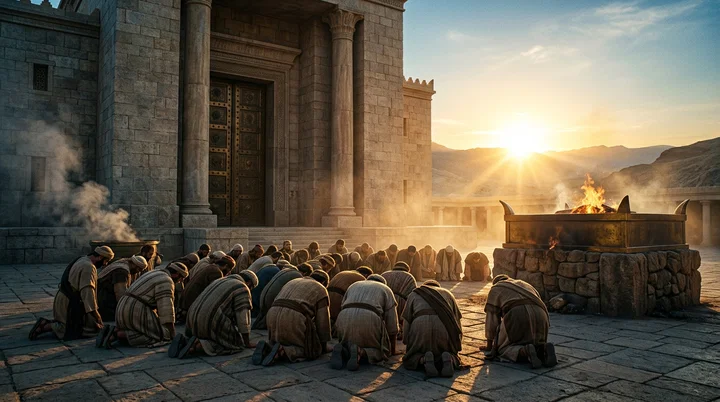
And he brought me into the inner court of the LORD’s house, and, behold, at the door of the temple of the LORD, between the porch and the altar, were about five and twenty men, with their backs toward the temple of the LORD, and their faces toward the east; and they worshipped the sun toward the east.
Translations
American King James Version, King James Version
And he brought me into the inner court of the LORD’s house, and, behold, at the door of the temple of the LORD, between the porch and the altar, were about five and twenty men, with their backs toward the temple of the LORD, and their faces toward the east; and they worshipped the sun toward the east.
And he brought me into the inner court of the Lord’s house, and behold, at the door of the temple of the Lord, between the porch and the altar, were about five and twenty men, with their backs toward the temple of the Lord, and their faces towards the east; and they worshipped the sun towards the east.
And he brought me into the inner court of the LORD'S house, and behold, at the door of the temple of the LORD, between the porch and the altar, were about five and twenty men, with their backs towards the temple of the LORD, and their faces towards the east; and they worshiped the sun towards the east.
And he brought me into the inner court of the LORD’S house, and behold, at the door of the temple of the LORD, between the porch and the altar, were about five and twenty men, with their backs toward the temple of the LORD, and their faces toward the east; and they worshipped the sun toward the east.
And he brought me into the inner court of Jehovah’s house; and behold, at the door of the temple of Jehovah, between the porch and the altar, were about five and twenty men, with their backs toward the temple of Jehovah, and their faces toward the east; and they were worshipping the sun toward the east.
And He bringeth me in unto the inner court of the house of Jehovah, and lo, at the opening of the temple of Jehovah, between the porch and the altar, about twenty-five men, their backs toward the temple of Jehovah, and their faces eastward, and they are bowing themselves eastward to the sun.
And he brought me into the inner court of Jehovah's house, and behold, at the entry of the temple of Jehovah, between the porch and the altar, were about five and twenty men, with their backs toward the temple of Jehovah and their faces toward the east; and they worshipped the sun toward the east.
So he brought me into the inner court of the house of Yahweh, and lo! at the opening of the temple of Yahweh, between the porch and the altar, about twenty-five men,—their backs towards the temple of Yahweh and their faces eastward, and they were bowing down eastward unto the Sun.
Berean Standard Bible, Majority Standard Bible
So He brought me to the inner court of the house of the LORD, and there at the entrance to the temple of the LORD, between the portico and the altar, were about twenty-five men with their backs to the temple of the LORD and their faces toward the east; and they were bowing to the east in worship of the sun.
He brought me into the inner court of the LORD’s house; and I saw at the door of the LORD’s temple, between the porch and the altar, there were about twenty-five men with their backs toward the LORD’s temple and their faces toward the east. They were worshiping the sun toward the east.
And he took me into the inner square of the Lord's house, and at the door of the Temple of the Lord, between the covered way and the altar, there were about twenty-five men with their backs turned to the Temple of the Lord and their faces turned to the east; and they were worshipping the sun, turning to the east.
And he caused me to enter into the inner court of the Lordes house, and beholde, at the doore of the Temple of the Lord, betweene the porche and the altar were about fiue and twentie men with their backs toward the Temple of the Lord, and their faces towarde the East, and they worshipped the sunne, towarde the East.
Douay-Rheims (Challoner revision)
And he brought me into the inner court of the house of the Lord: and behold at the door of the temple of the Lord, between the porch and the altar, were about five and twenty men having their backs towards the temple of the Lord, and their faces to the east: and they adored towards the rising of the sun.
Pictures
Cross-references
- Deuteronomy 4:19
And lest thou lift up thine eyes unto heaven, and when thou seest the sun, and the moon, and the stars, even all the host of heaven, shouldest be driven to worship them, and serve them, which the LORD thy God hath divided unto all nations under the whole heaven.
Forbids worshiping the sun and other heavenly bodies.
- Deuteronomy 17:3
And hath gone and served other gods, and worshipped them, either the sun, or moon, or any of the host of heaven, which I have not commanded;
Both condemn worship of the sun as forbidden idolatry.
- Job 31:26-28
If I beheld the sun when it shined, or the moon walking in brightness;
Treats worship of the sun as unfaithfulness to God.
- 2 Chronicles 33:3
For he built again the high places which Hezekiah his father had broken down, and he reared up altars for Baalim, and made groves, and worshipped all the host of heaven, and served them.
Records Manasseh’s worship of the heavenly host.
- Ezekiel 8:9-12
And he said unto me, Go in, and behold the wicked abominations that they do here.
Both scenes show idolatrous worship among successive abominations in the temple vision.
- Jeremiah 7:18
The children gather wood, and the fathers kindle the fire, and the women knead their dough, to make cakes to the queen of heaven, and to pour out drink offerings unto other gods, that they may provoke me to anger.
People offer worship to other gods, including the queen of heaven.
- 2 Kings 23:5
And he put down the idolatrous priests, whom the kings of Judah had ordained to burn incense in the high places in the cities of Judah, and in the places round about Jerusalem; them also that burned incense unto Baal, to the sun, and to the moon, and to the planets, and to all the host of heaven.
Both texts describe worship directed toward the sun.
- Exodus 20:4-5
Thou shalt not make unto thee any graven image, or any likeness of any thing that is in heaven above, or that is in the earth beneath, or that is in the water under the earth:
Prohibits making and worshipping images, which this sun worship violates.
- 2 Kings 23:11
And he took away the horses that the kings of Judah had given to the sun, at the entering in of the house of the LORD, by the chamber of Nathan-melech the chamberlain, which was in the suburbs, and burned the chariots of the sun with fire.
Both describe worship of the sun at the LORD’s temple.
- Ezekiel 8:10
So I went in and saw; and behold every form of creeping things, and abominable beasts, and all the idols of the house of Israel, pourtrayed upon the wall round about.
shown in same vision as successive abominations
- Ezekiel 8:3
And he put forth the form of an hand, and took me by a lock of mine head; and the spirit lifted me up between the earth and the heaven, and brought me in the visions of God to Jerusalem, to the door of the inner gate that looketh toward the north; where was the seat of the image of jealousy, which provoketh to jealousy.
The vision first shows worship of the image of jealousy.
- Jeremiah 8:2
And they shall spread them before the sun, and the moon, and all the host of heaven, whom they have loved, and whom they have served, and after whom they have walked, and whom they have sought, and whom they have worshipped: they shall not be gathered, nor be buried; they shall be for dung upon the face of the earth.
Both describe worship of the sun and heavenly host.
- Jeremiah 2:27
Saying to a stock, Thou art my father; and to a stone, Thou hast brought me forth: for they have turned their back unto me, and not their face: but in the time of their trouble they will say, Arise, and save us.
Both describe idolaters turning their backs on the Lord.
- Jeremiah 19:13
And the houses of Jerusalem, and the houses of the kings of Judah, shall be defiled as the place of Tophet, because of all the houses upon whose roofs they have burned incense unto all the host of heaven, and have poured out drink offerings unto other gods.
Both describe worship directed toward the sun or host of heaven.
- Exodus 20:3
Thou shalt have no other gods before me.
Sun worship violates the command to have no other gods.
- 2 Kings 21:3
For he built up again the high places which Hezekiah his father had destroyed; and he reared up altars for Baal, and made a grove, as did Ahab king of Israel; and worshipped all the host of heaven, and served them.
Both describe worship of the host of heaven, including sun worship.
- Ezekiel 9:1-6
He cried also in mine ears with a loud voice, saying, Cause them that have charge over the city to draw near, even every man with his destroying weapon in his hand.
Judgment begins at the sanctuary, while the grieving faithful are marked for protection.
- Romans 1:25
Who changed the truth of God into a lie, and worshipped and served the creature more than the Creator, who is blessed for ever. Amen.
People turn from honoring God to worshiping created things.
- 1 John 5:21
Little children, keep yourselves from idols. Amen.
warns against idols like sun worship
Commentary
Each commentary is drawn from primary sources: the writings of Ellen G. White and Adventist pioneers and periodicals. Each commentary is separate. Its own words are not a quotation; follow the references to read the source passages.
Ellen G. White
1 source
In the sixth year of Zedekiah, Ezekiel was shown in vision the wicked practices then being carried on in Jerusalem, within the gate of the Lord's house and even in the inner court.PK 448.2–449.1 Among what was revealed to him was one of the greater abominations committed there.PK 448.2–449.1 At the door of the temple of the Lord, in the inner court in the space between the porch and the altar, were about twenty-five men with their backs turned toward the temple and their faces toward the east, worshiping the sun toward the east.PK 448.2–449.1
Together with the other idolatries practiced at that time, this sun worship filled the land with violence and provoked God to anger.PK 448.2–449.1 Because of it He would deal in fury, without sparing and without pity, and He would not hear even though they cried in His ears with a loud voice.PK 448.2–449.1
Sources
Pioneers and periodicals
50 sources
About five and twenty men stood in the inner court of the Lord's house at the door of the temple between the porch and the altar, with their backs toward the temple and their faces toward the east worshipping the sun toward the east.ST Jul 13, 1915STST Apr 1, 1889 They were prominent men of Israel, elders and priests of sanctuary service, whose eastward posture turned away from God's presence, for His house was entered from the east so that those worshipping Him faced west with their backs to the rising sun.ST Jul 13, 1915STST Feb 4, 1903ST Apr 1, 1889ST It was an extreme and climactic abomination, honoring another god in God's own court, contemning the true God, profaning His temple and polluting His worship.ST Jul 26, 1910STST Apr 1, 1889ST Oct 29, 1894 With Ezekiel 9 it is typical of the great sealing work, the same as Revelation 7:2-3, where those who sigh and cry over the abominations in the temple are marked in the forehead before judgment comes.ST Jul 26, 1910ST Jul 26, 1910ST Jan 10, 1900ST Nov 10, 1909ST Jan 10, 1900 That sun worship displaced true worship and set aside the Sabbath, and Sun-day stands as its chief counterfeit sign against the Lord's Sabbath, so that eastward sun worship and its sunrise rites, including Easter sunrise meetings, remain forbidden idolatry.ST Feb 4, 1903STST Aug 11, 1909
Temple Scene Described
About five and twenty men stood in the inner court of the Lord's house, at the door of the temple between the porch and the altar, with their backs toward the temple and their faces toward the east as they worshipped the sun toward the east.ST Jul 13, 1915STST Apr 1, 1889ST Dec 24, 1894ST Jan 30, 1896 This sun worship had entered the Lord's temple itself as a forbidden idolatry and false worship practiced by Judah, reaching its climax among the abominations shown to Ezekiel.ST Apr 1, 1889ST Jan 30, 1896ST The men were prominent men of Israel, described as elders, indeed as twenty-five priests while apparently assigned to sanctuary service.ST Jul 13, 1915STSTST May 6, 1913 Their act is set forth by some as especially abominable and most degrading to humanity, bringing judgment for these abominations.ST Aug 12, 1913
God's worship was arranged in deliberate opposition to sun worship, for the tabernacle was always pitched and the temple entered from the east with its door toward the east.STST Feb 4, 1903ST Apr 1, 1889ST Nov 5, 1894ST Nov 14, 1892 Those who worshipped toward His presence manifested by the shekinah in the most holy place faced west with their backs to the east, thereby renouncing sun worship and all idolatry.STST Feb 4, 1903ST Nov 5, 1894ST Nov 14, 1892 The arrangement kept worshippers from facing east while serving before the Lord, so that they would not even appear to worship the sun.STST Apr 1, 1889ST Jul 19, 1905 The court gate was at the east end, corresponding to the east-facing door of the tabernacle and temple.ST May 1, 1901
Turning east to the sun therefore meant turning away from the worship of God and from His sanctuary and presence, and their posture outwardly displayed rejection of Jehovah.STST Feb 4, 1903ST Oct 29, 1894ST Nov 5, 1894ST Jan 24, 1906 Sun worship was directed eastward while worship entering the sanctuary faced west toward God's presence, so turning from the sanctuary toward the sun reversed the proper direction of worship and signified rejection of God and His worship.STST Feb 4, 1903ST Nov 5, 1894ST Jan 24, 1906ST Dec 24, 1894 The vision belongs to what Ezekiel saw while on the Chebar, understood as the Nar Kabari, the Euphrates of Nippur, the great canal running through Nippur and central Babylonia.RH Sep 21, 1905 Nippur was the center of Babylonian worship, and the worship of the sun toward the east, along with the women weeping for Tammuz, was one of the heathen Babylonian rites with which Ezekiel was familiar there.RH Sep 21, 1905
The eastward worship reflects the practice of all the Eastern nations, who performed divine worship with their faces turned toward where the sun rises.ST Dec 24, 1894 It is the worship offered to Ra at Heliopolis and to Baal by the Canaanites, Syrians and Phoenicians.ST Dec 24, 1894 The larger vision in Ezekiel chapters 1-10 gives a visible representation of the sanctuary and true tabernacle in heaven which the Lord pitched and not man, a shadow and example of heavenly things.ST Jul 24, 1884 That vision shows the exalted position occupied by a covering cherub and consequently the great power possessed by such a being.ST Jul 24, 1884
Nature of the Abomination
Sun worship carried into the Lord's temple was an extreme and climactic abomination, worse than the idolatrous practices shown before it and reckoned among Judah's greatest sins.ST Jul 26, 1910ST Apr 1, 1889ST Jul 26, 1910 About twenty-five men stood in the inner court with their backs toward the temple and their faces toward the east worshiping the sun, bringing a forbidden false worship into the very house of God.ST Jul 26, 1910ST Apr 1, 1889ST Jul 26, 1910ST By honoring another god in God's court they contemned the true God, profaned His temple, polluted divine worship, abandoned the Creator and Upholder, rejected God, and brought God's judgments upon Israel.STST Oct 29, 1894ST Sep 8, 1909ST Aug 11, 1909 The eastward direction of sun worship set against the westward direction of Israel's worship of the Lord teaches the absolute contrast between false and true worship.
Sun worship was the most abominable form of nature worship, for instead of honoring God as the source of light and life men worshiped a created thing.STST Dec 5, 1911ST Sep 3, 1902 The sun was treated as the source of fertility and procreative power, and nature worship was used to indulge lust, so that sexual impurity seemed like acceptable religion amid feasts and revelry forbidden by God's law.ST Dec 5, 1911ST Sep 3, 1902 This worship was carried on under the names of Baal, Tammuz, Molech and other images which were all sun images.ST Aug 20, 1894 The weeping for Tammuz and the worship toward the east was child worship which was in fact sun worship, worshiping the child Nimrod as the promised Seed and diverting the descendants of faithful Abraham from the true promised Seed and from the worship of the true God.STST Aug 20, 1894
Tammuz is Nimrod, builder of the tower of Babel, worshiped by the name Osiris in Egypt and as Tammuz, the same as Adonis the hunter, in Phoenicia and Assyria.RH Dec 16, 1909 In the Babylonian system the sun, or Baal, was the one only god, so worship of Tammuz as God incarnate meant worship of him as an incarnation of the sun.RH Dec 16, 1909 In this way sun worship is traced back to Nimrod, whose worship was universal in old time, and it is idolatry to be shunned.RH Dec 16, 1909 They also put the branch to the nose, supposedly as a symbol of faith in the sun's power to produce.ST May 6, 1913 The act is Mithraism and the apostasy of the Gentile world to sun worship by prostrating toward the east.ST Apr 2, 1896ST Nov 14, 1892
Israel and Judah were drawn into this idolatry through alliances with heathen peoples beginning in Solomon's time.ST Jul 19, 1905 Their own people and kings embraced false worship including sun worship and its feasts, with disastrous results, and this history taught later Judean youths to refuse Babylonian practices that would bind them to idolatry.ST Jul 19, 1905ST Sep 18, 1901 The episode shows how quickly the people forsook God and became idolaters.ST Jun 13, 1906 After reproof for worshiping the golden calf they turned to sun worship as a visible object of adoration that did not reveal God's loving, fatherly care.ST Jun 13, 1906ST Jun 23, 1914
Prophecy and Sealing Work
Ezekiel 8 together with chapter 9 is typical of the great sealing work.ST Jul 26, 1910ST Jul 26, 1910 That section presents striking prophecies about the future, using Israel as a symbol of the last days.ST Nov 10, 1909
Ezekiel 8 with Ezekiel 9 presents the same work as Revelation 7:2-3, the sealing of the servants of God in their foreheads before hurt comes to the earth and the sea, and the mark commanded in Ezekiel 9:4 is that seal.ST Jan 10, 1900ST Jan 10, 1900 The sun worship toward the east is one of the abominations in the temple over which the faithful sigh and cry.ST Jan 10, 1900 The judgment for these abominations shown in the following chapter also predicts the final judgment, when God's angels pass through His professed people and mark those who grieve over the wrongdoing among them.ST Aug 12, 1913 The seal or mark is set in the forehead because the forehead is the seat of the mind, with which the law of God is served.ST Jan 10, 1900ST Jan 10, 1900 The message is not to a people that do not know God but to a people serving God whose practice on some point of faith or life is not right, to set them right on God's law and especially on the part of it that is the seal or sign of His authority and right to command.ST Jan 10, 1900
Sabbath Against Sunday Worship
Sun worship in the inner court displaced true worship and set aside the Sabbath, which commemorates God's creative power as Creator and Upholder and stands as a sign of loyalty between God and His people.ST Feb 4, 1903ST Aug 11, 1909 Keeping God's Sabbath would have helped preserve Israel from that idolatry, for turning backs on the temple to face east outwardly displayed rejection of Jehovah, since the temple was entered from the east and the Lord was worshiped toward the west.ST Feb 4, 1903 Apostasy from the Sabbath led to adoption of the day associated with sun worship, so that sun worship took the place of the Lord's Sabbath and led to Sabbath breaking and transgression of God's Sabbath.ST Oct 29, 1894ST Sep 10, 1896 This apostasy is joined with violation of God's law by the priests and their profaning of the Sabbath, and with prominent men of Israel reaching the point of worshiping the sun in the temple.ST Jul 13, 1915ST
Sun-day is the chief mark of this sun worship, in contrast to the Sabbath as the sign of loyalty, a counterfeit sign set against the Lord's Sabbath and a rival worship day brought in place of the Sabbath.ST Feb 4, 1903ST Sunday observance originated in pagan sun worship as an old heathen day dedicated to sun worship and a solar holiday of pagan origin, the same heathen practice seen when men turned their backs on the temple to worship toward the east.RH Jun 8, 1916ST Feb 13, 1896ST Sep 16, 1913 The Galatians' return to former gods is reckoned among such observances.ST Feb 13, 1896 This apostasy is connected in turn to the demand for Sunday enforcement by civil law, showing why such Sunday laws are wrong.ST Jul 13, 1915RH Jun 8, 1916
Replacing God's commanded seventh-day Sabbath with a human-made day of rest follows the pattern of this heathen worship, because it rejects God's authority and honors a human institution instead.ST Nov 19, 1894ST Nov 26, 1912 Sun worship on the first day of the week is likewise heathen idolatry and violates God's law.ST Nov 26, 1912 The about twenty-five men worshiping the sun with backs toward the temple and faces east give the pattern by which the Sabbath was crushed out in Israel and again in the Christian church as Sunday rose.ST Jan 30, 1896ST Oct 22, 1896 Their sun worship marks the decline of the Jewish church amid worldly prosperity and parallels the later Christian church's paganized worship and departure from God, with Sunday holding a prominent place among the heathen times the Bible prohibits.ST Jan 30, 1896ST Oct 22, 1896
The errors, superstitions, and habits of Persian sun worshipers in Ezekiel's time were handed down from father to son to the heathen systems of the age of Constantine and then baptized into the Roman Catholic church.RH Jul 15, 1875 There in many dangerous and subtle forms they still corrupt the nations, dishonor Christianity, and bring labor and sorrow and affliction and darkness on God's people.RH Jul 15, 1875 After the Jews returned to Palestine, there is no indication they were told to change their reckoning of the Sabbath day, while sun worship itself stands condemned in Scripture as a heathen practice.RH Oct 18, 1906
Worship Practice and Application
The Lord condemned worship directed toward the east as sun worship, and keeping the custom of worshiping eastward was not made acceptable by rejecting the belief that God dwelt in the sun.ST Dec 24, 1894ST Jan 24, 1906 Eastward-facing worship customs are old idolatry rather than divine direction, for the temple entrance faced east so that worshipers entering it faced west toward God's presence in the holy of holies, and turning eastward to worship the sun reversed the proper direction.ST Jan 24, 1906RH Sep 16, 1915 God's people were not to imitate the heathen practice of facing the rising sun in worship, since the sanctuary arrangement directed worshipers to face west instead, with their backs to the east.ST Jan 24, 1906RH Sep 16, 1915 Facing the sun in a religious ceremony is an outward form rooted in pagan sun worship, not genuine worship of Jehovah, in contrast to worship directed toward the west and to the true God who created the sun.ST Jul 13, 1915ST Dec 24, 1894 The men with their backs toward the temple and their faces toward the east displayed sun worship as an abomination within the sanctuary itself.ST Jul 13, 1915ST Dec 24, 1894
Christians who assembled at sunrise on Sunday and prayed toward the rising sun practiced something resembling this condemned act, even though they claimed a different purpose.AUST Jun 28, 1920 They worshiped toward the sun like the heathen, turning their backs toward the temple as the men in the Lord's temple had turned their backs toward it to worship the rising sun toward the east.AUST Jun 28, 1920 Holding a union sunrise prayer meeting on Easter Sunday morning is a return to those heathen times and is in perfect harmony with Easter celebration, for the worship of the sun toward the east by men who turned their backs on the temple is Mithraism.ST Apr 2, 1896RH Apr 8, 1909 The verse stands as a biblical example of the pagan sun worship associated with ancient spring festivals and deities such as Tammuz and Ostara.ST Apr 2, 1896RH Apr 8, 1909
The verse shows open false worship that breaks the second commandment, which does not require carving or molding or casting a graven image and bowing down to it.RH Mar 9, 1916 A person may hold a pantheon of gods in the temple of the mind, with the image concept formed in the mind before it is made in concrete form, and God sees the cherished imaginings of sins and lusts in the soul.RH Mar 9, 1916 The chapter uncovers sins committed in the dark in the chambers of imagery, and the same idolatry occurs when people daily bow to and render homage to farms, houses, automobiles, art, books, and their own handiwork.RH Mar 9, 1916 Whatever object a person daily bows to and renders homage to, that he worships, even when it is not a caricature of a man, ox, or goat, and by worshiping a false god he transgresses the second commandment, yet the grace of Christ can save from every species of false worship, open or in secret.RH Mar 9, 1916 The passage covering the verse is an example of evil that should be brought to light rather than kept hidden.ST Jan 11, 1899
Sources