1 Kings 12:32
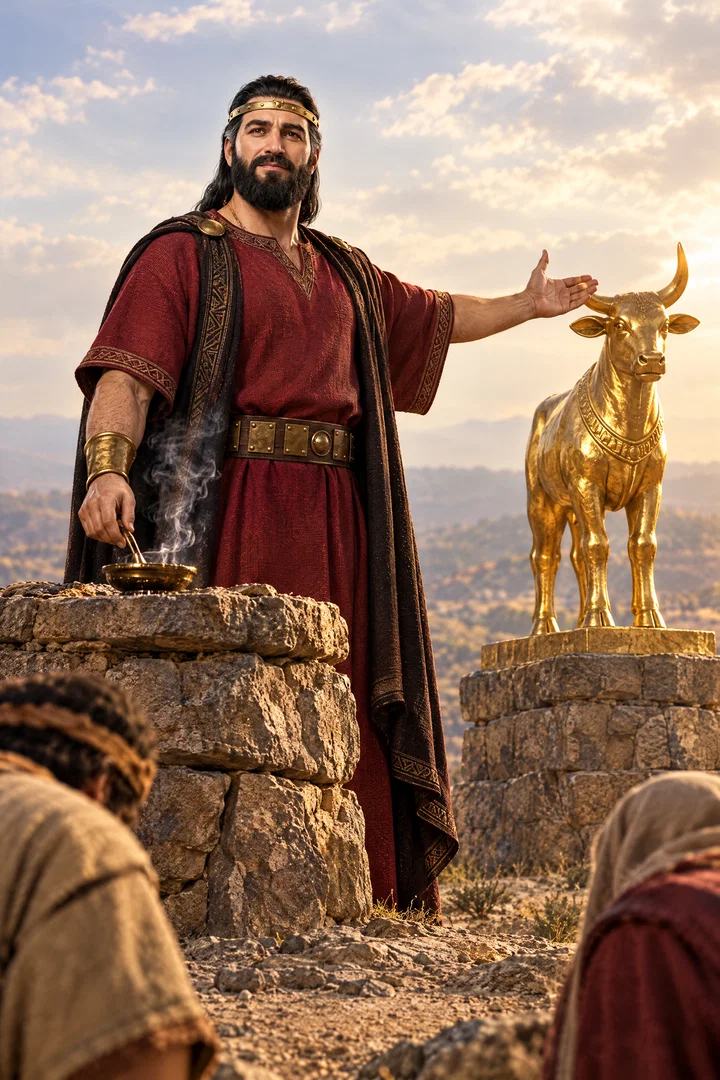
And Jeroboam ordained a feast in the eighth month, on the fifteenth day of the month, like unto the feast that is in Judah, and he offered upon the altar. So did he in Beth-el, sacrificing unto the calves that he had made: and he placed in Beth-el the priests of the high places which he had made.
Translations
And Jeroboam ordained a feast in the eighth month, on the fifteenth day of the month, like to the feast that is in Judah, and he offered on the altar. So did he in Bethel, sacrificing to the calves that he had made: and he placed in Bethel the priests of the high places which he had made.
And Jeroboam ordained a feast in the eighth month, on the fifteenth day of the month, like unto the feast that is in Judah, and he offered upon the altar. So did he in Beth-el, sacrificing unto the calves that he had made: and he placed in Beth-el the priests of the high places which he had made.
And Jeroboam ordained a feast in the eighth month, on the fifteenth day of the month, like unto the feast that is in Judah, and he offered upon the altar (so did he in Beth-el,) sacrificing unto the calves that he had made: and he placed in Beth-el the priests of the high places which he had made.
And Jeroboam ordained a feast in the eighth month, on the fifteenth day of the month, like the feast that is in Judah, and he offered upon the altar. So did he in Beth-el, sacrificing to the calves that he had made: and he placed in Beth-el the priests of the high places which he had made.
And Jeroboam ordained a feast in the eighth month, on the fifteenth day of the month, like unto the feast that is in Judah, and he went up unto the altar; so did he in Beth-el, sacrificing unto the calves that he had made: and he placed in Beth-el the priests of the high places which he had made.
And Jeroboam ordained a feast in the eighth month, on the fifteenth day of the month, like unto the feast that is in Judah, and he went up unto the altar; so did he in Beth-el, sacrificing unto the calves that he had made: and he placed in Beth-el the priests of the high places that he had made.
and Jeroboam maketh a festival in the eighth month, in the fifteenth day of the month, like the festival that [is] in Judah, and he offereth on the altar — so did he in Beth-El — to sacrifice to the calves which he made, and he hath appointed in Beth-El the priests of the high places that he made.
And Jeroboam ordained a feast in the eighth month, on the fifteenth day of the month, like the feast that was in Judah, and he offered upon the altar. So did he in Bethel, sacrificing to the calves that he had made; and he placed in Bethel the priests of the high places that he had made.
And Jeroboam made a festival in the eight month, on the fifteenth day of the month, like the festival which [was held] in Judah, and offered up on the altar, likewise, did he in Bethel, sacrificing to the calves which he had made,—and he kept in attendance in Bethel, the priests of the high-places which he had made.
Berean Standard Bible, Majority Standard Bible
And Jeroboam ordained a feast on the fifteenth day of the eighth month, like the feast that was in Judah, and he offered sacrifices on the altar; he made this offering in Bethel to sacrifice to the calves he had set up, and he installed priests in Bethel for the high places he had set up.
Jeroboam ordained a feast in the eighth month, on the fifteenth day of the month, like the feast that is in Judah, and he went up to the altar. He did so in Bethel, sacrificing to the calves that he had made, and he placed in Bethel the priests of the high places that he had made.
And Jeroboam gave orders for a feast in the eighth month, on the fifteenth day of the month, like the feast which is kept in Judah, and he went up to the altar. And in the same way, in Beth-el, he gave offerings to the oxen which he had made, placing in Beth-el the priests of the high places he had made.
And Ieroboam made a feast the fifteenth day of the eight moneth, like vnto the feast that is in Iudah, and offred on the altar. So did he in Beth-el and offered vnto the calues that he had made: and he placed in Beth-el the Priestes of the hie places, which he had made.
Douay-Rheims (Challoner revision)
And he appointed a feast in the eighth month, on the fifteenth day of the month, after the manner of the feast that was celebrated in Juda. And going up to the altar, he did in like manner in Bethel, to sacrifice to the calves, which he had made: and he placed in Bethel priests of the high places, which he had made.
Pictures
Cross-references 20 of 32
- 1 Kings 13:1-5
And, behold, there came a man of God out of Judah by the word of the LORD unto Beth-el: and Jeroboam stood by the altar to burn incense.
A prophet denounces Jeroboam’s altar, and its breaking confirms the judgment.
- Amos 7:13
But prophesy not again any more at Beth-el: for it is the king’s chapel, and it is the king’s court.
Bethel is identified as the king’s sanctuary and royal temple.
- Leviticus 23:34
Speak unto the children of Israel, saying, The fifteenth day of this seventh month shall be the feast of tabernacles for seven days unto the LORD.
God appointed the feast for the fifteenth day of the seventh month; Jeroboam rescheduled it.
- 1 Kings 12:27
If this people go up to do sacrifice in the house of the LORD at Jerusalem, then shall the heart of this people turn again unto their lord, even unto Rehoboam king of Judah, and they shall kill me, and go again to Rehoboam king of Judah.
Jeroboam feared worship in Jerusalem would reunite the people, so he established rival worship at Bethel.
- Genesis 28:16-19
And Jacob awaked out of his sleep, and he said, Surely the LORD is in this place; and I knew it not.
Jacob called Bethel God’s house, contrasting with its later idolatrous worship.
- Genesis 12:8
And he removed from thence unto a mountain on the east of Beth-el, and pitched his tent, having Beth-el on the west, and Hai on the east: and there he builded an altar unto the LORD, and called upon the name of the LORD.
Abraham built an altar near Bethel, later made a center of calf worship.
- 2 Kings 23:15
Moreover the altar that was at Beth-el, and the high place which Jeroboam the son of Nebat, who made Israel to sin, had made, both that altar and the high place he brake down, and burned the high place, and stamped it small to powder, and burned the grove.
Josiah later destroyed Bethel’s altar and high place.
- 1 Kings 13:4-5
And it came to pass, when king Jeroboam heard the saying of the man of God, which had cried against the altar in Beth-el, that he put forth his hand from the altar, saying, Lay hold on him. And his hand, which he put forth against him, dried up, so that he could not pull it in again to him.
Jeroboam’s hand withers and the altar breaks as signs of judgment at Bethel.
- Amos 7:9
And the high places of Isaac shall be desolate, and the sanctuaries of Israel shall be laid waste; and I will rise against the house of Jeroboam with the sword.
Israel’s idolatrous worship places are called sanctuaries.
- 1 Kings 14:16
And he shall give Israel up because of the sins of Jeroboam, who did sin, and who made Israel to sin.
Israel’s coming punishment is attributed to Jeroboam’s sin and the sin he led Israel into.
- Genesis 35:6-7
So Jacob came to Luz, which is in the land of Canaan, that is, Beth-el, he and all the people that were with him.
Jacob returned to Bethel and built an altar there.
- 1 Kings 11:29-38
And it came to pass at that time when Jeroboam went out of Jerusalem, that the prophet Ahijah the Shilonite found him in the way; and he had clad himself with a new garment; and they two were alone in the field:
Ahijah foretold Jeroboam’s rule and promised him a lasting house if he obeyed God.
- Exodus 32:4-5
And he received them at their hand, and fashioned it with a graving tool, after he had made it a molten calf: and they said, These be thy gods, O Israel, which brought thee up out of the land of Egypt.
Jeroboam’s calf worship and feast echo the wilderness golden calf.
- 1 Samuel 7:16
And he went from year to year in circuit to Beth-el, and Gilgal, and Mizpeh, and judged Israel in all those places.
Samuel’s yearly circuit included Bethel.
- 1 John 5:21
Little children, keep yourselves from idols. Amen.
The lesson’s golden text warns against idols.
- Deuteronomy 32:16-17
They provoked him to jealousy with strange gods, with abominations provoked they him to anger.
Both describe worship of newly established gods.
- 1 Kings 16:31-33
And it came to pass, as if it had been a light thing for him to walk in the sins of Jeroboam the son of Nebat, that he took to wife Jezebel the daughter of Ethbaal king of the Zidonians, and went and served Baal, and worshipped him.
Ahab’s Baal worship follows the idolatrous worship Jeroboam established.
- 2 Kings 17:7-8
For so it was, that the children of Israel had sinned against the LORD their God, which had brought them up out of the land of Egypt, from under the hand of Pharaoh king of Egypt, and had feared other gods,
Israel’s adoption of forbidden worship is condemned.
- 1 Kings 13:33
After this thing Jeroboam returned not from his evil way, but made again of the lowest of the people priests of the high places: whosoever would, he consecrated him, and he became one of the priests of the high places.
Jeroboam continued appointing unauthorized priests for worship at the high places.
- Deuteronomy 12:5-14
But unto the place which the LORD your God shall choose out of all your tribes to put his name there, even unto his habitation shall ye seek, and thither thou shalt come:
Contrasts worship at the place the Lord appointed with Jeroboam’s alternatives.
Commentary
Each commentary is drawn from primary sources: the writings of Ellen G. White and Adventist pioneers and periodicals. Each commentary is separate. Its own words are not a quotation; follow the references to read the source passages.
Ellen G. White
3 sources
On the fifteenth day of the eighth month a feast was ordained at Bethel, deliberately modeled on the feast observed in Judah, and sacrifice was offered personally upon the altar there.PK 101.2 By that observance solemnity was given to the dedication of an unauthorized altar at Bethel.PK 102.3 There sacrifice was made to the calves that had been fashioned, and priests of high places of human making were stationed at Bethel, so that worship was set up on self-chosen terms.PK 101.2
The act fostered disregard for worship at the temple in Jerusalem and turned the people away from true worship.PK 102.3 The prophet's message should have brought repentance and abandonment of those plans, but instead the heart was hardened and the self-chosen way was pursued.PK 102.3 That spirit and work led the children of Israel away from God into idolatry, causing them both to do and to permit terrible evils.Lt 113, 1903, par. 14 Men today remain in danger of manifesting the same spirit and carrying on a work similar in character.Lt 113, 1903, par. 14 The Judge of all the earth will lay to that charge the awful results of such a course, and upon all who follow the example will be laid the results of their own wrong course.Lt 113, 1903, par. 14
Sources
Pioneers and periodicals
47 sources
After Solomon's death the kingdom divided into Judah under Rehoboam and the ten tribes of Israel under Jeroboam, who received his rule by prophecy yet deliberately turned from God's commands.ST Apr 26, 1910RH May 25, 1916ST Dec 7, 1882ST May 20, 1913RH May 1, 1879 To keep his people from going to Jerusalem, Jeroboam set up a rival worship at Bethel with an altar, calves presented as Jehovah, and priests of the high places of his own making.RH Sep 1, 1863RH Mar 11, 1858RH Aug 1, 1871ST Apr 26, 1910 He ordained a feast on the fifteenth day of the eighth month patterned after Judah's autumn feast, but held a month later than the appointed seventh month by his own choice and devising.RH Jul 17, 1913RH May 5, 1868ST Dec 7, 1882RH Oct 12, 1916ST Jul 2, 1885 Altering God's appointed time while keeping the outward form was disobedience no less than refusing His command outright, and it began an apostasy that led Israel into Baal worship and a lasting curse.ST Dec 7, 1882RH Oct 22, 1861ST Apr 26, 1910ST Dec 7, 1882RH Mar 4, 1873 By the same principle, keeping another day does not fulfill God's requirement to keep the specific day He commanded, as keeping the first day does not fulfill the fourth commandment to keep the seventh.RH Oct 22, 1861RH Mar 23, 1852
Historical Setting
The verse belongs to the history after Solomon's death when the ten tribes revolted and the kingdom divided into the separate kingdoms of Judah and Israel.ST Apr 26, 1910RH May 25, 1916 It stands in a sad account of moral decline that carries important lessons, recording Jeroboam's rule over Israel and showing that after Solomon's death the ten tribes separated from Judah and Benjamin under King Jeroboam.ST Apr 26, 1910RH May 1, 1879 Solomon's sin in multiplying wives turned his heart from God and divided the kingdom, leaving ten tribes in Israel under Jeroboam and two and a half tribes in Judah under Solomon's son Rehoboam, with war and strife between the two divisions.ST May 20, 1913 Rehoboam was a deplorably weak king while Jeroboam was in some respects a much stronger king, yet Jeroboam induced Israel to revolt and then made his great mistake at Bethel.ST May 20, 1913
Jeroboam rose as king of the ten tribes at Israel's separation from Judah, a capable ruler who received his kingdom through prophecy yet deliberately disregarded God's commands.ST Dec 7, 1882 Bethel's sacred history made it easier for him to draw the people there instead of Jerusalem, for Abraham had worshiped there, Jacob had met the Lord and built altars there, and the people had sought the Lord there in the time of the judges.ST Jul 2, 1885 He used these memories to make his worship seem continuous with the worship of Israel's God, even presenting the calves as representations of the God who brought Israel out of Egypt while the people sacrificed to the calves he had made.ST Jul 2, 1885
After the revolt Bethel became a center of idolatry where calf worship was established so that Israel would not go to Jerusalem to worship, and a temple was likely built there for the calf.ST Sep 29, 1898 The nearby view of Jerusalem and Solomon's temple continually reminded worshipers at Bethel of their apostasy.ST Sep 29, 1898
Feast and Actions
Jeroboam ordained at Bethel a feast on the fifteenth day of the eighth month, patterned after the feast in Judah but held at a different time by his own choice and devising, creating a rival observance.RH Jul 17, 1913RH May 5, 1868ST Jul 2, 1885 He made sacrifices to the golden calves he had fashioned and appointed priests for the high places he had established, making the feast part of his idolatrous worship and replacing worship in Jerusalem with a rival religious system.RH Jul 17, 1913RH May 5, 1868ST Jul 2, 1885 The feast deliberately resembled Judah's autumn feast but was held in the eighth month rather than the appointed seventh month, the change of time being devised by the king himself.ST Dec 7, 1882ST Jul 2, 1885RH Apr 7, 1910 It was his own invention intended to replace the Feast of Tabernacles, which God had appointed for the fifteenth day of the seventh month and observed for a week.ST Dec 7, 1882RH Oct 12, 1916 Keeping the outward form while altering God's appointed time subverted the ordinance, illustrating the difference between obeying God at the time He appoints and choosing another time to suit one's own preference, and this man-made festival formed part of a system in which error replaced truth and the people forgot God and His ordinances.ST Dec 7, 1882RH Oct 12, 1916 It advanced worship that diverted the northern tribes from Jerusalem.RH Apr 7, 1910
He went up to the altar at Bethel himself, sacrificing to the calves he had made, and placed in Bethel the priests of the high places he had made.ST Jun 29, 1904RH May 13, 1875ST Jul 2, 1885 His worship imitated the feast observed in Judah but was directed away from the true God.RH May 13, 1875 It is an act of idolatry to keep away from, connected with the appeal that worship away from Jerusalem would be easier, portraying this as a choice to worship in one's own way rather than obey the Lord's directions.ST Jun 29, 1904ST Jul 2, 1885 One account describes the rival system as setting the feast on the same day as Judah's feast while sacrificing at the altar to the calves and appointing priests for the high places, as part of his turn to idolatry by which he led Israel into sin.RH May 9, 1871
Rival Worship System
The verse sets up a rival sanctuary and counterfeit worship at Bethel against God's temple and sanctuary in Jerusalem, with its own feast patterned after Judah's feast, its own sacrifices to the golden calves, and its own appointed priests for the high places he had made.RH Sep 1, 1863RH Feb 3, 1853ST Jul 1, 1880RH Feb 15, 1870 This counterfeit system was established after Solomon built the temple on Mount Moriah, and it drew the ten tribes away from worshiping the living and true God.RH Mar 11, 1858RH Feb 3, 1853ST Jul 1, 1880RH Feb 15, 1870 The chapel at Bethel was called a sanctuary, which shows that idolatrous worship could have a sanctuary just as the worship of Jehovah did.ST Aug 3, 1915RH Jan 6, 1853 It was an idolatrous sanctuary set up as a rival to God's temple in Jerusalem, a place of worship associated with the calves and the priests Jeroboam appointed.ST Aug 3, 1915RH Jan 6, 1853
The calves were presented to the people as representations of Jehovah, the God who brought Israel out of Egypt.RH Aug 1, 1871ST Apr 26, 1910 At first the calf worship was instituted not to turn Israel away from Jehovah but to keep the people from going up to Jerusalem to worship.RH Aug 1, 1871ST Apr 26, 1910 Worshiping the true God through such images broke the second commandment, and this departure from true worship prepared the way for Israel to forsake Jehovah for other gods.RH Aug 1, 1871 The sin continued despite God's solemn warnings and brought a lasting curse, for Jeroboam's act made Israel to sin.ST Apr 26, 1910
The rival feast and worship served a political purpose driven by fear of losing influence over the people.ST Sep 7, 1904ST Apr 24, 1901 By establishing a feast at Bethel imitating Judah's feast and offering sacrifices there to the golden calves he had made, with priests for the high places he had set up, Jeroboam used religious authority to keep the people from going to Jerusalem and giving their allegiance to Judah's king.RH Jul 17, 1913ST Sep 7, 1904ST Apr 24, 1901ST Feb 14, 1884 It was part of his effort to turn Israel from worshiping God at Jerusalem and to strengthen the state and his own rule.RH Jul 17, 1913ST Feb 14, 1884ST Apr 24, 1901 This illustrates how religion can be used to support civil authority and how this motive can lead to a union of church and state.ST Apr 24, 1901
The alternative sites and practices appealed to ease, portraying worship away from Jerusalem as easier while claiming to worship the same God.ST Jul 2, 1885ST Jul 2, 1885 This was a choice to worship in one's own way rather than to obey the Lord's directions.ST Jul 2, 1885 It illustrates how leaders can draw people from obedience to God by warning of social and practical losses, tempting with worldly amusements, and telling them that obedience to God's command is unnecessary, as applied to those urged to keep the Sabbath and look for Christ.ST Jul 2, 1885 Jeroboam retained the name of Jehovah's worship while changing it by introducing symbols, an altar, and a feast at Bethel, so that Bethel, the house of God, was made subject to himself rather than kept for God's worship.STST Jun 17, 1886RH Dec 23, 1915 This illustrates Israel's attempt to combine the worship of God with the worship of Baal, compromising the pure service of Jehovah, and this persistent divided worship eventually led to captivity.STST Jun 17, 1886RH Dec 23, 1915 Even a small departure from God and His law grows farther from Him when continued, for within less than fifty years Baal worship had risen in Samaria and was corrupting Israel, showing that symbolic or sensuous additions to worship can become hindrances and that material aids should therefore be few and simple.ST
Changing Appointed Times
Jeroboam kept the outward shape of the autumn feast appointed for Judah but moved it to the fifteenth day of the eighth month instead of the seventh month, sacrificing to the calves he had made at Bethel and appointing priests for the high places, a change devised by the king himself to suit his own preference.ST Dec 7, 1882ST Dec 7, 1882 To alter God's appointed time while keeping the form subverts the ordinance, for obedience means keeping what God commands at the time He appoints and not at another time of human choosing.ST Dec 7, 1882ST Dec 7, 1882 Changing the appointed time of a divine institution is disobedience even when the institution is otherwise observed, and is no less wrong than refusing the commandment outright.ST Dec 7, 1882ST Dec 7, 1882
The alteration seemed small, yet it was the beginning of Israel's great apostasy that later culminated in Baal worship, substituting humanly devised worship for God's command.RH Oct 22, 1861 In the same way, changing the Sabbath to another day substitutes human devising for divine command.RH Oct 22, 1861 Holding the feast in the eighth month instead of the seventh shows that observing a similar day is not obedience when God has specified the day, and by analogy keeping the first day of the week does not fulfill the fourth commandment's requirement to keep the seventh day.RH Mar 23, 1852
After turning from God Jeroboam set up gods of his own and instituted a festival like the one God had commanded but changed its date to maintain separation from God's people.RH May 5, 1868 Those who abandon God and worship idols may also abandon the memorial of the Creator's work, and his example does not support the claim that the heathen preserved the correct day while the fourth commandment was wrong.RH May 5, 1868 Worship of other gods can be accompanied by newly chosen observances that rival the institutions commemorating the Creator.RH May 5, 1868 The rival ruler substitutes his own worship for what God commanded, changing public worship from the seventh day to the first day devised in his own heart, with no necessity except to make the people forget the true King and His former rule and to turn their hearts away from Him. With the changed day he adds many more days of his own, with ceremonies and rites that everyone must learn from him and his prophets, until the people forget God and His laws and serve the prince of Babylon and obey his laws.
Jeroboam used royal authority to establish worship contrary to God's law with altar and calves, feast like Judah's, and appointed priests, showing that obedience to a ruler is sinful when the ruler's command conflicts with God's law.RH May 12, 1868 His religious institution was a usurper, yet God's blessing on people who honor a mistaken institution comes in spite of it, not because of the institution itself.ST Sep 10, 1894
Consequences and Warnings
God did not accept the man-made substitute for His appointed worship, and Israel was soon cut short.RH Jul 17, 1866 Jeroboam devised a different feast date at Bethel on the fifteenth day of the eighth month, patterned after Judah's feast, offered sacrifices there, and installed priests for the high places he had made.RH Oct 12, 1916RH Jul 17, 1866 The feast was his own invention intended to replace the Feast of Tabernacles, which God had appointed for the fifteenth day of the seventh month and observed for a week.RH Oct 12, 1916 This man-made festival formed part of an idolatrous religious system in which error replaced truth and the people forgot God and His ordinances.RH Oct 12, 1916
Jeroboam's act made Israel sin and brought a lasting curse on the ten tribes.ST Apr 26, 1910 The calves were presented as representations of Jehovah to keep Israel from going to Jerusalem to worship, but the sin continued despite God's solemn warnings.ST Apr 26, 1910 His actions at Bethel and Dan left a lasting stain on history and brought no blessing, but a curse.RH Mar 4, 1873
Even a small departure from God and His law grows farther from Him when continued.ST Jeroboam retained the name of Jehovah's worship while changing it by introducing symbols, an altar, and a feast at Bethel, and this departure led toward outright pagan worship.ST Within less than fifty years Baal worship had risen in Samaria and was corrupting Israel.ST Symbolic or sensuous additions to worship can become hindrances, so material aids should be few and simple.ST
The history belongs to the sad account of moral decline after the division of the kingdom following Solomon's death and Jeroboam's rule over Israel, with important lessons to be studied.ST Apr 26, 1910 Jeroboam ordained a feast in the eighth month on the fifteenth day like the feast in Judah, went up to the altar at Bethel himself to sacrifice to the calves he had made, and placed there the priests of the high places he had made.ST Jun 29, 1904 It is an act of idolatry to keep away from, showing departure from God through worship of the calves and appointment of priests, and this history is an object lesson in backsliding and sin.ST Jun 29, 1904ST Apr 28, 1909 The verse illustrates that a desired end does not justify questionable means, since religious methods adopted to secure unity or influence can degrade the divine character, undermine faith, and lead people into sin.RH Apr 7, 1910
The false worship serves as a comparison for professed Christians who claim zeal for God while replacing true worship with idolatry.ST Dec 4, 1893 Jeroboam set up golden calves and appointed priests for the worship he had established, creating a rival religious feast and worship system like Judah's feast but tied to the calves and priests he had appointed.ST Jul 2, 1885ST Dec 4, 1893 It illustrates how leaders can draw people from obedience to God by appealing to ease and offering a different form of worship while claiming to worship the same God.ST Jul 2, 1885 The same inducement is applied to those urged to keep the Sabbath and look for Christ: they are warned of social and practical losses and tempted by worldly amusements, while being told that obedience to God's command is unnecessary.ST Jul 2, 1885
Sources