2 Kings 25:9
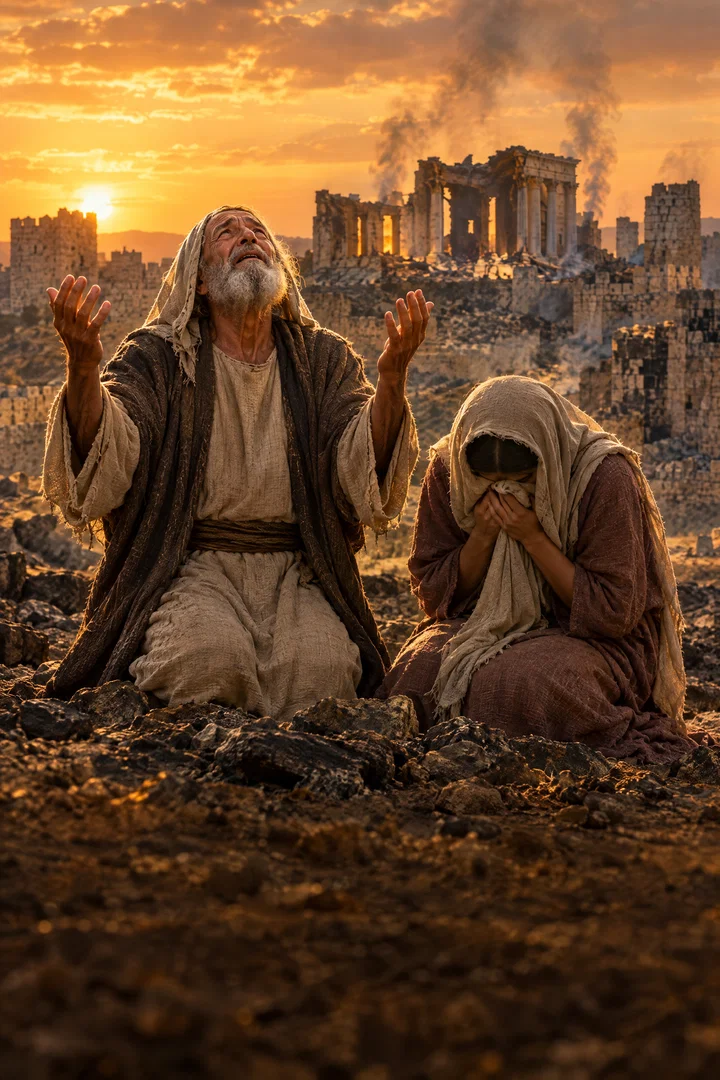
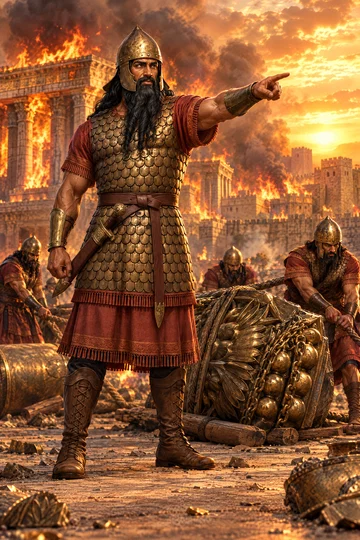
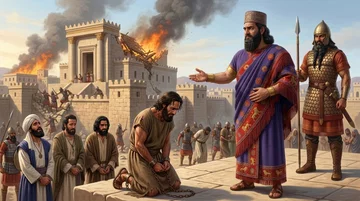
And he burnt the house of the LORD, and the king’s house, and all the houses of Jerusalem, and every great man’s house burnt he with fire.
Translations
American King James Version, King James Version
And he burnt the house of the LORD, and the king’s house, and all the houses of Jerusalem, and every great man’s house burnt he with fire.
and he burnt the house of the Lord, and the king’s house, and all the houses of Jerusalem, and every great man’s house burnt he with fire.
And he burnt the house of the LORD, and the king's house, and all the houses of Jerusalem, and every great man's house he burnt with fire.
And he burnt the house of the LORD, and the king’s house; and all the houses of Jerusalem, even every great house, burnt he with fire.
And he burnt the house of Jehovah, and the king’s house; and all the houses of Jerusalem, even every great house, burnt he with fire.
and he burneth the house of Jehovah, and the house of the king, and all the houses of Jerusalem, yea, every great house he hath burned with fire;
and he burned the house of Jehovah, and the king's house, and all the houses of Jerusalem; and every great [man's] house he burned with fire.
and burned the house of Yahweh, and the house of the king,—yea, all the houses of Jerusalem, even every great man’s house, burned he with fire.
Berean Standard Bible, Majority Standard Bible
He burned down the house of the LORD, the royal palace, and all the houses of Jerusalem— every significant building.
He burned the LORD’s house, the king’s house, and all the houses of Jerusalem. He burned every great house with fire.
And he had the house of the Lord and the king's house and all the houses of Jerusalem, even every great house, burned with fire;
And burnt the house of the Lord, and the Kings house, and all the houses of Ierusalem, and all the great houses burnt he with fire.
Douay-Rheims (Challoner revision)
And he burnt the house of the Lord, and the king’s house, and the houses of Jerusalem, and every house he burnt with fire.
Pictures
Cross-references
- Jeremiah 52:12-13
Now in the fifth month, in the tenth day of the month, which was the nineteenth year of Nebuchadrezzar king of Babylon, came Nebuzar-adan, captain of the guard, which served the king of Babylon, into Jerusalem,
Also records the temple’s burning in the fifth month.
- 2 Chronicles 36:18-19
And all the vessels of the house of God, great and small, and the treasures of the house of the LORD, and the treasures of the king, and of his princes; all these he brought to Babylon.
The parallel account describes the temple and Jerusalem being burned.
- Jeremiah 39:8
And the Chaldeans burned the king’s house, and the houses of the people, with fire, and brake down the walls of Jerusalem.
Describes Jerusalem’s capture and burning by the Babylonians.
- Zechariah 7:1-5
And it came to pass in the fourth year of king Darius, that the word of the LORD came unto Zechariah in the fourth day of the ninth month, even in Chisleu;
The fifth-month fast commemorates Jerusalem’s destruction.
- 1 Kings 9:7-9
Then will I cut off Israel out of the land which I have given them; and this house, which I have hallowed for my name, will I cast out of my sight; and Israel shall be a proverb and a byword among all people:
The temple’s burning fulfills the warned judgment for Israel’s disobedience.
- 2 Chronicles 36:14-16
Moreover all the chief of the priests, and the people, transgressed very much after all the abominations of the heathen; and polluted the house of the LORD which he had hallowed in Jerusalem.
Judah’s profanation of the temple and rejection of God’s messengers brought judgment.
- 2 Kings 25:13-17
And the pillars of brass that were in the house of the LORD, and the bases, and the brasen sea that was in the house of the LORD, did the Chaldees break in pieces, and carried the brass of them to Babylon.
Temple furnishings and treasures were carried away to Babylon after its destruction.
- 2 Chronicles 7:19-22
But if ye turn away, and forsake my statutes and my commandments, which I have set before you, and shall go and serve other gods, and worship them;
God’s conditional promise to Solomon includes the temple’s destruction if Israel turns away.
- Jeremiah 32:1-5
The word that came to Jeremiah from the LORD in the tenth year of Zedekiah king of Judah, which was the eighteenth year of Nebuchadrezzar.
Places Jeremiah’s prophecy during the siege that led to the city’s fall.
- 2 Chronicles 36:21
To fulfil the word of the LORD by the mouth of Jeremiah, until the land had enjoyed her sabbaths: for as long as she lay desolate she kept sabbath, to fulfil threescore and ten years.
Explains the desolation as fulfilling the land’s sabbaths for seventy years.
- Jeremiah 17:27
But if ye will not hearken unto me to hallow the sabbath day, and not to bear a burden, even entering in at the gates of Jerusalem on the sabbath day; then will I kindle a fire in the gates thereof, and it shall devour the palaces of Jerusalem, and it shall not be quenched.
God warns that Jerusalem’s palaces will be consumed by an unquenchable fire.
- Micah 4:10
Be in pain, and labour to bring forth, O daughter of Zion, like a woman in travail: for now shalt thou go forth out of the city, and thou shalt dwell in the field, and thou shalt go even to Babylon; there shalt thou be delivered; there the LORD shall redeem thee from the hand of thine enemies.
Zion is carried away from the city to Babylon.
- 2 Kings 24:10-17
At that time the servants of Nebuchadnezzar king of Babylon came up against Jerusalem, and the city was besieged.
Describes the earlier capture of Jerusalem and deportation under Nebuchadnezzar.
- Jeremiah 37:1-10
And king Zedekiah the son of Josiah reigned instead of Coniah the son of Jehoiakim, whom Nebuchadrezzar king of Babylon made king in the land of Judah.
Describes Egypt’s failed attempt to help Jerusalem during the siege.
Commentary
Each commentary is drawn from primary sources: the writings of Ellen G. White and Adventist pioneers and periodicals. Each commentary is separate. Its own words are not a quotation; follow the references to read the source passages.
Ellen G. White
3 sources
After the Babylonian conquest, in the defeat and exile of the people, the house of the Lord and the king's house and all the houses of Jerusalem, including the homes of the people and every great man's house, were burned with fire.4T 184.2SG4 114.3–4STB 290.3 That burning was the fulfillment of the calamity God had warned would fall upon the temple if Israel departed from Him.SG4 114.3–4 The splendor of the temple had been promised to endure only on condition that Solomon himself remained faithful and the people obeyed God's commandments.SG4 114.3–4 Its destruction, with Israel's captivity, came because of the people's disobedience and wickedness and their departure from God.SG4 114.3–4 The burning of the city was part of the fearful penalty that followed Zedekiah's unbelief and his choice to follow ungodly counsel.4T 184.2
The destruction and scattering came because the people had failed to serve as missionaries and had separated themselves from the surrounding peoples.STB 290.3 Yet through their scattering the knowledge of God's truth was to reach the world.STB 290.3 If they were loyal and true and submissive, God would bring them back to their own land.STB 290.3
Sources
Pioneers and periodicals
25 sources
It records that on the seventh day of the fifth month Nebuzar-adan came to Jerusalem and burned the house of the Lord, the king's house and all the houses of Jerusalem, broke down the walls and carried the remnant to Babylon with the vessels of the temple, leaving the land desolate to enjoy her Sabbaths for seventy years.ST Jan 14, 1886ST Aug 20, 1885 The burning was permitted because the people departed from keeping His commandments, turning to idols and trusting in the beauty of the temple and city while their hearts followed the nations.ST Nov 5, 1912ST Oct 9, 1884ST Jul 26, 1905 It was the climax of rejecting God as King and wanting to be governed like the nations, continued through apostasy despite centuries of prophetic warning.ST Nov 9, 1882RH Oct 8, 1861 The burning in the fifth month was commemorated by the fast of the fifth month kept through the captivity.ST Jun 14, 1883ST Jun 21, 1883ST Jun 14, 1883 Beyond its fulfillment in ancient Israel it is typical of events to transpire at the close of this dispensation, and its unquenchable fire shows a fire that cannot be put out until it has completed its consuming work.ST Jan 19, 1915RH Sep 17, 1872
Fall of Jerusalem Narrated
On the seventh day of the fifth month Nebuzar-adan, captain of the guard and servant of the king of Babylon, came to Jerusalem and burned the house of the Lord, the king's house, all the houses of Jerusalem and every great man's house with fire.ST Jan 14, 1886 He broke down the walls of Jerusalem and carried the remnant of the people to Babylon with all the vessels of gold, silver and brass, including the two great brass pillars Solomon had made, the brazen sea and the bases whose brass was without weight.ST Jan 14, 1886 That completed the captivity of Judah and left the land desolate, after the poor who had been left as vinedressers and husbandmen under the governor Gedaliah fled to Egypt, fulfilling the word of the Lord by Jeremiah that the desolate land would enjoy her Sabbaths to fulfill seventy years.ST Jan 14, 1886
It was the final destruction after a year-and-a-half siege, when Nebuchadnezzar's forces burned the temple, the royal palace and the houses of the leading men, broke down the walls and carried many into exile.ST Aug 20, 1885 That destruction followed successive rebellions by Jehoiakim and Zedekiah against Babylon.ST Aug 20, 1885 It belongs to the account of Jerusalem's conquest by Nebuchadnezzar and its destruction before the carrying to Babylonian captivity, dated to a conquest in 606 B.C. and removal to Babylon by 588 B.C.ST Jul 23, 1885
It shows the taking of Jerusalem by Nebuchadnezzar 238 years after it had been taken by Jehoash, when the city was almost totally destroyed and Solomon's temple was burned and buried together with the king's palace.RH Jul 21, 1868 The larger part of the people were carried into captivity and the city lay desolate for half a century.RH Jul 21, 1868 Then Zerubbabel led back 52,000 captives and rebuilt the temple with a portion of the dwellings, 79 years later Ezra conducted a second colony, and 13 years after that Nehemiah guided the third colony and rebuilt the walls.RH Jul 21, 1868 The temple so burned later lay in ruins in Daniel's day and was eventually destroyed by the Romans in A.D. 70.ST Dec 8, 1881
It belongs to the third great section of the history of the monarchy, the history of the remaining kingdom of Judah after the ten tribes were swept away, and stands at the close of the history of the kings from Solomon's accession to the Babylonian captivity recorded in the books of Kings.ST Dec 9, 1897 It closes the history of the kingdom of Judah by recording the laying waste of Jerusalem and the despoiling of the temple.ST Dec 9, 1897ST Jun 10, 1913 It stands in the closing chapters of Kings which record the wicked and weak reigns of Judah's kings.ST May 10, 1910 It belongs to the historical account of Jerusalem's fall that is compared with the conclusion of Jeremiah, recording the destruction of the temple, the king's house and Jerusalem's other houses by fire.RH Jul 27, 1916
It belongs to the fuller account of Zedekiah's downfall and of Jerusalem's fall and the Jews' captivity.ST Nov 4, 1897ST Sep 19, 1911 It records Babylon's fiery destruction of Jerusalem and the burning of its buildings as the overthrow of Judah's kingdom and the scattering of its people into captivity.ST Nov 7, 1906ST Sep 19, 1911 It is part of the history of Judah's loss of independent government and its subjection as a province to the kingdoms ruling the world.ST Nov 4, 1897
Judgment for Unfaithfulness Explained
Solomon's temple followed the same general plan as the tabernacle because it was intended for the same purpose, carrying out the pattern given to Moses on Mount Sinai which was a type of the true tabernacle in heaven, but it was built larger and more substantially because it was designed to be permanent while the tabernacle was portable.ST Oct 9, 1884 Yet with all its apparent durability it did not stand as long as the temporary tabernacle, for it was destroyed by the king of Babylon 424 years after its erection, which God permitted because the people departed from keeping His commandments.ST Oct 9, 1884
The burning of the temple together with the king's house and the prominent houses of Jerusalem was the final destruction of Solomon's temple because the chosen people were unfaithful.ST Nov 5, 1912 They had turned to idols, and the temple could not remain as a place of honor to God while the people were unfaithful but had become a reproach, so God permitted its destruction.ST Nov 5, 1912 When Israel forgot God and made Solomon's temple and Jerusalem objects of devotion, both were burned in the nation's overthrow.ST Jul 26, 1905 The temple's beauty and religious service had become objects of trust while the people's affections, conduct, and motives followed the surrounding nations, and God removed these material things by fire to correct and punish them.ST Aug 8, 1906
The destruction was the climax of Judah's apostasy in her captivity and the destruction of Jerusalem, and the inevitable result of rejecting God as King and wanting to be governed like the nations. That course began when Israel demanded a visible king in Samuel's time and continued through the history of the undivided and divided kingdom as apostasy broken only by occasional revivals of true worship and the reality of the sanctuary. For centuries God warned through the prophets against formalism, against trusting in human power, and against rejecting the covenant blessings conditioned on obedience, but Judah continued in apostasy even after Israel was carried captive by the king of Assyria, so judgment fell on Jerusalem.
The burning marked the overthrow of Israel's kingdom under Zedekiah, when Jerusalem's temple and other buildings were burned and the kingdom was brought down as foretold by Ezekiel.ST Nov 9, 1882 This destruction followed the people's unfaithfulness and rejection of God, and accompanied the removal of the crown and Zedekiah's captivity in Babylon.ST Nov 9, 1882 It was part of the account of the destruction of Jerusalem and the captivity of Judah, showing the city's destruction as the fulfillment of God's judgment on Israel for disobeying His commands and adopting slavery along with the idolatry of neighboring peoples.RH Oct 8, 1861
Before the temple was destroyed by Nebuchadnezzar, the ark had been removed and hidden in a cave, so it was not among the temple treasures later taken to Rome. The burning belongs to the biblical history of the Babylonian captivity, within a history of empires that also shows God's overruling hand in the affairs of nations.ST Feb 11, 1897
Remembrance Prophecy and Doctrine
The burning of the temple and the city of Jerusalem by the king of Babylon took place in the fifth month, and that burning is what the Jews' fast of the fifth month commemorated.ST Jun 14, 1883ST Jun 21, 1883ST Jun 14, 1883 The fast was kept during the captivity, through the seventy years the Jews spent in captivity.ST Jun 14, 1883ST Jun 14, 1883 The record of the Babylonian burning of the temple in Jerusalem identifies the destruction that gave rise to the fast.ST Jun 14, 1883ST Jun 21, 1883
The final destruction of Jerusalem and of the house of the Lord, together with the captivity in Babylon and the prophecies relating to it, has meaning beyond its primary fulfillment among God's ancient people.RH Sep 17, 1872 It is typical of events to transpire either under the gospel or at the close of this dispensation.RH Sep 17, 1872 Type must therefore be distinguished from antitype, and those living in the Christian dispensation have a special interest in it.RH Sep 17, 1872
The fire that consumed the temple, the king's house, and the other houses of the city was unquenchable fire, and it demonstrates what unquenchable fire means.ST Jan 19, 1915 Unquenchable fire cannot be put out before it completes its consuming work, rather than keeping what it burns alive forever.ST Jan 19, 1915 That Jerusalem is not burning now proves the fire finished its work of consumption.ST Jan 19, 1915
The destruction of the Lord's house, the king's house, and the houses of Jerusalem by fire during the Babylonian captivity is established historical truth.ST May 11, 1915 Yet its past events do not by themselves reveal the truth needed for the present emergencies of later generations.ST May 11, 1915
Sources