2 Samuel 5:6
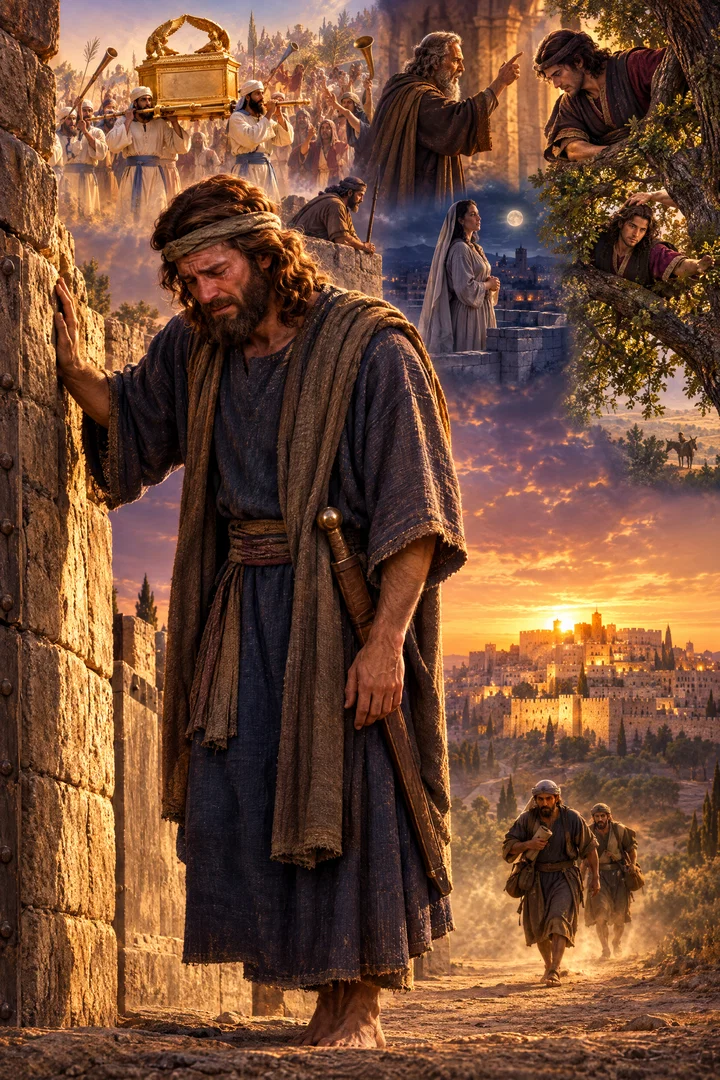
And the king and his men went to Jerusalem unto the Jebusites, the inhabitants of the land: which spake unto David, saying, Except thou take away the blind and the lame, thou shalt not come in hither: thinking, David cannot come in hither.
Translations
And the king and his men went to Jerusalem to the Jebusites, the inhabitants of the land: which spoke to David, saying, Except you take away the blind and the lame, you shall not come in here: thinking, David cannot come in here.
King James Version, KJV Cambridge Paragraph Bible
And the king and his men went to Jerusalem unto the Jebusites, the inhabitants of the land: which spake unto David, saying, Except thou take away the blind and the lame, thou shalt not come in hither: thinking, David cannot come in hither.
And the king and his men went to Jerusalem to the Jebusites, the inhabitants of the land: who spoke to David, saying, Except thou shalt take away the blind and the lame, thou shalt not come in hither: thinking, David cannot come in hither.
And the king and his men went to Jerusalem against the Jebusites, the inhabitants of the land: which spake unto David, saying, Except thou take away the blind and the lame, thou shalt not come in hither: thinking, David cannot come in hither.
And the king and his men went to Jerusalem against the Jebusites, the inhabitants of the land, who spake unto David, saying, Except thou take away the blind and the lame, thou shalt not come in hither; thinking, David cannot come in hither.
And the king goeth, and his men, to Jerusalem, unto the Jebusite, the inhabitant of the land, and they speak to David, saying, 'Thou dost not come in hither, except thou turn aside the blind and the lame;' saying, 'David doth not come in hither.'
And the king and his men went to Jerusalem against the Jebusites, the inhabitants of the land; and they spoke to David, saying, Thou shalt not come in hither, but the blind and the lame will drive thee back; as much as to say, David will not come in hither.
Then went the king and his men, to Jerusalem, against the Jebusites, inhabiting the land,—and they spake to David, saying—Thou canst not come in hither, unless thou take away the blind and lame—Thinking, David will not come in hither.
Berean Standard Bible, Majority Standard Bible
Now the king and his men marched to Jerusalem against the Jebusites who inhabited the land. The Jebusites said to David: “ You will never get in here. Even the blind and lame can repel you.” For they thought, “ David cannot get in here.”
The king and his men went to Jerusalem against the Jebusites, the inhabitants of the land, who spoke to David, saying, “ The blind and the lame will keep you out of here,” thinking, “ David can’t come in here.”
And the king and his men went to Jerusalem against the Jebusites, the people of the land: and they said to David, You will not come in here, but the blind and the feeble-footed will keep you out; for they said, David will not be able to come in here.
The King also and his men went to Ierusalem vnto the Iebusites, the inhabitants of the land: who spake vnto Dauid, saying, Except thou take away the blinde and the lame, thou shalt not come in hither: thinking that Dauid coulde not come thither.
Douay-Rheims (Challoner revision)
And the king and all the men that were with him went to Jerusalem to the Jebusites the inhabitants of the land: and they said to David: Thou shalt not come in hither unless thou take away the blind and the lame that say: David shall not come in hither.
Pictures
Cross-references
- 1 Chronicles 11:4-6
And David and all Israel went to Jerusalem, which is Jebus; where the Jebusites were, the inhabitants of the land.
Retells David’s capture of Jerusalem from the Jebusites.
- Psalms 78:68
But chose the tribe of Judah, the mount Zion which he loved.
Distinguishes the tribe of Judah from Mount Zion, located within Judah.
- Ezra 1:3
Who is there among you of all his people? his God be with him, and let him go up to Jerusalem, which is in Judah, and build the house of the LORD God of Israel, (he is the God,) which is in Jerusalem.
Locates Jerusalem in Judah, the city David captured.
- Judges 1:8
Now the children of Judah had fought against Jerusalem, and had taken it, and smitten it with the edge of the sword, and set the city on fire.
Judah’s early capture of Jerusalem contrasts with David’s later capture of its fortress.
- Judges 1:21
And the children of Benjamin did not drive out the Jebusites that inhabited Jerusalem; but the Jebusites dwell with the children of Benjamin in Jerusalem unto this day.
Benjamin fails to drive the Jebusites from Jerusalem.
- Genesis 14:18
And Melchizedek king of Salem brought forth bread and wine: and he was the priest of the most high God.
Melchizedek lived at Salem, the earlier name of the site.
- Psalms 125:2
As the mountains are round about Jerusalem, so the LORD is round about his people from henceforth even for ever.
The surrounding mountains picture the Lord’s protection of Jerusalem.
- 2 Samuel 5:1-2
Then came all the tribes of Israel to David unto Hebron, and spake, saying, Behold, we are thy bone and thy flesh.
Israel gathers at Hebron to choose David
- 1 Kings 11:36
And unto his son will I give one tribe, that David my servant may have a light alway before me in Jerusalem, the city which I have chosen me to put my name there.
God chose Jerusalem as the place for his name.
- Psalms 69:35
For God will save Zion, and will build the cities of Judah: that they may dwell there, and have it in possession.
Identifies Zion with Jerusalem in Judah.
- 2 Samuel 5:10
And David went on, and grew great, and the LORD God of hosts was with him.
David grew great because the LORD God of hosts was with him.
Commentary
Each commentary is drawn from primary sources: the writings of Ellen G. White and Adventist pioneers and periodicals. Each commentary is separate. Its own words are not a quotation; follow the references to read the source passages.
Ellen G. White
1 source
Jebus was a fortified stronghold still held by the Canaanites, situated upon the heights of Zion and Moriah.PP 703.2 For centuries it had been regarded as impregnable to assault.PP 703.2 It was captured by the Hebrews under the leadership of Joab.PP 703.2 After its capture it was made the capital of Israel and renamed Jerusalem.PP 703.2
Sources
Pioneers and periodicals
19 sources
David and his men went up to Jerusalem, then called Jebus, to take its strongly fortified citadel on Mount Zion from the Jebusites who held it.ST Sep 10, 1896ST Jun 25, 1896RH Jul 21, 1868 The Jebusites answered his demand to surrender with contemptuous boasting that he could never enter, saying that even the blind and the lame could hold the heights against him in their trust in its rocky ravines and walls.ST Jun 19, 1884ST Jun 25, 1896ST Jun 19, 1884RH Jul 21, 1868 David nevertheless took the stronghold by stratagem, rewarding with command whoever first entered it, which Joab won and thereby helped defeat the Jebusites.ST Sep 10, 1896ST Apr 14, 1909RH Jul 21, 1868 Having become king over all Israel after reigning at Hebron, he moved his throne there and rebuilt and fortified it as the city of David, making Jerusalem the political and ecclesiastical capital and center of the kingdom and its worship.ST Sep 10, 1896ST Apr 29, 1913RH Jul 21, 1868RH Mar 30, 1916 Their boastful confidence when downfall was near shows that men are often surest of their own strength just before they fall, while David's success stands as proof of God's supernatural direction and help to those who acknowledge Him and ask and expect it in faith.ST Jun 19, 1884RH Aug 28, 1856ST Jun 19, 1884
Jebusite Defiance and Capture
David and his men went to Jerusalem, then called Jebus, which was held by the Jebusites in a strongly fortified citadel, with their stronghold on Mount Zion controlling the city.ST Sep 10, 1896ST Jun 25, 1896RH Jul 21, 1868 Jerusalem stood on a rocky plateau with deep ravines on three sides, making it a formidable military position.ST Jun 25, 1896 At that time it occupied only the southwest part of its later site, the area of Zion.RH Jul 21, 1868
The Jebusites taunted David that he could not come in, saying that even the blind and the lame would keep him out.ST Jun 19, 1884ST Jun 25, 1896ST Jun 19, 1884ST Apr 14, 1909RH Jul 21, 1868 Their words expressed vain confidence in the city's strength, trust in its fortifications, and contempt for his ability to capture it.ST Jun 25, 1896ST Jun 19, 1884RH Jul 21, 1868ST Sep 30, 1889 They were confident he could not take the city and boasted that its defenses made his entrance impossible.ST Jun 19, 1884ST Sep 30, 1889 The phrase about the blind and the lame reflects the common saying that Jerusalem's heights were defensible even by the lame and blind.ST Jun 25, 1896 It may mean disabled people unable to fight were thought sufficient to guard the fort, or it may have been mockery invoking lame and blind gods that have eyes but cannot see and feet but cannot walk.ST Sep 30, 1889
The taunt was likely a reply to David's demand that the Jebusites surrender, since they thought the city impregnable.ST Jun 19, 1884ST Jun 19, 1884 David nevertheless took the city by strategem.ST Sep 10, 1896 He offered command of his army to whoever first entered it, a reward won by Joab, probably by climbing the steep northeastern crags at night.RH Jul 21, 1868 With Joab's help he defeated the Jebusites and took Jerusalem, though they had taunted him that he could not enter.ST Apr 14, 1909ST Sep 30, 1889 That defeat of the Jebusites is counted among David's victories.ST Jun 26, 1884
Kingdom Established at Jerusalem
The verse belongs to the account of David establishing his reign and setting his throne in Jerusalem.ST Sep 10, 1896ST At thirty years old he took the throne of all Israel after the Israelites gathered to him at Hebron desiring him to rule because he was their bone and their flesh, had led them under Saul, and had been anointed king by the prophet.ST Sep 10, 1896 After first reigning at Hebron he became king over the whole kingdom, and his reign then began in Jerusalem and on Mount Zion, marking the transfer of his capital from Hebron to Jerusalem.ST Apr 29, 1913ST Apr 22, 1903 This shows God's providence in the building up of Israel's kingdom.ST Apr 29, 1913
David knew the Lord had established him king over Israel and went on and grew great because the Lord God of hosts was with him.ST Sep 10, 1896 His rule brought the subduing of his enemies and a great enlargement of Israel's dominion.ST Apr 22, 1903 He rebuilt, extended, and fortified part of the captured city and built his palace there, establishing it as the Jewish nation's settlement, so it was called the city of David.ST Sep 10, 1896RH Jul 21, 1868 By taking Jerusalem after becoming king over the whole nation, he made the city the political and ecclesiastical capital, centralizing the kingdom and its worship there.RH Mar 30, 1916
Zion, Sanctuary, and Faith
Mount Zion was the city of David, a part of Jerusalem, and lay within Judah as one of its cities and within its territory.ST May 27, 1880RH Dec 1, 1863RH Feb 18, 1858RH Jan 6, 1853 The mountain and the city were therefore distinct from the tribe of Judah and from the land of Canaan itself, yet contained within them.ST May 27, 1880RH Dec 1, 1863RH Feb 18, 1858RH Jan 6, 1853 The tribe of Judah and Mount Zion are not the same thing, but Zion is contained within Judah.ST May 27, 1880RH Feb 18, 1858RH Jan 6, 1853 This location explains why Judah is figuratively called God's sanctuary, and why Psalm 78:68 can name both Judah and Zion together without making Judah itself Zion.RH Dec 1, 1863RH Jan 6, 1853
The account to which the verse belongs stands as an example of God's supernatural directions and assistances to David.RH Aug 28, 1856 It shows that God sees all things and is everywhere and concerns Himself with the affairs of His creatures and is to be acknowledged in all ways.RH Aug 28, 1856 The same supernatural direction and assistance is given now where it is asked for and expected in faith.RH Aug 28, 1856 It is given to those who keep spiritual intercourse with their Maker instead of living under a refined spirit of atheism and putting their own wisdom, prudence, and strength in the place of God Almighty, for faith in God exercised and cultivated removes mountains.RH Aug 28, 1856
The episode illustrates that people may be most confident in their own strength when their downfall is near, so the Jebusites' boastful confidence in their impregnable city preceded their downfall.ST Jun 19, 1884ST Jun 19, 1884
Sources