Acts 14:14
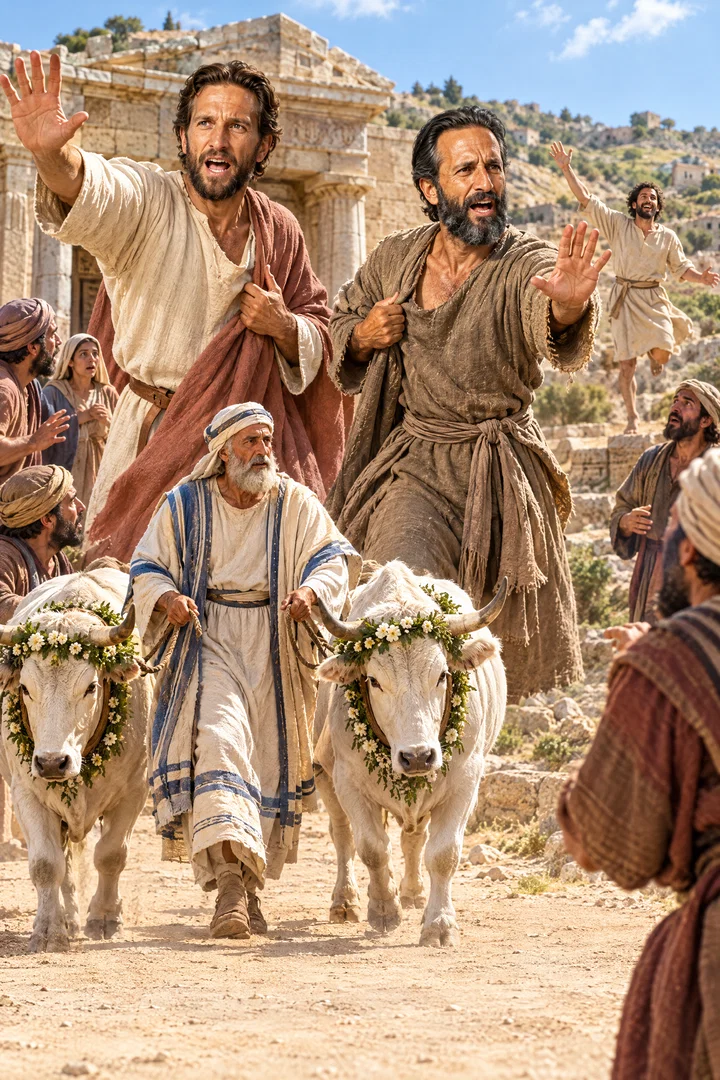
Which when the apostles, Barnabas and Paul, heard of, they rent their clothes, and ran in among the people, crying out,
Translations
American King James Version, King James Version, KJV Cambridge Paragraph Bible
Which when the apostles, Barnabas and Paul, heard of, they rent their clothes, and ran in among the people, crying out,
Which, when the apostles Barnabas and Paul heard of, they rent their clothes, and ran in among the people, crying out,
Revised Version, American Standard Version
But when the apostles, Barnabas and Paul, heard of it, they rent their garments, and sprang forth among the multitude, crying out
and having heard, the apostles Barnabas and Paul, having rent their garments, did spring into the multitude, crying
But the apostles Barnabas and Paul, having heard [ it], rent their garments, and rushed out to the crowd, crying
But the apostles Barnabas and Paul, hearing of it, rending asunder their own mantles, sprang forward amidst the multitude, crying aloud,
Berean Standard Bible, Majority Standard Bible
But when the apostles Barnabas and Paul found out about this, they tore their clothes and rushed into the crowd, shouting,
But when the apostles, Barnabas and Paul, heard of it, they tore their clothes and sprang into the multitude, crying out,
But when this came to the ears of the Apostles, Paul and Barnabas, they went running out among the people, parting their clothing, and crying out,
But when the Apostles, Barnabas and Paul heard it, they rent their clothes, and ran in among the people, crying,
Douay-Rheims (Challoner revision)
Which, when the apostles Barnabas and Paul had heard, rending their clothes, they leaped out among the people, crying,
Pictures
Cross-references
- Acts 14:19
And there came thither certain Jews from Antioch and Iconium, who persuaded the people, and, having stoned Paul, drew him out of the city, supposing he had been dead.
The crowd turns from attempted sacrifice to stoning Paul.
- Acts 14:8-10
And there sat a certain man at Lystra, impotent in his feet, being a cripple from his mother’s womb, who never had walked:
The healing prompted the crowd to honor the apostles as gods.
- 2 Corinthians 8:23
Whether any do enquire of Titus, he is my partner and fellowhelper concerning you: or our brethren be enquired of, they are the messengers of the churches, and the glory of Christ.
Both call others besides the Twelve apostles.
- Acts 14:18
And with these sayings scarce restrained they the people, that they had not done sacrifice unto them.
The crowd was only with difficulty restrained from sacrificing to them.
- Acts 13:2
As they ministered to the Lord, and fasted, the Holy Ghost said, Separate me Barnabas and Saul for the work whereunto I have called them.
Barnabas and Paul are set apart for the work to which God called them.
- Acts 14:4
But the multitude of the city was divided: and part held with the Jews, and part with the apostles.
Paul and Barnabas are also called apostles there.
- Hebrews 3:1
Wherefore, holy brethren, partakers of the heavenly calling, consider the Apostle and High Priest of our profession, Christ Jesus;
Christ himself is called an apostle.
Commentary
Each commentary is drawn from primary sources: the writings of Ellen G. White and Adventist pioneers and periodicals. Each commentary is separate. Its own words are not a quotation; follow the references to read the source passages.
Ellen G. White
14 sources
At Lystra after a man crippled from birth was healed while the gospel was preached, the people speaking in Lycaonian concluded the gods had come down in human form, calling Barnabas Jupiter and Paul Mercurius because Paul was the chief speaker, and the priest of Jupiter brought oxen and garlands to the gates to sacrifice; when the apostles, who had withdrawn to rest, heard the shouting and ascertained the intent to worship them, they were filled with horror and tore their clothes and ran urgently into the midst of the crowd crying out to stop the offerings.Ms 117a, 1901, par. 30–32AA 181.2–182.3SG1 94.1SLP 59.1–28RED 20.3–22.1
They declared themselves only mortal men of like passions with the people, mere human messengers and instruments of Jesus rather than divine beings to be worshiped.SG1 94.1ST Apr 26, 18838RED 20.3–22.1
They urged the people to turn from empty idols and vanities to the living God who made heaven and earth and the sea and all things in them, to whom alone worship and the honor for the miracle belonged, who though He let the nations walk in their own ways left Himself a witness in doing good and giving rain from heaven and fruitful seasons and filling hearts with food and gladness, yet even with these words they could barely hold the people back from sacrificing.Ms 117a, 1901, par. 30–32SG1 94.1EW 168.4
That refusal exalted God before the people and planted in their minds the first conception of faith in the true God and of the worship and honor due Him.EW 168.4
The honor soon turned to hate when unbelieving Jews from other cities turned the admiration of the idolaters to insult and violence, so that those ready to worship the disciples stoned Paul and dragged him out supposing him dead, yet as the disciples stood about him he rose and went on, showing that laborers together with God will meet similar opposition and be upheld by faith strengthened through effort and sacrifice.Lt 218, 1901, par. 13–153SP 378.1EW 168.4GW 107.3
Refusing Worship at Lystra
The scene is Lystra, just after the healing of a man crippled from birth who had faith to be healed, a well-known cripple healed while the gospel was being preached.Ms 117a, 1901, par. 30–32EW 168.48RED 20.3–22.1 The miracle took place as Jesus was preached and miracles were wrought, and it set in motion the attempt to worship the apostles.Ms 117a, 1901, par. 30–32EW 168.48RED 20.3–22.1
Speaking in Lycaonian, the people declared that the gods had come down in human form, calling Barnabas Jupiter and Paul Mercurius because Paul was the chief speaker.Ms 117a, 1901, par. 30–328RED 20.3–22.1 The Lycaonians concluded that Jupiter and Mercury had come down in the persons of Barnabas and Paul, and the priest of Jupiter brought oxen and garlands to the gates, with priests preparing beasts, garlands and offerings, to sacrifice with the people.Ms 117a, 1901, par. 30–328RED 20.3–22.1
The apostles had withdrawn to rest in a private house when they heard music and shouting at the gate.8RED 20.3–22.1 When they ascertained that the people meant to honor them as visitors from heaven with sacrifice, they were filled with horror and indignation.8RED 20.3–22.1
When they realized the intent to honor them as gods and to carry out sacrifice to them, they tore their clothes and ran urgently into the midst of the crowd, crying out to stop the sacrifices and offerings.AA 181.2–182.3SG1 94.1SLP 59.1–23SP 363.1–364.2SLP 57.2–58.3 Their tearing of garments and rushing among the tumultuous multitude was a positive denial of the divinity attributed to them, expressing grief, horror and indignation at the idolatrous worship and the plan to prevent further proceedings.SG1 94.1SLP 59.1–28RED 20.3–22.13SP 363.1–364.2SLP 57.2–58.3
Mortal Messengers Pointing to God
When the crowd moved to honor them as gods, Paul and Barnabas made clear that they were human beings, not objects of worship, tearing their clothes and running among the people to stop the idolatrous proceedings.SG1 94.18RED 20.3–22.1SLP 57.2–58.3 They cried out that they were men of like passions with the Lystrans themselves, positively denying the divinity attributed to them with indignation and horror.8RED 20.3–22.1SLP 57.2–58.3 They acted only as human messengers and instruments of Jesus, whom God had raised and exalted, refusing honor for themselves.ST Apr 26, 1883SLP 57.2–58.3
They directed the people to turn from empty idols and vanities to the living God, declaring that worship belongs to God alone.SG1 94.1EW 168.48RED 20.3–22.1 That living God is the Creator who made heaven and earth and the sea and all things in them, and the honor and praise for the miracles belonged to Him through Jesus.SG1 94.1EW 168.4ST Apr 26, 1883 Even while declaring themselves mortal men like their hearers, they urged this turning as the purpose of their cry in the midst of the tumult.Ms 117a, 1901, par. 30–328RED 20.3–22.1
They further proclaimed that though God had suffered all nations to walk in their own ways, He had not left Himself without witness in doing good.Ms 117a, 1901, par. 30–32 That witness was seen in giving rain from heaven and fruitful seasons and in filling hearts with food and gladness.Ms 117a, 1901, par. 30–32 Even with these words they could scarcely restrain the people and barely held them back from sacrificing to them.Ms 117a, 1901, par. 30–32EW 168.4
That refusal exalted God before the people in place of the apostles.EW 168.4 It planted in their minds the first conception of faith in the true God.EW 168.4 By it they learned the worship and honor due to Him alone.EW 168.4
Faithful Through Violent Opposition
The honor shown at Lystra quickly turned to insult, abuse, and an attempt to kill.Lt 218, 1901, par. 13–153SP 378.1EW 168.4SLP 72.2 Unbelieving Jews from other cities followed after Paul with false reports, and at Satan's urging turned the wonder and admiration of the idolaters into hate.EW 168.4 Those who had been ready to worship the disciples then stoned Paul and dragged him out of the city, supposing him dead.Lt 218, 1901, par. 13–15EW 168.4 As the disciples stood about him mourning, he rose up and went with them into the city.EW 168.4
This refusal of worship belongs to the wider labor of Paul and Barnabas in visiting every place where they could gain entrance and winning souls to Christ.Lt 218, 1901, par. 13–15 After working over a large territory they visited again the churches they had planted and then returned to Antioch, the place from which they had been set apart by prayer and counsel for the work.Lt 218, 1901, par. 13–15 They taught many, and returned to confirm the souls of the disciples and to exhort them to continue in the faith, for through much tribulation the kingdom of God is entered.Lt 218, 1901, par. 13–15
Laborers together with God in the last days are to study and become familiar with the whole of Acts 14, for they will meet similar experiences of opposition.Lt 218, 1901, par. 13–15 They may even be stoned and left for dead, yet rise to go on preaching the gospel.Lt 218, 1901, par. 13–15 Paul facing the furious mob at Lystra without turning aside from serving Christ shows faith strengthened by effort and sacrifice upholding him amid persecution.Lt 218, 1901, par. 13–15GW 107.3 The later mistaken conclusion of the islanders that Paul was a god echoed the crowd's mistaken response at Lystra.SLP 270.2
Sources
Pioneers and periodicals
50 sources
At Lystra Paul healed a man lame from birth, and the astonished crowd called Barnabas Jupiter and Paul Mercurius and brought oxen and garlands to offer sacrifice, but when the two understood the intent they tore their clothes and rushed among the people crying out in protest to stop it.RH Nov 16, 1916ST Dec 9, 1897ST May 21, 1902ST May 21, 1902ST May 21, 1902 They utterly refused divine honor, declaring they were only human beings of like passions and not divine, seeking neither their own glory nor gain.RH Oct 15, 1903ST Jul 4, 1905 The naming of both Barnabas and Paul as apostles shows the office was not limited to the twelve, for an apostle is one sent out with a message.RH Jan 13, 1859RH Oct 15, 1861ST Nov 9, 1882ST Jun 17, 1903 They called the people to turn from these vanities and idols to the living God, the Maker of heaven and earth and sea and all things therein, whose rain from heaven and fruitful seasons and food and gladness witness to His goodness and power.RH Oct 15, 1903RH May 30, 1871ST Aug 12, 1897 By naming God as Creator of heaven, earth and sea the appeal presents the Creator title of the fourth commandment and the Sabbath as His memorial of creative power and sign of allegiance, and it stands as the example that a true messenger magnifies God and exalts Christ rather than himself.STRH Mar 11, 1875RH Oct 6, 1868ST May 21, 1902ST Aug 26, 1897
Setting at Lystra
Paul and Barnabas came to Lystra and the country round about to preach after fleeing Iconium to escape a mob of Gentiles, Jews and rulers seeking to stone them.ST May 21, 1902 At Lystra Paul discerned that a man lame from birth who had never walked had faith to be healed, commanded him to stand upright, and the man immediately jumped up and walked.ST May 21, 1902ST Mar 13, 1884ST Jun 21, 1883RH Nov 6, 1900 The astonished heathen crowd cried out in their own language that the gods had come down to them in the likeness of men.ST May 21, 1902ST May 21, 1902ST Mar 13, 1884 As worshipers of Jupiter and Mercury they called Barnabas Jupiter and Paul Mercurius, treating the apostles as gods because of the miracle that had healed the cripple.ST May 21, 1902ST Mar 13, 1884ST Aug 12, 1897
The priest of Jupiter brought oxen and garlands to the gates to offer sacrifice to them with the multitudes.ST May 21, 1902ST May 21, 1902RH Feb 15, 1870 Paul had spoken to the Lycaonians in the common Greek of the period, but when excited the people returned to their native language which Paul and Barnabas did not at first understand.ST May 21, 1902RH May 20, 1915 When they heard what the demonstration meant they understood that a sacrifice was intended.ST May 21, 1902ST May 21, 1902 When they heard of the intended sacrifice, they rent their clothes and ran in among the people, crying out in protest to stop the idolatrous act.RH Oct 15, 1903RH Nov 16, 1916ST Dec 9, 1897ST May 21, 1902ST May 21, 1902 Their tearing of clothes and rushing among the crowd was an urgent response of grief, horror, distress and protest against being honored as gods.RH Nov 16, 1916ST Dec 9, 1897ST Jun 17, 1897ST Apr 29, 1897ST Nov 21, 1892
It was a first visit to a heathen place with no Jewish synagogue and few Jews, where as strangers they preached the gospel to a heathen crowd.ST Feb 13, 1896ST Mar 13, 1884 Lycaonia was a part of Galatia, where before the gospel the people served those which by nature are no gods.ST Feb 13, 1896 The verse stands among Paul's places of labor recorded in Acts 14, showing the place and cause of his stoning and furnishing an example of his zeal for the work and forgetfulness of self.ST Mar 10, 1898 That exciting experience at Lystra came before the visit to neighboring towns and the journey on to Perga and to Attalia, where they took ship for Antioch in Syria.ST Mar 10, 1898ST May 28, 1902 An older English wording renders the running in as skipped out among the people, which means went out among them though the wording now sounds strange.ST Dec 16, 1880
Meaning of Apostles
The verse calls both Barnabas and Paul apostles, though neither was one of the twelve, which proves the title and office were not limited to the twelve originally chosen by Jesus.RH Jan 13, 1859RH Oct 15, 1861ST Jun 17, 1903RH May 19, 1874RH Jan 19, 1869 The term was not confined to Christ's twelve apostles or to the twelve alone in that age, but was applied in the New Testament to a number of others besides them.RH Oct 15, 1861RH Jan 19, 1869RH Aug 18, 1874 Barnabas as well as Paul was an apostle, with Barnabas serving as an apostle for a particular work.ST Nov 9, 1882ST Jun 17, 1903 This is seen at Lystra after a miracle, when the priests of Jupiter prepared to sacrifice to them supposing the gods had come down, and Paul and Barnabas tore their clothes and intervened to stop the people's mistaken worship.RH Jan 13, 1859
The word apostle translates the Greek apostolos and means one sent out, one sent with a message, a messenger, one sent forth.RH Oct 15, 1861ST Jun 17, 1903ST Mar 14, 1911ST Oct 27, 1898ST Jul 8, 1889 Messenger translates the same Greek word apostolos, and apostle means one sent.ST Mar 14, 1911 An apostle is one sent with a message and one chosen of God to lead out in presenting His message to the church and to the world.RH May 19, 1874ST Oct 27, 1898
Apostles are people specially raised up and sent by God's providence and Spirit and selected in an especial manner to take a leading part and do the work of God and perform a special work in His cause.RH May 19, 1874RH Aug 18, 1874 They always bear a message in advance of the people of God at the time they go forth, which was true of Paul and Barnabas as of Jesus and the twelve.ST Oct 27, 1898 They were sent by God to proclaim His truth, establish His work, and exercise a measure of general oversight, which work required wisdom to make sound plans and build up God's work.ST Jul 8, 1889
With Jesus Christ the great apostle, the twelve, Epaphroditus and others, they show God has chosen messengers for advance work in every age.ST Oct 27, 1898 The number twelve corresponds with the twelve tribes of Israel, and when Judas apostatized another was chosen to fill his place.RH Aug 18, 1874 There is no record of another election to this office and no instruction that the church must select individuals to fill it in succeeding ages, though when the providence of God makes manifest that He has raised up a man the church should give him his proper degree of influence and position.RH Aug 18, 1874
Rejecting Divine Honor
The tearing of clothes and rushing in among the crowd was grief and urgency at learning the people meant to honor them as gods, an act of horror and urgent protest to stop the sacrifice and reject the mistaken belief that they were gods in order to teach the truth about God.RH Nov 16, 1916ST Jun 17, 1897ST Apr 29, 1897ST Nov 21, 1892ST Nov 21, 1892 It was urgent distress and distressed excitement when they understood the demonstration, for at first they had not understood it, and then they cried out to stop the idolatrous act.ST Apr 29, 1897ST Nov 21, 1892ST May 21, 1902ST Nov 21, 1892 The healing of the lame man had led the people to call Barnabas Jupiter and Paul Mercurius and to bring oxen and wreaths with the priest of Jupiter to sacrifice to them.ST May 21, 1902
They utterly refused divine honor, declaring they were only human beings, men of like passions with the people and not divine beings.RH Oct 15, 1903ST Jul 4, 1905ST May 21, 1902 Their tearing of clothes and running in crying out disclaimed all honor and proved they sought neither their own glory nor money, refusing to let a miracle or public excitement turn attention from God.ST Jul 4, 1905ST Mar 13, 1884 The honor and praise for their miracles belonged to Jesus, whom God had raised and exalted, for they acted only as His instruments.ST Apr 26, 1883
The miracle did not make them divine, and the people's response ignored the principles of righteousness. Worship belongs to God who inspired Paul, not to Paul himself, while Paul as God's accredited and approved agent is to be highly esteemed.RH Oct 6, 1868 Accepting that worship would turn attention away from God the true Source of power and rob God of the honor due His name.ST May 21, 1902ST May 21, 1902 The effort to worship them was inspired by the adversary of truth, who when truth cannot be denied perverts it to serve a sinister purpose.ST May 21, 1902
They called the people to turn from these vanities, idols and false gods to the living God, the Maker of heaven and earth and sea and all things therein.RH Oct 15, 1903RH May 30, 1871ST May 21, 1902ST Aug 2, 1877 This identifies God by His creative works and by the Creator title, distinguishing the true God from idol gods and false gods and turning the people from idolatry toward Him.RH May 30, 1871STST Aug 2, 1877 In this the Creator title expressed in the fourth commandment presents the Sabbath as a sign of His creative power.ST
They pointed to rain from heaven, fruitful seasons, food and gladness and many other blessings as witnesses of His goodness, power and love.RH Oct 15, 1903ST Aug 12, 1897ST May 21, 1902 Nature continually proclaims the perpetual presence and manifestation of God's power and love everywhere, meant to keep men in closer touch with Him and not to be seen as mere natural results.ST Aug 12, 1897ST May 21, 1902 All people are therefore accountable to God for how they receive or reject that witness, and forgetting God brings great loss.ST Aug 12, 1897ST May 21, 1902
Creator Sabbath and Idolatry
In rejecting worship Paul and Barnabas directed the people to the living God as Maker of heaven and earth and sea, identifying Him by the Creator title expressed in the fourth commandment.STRH Mar 11, 1875RH Apr 29, 1875 That appeal distinguished the true God from idol gods by creation, and it followed the invariable biblical pattern under both old and new dispensations of resting on the creation fact that lies at the foundation of the Sabbath institution.RH Mar 11, 1875RH Apr 29, 1875 By that creation the Sabbath identifies the Lawgiver as Creator and stands as His sign of creative power, authority and allegiance.STRH Mar 11, 1875RH Apr 29, 1875
The Sabbath was designed as a memorial of God's creative work whose faithful observance would keep the living God in mind.ST May 21, 1902 Accepting worship for the miracle would have turned attention away from God the true Source of power and robbed God of the honor due His name.ST May 21, 1902 The effort to worship the apostles was inspired by the adversary of truth, who when truth cannot be denied perverts it to serve a sinister purpose.ST May 21, 1902 The same principle is at work in perverting the Sabbath commandment by substituting another day for the day the commandment enjoins, leaving the commandment virtually of no effect while easing deceived consciences.ST May 21, 1902 Its neglect and perversion encourages men to follow ways of their own devising instigated by God's adversary.ST May 21, 1902
The incident illustrates the Gentile tendency to treat many beings as gods and direct worship toward them, taking a miracle as a sign that gods had come among them in the struggle the apostles faced to prevent sacrifice.ST Nov 5, 1894 The miracle did not make them divine, and the people's response ignored the principles of righteousness. Lycaonia was a part of Galatia, where before the gospel the people served those which by nature are no gods, and their attempt to worship the preachers as gods shows the Galatians were heathen idolaters by background.ST Nov 5, 1894ST Feb 13, 1896 The days and months and times and years of Galatians 4:10-11 were a turning again to that old heathen worship and bondage with its feasts and festivals.ST Feb 13, 1896
They tore their clothes and ran in among the crowd crying out in protest, refusing worship rather than letting a miracle or public excitement turn attention from God.ST Jul 4, 1905 Their response exposes the danger of judging religion by sense, feelings, appearances or miraculous displays. The crowd first treated the healers as divine and then turned against them after hostile reports, while faith founded on God's truth and shown in the fruits of the Spirit and obedience is what holds firm under trial.
The events show the gift of tongues at work for such special occasions when traveling among people who did not use the same language, with no reason for its exercise when speaker and audience understand the same language.ST Jun 7, 1910 The gift may be given to one individual in such an audience who earnestly desires to know God's message of love but does not know the minister's language, and special help of the Spirit is given for quickly learning a foreign language when desired solely for the glory of God to give power for disseminating light concerning the things of the kingdom of Christ.ST Jun 7, 1910 Preaching at Lystra just as at Athens proves God cares for uncultivated and semibarbarous people as well as cultivated people and the gospel is for both.ST Sep 10, 1896 There Paul showed the same uncompromising commitment to the gospel he showed among other peoples, refusing to yield to another religious system while remaining willing to hear honest questions and give reasons for faith.RH Mar 5, 1857
Example for Gospel Workers
At Lystra the healing of a cripple drew the crowd to offer worship, and tearing clothes and rushing in among the people crying out was an urgent refusal to be honored as divine beings rather than letting a miracle and public excitement turn attention away from God.ST Jul 4, 1905ST Apr 6, 1882ST Aug 16, 1883 That refusal stands as the pattern for correcting idolatrous misunderstanding, protesting that the workers are not divine and disclaiming all honor.ST Jul 4, 1905ST Apr 6, 1882RH Oct 6, 1868 Even urgent resistance did not secure lasting favor, for the same people who would have honored them could quickly be persuaded to stone them.ST Aug 16, 1883
A true prophet and messenger does not call attention to himself but to God, magnifying the Word of the Lord and exalting Jesus Christ.RH Oct 6, 1868ST Aug 26, 1897 Worship belongs to God who inspires and sends His accredited agent, while the agent himself is to be highly esteemed without being worshiped.RH Oct 6, 1868ST Aug 26, 1897 All who truly receive the message will therefore glorify God and not the man, and men who preach themselves are to be received with suspicion.ST Aug 26, 1897 True prophets are often not welcomed in their own age, though later ages praise, adore, worship them and build monuments to them.ST Aug 26, 1897
The same excitable crowd that came with oxen and garlands to sacrifice to them as gods within a few days stoned Paul and dragged him out of the city apparently dead.RH Feb 15, 1870ST Mar 13, 1884ST Jun 21, 1883RH Apr 10, 1913 That sudden reversal was pressed by envious Jews and other leaders inciting a heathen crowd that was ready to meet any outward demand, showing the fickleness of human nature, the sudden reversals of Christian ministry, and that public favor can turn quickly and the friendship of the world is dangerous.ST Mar 13, 1884RH Apr 10, 1913ST Aug 26, 1897ST Jul 30, 1894 Meeting praise from the multitude is no proof of being right, and being spoken against and meeting scorn and ridicule is no proof of being wrong in views of truth and duty, for popular feeling is fickle and generally wrong and is no correct standard of judgment.RH Feb 15, 1870 Popular praise is therefore not a reliable measure of a minister's success or of God's favor, and accepting worship can destroy a worker's influence for good.ST Aug 16, 1883ST Jul 30, 1894
The place of this refusal among Paul's places of labor marks the place and cause of his stoning and furnishes a striking example of zeal for the work and forgetfulness of self while preaching an unpopular doctrine and healing the sick amid violent opposition.ST Mar 10, 1898RH Aug 3, 1876 He survived and continued preaching the same doctrine after the stoning.ST Mar 10, 1898RH Aug 3, 1876 Because pleasant deception failed when they utterly refused worship and directed attention back to God as the true Source of power, the adversary resorted to persecution leading to the stoning, for persecution is always his last resort when arts and arguments fail.ST May 21, 1902
Sources