Translations
American King James Version, King James Version, KJV Cambridge Paragraph Bible, Webster Bible
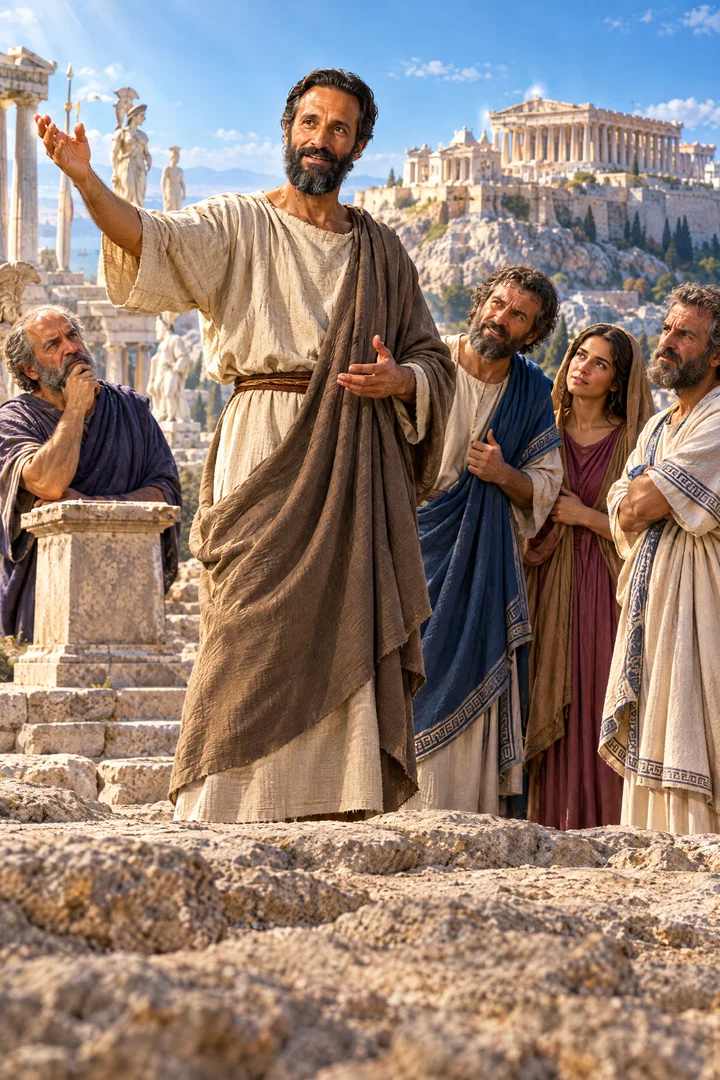
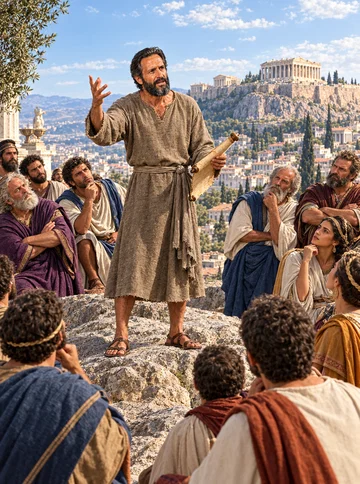
So Paul departed from among them.
Revised Version, American Standard Version, World English Bible
Thus Paul went out from among them.
and so Paul went forth from the midst of them,
Thus Paul went out of their midst.
Thus, Paul, came forth out of their midst.
Berean Standard Bible, Majority Standard Bible
At that, Paul left the Areopagus.
And so Paul went away from among them.
And so Paul departed from among them.
Douay-Rheims (Challoner revision)
So Paul went out from among them.
Pictures
Cross-references
- Acts 18:1-5
After these things Paul departed from Athens, and came to Corinth;
Paul leaves Athens and begins preaching in Corinth before Silas and Timothy arrive.
- Acts 17:23
For as I passed by, and beheld your devotions, I found an altar with this inscription, TO THE UNKNOWN GOD. Whom therefore ye ignorantly worship, him declare I unto you.
Paul identifies the Athenian altar to the unknown God.
- 1 Thessalonians 3:1-7
Wherefore when we could no longer forbear, we thought it good to be left at Athens alone;
Paul sent Timothy from Athens to Thessalonica after departing from Athens.
- Acts 17:15
And they that conducted Paul brought him unto Athens: and receiving a commandment unto Silas and Timotheus for to come to him with all speed, they departed.
Paul arrived in Athens and sent word for Silas and Timothy to join him.
- Acts 17:2
And Paul, as his manner was, went in unto them, and three sabbath days reasoned with them out of the scriptures,
Paul reasons with them in the synagogue on three Sabbaths.
- Acts 17:18
Then certain philosophers of the Epicureans, and of the Stoicks, encountered him. And some said, What will this babbler say? other some, He seemeth to be a setter forth of strange gods: because he preached unto them Jesus, and the resurrection.
Debate over resurrection forms the setting for Paul’s departure.
Commentary
Each commentary is drawn from primary sources: the writings of Ellen G. White and Adventist pioneers and periodicals. Each commentary is separate. Its own words are not a quotation; follow the references to read the source passages.
Ellen G. White
13 sources
So Paul departed from among them closes his labors in Athens, his teaching cut short as he left the people and went on to Corinth.AA 240.2–241.18RED 59.18RED 60.1–61.1 At the Areopagus he had proclaimed Christ to philosophers and sages devoted to art and idol worship, with noble firmness and winning power that astonished and silenced proud philosophy, yet with tact born of divine love that revealed the true God rather than directly attacking their gods.AA 240.2–241.1ST Sep 22, 1914SLP 291.1–2 His work was not wholly in vain, for Dionysius and several others accepted the gospel, yet comparatively few received it and the fruit was limited because pride of intellect counted it foolishness.AA 240.2–241.18RED 59.16T 141.38RED 60.1–61.1 Inspiration preserved the account as a treasure of knowledge for all coming generations, bearing witness of unshaken confidence in loneliness and of victory gained for Christianity in the very heart of paganism.AA 240.2–241.18RED 59.1 Disappointed that meeting eloquence with eloquence and logic with logic had no real effect, he determined on an entirely different course in Corinth, centering his teaching in veriest simplicity on salvation through Christ and Him crucified.ST Sep 22, 1914Ms 114, 1898, par. 17–19SLP 120.1–29MR 69.38RED 60.1–61.1
Paul's Work in Athens
So Paul departed from among them closes his labors in Athens, his teaching there cut short as he left the people and went on to Corinth.AA 240.2–241.18RED 59.18RED 60.1–61.1 The setting was his public proclamation at the Areopagus to Greek philosophers and sages, among a people devoted to art and the worship of idols.AA 240.2–241.1ST Sep 22, 1914SLP 291.1–2SLP 304.1–2 With all their knowledge, refinement, and art they were yet proud, self-sufficient, and sunken in vice.AA 240.2–241.1
He proclaimed the faith of Christ with noble firmness and winning power, rising before the sages of Greece to forcefully answer proud philosophy and give evidence for the faith.RH Dec 21, 1911SLP 291.1–2AA 462.1–2 By knowledge and eloquence he astonished his hearers and put to silence their arguments.ST Sep 22, 1914SLP 291.1–2AA 462.1–2 His course showed tact born of divine love, for instead of directly attacking their gods and great men he carefully drew their minds away from heathen deities by revealing to them the true God who was to them unknown.AA 240.2–241.1 A direct attack might easily have irritated his proud listeners and brought himself into difficulty and even danger of meeting the fate of Socrates.AA 240.2–241.1
His labors there were not wholly in vain, for Dionysius, one of the most prominent citizens, and some others, several in all, accepted the gospel message and united themselves fully with the believers and joined themselves to him.AA 240.2–241.18RED 59.1 Yet comparatively few received the gospel and the fruit was limited, because the people cherished pride of intellect and worldly wisdom and counted the gospel of Christ foolishness.ST Sep 22, 19146T 141.38RED 60.1–61.1 Inspiration preserved this glance into the life of the Athenians, with his words and the description of his attitude and surroundings traced to be handed down through all coming generations as a treasure of knowledge for the church.AA 240.2–241.18RED 59.1 It bears witness of his unshaken confidence and his courage in loneliness and adversity, and of the victory he gained for Christianity even in the very heart of paganism, that it might be seen how God through His servant rebuked idolatry and the sins of a proud, self-sufficient people.AA 240.2–241.18RED 59.1
This time belongs to his former years of free public labor with open opportunity to stand before philosophers and before kings and governors and reason of righteousness, temperance, and judgment to come.AA 462.1–2 That stands in contrast to his later confinement to his own dwelling in Rome, where he could proclaim truth only to those who sought him there and had no command like Moses and Aaron to go and rebuke the king.AA 462.1–2
Beyond Human Wisdom
Paul was fitted to speak before kings and the great and learned men, and intellectual acquirements often prepared the way for the gospel, yet in Athens he tried meeting false philosophy with true philosophy, eloquence with eloquence, logic with logic and oratory with oratory, displaying his learning, ability and smartness upon his hearers.Ms 114, 1898, par. 17–199MR 69.38RED 67.1–2 The learned effort disappointed him and failed to bring the success he hoped for, having no real effect.Ms 114, 1898, par. 17–19SLP 120.1–29MR 69.38RED 67.1–2 Looking back he saw that something above even the wisdom of learned men is needed, that intellectual development must be sanctified by the Spirit of God in order to convict and convert sinners, and that power must be received from a higher source by eating the flesh and drinking the blood of the Son of God, which gives eternal life.Ms 114, 1898, par. 17–19
Because of that disappointment he determined on an entirely different course in Corinth, avoiding elaborate arguments and worldly wisdom and centering his teaching in veriest simplicity on salvation through Christ, especially Christ crucified, as Saviour of sinners, presenting plain simple truth about Christ and His mission to the world.ST Sep 22, 1914SLP 120.1–28RED 60.1–61.18RED 67.1–2 Though his reasoning in Athens had astonished and silenced his hearers, the effort led few to accept the gospel, and afterward he pointed people simply to Christ as the Saviour of sinners.ST Sep 22, 1914 The lesson is to know nothing but Jesus Christ and Him crucified, because a short lifetime leaves time for nothing else.9MR 69.3
Sources
Pioneers and periodicals
34 sources
So Paul departed from among them closes his work at Athens, leaving the gathering on the Areopagus, also called Mars Hill, after his address to the philosophers and going on to Corinth.ST Jul 8, 1897ST Jan 21, 1903ST Jan 27, 1898 Before departing he set forth the unknown God whom the Athenians ignorantly worshiped as the God who made the world and all things therein, teaching humanity's relation to God, the exposure of idolatry, the command for all everywhere to repent, and coming judgment in righteousness by the risen Man.ST Jan 21, 1903ST Jan 27, 1898 When he spoke of the resurrection of the dead, some mocked and others delayed while a few believed, because belief in the soul's immortality effectively denied the resurrection and made it the testing truth there.ST Jul 8, 1897ST Jan 21, 1903ST Jan 27, 1898RH Mar 13, 1879ST Nov 13, 1879 Immediately after the departure certain men joined him and believed, including Dionysius the Areopagite and Damaris, though the address appears to have won no more than one member of the assembly.ST Jan 21, 1903ST Jan 27, 1898RH Dec 19, 1907 His work at Athens was just as faithful and acceptable when it showed no apparent result as his work in gathering a church at Corinth, and though his reasoning there led few to accept the gospel, afterward he avoided elaborate arguments and pointed people simply to Christ as Saviour of sinners.ST Sep 22, 1914RH Oct 3, 1907RH Feb 26, 1861ST Dec 6, 1883ST Oct 25, 1877
Setting and Departure
So Paul departed from among them closes his work at Athens, after his address on the Areopagus, also called Mars Hill, to the philosophers, when he left the gathering there and went on to Corinth.ST Jul 8, 1897ST Jan 21, 1903RH Oct 3, 1907RH Feb 27, 1908ST Feb 3, 1898 The departure came after some who heard of the resurrection of the dead mocked and others said they would hear him again concerning it.ST Jul 8, 1897ST Jan 21, 1903ST Jan 27, 1898ST Feb 3, 1898 It ended his address setting forth the unknown God who made the world, creation, acceptable worship, the command for all men everywhere to repent, and coming judgment in righteousness by the risen Man.ST Jan 21, 1903ST Jan 27, 1898ST Feb 3, 1898 His effort there included speaking with its learned men and quoting their poets, but no remarkable work followed.RH Oct 3, 1907
It belongs to his first preaching of the gospel in Athens, about A.D. 52, when he was alone because Luke had been left at Philippi and Silas and Timothy at Berea and Thessalonica.ST Jul 8, 1897 The address was given when he was alone, to an idolatrous crowd, with no Christian hearers present.ST Jul 8, 1897ST Apr 19, 1877 He passed through a city full of temples, idols, and altars, seeing gods multiplied on every side, and was stirred with pity at the wretchedness of poor people who have many gods yet remain far behind and satisfied.ST Apr 19, 1877
His departure was neither abrupt nor forced by riot or threat, for he stayed as long as he had intended.ST Sep 27, 1883 He left after his discussions with the Jews and philosophers, his speech at the Areopagus, and the conversion of some hearers.ST Sep 27, 1883 The account fits the likelihood that Timothy joined him in Athens and was then sent back to Thessalonica, explaining why Timothy did not reach him in Corinth until later.ST Sep 27, 1883
The result is shown immediately after the departure, in that certain men joined him and believed.ST Jan 21, 1903ST Jan 27, 1898ST Sep 27, 1883 Among them were Dionysius the Areopagite, whose conversion is mentioned after the departure, and Damaris, with scoffers becoming penitent believers and Gentiles coming into the church.ST Jan 21, 1903ST Jan 27, 1898RH Dec 19, 1907RH Oct 16, 1860 That exposition of Christian truth before the leading assembly appears to have won no more than one member of the assembly to Christianity.RH Feb 26, 1861
It closes his work at Athens in Acts 17, among the places of labor in that chapter, and follows his noted sermon at Athens, the most prominent event of the chapter.ST Jun 9, 1898 It closes his experience at Athens as one part of the account in Acts 17-20 at Thessalonica, Berea, Athens, Corinth, Ephesus and Troas with the farewell to the elders of Ephesus, showing how wonderfully God worked in each place and how the word triumphed in every case notwithstanding persecution.ST Jul 7, 1909 That sermon teaches that in God all live and move and have being, declares the judgment and the resurrection, and shows the burden of his preaching.ST Jun 9, 1898 It belongs to his work among the Gentiles at Athens before his statement at Corinth in Acts 18:6 that he would go to the Gentiles.RH Dec 19, 1871
Message and Response
Before departing Paul set forth the unknown God whom the Athenians ignorantly worshiped as the God who made the world and all things therein.ST Jan 21, 1903RH Sep 10, 1872 He distinguished the true God from the multitude of false gods by creation and the power to create.RH Sep 10, 1872 He taught that in God all live and move and have being, declared the worship He accepts and humanity's relation to Him, exposed idolatry, commanded all men everywhere to repent, and announced coming judgment in righteousness by the risen Man.ST Jan 21, 1903ST Jan 27, 1898ST Jun 9, 1898ST Dec 3, 1896 That proclamation of creation, repentance, judgment by Christ, and the resurrection drew mockery from some and delay from others.ST Jan 21, 1903ST Jan 27, 1898
At Athens he adapted his approach to the Epicureans and Stoics, beginning from the altar inscription and reasoning about the Creator, humanity's relation to God, idolatry, repentance, future judgment, Jesus, and the resurrection.RH Feb 27, 1908 He spoke with its learned men and quoted their poets, proclaiming faith in Christ before Greek sages with firmness, knowledge, and eloquence.ST Feb 14, 1884RH Dec 21, 1911RH Oct 3, 1907 His reasoning astonished and silenced his hearers as a powerful challenge to proud philosophy, forcefully answering it and giving evidence for the faith.ST Sep 22, 1914ST Feb 14, 1884RH Dec 21, 1911 He reasoned about righteousness, self-control, and coming judgment.ST Feb 14, 1884
When he spoke of the resurrection of the dead and judgment by Christ, some mocked and others said they would hear him again, and almost all rejected the message.ST Jul 8, 1897ST Jan 21, 1903RH Apr 2, 1861 His hearers responded in different ways by mocking, delaying, and believing.ST Jan 27, 1898ST Jul 10, 1893 His minority position under opposition did not make him sectarian.ST Dec 6, 1883
The resurrection was the testing truth at Athens because belief in the soul's immortality effectively denied it.RH Jan 7, 1862 Heathen philosophers mocked the Christian hope of future life through the resurrection of the dead as unreasonable and unphilosophical.RH Mar 13, 1879ST Nov 13, 1879 Christians rested future life on the Bible promise of the resurrection, while Platonists argued for it through the soul's immortality.RH Mar 13, 1879 In that encounter he exalted Christ alone rather than placing Him alongside the Greek gods, refusing to honor idolatrous faiths or dilute the gospel.ST Nov 13, 1893 He preached the gospel as the only true religion that people must believe to be saved and not as personal opinion, while listening meekly to honest questions and giving reasons for the faith.ST Nov 13, 1893RH Mar 5, 1857 With those who mocked and those who believed, the passage is among the Scriptures teaching that the world will continue to oppose Christ and His true church until the end of the age.ST Aug 7, 1901
Example for Workers
Paul's labor at Athens was just as faithful and acceptable when it showed no apparent result as his labor in gathering a church at Corinth.ST Oct 25, 1877 His departure from Athens after proclaiming truth to people who largely opposed or rejected it shows that holding a minority position under opposition does not make one sectarian.ST Dec 6, 1883
His departure from the Areopagus came after he had presented the gospel to the philosophers of Athens.ST Sep 22, 1914 Though his reasoning astonished and silenced his hearers, the effort led few to accept the gospel.ST Sep 22, 1914RH Feb 9, 1905 His work there included speaking with its learned men, quoting their poets, and giving an exposition of Christian truth before the leading assembly, yet no remarkable work followed.RH Oct 3, 1907RH Feb 26, 1861 That address appears to have won no more than one member of the assembly to Christianity, and where he had preached amid controversy few received his message.RH Feb 26, 1861RH Feb 9, 1905 Afterward he avoided elaborate arguments and pointed people simply to Christ as the Saviour of sinners.ST Sep 22, 1914
The preaching recorded in Acts 17:16-34 represents gospel work among cultivated, civilized people, set alongside preaching like that at Lystra among uncultivated people.ST Sep 10, 1896 This shows that God cares for both classes and that the gospel is addressed to the wise and cultivated as well as to the semibarbarous.ST Sep 10, 1896 It also illustrates that a trained preacher could serve in a setting suited to his abilities, contrasted with Peter's preaching at Pentecost, which was especially appropriate to its occasion.RH Jun 18, 1872
The departure from Athens came after Gentiles there came into the church, as at Antioch, Corinth, and Rome.ST Jun 16, 1898 That coming of Gentiles into the church proves successful foreign missionary work among the Gentiles.ST Jun 16, 1898 Such success requires increased skilled effort by the home church to care for a growing church.ST Jun 16, 1898
Sources