Acts 19:30
And when Paul would have entered in unto the people, the disciples suffered him not.
Translations
American King James Version, Webster Bible
And when Paul would have entered in to the people, the disciples suffered him not.
King James Version, KJV Cambridge Paragraph Bible, Douay-Rheims (Challoner revision)
And when Paul would have entered in unto the people, the disciples suffered him not.
Revised Version, American Standard Version
And when Paul was minded to enter in unto the people, the disciples suffered him not.
And on Paul's purposing to enter in unto the populace, the disciples were not suffering him,
But Paul intending to go in to the people, the disciples suffered him not;
But, Paul, being minded to enter in among the populace, the disciples would not suffer him.
Berean Standard Bible, Majority Standard Bible
Paul wanted to go before the assembly, but the disciples would not allow him.
When Paul wanted to enter in to the people, the disciples didn’ t allow him.
And when Paul was about to go in to the people, the disciples did not let him.
And when Paul would haue entred in vnto the people, the disciples suffred him not.
Pictures
Cross-references
- Acts 19:1-7
And it came to pass, that, while Apollos was at Corinth, Paul having passed through the upper coasts came to Ephesus: and finding certain disciples,
Paul instructs and baptizes disciples who had received only John’s baptism.
- Acts 19:35-41
And when the townclerk had appeased the people, he said, Ye men of Ephesus, what man is there that knoweth not how that the city of the Ephesians is a worshipper of the great goddess Diana, and of the image which fell down from Jupiter?
The town clerk calmed the Ephesian crowd and dismissed the assembly.
- 1 Corinthians 15:32
If after the manner of men I have fought with beasts at Ephesus, what advantageth it me, if the dead rise not? let us eat and drink; for to morrow we die.
Paul describes his conflict at Ephesus as fighting beasts.
- Matthew 10:16
Behold, I send you forth as sheep in the midst of wolves: be ye therefore wise as serpents, and harmless as doves.
memorized with verses 29-31
- Acts 19:26
Moreover ye see and hear, that not alone at Ephesus, but almost throughout all Asia, this Paul hath persuaded and turned away much people, saying that they be no gods, which are made with hands:
Paul’s teaching against handmade gods threatened the silversmiths’ trade.
- Acts 19:9
But when divers were hardened, and believed not, but spake evil of that way before the multitude, he departed from them, and separated the disciples, disputing daily in the school of one Tyrannus.
same believers meeting in school of Tyrannus
Commentary
Each commentary is drawn from primary sources: the writings of Ellen G. White and Adventist pioneers and periodicals. Each commentary is separate. Its own words are not a quotation; follow the references to read the source passages.
Ellen G. White
7 sources
This moment comes at the close of Paul's work of more than three years in Ephesus, where a flourishing church had been raised up and from which the gospel had spread throughout the province of Asia among both Jews and Gentiles.AA 291.1–2 At that time Paul purposed to pass through Macedonia and Achaia to go to Jerusalem and afterward to see Rome, sent Timothy and Erastus ahead into Macedonia, and decided to remain in Ephesus until after Pentecost, when an event hastened his departure.AA 291.1–2
It took place during the yearly ceremonies at Ephesus in honor of Diana, which drew great numbers of people from all parts of the province and were conducted with utmost pomp and splendor.AA 291.3–292.1 It was a trying time for those newly come to the faith who met in the school of Tyrannus, who were an inharmonious note in the festive chorus and faced ridicule, reproach, and insult.AA 291.3–292.1 Paul's labors had given heathen worship a telling blow, causing a perceptible falling off in attendance at the national festival and in the enthusiasm of the worshipers.AA 291.3–292.1 His influence extended far beyond actual converts, so that many who had not openly accepted the new doctrines were enlightened to lose all confidence in their heathen gods.AA 291.3–292.1
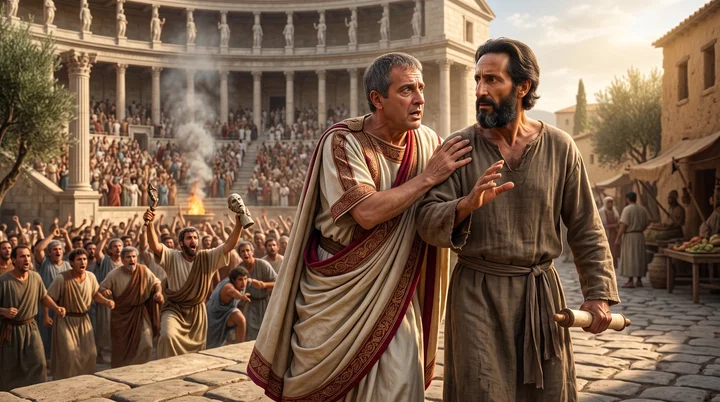
Paul wanted to enter the theater and go in to the people to speak to the rioting crowd during the Ephesian uproar.AA 293.1–4SLP 143.2–144.1RH Sep 14, 1911AA 295.1–2 The disciples, his companions, would not let him enter, because his appearance would inflame the mob and put his life in immediate and extreme danger.AA 293.1–4SLP 143.2–144.1RH Sep 14, 1911AA 295.1–2 They knew that seeing Paul would intensify the mob's anger and leave his life beyond any human hope of rescue, while his companions were not the crowd's main target.RH Sep 14, 1911
God had protected Paul, and the time for his martyrdom had not yet come, and the disciples' action helped preserve his life amid the tumult.RH Sep 14, 1911AA 295.1–2 The chapter to which the verse belongs records the experience of the early apostles as matching the promised blessing now received, including speaking in other tongues as the Spirit gives utterance and meeting persecution with it.Ms 115, 1908
Sources
Pioneers and periodicals
28 sources
When the stir about the Way filled Ephesus with confusion, the mob seized Gaius and Aristarchus and rushed into the theater, and Paul purposed to go in to the people to address them.ST Mar 4, 1903ST Aug 12, 1897ST Feb 17, 1898 The disciples would not allow it but held him back from his purpose, and certain chief officers of Asia who were his friends also sent to him begging him not to venture himself into the theater.ST Mar 4, 1903ST Aug 12, 1897 They knew his appearance would intensify the anger of the mob and put his life beyond any human hope of rescue, yet by staying out he was kept in little or no danger, for God protected him because the time for his martyrdom had not yet come.RH Sep 14, 1911RH Dec 3, 1867 The uproar was driven chiefly by selfish business interests, for the silversmiths and makers of shrines of Diana saw their income threatened by teaching that turned people from Diana worship to the true God.RH May 12, 1868 Even amid such persecution God worked wonderfully so that His word triumphed and prevailed, teaching that the Lord preserves the faithful and that His servants may need to wait until tumult and prejudice subside before quietly continuing their work.ST Jul 7, 1909ST Mar 18, 1903RH May 12, 1868ST Feb 17, 1898
Uproar at Ephesus
During the stir concerning the Way the city was filled with confusion, and the mob seized Gaius and Aristarchus, Paul's companions in travel, and rushed with one accord into the theater.ST Mar 4, 1903ST Feb 17, 1898ST Mar 4, 1903 It was there that Paul purposed to enter in unto the people and address them in the midst of the uproar.ST Mar 4, 1903ST Aug 12, 1897ST Feb 17, 1898RH Jul 6, 1868ST Jun 18, 1885 He wanted to go in to the enraged crowd gathered in the theater and speak to them, but he was prevented from carrying out his purpose.ST Aug 12, 1897RH Jul 6, 1868ST Jun 18, 1885
When Paul would have entered, the disciples suffered him not and held him back.ST Mar 4, 1903ST Aug 12, 1897ST Feb 17, 1898ST Jan 23, 1907 They stopped him when he tried to enter the crowd and did not allow him to go in.ST Aug 12, 1897ST Mar 4, 1903 Certain chief officers of Asia who were his friends also sent unto him and begged him not to venture himself into the theater.ST Mar 4, 1903
The opposition was driven chiefly by selfish business interests, as those whose trade depended on making shrines of Diana saw their income threatened.RH May 12, 1868ST Feb 17, 1898ST Oct 3, 1906 The silversmiths and idol-makers and sellers of articles of religion opposed him because his teaching was turning people from Diana worship to the true God.RH May 12, 1868ST Apr 1, 1886 The crowd's support for Diana and for the temple of Diana of the Ephesians was used to oppose the truth Paul preached in its simplicity, as when artists and others protested when their work was challenged.RH May 12, 1868ST Apr 1, 1886ST Oct 3, 1906
The riot occurred about A.D. 57, near the close of Paul's work at Ephesus and near the close of his third missionary journey.ST Mar 4, 1903 Demetrius's opposition to Paul's preaching stirred the confusion that drove the crowd to rush to the theater.ST Jul 24, 1893RH May 12, 1868 The town clerk calmed the tumult, directed Demetrius to seek legal recourse, and dismissed the assembly.ST Jul 24, 1893RH May 12, 1868
The setting is conflict between Christianity and the worship of Diana, in which Paul's preaching exalted Christ alone and did not honor Diana or other false religions.ST Nov 13, 1893ST Jan 23, 1896 For this refusal he was mocked and mobbed when he was willing to face the angry crowd.ST Nov 13, 1893 The worship of Diana of the Ephesians in Paul's days was of the same cult and character as the worship of Semiramis, wife of Nimrod, who was early worshiped as a goddess and is also worshiped as the queen of heaven and Venus.ST Mar 4, 1913 That Ephesian setting is connected with Satan's use of wonders to support pagan religion.RH Jul 28, 1868
Teaching and Application
The verse belongs to Paul's experience at Ephesus where God worked wonderfully, and where notwithstanding persecution the word of God triumphed and prevailed.ST Jul 7, 1909 It belongs to the account of his ministry there in which opposition arose even as converts turned from their former practices. It is included in the account of the riot at Ephesus, which is paired with the teaching that the Lord preserves the faithful.ST Mar 18, 1903
During the uproar Paul wanted to go in among the people and enter the theater to speak to and address the rioting crowd, but the disciples stopped him and refused to let him expose himself to such danger.RH Sep 14, 1911RH Dec 3, 1867 They knew that seeing Paul would intensify the mob's anger and put his life beyond any human hope of rescue, while his companions were not the crowd's main target.RH Sep 14, 1911 Because he did not enter the theater he was in little or no danger from the insurrection, their intervention keeping him from entering a situation in which his life was at risk.RH Dec 3, 1867 God had protected him, and the time for his martyrdom had not yet come.RH Sep 14, 1911
The keeping of Paul from the uproarious assembly illustrates that God's servants may need to wait until a tumult and the prejudice it stirs have subsided before quietly continuing their work of teaching the truth.RH May 12, 1868 The tumult arose from business interests, because the spread of Christianity threatened the silversmiths' income from Diana worship.ST Feb 17, 1898 The disturbance could otherwise have led to wholesale persecution and massacre of Christians.ST Feb 17, 1898
The verse belongs to the story of the believing Ephesians whose conversion led them to burn their books of magic.ST Dec 14, 1904 It teaches that the right kind of religion gives up and destroys cherished idols and sinful livelihoods, as with a poppy field grown for opium, and so it will be with anyone possessed of idols.ST Dec 14, 1904
Paul wanted to enter the crowd during the disturbance and was willing to face the angry crowd, but the disciples held him back, although he was working for a deeper and more lasting peace.ST Jan 23, 1907ST Nov 13, 1893 His preaching exalted Christ alone and did not honor Diana or other false religions, and for this refusal he was mocked and mobbed.ST Nov 13, 1893 His example presents cooperation with Diana's worshippers in a shared religious effort as inconsistent with the gospel's claim to be the way of life.RH Jul 30, 1914 Preaching the gospel in its simplicity threatened the sellers of articles of religion whose trade depended on idolatry and on making shrines for Diana, and the same uproar would be created if a second Paul preached against shrine worship surrounded by commerce in rosaries, crowns, garlands and pictures, as when artists and others protested when their work was challenged.ST Apr 1, 1886ST Oct 3, 1906 The Ephesian uproar shows that the gospel may meet strong opposition, like resistance that might arise from a church party, yet even so a church can still be established there, as one was at Ephesus.RH Jul 30, 1908
The verse is part of the close of Acts leading to Paul's arrival in Rome, his reception there, and his effort to reach his own people with its twofold result, without reaching his last imprisonment and death, an inspiring record of the work of men who trusted God.ST Oct 29, 1912 The chapter shows no hint that Paul introduced a new Sabbath during his work there.RH Nov 21, 1871 The description of his conflict with beasts refers to the violence and fury of fierce pagan zealots such as Demetrius and his fellow craftsmen who raised the tumult, not necessarily to an actual fight with wild animals.RH Dec 3, 1867 The chapter is part of an unusual case involving people who had received an incomplete baptism and instruction, which does not clearly prove that everyone baptized with John's baptism must be baptized again, but does show that rebaptism is right when a person's first baptism did not meet the requirements of the gospel rite.ST Jun 3, 1880
Sources