Acts 19:34
But when they knew that he was a Jew, all with one voice about the space of two hours cried out, Great is Diana of the Ephesians.
Translations
American King James Version, King James Version, KJV Cambridge Paragraph Bible, Webster Bible
But when they knew that he was a Jew, all with one voice about the space of two hours cried out, Great is Diana of the Ephesians.
Revised Version, American Standard Version
But when they perceived that he was a Jew, all with one voice about the space of two hours cried out, Great is Diana of the Ephesians.
and having known that he is a Jew, one voice came out of all, for about two hours, crying, 'Great [is] the Artemis of the Ephesians!'
But, recognising that he was a Jew, there was one cry from all, shouting for about two hours, Great [ is] Artemis of the Ephesians.
But, recognizing that he was a Jew, one voice arose from all for about two hours, as they cried aloud—Great, is Diana of the Ephesians!
Berean Standard Bible, Majority Standard Bible
But when they realized that he was a Jew, they all shouted in unison for about two hours: “ Great is Artemis of the Ephesians!”
But when they perceived that he was a Jew, all with one voice for a time of about two hours cried out, “ Great is Artemis of the Ephesians!”
But when they saw that he was a Jew, all of them with one voice went on crying out for about two hours, Great is Diana of Ephesus.
But when they knew that he was a Iewe, there arose a shoute almost for the space of two houres, of all men crying, Great is Diana of the Ephesians.
Douay-Rheims (Challoner revision)
But as soon as they perceived him to be a Jew, all with one voice, for the space of about two hours, cried out: Great is Diana of the Ephesians.
Pictures
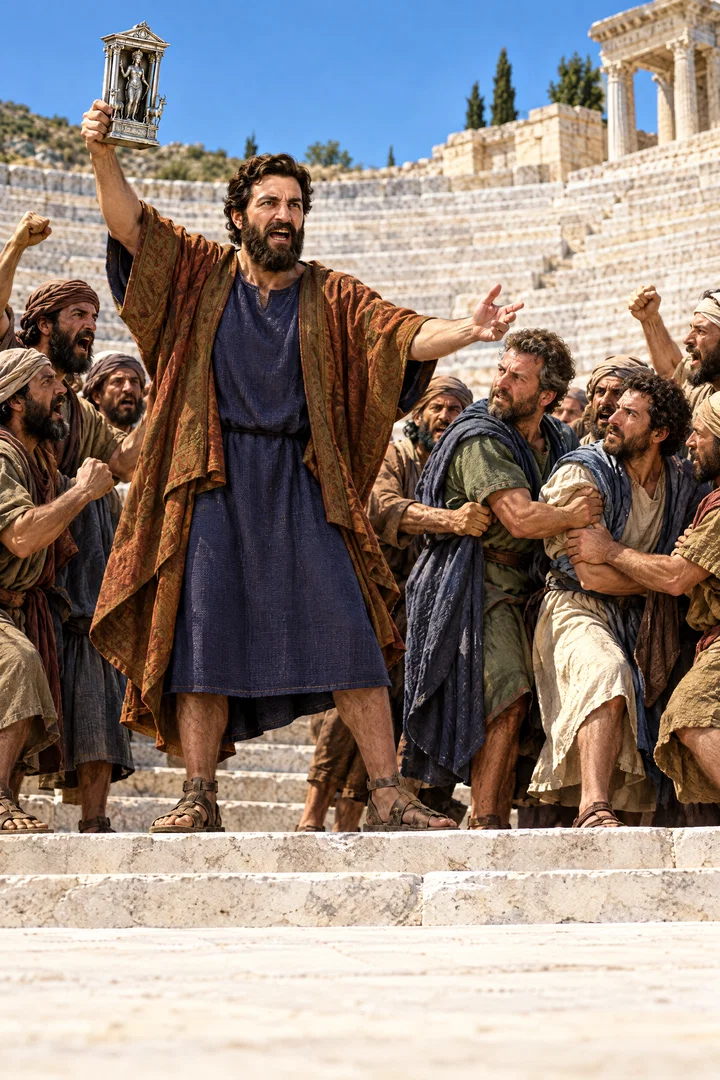
Cross-references
- Acts 19:24-27
For a certain man named Demetrius, a silversmith, which made silver shrines for Diana, brought no small gain unto the craftsmen;
The shrine makers’ threatened trade and appeal about Diana explain the crowd’s outcry.
- Acts 19:28
And when they heard these sayings, they were full of wrath, and cried out, saying, Great is Diana of the Ephesians.
The crowd repeats its shout praising Diana.
- Revelation 2:1
Unto the angel of the church of Ephesus write; These things saith he that holdeth the seven stars in his right hand, who walketh in the midst of the seven golden candlesticks;
The letter is addressed to the church in Ephesus.
- Acts 19:38-40
Wherefore if Demetrius, and the craftsmen which are with him, have a matter against any man, the law is open, and there are deputies: let them implead one another.
The town clerk directs the complaint to lawful courts and seeks to quiet the assembly.
- Acts 20:1
And after the uproar was ceased, Paul called unto him the disciples, and embraced them, and departed for to go into Macedonia.
departure from Ephesus hastened by the uproar
- 1 Corinthians 15:32
If after the manner of men I have fought with beasts at Ephesus, what advantageth it me, if the dead rise not? let us eat and drink; for to morrow we die.
Paul’s reference to fighting beasts at Ephesus connects with the uprising.
Commentary
Each commentary is drawn from primary sources: the writings of Ellen G. White and Adventist pioneers and periodicals. Each commentary is separate. Its own words are not a quotation; follow the references to read the source passages.
Ellen G. White
7 sources
The shout took place during the yearly special ceremonies held at Ephesus in honor of Diana, which drew great numbers of people from all parts of the province and were conducted with the utmost pomp and splendor.AA 291.3–292.1 It came after more than three years of work at Ephesus that had raised up a flourishing church and spread the message throughout Asia among both Jews and Gentiles.AA 291.1–2 That work had given idol worship a telling blow, producing a perceptible falling off in attendance at the national festival and in the enthusiasm of the worshipers, while many who had not openly accepted the new teaching became so far enlightened as to lose all confidence in their pagan gods.AA 291.3–292.1
The tumult was stirred by craftsmen who feared the spread of the teaching would endanger their image-making business and the income of pagan priests and artisans.AA 295.1–2 For the company of believers meeting in the school of Tyrannus, the gala season was a trying time, since they were an inharmonious note in the festive chorus and ridicule, reproach, and insult were freely heaped on those newly come to the faith.AA 291.3–292.1 The shouting took place in a confused theater assembly growing in tumult, where most did not know why they had come together.AA 294.1–2 Because Paul and some of his companions were of Hebrew extraction, the Jews were anxious to show they were not sympathizers with his work, so they put forward Alexander, a Jewish craftsman and coppersmith of considerable ability, to set the matter before the people and turn the wrath of the people exclusively against Paul and his companions.AA 294.1–2
The man put forward was Alexander, a companion of Paul, and when the crowd saw and knew that he was a Jew, they rejected his attempt to address them, refused him a hearing, and thrust him aside.8RED 77.3–78.3SLP 144.2RH Sep 14, 1911AA 294.1–2 Then all with one voice joined together in a continuous shout honoring Diana as great and as the goddess of the Ephesians for about two hours, until they stopped from sheer exhaustion, showing the crowd's fervor and disorder.8RED 77.3–78.3SLP 144.2RH Sep 14, 1911AA 294.1–2 The city recorder's decision afterward vindicated Paul as innocent of unlawful conduct, checked the mob, and kept the uproar from disgracing the Christian cause.AA 295.1–2 The event hastened Paul's departure at a time when he purposed to pass through Macedonia and Achaia to go to Jerusalem and afterward see Rome, having sent Timothy and Erastus ahead into Macedonia and intending himself to remain at Ephesus until after Pentecost.AA 291.1–2 In contrast to the religion of Diana, which rested on a false foundation and proved worthless so that its temple was ruined, its worshipers perished, and the religion was forgotten or became like an idle tale, the Christians gathered at Ephesus endured as precious living stones built on Christ.8RED 77.3–78.3
Sources
Pioneers and periodicals
41 sources
The crowd recognized Alexander as a Jew put forward to defend the Jews, refused to hear him, and with one voice shouted in honor of Diana for about two hours.ST Feb 17, 1898ST Aug 12, 1897ST Mar 4, 1903RH Jul 6, 1868 The uproar had been stirred by Demetrius and the craftsmen because Paul's preaching against idolatry threatened their livelihood from making silver shrines, with zeal for Diana used to win the crowd rather than from sincere devotion.RH Dec 3, 1867ST Mar 18, 1903ST Feb 17, 1898 Having no reasoned argument, the confused multitude joined in loud prolonged repetition to silence opposition, defend their fables, and protect cherished error from exposure.RH Jun 20, 1865RH May 12, 1868ST Apr 10, 1884RH Jun 12, 1856 The cry honored Diana of the great Ephesian temple worshiped throughout Asia and the world, yet her worship has vanished while the humble faith of Christians has spread over the earth.ST Nov 29, 1910ST Dec 14, 1904ST Nov 14, 1878ST Jan 23, 1896 True faith exalts Christ alone and gives up idols completely, while mere shouting cannot make a false claim true or holy.ST Dec 14, 1904ST Apr 9, 1896RH Jul 30, 1914ST Nov 13, 1893RH Jun 12, 1856
Riot Setting at Ephesus
The shout belongs to the uproar at Ephesus during Paul's missionary journeys, led by Demetrius and his fellow craftsmen after his preaching called people to leave idolatry and worship the true God.RH Dec 3, 1867ST Mar 18, 1903 The city was filled with confusion and the crowd rushed into the theater, and the town clerk eventually quieted them and directed Demetrius to seek redress through the courts.ST Jul 24, 1893 The silversmiths' attack was driven chiefly by fear that the spread of Christianity would reduce demand for idols and threaten their income from Diana's worship and the trade in silver shrines, with concern for Diana added as a secondary appeal to win the crowd's support rather than from sincere religious devotion.ST Feb 17, 1898ST Apr 1, 1886ST Oct 3, 1906 The public turmoil around the conflict shows the resistance Paul's preaching could provoke among those involved in pagan religious commerce.ST Apr 1, 1886ST Oct 3, 1906
Most of the people did not understand what had started the uproar or why they had gathered, having been stirred by a few leaders with an appeal to religious zeal.ST Jul 24, 1893RH May 12, 1868 Paul did not enter the theater and so was scarcely in danger, while Gaius and Aristarchus were exposed to danger.RH Dec 3, 1867 The crowd's fury shows the violence of the adversaries and the fierce pagan zeal Paul faced at Ephesus, explaining his image of fighting with beasts as contending with fierce zealots rather than being made to fight wild animals.RH Dec 3, 1867RH Dec 3, 1867 The disturbance might have led to persecution and massacre of Christians, but the town clerk's prudent action in quieting the crowd prevented that worse outcome.ST Feb 17, 1898 His course shows the principle that disputes should be handled through the courts with people's rights protected, rather than religious beliefs enforced by force and compulsion.ST Jan 23, 1907ST Jul 24, 1893 The episode thus shows the opposition and persecution surrounding Paul's work at Ephesus, yet also how wonderfully God wrought and how the word of God triumphed in every place despite persecution.ST Jul 7, 1909
Alexander Rejected as Jew
The Jews put Alexander forward as their spokesman to make a defense for them and to quiet the disturbance.ST Mar 4, 1903ST Feb 17, 1898ST Mar 4, 1903ST Aug 12, 1897 They did so because they feared the crowd would turn against them as it had turned against the Christians.ST Mar 4, 1903ST Mar 4, 1903 They also acted lest they be reckoned with the Christians as causing the disturbance.ST Aug 12, 1897
When the crowd perceived that Alexander was a Jew, they refused to hear his attempted defense and would not listen to him.RH Sep 14, 1911ST Feb 17, 1898ST Aug 12, 1897RH Jul 6, 1868 They recognized him as a Jew and rejected his attempt to address them.RH Sep 14, 1911ST Feb 17, 1898ST Aug 12, 1897 Instead of granting him a hearing, they drowned him out with a united shout exalting Diana of the Ephesians that lasted about two hours.ST Feb 17, 1898ST Aug 12, 1897RH Jul 6, 1868ST Aug 12, 1897
They saw in him simply another man who refused homage to their goddess.ST Mar 4, 1903ST Mar 4, 1903 They took him as representing Paul's teaching, and after learning that Paul's companions were Jews the whole multitude joined the cry.RH May 12, 1868ST Apr 10, 1884 In this way hostility toward Jews and Christians intensified the uproar.RH Jul 6, 1868
United Two-Hour Shout
When the crowd perceived that the man put forward to speak was a Jew, all with one voice cried out, Great is Diana of the Ephesians, for about the space of two hours.ST Feb 17, 1898ST Aug 12, 1897ST Feb 17, 1898ST Mar 4, 1903 The Jews had put Alexander forward as their spokesman to make a defense for them because they feared the crowd would turn against them as it had turned against the Christians, but the crowd refused to hear his attempted defense and would not listen to him.ST Feb 17, 1898ST Aug 12, 1897ST Feb 17, 1898ST Mar 4, 1903RH Jul 6, 1868 They saw in him simply another man who refused homage to their goddess, and their response to his Jewish identity intensified the uproar.ST Mar 4, 1903RH Jul 6, 1868 The prolonged outcry was united praise and honor of Diana in support of her worship, and it helped turn the people against Paul, though the attack was driven chiefly by the silversmiths' fear that his teaching would reduce demand for idols.ST Mar 4, 1903RH Jul 6, 1868
Although the assembly was confused and people had been crying different things, they joined in shared praise of Diana.ST Apr 10, 1884 They had no clear reason for her worship beyond the claim that Asia and the world worshiped her. After the crowd learned Paul's companions were Jews, it thought its repeated cry would prove Diana's greatness, but its zeal was deluded.ST Apr 10, 1884
Having no better argument to exalt their goddess, they used loud repetition and prolonged shouting to silence opposing arguments and to defend their beliefs and fables.RH Jun 20, 1865RH May 12, 1868RH Jun 12, 1856 Their loud insistence was an attempt to convince themselves of what they claimed and to protect cherished opinions from facts that could expose their error.RH Jun 20, 1865 Most of the people did not understand what had started the uproar, for a few leaders had stirred them by appeal to religious zeal, and after the crowd focused on Alexander as representing Paul's teaching the whole multitude joined the cry.RH May 12, 1868 It was a united defense of fables, not a reasoned argument against the truth, and it stands as a loud public clamor in confusion and uproar, without knowing why, that obscures the gospel.RH May 12, 1868RH Jun 12, 1856ST Aug 7, 1893
The noisy outburst in praise of Diana lasted about two hours and was eventually quieted.ST Apr 14, 1881 That brief though vehement clamor is contrasted with the more persistent devotion given to worldly philosophy.ST Apr 14, 1881
Diana Worship Described
Ephesus was a major city in Asia Minor known for its great temple of Diana, also called Artemis.ST Nov 29, 1910 That temple was a vast, rich marble structure reckoned a wonder of the world, and Diana herself is identified as the moon goddess Luna.ST Nov 14, 1878 Paul's teaching called the people to leave idolatry and worship the true God, threatening the trade in silver shrines used in devotion to her.
Diana was one of the most renowned goddesses in the world, worshiped throughout Asia and the world and honored by kings and princes with offerings.ST Nov 14, 1878 Civic authority held her worship to be beyond dispute, and she was the object of intense public devotion, so that Ephesus is described as possessed of idols with the whole crowd crying out for her.ST Dec 14, 1904ST Nov 14, 1878ST Jan 23, 1896 The mob showed that intense devotion together with hostility toward Jews and Christians when, recognizing a man as a Jew, they refused to hear him and shouted together for two hours.RH Jun 30, 1863ST Jan 23, 1896 Outward attendance at Christian services while absorbed in thoughts of Diana likewise shows that attendance does not mean attention or loyalties have turned from idolatry.RH Jun 30, 1863
Diana of the Ephesians was worshiped in Paul's days as one form of the same early goddess cult.ST Mar 4, 1913 Semiramis, wife of Nimrod, was among the goddesses early worshiped, and the nature of her worship connects her with the queen of heaven, Venus, Diana, and other goddesses of the same cult and character.ST Mar 4, 1913 The plain worship of humble Christians looked contemptible beside Diana's magnificence and mighty system.ST Nov 14, 1878 Yet eighteen centuries later the religion of Jesus has spread over the earth while Diana, her temple, and her followers have vanished into history with no vestige left, proving the power of God and the eternal stability of his religion.ST Nov 14, 1878 Ephesus was a place where Satan worked through wonders and deception to support pagan deities, including Diana.RH Jul 28, 1868
Lessons from Crowd Behavior
The two-hour united shout was driven by superstition and fanaticism rather than understanding, reflecting an excitable temperament that could be roused to prolonged chanting.ST Jul 29, 1897 Most of the people did not know why they had gathered, having been stirred by the craftsmen's agitation, and they were swept along by excitement without understanding what they were joining.ST Jul 29, 1897ST Mar 17, 1887 Religious gatherings driven by excitement may likewise produce temporary professions of conversion without instruction or lasting change.ST Mar 17, 1887
Religious prejudice and popular tradition can be stirred up by craftsmen's agitation to defend interests threatened by truth, as Paul's preaching had caused a decline in the business connected with Diana's worship.ST Jan 23, 1907ST Mar 17, 1887RH May 12, 1868 The prolonged united cry of loyalty to Diana illustrates religious force and compulsion, in contrast with the principle that disputes should be handled through the courts with people's rights protected rather than religious beliefs enforced.ST Jan 23, 1907 It illustrates the spirit of religious majorities that use civil law and compulsion to suppress a minority whose beliefs challenge their practices.ST Jan 23, 1907RH Apr 26, 1870 People who teach Sunday as a Christian Sabbath raise a similar alarm against those teaching the biblical Sabbath, and the uproar can obscure truth, so God's servants must wait for it to subside and then teach patiently.RH May 12, 1868
The scene serves as a comparison for religious teachers who readily echo claims they have not examined, exclaiming in effect that great is science of the nineteenth century.ST Aug 25, 1881 Sellers of religious wares like those at Loreto are compared to the Ephesian sellers, since the uproar shows the public resistance Paul's preaching could provoke among those involved in pagan religious commerce.ST Apr 1, 1886
Doctrine Gospel and Application
The chapter gives no hint of a new Sabbath and teaches no change of the Sabbath to the first day.RH Nov 21, 1871 The crowd's loud, united praise of Diana is a parallel to praise directed to Sunday, showing how false religious practices give glory to something other than God.ST Apr 9, 1896 Those who teach Sunday as a Christian Sabbath raise a similar alarm against those teaching the biblical Sabbath, for religious prejudice and popular tradition can be stirred up to defend interests threatened by truth.RH May 12, 1868 Such uproar can obscure truth, so God's servants must wait for it to subside and then teach patiently.RH May 12, 1868
Loud repetition cannot make a false claim true or holy, since the people cried out with one voice for about the space of two hours to exalt their goddess because they had no better argument.RH Jun 12, 1856 Those who call Sunday God's holy day though there is no scriptural direction for the change attempt to make it holy merely by calling it so, which mocks God and cannot deceive Him.RH Jun 12, 1856 True conversion means giving up idols completely, as Ephesus was possessed of idols with the whole crowd crying out for Diana.ST Dec 14, 1904 The believing Ephesians burned their books of magic, and anyone possessed of idols will do the same, even destroying a sinful livelihood like a poppy field grown for opium.ST Dec 14, 1904
Paul's Christian mission in Ephesus stood apart from the worship of Diana and other pagan deities, exalting Christ alone rather than complimenting an idolatrous faith.RH Jul 30, 1914ST Nov 13, 1893 His refusal to honor Diana alongside Christ led to opposition and mob violence.ST Nov 13, 1893 Christians would not join pagan worshipers in religious work that directed people to their temples rather than to the gospel.RH Jul 30, 1914 Opposition need not prevent a church from being established, for one followed the Ephesian uproar stirred up by those defending Diana and her worship, so a church party defending its religion elsewhere need not prevent establishment there.RH Jul 30, 1908 The crowd's prolonged cry in praise of Diana after learning the man was a Jew is likewise seen in people cheering as crowns were placed on wooden images, a display of idolatry like the worship of Diana.RH Dec 12, 1907
Sources