Acts 27:21
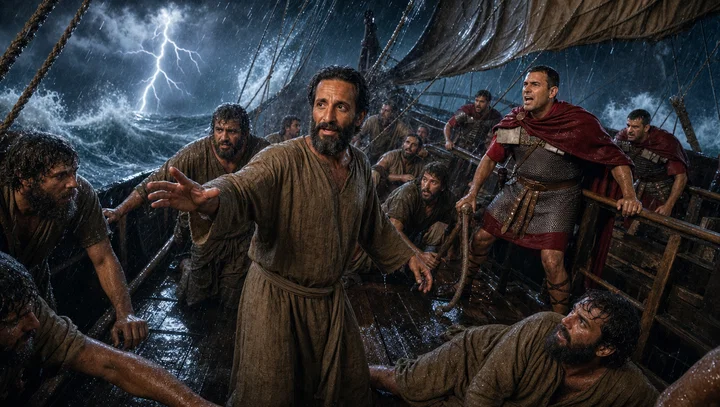
But after long abstinence Paul stood forth in the midst of them, and said, Sirs, ye should have hearkened unto me, and not have loosed from Crete, and to have gained this harm and loss.
Translations
But after long abstinence Paul stood forth in the middle of them, and said, Sirs, you should have listened to me, and not have loosed from Crete, and to have gained this harm and loss.
King James Version, KJV Cambridge Paragraph Bible
But after long abstinence Paul stood forth in the midst of them, and said, Sirs, ye should have hearkened unto me, and not have loosed from Crete, and to have gained this harm and loss.
But after long abstinence, Paul stood forth in the midst of them, and said, Sirs, ye should have hearkened to me, and not have loosed from Crete, and to have gained this harm and loss.
Revised Version, American Standard Version
And when they had been long without food, then Paul stood forth in the midst of them, and said, Sirs, ye should have hearkened unto me, and not have set sail from Crete, and have gotten this injury and loss.
And there having been long fasting, then Paul having stood in the midst of them, said, 'It behoved [you], indeed, O men — having hearkened to me — not to set sail from Crete, and to save this hurt and damage;
And when they had been a long while without taking food, Paul then standing up in the midst of them said, Ye ought, O men, to have hearkened to me, and not have made sail from Crete and have gained this disaster and loss.
But, when they had been, long without food, then, Paul, standing in the midst of them, said—Ye ought, indeed, Sir! yielding to me, not to have sailed away from Crete, to get this damage and loss. …
Berean Standard Bible, Majority Standard Bible
After the men had gone a long time without food, Paul stood up among them and said, “ Men, you should have followed my advice not to sail from Crete. Then you would have averted this disaster and loss.
When they had been long without food, Paul stood up in the middle of them and said, “Sirs, you should have listened to me, and not have set sail from Crete and have gotten this injury and loss.
And when they had been without food for a long time, Paul got up among them and said, Friends, it would have been better if you had given attention to me and not gone sailing out from Crete, to undergo this damage and loss.
But after long abstinece, Paul stood forth in the mids of them, and said, Syrs, ye should haue hearkened to me, and not haue loosed from Candie: so should ye haue gained this hurt and losse.
Douay-Rheims (Challoner revision)
And after they had fasted a long time, Paul standing forth in the midst of them, said: You should indeed, O ye men, have hearkened unto me, and not have loosed from Crete, and have gained this harm and loss.
Pictures
Cross-references
- Acts 27:9-10
Now when much time was spent, and when sailing was now dangerous, because the fast was now already past, Paul admonished them,
Paul recalls his warning that sailing would bring danger and loss.
- Acts 27:25
Wherefore, sirs, be of good cheer: for I believe God, that it shall be even as it was told me.
Paul urges courage in the storm because he believes God’s promise.
- Acts 27:11-12
Nevertheless the centurion believed the master and the owner of the ship, more than those things which were spoken by Paul.
rejected counsel to winter in Crete
- Acts 27:31
Paul said to the centurion and to the soldiers, Except these abide in the ship, ye cannot be saved.
Paul later warns that the sailors must remain aboard to be saved.
- Acts 27:1-2
And when it was determined that we should sail into Italy, they delivered Paul and certain other prisoners unto one named Julius, a centurion of Augustus’ band.
Introduces the voyage and its departure.
- 2 Corinthians 11:25
Thrice was I beaten with rods, once was I stoned, thrice I suffered shipwreck, a night and a day I have been in the deep;
Paul says he suffered shipwreck three times.
- Acts 28
And when they were escaped, then they knew that the island was called Melita.
The chapter’s account of Paul’s arrival at Rome also contains no such accusation.
Commentary
Each commentary is drawn from primary sources: the writings of Ellen G. White and Adventist pioneers and periodicals. Each commentary is separate. Its own words are not a quotation; follow the references to read the source passages.
Ellen G. White
7 sources
This verse belongs to Paul's sea voyage to Rome, when he was traveling as a prisoner with other prisoners under a centurion's charge.AA 439.1 It is set in first-century seafaring, when sailors depended largely on the sun and stars for navigation, when storms made travel perilous, and when for part of the year safe navigation was almost impossible.AA 439.2
Paul speaks after a long period without eating and after fourteen days drifting under a sunless and starless sky.SLP 266.2–3AA 442.2–443.1SLP 266.1 He stands on the deck in the midst of the panic-stricken company during a lull when the storm has eased enough for him to address them.AA 442.2–443.1RH Nov 23, 1911GW 107.3 He reminds them that they should have listened to his warning not to sail from Crete, and that leaving had brought harm and loss, with the present danger and loss confirming his warning.SLP 266.2–3AA 442.2–443.1RH Nov 23, 1911SLP 266.1GW 107.3
Though himself suffering physically, he remains calm and fearless for himself, with his heart stayed on God and holding by faith to divine power.SLP 266.2–3AA 442.2–443.1SLP 266.1 He holds words of hope for the darkest hour and help for every emergency, because he knows God will preserve him to reach Rome to witness for the truth of Christ.SLP 266.2–3AA 442.2–443.1 His heart is moved with pity and concern for the lives of those with him, whom he sees as sinful and unprepared to die, and he has prayed earnestly that God would spare their lives and received assurance that his prayer was granted.SLP 266.2–3AA 442.2–443.1SLP 266.1 On that basis he urges them to take courage, promising that no one will die though the ship will be lost and that all aboard will be spared, and even in this crisis he speaks with courage and hope as a witness to God.SLP 266.2–3RH Nov 23, 1911SLP 266.1GW 107.3
Sources
Pioneers and periodicals
28 sources
After long abstinence from food when all hope of rescue was gone and the storm had eased enough for him to be heard, Paul stood among the officers, crew, soldiers and passengers and reminded them that they should have heeded his counsel to winter in Crete and that leaving had brought the harm and loss they were suffering.ST May 19, 1898ST May 19, 1898 His reminder was not blame but a vindication of his earlier counsel to prepare them to trust the encouragement he would give next. He then urged them to take courage with the angel's assurance that he must stand before Caesar and that God had granted him the lives of all aboard, though the ship would be lost upon a certain island without loss of life.ST Dec 9, 1897RH Jun 30, 1903ST Mar 19, 1885 What seemed to obstruct his way to Rome was God's providence carrying him there at government expense with missionary opportunity along the way, and the whole shipload of reckless men was spared from death at sea for the sake of God's servant aboard.ST Mar 30, 1904ST Oct 24, 1895ST Mar 9, 1888ST Jul 23, 1885 Though a chained prisoner suffering with them, he alone did not despair but became the ship's steady leader and comfort, and his sublime faith and courage sustained the company and showed the weakness of human judgment against God's purposes.ST Jun 12, 1884ST Jul 16, 1885ST Apr 29, 1903
Setting and Plain Meaning
Paul was on his voyage to Italy and Rome as a prisoner under the charge of Julius after his appeal to Caesar, following two years at Caesarea.ST Mar 19, 1885ST Feb 25, 1889 Luke accompanied him on that last perilous voyage, and he traveled with only two companions in heart.ST Jun 19, 1884ST Apr 29, 1903 He went as a chained prisoner bound with others to Caesar's court, the conspicuous prisoner-in-chief charged as a criminal yet guilty of no crime, on his way to years in chains testifying of Christ before kings and emperors.RH Oct 4, 1906ST Apr 29, 1903
The voyage came late in the season for ancient navigation, when worsening and uncertain weather made travel increasingly dangerous.ST Mar 19, 1885 Paul had advised going into winter quarters at Lasea on the island of Crete, but those in authority rejected his counsel because the harbor was not sufficiently commodious and decided to sail on to Phenice to winter there.ST Mar 19, 1885ST Aug 21, 1893 After leaving Crete against his counsel a fierce windstorm arose and drove the ship wide of its course over the open Mediterranean beyond Sicily past Mount Etna, naming places that can still be seen by travelers passing over those waters.RH Jul 25, 1907ST Aug 21, 1893ST Aug 21, 1901 The tempest lasted fourteen days, during which Satan sought to destroy Paul by the enraged sea, and the historical account of the shipwreck stands as fact whose credibility is strengthened by study.ST Jul 16, 1885ST Aug 21, 1901ST Jul 5, 1910
He spoke after long abstinence without food, when the storm had taken away all hope of being saved.ST May 19, 1898ST May 19, 1898 The storm had eased enough for him to address them, and he stood forth in the midst of the ship's officers, crew, soldiers, and passengers.RH Nov 23, 1911ST May 19, 1898RH Feb 4, 1915 As the only one among them who did not despair, he kept the spirits of the company through steady endurance and leadership amid danger.ST Jul 16, 1885
The verse means he reminded them that they should have hearkened unto his counsel and not have loosed from Crete, and that rejecting his warning and sailing on had brought the harm and loss, injury and trouble, they were then suffering.ST May 19, 1898ST May 19, 1898RH Jun 30, 1903 His long abstinence preceded his prediction that they would ultimately be safe, with assurance that no one would die though the ship would be lost.RH Jun 30, 1903RH Jan 26, 1860 His reminder was not meant as blame or reproach, but to show the value and soundness of his earlier counsel and to prepare them to heed the encouragement and guidance he would give next.
After reproving them he urged them to take courage and comforted them with the message brought to him by the angel.RH Nov 23, 1911ST Dec 9, 1897ST Mar 19, 1885 He trusted the assurance that he must stand before Caesar and that God had granted him the lives of everyone on the ship.RH Jun 30, 1903ST Mar 19, 1885 He foretold that the ship would be lost and they would be wrecked upon a certain island without loss of life.RH Nov 23, 1911ST Dec 9, 1897RH Jun 30, 1903
Providence and Preservation in Shipwreck
Paul stood forth after long abstinence and warned that they should have heeded his counsel not to loose from Crete and so have gained this harm and loss as part of God's providence guiding him to Rome and preparing better treatment there and his release from prison. His arrest, imprisonment, delays, and voyage as a prisoner after his appeal to Caesar seemed to obstruct his plan to visit Rome, yet the journey brought him there at government expense and gave him missionary opportunities along the way.ST Mar 30, 1904ST Feb 25, 1889 Though most would call a voyage with such harm and loss after leaving Crete against his counsel not prosperous, it was prosperous by the will of God in answer to his earnest prayer to visit Rome, giving no cause for complaint or mourning.ST Oct 24, 1895ST Feb 25, 1889 What looks disastrous from the wrong side looks prosperous when seen as God sees it, because all things work together for good to them that love God and God knows far better than men how prayers should be answered, even when answered not in the way expected.ST Oct 24, 1895
The voyage shows wicked men's lives spared on account of a righteous man, for Paul's presence and God's message through him meant the people aboard would be saved.ST Mar 9, 1888 A whole shipload of reckless and wicked men escaped death at sea because Paul, God's servant, was aboard.ST Mar 9, 1888ST Jul 23, 1885
Paul's preservation in the shipwreck stands together with Old Testament deliverances such as the preservation of Shadrach, Meshach, and Abednego in the fiery furnace, for Old and New Testaments are one system with Christ as the product and perfection of Old Testament facts, so the New Testament deliverance and the Old Testament miracles cannot be separated.ST Nov 25, 1889 The shipwreck account is historical fact whose credibility and the vital truths connected with the Bible's historical record are strengthened by study.ST Jul 5, 1910 Acts 27 contains no accusation that Paul taught sanctification of the first day instead of the seventh.ST Jul 13, 1882
The trip to Rome in Acts 27 and 28 was labor and sacrifice and suffering amid harm, loss, and long abstinence, not a holiday rest, enduring hardship for his work rather than taking a vacation, and it stands against using his life to justify holidays for clergymen.ST Mar 18, 1889 The terrifying journey by sea as a prisoner after two years at Caesarea on the way to several years in chains at Rome testifying of Christ before kings and emperors was one stage in learning patience through patient sturdy toil and untold suffering to carry the gospel to the Gentiles. It ended not in living and being changed at the Lord's coming as he had hoped but in toil and labor and suffering and martyrdom at Rome for the truth's sake.
Courage and Spiritual Application
Though suffering and a prisoner, Paul remains courageous, self-possessed and firm in speech, becoming the ship's leader and comfort during the perilous storm voyage after passengers and crew had lost hope.ST Jun 12, 1884ST Jul 16, 1885ST Jun 21, 1883 He is the only one among them who does not despair through fourteen days of tempest, and his steady endurance and leadership keep the spirits of the company and crew.ST Jun 12, 1884ST Jul 16, 1885 His sublime faith and courage rise superior to all ills and cheer the hearts of his discouraged companions while the vessel is buffeted by wave, wind and current and suffers shipwreck.ST Apr 29, 1903 The storm-tossed vessel shows the weakness of human judgment and power against God's purposes, while Paul as chained prisoner-in-chief, charged as a criminal yet guilty of no crime, bound with others to Caesar's court at Rome and on to Puteoli, associated with sinners yet hating sin and traveling with only two companions in heart, stands conspicuous in courage.ST Jun 12, 1884ST Apr 29, 1903
As a shipwrecked voyager he acts the part of a sailor as well as a minister, giving directions concerning the company and the soldiers and the ship, and he is not ashamed to do so. He speaks after long abstinence to rebuke disobedience to his warning not to sail from Crete, saying that disobedience brought the harm and loss then suffered, and his abstinence precedes his prediction that all aboard would ultimately be safe.RH Jan 26, 1860 He holds out with great power of endurance through long abstinence and trial while his vessel is wrecked on the open Mediterranean beyond Sicily after passing out of sight of land past Mount Etna.ST Aug 21, 1901
The verse supplies the lesson that a person must not loose from Crete: the soul must remain abiding in Christ and trusting in him, since no harm can befall while it abides in him.ST May 23, 1911 As God once calmed the Sea of Galilee, He now speaks peace to the Great Sea to bear safely on a quiet, almost motionless, glassy sea the missionaries called from the West to go East, sparing them that same ordeal because they do not have Paul's power of endurance.ST Aug 21, 1901
Sources