Acts 6:12
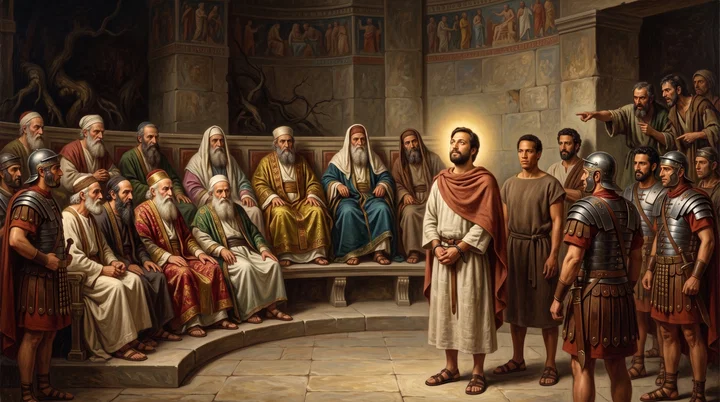
And they stirred up the people, and the elders, and the scribes, and came upon him, and caught him, and brought him to the council,
Translations
And they stirred up the people, and the elders, and the scribes, and came on him, and caught him, and brought him to the council,
King James Version, KJV Cambridge Paragraph Bible, Webster Bible
And they stirred up the people, and the elders, and the scribes, and came upon him, and caught him, and brought him to the council,
Revised Version, American Standard Version
And they stirred up the people, and the elders, and the scribes, and came upon him, and seized him, and brought him into the council,
They did stir up also the people, and the elders, and the scribes, and having come upon [him], they caught him, and brought [him] to the sanhedrim;
And they roused the people, and the elders, and the scribes. And coming upon [ him] they seized him and brought [ him] to the council.
And they stirred up the people and the elders and the scribes; and, coming upon him, they caught him away, and led him into the high-council.
Berean Standard Bible, Majority Standard Bible
So they stirred up the people, elders, and scribes and confronted Stephen. They seized him and brought him before the Sanhedrin,
They stirred up the people, the elders, and the scribes, and came against him and seized him, then brought him in to the council,
And the people, with the rulers and the scribes, were moved against him, and they came and took him before the Sanhedrin,
Thus they mooued the people and the Elders, and the Scribes: and running vpon him, caught him, and brought him to the Councill,
Douay-Rheims (Challoner revision)
And they stirred up the people, and the ancients, and the scribes; and running together, they took him, and brought him to the council.
Pictures
Cross-references
- Acts 7:54-60
When they heard these things, they were cut to the heart, and they gnashed on him with their teeth.
Stephen’s defense before the council leads to his death by stoning.
- Acts 7:1
Then said the high priest, Are these things so?
The high priest questions Stephen before the council.
- Matthew 26:59-61
Now the chief priests, and elders, and all the council, sought false witness against Jesus, to put him to death;
Both face false testimony brought to secure condemnation.
- Acts 8:1-3
And Saul was consenting unto his death. And at that time there was a great persecution against the church which was at Jerusalem; and they were all scattered abroad throughout the regions of Judæa and Samaria, except the apostles.
Saul supports the persecution that scatters believers.
- Acts 7:59-60
And they stoned Stephen, calling upon God, and saying, Lord Jesus, receive my spirit.
Stephen is condemned and killed.
- Acts 7:51-53
Ye stiffnecked and uncircumcised in heart and ears, ye do always resist the Holy Ghost: as your fathers did, so do ye.
Stephen rebuked the council for resisting God and persecuting the prophets.
- Acts 5:27
And when they had brought them, they set them before the council: and the high priest asked them,
The apostles are brought before the council.
- Acts 17:5
But the Jews which believed not, moved with envy, took unto them certain lewd fellows of the baser sort, and gathered a company, and set all the city on an uproar, and assaulted the house of Jason, and sought to bring them out to the people.
Both describe opponents coming upon people, using the Greek verb ephistemi.
- Acts 4
And as they spake unto the people, the priests, and the captain of the temple, and the Sadducees, came upon them,
Both recount persecution of believers after the resurrection.
- Leviticus 24:16
And he that blasphemeth the name of the LORD, he shall surely be put to death, and all the congregation shall certainly stone him: as well the stranger, as he that is born in the land, when he blasphemeth the name of the LORD, shall be put to death.
Blasphemy carried the death penalty used against Stephen.
- Deuteronomy 19:15
One witness shall not rise up against a man for any iniquity, or for any sin, in any sin that he sinneth: at the mouth of two witnesses, or at the mouth of three witnesses, shall the matter be established.
Two witnesses were required to establish a charge.
Commentary
Each commentary is drawn from primary sources: the writings of Ellen G. White and Adventist pioneers and periodicals. Each commentary is separate. Its own words are not a quotation; follow the references to read the source passages.
Ellen G. White
15 sources
Opponents who could not answer Stephen stirred up the people, the elders, and the scribes against him, then seized him and brought him before the council, the Sanhedrin, for trial.AA 97.1Ms 22, 1900, par. 29–30Ms 11, 1900, par. 1–5 They acted because they could not withstand, answer, or overcome the wisdom and spirit with which he spoke, the power of his preaching, and the weight of evidence he presented.AA 97.1Ms 22, 1900, par. 29–30AC1 31.1–2 Their hostility was bitter hatred of that evidence and of his bold testimony about Jesus, the same hatred they had shown toward Christ, and they seized him to silence his preaching, to make an example of him, and to put him to death.Ms 11, 1900, par. 1–5AC1 31.1–27RED 31.1–2SLP 16.1 The seizure was supported by arranged false testimony and false witnesses accusing him of speaking blasphemy against Moses, God, the holy place or temple, and the law, including the claim that Jesus would destroy the customs Moses had given.Ms 22, 1900, par. 29–30Ms 11, 1900, par. 1–5SG1 87.1 The proceeding was unlawful in taking the law into Jewish hands to try and execute a prisoner, and those behind it expected to escape danger because they had previously bribed or persuaded Roman authorities to overlook such trials and executions and believed they could do so again.AC1 31.1–27RED 31.1–2SLP 16.1
Arrest and Accusation
His opponents stirred up the people and the elders and the scribes, then came upon him, seized him, and brought him before the council for trial.AA 97.1Ms 22, 1900, par. 29–30Ms 11, 1900, par. 1–5SG1 87.1 The council before which he was placed was the Sanhedrin.AC1 31.1–27RED 31.1–2SLP 16.1AA 98.1–3RH Feb 23, 1911 The seizure followed arranged action against him after his preaching and wisdom could not be overcome.AA 97.1Ms 22, 1900, par. 29–30 His bold testimony about Jesus had provoked the same hatred that had been shown toward Christ.Ms 11, 1900, par. 1–5
The seizure was supported by arranged false testimony and hired false witnesses.Ms 22, 1900, par. 29–30SG1 87.1EW 164.1 They accused him of speaking blasphemy against Moses, against God, against the holy place or temple, and against the law.Ms 22, 1900, par. 29–30Ms 11, 1900, par. 1–5SG1 87.1EW 164.1 Part of the charge was the claim that Jesus would destroy the customs Moses had given.SG1 87.1EW 164.1
The proceeding took the law into Jewish hands to try and execute a prisoner, and was therefore unlawful.AA 98.1–3RH Feb 23, 19113SP 294.2 Those behind it sought to silence his preaching, to make an example of him, and to put him to death.AC1 31.1–2SLP 16.1AA 98.1–3RH Feb 23, 19113SP 294.2 They expected to escape danger and consequences because they had previously bribed or persuaded Roman officials and authorities to overlook such trials and executions of prisoners by the Jews, and they believed they could do so again without endangering themselves.AC1 31.1–2SLP 16.1AA 98.1–3RH Feb 23, 19113SP 294.2
The false witnesses were used to supply a pretext for condemnation.SLP 213.1 If he or other Christians had broken the Sabbath, their enemies could have charged them with it directly.SLP 213.1 Their care to respect lesser customs shows that Sabbath-breaking would have brought the severest penalty.SLP 213.1
Motives and Aftermath
Stephen's opponents acted because they could not withstand, answer, or overcome the wisdom and spirit with which he spoke.AA 97.1Ms 22, 1900, par. 29–30 Confronted with the power of his preaching and the weight of evidence he presented, the priests and rulers would not yield but chose hostility instead.AC1 31.1–2RH Feb 23, 19113SP 294.2 Unable to answer his teaching, they determined to silence him and make an example of him.AA 98.1–3 Their hostility arose from bitter hatred of the evidence and of his bold testimony about Jesus.AC1 31.1–27RED 31.1–23SP 294.2 That testimony provoked in them the same hatred they had shown toward Christ, leading them to press false charges of blasphemy against Moses, God, the holy place, and the law.Ms 11, 1900, par. 1–5
They seized him to silence his preaching, to make an example of him, and to put him to death.AC1 31.1–27RED 31.1–2SLP 16.1AA 98.1–33SP 294.2 Angered by the power of his preaching and unwilling to accept the evidence, the priests and rulers sought his death as the way to stop his voice.AC1 31.1–2RH Feb 23, 19113SP 294.2 Saul took a prominent part in the trial and conviction that followed.AA 112.2–113.1 The signs of God's presence with Stephen made Saul doubt whether his opposition to Jesus' followers was right.AA 112.2–113.1 Persuaded by the priests and rulers that Stephen was a blasphemer and Jesus an impostor, he became a bitter persecutor.3SP 305.2AA 112.2–113.1
He had believers dragged before councils and tribunals and imprisoned or condemned to death for faith in Jesus even when there was no evidence of any other offense.3SP 305.2AA 112.2–113.1 That persecution brought grief to the church and drove many to flee.AA 112.2–113.1 The case also illustrates how unreliable claims and rumors gain influence when listeners want them to be true.Ms 4, 1883, par. 63–64 Opponents may seize on rumors and supposed errors to silence those who speak unwelcome truth.Ms 4, 1883, par. 63–64
Sources
Pioneers and periodicals
27 sources
Unable to overcome Stephen by fair argument or withstand the wisdom and Spirit by which he spoke, his opponents hired men to spread a false report that he spoke blasphemy against Moses and God and against the law and the temple, and by that false testimony stirred the people, elders and scribes to indignant prejudice.ST Mar 3, 1914ST Feb 12, 1902ST Feb 4, 1897RH Jun 24, 1852ST Aug 12, 1897 They then came upon him in sudden assault, seized him with no chance of escape, and brought him before the Sanhedrin, the highest council of the nation, to stand amid hostility and false accusation.ST Jan 14, 1913ST May 24, 1883ST Feb 12, 1902 The proceeding kept a semblance of lawful procedure while condemning an innocent person by false witnesses in violation of the ninth commandment, turning the law to serve evil as in Naboth's case and repeating the unlawful arrest and condemnation of Jesus before the Jewish tribunal.RH Apr 14, 1874ST Aug 13, 1902ST Jan 29, 1902 This official action against Stephen, leading to his condemnation and death, marked the completion of old Israel's rejection of Christ in the autumn of A.D. 34 and was followed by the scattering of the Jerusalem church.ST Jul 17, 1901RH May 10, 1915 Facing death he was sustained by astonishing faith and fervor imparted by God, with heavenly glory lighting his face and giving power to his witness, teaching those who preach the word to fear not them which kill the body but are not able to kill the soul.ST Sep 23, 1908ST Mar 11, 1897ST May 3, 1910ST Jan 9, 1912ST Jun 26, 1901
Stephen's Seizure and Trial
This verse belongs to the account of the seven men chosen by the Jerusalem church and the work of Stephen, whose ministry brought opposition when the people, the elders, and the scribes were stirred up, seized him, and brought him before the council.CO 34.1RH Dec 25, 1913 The apostles made preaching and prayer their chief ministry and arranged for deacons to serve tables so they could devote themselves to it, and the proposal pleased the multitude.RH Dec 25, 1913 Stephen served as a deacon yet preached the gospel when the Lord opened the way, so that serving as a deacon did not prevent him from preaching.CO 34.1CO 34.2
His opponents could not withstand the wisdom and the Spirit by which he spoke, cope with him in debate, or overcome him by fair argument.ST Feb 12, 1902ST Feb 4, 1897ST Aug 12, 1897ST Sep 19, 1900 The combined wisdom of an array of scholars from the synagogues failed with questions and contradictions against one Christian man unknown to fame among the despised sect, and his wisdom turned the victory against them.ST Feb 12, 1902ST Feb 12, 1902 Being determined to silence his preaching rather than yield to its evidence, they turned to violent treatment and had him seized and arraigned before the council.ST Feb 12, 1902ST Feb 4, 1897ST Feb 12, 1902 They seized him with no chance of escape after failing to confuse him, because they could not overcome his arguments.ST Aug 12, 1897ST Feb 12, 1902ST Sep 19, 1900
They suborned and hired men to make a false report that he spoke blasphemous words against Moses and against God and against the law, the holy place and the temple.ST Mar 3, 1914ST Feb 12, 1902RH Jun 24, 1852ST Feb 12, 1902 That false testimony won the support of many who had gladly listened to him, for the leaders knew that charge would turn the people.ST Feb 12, 1902 The people were stirred to indignant prejudice by the false report.ST May 24, 1883ST Feb 12, 1902ST Sep 19, 1900 This gave the elders and scribes the opportunity they wanted to join with the people, so that the opponents stirred up the people and the religious leaders and secured a trial through false witnesses and accusations about the temple and the law.ST Mar 3, 1914ST May 24, 1883ST Feb 12, 1902
The word for coming upon him means to come upon or assault, here a sudden assault, while its precise sense depends on the words around it.ST Jan 14, 1913 With no chance of escape he was seized and brought before the council, the Sanhedrin, the highest council of the Jewish nation.RH Feb 23, 1911ST May 24, 1883ST Feb 12, 1902 He was thus placed there amid hostility and false accusations before he had spoken in his defense.ST May 24, 1883 The priests and rulers, angered by the power of his preaching and unwilling to accept its evidence, sought to silence him by putting him to death and expected the Roman authorities to overlook the Jews taking the law into their own hands.RH Feb 23, 1911
The proceeding was the condemnation of an innocent person through false witnesses, as in the case of Stephen.RH Apr 14, 1874 He was attacked with false witnesses and dragged before the council in violation of the ninth commandment.ST Jan 29, 1902 With a semblance of lawful procedure the law was turned to serve evil, for his case resembled Naboth's in that both were condemned through suborned witnesses.ST Jul 14, 1898 It repeated the unlawful arrest and condemnation of Jesus by false witnesses before the Jewish tribunal, and his arrest was part of the lawless proceedings that led to his death on a false charge of blasphemy.ST Feb 12, 1902ST Aug 13, 1902ST Jul 14, 1898
Prophecy, Doctrine and Courage
The seizing and bringing of Stephen before the council was the official action that led to his condemnation and death and marked the completion of old Israel's rejection of Christ in the autumn of A.D. 34.ST Jul 17, 1901 That scattering of the Jerusalem church followed this closing act of rejection.ST Jul 17, 1901 This persecution of Christ's followers after the resurrection helped fill Jerusalem's cup of iniquity.RH May 10, 1915
The preaching of the word from Acts 2 to 8 brought persecution as well as bringing saved people into the church.ST Sep 23, 1908 Opposition to Stephen's witness stirred up the people, the elders, and the scribes, who seized him and brought him before the council.ST Mar 11, 1897 His bold stand for Christ led to his persecution and death.ST Mar 11, 1897 After the disputants were unable to withstand the wisdom and the Spirit by which he spoke, his enemies suborned men to say he spoke blasphemous words against Moses and against God, then stirred up the people and the elders and the scribes, seized him, and brought him into the council where false witnesses accused him concerning the holy place and the law.ST Feb 12, 1902 The lesson is to fear not them which kill the body but are not able to kill the soul.ST Feb 12, 1902
His arrest belonged to the charge that he spoke against the law and sought to change the customs Moses had delivered.ST Sep 3, 1912 Stephen was martyred on that charge.ST Sep 3, 1912 Altering those customs was treated as an offense deserving death, not as an authority granted to anyone after Moses.ST Sep 3, 1912 The surrounding account is an example of false witnesses accusing someone of speaking against the law, and such accusations are no proof that Paul violated the Sabbath.RH Feb 3, 1852
The priests and rulers, angered by the power of his preaching and unwilling to accept the evidence he presented, sought to silence him by putting him to death.RH Feb 23, 1911 They expected to avoid danger by again getting the Roman authorities to overlook proceedings in which the Jews took the law into their own hands.RH Feb 23, 1911 It was the work of false-headed and false-hearted professors seeking to get rid of the testimony of truth.ST Jan 29, 1902 It stands as one case in a continuing line of false witnesses against Paul and against the martyrs of Christ through all following ages.ST Jan 29, 1902
At this point he stood facing death, sustained by astonishing faith, fervor, and foresight imparted by God.ST Jan 9, 1912 The heavenly glory that accompanied the Holy Spirit's work at Pentecost was later seen in Stephen, lighting his face and giving power to his witness.ST May 3, 1910 His heroism when seized and brought before the council, with wisdom, self-denial and fidelity, shows beyond question that he was being led by a superhuman power.ST Jun 26, 1901 An all-seeing eye and a master hand was directing the gospel work after Pentecost.ST Jun 26, 1901
Sources