Matthew 26:59
Now the chief priests, and elders, and all the council, sought false witness against Jesus, to put him to death;
Translations
American King James Version, King James Version, KJV Cambridge Paragraph Bible
Now the chief priests, and elders, and all the council, sought false witness against Jesus, to put him to death;
Now the chief priests and elders, and all the council, sought false testimony against Jesus, to put him to death;
Revised Version, American Standard Version
Now the chief priests and the whole council sought false witness against Jesus, that they might put him to death;
And the chief priests, and the elders, and all the council, were seeking false witness against Jesus, that they might put him to death,
And the chief priests and the elders and the whole sanhedrim sought false witness against Jesus, so that they might put him to death.
Now, the High-priests and all the High-council, were seeking false-witness against Jesus, that they might, put him to death;
Now the chief priests and the whole Sanhedrin were seeking false testimony against Jesus in order to put Him to death.
Now the chief priests, the elders, and the whole Sanhedrin were seeking false testimony against Jesus in order to put Him to death.
Now the chief priests, the elders, and the whole council sought false testimony against Jesus, that they might put him to death,
Now the chief priests and all the Sanhedrin were looking for false witness against Jesus, so that they might put him to death;
Nowe the chiefe Priestes and the Elders, and all the whole councill sought false witnesse against Iesus, to put him to death.
Douay-Rheims (Challoner revision)
And the chief priests and the whole council sought false witness against Jesus, that they might put him to death:
Pictures
Cross-references 20 of 48
- Mark 14:55-56
And the chief priests and all the council sought for witness against Jesus to put him to death; and found none.
The council seeks testimony to condemn Jesus, and witnesses give false evidence.
- John 18:19-23
The high priest then asked Jesus of his disciples, and of his doctrine.
Jesus challenges the authorities to produce witnesses after questioning him about his teaching.
- Matthew 27:1-2
When the morning was come, all the chief priests and elders of the people took counsel against Jesus to put him to death:
The council’s decision was followed by Jesus being handed over to Pilate.
- Matthew 26:63-66
But Jesus held his peace. And the high priest answered and said unto him, I adjure thee by the living God, that thou tell us whether thou be the Christ, the Son of God.
The council condemns Jesus after his declaration of his identity.
- Acts 6:13
And set up false witnesses, which said, This man ceaseth not to speak blasphemous words against this holy place, and the law:
False witnesses also testified against Stephen.
- Luke 22:54-71
Then took they him, and led him, and brought him into the high priest’s house. And Peter followed afar off.
Parallel account of Jesus’ arrest and hearing that night.
- John 18:38
Pilate saith unto him, What is truth? And when he had said this, he went out again unto the Jews, and saith unto them, I find in him no fault at all.
Pilate declares that he finds no fault in Jesus.
- Matthew 27:22-23
Pilate saith unto them, What shall I do then with Jesus which is called Christ? They all say unto him, Let him be crucified.
The people demand Jesus’ crucifixion.
- Matthew 27:35
And they crucified him, and parted his garments, casting lots: that it might be fulfilled which was spoken by the prophet, They parted my garments among them, and upon my vesture did they cast lots.
Jesus is followed to Calvary and crucified.
- Exodus 20:16
Thou shalt not bear false witness against thy neighbour.
The leaders’ false testimony violated the commandment against bearing false witness.
- Isaiah 53:7
He was oppressed, and he was afflicted, yet he opened not his mouth: he is brought as a lamb to the slaughter, and as a sheep before her shearers is dumb, so he openeth not his mouth.
The Messiah remains silent under accusation and condemnation.
- Matthew 26:65-66
Then the high priest rent his clothes, saying, He hath spoken blasphemy; what further need have we of witnesses? behold, now ye have heard his blasphemy.
The council condemns Jesus to death after hearing testimony of blasphemy.
- John 11:53
Then from that day forth they took counsel together for to put him to death.
The leaders take counsel together to put Jesus to death.
- 1 Kings 21:10
And set two men, sons of Belial, before him, to bear witness against him, saying, Thou didst blaspheme God and the king. And then carry him out, and stone him, that he may die.
Jezebel arranges false testimony against Naboth, leading to his death.
- John 2:19
Jesus answered and said unto them, Destroy this temple, and in three days I will raise it up.
Jesus’ temple saying was twisted into a charge and was being fulfilled.
- Acts 6:11
Then they suborned men, which said, We have heard him speak blasphemous words against Moses, and against God.
Men were suborned to bring false charges against Stephen, as against Jesus.
- Matthew 26:67
Then did they spit in his face, and buffeted him; and others smote him with the palms of their hands,
They spit on and beat Jesus in open outrage after condemning him.
- Matthew 27:4
Saying, I have sinned in that I have betrayed the innocent blood. And they said, What is that to us? see thou to that.
Judas confesses that he betrayed innocent blood.
- Mark 15:1
And straightway in the morning the chief priests held a consultation with the elders and scribes and the whole council, and bound Jesus, and carried him away, and delivered him to Pilate.
same hearing before the council
- Psalms 35:11
False witnesses did rise up; they laid to my charge things that I knew not.
Foretells false witnesses accusing Jesus.
Commentary
Each commentary is drawn from primary sources: the writings of Ellen G. White and Adventist pioneers and periodicals. Each commentary is separate. Its own words are not a quotation; follow the references to read the source passages.
Ellen G. White
28 sources
The chief priests, elders, and all the council sought and hired false testimony against Jesus in His trial before Caiaphas to provide a pretext to put Him to death.Ms 45, 1897, par. 1–2DA 698.1–700.5ST Feb 5, 1880 They kept the proceedings secret and unjust, seeking by perjury what they could not prove fairly in order to condemn Him while keeping the appearance of a legal trial.DA 698.1–700.55RED 33.1 Many false witnesses came but failed until two distorted His words about destroying and rebuilding the temple in three days.Ms 45, 1897, par. 1–2 They had to resort to lies because no fault could be found in Him, for their charge that He had broken the Sabbath could not be substantiated, showing He had kept the law and done nothing contrary to its commandment.HSFM 234.3–235.2ST Nov 12, 1894ST Jul 29, 1897ST Sep 16, 1913 Though guiltless He was condemned on false testimony, yet God overruled His death to make Him the Redeemer and Saviour of humanity, which did not lessen the heinous guilt of His accusers.ST Feb 5, 18801SP 157.2–158.2PP 239.2–4
Setting and Unjust Proceedings
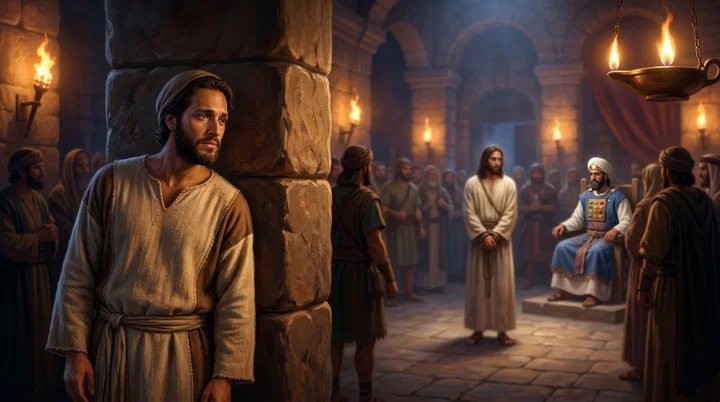
Matthew 26:59 belongs to Jesus' appearance before Annas and the court of Caiaphas.DA 698 It was a mock examination held in the palace of the officiating high priest in early morning darkness, after He was hurried there through dark narrow streets by an armed band amid insult and mockery, guided by torches and lanterns.5RED 27.1 There He was coarsely accused by His persecutors, sneeringly questioned by the priest, and reviled by the whole assembly seeking to put Him to death.5RED 27.1
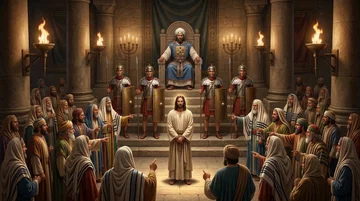
The full council was assembled for trial in the judgment hall, with Caiaphas as presiding officer seated on the throne of judgment.5RED 35.3–36.23SP 115.3–116.2 Jesus stood as a captive at its foot to be tried for His life, with judges and those specially interested on either side, Roman soldiers ranged on the platform below the throne, and the eyes of the multitude upon Him amid wild excitement and watching.5RED 35.3–36.23SP 115.3–116.2ST Jun 13, 1878 He stood calm and serene, dignified, majestic, with a God-like presence and holy influence emanating from Him and pervading the atmosphere around Him.5RED 35.3–36.23SP 115.3–116.2ST Jun 13, 1878 Even the hardened multitude questioned whether such a man of such presence should be sentenced as a common criminal, in strong contrast to the excited, malignant, hostile and contemptuous bearing of Annas and Caiaphas.5RED 35.3–36.23SP 115.3–116.2ST Jun 13, 1878
The contrast was heightened by dress and history, for the high priest stood in gorgeous robe with glittering tiara and costly breastplate upon which the light of God's glory had often flashed in former days.5RED 35.3–36.23SP 115.3–116.2 Jesus wore coarse, homely garb, though He had reigned crowned in the courts of heaven in garments of brightness attended by holy angels, now standing at an earthly throne to be tried for His life.5RED 35.3–36.23SP 115.3–116.2ST Jun 13, 1878 Caiaphas was momentarily struck with admiration for Jesus' dignified bearing and convicted that He was akin to God, then banished the thought.5RED 35.3–36.2 In sneering, haughty tones he demanded that Jesus work one of His famed mighty miracles before him, which Jesus heard as though He heard it not.5RED 35.3–36.23SP 115.3–116.2
Perceiving the influence in Jesus' favor, Caiaphas hastened the trial to break that influence.5RED 35.3–36.23SP 115.3–116.2ST Jun 13, 1878 While Jesus endured this He suffered a keener pang than His enemies could inflict when He heard His beloved disciple deny Him with cursing and swearing.5RED 27.1 The leaders sought a pretext to condemn Jesus while maintaining the appearance of a legal trial.5RED 33.1 They kept the proceedings secret so the people could not bring testimony about His mighty works that would vindicate Him, turn public anger against the council, defeat its plans, and lead to His release and renewed honor among the people.5RED 33.1
Determined to secure His death, they watched and hunted Him, trying to obtain by perjury what they could not establish fairly.DA 698.1–700.5 They sought charges that would condemn Him before both Jewish and Roman authorities, in secretive, unjust proceedings that violated their own rule that a person was innocent until proved guilty.DA 698.1–700.5 He had taught openly and directed His accusers to ask those who had heard Him.DA 698.1–700.5
False Testimony and Innocence
The chief priests, elders, and all the council sought and hired false testimony against Jesus in order to put Him to death, providing a pretext for condemnation.Ms 45, 1897, par. 1–2DA 698.1–700.5ST Feb 5, 1880RH Jun 12, 1900SG3 174.2–176.1 They had watched and hunted Him, trying to obtain by perjury what they could not establish fairly, and sought charges that would condemn Him before both Jewish and Roman authorities.DA 698.1–700.5ST Feb 5, 1880SG3 174.2–176.11SP 157.2–158.2 Many false witnesses came, but their accusations failed until two witnesses misrepresented His words about destroying and rebuilding the temple in three days.Ms 45, 1897, par. 1–2 This was the only charge brought against Him; His words were distorted and applied falsely, His enemies repeated the accusation in mockery while He hung on the cross, and their misstatement nevertheless publicized His words and made their fulfillment more impressive.Ms 45, 1897, par. 1–2
His words and motives were watched for grounds to accuse Him, misrepresented, and used against Him.Lt 50, 1889, par. 6–9Ms 4, 1875, par. 12–14 He was presented to the people in the worst possible light through false statements and accusations by scribes and Pharisees who planned His betrayal and took a prominent part in His trial.Lt 50, 1889, par. 6–9Ms 4, 1875, par. 12–14 They acted from jealousy and fear that He would gain greater influence, authority, and become king of the Jews, and because His righteous, self-denying life and faithful reproof of sin challenged and rebuked their corruption.ST Feb 5, 1880SG3 174.2–176.11SP 157.2–158.2PP 239.2–4 Their false testimony did not make Him guilty.SG3 174.2–176.1
The hired witnesses' lies reveal how corrupt the priesthood had become and how men in high religious positions brought false accusations despite His pure character, teachings, and works of mercy and love.RH Jun 12, 190012MR 388.3–4Ms 55, 1886, par. 8–11 While slander did not spare Him from reproach, the truth came to His defense in that Pilate declared Him faultless and Judas admitted that he had betrayed innocent blood, and He declared Himself guiltless with evidence proving His innocence.RH Jun 12, 190012MR 388.3–4Ms 48, 1893, par. 7Ms 55, 1886, par. 8–11 Though He was guilty of no wrong and was condemned on false witnesses' testimony, God overruled the crucifixion to make Him the Redeemer and Saviour of humanity and ruler over the world.ST Feb 5, 18801SP 157.2–158.2PP 239.2–4 This brought about through His death the very rule His enemies sought to prevent when they rejected Him as king and demanded His crucifixion; God's providential use of their actions did not lessen their guilt and their crime remained heinous.ST Feb 5, 18801SP 157.2–158.2PP 239.2–4
Sabbath Proof and Application
The need to hunt for false testimony to secure a death sentence proves the charge that He had broken the Sabbath could not be sustained, for no fault could be found in Him so witnesses had to lie, and if the accusation had been valid there would have been no need to hire false witnesses to testify against Him.HSFM 234.3–235.2ST Nov 12, 1894ST Jul 29, 1897 The resort to hired falsehood to furnish a pretext for putting Him to death is evidence that neither He nor Stephen nor His followers violated the Sabbath of the fourth commandment, since if they had broken it their enemies could have condemned them for that offense without needing false witnesses.ST May 1, 1884SLP 213.1 Their careful respect even for lesser customs confirms this, because Sabbath breaking would have brought severe penalties and would have supplied an open ground of condemnation.SLP 213.1
The accusations brought by the priests and rulers at His trial were false because He had kept the Sabbath and had done nothing contrary to its commandment, which is why false witnesses had to be sought rather than the charge proved.ST Sep 16, 1913 His death shows that God's law is immutable, for He magnified it and made it honorable and declared that He came not to destroy the law but to fulfill it.ST Sep 16, 1913 The Pharisees and Jewish leaders accused Him of breaking the law in order to condemn and crucify the Son of God, yet they could not prove the charge, so they hired witnesses to lie against Him to carry out their purpose, while He declared Himself guiltless with evidence proving His innocence.Ms 48, 1893, par. 7 Ministers of the gospel today who stand in the pulpit and say Christ broke the law speak Satan's suggestion and place themselves with the Jews, the scribes and priests and rulers who falsely accused Him, and the same work of false accusation is done when ministers prejudice people by telling them that Seventh-day Adventists do not believe in Christ.Ms 48, 1893, par. 7Ms 48, 1893, par. 8
His miracles and other evidence of His Messiahship did not soften His opposers with greater light but hardened them into hatred and a determination to extinguish the truth, showing how those who reject God's law and choose darkness can treat deception as justified when it serves their ends.GW92 181.3–182.1 Their conduct during His greatest trial, when religious leaders sought testimony against Him in order to condemn Him, reflects the cruelty of bigotry and prejudice that can remain firmly rooted in human hearts.GW92 181.3–182.1Lt 40, 1890, par. 17 Corrupt men joining together to seek false testimony in order to have Him put to death displays the same spirit that appears when corrupt men whose wrongdoing has been reproved use false witnesses, with the devil supplying witnesses to serve their purpose.Ms 51, 1897, par. 9 Slander did not spare Him from reproach despite His pure character, teachings, and works of mercy and love, for He was watched for grounds to accuse Him and His words and motives were misrepresented and used against Him, so His followers should expect similar treatment and hostile scrutiny, and the same kind of unjust treatment can weaken those who serve God.Ms 4, 1875, par. 12–14Ms 55, 1886, par. 8–11
Sources
Pioneers and periodicals
53 sources
The whole council under Caiaphas met at night after Jesus was led bound to the high priest's house to find lying testimony that would let them put Him to death.ST Jun 13, 1878ST Mar 6, 1901ST Mar 14, 1906RH Feb 5, 1914 They were not testing His claims by Scripture, for He was blameless and the promised Messiah, but they wanted Him dead from jealousy and fear because His pure life and teaching exposed them and drew the people away.ST Feb 5, 1880ST Mar 14, 1906RH Oct 27, 1874RH Oct 27, 1874 Though many lying witnesses came, they found nothing and contradicted one another, so at last they condemned Him not on that testimony but for truthfully declaring Himself the Son of God.ST Mar 6, 1901ST Jan 19, 1882ST Jul 12, 1899ST Dec 1, 1898ST Feb 20, 1901 In His meek silence under oppression He fulfilled Isaiah 53:7, and their false accusations fulfilled Psalm 35:11, while even His judge could find no fault in Him.ST Oct 12, 1904ST Oct 21, 1930ST Feb 20, 1901 They had to seek false testimony because no true charge of Sabbath-breaking could be proved against Him, which shows He kept the Father's commandments and had not changed the Sabbath day.ST May 1, 1884ST Nov 12, 1894ST Jul 29, 1897RH Jan 21, 1858
Trial Setting and Procedure
The seeking of false witness belongs to the nighttime trial after Jesus was led bound with utterly needless precaution first to Annas the former high priest and father-in-law of Caiaphas who then held the office, and then to the house of Caiaphas the high priest where the scribes and the elders were gathered together.ST Mar 6, 1901ST Mar 14, 1906 All the disciples forsook Him and fled and left Him alone with His enemies, while Peter followed afar off into the court to see the end.ST Mar 6, 1901ST Mar 14, 1906 Condemnation was obtained before the people knew what was happening, on the day of His crucifixion that was more memorable than any other in His history and showed His love for humanity in death.RH Feb 5, 1914RH Feb 13, 1872
In the judgment hall He stood as a captive on trial for His life at the foot of the throne, with Caiaphas presiding in hostile, contemptuous, sneering and haughty tones and hastening the trial when he perceived Jesus gaining influence.ST Jun 13, 1878 Judges and those specially interested in the trial were on either side, Roman soldiers were ranged on the platform below the throne, and the multitude watched.ST Jun 13, 1878 In strong contrast Caiaphas stood in gorgeous robe with glittering tiara and costly breastplate while Jesus wore coarse, homely garb, yet Jesus stood calm and serene with dignified, majestic and Godlike bearing from which a holy influence emanated, so that even the hardened multitude questioned whether a man of such presence should be sentenced as a common criminal.ST Jun 13, 1878 He who had reigned in the courts of heaven, crowned and clothed in brightness and attended by holy angels, was now standing at an earthly throne to be tried for His life.ST Jun 13, 1878
After examination before the proud Annas where Peter denied Him, witnesses suborned to testify against Him were brought before the haughty Caiaphas, with condemnation already decided through betrayal by a professed follower.ST Mar 28, 1906ST Dec 1, 1898 He kept silent while they sought false testimony, after long watching by spies for a traitorous word had failed and even hired false witnesses could not agree, since two agreeing witnesses to something in His past life were needed to condemn Him.ST Mar 28, 1906ST Dec 1, 1898 At last witnesses claimed He said He could rebuild the pulled-down temple in three days, but this was not enough, so the high priest put Him under oath before the living God to say whether He claimed to be the Son of the Most High.ST Dec 1, 1898 Silent until then, He answered truthfully under oath and declared Himself to be the Son of God, for which He was adjudged guilty of blasphemy and worthy of death with no further evidence declared needful, followed by mocking, beating, spitting in His face, blindfolding and striking Him with the taunt to prophesy who struck Him until reviling cruelty grew weary, and they moved to have the judgment confirmed before the Roman tribunal.ST Mar 28, 1906ST Dec 1, 1898
The proceeding was a mock trial and a mockery of public justice in which He was condemned through malice and perjury and did not answer the accusations, though declared innocent by His judge.RH Nov 18, 1862RH Dec 8, 1859 Annas condemned Him despite having no authority to judge Him, and the nighttime condemnation was contrary to Jewish law.ST Dec 24, 1912 The next morning Caiaphas condemned Him for blasphemy but could not enforce a death sentence, and Pilate ultimately sentenced Him to death while declaring that he found no crime in Him.ST Dec 24, 1912 This mock trial preceded His crucifixion.ST Dec 7, 1904
The council was the Sanhedrin, the celebrated highest and supreme court of the Jewish nation for several centuries before the destruction of Jerusalem by Titus, with great authority while Christ was on earth, before which His case was considered and He was condemned as a malefactor and a false prophet.RH Feb 16, 1911 Its name comes from the Greek Sunedrion, with no Hebrew noun for it in the Bible, showing it originated when Greek was generally known and spoken after the Babylonian captivity, probably within a century or two after the return from Babylon, though its exact beginning cannot be told.RH Feb 16, 1911 The claim that it continued the large council of seventy-one over which Moses himself presided, seventy prominent men endued with the Holy Spirit who served as the counselors Moses relied on, is rejected because no mention of any such council after Moses' death is found in the Old Testament writings, showing that council terminated with Moses' work.RH Feb 16, 1911 After the captivity its seat of authority was moved from place to place, and it ceased to exist in A.D. 425 in the city of Tiberias.RH Feb 16, 1911
His standing as an accused culprit before the highest court of His own nation, with Caiaphas sitting as judge as head of that court and pronouncing Him guilty, is not merely the event of a day or an incident in the nation's life but is of world-wide and ages-long import.ST Mar 6, 1901 The word translated seek does not mean only a slight wish or desire but earnest, persevering, determined effort with concentration of mind and body, pursued here with resolute determination to find witnesses.RH Apr 9, 1867 The phrase to put to death uses a Greek word meaning make to die, the same Greek word used for mortifying the deeds of the body through the Spirit.ST Oct 31, 1895
Corrupt Judges and Motives
The chief priests, elders and all the council assembled not to judge His claims fairly or to test His fulfillment of prophecy by Scripture, but to secure His death through false testimony.RH Oct 27, 1874RH Oct 27, 1874 He was the promised Messiah, spoke truth and was blameless, so the law under which He was tried would have acquitted Him if applied fairly.RH Oct 27, 1874 The law itself was not at fault, but their wrong interpretation and their rejection of Him because He did not come as they expected led them to condemn Him without examination.RH Oct 27, 1874RH Oct 27, 1874 They condemned Him without fairly examining His claims, though renewed examination of the Scriptures to which He appealed could have convinced them He was the Messiah.RH Oct 27, 1874RH Oct 27, 1874
They were leaders in the plot against Him who sought to allay all jealousy and unite every possible force against Him.ST Mar 14, 1906 They acted from jealousy and fear that He would gain greater authority and become king of the Jews.ST Feb 5, 1880 His pure teaching and holy life condemned their pride, hypocrisy and extortion, His pure and truthful life and words exposed their false-heartedness, and His winning the people threatened their influence and position so that they feared losing it.ST Jun 7, 1877ST Jan 29, 1902
It was a deeply vindictive assembly at Caiaphas's house.ST Mar 27, 1901 It included priests whose greed and selfishness He had reproved, elders whose hypocrisy He had exposed, and scribes whose ignorance He had challenged.ST Mar 27, 1901 Both Sadducees and Pharisees were represented, and both groups opposed doctrines He had publicly condemned.ST Mar 27, 1901
They knew of no true testimony that could condemn Him.ST Mar 6, 1901 Their rejection of truth and persistent impenitence and sin led them to seek lies against the innocent and to press on with mock trial and sentence of death.ST Mar 6, 1901RH Apr 16, 1867 Refusing to walk in the light can thus lead to deeper wrongdoing.ST Mar 6, 1901
They arranged to seize Him and hired people to testify falsely so they could condemn Him and put Him to death.ST Feb 5, 1880 Those hired false witnesses were secretly instructed by His accusers in the perjured testimony they were to give, the universal tactic of the unprincipled in defending falsehood, even as Stephen's accusers afterward suborned men against him.ST Feb 4, 1897 The hired lies reveal the priesthood's corruption, while truth came to His defense when Pilate declared Him faultless and Judas admitted that he had betrayed innocent blood.RH Jun 12, 1900
The Jews could try and condemn but Rome had reserved capital punishment to itself, so the Romans had to dispose of the sentence.ST Jun 7, 1877 The Jews pressed vehemently for His death and clamored for crucifixion, while the Romans gave Him up to death though acknowledging Him innocent, moved in part by political fear of His claims as king of the Jews.ST Jun 7, 1877 Both joined in the act, the one to condemn and the other to execute, and so both Jews and Romans share responsibility for crucifying Him.ST Jun 7, 1877
Through His death Jesus became Redeemer and Saviour of the world, bringing about the very outcome they sought to prevent.ST Feb 5, 1880 God's providential use of their crime did not lessen their guilt, though they rejected Him as king and demanded His crucifixion.ST Feb 5, 1880 His enemies pursued Him with the persistence of envious conspirators who will not give up seeking occasion against their object until they find a pretext, though the charges were sustained only by false witnesses.ST Oct 12, 1904
Collapse of False Testimony
At first the seeking found nothing though many false witnesses came, because there was no truthful case with which to mislead court and crowd.ST Mar 6, 1901ST Jan 19, 1882 Many witnesses were called, but their contradictions undermined one another and the malicious accusations collapsed.ST Jan 19, 1882 Their disagreement and self-contradiction exposed that they were not telling the truth.ST Jan 19, 1882ST Jul 12, 1899 The witnesses testified against Him but did not agree about the nature of their proof.ST Jul 12, 1899ST Jul 24, 1879
Even hired false witnesses brought before the high priest could not agree, though two agreeing witnesses to something in His past life were needed to condemn Him.ST Dec 1, 1898 Their long watching by spies for a traitorous word had failed after He was seized through the betrayal of a professed follower with condemnation already decided, and He remained silent while they sought false testimony to put Him to death.ST Dec 1, 1898 At last witnesses claimed He said He could rebuild the pulled-down Jerusalem temple in three days, but this was not enough, so the high priest put Him under oath before the living God to say whether He claimed to be the Son of the Most High, and when Jesus, silent until then, answered truthfully under oath, the priest declared no further evidence was needed and they moved to have the judgment confirmed before the Roman tribunal.ST Dec 1, 1898 The council condemned Him at last not on that testimony but for declaring Himself the Son of God and thereby making Himself equal with God, a reasoning that Sonship meant equality with God that was correct and logical, so He was condemned for asserting His divinity, the very fact that is the foundation of hope, and even His enemies could not ground condemnation on the frivolous accusations of the false witnesses, which shows the perfection of His character.ST Dec 1, 1898ST Feb 20, 1901
Innocence and Meekness of Jesus
When the chief priests and elders and all the council sought false witness to put Him to death, Jesus of Nazareth showed flawless meekness greater than the meekness of Moses, and though oppressed and afflicted and brought as a lamb to the slaughter He opened not His mouth, literally fulfilling Isaiah 53:7.ST Oct 12, 1904 Even the governor who passed sentence of death upon Him could find no fault in Him, yet in His earthly pilgrimage He did not inherit the earth.ST Oct 12, 1904 Even His enemies could not ground condemnation on the frivolous accusations of the false witnesses, which shows the perfection of His character, and the council condemned Him at last not on that testimony but for declaring Himself the Son of God and thereby making Himself equal with God.ST Feb 20, 1901 Their reasoning that Sonship meant equality with God was correct and logical, so Jesus was condemned for asserting His divinity, the very fact that is the foundation of hope.ST Feb 20, 1901
Prophecy Fulfilled at Trial
The seeking of false testimony against Him at His trial fulfilled Psalm 35:11.ST Oct 21, 1930 This was one of the prophecies fulfilled during the day of His crucifixion.ST Oct 21, 1930 When the chief priests and elders and all the council sought false witness to put Him to death, Jesus of Nazareth showed flawless meekness greater than the meekness of Moses.ST Oct 12, 1904 Though oppressed and afflicted and brought as a lamb to the slaughter, He opened not His mouth, literally fulfilling Isaiah 53:7.ST Oct 12, 1904 Even the governor who passed sentence of death upon Him could find no fault in Him, yet in His earthly pilgrimage He did not inherit the earth.ST Oct 12, 1904
Sabbath Doctrine Confirmed
The council had to seek false witness to put Him to death because the charge that He had broken the Sabbath could not be substantiated, and with no fault to be found in Him witnesses had to lie.ST Nov 12, 1894ST Jul 29, 1897ST Nov 19, 1912 If Jesus or Stephen had violated the Sabbath of the fourth commandment, their enemies could have condemned them for it without needing false witnesses, so the resort to false testimony shows they did not break it.ST May 1, 1884 He kept the Father's commandments and gave them no lawful ground for accusation.ST May 1, 1884RH Jan 21, 1858
If He had changed the Sabbath day they would have had true evidence ready at hand, and that alone would have been enough to condemn Him to death, since defiling the Sabbath is punished by death under the law, so the need to look for false testimony proves He had not changed the day.RH Jan 21, 1858 Because He had kept the Sabbath and done nothing contrary to its commandment, the priests and rulers' accusations at His trial were false.ST Sep 16, 1913 His death also shows God's law is immutable, which Christ magnified and made honorable, declaring He came not to destroy the law but to fulfill it.ST Sep 16, 1913 He was put to death only a few hours before the holy women kept the Sabbath according to the commandment, for the Pharisees knew Rome would not condemn Him for keeping the Sabbath according to the commandment and therefore sought false witnesses, and His death was because of His loyalty in keeping the Sabbath according to the commandment.ST Oct 3, 1900
At last He was arraigned before the high priest on two accusations, that He had broken the Sabbath and that He made Himself equal with God, and He denied neither charge nor sought to correct the impression made upon friends as well as enemies that He had broken the Sabbath.ST Dec 6, 1883
Parallels with Other Scriptures
Bearing false witness against Jesus worked by using statements that accorded with facts in general to insinuate a false conspiracy worthy of death.RH Jun 23, 1868 Doeg reported David coming to Ahimelech at Nob and receiving inquiry, food, and Goliath's sword as if Ahimelech had joined David against Saul, when Ahimelech had been imposed upon by David and intended respect to Saul, and in the same way the chief priests, elders, and all the council sought testimony that twisted true actions into a charge worthy of death.RH Jun 23, 1868 His opponents' use of false witnesses in an effort to secure His death shows how legal proceedings and testimony could be corrupted to serve an evil purpose, as in Naboth's vineyard.ST Jul 14, 1898
Jesus was convicted before the Jewish tribunal through the testimony of false witnesses, and because that method had succeeded in putting Him to death, the synagogue leaders who hated Stephen used it again to close his mouth.ST Feb 12, 1902 They hired men easily induced to swear falsely that they had heard Stephen speak blasphemous words against Moses and against God, knowing such a charge would turn the people who had gladly listened to him against him.ST Feb 12, 1902 He was given only a mock trial before the council, with false witnesses hired and secretly instructed by His accusers in the perjured, prejudicial testimony they were to give in order to condemn Him to death on the cross, which is the universal tactic of the unprincipled in defending falsehood.ST Feb 4, 1897ST Feb 19, 1902 Stephen's accusers likewise suborned men against him, using the very same false story later told against Stephen.ST Feb 4, 1897ST Feb 19, 1902
His condemnation through false testimony from people seeking His death illustrates that the innocent can be condemned by perjured witnesses.RH Apr 14, 1874
Warnings for Christian Life
Refusing to walk in the light can lead to deeper wrongdoing, for those who reject truth are led to seek lies against the innocent to put them to death when they know of no true testimony that could condemn.ST Mar 6, 1901 The chief priests, elders and all the council were Christ's most bitter opposers in seeking false witness to put Him to death, and the same class of ministers now opposes the warning of His near coming.RH Jul 25, 1854 They quiet consciences by saying the judgment is far off, like the evil servants who say My Lord delayeth His coming.RH Jul 25, 1854
The same pattern appears when priests try to hire false witnesses to accuse Sabbath-keeping believers of teaching insubordination to the government.RH Jul 23, 1914 The seeking of false testimony before the Sanhedrin to put Him to death marks the treatment He would receive if He returned to earth, the same unjust proceedings.RH Dec 13, 1906 Merely seeming orthodox in creed and resting in traditional belief is lip-confession joined to life-denial.RH Dec 29, 1863 Hollow homage that says Hail, Master while denying Him in the life stands only a single step from mocking Christ, and quickly passes from that mockery to smiting and buffeting in the broader denial and open outrage of rejecting Christ to put Him to death.RH Dec 29, 1863
Peter's attempt to defend Jesus with the sword and his later denial show that forceful assertiveness is not true courage nor evidence of a regenerated life, but reflects the aggressiveness of the human heart.RH Feb 5, 1914 Christian perfection means taking up the cross and following Christ through suffering rather than seeking continual joy or extraordinary experiences, joys and revelations.RH Jul 30, 1867RH Aug 14, 1860 That path follows Him through the trial before Caiaphas, the unjust judgment of Pilate, and the shame of Calvary.RH Aug 14, 1860
Sources