Acts 7:57
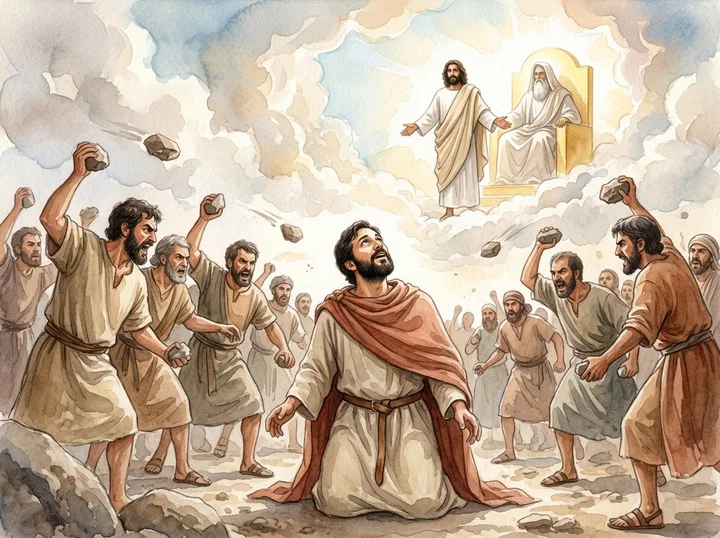
Then they cried out with a loud voice, and stopped their ears, and ran upon him with one accord,
Translations
Then they cried out with a loud voice, and stopped their ears, and ran on him with one accord,
King James Version, KJV Cambridge Paragraph Bible, Webster Bible
Then they cried out with a loud voice, and stopped their ears, and ran upon him with one accord,
Revised Version, American Standard Version
But they cried out with a loud voice, and stopped their ears, and rushed upon him with one accord;
And they, having cried out with a loud voice, stopped their ears, and did rush with one accord upon him,
And they cried out with a loud voice, and held their ears, and rushed upon him with one accord;
And, crying out with a loud voice, they held their ears, and rushed with one accord upon him;
Berean Standard Bible, Majority Standard Bible
At this they covered their ears, cried out in a loud voice, and rushed together at him.
But they cried out with a loud voice and stopped their ears, then rushed at him with one accord.
But with loud cries, and stopping their ears, they made an attack on him all together,
Then they gaue a shoute with a loude voyce, and stopped their eares, and ranne vpon him violently all at once,
Douay-Rheims (Challoner revision)
And they crying out with a loud voice, stopped their ears, and with one accord ran violently upon him.
Pictures
Cross-references
- Acts 8:1
And Saul was consenting unto his death. And at that time there was a great persecution against the church which was at Jerusalem; and they were all scattered abroad throughout the regions of Judæa and Samaria, except the apostles.
Saul consented to Stephen’s death, and persecution followed.
- Acts 9:1-6
And Saul, yet breathing out threatenings and slaughter against the disciples of the Lord, went unto the high priest,
Saul’s persecution of Christ’s followers follows his presence at Stephen’s death and leads to his conversion.
- Acts 6:15
And all that sat in the council, looking stedfastly on him, saw his face as it had been the face of an angel.
Stephen’s face shone with heavenly glory before his opponents attacked him.
- Luke 23:34
Then said Jesus, Father, forgive them; for they know not what they do. And they parted his raiment, and cast lots.
Stephen prayed for his murderers as Jesus did.
- Acts 8:4
Therefore they that were scattered abroad went every where preaching the word.
Persecution after Stephen’s death scattered believers who preached elsewhere.
- Acts 22:20
And when the blood of thy martyr Stephen was shed, I also was standing by, and consenting unto his death, and kept the raiment of them that slew him.
Paul recalls standing by and consenting to Stephen’s death.
- Acts 6:10
And they were not able to resist the wisdom and the spirit by which he spake.
Unable to withstand Stephen’s Spirit-given wisdom, his opponents turn against him.
- John 19:15
But they cried out, Away with him, away with him, crucify him. Pilate saith unto them, Shall I crucify your King? The chief priests answered, We have no king but Cæsar.
Both crowds cry out against Jesus and Stephen in rejection.
- Acts 8:3
As for Saul, he made havock of the church, entering into every house, and haling men and women committed them to prison.
continues Saul's attack after Stephen's stoning
- Acts 13:45
But when the Jews saw the multitudes, they were filled with envy, and spake against those things which were spoken by Paul, contradicting and blaspheming.
Both describe hostile rejection of the preached Word.
- Acts 7:51-53
Ye stiffnecked and uncircumcised in heart and ears, ye do always resist the Holy Ghost: as your fathers did, so do ye.
rebuke they refused to heed
- Acts 6:8
And Stephen, full of faith and power, did great wonders and miracles among the people.
Stephen is described as full of faith and power.
- Acts 7:38
This is he, that was in the church in the wilderness with the angel which spake to him in the mount Sina, and with our fathers: who received the lively oracles to give unto us:
same Stephen who speaks then is killed
- Acts 11:19-21
Now they which were scattered abroad upon the persecution that arose about Stephen travelled as far as Phenice, and Cyprus, and Antioch, preaching the word to none but unto the Jews only.
Persecution scattered believers, carrying the Gospel to Gentiles and establishing the Antioch church.
- Acts 6:5-6
And the saying pleased the whole multitude: and they chose Stephen, a man full of faith and of the Holy Ghost, and Philip, and Prochorus, and Nicanor, and Timon, and Parmenas, and Nicolas a proselyte of Antioch:
The believers choose seven helpers and commission them before the apostles.
- Matthew 23:34-35
Wherefore, behold, I send unto you prophets, and wise men, and scribes: and some of them ye shall kill and crucify; and some of them shall ye scourge in your synagogues, and persecute them from city to city:
Persecution of God’s messengers brings guilt and coming judgment.
- John 19:6
When the chief priests therefore and officers saw him, they cried out, saying, Crucify him, crucify him. Pilate saith unto them, Take ye him, and crucify him: for I find no fault in him.
Both crowds cry out violently against the one they seek to kill.
Commentary
Each commentary is drawn from primary sources: the writings of Ellen G. White and Adventist pioneers and periodicals. Each commentary is separate. Its own words are not a quotation; follow the references to read the source passages.
Ellen G. White
37 sources
When Stephen openly declared that he saw the glory of God and Jesus standing at His right hand in heaven, his hearers shouted loudly to drown his voice, deliberately covered their ears so they would not hear him, and rushed upon him together in furious accord.AA 97.1ST Dec 5, 1878RH Feb 23, 19113SP 298.2–3Ms 11, 1900, par. 1–5 It was no lawful sentence but a mob killing in and outside the judgment hall, driven by priests and rulers and men of sacred trust who were beside themselves with anger like wild beasts, while Roman authorities bribed to inaction made no effort to stop it.Ms 22, 1900, par. 31–32SLP 19.17RED 36.1SLP 20.1AC1 36.1 Unable by wisdom to answer his Spirit-filled arguments from Scripture and unwilling to bear witness to the One they had crucified, they shut themselves off from God's evidence and rejected the Holy Spirit's testimony that the crucified and risen Jesus is the Son of God.Ms 11, 1900, par. 1–5Ms 22, 1900, par. 31–32SG1 101.1Ms 17, 1885, par. 12–13 Saul stood by consenting, with the witnesses' clothes laid at his feet, at first closing his own eyes and ears and hunting the church, yet Stephen's steadfast faith, shining face, and prayer in death shook his prejudice and helped prepare him to recognize the truth and proclaim the same cause after Christ met him on the way to Damascus.Ms 11, 1900, par. 1–5ST Dec 5, 18783SP 305.2EW 165.27RED 36.1 This history will be repeated when religious leaders oppose God's servants as truth is presented, yet the persecutors can harm only the body and cannot take hope and eternal life, for heaven is opened to sustain the faithful as Christ stands ready to uphold them.Ms 22, 1900, par. 31–32SLP 19.1ST Dec 12, 1878Lt 10, 1879, par. 4–9Ms 16, 1895, par. 18
Immediate Setting and Actions
The outcry came the moment Stephen openly proclaimed that he saw Jesus standing at the right hand of God in heaven, describing the glory of God and Christ beside Him.ST Dec 5, 1878RH Feb 23, 19113SP 298.2–3Ms 11, 1900, par. 1–5SLP 19.1 It was his triumphant testimony to the crucified and risen Saviour, and the declaration of the heavenly vision he saw opened before him.Ms 11, 1900, par. 1–5SLP 19.1AA 101.1 At that declaration his hearers shouted with a loud voice to drown his voice.AA 97.1RH Feb 23, 1911Ms 11, 1900, par. 1–5SLP 19.1AA 101.1 They deliberately stopped or covered their ears so they would not hear him, and rushed furiously upon him together with one accord.AA 97.1ST Dec 5, 1878RH Feb 23, 19113SP 298.2–3Ms 11, 1900, par. 1–5
The setting was Stephen's trial, with his face shining with heavenly glory like an angel and calm with angelic light.Ms 11, 1900, par. 1–5SLP 19.1 From their faces and resistance and the tumult that broke out he recognized that his testimony was about to be silenced and that his words would lead to his death, and he abruptly brought his sermon to a close.7RED 34.1AA 100.1 They dragged him from the judgment hall, cast him out of the city to stone him, while the witnesses laid their clothes at Saul's feet.Ms 11, 1900, par. 1–5EW 165.1
No legal sentence was passed upon Stephen, for it was an unlawful mob killing.7RED 36.1SLP 20.1AC1 36.1 The Roman authorities had been bribed with large sums of money to make no investigation of the case.7RED 36.1SLP 20.1 They made no special effort to stop the cruel work, secretly aiding the Jews to conciliate them and secure their favor.SLP 20.1
Those acting included the priests and rulers and men bearing sacred responsibilities.Ms 22, 1900, par. 31–32SLP 19.1 They were beside themselves with anger, more like wild beasts of prey gnashing their teeth than human beings.SLP 19.1 The infuriated priests and excited mob rushed upon him gnashing their teeth.SLP 19.1
Rejection of Evidence and Truth
The stopping of the ears was a deliberate and united refusal to listen to Stephen's triumphant testimony to the crucified and risen Saviour standing at the right hand of God.Ms 11, 1900, par. 1–5Ms 22, 1900, par. 31–32SLP 19.1 They cried out with a loud voice to drown his voice, covered their ears so they would not hear his words, and ran upon him together with one accord to cast him out and stone him.Ms 11, 1900, par. 1–5Ms 22, 1900, par. 31–32SLP 19.1AA 101.1 In doing so they shut themselves off from the evidence God had given them, including his angel-like face shining with heavenly glory.Ms 11, 1900, par. 1–5SG1 101.1EW 173.3
They acted in rage, hatred and fury because they understood the force of that witness.ST Dec 5, 1878Ms 11, 1900, par. 1–5 They could not bear hearing of the One they had crucified, and they could not endure the heavenly vision of glory he proclaimed.Ms 11, 1900, par. 1–5SLP 19.1AC1 35.1–2 The tumult that arose as he gave his final testimony showed they were turning against his message.ST Dec 5, 18783SP 297.2 Beside themselves with anger, they became more like wild beasts of prey gnashing their teeth than human beings.SLP 19.1
They were unable by wisdom to resist the Spirit with which he spoke and unable to controvert his arguments from Scripture.Ms 11, 1900, par. 1–5 They did not answer him, for his words of truth could not be refuted.Ms 17, 1885, par. 12–13 Instead they sought to silence him with stones, joining together in violent opposition unto death.Ms 11, 1900, par. 1–5Ms 17, 1885, par. 12–13
In this they refused the Holy Spirit's evidence that Jesus, who had been crucified, is the Son of God, because they did not want to be convinced.SG1 101.1EW 173.33SP 321.2 Their rejection continued their rebellion against God, as men bearing sacred responsibilities ranged themselves on the side of the enemy to persecute one cooperating with Jesus Christ.Ms 22, 1900, par. 31–32EW 173.3 It was rage and hatred worked by Satan in the children of disobedience.Ms 11, 1900, par. 1–5 Stephen died vindicating that truth, after boldly presenting from prophecy the evidence that Jesus was the Son of God.SLP 36.3–43SP 321.2
Saul Witnessed and Changed
Saul was present at Stephen's trial and death, standing by and consenting to the stoning though he did not himself cast the stones, while the witnesses laid their clothes at his feet.Ms 11, 1900, par. 1–5EW 165.2Ms 17, 1908, par. 18–28 The death took place with no legal sentence passed, for the Roman authorities had been bribed to make no investigation and made no special effort to stop the cruel work.7RED 36.1 Saul consented to the death as blasphemy punished, yet after Christ was revealed to him Stephen's testimony about seeing the Son of Man in heaven became truth to him.3SP 307.2–308.1
Saul had been educated by the most learned teachers of the age, taught by Gamaliel, and was a rabbi and statesman and a member of the Sanhedrin, very zealous for the suppression of Christianity.RH Mar 6, 1900 The priests and rulers convinced him that Stephen was a blasphemer for preaching Jesus Christ, that Jesus was an impostor, and that those ministering in holy offices were right.SLP 21.1 Once fully settled in that conviction he with decided mind and strong purpose became bitter in opposition and voluntarily engaged in persecution.SLP 21.1 Angered at his own secret conviction that Stephen was honored of God at the very time he was dishonored by men, he with frenzied zeal hunted down the church of God, seizing believers in their houses and delivering them to the priests and rulers for imprisonment and death, to the terror of the Christians in Jerusalem.7RED 36.1SLP 20.1Ms 17, 1908, par. 18–28 He made havoc of the church, entering into every house and committing men and women to prison.RH Mar 6, 1900
Stephen's death was triumphant, and his faith, steadfastness, words, and God-given glory greatly stirred Saul's mind and shook his prejudice against Christianity.3SP 305.2SLP 21.1SLP 20.1 The glory on Stephen's face as he looked toward heaven struck Saul and brought him, helpless, to Jesus.SLP 204.1 His witness displayed God's presence, which stirred Saul to doubt the cause he defended.AA 112.2–113.1 That lasting impression made on those not hardened against the light contributed to Saul's conversion, in contrast to the crowd who in fury stopped their ears and rushed together upon Stephen.ST Dec 5, 1878 Saul nevertheless at first suppressed his conscience, took part in Stephen's trial and conviction, and became bitterly active in persecuting Jesus' followers.AA 112.2–113.1
Saul closed his eyes and ears to the compelling and most striking evidence given in Stephen's martyrdom and relentlessly led the van in the persecution of believers in Christ, carried away by the malice and prejudice of the priests and rulers.AA 118.2–33SP 311.2ST Dec 12, 1878 Stephen was sustained in death by a power higher than that of earth, yet Saul accepted the rulers' view that he was a blasphemer and Jesus an impostor.3SP 305.2ST Dec 12, 1878 Afterward Saul remembered his guilt with bitterness, horror, torture of remorse, repentance and earnest prayer, seeing his former blindness of understanding.AA 118.2–33SP 311.2ST Dec 12, 1878 He grieved that he had closed his eyes and ears to compelling evidence and urged the persecution, knowing that prejudice and unbelief had clouded his perceptions and prevented him from discerning the truth Stephen had testified.AA 118.2–3ST Dec 12, 1878 When Christ was revealed to him he recognized that the dying Stephen had seen the kingdom of glory and that his testimony of seeing the Son of Man in heaven was truth.3SP 307.2–308.1
Their violence did not defeat the gospel, for Stephen's shed blood was a witness for Christ and his death and prayer of compassion convicted Saul, who later became a messenger of Christ.SLP 206.2–207.1 Stephen died after boldly presenting from prophecy the evidence that Jesus was the Son of God, the same cause Paul later proclaimed in the synagogue.SLP 36.3–4 Though enemies killed him and made it appear that wicked men had triumphed and God's cause was failing, from this very event Paul was converted, and through his preaching thousands came to the gospel.Lt 10, 1879, par. 4–9 The persecution scattered church members and helped carry the gospel beyond Jerusalem.7MR 362.1 Stopped in his career on the way to Damascus to arrest Christians, when light from heaven shone round him and Jesus spoke to him, he was blinded and led by the hand into Damascus, after which Saul converted was called Paul and united with the disciples among the chief of the apostles.RH Mar 6, 1900 Years later the place of Stephen's martyrdom in Jerusalem remained known, and seeing it recalled Paul's former life and bitter prejudice with anxiety and remorse, while the scene of the mob crying out and rushing upon Stephen rose vividly before him and made him ask if he was going forward to a similar fate in Jerusalem.SLP 206.2–207.1
Warning and Assurance Today
This history will be repeated, for as truth is presented religious leaders will do all they can to oppose God's servants and would act as the priests and rulers did if they dared.Ms 22, 1900, par. 31–32 Men bearing sacred responsibilities ranged themselves on the side of the enemy to persecute one who was cooperating with Jesus Christ, and when Stephen told the truth they refused to listen but cried out with a loud voice, stopped their ears, and ran upon him together with one accord to cast him out and stone him.Ms 22, 1900, par. 31–32
Stephen had expected this outbreak and was not intimidated by it, remaining calm with a face shining with angelic light so that the infuriated priests and excited mob held no terrors for him.SLP 19.1 The priests and rulers were beside themselves with anger, more like wild beasts of prey gnashing their teeth than human beings, and when he proclaimed the glorious scene opened before him it was more than they could endure, so they covered their ears so they might not hear his words and with loud cries ran furiously upon him with one accord.SLP 19.1 The scene about him faded from his vision because the gates of heaven were ajar and he saw the glory of the courts of God and Christ as if just risen from His throne standing ready to sustain His servant who was about to suffer martyrdom for His name, and he was sustained in his death by a power higher than that of earth.SLP 19.1ST Dec 12, 1878
His enemies could harm his body but could not take away his hope or eternal life, though in killing one who remained faithful to Christ they made it appear that wicked men had triumphed and God's cause was failing.Lt 10, 1879, par. 4–9Ms 16, 1895, par. 18 Even in such tribulation the Lord loves His people and all heaven is interested in the great work in which they are engaged.Ms 22, 1900, par. 31–32 From this very event Paul was converted, and through his preaching thousands came to the gospel.Lt 10, 1879, par. 4–9
Sources
Pioneers and periodicals
76 sources
The verse describes what the council did when Stephen declared he saw the heavens opened and the Son of man standing at God's right hand, answering with three united acts of crying out loudly, covering their ears against his words, and rushing upon him together.ST Dec 5, 1878RH Feb 23, 1911RH Apr 3, 1879ST Feb 19, 1902ST Feb 4, 1897
They acted in furious rage like beasts of prey, dragging him from the judgment hall without legal sentence and casting him out of the city to stone him, making him the first Christian martyr after Christ's ascension.ST Dec 5, 1878ST Mar 3, 1914ST Mar 11, 1897
Stopping their ears was willful refusal of convicting truth and rejection of God's Spirit working in Stephen, which persisted in becomes blasphemy against the Holy Spirit that leaves no way to repentance and cannot be forgiven.ST Feb 21, 1906ST Jul 9, 1874ST Aug 19, 1913ST Jan 13, 1898
His martyrdom closed the seventy weeks set apart for the Jews in the autumn of A.D. 34, ending Israel's probation as God's special nation and turning the gospel through scattering persecution to the Gentiles.STST Sep 20, 1910ST Jun 26, 1907RH Oct 11, 1915ST
Saul, afterward Paul, was present consenting to the death and keeping the stoners' garments, yet the evidence of God's presence with Stephen stirred him with an impression he could never efface.ST Mar 10, 1914ST Mar 10, 1914RH Aug 27, 1901ST Jan 22, 1885
Immediate Setting and Actions
The cry, the stopped ears, and the rush came at once after the declaration that the heavens were opened and the Son of man was seen standing on the right hand of God, a testimony the hearers could not endure.ST Dec 5, 1878RH Feb 23, 1911ST Mar 3, 1914ST Feb 4, 1897ST Feb 4, 1897 The priests and rulers were beside themselves with anger at that sight proclaimed, treating it as more than could be borne.ST Dec 5, 1878RH Feb 23, 1911ST Mar 3, 1914 Their answer was united and threefold: they cried out with a loud voice, they stopped or covered their ears against the words, and they ran upon him together with one accord.ST Feb 4, 1897RH Apr 3, 1879ST Feb 19, 1902ST Feb 4, 1897RH May 10, 1915 That shouting, ear-stopping, and rushing together was deliberate rejection breaking into united violence, and it led directly to martyrdom.ST Feb 4, 1897ST Nov 5, 1896
They acted in fury, anger and rage, gnashing on him with their teeth with cruel faces.ST Dec 5, 1878RH Feb 23, 1911ST Mar 3, 1914ST Dec 5, 1878ST Mar 11, 1897 In that state they are described as behaving more like beasts of prey than human beings, furiously bent on silencing him.ST Mar 3, 1914 The rush was mob violence with no legal sentence passed upon him.ST Mar 3, 1914 His face shone with heavenly glory as they dragged him from the judgment hall, since their violence was no answer to arguments from Scripture that could not be controverted, so they silenced him with stones.
They took the law into their own hands on a false charge of blasphemy, an act of lawlessness like the arrest and condemnation of Jesus.ST Aug 13, 1902 They cast him out of the city in a disgraceful way and stoned him to death.ST Mar 11, 1897RH Feb 10, 1863 The ecclesiastical authorities thus put the devout and zealous Stephen to death at Jerusalem.RH Feb 10, 1863 By that death he became the first Christian martyr, the protomartyr, willing to lose his life for Christ in trust that his life would be kept unto eternal life.ST Mar 11, 1897RH Mar 10, 1868ST Feb 14, 1884RH Dec 22, 1863 His suffering was accompanied by a visible manifestation of divine approval honoring his character and work, and as the first recorded martyrdom after Christ's ascension his persecution marked the beginning of persecution against the church after Christ's resurrection.ST Nov 5, 1896ST Feb 14, 1884RH Nov 17, 1863
Rejection of Truth and Spirit
Stopping their ears was deliberate and willful refusal to listen when reproof cut to the heart and exposed guilt, shutting themselves off from convicting light and choosing spiritual darkness and a return to spiritual chaos.ST Feb 21, 1906ST Jul 9, 1874ST Feb 12, 1894RH Sep 16, 1852 Instead of asking whether these things are so, they would endure the testimony no longer, gnashed on their reprover, cried out, rushed upon him with one accord, and stoned him, while those cut by Peter for the same sin asked what they should do.ST Jul 9, 1874RH Sep 16, 1852 The same refusal is repeated whenever people reject confronting truth and attack its advocates, as with religious teachers who profess great interest in the Sabbath yet will not hear the truth about it and give error for truth and human traditions for the commandments of God.ST Jul 9, 1874ST Feb 12, 1894RH Sep 16, 1852
In that united outcry and attack they rejected Stephen's Spirit-given testimony and the working of God's Spirit in him, attributing that work to the enemy.ST Feb 21, 1906ST Aug 19, 1913ST Jan 13, 1898 This is blasphemy against the Holy Spirit in word and deed and above all in heart, and when deliberately persisted in it cannot be forgiven because it leaves no way to true repentance, with no other means left for God to reach and cleanse the soul once the blood of Christ and the power of the Spirit through the word are rejected.ST Aug 19, 1913 Paul shared in that blasphemy, yet he obtained mercy and forgiveness because he did it ignorantly in unbelief, showing the unforgivable sin to be the unrepentable sin.ST Aug 19, 1913
Spirit-energized preaching does not leave hearers unmoved but produces a response, either conversion or anger.RH Apr 7, 1868RH Apr 2, 1861 The same message of Christ crucified that pricked Peter's hearers unto faith and conversion hardened Stephen's hearers to furious rejection after his pointed sermon exposed their sins.RH Apr 7, 1868RH Apr 2, 1861ST Jan 13, 1898 So the same Gospel that pricks some in heart unto faith hardens others who reject its evidence of the Holy Spirit's power, with believers growing in grace while rejecters of God's mercy and love increase in wickedness until they fill up the cup of iniquity and destruction follows.ST Jan 13, 1898
By violently rejecting Stephen the Jews rejected Christ a second time, rejecting the mercy offered through the crucified and risen Christ.STST Oct 25, 1905STST Sep 2, 1913ST Prejudice closed their ears and drove them to intolerance and violence, as council and crowd shouted, stopped their ears, and rushed together upon the declarer of the gospel.ST Aug 20, 1896 Their zeal and learning did not keep them from this rejection and did not prove understanding of God's truth.ST Aug 20, 1896ST Jan 8, 1902 So too Saul closed his eyes and ears against the most striking evidence given in Stephen's martyrdom, carried away by the malice and prejudice of priests and rulers to lead in persecution, and he later remembered it with bitterness, horror, torture of remorse, repentance and earnest prayer, seeing that prejudice and unbelief had clouded his perceptions and kept him from discerning the truth Stephen testified.ST Dec 12, 1878
End of Seventy Weeks
The outcry and rush upon Stephen mark the end of the seventy weeks set apart for the Jews, the close of the final week of that prophecy.STST Jun 26, 1907RH Oct 11, 1915ST Mar 2, 1882 That close is generally dated to the autumn of A.D. 34, when the Sanhedrin formally rejected the gospel in putting Stephen to death.ST Jun 26, 1907RH Oct 11, 1915ST Mar 2, 1882RH Jan 7, 1858 His martyrdom came in the final part of the seventieth week, three and a half years after Christ's crucifixion in the spring of A.D. 31, near the end of the three-and-one-half-year period of final ministry to the Jews.ST Oct 25, 1905RH Jan 12, 1911RH Nov 12, 1901 It was the first great dispensational section of the 2300 days cut off for Daniel's people, breaking down the middle wall of partition between the Jews and the rest of the world.RH Nov 12, 1901
It was the Sanhedrin's formal, national rejection of the gospel, closing Israel's probation as a nation.ST Sep 20, 1910ST Jun 26, 1907RH May 23, 1912ST Mar 2, 1882 By stoning Stephen the Jews rejected Christ a second time, rejecting the mercy offered through the crucified and risen Christ.STST Sep 20, 1910 After this they were no longer God's special separate people as a nation, but were given over as a people to unbelief and blindness.STRH May 23, 1912RH May 7, 1872 The violent refusal of Stephen's appeal expressed the wider rejection of the Holy Spirit.RH May 23, 1912
The rejection was followed by a general persecution that scattered the Jerusalem church and turned the gospel to the Gentiles beyond its former exclusive focus on the Jews.ST Sep 20, 1910RH Oct 11, 1915ST Oct 25, 1905RH May 23, 1912 The apostles' final period of ministry to the Jews ended with the second rejection of Christ in Stephen's martyrdom, and then the disciples were dispersed to preach the word elsewhere.STST Sep 2, 1913RH Jan 12, 1911 Saul's conversion came the next year, and Paul was raised up as apostle to the Gentiles.RH Nov 12, 1901 This rejection and persecution of Stephen and the apostles, continuing against Christ's disciples the same murderous spirit shown toward Christ, helped fill up the Jewish leaders' guilt and cup of iniquity before Jerusalem's destruction.RH May 10, 1915RH May 7, 1872
Saul and Stephen's Witness
Saul, afterward called Paul, was present among the hostile crowd at Stephen's trial and took a prominent part in his conviction, consenting to his death and caring for the stoners' garments laid at his feet.ST Mar 10, 1914RH Mar 6, 1900RH Aug 27, 1901ST Jan 22, 1885 He heard Stephen's arguments and joined in condemning him, standing among the persecutors who shed the first Christian martyr's blood.ST Jan 22, 1885ST May 21, 1912 At that time he was a rigid Pharisee, a rabbi and statesman and member of the Sanhedrin, educated by the most learned teachers of the age under Gamaliel, and very zealous for the suppression of Christianity.RH Mar 6, 1900ST Jan 22, 1885 His part in Stephen's death led into wider persecution in which he made havoc of the church, entering every house and causing holy men and women to be dragged before tribunals and committed to prison for faith in Jesus, bringing sadness and gloom to the newly organized church and causing many to flee Jerusalem, until he was stopped in his career on the way to Damascus to arrest Christians when light from heaven shone round him and Jesus spoke to him.ST Mar 10, 1914RH Mar 6, 1900
The striking evidences of God's presence with Stephen deeply stirred Saul's mind, made an impression that could not be effaced, and led him to doubt the righteousness of the cause he had espoused against the followers of Jesus.ST Mar 10, 1914RH Aug 27, 1901 In his perplexity and severe inner trial he appealed to priests and rulers in whose wisdom he had full confidence, and their arguments for a time convinced him that Stephen was a blasphemer, that the Christ Stephen preached was an impostor, and that those ministering in holy office must be right.ST Mar 10, 1914 He thus closed his eyes and ears against the most striking evidence given in Stephen's martyrdom, carried away by the malice and prejudice of the priests and rulers to lead relentlessly the van in persecution.ST Dec 12, 1878ST Mar 10, 1914 He later remembered his part with bitterness, horror, torture of remorse, repentance and earnest prayer, seeing his former blindness of understanding and knowing that prejudice, malice and unbelief had clouded his perceptions and prevented him from discerning the truth Stephen had testified.ST Dec 12, 1878ST Mar 10, 1914 Yet his hearing of Stephen's final inspired discourse without immediate conversion shows that hearing does not mean rejecting its light and that God had not given him up, so no one's case should be considered hopeless.ST Jul 18, 1900
Stephen was full of grace and power, worked great signs and wonders among the people, and took a bold stand for Christ, which is why the Jews cried out, stopped their ears, ran upon him with one accord, gnashed on him with their teeth, cast him out of the city and stoned him to death.ST Mar 11, 1897 He was filled with the Holy Spirit, so that his accusers and enemies saw his face as the face of an angel, shining with heavenly glory even as they dragged him from the judgment hall, and his suffering was accompanied by a visible manifestation of divine approval honoring his character and work.ST Feb 14, 1884RH Dec 9, 1873 Their violence was no answer to his arguments from Scripture, for his words could not be controverted and they silenced him with stones. The heavenly glory accompanying the Holy Spirit's witness was displayed through Stephen, giving power and light to the witness borne by God's earthly servants.ST May 3, 1910 His angelic countenance and trust show that God himself was his shield in strength, comfort and calm faith amid danger and sorrow, not a protection that keeps every calamity away, for he was not spared injury when he sealed his testimony for Christ and his teachings with his blood as the first martyr.RH Oct 4, 1853RH Dec 9, 1873
Death and Doctrinal Implications
Stephen died gazing toward heaven upon its glory, beholding the exaltation of Christ there as the crowd rushed upon him.ST Jun 5, 1879RH Jun 16, 1874RH Oct 29, 1872 His death is described as falling asleep, for death is absolute unconsciousness without thought or perception of the lapse of time.RH Dec 22, 1868ST Jun 5, 1879RH Jun 16, 1874RH Oct 29, 1872 Because the dead have no awareness, long ages in the grave are no more than a wink of the eye.RH Oct 29, 1872 He will therefore experience no delay between his last view of heaven and awakening in it, so that when consciousness returns in the resurrection it will seem that he entered Christ's glorious presence without a moment's interruption.RH Dec 22, 1868ST Jun 5, 1879RH Jun 16, 1874RH Oct 29, 1872
Christ's appearing to Stephen does not prove that Christ comes whenever a saint dies.RH Nov 17, 1863 Stephen's death was the first recorded martyrdom after Christ's ascension, so such a view would make his death a coming followed by countless further comings, contrary to the teaching that Christ appears a second time.RH Nov 17, 1863 His vision instead makes heaven a sure hope worth praying for while waiting for Christ to appear.RH Dec 11, 1866 While they stoned him, God gave Stephen a revelation of the saints' reward and the glories awaiting those who overcome.RH Mar 19, 1914 As martyr he belongs to Christ's church, included in the apostle's "we" in 1 Corinthians 15:51 along with Christians who will be living when Christ comes.ST Dec 12, 1892
His condemnation came for teaching and practicing a faith different from Judaism, paying with his life for exercising Gospel-given freedom to worship God soon after Christ burst the shackles of the tomb.RH May 28, 1908ST Jul 6, 1904 It shows the religion of ceremony warring against the religion of the soul, in which formal deteriorated religion uses invective, hatred, threatenings and slaughter with body-bruising persecution to stop free worship.ST Jul 6, 1904 The persecutors' hardness of heart in shutting their ears and rushing upon him is an example of a pattern repeated throughout church history.RH May 28, 1908ST Feb 12, 1902 Persecution becomes possible when religious authority gains control of civil law and imposes its faith on others.ST Feb 12, 1902
Example and Warning for Believers
Stephen stands as a pattern of wisdom, courage, self-denial and faithfulness under the Holy Spirit's leadership, showing what fearless witness looks like before a hostile crowd.ST Jun 26, 1901RH Jan 13, 1874 His death as the first martyr is held up as faithful zeal under persecution that believers should be willing to share, accepting even condemnation to be stoned rather than yielding.RH Dec 22, 1863 He is the example of God's people bearing witness before rulers by preaching Christ rather than defending themselves or asking favors, so that trial itself gives rulers opportunity to hear the truth.ST Oct 8, 1894 Christ gives His people what to say and the Spirit speaks through them, and therefore they must learn to trust the Lord and know His voice by faithful study of His word.ST Oct 8, 1894 His course in the face of fury is the measure of the persecution that attends those who remain faithful to God.ST Sep 10, 1894
Preaching in God's power does not leave hearers neutral, but produces either conversion or anger.RH Apr 7, 1868 After a pointed sermon exposed sin, the hearers resisted the message and killed the messenger, proving that Spirit-empowered preaching moves men deeply.RH Apr 7, 1868 The shouting, ear-stopping and united rush that ended in stoning illustrate how gospel preaching can provoke open, intense hostility rather than indifference. Truth pressed home chafes its hearers instead of being delivered in a quiet or unobtrusive way that leaves them undisturbed.RH Nov 29, 1853
The passions that drove the mob are satanic, and only God's restraining power holds them back from violence.RH Sep 7, 1911ST Sep 19, 1911 That same spirit of mob violence remains active in the world and may turn against Christ's followers in times of crisis.ST Sep 19, 1911 The treatment of Stephen, who was attacked when opponents could not withstand his wisdom and the Spirit by which he spoke, is presented as the pattern for a future decree to kill those who refuse Sunday observance.ST Nov 2, 1915 The same hostility shown toward him was already being repeated against those who spoke for truth.ST Feb 12, 1894
The united cry, closed ears and rush warn all who, when cut to the heart by reproof, gnash on the reprover and refuse to listen instead of asking whether these things are so.ST Jul 9, 1874 It is willful rejection of convicting truth, and it applies to religious teachers who profess great interest in the Sabbath yet refuse to hear the truth about it, who must ask whether they are giving error for truth and human traditions for God's commandments.ST Jul 9, 1874 It is the example of people rejecting a truth that confronts them and attacking its reprover.RH Sep 16, 1852 Public opinion helped cause his death, showing how the crowd's voice can carry even murder forward.ST Jun 7, 1910 The same ear-stopping represents those who close themselves to the gospel, whose ungodly living blinds faith and dulls conscience until they no longer see the gospel's beauty or recognize what is right, so that their unbelief becomes real rather than pretended.ST Sep 9, 1886 He was stoned because he was a Christian, because of his goodness, making no variance or strife but suffering it, proving that the follower of Christ stays at peace with all men while sinful men resent goodness that condemns their evil course, so that a man's foes become those of his own household and all who live godly in Christ Jesus suffer persecution as evil men grow worse and worse.ST Oct 20, 1887
His martyrdom, including this united violent rejection, became a luminous example of pure and unselfish Christian character. It vindicated the divine power of Christ's religion and pointed ahead to its final victory. The fury of the crowd stands in contrast with the lasting impression his faith and words made on those who were not hardened against the light.ST Dec 5, 1878 His opponents went to extremes in resisting truth and took part in the persecution that ended in his death, yet that death bore fruit for the church.ST Feb 4, 1897 Persecution drove insincere people out while making the work of sincere believers a powerful force for good.ST Feb 4, 1897
Sources