John 19:6
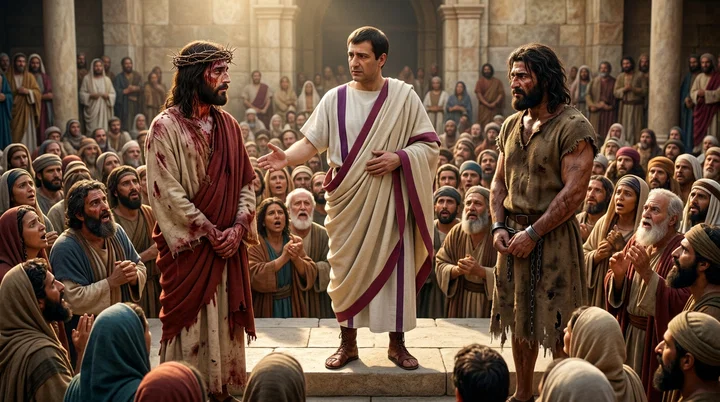
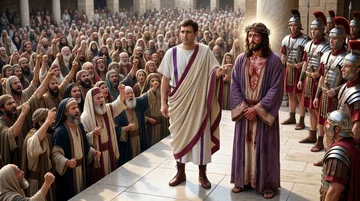
When the chief priests therefore and officers saw him, they cried out, saying, Crucify him, crucify him. Pilate saith unto them, Take ye him, and crucify him: for I find no fault in him.
Translations
When the chief priests therefore and officers saw him, they cried out, saying, Crucify him, crucify him. Pilate says to them, Take you him, and crucify him: for I find no fault in him.
King James Version, KJV Cambridge Paragraph Bible
When the chief priests therefore and officers saw him, they cried out, saying, Crucify him, crucify him. Pilate saith unto them, Take ye him, and crucify him: for I find no fault in him.
When therefore the chief priests and officers saw him, they cried out, saying, Crucify him, crucify him. Pilate saith to them, Take ye him, and crucify him: for I find no fault in him.
When therefore the chief priests and the officers saw him, they cried out, saying, Crucify him, crucify him. Pilate saith unto them, Take him yourselves, and crucify him: for I find no crime in him.
When therefore the chief priests and the officers saw him, they cried out, saying, Crucify him, crucify him! Pilate saith unto them, Take him yourselves, and crucify him: for I find no crime in him.
When, therefore, the chief priests and the officers did see him, they cried out, saying, 'Crucify, crucify;' Pilate saith to them, 'Take ye him — ye, and crucify; for I find no fault in him;'
When therefore the chief priests and the officers saw him they cried out saying, Crucify, crucify [ him]. Pilate says to them, Take him ye and crucify [ him], for I find no fault in him.
When, therefore, the High-priests and the officers saw him, they cried aloud, saying—Crucify! Crucify! Pilate saith unto them—Ye, take him, and crucify; for, I, find not in him, a fault.
Berean Standard Bible, Majority Standard Bible
As soon as the chief priests and officers saw Him, they shouted, “ Crucify Him! Crucify Him!”“ You take Him and crucify Him,” Pilate replied, “ for I find no basis for a charge against Him.”
When therefore the chief priests and the officers saw him, they shouted, saying, “ Crucify! Crucify!”Pilate said to them, “ Take him yourselves and crucify him, for I find no basis for a charge against him.”
So when the chief priests and the police saw him they gave a loud cry, To the cross! to the cross! Pilate said to them, Take him yourselves and put him on the cross: I see no crime in him.
Then when the hie Priests and officers sawe him, they cried, saying, Crucifie, crucifie him. Pilate said vnto them, Take yee him and crucifie him: for I finde no fault in him.
Douay-Rheims (Challoner revision)
When the chief priests, therefore, and the servants, had seen him, they cried out, saying: Crucify him, crucify him. Pilate saith to them: Take him you, and crucify him: for I find no cause in him.
Pictures
Cross-references 20 of 28
- John 18:38
Pilate saith unto him, What is truth? And when he had said this, he went out again unto the Jews, and saith unto them, I find in him no fault at all.
Pilate declares that he finds no fault in Jesus.
- Matthew 27:22
Pilate saith unto them, What shall I do then with Jesus which is called Christ? They all say unto him, Let him be crucified.
Pilate asks what to do with Jesus, and the crowd demands his crucifixion.
- Luke 23:18-23
And they cried out all at once, saying, Away with this man, and release unto us Barabbas:
The crowd demands Barabbas’s release and Jesus’ crucifixion despite Pilate finding no fault in him.
- John 19:15
But they cried out, Away with him, away with him, crucify him. Pilate saith unto them, Shall I crucify your King? The chief priests answered, We have no king but Cæsar.
The leaders reject Jesus as king and declare Caesar their king.
- Mark 15:13-14
And they cried out again, Crucify him.
The crowd cries for Jesus to be crucified, and Pilate asks what evil he has done.
- Matthew 27:25
Then answered all the people, and said, His blood be on us, and on our children.
The crowd’s demand for crucifixion is paired with its acceptance of responsibility for Jesus’ blood.
- Luke 23:4
Then said Pilate to the chief priests and to the people, I find no fault in this man.
Pilate declares Jesus innocent before the crowd.
- John 18:40
Then cried they all again, saying, Not this man, but Barabbas. Now Barabbas was a robber.
The crowd chooses Barabbas instead of Jesus.
- John 19:12
And from thenceforth Pilate sought to release him: but the Jews cried out, saying, If thou let this man go, thou art not Cæsar’s friend: whosoever maketh himself a king speaketh against Cæsar.
The threat about Caesar overcomes Pilate’s resistance to releasing Jesus.
- 1 Corinthians 5:7
Purge out therefore the old leaven, that ye may be a new lump, as ye are unleavened. For even Christ our passover is sacrificed for us:
Christ is identified as the Passover sacrifice.
- Acts 3:13-15
The God of Abraham, and of Isaac, and of Jacob, the God of our fathers, hath glorified his Son Jesus; whom ye delivered up, and denied him in the presence of Pilate, when he was determined to let him go.
The leaders rejected Jesus despite Pilate’s intent to release him, choosing a murderer and demanding his death.
- Matthew 27:24
When Pilate saw that he could prevail nothing, but that rather a tumult was made, he took water, and washed his hands before the multitude, saying, I am innocent of the blood of this just person: see ye to it.
Pilate declares Jesus innocent yet yields to the crowd.
- John 19:1
Then Pilate therefore took Jesus, and scourged him.
Pilate orders Jesus scourged before handing Him over.
- John 19:10
Then saith Pilate unto him, Speakest thou not unto me? knowest thou not that I have power to crucify thee, and have power to release thee?
Pilate claims power to condemn or release Jesus, despite his innocence.
- Luke 23:14-15
Said unto them, Ye have brought this man unto me, as one that perverteth the people: and, behold, I, having examined him before you, have found no fault in this man touching those things whereof ye accuse him:
Pilate and Herod find no basis for the charges against Jesus.
- Luke 23:21
But they cried, saying, Crucify him, crucify him.
Both record the crowd crying, “Crucify him.”
- John 18:31
Then said Pilate unto them, Take ye him, and judge him according to your law. The Jews therefore said unto him, It is not lawful for us to put any man to death:
Pilate uses the same word, “take,” in addressing Jesus' accusers.
- Luke 23:18
And they cried out all at once, saying, Away with this man, and release unto us Barabbas:
The crowd demands Barabbas’s release.
- Acts 2:23
Him, being delivered by the determinate counsel and foreknowledge of God, ye have taken, and by wicked hands have crucified and slain:
Jewish guilt using lawless Romans
- Matthew 27:2
And when they had bound him, they led him away, and delivered him to Pontius Pilate the governor.
Both describe Jesus before Pilate during his trial and condemnation.
Commentary
Each commentary is drawn from primary sources: the writings of Ellen G. White and Adventist pioneers and periodicals. Each commentary is separate. Its own words are not a quotation; follow the references to read the source passages.
Ellen G. White
48 sources
The chief priests and officers, stirred by the priests, rulers and elders, cried out for Him to be crucified, and Pilate answered that they should take Him and crucify Him themselves, for he found no fault in Him.COS 152.1–4Lt 30, 1900, par. 5–6AA 42.3 His reply was not a finding of guilt but a despairing, angry challenge to their cruel and unreasonable fury, for he found no grounds to condemn Jesus and they lacked authority to carry out a death sentence, having already scourged Him in hope that suffering would satisfy the crowd.3SP 144.1RH Jan 23, 1900DA 723.1–724.15RED 63.2–64.1ST Jul 11, 1878 Jesus was sinless, faultless and perfect, God veiled in humanity, and Pilate's admission was a public declaration by a heathen judge establishing His innocence as part of God's appointed purpose.Ms 112, 1897, par. 26–30Ms 110, 1899, par. 36–37Lt 28, 1872, par. 10–13Ms 111, 1897, par. 42–45Ms 74, 1911, par. 17 Though Pilate knew Jesus was innocent and knew what was right, to appease the mob and save his own office, position and honor he handed Christ over to be crucified rather than stand by his conviction.RH Jan 23, 1900Ms 17, 1911, par. 18ST Nov 2, 1882 The leaders could point to no condemning act in Christ's life, but His goodness stirred their jealousy and hate until rejection of light hardened their hearts, and their cry was the climax of Satan's malice working through priests and people, leaving all who hear to choose Christ's side rather than join His opponents.Lt 30, 1900, par. 5–6Lt 28, 1872, par. 10–13Lt 2, 1874, par. 37–431RED 59.14SP 321.1–2
Trial Cry and Reply
When the chief priests and officers saw Him they cried out, Crucify Him, crucify Him, stirred to it by the priests and rulers and elders, and Pilate answered, Take ye Him and crucify Him, for I find no fault in Him.COS 152.1–4Lt 30, 1900, par. 5–619MR 263.2–264.1Ms 51, 1897, par. 31–32ST Nov 2, 1882 The demand was for crucifixion while the judge himself declared no fault in Him, setting vengeful demand against recognition that He was guilty of no crime deserving death.COS 152.1–4AA 42.3Ms 51, 1897, par. 31–32ST Nov 2, 1882 Some who joined in that demand for His crucifixion later heard the apostles.AA 42.3
Pilate's bidding to take and crucify Jesus was not a finding of guilt but a despairing challenge wrung from him by cruel, unreasonable fury.3SP 144.1DA 723.1–724.15RED 63.2–64.1 He had found no grounds for condemnation, and they lacked authority themselves to carry out the death sentence.DA 723.1–724.1 He spoke in despair and frustration and in anger, still holding Jesus innocent in his judgment.3SP 144.15RED 63.2–64.1ST Jul 11, 1878 He had already ordered Jesus scourged, hoping that suffering would satisfy the crowd, yet the demand to crucify continued.ST Jul 11, 1878
He declared Jesus innocent and without fault repeatedly, twice and even three times, knowing He had been delivered for envy, yet the cry for death went on and the unjust sentence followed.RH Jan 23, 1900ST Jul 11, 1878ST Jul 12, 1899 The accusers could prove no guilt, but Pilate yielded and handed Him over to a cruel death.ST Jul 12, 1899 Those who had wanted to make Jesus king soon chose Barabbas instead and cried for Jesus to be crucified.Ms 67, 1897, par. 19–21 The demand swelled into the cry of a great multitude following Him to Calvary, many mocking and deriding while others wept and recounted His praise.ST Oct 7, 1886 Those He had healed of infirmities and raised from the dead declared His marvelous works with earnest voice and asked what He had done to be treated as a criminal, while many who only days before had attended Him with joyful hosannas and waving palm branches as He rode triumphantly to Jerusalem shouted His praise then because it was popular and now joined the call for His death because that was popular.ST Oct 7, 1886
The cry belongs to the condemnation and the road from Pilate's hall to Calvary.DA 722.5 On that road Judas's death left the crowd quieter and made some recognize that retribution was coming upon those responsible for Jesus' blood.DA 722.5 The priests loudly demanded that He be crucified though Pilate had found no fault in Him, and after the resurrection their demand stood in stark contrast to the soldiers' testimony that the crucified Jesus was the Son of God.Ms 203, 1898, par. 3–6
Christ Declared Innocent
John 19:6 presents Jesus as sinless, faultless, and perfect in humanity, even as men claiming great righteousness joined in demanding His death.Ms 110, 1899, par. 36–37Lt 28, 1872, par. 10–13Ms 74, 1911, par. 17 He combines humanity with divinity as God veiled in humanity, the Son of the living God and the Prince of Life.Ms 110, 1899, par. 36–37Ms 74, 1911, par. 1712MR 413.4–414.2 He had done so much good for the very people given over to rage against Him.Ms 110, 1899, par. 36–37 His humble, travel-worn appearance concealed a heart of divine love, yet His works had shown Him to be the Lord of life and glory.AA 150.1–151.1
Pilate's admission in the verse is a public declaration establishing that Christ had committed no fault.Ms 112, 1897, par. 26–30Ms 111, 1897, par. 42–4512MR 413.4–414.2 It is the testimony of an irreligious heathen judge to the innocence of Christ.12MR 413.4–414.2 That publicity, point after point and scene after scene of humiliation at the Passover, was part of God's appointed purpose.Ms 111, 1897, par. 42–4512MR 413.4–414.2
Despite Pilate's stated judgment that He was innocent, Jesus was condemned as a malefactor and gave Himself up to be killed on the cross.AA 42.3Ms 21, 1897, par. 27–29Ms 111, 1897, par. 42–45 His public condemnation and death were part of God's appointed purpose.Ms 111, 1897, par. 42–45 The verse exposes the contrast between Christ's innocence and the determined hostility of the priests and rulers who persisted in demanding His crucifixion.DA 735.1–5 Some who joined in that demand later heard the apostles.AA 42.3
Pilate's Unjust Condemnation
Pilate knew Jesus was innocent and knew what was right, yet to appease the angry mob he handed Christ over to be crucified, choosing to sacrifice an innocent life rather than stand by his conviction because he feared losing his position and honor and sought to save his own office.RH Jan 23, 1900Ms 17, 1911, par. 18ST Nov 2, 1882Ms 74, 1911, par. 17Ms 72, 1898, par. 11 He knew Jesus had been delivered for envy and twice declared Him innocent and without fault, yet he condemned Him.RH Jan 23, 1900 He declared before scornful accusers that Jesus was faultless, the Son of the living God, yet gave Him up to be derided and crucified, letting spikes be driven through His hands and feet and Him be hanged on the cruel cross to save his own office.Ms 74, 1911, par. 17
By claiming power to crucify and to release, Pilate made himself responsible for the condemnation of Christ, for the cruel scourging, and for the insults offered before any wrong was proved against Him.RH Jan 23, 1900 Appointed to administer justice, he refused to do it and delivered an innocent man to murderers for a most ignominious and cruel death.RH Jan 23, 1900Ms 73, 1911, par. 17–18 Washing his hands and saying he was innocent of the blood of this just person did not make him guiltless or cleanse his conscience.RH Jan 23, 1900 Had he used his power and position to protect Christ he would not have been held guilty for His death, though Christ would still have been crucified.RH Jan 23, 1900 His public declaration that he found no fault in Jesus stands even as he ordered Him scourged and delivered Him to be put to death.Ms 112, 1897, par. 26–30Ms 128, 1897, par. 1–4
Pilate yielded to the priests and rulers and to the crowd rather than uphold justice and protect Jesus, and he should have firmly defended Christ and refused to condemn Him.Ms 112, 1897, par. 26–30ST Nov 2, 1882Ms 72, 1898, par. 11 His first retreat from justice in allowing an innocent man to be scourged was a cruel act that brought lasting remorse.Ms 112, 1897, par. 26–30 His wavering allowed the crowd to overrule him and led to his ruin, illustrating how compromising with evil for self-interest carries a person into guilt.ST Nov 2, 1882 His failure to act on his conviction brought him a guilty conscience and lasting infamy, and his conduct became an example followed by judges who surrender justice to public pressure.Ms 72, 1898, par. 11
Pilate's own declaration of Christ's innocence would testify against him at the judgment, as would the guilty act of those to whom he delivered Jesus.Ms 17, 1911, par. 18
Leaders' Hostile Rejection
The leaders could point to no act in His life to condemn, yet men claiming great righteousness joined in demanding the death of the sinless One.Lt 28, 1872, par. 10–131RED 59.1SG4 117.1LC1 59.1 His goodness and humble, self-denying life, and the attention His works drew, stirred their jealousy and hate until they treated the innocent One as deserving death.1RED 59.1SG4 117.1LC1 59.1 Their rejection of light and unbelief hardened their hearts until they called for His crucifixion, with the chief priests and elders stirring the crowd to the cry.Lt 28, 1872, par. 10–13Lt 2, 1874, par. 37–431RED 59.1SG4 117.1LC1 59.1 Rejecting light left them under Satan's control, until good appeared evil and evil good, darkness for light and light for darkness.1RED 59.1SG4 117.1LC1 59.1
Their cry for crucifixion was the climax of rejection, prompted by Satan whose malice worked through priests and people against Jesus.1RED 59.14SP 321.1–2GC 500.4–501.2 It was directed against One whose mercy and love revealed God's character, and it reveals the malice behind the world's rejection of the Redeemer.4SP 321.1–2GC 500.4–501.2 By that rejection the verdict exposed Satan and his synagogue leagued against divinity, rejecting and dishonoring Christ as far as combined human and satanic power could.12MR 413.4–414.2 Satan led the mob in abusing the Saviour while demanding Jesus' death and Barabbas's release, choosing a robber and a heathen king in place of the Prince of Life and withdrawing from the divine theocracy.12MR 413.4–414.2Lt 12, 1911, par. 8–11 That cry helps expose Satan's character before the universe.GC 500.4–501.2
The religious leaders' demand for His crucifixion exposed the injustice and oppression of their religion.Ms 111, 1897, par. 16–18 Their appeal to human religious law to demand the death of One declared faultless shows how religious authority joined to civil power can use law to oppose God and persecute those who remain loyal to Him.Lt 90, 1897, par. 13–18 The demand exposed hypocrisy cloaked by a garment of religion, contradicting their grand Passover ceremonies and revealing imposing religious dress covering hearts needing the molding of the Spirit of God, mingled with selfishness, fraud, discontent and unholy passions.12MR 411.3–4 The cry against the holy Prince of heaven shows what people do when they are not under the control of God's Spirit and are moved by Satan.19MR 277.1–278.1
The priests loudly demanded His crucifixion and joined that cry with the declaration that His blood would be upon them and their children.Ms 94, 1897, par. 17–2112MR 411.3–4 They made that demand after deliberately choosing Barabbas, a choice that would mark their character as long as life should last.12MR 411.3–4 The invoked blood would indeed come upon them as the blight of God's curse, never ceasing to torture the hearts of the speakers.12MR 411.3–4 Jesus never spurns the true penitent, but He hates such hypocrisy.12MR 411.3–4
Example Warning and Future
The hostility that cried for crucifixion could not prevent Christ from completing His work, and He endured rejection, suffering, insults and outrage with meekness and calmness, without murmuring, without retaliating, and without using His divine power to escape.Lt 2, 1874, par. 37–43Lt 12, 1911, par. 8–11 In that patient endurance He left His followers an example of how to bear trials and reproach, and His faithfulness under the test helped prove false the charges Satan had brought against God.Lt 2, 1874, par. 37–43Lt 12, 1911, par. 8–11 The disciples had been prepared beforehand for this humiliation and for the fickleness of people who had once followed Jesus, so that the crowd's rejection would not take them by surprise nor make their faith depend on public opinion.4RED 102.2–103.1
The same rebellion and hatred shown toward Christ will be present at His second coming.SG4 118.2LC1 60.2 If He came again as humbly as the first time, reproving sin and commending virtue and holiness, many would cry out against Him, and even more would reject Him.SG4 118.2LC1 60.2 Before His return infidelity and denial concerning Christ as the true Messiah and Saviour will grow, with Satan using his skill to deceive even more effectively than at the first advent.SG4 118.2LC1 60.2 The scene also represents the spirit of those who will oppose God's people in the coming crisis, showing what people do when they are not under the control of God's Spirit but are moved by Satan.19MR 277.1–278.1
The cry sets those who reject Christ against those who stand with Him, making it a matter of personal responsibility to choose Christ's side rather than the side of His opponents.Lt 30, 1900, par. 5–619MR 263.2–264.1 Encouraging transgression by example brings accountability to God.19MR 263.2–264.1 Those who now dishonor God, deny their Saviour, and are disloyal to Him would have joined the cry to crucify Him if He were present on earth in human form among them.STB 358.3–4MWISDAP 15.3–4
Remembering this innocent suffering calls believers to serve God with all their hearts, to lay hold on Christ by faith for strength and grace and power to follow on to know the Lord, and to keep warning neighbors and winning souls to Him.Ms 73, 1911, par. 17–18 The account of how Jesus was in the world and hung on the cross with spikes driven through His hands and feet is to be told as testimony to those in the world, while impurity and sin are overcome by the blood of the Lamb.Ms 74, 1911, par. 17 A crowd's cry to crucify can also represent the persecuting, accusatory influence of people who join a popular attack on someone already burdened and opposed, warning against adding suspicion, envy, jealousy and faultfinding to another person's trials.Ms 7, 1882, par. 24–25
Sources
Pioneers and periodicals
46 sources
When the chief priests and officers saw Jesus they cried out for His crucifixion, and Pilate answered that they should take Him and crucify Him while declaring that he found no fault in Him, laying bare the conflict between their demand for death and his own judgment of innocence.ST May 13, 1897ST May 13, 1897 Pilate knew Jesus was innocent and had been delivered for envy, declaring Him without fault two and three times, yet he condemned Him under relentless pressure to protect his standing with Caesar rather than stand by conviction.RH Jan 23, 1900ST Nov 2, 1882ST Jul 14, 1881RH Dec 9, 1858 The demand was unjust because Jesus was harmless and sinless and had done no evil but only blessed, healed and fed the people, and its persistence by priests, officers and the stirred-up mob was moved by a satanic spirit and shows that a condemning majority, even with religious leaders, does not settle what is right.ST Jul 12, 1899RH Jun 10, 1862RH Dec 15, 1863RH Jan 9, 1900RH Sep 7, 1911 Christ the Lamb of God and our Passover was sacrificed on the fourteenth day of the first month, the appointed day for the paschal lamb, so that the type met its antitype exactly as to time.RH Oct 30, 1855ST Aug 13, 1874 The verse warns that knowing what is right yet yielding to public pressure and fear of losing position and honor for self-interest carries a person into guilt and ruin, for every reader stands before incarnate truth with troubled conscience and must decide whether to take Jesus as leader.ST Nov 2, 1882RH Sep 28, 1911RH Oct 17, 1854
Trial Words and Setting
When the chief priests and officers saw Jesus they cried out for His crucifixion, and Pilate answered that they should take Him and crucify Him while declaring that He found no fault and no crime in Him, exposing the conflict between their demand for death and his judgment that Jesus was not guilty.ST May 13, 1897ST May 13, 1897 The cry came after Pilate had yielded to scourging as preliminary to crucifixion and as a compromise to satisfy wrath.ST Jul 11, 1878ST Nov 9, 1882 His compassion was awakened when he saw Jesus bloody from the scourge, clothed in the purple robe and wearing the crown of thorns, probably bearing the reed in His hand.ST Nov 9, 1882 After declaring for the third time that he found no fault in Him, Pilate led Jesus forth as behold the man, hoping the sight of one so meek, helpless, wretched, innocent and miserable would touch all hearts as it had touched his own and satisfy unreasoning wrath.ST Nov 9, 1882 He asked in effect whether such a man could be a king, an insurgent, a man to be feared or dangerous, and whether this suffering was not enough.ST Nov 9, 1882
Pilate spoke in despair after losing all patience with unreasoning cruelty, and in anger told them to take and crucify Him themselves even while affirming His innocence.ST Jul 11, 1878ST Oct 7, 1886ST Nov 9, 1882 His words taunted the rulers that if they insisted they must do it themselves, because he found Jesus innocent and believed He had already been punished as much as He deserved.ST Oct 7, 1886ST Nov 9, 1882 The priests had moved the mob to mad fury, and instead of pitying Jesus in His suffering and forbearance they shouted for His crucifixion with hoarse voices like the roaring of wild beasts.ST Oct 7, 1886 Pilate presented Jesus beside Barabbas, a robber, assassin and murderer, so that Jesus stood calmly before rage with purity and humble, Godlike bearing in sharp contrast to Barabbas's defiant appearance, making His blamelessness and the contrast visible to the crowd.RH Apr 2, 1908ST Jan 17, 1911 The rulers demanded the release of Barabbas, whose crime was practically what they charged against Jesus, even though Barabbas stood convicted and Jesus stood declared innocent, and even Barabbas joined the demand against the innocent Jesus.ST Jan 17, 1911ST Mar 13, 1901
The word take in Pilate's command means to take or receive, the same word used when Jesus tells His disciples to receive the Holy Spirit in John 20:22, showing that they are to take or receive the Spirit by faith and carry the Spirit with them in their work.RH Apr 24, 1913 The people at large are not said to have joined in the renewed demand at that sight, and for a time through fear or pity they were perhaps silent.ST Nov 9, 1882 Yet the same multitude that had hailed Him as king with joyful hosannas and waving of palm branches as He rode triumphantly to Jerusalem hissed at Him, reviled Him and swelled the demand to crucify Him.ST Oct 7, 1886ST Oct 8, 1896 Many mocked and derided Him on the way to Calvary while others wept and recounted His praise, and those He had healed of infirmities and raised from the dead declared His marvelous works with earnest voice and asked what He had done to be treated as a criminal, shouting His praise then because it was popular and now joining the call for His death because that was popular.ST Oct 7, 1886
Jesus knew this trial of betrayal, condemnation in the judgment hall, humiliation and demand for crucifixion awaited His disciples.ST Oct 8, 1896 He knew who among His followers were unbelieving and weak in faith, and knew these faint-hearted, undecided ones would sink beneath fear and disappointment at that hour.ST Oct 8, 1896 Their apostasy then would have been more than the twelve could have endured in addition to their grief and the ruin of their hopes, so He brought about an earlier sifting crisis while He was still present to comfort and strengthen His chosen and prepare them for what was to follow.ST Oct 8, 1896 After being declared innocent Jesus received unmerited torture and mockery from the soldiers of Herod and Pilate and then the compromise scourging before being handed to His persecutors for crucifixion, His life sacrificed in that cruel manner so that our lives might be saved.ST Mar 13, 1901
Pilate's Compromise and Guilt
Pilate knew Jesus was innocent and had been delivered for envy, declaring Him without fault twice and a third time, yet he condemned Him and ordered the execution when the demand for crucifixion was renewed with relentless pressure.RH Jan 23, 1900ST Nov 2, 1882ST Jul 12, 1899ST Jul 14, 1881RH Dec 9, 1858 He resisted his own conscience even while troubled by Jesus' words, and allowed the innocent One to be led away to die rather than uphold justice.ST Nov 2, 1882ST Jul 14, 1881RH Jun 15, 1911 The accusers could find no basis to prove guilt, but their cry followed scourging and mockery and Pilate yielded to it instead of releasing Him.ST Jul 12, 1899RH Dec 9, 1858
He yielded to protect his worldly position, standing and honor with Caesar after he was threatened that releasing Jesus would make him no friend of Caesar.ST Jul 14, 1881RH Dec 9, 1858ST His career had not been the best, and he feared being accused to Caesar and deposed and perhaps slain, so he was constrained to deliver Jesus to be crucified when the Jewish leaders who had no power to execute pressed their demand for death.RH Dec 9, 1858ST He chose to sacrifice an innocent life rather than stand by conviction, and his wavering let the crowd overrule him and led to his ruin.ST Nov 2, 1882ST Jul 14, 1881 The independence he later showed in refusing to change the inscription was an independence he had failed to exercise when deciding Jesus' fate.ST May 17, 1899
Washing his hands and saying he was innocent of the blood of this just person did not make him guiltless or cleanse his conscience.RH Jan 23, 1900 By claiming power to crucify and to release he made himself responsible for the condemnation, for the cruel scourging and for the insults offered before any wrong was proved against Him.RH Jan 23, 1900 Appointed to administer justice, he refused to do it and delivered an innocent man to his murderers for the most ignominious and cruel death.RH Jan 23, 1900 Christ would still have been crucified, but had Pilate used his power and position to protect Him he would not have been held guilty for His death.RH Jan 23, 1900
His conduct reveals weakness, cowardice and despair, for while declaring Jesus innocent he gave Him over to scourging and the soldiers' cruelty.ST Nov 2, 1882RH Sep 28, 1911 Standing face to face with incarnate truth in humble beauty with a troubled conscience, he knew and said Jesus was innocent and should in justice have used his power and word to stay the mob and save Him from crucifixion.ST Oct 7, 1886 Instead, from fear of public pressure and of losing position and honor, he denied his true conviction and his best of friends, yielded to the crowd rather than uphold justice, spoke the dreaded sentence and handed Jesus to be scourged and crucified with no repentance.ST Nov 2, 1882RH Sep 28, 1911 His words expose the injustice of condemning a man he had found guilty of no crime, yet telling the crowd to crucify Him after yielding to their pressure.ST Nov 2, 1882ST Oct 7, 1886
Acknowledging Jesus innocent and then handing Him over to be crucified, he acted against his own judgment and every claim of justice and humanity.ST Jul 12, 1899RH Mar 19, 1857 By this contradiction pagan Rome through its governor professed one thing and did the opposite, and this illustrates speaking with the dragon's voice.RH Mar 19, 1857
Cry for Crucifixion
The chief priests and officers demanded crucifixion despite innocence, and the question what evil He had done exposed the groundlessness of their hatred and set His innocence plainly before them, yet they refused to listen and only repeated the demand.ST Jul 12, 1899RH Dec 15, 1863 The demand was unjust because Jesus was harmless and sinless and had done no evil, but had blessed people, healed the sick and fed the hungry, while His accusers could find nothing to prove Him guilty.ST Jul 12, 1899RH Jan 9, 1900 His innocence was declared three times, but that did not prevent the unjust sentence and His being handed over to suffer a cruel death.ST Jul 12, 1899RH Jan 9, 1900
The chief priests and officers stirred up and inflamed a popular demand, crying for crucifixion even though no fault was found in Him.ST Apr 22, 1913 In this way ambitious leaders moved the mob and brought the people to demand injustice against an innocent person.ST Apr 22, 1913
That cry was not the voice of God, and popular opinion in condemning what was right cannot be treated as divine authority.RH Jun 10, 1862ST Sep 9, 1889 The crowd joined the demand even though no fault was found in Him, showing a majority condemning what was right.ST Sep 9, 1889ST Feb 10, 1887 The Jerusalem crowd's call for execution despite the declaration of no fault proves the majority is not thereby right, and religious leaders with a multitude can be wrong, so majority opinion does not settle moral questions.ST Feb 10, 1887ST Jan 4, 1905
The demand to crucify the Son of God was inspired by a satanic spirit, the same spirit that moved the mob against Stephen and is still in evidence on earth.RH Sep 7, 1911 Without the restraining power of God and of the Spirit, earthly people give way to thoughtless amusement and maddened, satanic passion against the innocent, held in check only by the holding of the winds.RH Sep 7, 1911 Its persistence proves the night is far spent and the day is at hand, so what is to be done must be done quickly.RH Sep 7, 1911 In blindness the scribes and Pharisees saw in Him only a malefactor worthy of death and cried out for crucifixion, yet their contempt did not change who He was or stop the truth from going forth, just as contempt for the Advent proclamation does not lessen its importance.RH Jan 6, 1874
Passover Fulfillment and Rejection
Christ, the Lamb of God and our Passover, was sacrificed and died on the fourteenth day of the first month, on the day appointed for the paschal lamb slain on that day.RH Oct 30, 1855ST Aug 13, 1874RH Dec 15, 1868 The Passover killed on the fourteenth met its antitype exactly as to time in that death.RH Oct 30, 1855ST Aug 13, 1874RH Dec 15, 1868 This fulfillment is a divine exposition of the spring types showing that the grand event noted by the type meets its antitype on the very day of the type, and more preliminary and circumstantial offerings do not prevent it from doing so.RH Dec 15, 1868
The scene is part of Israel's rejection of the Son, in which the people rejected Jesus as Messiah and demanded His crucifixion.ST Feb 5, 1902RH Mar 31, 1903 Their rejection followed their failure to receive John the Baptist's message preparing them to recognize Him.RH Mar 31, 1903 The generation that put Christ to death was given the gospel after His resurrection and ascension, and His crucifixion brought the destruction of the temple and the end of Jerusalem's national existence.RH Mar 31, 1903
The men in active leadership turning from John's message and demanding the Messiah's death marks rejection of the true Christ by the professed people of God, after which false messiahs arose.RH Apr 21, 1903 That rejection is a true and typical picture fulfilled again in the last generation, for those who first heard the call to fear God and give Him glory because the hour of His judgment is come treated the message and messengers as the former generation treated John, and in the same spirit crucified the message as the former crucified the Messiah.RH Apr 21, 1903RH Mar 31, 1903 Their children have now come as responsible workers and are given the threefold message of the kingdom, the judgment hour and the soon coming of the Son of man to accept or crucify before the first generation passes.RH Apr 21, 1903 When the gospel will have been preached in all the world for a witness then the end will come, as Jerusalem was left in ruins before those in middle life who demanded the crucifixion passed away.RH Apr 21, 1903 Invoking the rejection compares it with rejection of the message announcing the coming King.RH Apr 21, 1903RH Mar 31, 1903
Religious leaders demanding Jesus' death and appealing to civil authority, which granted their demand, made the death of the Son of God possible through professed people of God using state power to enforce religious aims.ST Oct 2, 1893 The chief priests and officers unitedly demanding His death while Pilate declares Him innocent and tells them to crucify Him, together with Pilate and Herod becoming friends despite former enmity, is a pattern for the final effort to persecute Christ in His people when divided religious groups will unite against them.ST Oct 2, 1893RH Feb 24, 1874
Warning and Personal Application
The declaration of innocence joined to surrender to crucifixion warns that knowing what is right yet fearing the loss of position and honor can lead to sacrificing an innocent life rather than standing by conviction.ST Nov 2, 1882RH Sep 28, 1911 Wavering that lets the crowd overrule conviction leads to ruin, showing how compromising with evil for self-interest carries a person into guilt.ST Nov 2, 1882 Fear of public pressure can make people abandon truth even when they recognize it is innocent.RH Sep 28, 1911 A holy person who openly rebukes sin may be rejected by a professedly pious crowd demanding death though innocent, so Christians must resist sin boldly but meekly and not give up when they suffer for doing so.RH Oct 17, 1854
The same test comes to every reader, who stands face to face with incarnate truth in humble beauty with a troubled conscience and must pass sentence. The mob in mad derision demands a decision whether Jesus shall live or die, and the reader must decide whether to take Jesus as leader rather than deny true conviction and hand Him over with no repentance.
The sufferings set forth in this chapter subdue pride and drive out discontent, so that reading it can help a fretful, gloomy or discontented Christian.ST Apr 17, 1879 Its cruel mockery and terrible scenes at Calvary are vivid enough to imagine witnessing.RH Apr 8, 1902ST Feb 16, 1882 His death was for the speaker, and it is answered with a desire to belong wholly to Him and follow His will.RH Apr 8, 1902
Sources