John 19:15
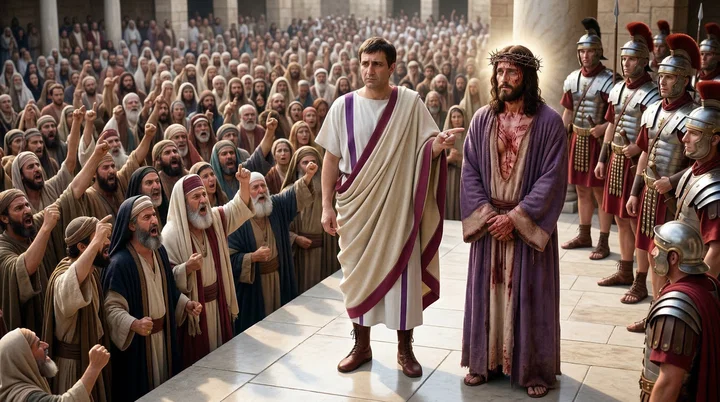
But they cried out, Away with him, away with him, crucify him. Pilate saith unto them, Shall I crucify your King? The chief priests answered, We have no king but Cæsar.
Translations
But they cried out, Away with him, away with him, crucify him. Pilate says to them, Shall I crucify your King? The chief priests answered, We have no king but Caesar.
But they cried out, Away with him, away with him, crucify him. Pilate saith unto them, Shall I crucify your King? The chief priests answered, We have no king but Cæsar.
But they cried out, Away with him, away with him, crucify him. Pilate saith unto them, Shall I crucify your King? The chief priests answered, We have no king but Cesar.
But they cried out, Away with him, away with him, crucify him. Pilate saith to them, Shall I crucify your King? The chief priests answered, We have no king but Cesar.
They therefore cried out, Away with him, away with him, crucify him. Pilate saith unto them, Shall I crucify your King? The chief priests answered, We have no king but Caesar.
They therefore cried out, Away with him, away with him, crucify him! Pilate saith unto them, Shall I crucify your King? The chief priests answered, We have no king but Cæsar.
and they cried out, 'Take away, take away, crucify him;' Pilate saith to them, 'Your king shall I crucify?' the chief priests answered, 'We have no king except Caesar.'
But they cried out, Take [ him] away, take [ him] away, crucify him. Pilate says to them, Shall I crucify your king? The chief priests answered, We have no king but Caesar.
They, therefore, cried aloud—Away! away! Crucify him! Pilate saith unto them—Your king, shall I crucify? The High-priests answered—We have no king but Caesar!
Berean Standard Bible, Majority Standard Bible
At this, they shouted, “Away with Him! Away with Him! Crucify Him!”“ Shall I crucify your King?” Pilate asked.“ We have no king but Caesar,” replied the chief priests.
They cried out, “Away with him! Away with him! Crucify him!”Pilate said to them, “ Shall I crucify your King?”The chief priests answered, “ We have no king but Caesar!”
Then they gave a loud cry, Away with him! away with him! to the cross! Pilate said to them, Am I to put your King to death on the cross? The chief priests said in answer, We have no king but Caesar.
But they cried, Away with him, away with him, crucifie him. Pilate sayde vnto them, Shall I crucifie your King? The high Priestes answered, We haue no King but Cesar.
Douay-Rheims (Challoner revision)
But they cried out: Away with him; away with him; crucify him. Pilate saith to them: Shall I crucify your king? The chief priests answered: We have no king but Caesar.
Pictures
Cross-references 20 of 59
- Matthew 27:22-26
Pilate saith unto them, What shall I do then with Jesus which is called Christ? They all say unto him, Let him be crucified.
The crowd rejects Jesus as King, demands his crucifixion, and accepts responsibility for his blood.
- Luke 23:18-21
And they cried out all at once, saying, Away with this man, and release unto us Barabbas:
The crowd demands Barabbas instead of Jesus and cries for Jesus to be crucified.
- Matthew 27:22
Pilate saith unto them, What shall I do then with Jesus which is called Christ? They all say unto him, Let him be crucified.
The crowd demands that Jesus be crucified.
- 1 Samuel 8:7
And the LORD said unto Samuel, Hearken unto the voice of the people in all that they say unto thee: for they have not rejected thee, but they have rejected me, that I should not reign over them.
Israel’s demand for a human king foreshadows rejecting Jesus as King.
- John 18:36
Jesus answered, My kingdom is not of this world: if my kingdom were of this world, then would my servants fight, that I should not be delivered to the Jews: but now is my kingdom not from hence.
Jesus says his kingdom is not of this world.
- John 19:19
And Pilate wrote a title, and put it on the cross. And the writing was, JESUS OF NAZARETH THE KING OF THE JEWS.
Pilate’s inscription declares Jesus King of the Jews.
- Mark 15:1-20
And straightway in the morning the chief priests held a consultation with the elders and scribes and the whole council, and bound Jesus, and carried him away, and delivered him to Pilate.
A parallel account of Pilate’s judgment and Jesus’ condemnation.
- Luke 23:21
But they cried, saying, Crucify him, crucify him.
The crowd repeatedly demands that Jesus be crucified.
- John 19:4
Pilate therefore went forth again, and saith unto them, Behold, I bring him forth to you, that ye may know that I find no fault in him.
Pilate declares Jesus innocent before the rejection.
- John 18:40
Then cried they all again, saying, Not this man, but Barabbas. Now Barabbas was a robber.
The crowd chooses Barabbas, a robber, instead of Christ.
- Luke 19:14
But his citizens hated him, and sent a message after him, saying, We will not have this man to reign over us.
Both texts show people refusing Christ’s rule as king.
- John 19:6
When the chief priests therefore and officers saw him, they cried out, saying, Crucify him, crucify him. Pilate saith unto them, Take ye him, and crucify him: for I find no fault in him.
Pilate declares Jesus innocent while the rulers demand his crucifixion.
- Matthew 27:35-50
And they crucified him, and parted his garments, casting lots: that it might be fulfilled which was spoken by the prophet, They parted my garments among them, and upon my vesture did they cast lots.
Both texts recount Jesus’ crucifixion and the rejection of his kingship.
- Mark 15:26
And the superscription of his accusation was written over, THE KING OF THE JEWS.
Gives the charge written above Jesus on the cross.
- Luke 23:14
Said unto them, Ye have brought this man unto me, as one that perverteth the people: and, behold, I, having examined him before you, have found no fault in this man touching those things whereof ye accuse him:
Pilate declares that he finds no fault in Jesus before the accusation shifts.
- Acts 3:13-15
The God of Abraham, and of Isaac, and of Jacob, the God of our fathers, hath glorified his Son Jesus; whom ye delivered up, and denied him in the presence of Pilate, when he was determined to let him go.
Peter condemns the people for rejecting Jesus and choosing a murderer.
- Acts 21:36
For the multitude of the people followed after, crying, Away with him.
The crowd repeats the cry against Paul.
- Acts 2:23
Him, being delivered by the determinate counsel and foreknowledge of God, ye have taken, and by wicked hands have crucified and slain:
Peter charges his hearers with crucifying Jesus.
- John 18:31
Then said Pilate unto them, Take ye him, and judge him according to your law. The Jews therefore said unto him, It is not lawful for us to put any man to death:
The leaders say they lack authority to execute Jesus.
- John 18:38
Pilate saith unto him, What is truth? And when he had said this, he went out again unto the Jews, and saith unto them, I find in him no fault at all.
Pilate declares that he finds no fault in Jesus.
Commentary
Each commentary is drawn from primary sources: the writings of Ellen G. White and Adventist pioneers and periodicals. Each commentary is separate. Its own words are not a quotation; follow the references to read the source passages.
Ellen G. White
51 sources
At the Passover trial after the Sanhedrin had condemned Jesus, Pilate asked whether he should execute their King, and the chief priests as representatives of the nation with rulers and crowd demanded His crucifixion and professed allegiance to the Roman emperor alone.Ms 31, 1889, par. 86–87Ms 51, 1897, par. 33–34Ms 23, 1900, par. 7–9DA 722.5DA 723.1–724.1
That profession is apostasy and an oath of loyalty to a rival sovereign, rejecting Jesus as King and rejecting God as ruler and withdrawing from the divine theocracy to place themselves under Roman jurisdiction with no deliverer but Caesar.Lt 30, 1900, par. 5–6Ms 101, 1897, par. 1–2Ms 111, 1897, par. 42–45Ms 95, 1897, par. 8–9Ms 128, 1897, par. 26–29
By so confessing, they confess that Judah's governing authority has departed, marking the fulfillment of Jacob's prophecy at Christ's first coming.Ms 110, 1897, par. 6–11
Their answer is the decisive rejection that stands recorded for the last-day judgment, when the crucified Christ will be exalted as King and Judge of all, and because they do not repent it brings guilt that ends in Jerusalem's destruction forty years later and in life as a nation under foreign rule without Saviour.Ms 23, 1900, par. 7–9Ms 95, 1897, par. 8–9Ms 39, 1898, par. 5–7
Though Pilate found no fault in Jesus and had authority to release Him, he yielded to intimidation and delivered an innocent man to scourging and crucifixion to protect his position, and that plea of loyalty to Caesar does not make him innocent.EW 152.3SG1 56.1Ms 74, 1911, par. 17ST May 22, 1884Ms 72, 1898, par. 11
Trial Words and Setting
John 19:15 belongs to the account of Jesus' trial before Pilate after the Sanhedrin had condemned Him and sought Pilate's authority to carry out the sentence of death.DA 722.5DA 723.1–724.1 The scene stands at Passover, where Jesus is the real Passover Lamb whom the leaders rejected.DA 723.1–724.1 What follows leads from Pilate's hall toward Calvary, where the sight of Judas's mangled body lessens the mockery and pales the faces of those implicated in Jesus' death.DA 722.5 The charge connected with this cry is treason against the Roman government, an offense for which those executed were ordinarily buried in a ground reserved for executed criminals.5RED 92.2
When Pilate asked whether he should crucify their King, the chief priests, speaking as representatives of the Jewish nation, rejected Jesus as King and declared allegiance to Caesar.Ms 51, 1897, par. 33–34Ms 23, 1900, par. 7–9Ms 101, 1897, par. 1–2COL 293.1–3Lt 26, 1897, par. 8–9 Priests and rulers joined with the crowd and the people in demanding that Christ be crucified rather than recognized as King.Ms 31, 1889, par. 86–87 In that same demand they chose a robber and murderer over Christ, who is the truth itself.Ms 31, 1889, par. 86–87
By disowning any king of their own nation and professing allegiance to Caesar alone, they committed themselves to the principle that acknowledging any other king was treason.3SP 154.2–155.1ST Oct 7, 1886ST Jul 18, 1878 Their demand, joined to the claim to have no king but Caesar, became a public statement that anyone aspiring to be King of the Jews should be put to death however innocent of any other offense.3SP 154.2–155.1ST Oct 7, 1886ST Jul 18, 18785RED 74.2–75.1 So Pilate was left to present Jesus' claim to be King of the Jews as the sole stated reason for His death, with no other offense named or charged though He was innocent in every other respect.3SP 154.2–155.1ST Oct 7, 18865RED 74.2–75.1 His inscription over the cross naming Jesus King of the Jews wrote out the very sentiment they had expressed, and all took it as their own declaration.ST Oct 7, 1886ST Jul 18, 1878 When they objected to its wording and demanded that Pilate change it, their inconsistency was exposed and he refused.ST Jul 18, 18785RED 74.2–75.1
Rejection and Allegiance
The cry, We have no king but Caesar, was apostasy, an oath of loyalty to a rival sovereign in place of God.Lt 30, 1900, par. 5–6Ms 128, 1897, par. 26–29ST Jul 12, 1899 The chief priests speaking as representatives of the nation, with the people joining them, thereby rejected Jesus as King, rejected God as ruler, and refused obedience to God's rule.Lt 30, 1900, par. 5–6Ms 95, 1897, par. 8–9Ms 128, 1897, par. 26–29ST Jul 12, 1899 In choosing Caesar they chose a heathen ruler they themselves despised, withdrew from the divine theocracy, and placed themselves under Roman jurisdiction.Ms 101, 1897, par. 1–2Ms 111, 1897, par. 42–45DA 737.2–738.5 From that hour the nation had no deliverer but Caesar.Ms 95, 1897, par. 8–9DA 737.2–738.5
In that same choice they set a robber, murderer and thief in the place of Christ.Ms 31, 1889, par. 86–87Ms 78, 1893, par. 55–56Ms 111, 1897, par. 42–45Ms 39, 1898, par. 5–7 Barabbas, guilty of robbery, murder and theft, was preferred, while Christ who is the truth itself was demanded for crucifixion.Ms 31, 1889, par. 86–87Ms 78, 1893, par. 55–56 Against Him stood the world's Redeemer, whose divine character shone through His humanity, yet He was cast aside for the Prince of life to be replaced by a robber and a heathen king.Ms 78, 1893, par. 55–56Ms 111, 1897, par. 42–45 The priests under Caiaphas as representatives of the nation instructed the people to make this exchange, joining the crowd in calling for Christ's death.Ms 31, 1889, par. 86–8712MR 387.2–388.1
The rejection sprang from hatred of good, for His pure life and holy teaching exposed and condemned their sin.Lt 25b, 1892, par. 27–28CT 424.3–425.1STE 59.3 Instead of yielding, Israel's leaders prized human traditions and customs above God's commandments and truth, making void God's law by teaching human commandments as doctrine.TSSW 37.3–38.1Ms 15, 1896, par. 29–31 Though they appealed to the law and to the Father, and though He had come to give them life, they were blind in choosing Caesar over Christ.Ms 15, 1896, par. 29–31Ms 69, 1912, par. 30–33 For the same reason many reject God's word still, because pure truth confronts love of sin, stings the conscience, and condemns crooked practice, and those who exalt a false sabbath and turn others from loyalty to God repeat that course to the same point of rebellion.CT 424.3–425.1STE 59.3Ms 15, 1896, par. 29–31
The demand was driven by satanic frenzy, with Satan inspiring priests and people and leading the mob in malicious warfare against Jesus.Ms 78, 1893, par. 55–56GC88 501.1–2Lt 12, 1911, par. 8–11 That final outcry against the innocent One, who endured insult without retaliation and remained faithful to His Father, revealed the deceiver's character to the universe with amazement and indignation.GC88 501.1–2Lt 12, 1911, par. 8–11 The profession of loyalty to Rome was hypocritical and overreaching, for they opposed Roman rule when it suited them yet invoked Caesar's authority to secure condemnation.DA 737.2–738.5ST Oct 7, 1886 By disowning any king of their own nation and holding that acknowledging any other king was treason, they committed themselves to the principle that any claimant to be King of the Jews must die however innocent of other offense, and to destroy Christ they were willing to sacrifice their nation's very existence.ST Oct 7, 1886DA 745.2–4ST Jul 18, 1878
Prophecy, Judgment and Aftermath
By declaring allegiance to Caesar while seeking Christ's death before Pilate, the chief priests confessed that Judah's scepter, the tribe's governing authority, had departed, marking the fulfillment of Jacob's prophecy at Christ's first coming.Ms 110, 1897, par. 6–11 When Pilate challenged them to choose, the priests and rulers rejected Christ as their King, demanded His crucifixion, declared Caesar to be their king, and by choosing a robber and murderer instead of Christ made the decisive choice to reject Him.Ms 23, 1900, par. 7–9Ms 39, 1898, par. 5–7 That decision bound them to judgment at the last day and stands recorded for the judgment when the book in God's hand is opened.Ms 23, 1900, par. 7–9Ms 39, 1898, par. 5–7 Though Pilate found no fault in Jesus, he delivered Him to be scourged and crucified, yet the rejected and crucified Christ would be exalted as King and recognized by the heavenly universe and the world as Judge of all living.Ms 39, 1898, par. 5–7
The nation's representatives in that declaration rejected God as ruler rather than recognize Jesus as King, and their choice brought guilt even though opportunity to repent was given.Ms 95, 1897, par. 8–9 Because they did not repent, Jerusalem was destroyed forty years later and the people came under foreign rule.Ms 95, 1897, par. 8–9 As a nation they became like a severed, fruitless branch, without a deliverer or Saviour, having no deliverer but Caesar.Ms 95, 1897, par. 8–9DA 737.2–738.5 Speaking as representatives of the Jewish nation they placed themselves under Roman jurisdiction, which they despised, and in that declaration they unchurched themselves and cut themselves off from God as His church.Ms 101, 1897, par. 1–212MR 387.2–388.1 The chief priests under Caiaphas joined in instructing the people to choose Barabbas instead of Christ and cried out for Christ to be crucified, and by rejecting the divine theocracy and choosing Caesar, a heathen ruler, they dishonored Christ, the Prince of life and hope of Israel, proving Caiaphas unworthy of the high priesthood and that the corrupt Jewish high priesthood without vital connection to God or heavenly light on the priestly work ended with him.12MR 387.2–388.112MR 413.4–414.2
By choosing a heathen ruler over God the nation rejected God as its King and the theocracy.DA 737.2–738.5 The religious leaders had led the people to this choice and bore responsibility for its consequences.DA 737.2–738.5
Pilate's Compromise and Guilt
The Jewish leaders press their claim of loyalty to Caesar to pressure Pilate and intimidate him into condemning Jesus.ST May 22, 1884 Pilate has authority to release or to condemn, declares he finds no fault in Jesus, and is convinced He is innocent, yet he yields to the crowd's demand and hands Him over to be scourged and crucified.SG1 56.1Ms 74, 1911, par. 173SP 147.1Ms 72, 1898, par. 11 He does so to protect his position, power, and worldly honor, fearing the loss of his authority and even his life.EW 152.3SG1 56.1Ms 74, 1911, par. 17 Self-interest overcomes conscience and duty, and his earlier wavering allows the crowd to dictate his decision.SG1 56.13SP 147.1
The priests' declaration of loyalty to Caesar does not make Pilate innocent.SG1 56.1 He remains guilty for choosing his own interests over what he knows is right, scourging an innocent man and delivering Him to an ignominious death.SG1 56.1Ms 72, 1898, par. 11 His failure to stand firmly by his convictions and defend one he knows to be innocent leaves him with a guilty conscience and an infamous name.Ms 72, 1898, par. 11 His course becomes an example repeated by judges who give in to public pressure rather than protect the innocent.Ms 72, 1898, par. 11
After hearing that Christ has risen, Pilate becomes convinced that the One whose blood he shares guilt for is the Son of God, and he lives on in despair and anguish.EW 152.3 The demand for crucifixion is part of the abuse and condemnation of an innocent Christ.Lt 12, 1911, par. 8–11 Satan leads the mob in opposing Jesus, but Christ endures the insults without retaliation and remains faithful to His Father.Lt 12, 1911, par. 8–11
Echoes in History
About thirty years after the crowd demanded that Jesus be taken away, the same cry was raised against Paul.SLP 217.1–2 The mob's rage against Paul was driven by the same satanic spirit that had moved the people to clamor for the blood of Christ.SLP 217.1–2 That cry for His blood is echoed again when religious zealots demand Luther's death for teaching from the Bible.GC88 132.24SP 108.3 In that later case it is Roman zealots who call for Luther to be put to death, matching the Jewish leaders who rejected Jesus as King and demanded His crucifixion.GC88 132.24SP 108.3
The same voices that joined the demand for Jesus' crucifixion later praised Herod as a god, revealing changeable and misguided acclaim.3SP 343.27RED 76.3AC1 76.3–77.1 The crowd's praise and hostility could readily be turned toward different rulers, crying out against Jesus at one time and deifying Herod at another.3SP 343.27RED 76.3AC1 76.3–77.1 The disciples had already been prepared for this public reversal, because Jesus knew the crowd that hailed Him as king would turn against Him and revile Him.4RED 102.2–103.1 Having witnessed the fickleness of His followers and of the world's favor, they were not to be surprised when He was condemned and humiliated, nor to let the opinions of others shake their faith.4RED 102.2–103.1
Near the end of earth's history, people who reject the truth will repeat that choice.Ms 39, 1894, par. 11–12 Preferring deception, they will reject Jesus as their King and cry for Christ to be crucified.Ms 39, 1894, par. 11–12
Present Choice and Application
The cry for crucifixion and the disavowal of any king but Caesar set two opposing sides before every observer, those who stand with Christ and those who side with His opponents, and compel each person to decide whose side to take.Lt 30, 1900, par. 5–619MR 263.2–264.1 To encourage transgression by example in that setting brings accountability to God, for influence used against loyalty to Him will be judged.19MR 263.2–264.1
Opposition to those who testify against sin and warn of coming judgment continues the same conflict between evil and good that drove the hatred-filled demand for Jesus' death.Lt 25b, 1892, par. 27–28 Many reject God's word and God's commandments for the same reason Jesus was rejected, because pure life and holy teaching expose sin and condemn the sinner.CT 424.3–425.1STE 59.3 The Bible's truth stings the conscience of those drawn to evil and confronts love of sin, so it is turned away from just as He was.CT 424.3–425.1STE 59.3 When people make void God's law by teaching human commandments, exalt a false sabbath and turn others from loyalty to God, or cry for the commandments to be removed because the law condemns their sins and crooked practices, they repeat the course that led to that rejection and reach the same point of rebellion.Ms 15, 1896, par. 29–31Lt 1, 1895, par. 17–18
The choice that rejected the Messiah was followed by hostility to the apostles' witness, revealing unwillingness to face the guilt of Christ's murder.Ms 22, 1900, par. 17–20 To see Christ's own nation clamoring for His blood and rejecting Him as King, He in whom the disciples' hopes of eternal life were centered and whom they thought would take His place on David's throne, delivered into the hands of wicked men, gives cause to mourn and fast because the Bridegroom is taken away.ST Jul 7, 1898 Then come days of trial and temptation in which faith is tried and hope and courage fail.ST Jul 7, 1898
Sources
Pioneers and periodicals
104 sources
The crowd and chief priests cried out for Jesus to be taken away and crucified, and when Pilate asked if he should crucify their King they answered that they had no king but Caesar.ST May 13, 1897ST Mar 15, 1877
Pilate had repeatedly found Jesus innocent and knew the charges were unjust, yet to preserve his position and appease their wrath he yielded to their threats about loyalty to Caesar and delivered an innocent man to be crucified for treason against Rome.ST May 22, 1884ST Mar 15, 1877ST Mar 28, 1911ST Jan 23, 1901RH Jun 15, 1911
That answer was the final formal act of Israel's rejection of Jehovah as King, cutting the last bond to God and ending the theocracy, leaving their house desolate under Roman rule until its rightful Ruler comes.RH Mar 16, 1916RH Dec 24, 1903RH May 27, 1909ST Aug 23, 1910
It exemplifies the church turning from God to earthly political power, choosing Caesar as king and using the state to punish resistance to its religious traditions, even to condemning the Son of God.ST Dec 24, 1896ST May 19, 1914RH Dec 4, 1900
God left them to the consequences of choosing Caesar, so about forty years later Jerusalem rebelled against Rome and was destroyed with its temple razed, the people scattered and slain, and the same cry of Away with him is still made by everyone who refuses Christ as personal Saviour and crucifies Him afresh by living in sin.RH Mar 4, 1915ST Feb 11, 1913RH Jul 7, 1859ST Mar 26, 1912ST
Words and Historical Setting
The cry was Away with him, away with him, crucify him, raised by the crowd and the chief priests against Jesus, and to Pilate's question Shall I crucify your King the chief priests answered We have no king but Caesar.ST May 13, 1897ST Mar 15, 1877ST Mar 28, 1911RH Jun 1, 1916 In that answer they rejected Jesus as their King and declared allegiance to Caesar in determination to have Jesus crucified.ST May 13, 1897ST Mar 15, 1877ST May 13, 1897RH Jun 1, 1916 Their choice was a fearful responsibility, for they refused their own King in an attempt to protect the nation from Roman power, though they soon accused others of bringing His blood upon them.ST May 13, 1897RH Jun 1, 1916
Their answer affirmed the authority of the Roman emperor and pressed Pilate to treat Jesus as a political threat.ST Oct 7, 1886ST May 20, 1897ST Mar 15, 1877 Pilate therefore delivered Jesus to be crucified on the charge of treason against Caesar rather than on the Jewish charge of blasphemy.ST Mar 15, 1877 The claim that acknowledging any other king was treason made the rejection a demand that He be judged worthy of death, and earthly authority cannot rightly judge a person's duty to God, for fidelity to earthly rulers and fidelity to God are distinct obligations that need not conflict.ST Oct 7, 1886ST May 20, 1897ST Jan 23, 1901
The Caesar reigning at the crucifixion was Tiberius.RH Nov 12, 1861 Under Tiberius and Pilate the Jewish leaders lacked civil power to carry out the death sentence their own highest tribunal had pronounced.ST Oct 21, 1889 Pagan Rome at that time retained authority to execute the death penalty, and Jesus was crucified by that authority.ST Feb 10, 1898
Pilate had repeatedly declared Jesus innocent and knew the charges were unjust, yet he yielded to pressure and intimidation through claims of loyalty to Caesar.ST May 22, 1884ST Mar 28, 1911RH Jun 15, 1911 The leaders used that claim to make him fear he would be portrayed as hostile to Caesar if he favored one claiming kingship, and he acted to preserve his position and please the powerful.ST May 22, 1884ST Mar 6, 1884 He kept appealing to the people for consent to do his plain duty, offered to scourge an innocent man to appease unreasoning wrath, and then sentenced Him, having Him tortured and mocked before handing Him over to be crucified.ST Mar 28, 1911ST Mar 13, 1901
The rulers showed inconsistency by crying for the release of Barabbas while demanding that Jesus be crucified, though Barabbas was convicted of practically the same crime they charged against Jesus and Jesus had been declared innocent.ST Mar 13, 1901 After being declared innocent Jesus received unmerited torture and mockery from the soldiers of Herod and Pilate, then the compromise scourging, and after all was handed over to His persecutors to be crucified, sacrificing His life in that cruel manner that lives might be saved.ST Mar 13, 1901 A government may thus ratify the unjust will of the masses, but popular support and popular clamor do not make a religious cause right and can turn against even a righteous leader to bring grave injustice.RH Jun 4, 1908ST Mar 26, 1912ST Apr 22, 1913
By overreaching to secure condemnation the leaders committed themselves to the principle that allegiance to Rome required death for any man who aspired to be King of the Jews however innocent of any other offense.ST Oct 7, 1886ST May 20, 1897ST Jul 18, 1878 Pilate's inscription over the cross naming Jesus King of the Jews wrote out the very sentiment they had expressed, stating that no other offense was charged, though they objected to its wording.ST Oct 7, 1886ST May 20, 1897ST Jul 18, 1878
The crucifixion occurred on the fourteenth day of the first month in the spring, the day the Passover lamb was slain.RH Oct 30, 1855RH Dec 15, 1868 Christ as the Passover sacrifice and Lamb of God was killed at the appointed time, fulfilling the Passover type at the exact time appointed.RH Oct 30, 1855RH Dec 15, 1868 That cutting off of the Messiah was foretold for the middle of the seventieth week, and counting three and a half years back from it places the beginning of Christ's ministry in the autumn.
The account places the crucifixion on the day before the Sabbath commonly called Friday.ST Apr 21, 1914 That crucifixion is also recorded in the Babylonian Talmud as occurring on Passover afternoon at three o'clock.RH Sep 5, 1865 The Jewish authorities made an exception to their usual reluctance and to law and custom against trial and execution during Passover, trying and condemning Jesus by the highest Jewish authority on the feast's night and executing Him the following day in urgent demand for His death on the Passover day.ST Mar 6, 1884ST Apr 30, 1902
The cry was stirred up after ambitious religious leaders moved the people against Him.ST Mar 26, 1912 It was instigated by Satan let loose in human beings as a mob spirit that stirs a throng to violence, heard both when Jesus stood before those demanding His death and as they followed Him bearing His cross toward Calvary, and He was then given over to death because His ministry was finished and the powers of darkness were no longer held back from touching Him.ST Apr 22, 1903 Those demanding death included the Jerusalem Jews who only days later were gathered at Pentecost and thus participated in the rejection and death of the Prince of life, and they were descendants of Abraham, showing that descent from Abraham did not ensure righteousness or a living connection with Christ.RH Jan 5, 1860ST Feb 27, 1896
Rejection of God as King
The cry was Israel's final formal act of rejecting Jehovah and God as King, cutting the last strand that bound the nation to God.RH Mar 16, 1916RH Dec 24, 1903 It was the climax of Israel's practical rejection of God, when the people rejected God's only-begotten Son and declared Caesar their king.ST Apr 11, 1911ST Aug 23, 1910 It marks the Israel that rejected the Lord at His first advent.ST May 23, 1911
It was the final result of Israel's departure from God, in which the kingdom that had belonged to the Lord was perverted and its people rejected the King who should have represented God's rule.ST Oct 10, 1895 It marked the culmination of national apostasy after rejecting the Messiah.ST Nov 9, 1882 Their words echoed Israel's earlier rejection of God as King when the people asked Samuel for a human king like those of other nations, and the human-rulership ideal that began then reached its extreme and ultimately perverted the nation.ST Nov 4, 1897
The words openly renounced allegiance to Jehovah and the covenant with David's house.ST Nov 9, 1882 They were an oath of loyalty to a rival ruler and a refusal to obey God's rule, accepting Roman rule rather than acknowledging the Messiah.ST Jul 12, 1899ST May 13, 1897 By declaring they had no king but Caesar they proclaimed themselves political rather than religious.ST Jun 25, 1902
By that declaration the Jewish nation as a nation rejected Jesus when He stood among them as King with the kingdom of God at hand, refusing to receive and welcome Him and refusing to meet the conditions of the kingdom.ST Nov 5, 1912 Their earlier aim of saving the nation by putting Him to death had led them to this extreme rejection.ST May 13, 1897 They refused their own King in an attempt to protect the nation from Roman power.RH Jun 1, 1916 They thereby forfeited His glorious presence in the temple and being used for the evangelization of the world, and were left to the destruction brought upon them by the Caesars of the world.ST Nov 5, 1912
The declaration brought Israel's theocracy to an end and finally cut them off as God's nation.RH May 27, 1909ST Aug 23, 1910 Their earlier departures from God did not end that relationship, for God continued to work with and for them, but after this rejection their house was left desolate, and the kingdom would have no national or worldwide rule until its rightful ruler comes.RH May 27, 1909 Their declaration confirmed that the Jewish people were subject to Roman civil rule and that their former theocracy had not been restored.ST Sep 11, 1893 This rejection led God to allow the Romans to destroy Jerusalem and the kingdom and scatter the people, for Jesus had said that His kingdom was not of this world.ST Jun 30, 1909ST Jun 30, 1909 This national rejection did not mean that God cast off every Jew, for a remnant accepted Christ, and their acceptance showed that all could have done so.ST Dec 23, 1897
Judgment and Prophetic Fulfillment
The hardened and unbelieving people fulfilled prophecy when they demanded crucifixion, even without understanding what they were doing.ST Apr 12, 1883RH Feb 6, 1866 This rejection fulfilled what Jesus foresaw as He wept over Jerusalem, when the people rejected Him as Saviour and King, demanded His death, and declared allegiance to Caesar instead. Their cry fulfilled their choice of a murderer's release over Jesus' life, though Pilate repeatedly declared Jesus innocent, and this was the sin later set before them as evidence of refusal to be turned from iniquity.RH Jun 15, 1911
That final rejection and crucifixion, when the chief priests disowned Christ as King and chose Caesar, together with the later condemnation and persecution of His apostles and people after the resurrection, filled up the cup and measure of Israel's iniquity.RH May 10, 1915ST Mar 26, 1912 The fullest light from heaven had been given and evil had been restrained before this climax was reached.ST Mar 26, 1912 By this choice the house was left desolate and Jerusalem brought to destruction, the kingdom of God taken from those who rejected it and given to a nation bearing its fruits, and Israel set aside as God's special servants.RH May 10, 1915ST Nov 7, 1895ST Mar 26, 1912
By choosing Caesar they chose Roman rule, and God left them to its consequences.ST Their refusal of the Prince of Peace and of the only one who could save them pronounced their doom, and though Jesus was denied a fair trial at the crucifixion, the desolation of Jerusalem and its sanctuary by Roman power followed.ST Feb 11, 1913ST Mar 26, 1912 About forty years later Jerusalem rebelled against Rome and the city was destroyed with the temple razed, and this rejection of His leadership preceded that destruction.ST Feb 11, 1913 The nation went from rebellion to rebellion until in AD 70 Jerusalem was destroyed, many were killed and many taken captive and sold into slavery, the land was desolated, the temple destroyed, the people scattered, and Jesus' words were fulfilled.STST Jun 30, 1909ST Jun 17, 1913
When the people later sought freedom from Roman rule, Heaven confirmed the choice they had made, so their fighting against Rome did not undo it.ST May 14, 1902ST Jan 24, 1906 As a nation they rejected Jesus when He stood among them as King with the kingdom of God at hand, refusing to receive Him and to meet the conditions of the kingdom, and thereby forfeited His glorious presence in the temple and being used for evangelizing the world, being left to the destruction brought by the Caesars of the world.ST Nov 5, 1912 By rejecting the salvation He offered and crucifying the Messiah they destroyed the temple, brought their national existence to an end, and placed themselves as a nation beyond the reach of the gospel of grace He came to bring.ST Nov 5, 1912RH Mar 31, 1903 Putting human authority in God's place, this rejection was part of the abomination of desolation showing that Jerusalem's judgment was near.ST Jan 24, 1906
God reverses this human rejection through the resurrection, declaring Jesus to be His Son and King and placing Him at His right hand with all power and dominion, giving Christ the riches of the universe and the resources of infinite power for humanity to show God's love supreme and true happiness found in loving Him.ST Apr 10, 1901 Though Jesus fully admitted to Pilate that He is King of the Jews, His kingdom is not of this world but is to be established in the future world, so preaching that the kingdom of Heaven is at hand stops at this rejection and the kingdom is taken to be given to those bringing forth its fruits.RH Apr 9, 1872 The crowd demanded His crucifixion while He stood in a robe of mock royalty, accused as making Himself a king against Caesar, yet at His second coming those who pierced Him will see the same Jesus now clothed in rightful royal glory and still bearing the scars of Calvary.ST Jun 2, 1909RH Apr 9, 1872
Christ's Kingship and Kingdom
Jesus is the rightful King, the humble Prince of Peace and King of love whose kingdom is universal and everlasting.RH Jun 29, 1916 The denial of His kingship and declaration of allegiance to Caesar was taken as proof that He had committed treason, but His crucifixion and living kingship expose that charge as grave error, for His claim to be King is eternal truth to which His followers may testify.ST Jan 23, 1901 The demand for a human ruler bore bitter fruit in the cry to crucify the Prince of life when Israel rejected Jesus as king and chose Caesar instead.RH Jun 29, 1916 The proper answer is to have no king but Jesus and to let Him reign in the life, saving completely.RH Jun 29, 1916
The declaration that there was no king but Caesar was a choice of Caesar's rule over Christ the true King.RH Oct 29, 1901 It rejected the King who could free from sin and placed those who made it under earthly bondage, representing the choice between the kingdom of man and the kingdom of God.RH Oct 29, 1901ST Apr 11, 1900 It was the failure of earthly, fleshly hopes and the choice of human rule over God.ST Apr 11, 1900 The Jewish leaders preferred temporal rule under Caesar and demanded crucifixion because they rejected Christ's spiritual kingdom from the same hatred of the religion of love that led to His death.ST Feb 27, 1896
Acknowledging another sovereign in place of Christ is a rejection of His royalty.ST Jan 30, 1879 A Christian cannot be subject where Christ's kingship is openly denied or the world is treated as supreme.ST Jan 30, 1879 Earthly authority cannot rightly judge a person's duty to God, for fidelity to earthly rulers and fidelity to God are distinct obligations that need not conflict.ST Jan 23, 1901
The whole nation denied Jesus as King and called for His crucifixion while professing loyalty to Caesar alone.RH Sep 25, 1856 This took place when chief priests and Pharisees had condemned Him to death, when His own disciples had forsaken Him and fled, and when He hung faint, bleeding and dying, numbered with transgressors and counted accursed.RH Sep 25, 1856 At that very hour of weakness, desertion, mockery and dishonor, with no sceptre, crown, dominion, glory, majesty or power to be seen, the penitent thief alone openly confessed His innocence, called Him Lord, and believed in His kingdom and His power to give eternal life and glory.RH Sep 25, 1856 That universal rejection proves the strength of his faith.RH Sep 25, 1856
Church State and Persecution
The cry for Caesar in place of Christ shows what happens when the church turns from God to earthly political power, putting human authority and force where God alone should stand.ST Dec 24, 1896RH Dec 4, 1900ST Mar 19, 1912 To choose Caesar as king is to displace God, and that displacement brings ruin, as seen when the Jewish church was destroyed as God's church and nation.ST Dec 24, 1896RH Dec 4, 1900 The same pattern follows rejection of God's restoring reproof and warning in the message of John and Jesus, which would have healed if received; refused, it leaves Christ to unite with the world and the State and to oppose those who expose that union from the Word.ST Nov 25, 1897 That departure began in transgression of God's law and acceptance of human traditions, until God's people surrendered Christ's rightful place to worldly power and demanded His death.ST Mar 19, 1912
To declare loyalty to Caesar alone is for the church to become a political body under the state, accepting government aid and support secured by charters and incorporation and binding itself in return to sustain and uphold the laws of the land.RH Nov 26, 1857 Though claiming freedom as Abraham's children, those who reject the Messiah accept a degraded idea of freedom and rely on worldly political power instead, grasping at a substitute for God. The same substitution appeared after the Reformation, when loss of spiritual power led churches to turn from Christ as King and unite with the state.
The conduct at the trial shows how a church joined to the state uses civil power to punish resistance to its religious traditions, even to condemning the Son of God.ST Oct 2, 1893 Religious complaints and charges brought against Jesus led the governor to sentence Him to death, making Him a victim of religious legislation.ST May 19, 1914 That pressure worked by misrepresentation and threats to make the ruler yield, and the same kind of pressure is used when religious groups threaten political representatives to advance religious laws.ST Feb 12, 1894 The pattern continues wherever religious people reject Jesus as King and seek civil authority to compel religious observance.ST Mar 9, 1915
The leaders first took defining sin into their own hands in condemning Christ, then by threats compelled the Roman governor to execute Him.ST Oct 9, 1907ST Dec 18, 1893ST Oct 16, 1893 For civil government to enter the domain of conscience to define and punish sin is to usurp the place of God and rebel against His authority.ST Oct 9, 1907ST Dec 18, 1893 Such usurpation brings disaster upon the government itself and persecution upon its most conscientious and devoted citizens.ST Oct 9, 1907
A government may ratify the will of the masses and public sentiment even when that will is unjust, as Pilate's government gave way to the demand for crucifixion.RH Jun 4, 1908ST May 10, 1910 Numbers and popular support do not make a religious cause right, for truth is not determined by the majority but by God's word.RH Jun 4, 1908ST Jul 14, 1887 The cry for death reflects the same hostile mob spirit that can move against Christ's followers, held in check only by God's restraining power.ST Sep 19, 1911
Rejecting Jesus as King illustrates the fatal result of rejecting prophetic truth, for after rejecting the true Messiah the Jews stood under judgment ready to follow impostors promising deliverance from Roman rule.RH Jan 10, 1854 The same rejection repeats when the church turns from God's close healing message of reproof and warning, leaving Christ to unite with the world and the State.ST Nov 25, 1897 It is repeated by religious lawmakers who use civil power to silence Christ in His people because they reject inherited customs, especially Sunday observance, demanding dissenters be put out of the way.ST As the Jews cried for Jesus to be put away, so those who would do away with God's law say away with it, refusing to have it written in the heart.RH Jul 7, 1859 To argue the Sabbath is nailed to the cross while claiming Sunday as the only Sabbath aligns its speakers with the priests who rejected Christ's rule because they did not want its restraint, a self-condemning argument that figuratively crucifies the Sabbath between Friday and Sunday.RH Sep 23, 1858
Personal Application and Warning
Rejecting the only one able to save was rejecting the very means of salvation, an unpardonable sin that pronounced doom upon those who chose Caesar instead of their King.ST Mar 26, 1912 The refusal occurred at the crucifixion when a fair trial was denied, and desolation of Jerusalem and its sanctuary by Roman power followed.ST Mar 26, 1912
Pride and selfish expectation of earthly rule blinded leaders because a humble, suffering first advent contradicted hopes for a Messiah who would give political dominion, and they demanded death.RH Jul 6, 1868 The same human tendency seeks glory without first bearing the cross and suffering that precede it.RH Jul 6, 1868 Reading the account of unjust treatment and the demand for crucifixion and rejection of kingship helps subdue pride and cast out discontent.ST Apr 17, 1879
The choice set earthly honor and Caesar's favor above loyalty to God and brought guilt for death upon those who made it.ST Jul 11, 1878 It was made to protect the nation from Roman power by refusing the rightful King when challenged to decide whom to recognize, though soon after accusation was made against others for bringing that blood upon them.RH Jun 1, 1916 Religious profession and a history of devotion did not prevent deception, for the nation claiming to be the true church, its religious leaders and people and the popular leaders of Jerusalem, clamored for crucifixion even as life was offered as ransom for lost humanity.ST Jan 5, 1915RH Feb 10, 1863
The cry to take him away and kill him is still made by everyone who refuses to receive Christ as personal Saviour.RH Mar 4, 1915 Such refusal crucifies afresh and puts to open shame, making the rejecter a murderer of the Son of God, driving nails anew into hands and feet by living in sin, keeping the enmity that nailed him to the cross and trampling infinite love underfoot.RH Mar 4, 1915 Refusal to have God's law written in the heart repeats the same rejection, saying away with it as they cried away with him.RH Jul 7, 1859 The cry to take him away is like breaking the cable joining earth and heaven.RH Oct 15, 1857
The same demand to remove Christ rather than have him as King is now made against faith in God and his word, especially the record of creation.ST Dec 11, 1928 That faith is refused rule, called to be taken away and killed, then put out of sight as in a new tomb made secure with scientific-looking seals, in certainty that what Jesus and his word accomplished has been undone.ST Dec 11, 1928 Those who want a Christ only at a distance and reject the personal Jesus who will soon return to reign literally on earth still cry away with him, as at the first coming he was treated as an intruder by religious leaders who demanded death.ST Jul 26, 1883 Those who do not believe he is coming again will likewise be unprepared, reject him for a king of their own choosing, and perish with that king.ST Oct 23, 1901ST Nov 3, 1909
The cry is never-forgiving malice delighting to see a brother fall, holding the law right, the trespass wrong, and the guilty sinner worthy to die.RH Feb 22, 1912RH Jul 27, 1876 It stands condemned beside Jesus, who from a pure heart forgives, bids the sinner go and sin no more and live, and commands forgiveness as one would be forgiven.RH Feb 22, 1912RH Jul 27, 1876 At the cross the onlooker recognizes himself among those calling for death, seeing personal guilt in the suffering and responding with grief and sympathy.ST Mar 2, 1904 As a man of sorrows he shared every human burden through days of toil and nights of prayer, bearing the heavy cross, wearing the piercing crown of thorns, and enduring nails, spear, and gore, leaving no room to murmur in grief and pain, to ask for ease, or to live to please self, and making pain sweet by bringing believers lower at his feet into closer sympathy.
A thorn-crowned, blood-stained, cross-laden man was sent forth under an eastern sky to die for each person personally, with hands and feet pierced on the cross where fierce noontide heat beat for three hours.RH Apr 8, 1902 That death for the sinner calls for belonging wholly to him, receiving divine grace and strength to do his will in thought and word and deed and to follow even through bleeding suffering.RH Apr 8, 1902 Followers must likewise be ready to suffer, bear shame, and face contempt from the ungodly as they are conformed to his image, for as truth in human form he disturbed society and defense of the faith brings division rather than peace, requiring earnest contention and walking as he walked.RH May 21, 1861RH Jul 15, 1858 He alone displayed holiness in untarnished perfection, and his purity reproached wickedness so sharply that crucifixion was demanded, showing the contrast between his holiness and fallen humanity.RH Dec 9, 1862
His own nation clamoring for his blood and rejecting him as King, delivering into wicked hands the one in whom the disciples' hopes of eternal life were centered and whom they thought would take David's throne, gives cause to mourn and fast because the Bridegroom is taken away.ST Jul 7, 1898 Then come days of trial and temptation when faith is tried and hope and courage fail.ST Jul 7, 1898 Meeting incarnate truth face to face in humble heavenly beauty, with troubled conscience and stern sense of duty and stately power to keep conscience inviolate, do justice, stay the mad mob in derision crying for decision whether he should live or die, and save the innocent by true conviction, yet refusing and speaking the sentence to take, scourge, and crucify and denying the best of friends without repentance, shows every reader must now pass the same sentence and decide whether to take him as leader.
Sources