Acts 9:5
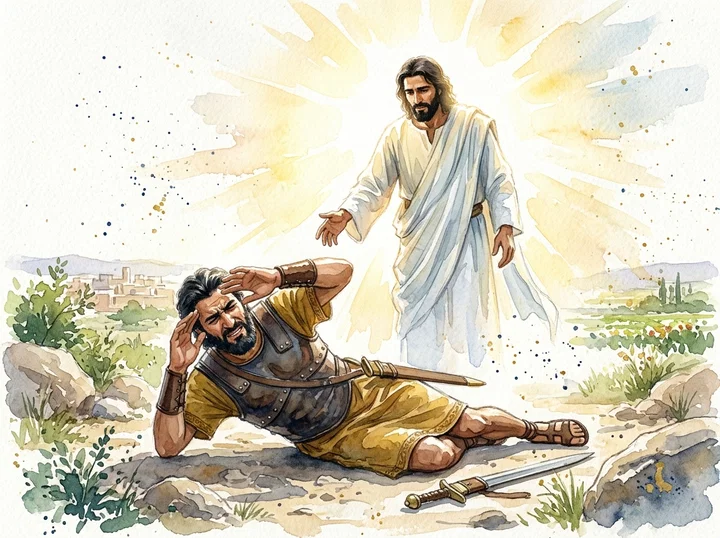
And he said, Who art thou, Lord? And the Lord said, I am Jesus whom thou persecutest: it is hard for thee to kick against the pricks.
Translations
And he said, Who are you, Lord? And the Lord said, I am Jesus whom you persecute: it is hard for you to kick against the pricks.
King James Version, KJV Cambridge Paragraph Bible
And he said, Who art thou, Lord? And the Lord said, I am Jesus whom thou persecutest: it is hard for thee to kick against the pricks.
And he said, Who art thou, Lord? And the Lord said, I am Jesus whom thou persecutest. It is hard for thee to kick against the goads.
Revised Version, American Standard Version
And he said, Who art thou, Lord? And he said, I am Jesus whom thou persecutest:
And he said, 'Who art thou, Lord?' and the Lord said, 'I am Jesus whom thou dost persecute; hard for thee at the pricks to kick;'
And he said, Who art thou, Lord? And he [ said], I am Jesus, whom thou persecutest.
And he said—Who art thou, Lord? And, he, [said] —I, am Jesus, whom, thou, art persecuting!
“ Who are You, Lord?” Saul asked.“ I am Jesus, whom you are persecuting,” He replied.
“ Who are You, Lord?” Saul asked. “ I am Jesus, whom you are persecuting,” replied the Lord.
He said, “ Who are you, Lord?”The Lord said, “ I am Jesus, whom you are persecuting.
And he said, Who are you, Lord? And he said, I am Jesus, whom you are attacking:
And he sayd, Who art thou, Lord? And the Lord sayd, I am Iesus whom thou persecutest: it is hard for thee to kicke against pricks.
Douay-Rheims (Challoner revision)
Who said: Who art thou, Lord? And he: I am Jesus whom thou persecutest. It is hard for thee to kick against the goad.
Pictures

Cross-references 20 of 75
- Acts 26:14-15
And when we were all fallen to the earth, I heard a voice speaking unto me, and saying in the Hebrew tongue, Saul, Saul, why persecutest thou me? it is hard for thee to kick against the pricks.
Jesus confronts Saul as he persecutes his followers and calls him to serve.
- Acts 7:54-60
When they heard these things, they were cut to the heart, and they gnashed on him with their teeth.
Stephen’s martyrdom made a lasting impression on Saul and preceded his conversion.
- Acts 9:17-18
And Ananias went his way, and entered into the house; and putting his hands on him said, Brother Saul, the Lord, even Jesus, that appeared unto thee in the way as thou camest, hath sent me, that thou mightest receive thy sight, and be filled with the Holy Ghost.
Ananias ministers to Saul in Jesus’ name, restoring his sight and welcoming the converted persecutor.
- Acts 22:7-8
And I fell unto the ground, and heard a voice saying unto me, Saul, Saul, why persecutest thou me?
Paul recounts Jesus identifying himself as the one Saul persecuted.
- Matthew 25:40
And the King shall answer and say unto them, Verily I say unto you, Inasmuch as ye have done it unto one of the least of these my brethren, ye have done it unto me.
What is done to Christ’s followers is treated as done to him.
- Acts 9:15
But the Lord said unto him, Go thy way: for he is a chosen vessel unto me, to bear my name before the Gentiles, and kings, and the children of Israel:
Jesus appoints Saul to bear his name to the Gentiles, kings, and Israel.
- Galatians 1:15-17
But when it pleased God, who separated me from my mother’s womb, and called me by his grace,
Paul recounts God’s call, his conversion, and his immediate departure for Arabia.
- Acts 8:1
And Saul was consenting unto his death. And at that time there was a great persecution against the church which was at Jerusalem; and they were all scattered abroad throughout the regions of Judæa and Samaria, except the apostles.
Saul consented to Stephen’s death and persecuted the church before his conversion.
- 1 Corinthians 15:8
And last of all he was seen of me also, as of one born out of due time.
Paul says the risen Christ appeared to him.
- Acts 7:58-60
And cast him out of the city, and stoned him: and the witnesses laid down their clothes at a young man’s feet, whose name was Saul.
Saul consented to Stephen’s death, making his persecution personally convicting.
- Acts 9:20
And straightway he preached Christ in the synagogues, that he is the Son of God.
After his encounter, Paul preached Jesus as the Son of God.
- 1 Timothy 1:13-16
Who was before a blasphemer, and a persecutor, and injurious: but I obtained mercy, because I did it ignorantly in unbelief.
Paul recalls persecuting the church and receiving Christ’s mercy, becoming an example of his patience.
- Philippians 3:6
Concerning zeal, persecuting the church; touching the righteousness which is in the law, blameless.
Both describe Saul’s zealous persecution of the church before he followed Christ.
- Acts 26:9-11
I verily thought with myself, that I ought to do many things contrary to the name of Jesus of Nazareth.
Paul recalls his former opposition to Jesus and persecution of his followers.
- Acts 26:15-16
And I said, Who art thou, Lord? And he said, I am Jesus whom thou persecutest.
The risen Jesus appears to Saul and appoints him as a minister and witness.
- 1 Corinthians 9:1
Am I not an apostle? am I not free? have I not seen Jesus Christ our Lord? are not ye my work in the Lord?
Paul cites having seen Jesus as evidence of his apostleship.
- Acts 8:3
As for Saul, he made havock of the church, entering into every house, and haling men and women committed them to prison.
Saul persecuted and imprisoned believers before his encounter with Jesus.
- Acts 22:21
And he said unto me, Depart: for I will send thee far hence unto the Gentiles.
Christ sends Paul to carry the gospel to the Gentiles.
- Acts 9:27
But Barnabas took him, and brought him to the apostles, and declared unto them how he had seen the Lord in the way, and that he had spoken to him, and how he had preached boldly at Damascus in the name of Jesus.
Barnabas recounts Saul’s encounter with the Lord.
- Galatians 1:16
To reveal his Son in me, that I might preach him among the heathen; immediately I conferred not with flesh and blood:
Christ was revealed to Paul and sent him to preach among the Gentiles.
Commentary part 1 of 2
Each commentary is drawn from primary sources: the writings of Ellen G. White and Adventist pioneers and periodicals. Each commentary is separate. Its own words are not a quotation; follow the references to read the source passages.
Ellen G. White
92 sources
Saul was on his way to Damascus with authority from the high priest to seize believers and bring them bound to Jerusalem for imprisonment and death.RH Mar 6, 1900Ms 46, 1900, par. 16–21Ms 99, 1894, par. 15–17 He was stopped by sudden light from heaven above the brightness of midday, fell blinded to the earth, and learned that the voice speaking to him was Jesus of Nazareth, the crucified, risen and ascended Messiah.Ms 37, 1898, par. 15–16RH Mar 6, 1900Ms 229, 1902, par. 15–18ST Jun 23, 1887RH Mar 16, 1911 To persecute his followers is to persecute Jesus himself, for he is the Head and Representative in heaven of his suffering people on earth.SLP 22.1ST Dec 12, 1878ST Dec 12, 1878 To kick against the goads is to resist divine light and conviction pressing on the conscience, a futile opposition to the onward progress of truth that cannot stop it and only wounds the opposer.SLP 22.1Lt 135, 1898, par. 11–12Ms 95, 1899, par. 3–5 Saul, though sincere in conscientious error and believing he was doing God service, yielded his will, asked what he should do, and was thoroughly converted from proud enemy to devoted apostle.SLP 22.1Ms 99, 1894, par. 15–17Lt 135, 1898, par. 11–123SP 312.2–3
Damascus Road Encounter
Saul was on the road to Damascus to seize men and women who believed, to bring them bound as prisoners to Jerusalem to be condemned and punished without mercy by imprisonment and death.RH Mar 6, 1900Ms 46, 1900, par. 16–21Ms 99, 1894, par. 15–17Ms 8, 1900, par. 2–3SLP 25.3–26.1 He acted with authority and honor from the high priest, in madness and zeal against the followers of Christ, making havoc of the church by entering houses and committing its members to prison.RH Mar 6, 1900Ms 46, 1900, par. 16–21Ms 99, 1894, par. 15–17Ms 8, 1900, par. 2–3 His determined purpose was to let no Christian escape his vigilance, to inquire after men, women, and children and their connections, and to crown his journey with success at no cost of difficulty or danger.SLP 25.3–26.13SP 310.2–311.1 The Commander of heaven saw the suffering brought upon His church and acted to arrest the bold persecutor.Ms 8, 1900, par. 2–3
He was stopped by sudden light from heaven shining round him, above the brightness of midday, which struck him to the earth stricken and blinded.Ms 37, 1898, par. 15–16RH Mar 6, 1900Ms 229, 1902, par. 15–18 Falling to the ground he heard a voice, and when from pale and terrified lips he asked who spoke, the Lord answered that He was Jesus whom Saul persecuted and warned that resistance was painful and useless.RH Mar 6, 1900Ms 46, 1900, par. 16–21Ms 99, 1894, par. 15–17Ms 8, 1900, par. 2–3 Paul beheld the glory of Christ's countenance and could not endure it, hearing His voice and knowing who He was, yet seeing only the light and glory and not the person of Christ.Ms 37, 1898, par. 15–16Ms 229, 1902, par. 15–18 The vision first filled him with terror at the revelation of Jesus in divine glory, enthroned as the One he had despised and whose followers he was trying to destroy, and then became his greatest consolation.AA 436.1ST May 29, 1884 That revelation of the risen Christ in divine glory converted him, so that afterward when questioned he testified with an illuminated face, and the meeting ended his career of persecution as he united with the disciples to become among the chief of the apostles.Ms 37, 1898, par. 15–16RH Mar 6, 1900SLP 36.2ST May 29, 1884
The encounter followed Stephen's martyrdom, in whose stoning Saul had taken part by consenting to his death and taking charge of the clothes of those who stoned him.RH Mar 6, 1900Ms 99, 1894, par. 15–17SG1 89.1 Stephen's faith, constancy, God-marked and glorified face, and words stayed in Saul's memory and testified to the truth he had proclaimed.7RED 35.33SP 299.2AC1 35.3 Even while his opposition continued, that witness had stirred doubts in him about the righteousness of his cause and resisted the voice of conscience and the grace of God.AA 112.2–113.1 His martyrdom thus resulted in and helped bring about Saul's conversion, as Jesus chose the persecutor of the church to preach His name, strengthen the disciples, and take up the work Stephen had left.SG1 89.17RED 35.33SP 299.2AC1 35.3
Saul was a prominent Jewish leader taught by Gamaliel, a rabbi and statesman and member of the Sanhedrin.RH Mar 6, 1900AA 112.1 He came in proud satisfaction expecting ostentation and applause for his zeal and penetration in searching out believers.SLP 25.3–26.1SLP ix.1 His plan was broken up and overturned, for instead of arriving in power and honor and wielding power, he entered the city virtually a prisoner himself, blind, helpless, and dependent on the guidance of his companions.SLP 25.3–26.13SP 310.2–311.1 Deprived of sight and tortured by remorse, he felt himself under sentence of death and did not know what further disposition the Lord would make of him.SLP 25.3–26.1 The voice from heaven reached him despite his pride, prejudice, blindness, and bigotry, in which God saw beneath a heart loyal to truth and duty whose zeal and intellectual power would then be joined to defending and proclaiming the gospel.SLP ix.1
Christ One With Believers
In the answer, I am Jesus whom thou persecutest, Jesus identifies himself with the believers Saul is hunting, teaching that in attacking them Saul is persecuting Jesus himself.SLP 22.1ST Dec 12, 1878Ms 17, 1908, par. 18–28 The voice declares that violence against Christ's followers is violence against Christ, their Head and Representative in heaven.ST Dec 12, 1878ST Dec 12, 1878AC1 41.27RED 41.23SP 309.3 To strike them is to strike directly against the Lord of heaven, and to afflict his brethren on earth is to strike against their Head and Representative in heaven.AC1 41.2SLP 25.17RED 41.2 Christ suffers in the person of his saints, whom he has redeemed with his own blood and called by his name.ST Dec 12, 1878AC1 41.2SLP 25.1ST Jun 3, 1897 Those he has redeemed remain his own, and persecuting them persecutes him.Ms 17, 1908, par. 18–28ST Jun 3, 1897
False accusations and false testimony against Christ's followers are accusations and testimony against Christ himself, and falsely accusing them is falsely accusing the Saviour of the world.AC1 41.2SLP 25.17RED 41.2AA 117.1–23SP 309.3 Cruel and untrue words, suspicion, jealousy, and condemnation directed against them are directed against Christ, and those who oppress them will answer to him.AC1 41.2SLP 25.1 Every blow aimed to wound Christ's servants wounds Christ, and harming or dishonoring the saints is wounding him.AAP 13.3ST Jul 27, 1882STB 473.2 His hand reaches over every sincere follower to cover them as a buckler, so that every blow aimed to injure them wounds the hand of Jesus that covers them.GW92 367.3–368.2 Injury, oppression, robbery, insult, and injustice done to any wronged person is charged as done to Jesus himself, who stands close beside sufferers for the truth and partakes in their suffering.AAP 13.3ST Jun 3, 1897ST Jul 27, 1882
The same oneness holds when one member of a divided household gives his heart to God and confesses Christ in word and deed, in spirit and actions, while the other members remain under Satan's control and rise in annoyed, angry, bitter opposition, misinterpreting the believer's best motives; their enmity against the child of God is enmity against Christ, the believer's hope and consolation, and opposition to believers is opposition to Christ himself, not to men only.ST Nov 26, 1894 It holds also for God's humble messenger, whose ill-treatment is charged as done to Jesus.AAP 13.3GW92 367.3–368.2 The answer at the same time reveals the speaker as Jesus of Nazareth, the Son of God, the long-looked-for Messiah, the Consolation and Redeemer of Israel.RH Mar 16, 1911AA 117.1–2SLP 23.2SG1 91.2 He is the Messiah and Redeemer once rejected, now revealed as crucified, risen, ascended, and alive, the world's Redeemer speaking with his own voice in heavenly glory.ST Jun 23, 1887RH Mar 16, 1911SG1 91.2SLP 256.1
Kicking Against Pricks
The saying pictures an animal kicking back against the sharp goads used to drive it, drawn from familiar objects to teach like a parable.SLP 22.1ST Dec 12, 18783SP 308.2 To kick against the pricks is to resist Jesus himself and to oppose the onward progress of his truth.ST Dec 12, 1878ST Dec 12, 1878 Such opposition is painful and futile and cannot stop that advance, for the truth marches on to triumph and victory.SLP 22.1ST Dec 12, 1878ST Dec 12, 18783SP 308.2 Saul's pursuit was driven by mistaken zeal, and his encounter exposed the error of fighting the very One he opposed.SLP 22.1
Resistance of this kind only injures the resister, bringing pain, distress, conviction and suffering upon himself.SLP 22.1ST Dec 12, 1878RH Mar 6, 1900SG1 90.1 The suffering brought on the opposer is far greater than what is inflicted on the persecuted, whose career of persecution is ended by Christ himself stopping him.RH Mar 6, 19003SP 308.2 Sooner or later his own mind and heart condemn him, and his own conscience testifies against him.ST Dec 12, 18783SP 308.2RH Mar 16, 1911 In Saul's case the revelation brought his former opposition into the light of truth that Jesus was the promised Messiah, risen and alive.RH Mar 16, 1911
Kicking against the pricks is resisting the divine light, conviction, direction and grace pressing upon the conscience.Lt 135, 1898, par. 11–12Ms 95, 1899, par. 3–5SG1 90.1ST Feb 12, 1894 It is resisting the Holy Spirit's enlightenment and the force turning the sinner from his course to submit to Jesus' direction.Ms 95, 1899, par. 3–5SG1 90.1AA 114.1–115.1 It is opposing God's work while thinking to serve God, in ignorance and error about whom is opposed.SLP 22.2AA 114.1–115.1 The heavenly light and voice awaken but do not remove the need to choose and act, for receiving light must be followed by obedient action in cooperation with God, leaving self out of the question and yielding the will to obey.Lt 135, 1898, par. 11–12ST Feb 12, 1894
The same resistance occurs when a person refuses God's warnings, counsels, reproofs and testimonies of reproof.Lt 14, 1883, par. 314MR 1.3–3.1Lt 52, 1907, par. 6–7 Then he follows his own judgment because it is more convenient and pleasing to the natural heart, despises warnings and correction, and refuses to be humbled when God is dealing to bring humility.Lt 14, 1883, par. 3Lt 133, 1901, par. 1618MR 267.3–268.2 It shows itself in speaking bitterly against brethren and organization, opposing visions and the work of God, and opposing with unjust words the mission of God's delegated messenger.Lt 7, 1864, par. 3–6 Such a course is fighting against God's dealing and against God himself, yielding to Satan's control and infatuation of the mind, becoming ensnared, overcome and blinded so as to be unable to discern the things of God.Lt 14, 1883, par. 314MR 1.3–3.1Lt 7, 1864, par. 3–6 It is working directly against the light, enshrouding the self in darkness and error, strengthening the hands of God's bitterest enemies, injuring one's own soul more than any others, and wronging and dishonoring the Lord Jesus himself rather than a humble human messenger.Lt 14, 1883, par. 3Lt 133, 1901, par. 1618MR 267.3–268.2Lt 7, 1864, par. 3–6 It makes work for repentance by repeating a past harmful course and stores up a reckoning in its record that must be met again, accounted for, and met in the judgment.Lt 133, 1901, par. 1618MR 267.3–268.2Lt 52, 1907, par. 6–7Lt 7, 1864, par. 3–6
Saul Convicted and Converted
Saul pursued believers to imprison, scourge, confine in stocks and kill them, consenting to Stephen's death and guarding the clothes of those who stoned him, yet in doing so he was persecuting Christ himself, who still is persecuted in the person of his saints by those of the same spirit and false religious views.SLP 22.1Ms 99, 1894, par. 15–17 He acted with mistaken zeal, sincere and conscientious error, prejudice, unbelief and ignorance, honestly believing he ought to oppose Jesus, exterminate his doctrine and do God service by suppressing faith in him.Ms 99, 1894, par. 15–17ST Jun 23, 1887AC1 38.2–37RED 38.2–3 His zeal was not inspired by heaven or true religion but was erroneous conscientiousness in false ideas, so that while he thought he served God he stood on Satan's side and did Satan's work.Ms 99, 1894, par. 15–17AC1 38.2–37RED 38.2–3 The warning that resistance was painful and futile exposed the error of that zeal and confronted him with the truth about whom he opposed.SLP 22.1AC1 38.2–3
Clear but terrible light broke upon his soul when Christ was revealed as the Redeemer he opposed, who came in fulfillment of his mission, was rejected, abused, condemned and crucified by those he came to save, and rose and ascended, overturning Saul's trust in the priests' denial of the resurrection.SLP 22.13SP 312.2–3SLP 23.1 In that light he saw his ignorance and error, no longer saw himself righteous but sinful, with thoughts, words and actions condemned by the law he thought he kept, and was filled with overwhelming guilt, abhorrence of self and bitter remorse.RH Jun 3, 1902SLP 23.1Lt 54, 1874, par. 79–80 He remembered that holy Stephen had been sacrificed by his consent and that through his instrumentality many worthy saints had met death, scourging, imprisonment and killing by cruel persecution.Ms 99, 1894, par. 15–17RH Jun 3, 1902SLP 23.1 Strict conscientiousness in that cruel work did not make him guiltless once the Spirit impressed its true character upon him, and hopeless and helpless he cast himself on Jesus as the only one who could pardon and clothe him with righteousness, yielding to conviction, giving up supposed righteousness and changing from a proud Pharisee trusting in good works whose tongue blasphemed Christ to a humble suppliant whose tongue praised him.RH Jun 3, 1902SLP 27.3Lt 54, 1874, par. 79–80
Stricken and wholly subdued, he left self out of the question and cried out in submission asking what Jesus would have him do, and was commanded to go into the city to learn his duty.Lt 135, 1898, par. 11–123SP 312.2–3ST Feb 12, 1894EW 166.1Lt 54, 1874, par. 66–68 The heavenly light and voice awakened him to the fact that the Jesus he persecuted was speaking and pressing divine light and direction upon him, yet did not force him to turn nor by itself convert him.Lt 135, 1898, par. 11–12ST Feb 12, 1894Lt 135, 1898, par. 6–10 He still had to yield his will, choose and act in cooperation with God, for light is useless if refused and abundance of evidence avails nothing while the sinner settles in disobedience.Lt 135, 1898, par. 11–12ST Feb 12, 1894Lt 135, 1898, par. 6–10
The meeting ended his career of persecution and marked his thorough conversion from determined enemy and stubborn unbeliever to sincere, fervent believer, disciple and learner of the very disciples he had persecuted.RH Mar 6, 1900EW 167.1ED 65.3–4AA 436.1Lt 54, 1874, par. 79–80 In the light of God's law he recognized himself a transgressor, died to sin, abandoned confidence in hereditary piety, forms, ceremonies and his own blamelessness, repented, trusted Christ's merits for pardon, obeyed the law, was baptized and preached Jesus as earnestly as he once condemned him.3T 432.23SP 320.1Lt 54, 1874, par. 79–80 He became a chosen vessel and apostle to Jews and Gentiles, professing faith in Jesus as Son of God from prophecy, wholly devoted to the Crucified One, living for Christ, rejoicing to suffer for him, bearing witness before kings and governors, and at last suffering martyrdom.RH Mar 6, 19003SP 320.1AA 436.1 The vision first filled him with terror and then became his greatest consolation, giving personal knowledge of Christ that shaped his whole life, teaching and understanding of Christian character, and placing him among the chief of the apostles united with the disciples.RH Mar 6, 1900AA 436.1
Conviction of his great sin drove him into Arabia in solitude to be alone with God, search his heart, deepen repentance, and prepare by prayer and study for a work too great for him.ED 65.3–4SLP 33.3–34.1AC1 50.1–2 There without conferring with the apostles he studied the Old Testament Scriptures with Christ as teacher, sought God earnestly until he knew his repentance was accepted, his sin pardoned and Jesus would be with him in ministry.ED 65.3–4SLP 33.3–34.1AC1 50.1–2 Jesus communed with him, established him in faith and bestowed wisdom and sustaining grace, confirming him as an apostle chosen not by men but by God with a plain commission to work among the Gentiles.SLP 33.3–34.1AC1 50.1–2 The heavenly light had blinded his eyes and left lasting marks of Christ's glory which he carried in his body ever after, and because he retired immediately the disciples heard of his change only as rumor and at first distrusted him and refused to receive him, to his great grief.SLP 33.3–34.1AC1 50.1–23SP 320.2SLP 35.3–36.1
Doctrine and Prophecy Confirmed
The voice on the Damascus road taught Saul that faith in Jesus does not make void God's law but upholds it, for Jesus came to uphold His Father's law, not to set it aside.ST Jun 23, 1887AA 120.2SLP 27.3Lt 54, 1874, par. 79–80 The One who spoke is the Author and Finisher of the faith and the foundation of all the religion of God's chosen people from Adam's day.Lt 54, 1874, par. 79–80 He is the originator and foundation of the entire Jewish system of sacrifices, in whom type met antitype in death at the cross, the vindicator of the truth and of His Father's law, and the fulfiller of all prophecies concerning Israel's Redeemer and Messiah.ST Jun 23, 1887AA 120.2Lt 54, 1874, par. 79–80 Saul had sincerely believed that faith in Jesus rejected God's law and sacrificial service and that in opposing Jesus he served God, but the revelation exposed his prejudice, unbelief, mistaken zeal and spiritual blindness.ST Jun 23, 1887AA 120.2SLP 27.3AA 119.1–120.1 Convicted by the Holy Spirit he saw his mistakes, abandoned confidence in his own good works, and humbly sought pardon and acceptance through the merits of the crucified, risen and ascended Christ.AA 120.2AA 119.1–120.1
In the light of that law Saul saw that the law he thought he kept zealously he had transgressed, saw himself a sinner, died to sin, repented of his sins, had faith in Jesus Christ as his Saviour, became obedient to the claims of God's law, was baptized, and preached Jesus as earnestly as he once condemned Him.3T 432.2Lt 54, 1874, par. 79–80 His pride in Pharisaical strictness ended, and his confidence in hereditary piety, forms, ceremonies, zeal and his own claim to be blameless was shown to be of no avail without faith in Christ.AA 119.1–120.13SP 370.3AA 228.1 He fully comprehended the difference between a living faith and a dead formalism, yet his change did not set aside his claim to be one of the children of Abraham.3SP 370.3 He kept the ten commandments in letter and in spirit as faithfully as before his conversion, while he knew the typical ceremonies that had shadowed forth Christ had met fulfillment at the crucifixion and must soon altogether cease, with the light of the gospel giving a new significance to the ancient rites of the Jewish religion.AA 120.23SP 370.3
Although Christ Himself stopped Saul, convicted him by bringing him directly into His presence, and chose him as a chosen vessel for a most important work, He did not immediately tell him that work nor teach him all the lessons of truth directly.3T 433.2AA 120.3–121.115MR 130.3–5 Saul's question about what to do was answered by placing him in connection with and under the direction of the organized and acknowledged church, where he could learn God's will from those appointed to teach the truth.3T 433.2AA 120.3–121.115MR 130.3–5 Christ respects the means He has appointed for enlightenment and salvation, working through the agencies He has ordained, with the church as His channel of light to the world and blessings coming through Ananias acting in Christ's name and authority.3T 433.23T 431.215MR 131.1–3 Thus Paul was turned from persecutor into a learner of the very disciples he had persecuted, made to confess his wrong to the people he meant to destroy, to join those he had sought to destroy, and to receive instruction, help and baptism, condemning the idea that religious light and experience can be held independent of Christ's acknowledged body or that a person is responsible to Christ alone apart from it.3T 432.23T 431.215MR 130.3–5
Warning and Mercy Applied
The words prove that all heaven is interested in the believing church, for the Commander of heaven saw the suffering being brought upon His church and acted to arrest the bold persecutor on the road to Damascus where he was going in zeal and madness to seize men and women believers to punish them with imprisonment and death.Ms 8, 1900, par. 2–3 The sudden light from heaven and the voice answering who speaks by declaring harm done to believers is harm done to Himself, and warning that fighting Him only injures the fighter, show that God will open ways before those who put their trust in Him.Ms 8, 1900, par. 2–3 The same revelation, given while Saul was foremost in persecuting His people and followed by genuine conversion and leading into mighty apostleship, proves that heaven observes all human actions and that Christ still lives and works today with the same power He showed with the apostles.Ms 57, 1909, par. 7–9
Christ's mercy reaches even His persecutors, for Paul had sent men and women to prison and to death while as conscientiously serving the Lord as those in every church who know not the truth but live up to the best light they have while living in error in worshipping an idol sabbath, and as Jesus revealed Himself to Paul after a while so He can reveal Himself to them.Ms 46, 1900, par. 16–21 They are to be saved by methods that enlighten rather than by piling up condemnation against them.Ms 46, 1900, par. 16–21 Even beneath hatred and contempt a determined enemy of the gospel may be willing to receive heaven's truth, as Saul's rescue and making into a devoted minister shows. One snared in error into whose soul light is flashed so that he beholds his true condition and life can humble himself, become converted, accept the truth, and be guided by the Spirit of truth to the best and highest good, for destiny in this life and the life to come depends on the character of faith, belief of falsehood is destructive to interest in the truth, yet one who clings to false theories and advocates them by pen and voice can still be turned when light reveals his condition.Ms 106, 1894, par. 2 Persecutors remain susceptible to divine impressions, and following God's instructions can avert much evil, with God responsible for the results.Ms 148, 1902, par. 16–17
Those who now stand in opposition in midnight darkness and in ignorance, without having rejected light and evidence, are precious in God's sight and, even when they seem to have passed the boundary of love and mercy, can still be won to Christ even in the very last work in the controversy.Ms 64, 1894, par. 9 Therefore every soul in darkness needs aid, every man is to be treated as honest, and no word or deed should confirm opposers in unbelief.Ms 64, 1894, par. 9 Saul was filled with bitter prejudice against Christ and His people, as bitter as the hardest prejudiced class to be met now, yet God can still work mightily to save and bring such prejudiced people into working order.Lt 54, 1874, par. 87–88 Those who labor for them must be humble and teachable and molded by His Spirit, hiding in God and letting His Spirit soften them, not getting in the way, laboring with melting love and pity and tenderness, clinging to Jesus Christ, being ready to be counseled by more experienced brethren, going forth not in their own name but in the might and power of Israel's God, and enduring difficulties and the fiercest opposition without discouragement as good soldiers of the cross.Lt 54, 1874, par. 87–88
The words are a lesson and warning to all to wake up and receive the converting power of God, for Saul before conversion was an unconverted man used by Satan to hunt up souls to persecute, and in persecuting them he was persecuting Jesus Himself.Lt 189, 1909, par. 21 Unconverted men still do the same work, as satanic agencies did in crucifying Christ, and the history of Lucifer exalting himself is to be repeated in men of great experience who do not exalt Jehovah and His Son.Lt 189, 1909, par. 21 Saul learned to his humiliation that while he thought he was doing God service he was persecuting Christ himself and using his power against the truth, and the revelation filled him with abhorrence of himself and his work, while the physical blindness caused by Christ's glory gave him days and nights for reflection that brought spiritual sight.RH Jun 3, 1902 He no longer saw himself righteous but sinful, with his thoughts, words, and actions condemned by the law, and his zeal in persecuting God's people filled him with bitter remorse, so that hopeless and helpless he cast himself on Jesus as the only one who could pardon him and clothe him with righteousness, yielding to the convictions of the Spirit, giving up his supposed righteousness, and changing from a proud Pharisee trusting in good works whose tongue blasphemed Christ to a humble suppliant whose tongue praised Christ.RH Jun 3, 1902 The same experience is required of those who despise the messages God sends for salvation and use their capabilities to make His work of none effect; they must repent and be forgiven or they cannot be saved.RH Jun 3, 1902
Kicking against the pricks means resisting God when He sends warnings, counsels, and reproof in the Judgment, following own judgment because it is more convenient and pleasing to natural hearts, rising up against testimonies of reproof, despising the warnings, and choosing own wisdom.Lt 14, 1883, par. 3 The result is being ensnared and overcome by the enemy, being so blinded by his infatuations as to be utterly unable to discern the things of God, working directly against the light, enshrouding in darkness and error, and sustaining and strengthening the hands of God's bitterest enemies.Lt 14, 1883, par. 3 Resisting God's warnings leads away from God's way into serious error, and the response is to humble oneself, repent, and be converted.Lt 52, 1907, par. 6–7 Jesus counts injury done to His servants as done to Himself, for His unfaltering servants who bear divine reproof are under the Infinite eye and carry heavy responsibility, and though they suffer bitter persecution from false teachers of religion they choose reproach and even death rather than unfaithfulness.ST Feb 12, 1880 Misrepresentation, falsehood, or abuse against them is regarded by God the same as though done unto Himself, and He will punish it accordingly.ST Feb 12, 1880 To wound His chosen is to wound the Lord Himself, for Christ takes the part of all who suffer unjustly and spreads His hand over His servants as a buckler, so cherishing suspicion and jealousy against those the Lord loves is exceedingly sinful because persecution of them is persecution of Him.ST Aug 19, 1880 God may long bear with perversity and delay punishment of the unjust course, but He records wrongs, remembers them, and will punish persecutors with the sword of justice.ST Aug 19, 1880
Paul's conversion serves as a model for Farel's change, for like Paul, Farel turned from a life of fierce religious zeal and opposition to the truth, from the bondage of church tradition and hostility toward those who opposed it, to faith in Jesus Christ and the liberty of serving Him.GC 213.2–214.1GC88 213.2–3 Jesus confronts Saul as he persecutes Him by attacking His followers and shows that resisting Jesus is futile, and Paul's experience is the example of the thorough conversion ministers need.4T 446.2 Paul was a persecutor before conversion, yet his heart was open to divine impressions.9T 238.5 Like Isaiah, Saul of Tarsus meeting the Lord at Damascus was confronted with his own unworthiness and received assurance of full and free forgiveness, and seeing the Lord changed him, beholding divine love transforming his heart.PK 314.1–2 The moment when Paul, while zealously persecuting Christ's followers, was suddenly stopped and given a view of the Saviour transformed him from a persecutor into one of Christ's most devoted and effective workers, and his life thereafter was wholly devoted to Christ.ST May 3, 1910
Because Jesus reaches His hand over every one of His sincere followers to cover them, every blow aimed to injure them wounds the hand of Jesus that covers them.GW92 367.3–368.2 Because Christ takes injury to His people as injury to Himself, those whom God honors must be honored, and those who have toiled long and unselfishly for His cause must be treated with respect and tenderness even when they can no longer do what they once did or err in judgment.GW92 367.3–368.2 A warm place is to be kept for those grown gray in service, since notwithstanding imperfections they may be more useful than those who criticize and reject them.GW92 367.3–368.2
Sources