Acts 9:7
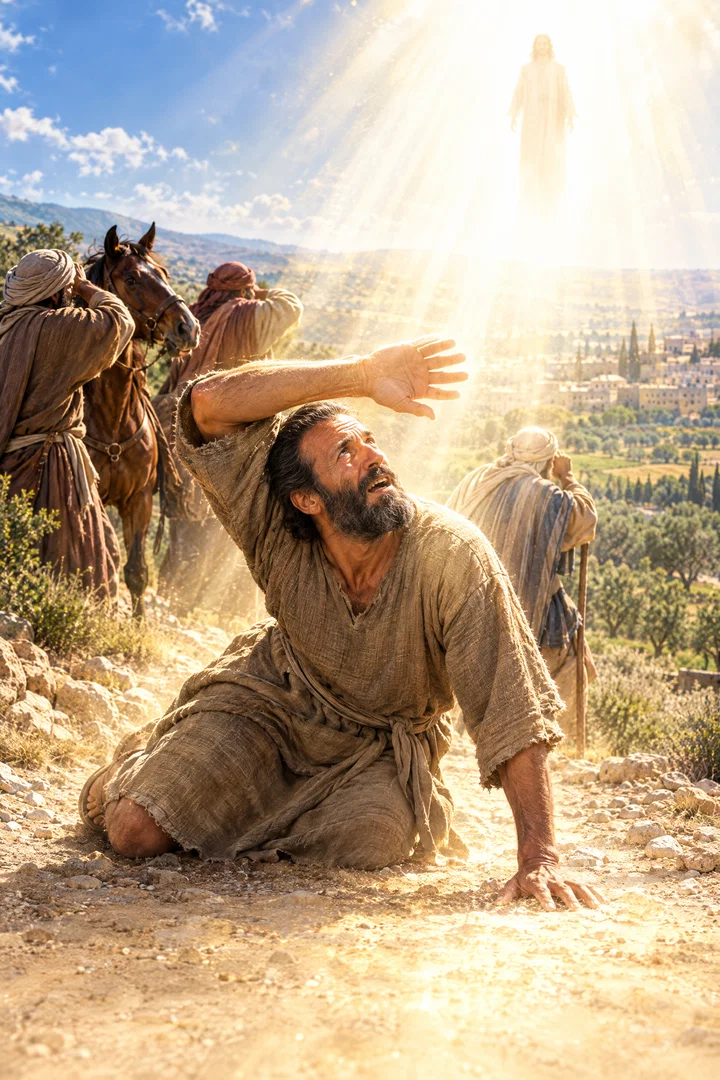
And the men which journeyed with him stood speechless, hearing a voice, but seeing no man.
Translations
American King James Version, King James Version, KJV Cambridge Paragraph Bible
And the men which journeyed with him stood speechless, hearing a voice, but seeing no man.
And the men who journeyed with him stood speechless, hearing a voice, but seeing no man.
Revised Version, American Standard Version
And the men that journeyed with him stood speechless, hearing the voice, but beholding no man.
And the men who are journeying with him stood speechless, hearing indeed the voice but seeing no one,
But the men who were travelling with him stood speechless, hearing the voice but beholding no one.
But, the men who were accompanying him, stood speechless,—hearing, indeed, the voice, but beholding no one.
Berean Standard Bible, Majority Standard Bible
The men traveling with Saul stood there speechless. They heard the voice but did not see anyone.
The men who traveled with him stood speechless, hearing the sound, but seeing no one.
And the men who were with him were not able to say anything; hearing the voice, but seeing no one.
The men also which iourneyed with him, stood amased, hearing his voyce, but seeing no man.
Douay-Rheims (Challoner revision)
And the Lord said to him: Arise, and go into the city, and there it shall be told thee what thou must do. Now the men who went in company with him, stood amazed, hearing indeed a voice, but seeing no man.
Pictures
Cross-references 20 of 25
- Acts 22:9
And they that were with me saw indeed the light, and were afraid; but they heard not the voice of him that spake to me.
contrasts hearing sound with understanding meaning
- Acts 26:12-18
Whereupon as I went to Damascus with authority and commission from the chief priests,
Paul recounts the Damascus encounter that changed his mission.
- Acts 9:15
But the Lord said unto him, Go thy way: for he is a chosen vessel unto me, to bear my name before the Gentiles, and kings, and the children of Israel:
Christ appoints Saul to carry his name to the Gentiles.
- Acts 9:17-20
And Ananias went his way, and entered into the house; and putting his hands on him said, Brother Saul, the Lord, even Jesus, that appeared unto thee in the way as thou camest, hath sent me, that thou mightest receive thy sight, and be filled with the Holy Ghost.
Saul regains his sight, is baptized, and begins preaching Christ.
- Acts 7:58-60
And cast him out of the city, and stoned him: and the witnesses laid down their clothes at a young man’s feet, whose name was Saul.
Stephen’s martyrdom, witnessed by Saul, precedes Saul’s conversion.
- John 12:28-29
Father, glorify thy name. Then came there a voice from heaven, saying, I have both glorified it, and will glorify it again.
Some hear God’s voice as thunder, while others recognize it as speech.
- Galatians 1:15-17
But when it pleased God, who separated me from my mother’s womb, and called me by his grace,
Paul recounts God’s call and his immediate response after the Damascus encounter.
- Acts 22:21
And he said unto me, Depart: for I will send thee far hence unto the Gentiles.
Jesus sends Paul to the Gentiles with the gospel.
- Acts 9:20-22
And straightway he preached Christ in the synagogues, that he is the Son of God.
Saul begins preaching Christ after his change.
- Acts 26:9-11
I verily thought with myself, that I ought to do many things contrary to the name of Jesus of Nazareth.
Paul recalls opposing Jesus and persecuting his followers before his conversion.
- Acts 8:1
And Saul was consenting unto his death. And at that time there was a great persecution against the church which was at Jerusalem; and they were all scattered abroad throughout the regions of Judæa and Samaria, except the apostles.
Saul’s consent to Stephen’s death precedes his conversion.
- Philippians 3:4-6
Though I might also have confidence in the flesh. If any other man thinketh that he hath whereof he might trust in the flesh, I more:
Paul's own account of his life before Damascus
- 1 Corinthians 15:8
And last of all he was seen of me also, as of one born out of due time.
Paul says the risen Christ appeared to him.
- Galatians 1:12
For I neither received it of man, neither was I taught it, but by the revelation of Jesus Christ.
Paul says his gospel came through a revelation of Jesus Christ.
- Acts 22:10
And I said, What shall I do, Lord? And the Lord said unto me, Arise, and go into Damascus; and there it shall be told thee of all things which are appointed for thee to do.
The Lord directs Paul after his conversion.
- 1 Corinthians 9:1
Am I not an apostle? am I not free? have I not seen Jesus Christ our Lord? are not ye my work in the Lord?
Paul cites having seen Jesus as evidence of his apostleship.
- Acts 26:11
And I punished them oft in every synagogue, and compelled them to blaspheme; and being exceedingly mad against them, I persecuted them even unto strange cities.
Paul recounts his zealous persecution before his conversion.
- Acts 26:22-23
Having therefore obtained help of God, I continue unto this day, witnessing both to small and great, saying none other things than those which the prophets and Moses did say should come:
Paul describes his ministry and witness to the Gentiles.
- 1 Timothy 1:13-16
Who was before a blasphemer, and a persecutor, and injurious: but I obtained mercy, because I did it ignorantly in unbelief.
Christ showed mercy and abundant grace to Paul, a former persecutor, as a pattern for believers.
- Acts 26:18
To open their eyes, and to turn them from darkness to light, and from the power of Satan unto God, that they may receive forgiveness of sins, and inheritance among them which are sanctified by faith that is in me.
Paul describes the change from darkness to service for God.
Commentary
Each commentary is drawn from primary sources: the writings of Ellen G. White and Adventist pioneers and periodicals. Each commentary is separate. Its own words are not a quotation; follow the references to read the source passages.
Ellen G. White
64 sources
The men journeying with Saul toward Damascus stood speechless because they heard a voice yet saw no one present.Ms 17, 1908, par. 18–28Ms 46, 1900, par. 16–21EW 167.1 A light from heaven brighter than the sun shone around them in terror and confusion, but while all was mysterious to them, Saul prostrate on the ground alone understood the words and saw Jesus the Son of God clearly before him.AC1 38.2–33SP 306.2–307.1 When the light left Saul blind, the witnesses of the event led him by the hand into Damascus.EW 167.13SP 310.2–311.1ST Dec 12, 1878 Jesus Himself spoke from heaven to arrest Saul, identifying Himself as the One Saul was persecuting in the person of His saints, and by the Holy Spirit convicted him of sin to stop his persecution and make him a messenger of the gospel.Ms 8, 1900, par. 2–3ST Jun 23, 1887AA 120.3–121.112MR 51.1–2Ms 148, 1897, par. 5–7 Though brought directly into Christ's presence, Saul was not then told his work nor taught truth directly, but was told to go into the city and placed in connection with Christ's church to learn God's will through appointed human agencies.AA 120.3–121.13T 432.23T 431.215MR 131.1–3SLP 30.2
Journey Toward Damascus
Saul was journeying toward Damascus with companions to find believers in Jesus and seize them.RH Mar 6, 1900Ms 46, 1900, par. 16–21Ms 8, 1900, par. 2–3Lt 107, 1904, par. 7–14 He was going to arrest Christians, to take men and women for imprisonment and death, being exceedingly mad against them and threatening, persecuting, imprisoning and killing them.RH Mar 6, 1900Ms 46, 1900, par. 16–21Ms 8, 1900, par. 2–3 The Commander of heaven saw the suffering brought upon His church and made His voice heard on that road to arrest the bold persecutor.Ms 8, 1900, par. 2–3
Saul had been taught by Gamaliel and was a rabbi and statesman and member of the Sanhedrin.RH Mar 6, 1900 He was zealous to suppress Christianity, had taken part in the stoning of Stephen, and made havoc of the church by entering houses and committing men and women to prison.RH Mar 6, 1900
Stephen's martyrdom came before Saul's conversion, and Stephen's faith, courage, constancy, godly appearance and glorified face, together with his words, remained in Saul's memory.7RED 35.3ST Dec 5, 1878SLP 19.2RH Feb 23, 1911 That lasting and deep impression contributed to his conversion.7RED 35.3ST Dec 5, 1878SLP 19.2RH Feb 23, 1911
Companions Hearing Unseen Voice
The men journeying with Saul stood speechless, hearing a voice but seeing no man or person present.Ms 17, 1908, par. 18–28Ms 46, 1900, par. 16–21EW 167.1SG1 90.2EW 166.2–3
Though they witnessed the encounter, they did not see the one who spoke and did not share Saul's sight of Jesus.EW 167.1SG1 89.1EW 166.2–3
Near Damascus a light from heaven above the brightness of the sun shone round about them, throwing Saul and his companions into the greatest confusion.AC1 38.2–33SP 306.2–307.1AA 114.1–115.17RED 38.2–3
The intensity of that glory struck the companions with terror and frightened them, almost blinding them.AC1 38.2–3AA 114.1–115.17RED 38.2–3ST Dec 12, 1878
To them all was unintelligible and mysterious.AC1 38.2–33SP 306.2–307.17RED 38.2–3ST Dec 12, 1878
Saul alone, lying prostrate on the ground, understood the words spoken.AC1 38.2–33SP 306.2–307.1AA 114.1–115.1ST Dec 12, 1878
He saw clearly before him Jesus the Son of God, and that image was imprinted forever upon his soul.AC1 38.2–3AA 114.1–115.17RED 38.2–3ST Dec 12, 1878
The hearing without seeing shows that heavenly agencies can communicate with men while remaining unseen.Ms 17, 1908, par. 18–28
The standing speechless of those men proves that heaven itself directly intervened, for the Commander of heaven saw the suffering brought upon His church in Saul's zeal to seize men and women for imprisonment and death and made His voice heard with light from heaven to arrest the bold persecutor.Ms 8, 1900, par. 2–3
When the heavenly light passed and left Saul blinded without sight, the companions who had witnessed it led him by the hand into Damascus.EW 167.1SG1 90.23SP 310.2–311.1ST Dec 12, 1878
So he who had set out expecting power entered the city helpless and dependent upon them.3SP 310.2–311.1
Saul Blinded Humbled Changed
The glory that struck Saul left him blinded so that when he arose he could see nothing, and the effect upon his eyes remained as a lasting mark of Christ's glory.AC1 50.1–27RED 50.3–51.1 He had neared Damascus in proud satisfaction, expecting honor from the high priest and applause for his zeal and penetration in searching out believers.SLP 25.3–26.1 He was determined that his journey would be crowned with success, that no Christian would escape his vigilance, and that he would inquire after men, women, and children and their connections, enter houses with power to seize them, and carry them as captives to Jerusalem to be condemned and punished without mercy.SLP 25.3–26.1 Instead he entered blind, helpless, dependent on the guidance of his companions who led him by the hand, virtually a prisoner rather than the powerful persecutor he had expected to be.SLP 25.3–26.13SP 310.2–311.1 Tortured by remorse, he felt himself under sentence of death and did not know what further disposition the Lord would make of him.SLP 25.3–26.1
The revelation humbled him by exposing that while he thought he was doing God service he had been persecuting Christ and using his power against the truth.RH Jun 3, 1902 The glory of the One he had blasphemed made him physically blind that he might receive spiritual sight.RH Jun 3, 1902 The encounter first filled him with terror and then became a source of consolation as he was transformed into a penitent believer.SLP 256.1 During the days and nights of blindness he had time for reflection and no longer saw himself righteous but sinful, with his thoughts, words, and actions condemned by the law.RH Jun 3, 1902 The thought of his zeal in persecuting God's people filled him with abhorrence of himself and bitter remorse, and like Isaiah he saw his own unworthiness.RH Jun 3, 1902PK 314.1–2RH Mar 25, 1915 Hopeless and helpless he cast himself on Jesus as the only one who could pardon him, clothe him with righteousness, and grant full and free forgiveness.RH Jun 3, 1902PK 314.1–2RH Mar 25, 1915 From a proud Pharisee who thought himself justified by good works and blameless touching the righteousness in the law, he struggled to give up his supposed righteousness and became a humble suppliant for mercy, with his tongue changed from blaspheming the name of Christ to sounding the praises of Him who called him out of darkness into marvelous light.RH Jun 3, 1902
Seeing the Lord gave him a glimpse of the beauty of God's character and of the loveliness of the divine character, and changed him.PK 314.1–2RH Mar 25, 1915 It inspired in him a desire for others to be freed from sin.PK 314.1–2RH Mar 25, 1915 That revelation made an impression that never lost its force on his mind, remaining with him to enable a correct representation of the Christian life and character.Lt 103, 1900, par. 19–22 It influenced his estimation and delineation of Christian character and of the obligation owed by man to God, and exalted him above every other apostle among believers in Christ.Lt 103, 1900, par. 19–22 That conversion gave him lasting assurance and encouragement for his later work.Ms 114, 1897, par. 11
Christ Convicts and Converts
Jesus Himself spoke to Saul from heaven on the road to Damascus, identifying Himself as the One Saul was persecuting in the person of His saints.Ms 8, 1900, par. 2–312MR 51.1–2Ms 148, 1897, par. 5–7Ms 1, 1895, par. 14–17 He had come full of zeal to take men and women for imprisonment and death, being exceedingly mad against believers, and the Commander of heaven made His voice heard with light from heaven to arrest the bold persecutor because of the suffering brought upon His church.Ms 8, 1900, par. 2–3Ms 1, 1895, par. 14–17 Christ miraculously arrested Saul in his course and by the Holy Spirit convicted his mind and heart of sin, stopping his persecution to make him a messenger of the gospel, especially to the Gentiles.ST Jun 23, 1887AA 120.3–121.13SP 312.2–3SLP 27.3AA 119.1–120.1 That revelation brought light to his mistaken understanding and showed the miraculous power that convicts people of sin.ST Jun 23, 1887AA 120.2SLP 27.3
Saul recognized that Jesus whom he had opposed and counted an imposter is indeed the Christ and Redeemer, the Son of God, the promised Messiah, the Author and foundation of all the religion of God's chosen people from Adam's day and the Finisher of the faith.ST Jun 23, 1887SG1 91.2Lt 54, 1874, par. 79–80 Convicted of sin by God's law, he recognized his sin, repented, died to sin, became obedient to the law, asked what the Lord wanted him to do, trusted Christ as his Saviour, was baptized, and began preaching Jesus.ST Jun 23, 18873T 432.23SP 312.2–33SP 320.1 His change from a persecutor of Jesus' followers into a believer who preached Jesus as earnestly and zealously as he had once condemned Him was brought about by overwhelming evidence, not by impulse or fanaticism.ST Jun 23, 1887SLP 33.1Lt 54, 1874, par. 79–80
Saul persecuted with strict conscientiousness, great zeal, sincerity and bitter prejudice, thinking that wiping out the saints, hailing them before judges, threatening, imprisoning and killing them was doing God service, but his zeal was not according to knowledge and he was in the wrong path.Ms 46, 1900, par. 16–21Lt 54, 1874, par. 79–80Lt 17, 1902, par. 17–20Ms 1, 1895, par. 14–17Ms 106, 1894, par. 3 Such sincerity and strict conscientiousness did not leave him guiltless once the Spirit impressed his cruel work upon him, for it does make a difference what a man believes even if he is sincere.Lt 54, 1874, par. 79–80Ms 106, 1894, par. 3 The more conscientious a man is in believing error, the more dangerous he becomes in opposing truth, but if converted he will be as zealous and persevering in spreading truth as he was in opposing it.Ms 1, 1895, par. 14–17Ms 106, 1894, par. 3 It is not safe to always follow the dictates of conscience, and conscience must be enlightened before spiritual things can be correctly discerned; the Lord's glory struck Paul blind to teach this, and the view given him of his wicked course was a terrible revelation to him that changed his character and his conscience.Lt 17, 1902, par. 17–20
With spiritual vision opened Saul learned that he had regarded Christ as making of none effect the law of God, but Christ came into the world for the express purpose of vindicating His Father's law, being its originator and foundation and the foundation and originator of the entire Jewish system of sacrifices.AA 120.2Lt 54, 1874, par. 79–80 In Christ's death at the crucifixion type met antitype, Old Testament prophecy was fulfilled, and Christ was seen as the vindicator of the truth and the fulfiller of all prophecies.AA 120.2Lt 54, 1874, par. 79–80 His apostleship came from God and not from men, with plain direction that his work was to be among the Gentiles, and his gospel came through revelation of Jesus Christ, not from human teaching.3SP 312.2–3AC1 50.1–2SLP 50.1–2ST Jun 12, 1879Ms 142, 1897, par. 13–15 The greatness of that call and the revelation that made Christ's mission and the distinction between living faith and dead formalism clear drove him to leave Damascus for Arabia for solitude with God for communion, contemplation, searching of heart, deepened repentance, prayer and study and earnest seeking until he knew his repentance was accepted, his great sin pardoned, and Jesus would be with him and had established him in faith with wisdom and grace for his coming ministry.AC1 50.1–2ST Jun 26, 1879
Directed to Christ's Church
Though brought directly into the presence of Christ to be fitted as a chosen vessel for a most important work, Saul was not immediately told the work assigned to him nor taught directly the lessons of truth he must learn.AA 120.3–121.115MR 130.3–5 When arrested in his course and convicted of sin he asked what he should do, and instead of answering directly Christ told him to arise and go into the city, placing him in connection with the church where they would tell him what he must do and he would learn God's will.AA 120.3–121.115MR 131.1–315MR 130.3–5 The account thus shows Christ directing Paul to receive further instruction through His church rather than independently of it, after conviction by God's law, repentance, obedience to the law, trust in Christ as Saviour, baptism, and beginning to preach Jesus.3T 432.23T 431.2
Christ's manner of working for the salvation of men is to work through appointed human agents and blessings that come through agencies He has ordained, rather than doing every part of the work directly Himself.3T 431.215MR 131.1–3SLP 30.2 He could have done all this work for Saul directly, but that is not His plan, so Paul had to take steps in his conversion and something to do in confession to those whose destruction he had meditated.3T 431.2SLP 30.2 He had to join the disciples he had persecuted and become a learner of them, and God gave a responsible work to do to the men He had authorized to act in His stead.3T 431.2SLP 30.2Lt 54, 1874, par. 79–80 Ananias served as Christ's representative in restoring Saul's sight and laying hands on him to receive the Holy Spirit.15MR 131.1–3 With spiritual vision opened he learned from the disciples that Jesus whom in blindness he had counted an imposter is indeed the Author and foundation of all the religion of God's chosen people from Adam's day and the Finisher of the faith, the vindicator of the truth and fulfiller of all prophecies.Lt 54, 1874, par. 79–80 Though he had regarded Christ as making of none effect the law of God, he learned that Christ was the originator and foundation of the entire Jewish system of sacrifices, that in Christ's death type met antitype, and that Christ came into the world for the express purpose of vindicating His Father's law.Lt 54, 1874, par. 79–80
Acts 9:1-18 gives principles to always remember about Christ and His organized and acknowledged church where He has a church.15MR 130.3–5 Christ does not sanction religious experience and exercise independent of His church.15MR 130.3–5
Warning and Encouragement Today
The speechless companions who heard a voice but saw no one prove that heaven itself stepped in to stop the maddened persecutor on his way to seize men and women for prison and death, and that all heaven cares for the believing church and will open a way for those who trust God.Ms 8, 1900, par. 2–3 The Commander of heaven saw the suffering laid on His church and made His voice heard, with light from heaven arresting Saul in full zeal, and Jesus Himself speaking to identify Himself as the One being persecuted.Ms 8, 1900, par. 2–3
Saul while still unconverted was hunting souls under Satan's use, and the whole chapter warns unconverted brethren to wake up and receive converting power lest Satan use them the same way to hunt and persecute souls.Lt 189, 1909, par. 21 History will be repeated, for as satanic agencies crucified Christ and as Lucifer exalted himself, that same self-exalting power will work through unconverted men in present and future experience.Lt 189, 1909, par. 21 Yet beneath hatred and contempt, even beneath crime and degradation, a soul may still be rescued by Christ's grace and become a jewel in the Redeemer's crown, as Saul of Tarsus, one of the most determined enemies of the gospel, became Paul the devoted minister of Christ. His change from persecutor to chief apostle stands as an example of mercy receiving the helpless.LS 101.1–102.2
Those who now oppose truth with bitter prejudice are no worse than Saul was when filled with bitter prejudice, and God can work mightily for such brethren.Lt 54, 1874, par. 87–88 Strong iron walls of prejudice can be broken down when God's servant is humble and teachable and molded by His Spirit, hides in God and lets His Spirit soften his spirit, refuses to get in the way and hedge up his own path, lets melting love and pity and tenderness dwell in his heart while he labors, clings to Jesus Christ, is ready to be counseled by more experienced brethren, is not too easily discouraged by difficulties or the fiercest opposition, and goes forth not in his own name but in the might and power of Israel's God, enduring hardness as a good soldier.Lt 54, 1874, par. 87–88
Paul was strict, zealous, and religious yet not a Christian until the Saviour revealed Himself to him, and that reveals the difference between being religious and being a true Christian.Lt 47, 1903, par. 23 Ever after that revelation Christ was to him supreme above all others and altogether lovely.20MR 155.2Lt 47, 1903, par. 23 The same thorough conversion is what ministers need before they are fitted for God's work, and what all require who with all their powers war against God's law, whose carnal minds are at enmity with God and not subject to His law, neither indeed can be, unless Christ is brought into life and character, without which profession of the Christian name is valueless.4T 446.2Ms 71, 1886, par. 4 Even as a persecutor his heart was susceptible to divine impressions.9T 238.5
Saul acted in conscientious error while threatening, persecuting, imprisoning, and killing Christians, and this proves that people in every church who do not know truth but live up to the best light they have, even while living in error in worshiping an idol sabbath, can be as conscientiously serving the Lord as Saul was until Jesus reveals Himself to them.Ms 46, 1900, par. 16–21 Sincerity does not remove the difference that belief makes, for the more conscientious a man is in believing error the more dangerous he becomes in opposing truth.Ms 106, 1894, par. 3 But if such a one becomes converted he will be as zealous and persevering in spreading truth as he was in opposing it.Ms 106, 1894, par. 3
Paul's sudden arrest while persecuting Christ's followers gave him a view of the Saviour that completely transformed him from zealous persecutor to devoted and effective worker for Christ.ST May 3, 1910 He had blasphemed His name and used every means to make others blaspheme, thinking that wiping out the saints, hailing them before judges, and bitter rage against them was doing God service, but his zeal was not according to knowledge and he was in the wrong path until Christ stopped him and showed him that in persecuting the saints he was persecuting Christ Himself.Lt 107, 1904, par. 7–14Ms 1, 1895, par. 14–17 When he saw his error he turned and joined the people he had thought worthy only of persecution, exchanged Phariseeism with its popularity, honor, and ambitious preferment for the gospel of Jesus Christ without counting it a sacrifice, served Christ through trials and humiliations, and at last suffered martyrdom for Him, his life wholly devoted to the Crucified One, his one aim to be faithful, to serve and honor Him whose name had once filled him with contempt, to win souls, counting his former righteousness of the law worthless and pressing to know Christ and the power of His resurrection.Lt 107, 1904, par. 7–14Ms 1, 1895, par. 14–17 That conversion experience was afterward related before kings and governors as testimony concerning Jesus, and his turn from religious tradition to liberty stands as the comparison for Farel's turn to the liberty of the sons of God.EW 172.3GC88 213.2–3
Sources
Pioneers and periodicals
128 sources
The companions stood speechless beside Saul, hearing a sound but seeing no one, sharing only part of what he experienced while terrified and nearly blinded by the intense light.ST Mar 10, 1914ST Feb 25, 1897ST Feb 25, 1897 What they heard was a confused noise whose words they did not grasp, while Saul both heard and understood the speech addressed to him, which explains why it is also said they did not hear the voice.ST Jun 26, 1884ST Oct 22, 1912ST Jun 21, 1883 The light that struck them all to the ground was the glory of the Lord, brighter than the noonday sun, felling the persecutor on his way to Damascus with authority to bind believers and leaving him blind and dependent on those he had led.ST Jan 15, 1902ST Jan 22, 1885RH Mar 13, 1856 His overthrow turned the chief persecutor into the chief apostle and preacher of the faith, commissioned directly by Christ as a witness of the resurrection and sent to the Gentiles.ST Oct 25, 1905ST Oct 17, 1895ST Jun 2, 1898 That turning marks the close of the seventy weeks allotted especially to the Jews, ending in autumn A.D. 34 when with Stephen's martyrdom and the scattering the gospel went fully to the Gentiles.ST Mar 2, 1882RH Jan 7, 1858RH Sep 20, 1870
Hearing Without Understanding
The men heard a voice or sound but did not understand the words spoken to Saul, while Saul both heard the sound and understood the message.ST Jun 26, 1884ST Oct 22, 1912ST Jun 21, 1883ST Apr 24, 1879ST May 30, 1911 Hearing can mean merely perceiving a sound or call and can also mean grasping speech, and in this second sense they did not hear the voice.ST Jun 26, 1884ST Oct 22, 1912ST Apr 24, 1879ST May 30, 1911ST Jun 2, 1898 This distinction reconciles the statement that they heard the voice with the statement in Acts 22:9 that they did not hear the voice, without making the accounts inconsistent.ST Jun 26, 1884ST Oct 22, 1912ST Jun 21, 1883ST Apr 24, 1879ST Jun 2, 1898 They heard the voice as a sound but saw no one, and did not hear in the sense of understanding what was spoken.ST Jun 26, 1884ST Oct 22, 1912ST May 30, 1911ST Jun 2, 1898
The Greek word for hear means to hear, hearken, listen to, obey, know and understand, and the word for voice means sound, noise as of thunder, report, and articulate voice.RH Aug 14, 1860RH Sep 11, 1860 Luke records that they heard a sound or noise but saw no man, while Paul in his own rehearsal states that they did not understand the voice speaking to him, so the two accounts do not contradict.RH Aug 14, 1860RH Sep 11, 1860 They heard a report but not an articulate voice, hearing only a confused noise without distinguishing or understanding the words the Lord spoke to Paul.RH Aug 14, 1860RH Sep 11, 1860
They heard only a confused noise and did not distinguish the words, more probably not even so hearing as to know that words were spoken at all.RH Sep 11, 1860RH Jan 16, 1872 This was as when the hearers of the voice from heaven said it thundered, while Paul alone heard words uttered.RH Jan 16, 1872 They heard the sound of all the words spoken between Saul and Jesus from the heavenly light, including his repentant question and the command to arise and go into the city to be told what he must do, but without their meaning.RH Jan 16, 1872ST Mar 26, 1902
Companions on the Road
Saul was on his way to Damascus with letters and authority from the priests and rulers at Jerusalem to find all who confessed Christ, bind them, and bring them to Jerusalem, breathing threats and slaughter as a persecutor who had held the garments of those who stoned Stephen, made havoc of the church by entering houses and committing men and women to prison, and pursued the humble followers with malicious intent in the harsher traits of religio-political Israel.RH Mar 6, 1900ST Mar 11, 1897RH Dec 16, 1915ST Jun 16, 1914 He traveled as a rabbi and statesman taught by Gamaliel and member of the Sanhedrin, zealous to suppress Christianity, marching in great pomp with his servants and expecting soon to carry out his purpose.RH Mar 6, 1900RH Dec 16, 1915 In persecuting the followers he was persecuting Christ himself, and on that journey Christ interposed in behalf of His followers, stopping the company with bright light from heaven and the voice of Jesus and through that intervention saving both Saul and those whom Saul would have persecuted.RH Mar 6, 1900ST Mar 11, 1897RH Dec 16, 1915
The men journeying with him stood speechless, hearing a voice but seeing no man, so they only partly shared in what was seen and heard when his journey was interrupted by the light from heaven.ST Feb 25, 1897ST Feb 25, 1897RH Dec 10, 1908ST Apr 26, 1910 They were filled with fear and terror, nearly blinded by the intense light, and the dazzling form and voice stopped Saul's boasts.ST Mar 10, 1914ST Dec 12, 1878 What they heard was unintelligible and mysterious to them, for they heard the speaking without seeing anyone present, while Saul unlike them understood the words and clearly saw that the speaker was the Son of God, the crucified Jesus, which revealed his former ignorance and error and his need for the Holy Spirit's enlightenment.RH Mar 6, 1900ST Mar 10, 1914 Their presence as men who heard a voice and saw no person supports an objective encounter rather than a private vision caused by sunstroke, which does not explain Saul's immediate change into a preacher.ST Apr 26, 1910
The proud leader was made helpless and became dependent on his own companions.ST Dec 12, 1878ST Jan 22, 1885ST Mar 26, 1902 When Saul arose he could see nothing, having been made blind by the glory, and his companions who had witnessed the heavenly encounter but could not see the person speaking led the now-blind Saul by the hand into Damascus.RH Mar 6, 1900ST Dec 12, 1878ST Jan 22, 1885 There he remained sightless for three days, trembling and fallen to the earth and asking what the Lord wanted him to do, told to arise and go into the city where he would be told what he must do.RH Mar 6, 1900ST Jan 22, 1885
Jesus revealed His heavenly glory to the persecuting Pharisee, brighter than the sun at midday, so that the men journeying with him were also struck by that glory and all fell prostrate to the earth. Saul was made blind by it and was restored to sight only by Christ's miracle-working power manifested through the church, remaining in Damascus to be taught the gospel and receiving the Spirit.RH Dec 16, 1915 The One so revealed in glory was the same personal Saviour who had lived among men in loving ministry as one common among men, passing for the carpenter's son of Nazareth whose earthly brothers were known, and who was condemned to death as a blasphemer for persistently saying He was the Son of God.
Conversion of Saul
The light on the road was the glory of the Lord, infinitely greater than the sun at its strongest, appearing at noon and striking Saul to the ground.ST Jan 15, 1902RH Mar 13, 1856ST Oct 31, 1916 As an enemy of Christ he could not look upon it, and he fell and was blinded, showing that mortal men cannot endure Christ glorified.ST Jan 15, 1902RH Mar 13, 1856 The encounter was prodigious, astonishing, startling and life-changing.ST Feb 7, 1900RH Dec 17, 1872ST May 4, 1876
Saul fell to the ground and recognized himself as the chief of sinners when the light from heaven and gentle voice pierced him.ST Jan 22, 1885 Even amid overwhelming signs and the darkness that followed he remained self-controlled and asked what he was to do, showing he recognized a call for action rather than giving way to terror.RH Jan 22, 1857 He soon responded by asking what the Lord wanted him to do, obeying the Lord, trembling, and going into Damascus.ST Jan 22, 1885ST Jun 5, 1901
The glory left him unable to see, so he had to be led by the hand to Damascus and remained without sight for three days, without eating or drinking, to be taught the gospel.RH Nov 13, 1900 His sight was restored through Ananias, after which he received the Spirit.RH Nov 13, 1900 The first revelation came with a divine brightness that badly damaged his eyes, and the resulting defect remained as an affliction in the flesh, seen in his large handwriting in Galatians and in his inability to write well with his own hand so he had to use another writer.RH Nov 13, 1900RH Oct 8, 1901
The conversion is the chief thing recorded in Acts 9, turning the persecutor who tried to destroy the faith into its extoller, advocate, preacher and chief apostle.ST Oct 25, 1905ST Jun 2, 1898ST Jul 24, 1879 From breathing threats and hatred for the church he came to love and labor for the cause, from violent persecutor to meek, nonresisting Christian who himself suffered persecution and became a martyr.RH Dec 19, 1912RH Jun 16, 1863 His first experience stopping him while campaigning against Christ differed from visions after conversion.RH Jun 16, 1863 Once filled with hatred he became a preacher of Christ, a champion of the truth, and the great apostle to the Gentiles, his earlier Pharisaic religion having been real and zealous but not bringing him to accept the truth about Jesus.ST Jul 24, 1879RH Dec 19, 1912RH Jun 16, 1863
He at once began to preach Christ with power, confounding the Jews by proving that Jesus is the Christ and Son of God.ST Jul 18, 1900 He could preach so soon because Christ was in him; he knew the Lord personally and had only to tell what he knew, which is all any preacher has to do or should do.ST Jul 18, 1900 His immediate power also rested on prior knowledge of Scripture learned as a Pharisee at the feet of Gamaliel, which gave the Holy Spirit a foundation to work with, enabled him at once to see the true light in the Scriptures and use them effectually, and his great force and faculties were not newly created but put to a new purpose.ST Jul 18, 1900
The miraculous appearance stopped his persecution and brought light to his mistaken understanding, showing him that Jesus whom he opposed was the Christ and Redeemer.ST Jun 23, 1887 The divine revelation broke through beliefs formed by early education and early teaching, exposed his sin, ignorance and need for the Spirit, and enabled him to begin to see the truth, after which he was sent to a fellow believer for further instruction.RH Sep 2, 1909RH Sep 2, 1909 That revelation made Christ's mission and his work among the Gentiles clear to him, including the distinction between living faith and dead formalism, and gave him a view of the Saviour that transformed him from zealous persecutor to devoted and effective worker.ST May 3, 1910ST Jun 26, 1879 The blindness that followed pictured the blindness of his mind, while the scales falling from his eyes pictured the Word shining within him and scattering the darkness of tradition, leading him to recognize his sin, repent, accept Christ, be grateful his eyes were opened, and preach him.ST Jun 23, 1887ST Dec 8, 1898
The appearance on the road was the basis of his apostolic call and his ministry received from heaven.ST Oct 17, 1895 He was chosen by the Lord Himself in a miraculous manner that could not be questioned, receiving commission directly from Christ as a witness of the resurrection with apostolic authority often accredited by miracles.ST May 27, 1897 So no assaults of the enemy could ever shake his faith in his divine commission, and he knew who called him.ST May 27, 1897
End of Seventy Weeks
The conversion on the road marks the termination of the seventy weeks, the 490 years cut off from the 2,300 years and allotted especially to the Jews, ending in autumn A.D. 34 when the time allotted to the Jews ended forever.ST Mar 2, 1882RH Jan 7, 1858RH Sep 20, 1870RH Jul 28, 1863RH Dec 23, 1852 The men traveling with Saul stood speechless during his encounter, hearing a voice but seeing no one, and that event belongs to the turning of the apostles to the Gentiles after the Jewish leaders and Sanhedrin formally rejected Christ by persecuting His disciples.ST Mar 2, 1882RH Sep 20, 1870RH Jul 28, 1863RH Dec 23, 1852RH Feb 22, 1870 God at that point commissioned Paul as the apostle to the Gentiles.RH Jul 28, 1863RH Dec 23, 1852RH Feb 22, 1870
Those who place the same events in A.D. 35 teach that Christ appeared to Saul personally on the road to Damascus and gave him his mission to the Gentiles after the Jewish Sanhedrin had rejected Christ by persecuting His disciples.RH Dec 23, 1852ST Mar 26, 1912RH Dec 19, 1907 That conversion marks the beginning of a new era in the church and the close of the final year of the prophetic week.RH Dec 23, 1852ST Mar 26, 1912RH Dec 19, 1907
The autumn A.D. 34 date stands three and a half years after the crucifixion in the spring of A.D. 31 in the midst of the seventieth week and three and a half years after the end of the sixty-nine weeks in the autumn of A.D. 27 when Christ commenced His ministry. Together with the martyrdom of Stephen and the formal rejection of the gospel by the Jewish Sanhedrim in the persecution and scattering of His disciples, the events of Acts 9:1-18 mark the termination of the seventy weeks and the turning of the apostles to the Gentiles.ST Sep 2, 1913RH Nov 12, 1901 After Christ's personal work of teaching and healing during the first half of the week and the ministry of the apostles during the second half, and soon after the martyrdom of Stephen, Paul was converted to become the great apostle to the Gentiles, closing the final half-week of special ministry to the Jews.ST Sep 2, 1913ST Aug 31, 1915RH Nov 12, 1901 At that same time the Jews permanently rejected the gospel, the middle wall of partition between Jews and the rest of the world was broken down, and the word turned to the Gentiles, forming with Stephen's martyrdom and the scattering the second rejection of Christ that brings the 490 years to their end in A.D. 34.ST Sep 2, 1913RH Nov 12, 1901
The conversion of Saul and his commission to the Gentiles opened the work of the gospel among them, after the period when that work had been directed exclusively to the Hebrews.ST Mar 18, 1889ST Jan 30, 1879ST Mar 26, 1912 Christ appeared to him on the road to Damascus, commissioned him as an apostle to the Gentiles, and thereby helped prepare him to accept the call to the Gentiles.ST Mar 18, 1889ST Jan 30, 1879ST Mar 26, 1912 That conversion followed Stephen's martyrdom and preceded Paul's work as the great apostle to the Gentiles.ST Mar 26, 1912ST Dec 19, 1892 It occurred about three years after the crucifixion and is dated about A.D. 34, identified as the beginning of the seventeen-year period leading to his later visit to Jerusalem.RH May 26, 1853ST Dec 19, 1892 Paul's conversion took place after the other apostles had spent three and one half years with Christ.ST Feb 15, 1910
Church Cooperation and Doctrine
God does not finish the work of bringing souls into the kingdom alone but brings His children home through various agencies, with the army above always cooperating with the children below so that no man and no angel can claim a soul saved by his labor alone and sower and reaper rejoice together.ST Sep 30, 1908 He does not come directly to those outside the church but reveals Himself to them through His church, using a human agent to speak to those who are without.ST Mar 4, 1913ST Apr 3, 1884 Jesus Himself stopped Saul on the journey and showed him he was persecuting the Son of God in His saints, exposing his sin and beginning his conversion, yet after Saul asked what he should do Christ placed him in connection with the church and its appointed ministers for direction rather than telling him directly.ST Apr 3, 1884RH Aug 24, 1916RH Sep 2, 1909 He was sent to a disciple to be told what to do and to receive further instruction through the church, to teach mutual dependence, to honor human agents, and to associate His people with Him in saving souls so they may share its joy.ST Sep 30, 1908ST Mar 4, 1913RH Aug 24, 1916RH Sep 2, 1909 A glorious angel would frighten the sinner, while the Spirit convicts and a human bears the message of life, and a divine revelation that broke through beliefs formed by early education was thus followed by sending to a fellow believer for further instruction.ST Sep 30, 1908RH Sep 2, 1909
Saul's prayer was heard and answered before he was baptized.RH Aug 3, 1876 After conviction and restoration he was baptized without delay, fellowshipped with the disciples at Damascus, and straightway preached Christ in the synagogues that He is the Son of God.RH Oct 27, 1868RH Aug 3, 1876 That baptism expressed faith in Christ's resurrection, yet the chapter records no keeping of a new Sabbath for that purpose, showing no new first-day Sabbath had been instituted as its memorial.RH Nov 21, 1871
In his gospel experience he passed from death unto life when, as chief of sinners going to destroy the people of God, Jesus spoke to him in an audible voice and he was three days without sight and neither ate nor drank.RH Oct 27, 1868 That blindness and helplessness was the covenant of ten commandments slaying him so that he died to sin, and in that slain state he prayed.RH Oct 27, 1868 Ananias was then sent to lay hands on him so he received sight and was filled with the Holy Ghost, was baptized, was strengthened with food, fellowshipped, and preached, so that by the holy, just, and good law violators under the gospel are slain and then made alive unto God through Jesus Christ.RH Oct 27, 1868 His conversion about three years after the crucifixion thus shows turning from transgressing God's law to keeping it, after conviction of sin and forgiveness through Christ.RH May 26, 1853
God brought the truth to Saul by an unusual means because of his integrity, unselfishness, and zeal, though he had been prejudiced against the followers of Jesus.ST May 17, 1883 He had persecuted while feeling free in his conscience, until God's Spirit shone on his heart and he recognized his error.RH Jan 16, 1866 His calling did not guarantee his final salvation, but he had to accept and obey the truth, with his own choices and faithfulness remaining necessary.ST May 17, 1883
True conversion is immediate and complete, not a partial work content with enrollment and safety, and Paul was converted at once and thoroughly and therefore went forth a mighty man with fruits proving it. It can happen in a moment, while sanctification unlike conversion is a lifelong growth in Christian character.ST Jun 7, 1883 Paul saw the Lord, learned his own wretched condition, was humbled, and accepted the Lord, and these are the same elements found in every conversion though they need not come with the same outward manifestations.ST Dec 8, 1898 Every sinner whatever the degree of disobedience, even a persecutor of Christians, must be changed and born again from above before standing in God's presence, as Saul was born again and became a great apostle.ST Jul 7, 1909 Conversion is always a miracle wrought by God's power but not always by external supernatural agencies, the great essential being a changed purpose and direction of life when previously contrary to God's plans and character, most marked when most antagonistic, repeated when thieves, drunkards, degraded men, terrors, and persecutors become rescuers, preachers, missionaries, kings, and apostles, as Paul was transformed from persecutor to one ready to suffer for His name.ST Sep 29, 1909
Visions given to Saul and Ananias after the ascension show God continuing to communicate with the Christian church through visions.RH Jun 26, 1855 The Lord's personal appearance to Paul on the road and His direction of Paul's movements show He continued to supervise and direct the gospel work.ST Jun 26, 1901 The turning of Saul to the Lord by the literal presence and appearance of Jesus is the most conspicuous example of His manifesting His presence in the ingathering of converts, an act of individual care in daily administration fulfilling His promise to be with them. An apostle standing as the Lord's representative, when speaking by direction of the Holy Spirit, speaks the word of God through him carrying the power of God's command.ST Jan 22, 1902 That a man was sent to Paul with a message from the Lord did not make Paul's gospel received from man, because its source was Christ.ST Dec 1, 1898
Helping Saul in the way and giving further instruction was reserved to Ananias a disciple, for Christ sends messages of comfort and instruction by angels to His church but His church must then bear them to souls in need and travail for those born into the kingdom, and angels personally reveal themselves as helpers only to those who by faith are God's children while God honors human servants with a share in saving souls.ST Aug 25, 1898 Saul saw Christ in His spiritual body, recognized through spiritual sight rather than ordinary eyes while the men with him saw no person, supporting that Christ's post-resurrection presence was perceived through spiritual senses.RH Nov 26, 1872
Through the Holy Spirit's power to convict of sin Saul came to recognize Jesus as the one who vindicated God's law, originated the Jewish sacrificial system, fulfilled its types, and fulfilled the Old Testament prophecies of Israel's Redeemer.ST Mar 10, 1914 Before conversion he trusted his own doings and self-righteousness instead of Jesus crucified, who is made righteousness, wisdom, redemption, and sanctification.RH Jul 20, 1911 God made a Paul out of a Saul, proving His power sufficient to regenerate any heart that does not resist His Spirit and that where sin abounds grace does much more abound.RH Jul 20, 1911
True Miracle Defended
The Damascus experience with men present hearing a voice and seeing no one was an objective miracle, not a feverish vision or delusion of sunstroke or other natural cause dismissed by philosophy.ST Apr 26, 1910ST May 19, 1909ST Jun 20, 1916RH Jun 23, 1910 Their presence, standing speechless as they heard a voice and saw no one, supports a real supernatural encounter rather than a private vision caused by sunstroke.ST Apr 26, 1910ST Apr 26, 1910 Reducing it to sunstroke minimizes the miraculous and calls the Bible account into question.ST Jun 20, 1916 Saul's immediate transformation from persecutor into a powerful preacher, and the greatness of all that has come out of that experience, show its reality and divine origin.ST Apr 26, 1910ST May 19, 1909RH Jun 23, 1910 The true record of Saul's conversion is a genuine miracle of conversion and not a figment of superheated imagination, shown by modern counterparts openly enacted, a radical change of heart in a vigorous opposer so that what he heartily endorsed he now opposes with all his might, with present zeal born of personal contact and most bitter experience.ST Dec 30, 1913
The persecuting Saul becoming the affectionate apostle, advocate and friend proves the power of the gospel on character and the power of truth to change an opponent into its supporter.RH Oct 16, 1860RH Apr 18, 1865 It turned a proud, unsocial Jewish persecutor into a disinterested lover of mankind.RH Oct 16, 1860 His changed life and willingness to die for Christ show the power of the gospel.RH Sep 19, 1912 As the bitterest enemy breathing threats and slaughter while enemies tried to stamp out truth by sword and prison and scattering believers, he came into direct touch with the power of Jesus, was overcome by it, yielded to it, and became the great apostle to the Gentiles.ST May 25, 1904 His change proves the mighty converting influence still in the Name of Jesus after His death, able to turn its fiercest opponent into its leading advocate.ST May 25, 1904 When a fierce enemy became convinced Christianity was true and devoted the rest of his life to advocating it, his conviction and lifelong advocacy became evidence for Christianity, and the experience and conversion he later testified about stand as evidence of Christ's power.RH Jan 14, 1862RH Apr 3, 1900
The miracle is not unique in history; its exact details have not been repeated, but the same result has been brought about times without number, giving perpetual evidence of the truth of Christianity.ST Sep 29, 1909 No other religion is marked by this repeated miracle of conversion, for Buddhists, Confucianists, and Moslems are born into their faiths and educated into their religion, with conversion practically unknown among them.ST Sep 29, 1909 The Christian religion is different, in that discipleship is personal surrender to Jesus Christ as Lord and Saviour, and the way Paul entered is open to all ages and classes, young and old, rich and poor, Jew and Gentile.ST Sep 29, 1909 His conversion argues that a spiritual change producing faith can have a divine cause, resting on the spiritual influence shown in conversion, not on the miracles that accompanied Paul.RH Jan 10, 1854
Ties to Other Scriptures
The overwhelming effect of the Lord meeting Paul and his companions on the way to Damascus was much like the effect of the majestic personage who appeared to Daniel by the Hiddekel, when Daniel alone saw the vision while the men with him were seized with quaking and fled and Daniel himself lost all strength.RH Dec 20, 1870 Unlike that personage beside the Hiddekel, who was an angel and not the Lord, the One who met Paul and his company was the Lord Himself.RH Dec 20, 1870
Confronted with divine glory, Saul of Tarsus saw himself in his true light for the first time, realizing as never before how far short he was of the perfect standard and how he partook of the sinfulness of his surroundings, just as Isaiah realized his uncleanness because his eyes had seen the King.ST Oct 6, 1898 The blindness that followed the light on the road pictured the blindness of his mind, while the scales falling from his eyes when Ananias spoke pictured the Word shining within him and scattering the darkness of tradition.ST Dec 8, 1898
Stephen's martyrdom made a deep impression on Saul, and the memory of Stephen's faith, constancy, and glorified face left a lasting impression and contributed to Saul's conversion, though the exact part that death played cannot be determined.ST Dec 5, 1878RH Feb 23, 1911 Saul had consented to Stephen's death but afterward became one of the staunchest defenders of the same truths Stephen had advocated, and his conversion was the fruit of that martyrdom.ST Feb 4, 1897 That conversion took place soon after Stephen was stoned and soon after his death and the persecution that scattered the church, within a persecution that eventually ended and spread the gospel to many places, and Saul later became Paul, the apostle to the Gentiles.ST Jul 18, 1911ST Jun 20, 1916
Paul repeated the story of his conversion later in Acts, and the number of times he repeated it and the instances where the repetitions are found are to be given.ST Jun 9, 1898 He tells it again in his Hebrew defense from the castle stairs to the Jerusalem crowd, including what happened to those journeying with him, his blindness and being led into Damascus, and the part of Ananias, a devout Jew well reported of by all the Jews at Damascus, in coming to Saul, restoring his sight, telling him what was appointed for him to do, and calling him to be baptized.ST Mar 31, 1898
The companions encountered the heavenly sign but did not distinguish the spoken voice as Paul did, for they heard a sound and saw the light yet could not discern the voice's message.RH Dec 18, 1900 This illustrates that the whole world may encounter the light surrounding the angel's warning, while only God's people recognize its call to come out of Babylon and escape the plagues.RH Dec 18, 1900 While opposing Christ, Saul in his first encounter with the Lord's glory was struck down and blinded by the heavenly light, unlike Stephen, who calmly saw the glory of God and Jesus.ST Jan 15, 1902
Call to Personal Change
The glory that struck Saul blind in body was given to open his sight in spirit, humbling him by showing that while he thought he was serving God he was persecuting Christ and fighting the truth with his power.RH Jun 3, 1902 In the days and nights of blindness he reflected and no longer saw himself righteous but sinful, with his thoughts, words and acts condemned by the law.RH Jun 3, 1902 His zeal in persecuting God's people filled him with self-abhorrence and bitter remorse, and hopeless and helpless he cast himself on Jesus as the only one who could pardon him and clothe him with righteousness.RH Jun 3, 1902 From a proud Pharisee who counted himself justified by good works and blameless in legal righteousness he struggled to surrender his supposed righteousness and became a humble suppliant for mercy, his tongue turned from blaspheming Christ's name to sounding praise to Him who called him from darkness into marvelous light.RH Jun 3, 1902 Seeing the Lord and the loveliness of the divine character brought him to see his own unworthiness, to receive full and free forgiveness as a changed man, and to desire that others be freed from sin.RH Mar 25, 1915
Education and position cannot overcome self-reliance, and heavenly light had to strike him to the earth and leave him blind before he would acknowledge Jesus as Messiah.RH Dec 14, 1916 His great force had been used in wickedness and was then directed to God's service, his faculties not newly created but put to a new purpose.ST Jan 14, 1875ST Dec 17, 1912 A man of temper, intense passion, purpose and energy, a ringleader bold and brave in sin, had that same ardor and energy controlled by grace turned into eminent leadership in aggressive work for God.RH Jun 20, 1871 Temper mastered by rule gives grit for overcoming the world, so those who lament strong tempers and repeated falls may learn that their disposition can be made very useful in the Lord's cause rather than disqualifying them.RH Jun 20, 1871 Once surrendered he became a powerful defender and messenger of the faith, the fierce persecutor converted into a leading apostle.RH Dec 14, 1916ST Dec 17, 1912
He had been a hater and persecutor, but when the Spirit of the God of love entered his heart his hatred vanished.ST May 3, 1899 Filled with love he thereafter risked his life to carry the truth to his enemies and persecutors.ST May 3, 1899 He passionately followed a mistaken conviction, then discovered his error and changed course, showing that passionately wrong conviction must be corrected.ST Aug 29, 1911 His example shows how the heart affects belief and openness to truth.ST Nov 13, 1879
Even a bitter persecutor who encounters God may see and believe, so those strongly opposed to the truth may yet accept it.RH Apr 24, 1913 God made a Paul out of a Saul, proving His power sufficient to regenerate any heart that does not resist His Spirit, where sin abounds grace much more abounding, instead of trusting own doings and self-righteousness rather than Jesus crucified made righteousness, wisdom, redemption and sanctification.RH Jul 20, 1911 His conversion is the pattern for one who turns from opposing a cause to helping build up what he once tried to tear down, made into a willing worker to do God's bidding.ST Sep 27, 1877RH Mar 31, 1874 So it was with a veritable Saul become Paul who for fifteen years knew the truth while bitterly opposing it, resisting his children keeping the Sabbath and studying the Bible while his wife kept the Sabbath and bore his opposition patiently for years with prayer, until ministers visited and his heart was worked upon.RH Sep 8, 1910 Through the grace of God and the influence of his godly family he became thoroughly converted, with eleven Sabbath-keepers in his own family, was solemnly ordained by laying on of hands as elder of a church, and helped carry forward the work among his own people.RH Sep 8, 1910
Jesus after His ascension appeared to Saul while persecuting Christians, striking him down and leaving him without sight, and defenders of the Inquisition appeal to that striking down and blinding as an example from Christ and His apostles authorizing severity against heretics.ST Jan 1, 1894 Met before Damascus by heaven's glory made visible in a material sense, he was struck blind, showing that great heavenly light given in bodily form can be followed by physical blindness.ST Oct 13, 1898 Rejecting divine light brings physical darkness, disease and death, and Palestine, blessed above every other country with manifestation after manifestation of heaven's light made visible, bears prevailing blindness as a curse resting on land and people for rejecting the light of truth.ST Oct 13, 1898
Paul knew who had called him and commissioned him to preach the gospel, and acted without consulting other people or letting their wishes sway his sense of duty.RH Dec 25, 1900 His change from Judaism to Christianity is to be recognized fairly and not accused as fickleness by evil surmising.RH Sep 22, 1874
Sources