Daniel 4:15
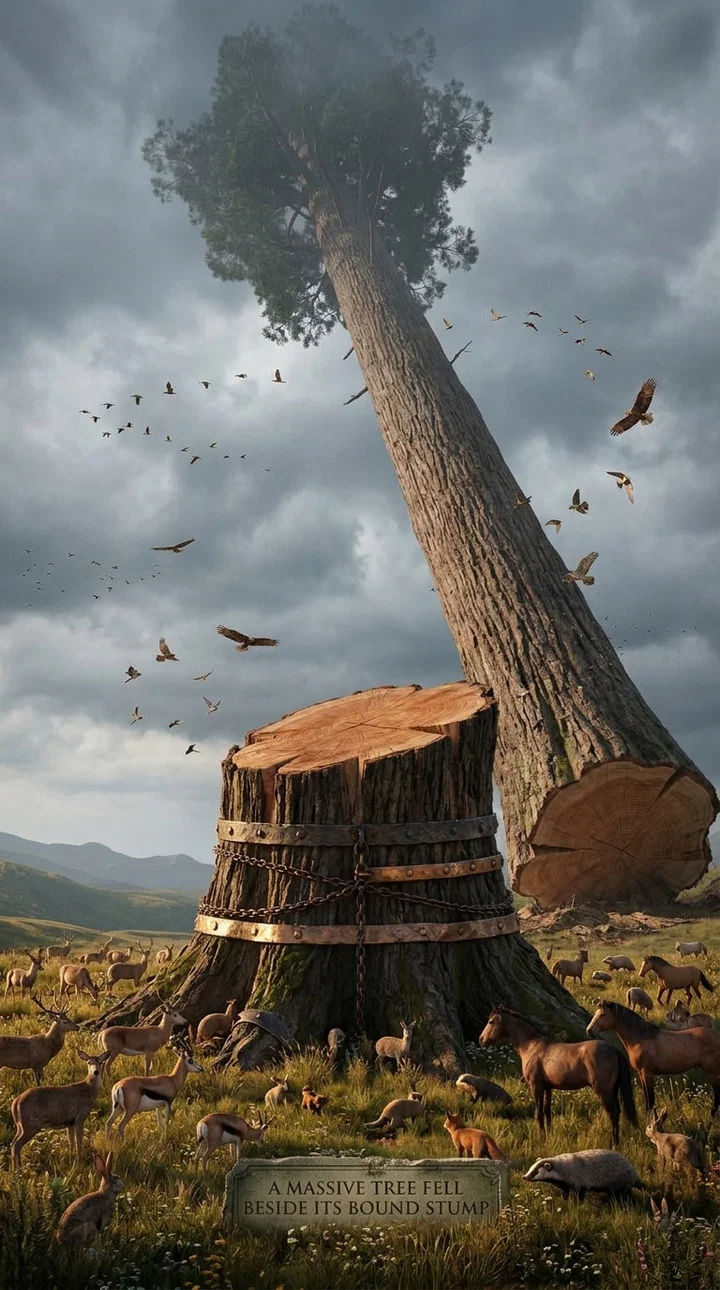
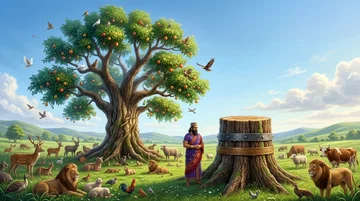
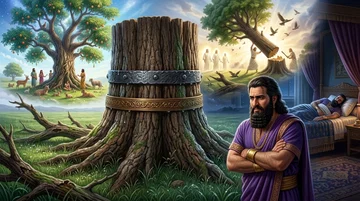
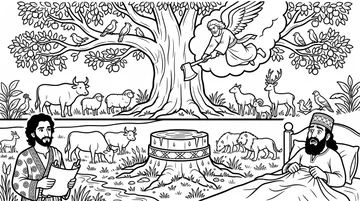
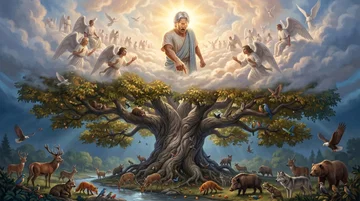
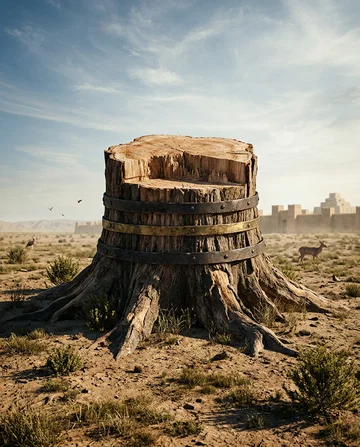
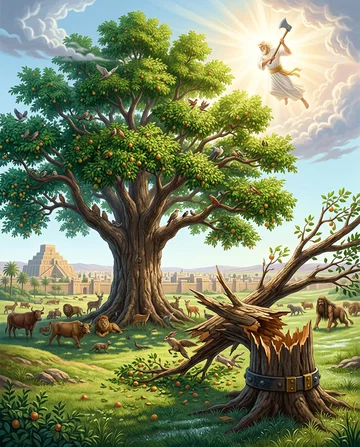
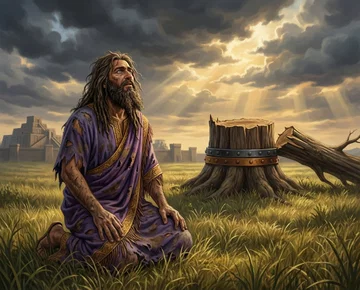
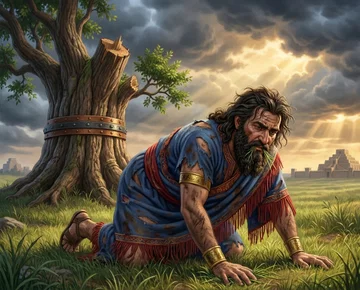
Nevertheless leave the stump of his roots in the earth, even with a band of iron and brass, in the tender grass of the field; and let it be wet with the dew of heaven, and let his portion be with the beasts in the grass of the earth:
Translations
American King James Version, King James Version, Revised Version
Nevertheless leave the stump of his roots in the earth, even with a band of iron and brass, in the tender grass of the field; and let it be wet with the dew of heaven, and let his portion be with the beasts in the grass of the earth:
nevertheless leave the stump of his roots in the earth, even with a band of iron and brass, in the tender grass of the field; and let it be wet with the dew of heaven, and let his portion be with the beasts in the grass of the earth:
Nevertheless leave the stump of its roots in the earth, even with a band of iron and brass, in the tender grass of the field; and let it be wet with the dew of heaven, and let its portion be with the beasts in the grass of the earth.
Nevertheless leave the stump of its roots in the earth, even with a band of iron and brass, in the tender grass of the field; and let it be wet with the dew of heaven: and let his portion be with the beasts in the grass of the earth:
but the stump of its roots leave in the earth, even with a band of iron and brass, in the tender grass of the field, and with the dew of the heavens is it wet, and with the beasts [is] his portion in the herb of the earth;
Nevertheless leave the stump of its roots in the earth, even with a band of iron and brass, in the tender grass of the field; and let it be bathed with the dew of heaven, and let his portion be with the beasts in the grass of the earth.
Nevertheless, the stock of its roots in the earth, leave ye, yea in a bond of iron and bronze, in the tender grass of the field, and, with the dew of the heavens, let it be drenched, and, with the wild beasts, be its portion, amongst, the herbage of the earth;
But leave the stump with its roots in the ground,
and a band of iron and bronze around it,
in the tender grass of the field.
Let him be drenched with the dew of heaven
and graze with the beasts on the grass of the earth.But leave the stump with its roots in the ground, with a band of iron and bronze around it, in the tender grass of the field. Let him be drenched with the dew of heaven and graze with the beasts on the grass of the earth.
Nevertheless leave the stump of its roots in the earth, even with a band of iron and bronze, in the tender grass of the field; and let it be wet with the dew of the sky. Let his portion be with the animals in the grass of the earth.
But keep its broken end and its roots still in the earth, even with a band of iron and brass; let him have the young grass of the field for food, and let him be wet with the dew of heaven, and let his part be with the beasts.
This is the dreame, that I King Nebuchad-nezzar haue seene: therefore thou, O Belteshazzar, declare the interpretation thereof: for all the wisemen of my kingdome are not able to shewe mee the interpretation: but thou art able, for the spirit of the holy gods is in thee.
Douay-Rheims (Challoner revision)
Nevertheless leave the stump of its roots in the earth, and let it be tied with a band of iron, and of brass, among the grass, that is without, and let it be wet with the dew of heaven, and let its portion be with the wild beasts in the grass of the earth.
Pictures

Cross-references
- Daniel 4:25
That they shall drive thee from men, and thy dwelling shall be with the beasts of the field, and they shall make thee to eat grass as oxen, and they shall wet thee with the dew of heaven, and seven times shall pass over thee, till thou know that the most High ruleth in the kingdom of men, and giveth it to whomsoever he will.
Describes Nebuchadnezzar’s humbling until he recognizes that the Most High rules human kingdoms.
- Daniel 4:34-37
And at the end of the days I Nebuchadnezzar lifted up mine eyes unto heaven, and mine understanding returned unto me, and I blessed the most High, and I praised and honoured him that liveth for ever, whose dominion is an everlasting dominion, and his kingdom is from generation to generation:
Describes Nebuchadnezzar’s restoration after his humiliation.
- Daniel 2:38
And wheresoever the children of men dwell, the beasts of the field and the fowls of the heaven hath he given into thine hand, and hath made thee ruler over them all. Thou art this head of gold.
Both dreams portray Babylon’s king and kingdom under God’s rule.
- Daniel 4:33
The same hour was the thing fulfilled upon Nebuchadnezzar: and he was driven from men, and did eat grass as oxen, and his body was wet with the dew of heaven, till his hairs were grown like eagles’ feathers, and his nails like birds’ claws.
Nebuchadnezzar’s foretold humiliation is fulfilled as he lives among the beasts.
- Daniel 4:26
And whereas they commanded to leave the stump of the tree roots; thy kingdom shall be sure unto thee, after that thou shalt have known that the heavens do rule.
The preserved stump signifies Nebuchadnezzar’s restored kingdom after he recognizes heaven’s rule.
- Daniel 4:30
The king spake, and said, Is not this great Babylon, that I have built for the house of the kingdom by the might of my power, and for the honour of my majesty?
Nebuchadnezzar’s boast triggers the judgment foretold in the dream.
- Jeremiah 27:6-7
And now have I given all these lands into the hand of Nebuchadnezzar the king of Babylon, my servant; and the beasts of the field have I given him also to serve him.
Nebuchadnezzar rules by God’s appointment, yet his dominion has a divinely set limit.
- Daniel 4:23
And whereas the king saw a watcher and an holy one coming down from heaven, and saying, Hew the tree down, and destroy it; yet leave the stump of the roots thereof in the earth, even with a band of iron and brass, in the tender grass of the field; and let it be wet with the dew of heaven, and let his portion be with the beasts of the field, till seven times pass over him;
The stump and its iron-and-brass band are repeated in the dream’s explanation.
- Daniel 5:20-21
But when his heart was lifted up, and his mind hardened in pride, he was deposed from his kingly throne, and they took his glory from him:
Belshazzar is reminded of Nebuchadnezzar’s humiliation by God.
- Daniel 4:20-22
The tree that thou sawest, which grew, and was strong, whose height reached unto the heaven, and the sight thereof to all the earth;
Daniel identifies the tree as the king and his dominion.
- Daniel 5:22-23
And thou his son, O Belshazzar, hast not humbled thine heart, though thou knewest all this;
Belshazzar knew Nebuchadnezzar’s lesson but still exalted himself and defied God.
- Daniel 4:32
And they shall drive thee from men, and thy dwelling shall be with the beasts of the field: they shall make thee to eat grass as oxen, and seven times shall pass over thee, until thou know that the most High ruleth in the kingdom of men, and giveth it to whomsoever he will.
The judgment fulfills the dream, while affirming that the Most High rules over kingdoms.
- Daniel 2:19-28
Then was the secret revealed unto Daniel in a night vision. Then Daniel blessed the God of heaven.
Daniel received a vision from God and revealed and interpreted Nebuchadnezzar’s earlier dream.
- Daniel 4:37
Now I Nebuchadnezzar praise and extol and honour the King of heaven, all whose works are truth, and his ways judgment: and those that walk in pride he is able to abase.
truth revealed by the tree dream
- Daniel 7:4
The first was like a lion, and had eagle’s wings: I beheld till the wings thereof were plucked, and it was lifted up from the earth, and made stand upon the feet as a man, and a man’s heart was given to it.
The lion’s plucking and restoration recalls Nebuchadnezzar’s insanity and humbling.
- Daniel 3:28-29
Then Nebuchadnezzar spake, and said, Blessed be the God of Shadrach, Meshach, and Abed-nego, who hath sent his angel, and delivered his servants that trusted in him, and have changed the king’s word, and yielded their bodies, that they might not serve nor worship any god, except their own God.
The furnace deliverance convinced Nebuchadnezzar that God ruled above earthly kings.
- Daniel 4:1-3
Nebuchadnezzar the king, unto all people, nations, and languages, that dwell in all the earth; Peace be multiplied unto you.
Nebuchadnezzar proclaims God’s signs and wonders to all peoples and languages.
- Daniel 4:9
O Belteshazzar, master of the magicians, because I know that the spirit of the holy gods is in thee, and no secret troubleth thee, tell me the visions of my dream that I have seen, and the interpretation thereof.
king asks Daniel to tell vision and meaning
- Daniel 4:27
Wherefore, O king, let my counsel be acceptable unto thee, and break off thy sins by righteousness, and thine iniquities by shewing mercy to the poor; if it may be a lengthening of thy tranquillity.
Daniel urges Nebuchadnezzar to turn from his sins before judgment.
Commentary
Each commentary is drawn from primary sources: the writings of Ellen G. White and Adventist pioneers and periodicals. Each commentary is separate. Its own words are not a quotation; follow the references to read the source passages.
Ellen G. White
22 sources
The order from heaven cuts down the lofty tree but leaves its stump bound with iron and brass in the grass, wet with dew and sharing the portion of the beasts.7MR 66.1–67.1Lt 71, 1894, par. 27–31Lt 51a, 1897, par. 6–7 The tree is Nebuchadnezzar in his God-given greatness and prosperity as head of the nations gathered under him.8T 126.313MR 63.1–3 The sentence left unfulfilled in the stump means he would lose throne and reason, be driven to live as a beast eating grass for seven years, yet not be utterly destroyed but preserved until he learned that the Most High rules over human kingdoms.Ms 15, 1896, par. 13–16Lt 114, 1903, par. 12–147MR 66.1–67.1Lt 51a, 1897, par. 6–713MR 64.1–2 It stands as God's warning against pride and self-exaltation, to bring down human strength that the Lord alone may be exalted.Lt 71, 1894, par. 27–31Lt 11a, 1886, par. 4–513MR 63.1–3 The command by the watcher shows that heaven sees every work, word, motive and secret thought, and will bring pride into judgment in order to correct and reform.Ms 29, 1895, par. 17Ms 29, 1895, par. 19–22Lt 41, 1898, par. 10–13Lt 120, 1899, par. 18–20
Tree, Stump and Sentence
This was another dream God gave to Nebuchadnezzar after he had acknowledged the God of the three Hebrews as the living God when he saw the form of the Fourth in the fiery furnace, but he did not continue to walk in the light and lost the holy impression made on his mind.Ms 15, 1896, par. 4–613MR 60.1–61.2 The lofty tree planted in the earth and reaching to heaven represented his greatness and prosperity.8T 126.313MR 63.1–3 That prosperity had been given him by God for the glory of God, in the kingdom designated as the head of gold.13MR 63.1–3 Its shelter for flocks and herds from the mountains and hills and for the birds of the air building their nests in its branches meant nations were gathered under his sovereignty, and his kingdom was firmly established in the hearts of his loyal subjects.8T 126.3
By order of a watcher and holy one come down from heaven the tree reaching to heaven would be hewn down.Lt 71, 1894, par. 27–31 But the stump of its roots would be left in the earth, bound with a band of iron and brass in the tender grass of the field, wet with the dew of heaven, with its portion with the beasts and sharing their dwelling and food.7MR 66.1–67.1Lt 71, 1894, par. 27–31Lt 51a, 1897, par. 6–7PK 515.2–516.2 The retained stump and roots indicated the tree was not wholly destroyed.Lt 51a, 1897, par. 6–7 Although the great tree was cut down, its root stump was preserved in the earth, secured with iron and bronze.7MR 66.1–67.1Lt 51a, 1897, par. 6–7PK 515.2–516.2
The stump represented Nebuchadnezzar: his kingdom and human reason would be taken from him, yet he would not be utterly destroyed but preserved while reduced to a beast-like condition.7MR 66.1–67.1 The sentence of the dream was that he would lose his throne and reason, be driven from men to dwell with the beasts of the field, eat grass like oxen and be wet with dew.Ms 15, 1896, par. 13–16Lt 114, 1903, par. 12–1413MR 64.1–2 He would live like a beast and remain in that condition for seven years, seven times passing over him, until he knew that the Most High rules in the kingdoms of men and gives it to whomsoever He will.Ms 15, 1896, par. 13–16Lt 114, 1903, par. 12–1413MR 64.1–2 His reason was misused in self-glorification, and he was humbled because he did not honor God.Ms 15, 1896, par. 13–16
The dream was very striking and explicit, given to the greatest ruler and most powerful king of his time.13MR 63.1–3 Nebuchadnezzar himself related it and called for its interpretation, and its significance troubled Daniel.13MR 64.1–2 The magicians, astrologers, soothsayers and Chaldeans could not make it known or tell its interpretation, because those who do not love and fear God cannot understand the mysteries of the kingdom of heaven and cannot approach the throne of Him who dwells in unapproachable light, while the servants of God understand the things of God.13MR 63.1–3 Daniel told the dream and its interpretation before the king because he was esteemed for unswerving integrity, faithfulness in honoring God at all times and in all places, unexcelled wisdom, and refusal to compromise to secure court position or even to preserve life when God's honor was involved, and the king remembered him as the only one who had given relief in earlier perplexity when this later perplexing vision came.13MR 63.1–3
Daniel explained the warning with a call to break off sins by righteousness and iniquities by showing mercy to the poor to lengthen tranquility.Lt 71, 1894, par. 27–3113MR 64.1–2 But the light from heaven was not accepted and exerted no saving influence upon his character.13MR 64.1–2 After twelve months of testing in which his actions were weighed in the balances of the heavenly sanctuary, his boast that he had built great Babylon by the might of his own power for the honor of his own majesty brought the instant voice from heaven that the kingdom was departed from him.Lt 71, 1894, par. 27–31 That fulfilled the divinely decreed banishment from human society, whose account also includes his conversion and miraculous restoration.Lt 71, 1894, par. 27–31PK 522.2 The verse belongs to the prophecy of Nebuchadnezzar's seven times, a predicted time period whose events were fulfilled in accordance with the prophecy.GC88 323.2GC 323.2–324.2
Pride, Judgment and Restoration
The dream laid out Nebuchadnezzar's future history as God's warning against self-exaltation and pride.Lt 71, 1894, par. 27–3113MR 63.1–3 It called him to trace out the end of all earthly things and the setting up of God's everlasting kingdom instead of following the imaginations of his proud heart in thinking his kingdom should become more extensive and powerful.Lt 71, 1894, par. 27–3113MR 63.1–3 Elevated and deceived by prosperity, he placed a high estimate on himself and did not consider God his source of strength.Lt 71, 1894, par. 27–31Lt 11a, 1886, par. 4–5 The moment he spoke his boast over what he had built, the sentence felled the tree, leaving the stump to mean the blessings God had bestowed were removed and his reason taken away.Lt 71, 1894, par. 27–31Lt 11a, 1886, par. 4–5
The stump left in the field means God surely punishes pride in many ways.Lt 11a, 1886, par. 4–5 He brings down anyone lifted up by a sense of his own ability who trusts in human strength.Lt 11a, 1886, par. 4–5 He does so to teach utter weakness that the proud may feel need of divine aid, for the Lord alone is to be exalted and glory belongs in nothing but Christ and Him crucified.Lt 11a, 1886, par. 4–5 Nebuchadnezzar's life therefore stands as a warning not to cherish his proud, self-exalting thoughts and feelings.Ms 15, 1896, par. 4–613MR 60.1–61.2 It warns not to set God aside and trust in one's own wisdom, nor to make human strength one's support, lest the same trying experience come upon those who entertain them.Ms 15, 1896, par. 4–613MR 60.1–61.221MR 53.3–4
The same judgment will surely fall on those with great light who through unholy confederacy sustain one another to do what God warned them not to do to carry out ambitious projects.Lt 71, 1894, par. 27–31 For God as Lord over all will uproot them and bring their plans to confusion.Lt 71, 1894, par. 27–31 His case also warns against acting with supremacy and exercising authority over God's people.Lt 71, 1894, par. 27–31Lt 188, 1901, par. 1 God's lessons are meant to lead people to reform, and neglecting the light and refusing to receive and practice them brings judgment and costs benefits that obedience would have received.Lt 71, 1894, par. 27–31Lt 201, 1899, par. 3–4 Yet if they repent and humble themselves and trust God to do justice and judgment they will find pardon, peace, acceptance, and another trial and proving.Lt 71, 1894, par. 27–31
Watcher Who Sees All
The felling of the tree was ordered and announced by an unseen heavenly watcher, and the leaving of its stump shows that the heavenly universe is acquainted with all the works of men.Ms 29, 1895, par. 17Lt 41, 1898, par. 10–13Lt 120, 1899, par. 18–20 A Watcher guards the interests of all men and sees all that is done.Ms 29, 1895, par. 19–22 He is present in all assemblies, including councils and committees, taking cognizance of what is done, and He is present in secret councils as well as open councils.Ms 29, 1895, par. 17Ms 29, 1895, par. 19–22
Every individual is before Him, and not a thought of the heart is unnoted.Ms 29, 1895, par. 19–22 He sees every plan and imagination, nothing can be hid from Him, and His ear hears the secret whispering of self-gratulation.Ms 29, 1895, par. 19–22 His eye reads men and measures men, and God observes and weighs people's words, motives, decisions and every deed.Ms 29, 1895, par. 19–22Lt 41, 1898, par. 10–13Lt 120, 1899, par. 18–20
Turning from God's word to human ideas and plans leaves responsible men without excuse, for He that sitteth in the heavens requires a different spirit to control proceedings.Ms 29, 1895, par. 17 Selfishness, self-exaltation and pomposity are abominated by God, are detrimental to all within their sphere, and develop a character so objectionable that its possessor cannot find a place among the redeemed.Ms 29, 1895, par. 17 Every secret thing is to be brought into judgment, and the Watcher will not long bear the perversity of men who have had great light and great opportunities.Ms 29, 1895, par. 17Ms 29, 1895, par. 19–22 His chastisement reveals pride that places self where God should be, in order to correct the sin that would otherwise ruin the soul.Ms 29, 1895, par. 19–22 Those who take a measuring line to measure character and climb upon the judgment seat to pass sentence upon others must humble their hearts before Him or they will make grievous mistakes.Ms 29, 1895, par. 19–22
Sources
Pioneers and periodicals
50 sources
The dream showed a vast tree sheltering the whole earth ordered to be cut down with its branches lopped and its fruit scattered, yet its rootstock was to be left alive in the ground bound with iron and brass amid the grass to share the dew and the lot of the beasts.RH Jan 2, 1900RH May 15, 1900ST Apr 12, 1905ST Oct 16, 1901 The felling meant Nebuchadnezzar's glory and rule would be brought low, while the stump left in the earth meant his kingdom would be kept secure for him and restored after his humiliation.ST Dec 23, 1897ST Jan 16, 1912RH Aug 22, 1907ST Jan 16, 1912 For seven literal years he would be deposed from his throne and driven from men to live as a beast eating grass and exposed to the dew, his reason taken and his body degraded until he learned humility.RH Nov 22, 1906ST Dec 29, 1887RH Jan 23, 1908RH Aug 12, 1875 The whole decree was to teach that the Most High rules in the kingdom of men and gives it to whom He will, and that heaven's chastening brings kings to acknowledge His supreme dominion.ST Dec 23, 1897ST Oct 18, 1905ST Dec 29, 1887ST Aug 9, 1910ST Apr 12, 1905 In that judgment mercy was mingled with a sure hope of restoration upon repentance, and his public proclamation of it was to lead all peoples to worship the true God and learn the folly of pride.RH Jan 2, 1900ST Jul 16, 1912RH Apr 10, 1916ST Apr 12, 1905
Dream Words and Setting
The verse stands in the dream of the great tree reaching to heaven and overshadowing and sheltering all the earth.ST Apr 12, 1905ST Oct 16, 1901 In the dream a holy watcher who takes cognizance of earthly things comes down from heaven and commands to hew down the tree, cut off its boughs and branches, shake off its leaves, scatter its fruit, and drive away beast and fowl from under and from it.ST Apr 12, 1905ST Oct 16, 1901 The tree is to be cut down and stripped, yet not to be destroyed utterly.ST Apr 12, 1905ST Oct 16, 1901 The one represented by the tree is to be humiliated to the utmost till seven times pass over him, with his heart changed from man's to beast's.ST Apr 12, 1905ST Oct 16, 1901
What is left by command is the stump of its roots in the earth, bound as with a band of iron and brass, in the tender grass of the field.RH Jan 2, 1900RH May 15, 1900RH Sep 25, 1900ST Oct 16, 1901 It is to be wet with the dew of heaven and to have its portion with the beasts in the grass of the earth, brought low among the beasts and exposed to the dew.RH Jan 2, 1900RH May 15, 1900RH Sep 25, 1900 The stump and roots are thus preserved in the ground and restrained and secured with iron and bronze, marking that the tree and the rule it represents will not be utterly destroyed.RH Jan 2, 1900RH May 15, 1900RH Sep 25, 1900 That preservation belongs to a judgment mingled with mercy, connected with the king's seven-year affliction and restoration to power, and with the heavenly watcher's rule over nations and their interests.RH Jan 2, 1900RH Sep 25, 1900
The word for being made wet with the dew of heaven uses a form of bapto in a secondary sense rather than meaning dip.ST Apr 22, 1880 That use does not establish the meaning of baptizo, the word used for the ordinance of baptism.ST Apr 22, 1880 The verse belongs to the historical part of Daniel, which chronologically comes before the events of Daniel 7 even though the book places the prophetic section after it.ST Apr 5, 1877 It belongs at the same time to the prophecies of Daniel beginning with the captivity of Judah.ST Jan 24, 1911
The verse is part of Nebuchadnezzar's own royal proclamation to all peoples, nations and languages that dwell in all the earth.ST Dec 29, 1887ST Oct 16, 1901 In it the king of Babylon himself tells of himself and Babylon and Daniel and God and the signs and wonders the Most High God wrought toward him.ST Oct 16, 1901 The account of his pride, of the judgment that came upon him, and of the blessing and glory he received from God was thus made known to the nations and languages throughout his realm and dominion.RH Feb 13, 1900ST Feb 4, 1886 It was written by the king for all posterity, copied from clay tablets or black basalt slabs, and faithfully preserved through Daniel though idolatrous successors sought to obliterate the knowledge and worship of the true God from Babylonian history.ST Oct 16, 1901
It belongs to God's warning to Nebuchadnezzar in Daniel 4:4-27, which foretold that he would be driven out from men and live wild for seven years.ST Dec 29, 1887 By that judgment he learned that Jehovah rules in the affairs of men and is above all gods, that His signs are great and His wonders mighty, and that His kingdom is an everlasting kingdom and His dominion from generation to generation.ST Dec 29, 1887ST Oct 16, 1901 When his understanding returned he published the signs and wonders of the high God unto all people, nations and languages that dwell in all the earth, holding open the lesson missed by Nimrod the first king of Babylon.ST Dec 29, 1887ST Oct 16, 1901 After being brought to a full acknowledgment of the true God he published a decree to that effect to all the nations of his dominion, yet that testimony had no discernible impression on those who followed him in the kingdom.ST Feb 4, 1886
The verse is part of the inspired record of Nebuchadnezzar's experience.ST Jul 16, 1912 That does not show that Nebuchadnezzar himself was inspired or that his own words were inspired.ST Jul 16, 1912 He came to recognize that God was just and right, that his own ways were evil, and submitted to God.ST Jul 16, 1912
Judgment Tempered With Mercy
The great tree hewn down is Nebuchadnezzar's kingdom and glory cut down and his rule brought low, yet the stump of its roots left in the earth means his kingdom would remain secure and be preserved through his humiliation to be restored afterward.ST Dec 23, 1897ST Jan 16, 1912ST Dec 1, 1909ST Jan 16, 1912ST Jun 10, 1913 The stump and roots remaining bound in the earth, exposed to the field, signify that his kingdom and life were not wholly destroyed but kept for restoration after he learned that heaven rules.ST Jan 16, 1912RH Aug 22, 1907ST Dec 1, 1909ST Jan 16, 1912ST Jun 10, 1913 The tree itself represents the Babylonian kingdom, while the king's changed life as a beast represents Nebuchadnezzar's own humiliation for seven years, driven to live among the beasts and be wet with heaven's dew and eat grass.ST Dec 23, 1897ST Jan 16, 1912RH Aug 22, 1907ST Jun 10, 1913
The band of iron and brass about the stump marks that preservation, protecting it as a source of possible future growth and greatness during the appointed period.ST Dec 23, 1897ST Jan 16, 1912ST Jan 16, 1912 God Himself kept the kingdom for him until the judgment's set time ended and his period of insanity was finished, so his rule was not destroyed permanently.ST Dec 23, 1897ST Jan 16, 1912ST Jan 16, 1912
The stump thus left shows judgment mingled with mercy and a blest ray of hope of restoration, watered by the dews of heaven even while a portion is appointed among the beasts until seven times pass over him.RH Jan 2, 1900ST Apr 12, 1905 This stands in contrast to the final destruction of the wicked, who will be cut down root and branch without any remnant of hope. The dream's detail of the stump and roots restrained with iron and bronze belongs to the king's being brought low among the beasts and exposed to the dew through his seven-year affliction unto restoration to power.RH Jan 2, 1900ST Apr 12, 1905
The stump left in the ground represents the continuation of his kingdom, while the iron and brass band and the dew and grass and living among the beasts describe his condition during his affliction.ST Jul 11, 1911ST Dec 3, 1896RH Oct 22, 1901 His being driven from human society to eat grass and live exposed shows his humbling did not mean his rule was beyond God's control, for God humbled him when he tried to take God's place by directing worship and punishing those who would not worship as he decreed.ST Jul 11, 1911ST Dec 3, 1896RH Oct 22, 1901
Seven Years of Humiliation
The decree pronounced seven times upon the king, meaning seven literal years in which he would be deposed from his kingly throne and royal office.ST Dec 29, 1887RH Aug 12, 1875 If he refused God's counsel he would be driven out from men and from human society to live wild in the fields among the beasts.ST Dec 29, 1887RH Oct 22, 1901 That driving out and living wild for seven years was foretold in the warning of Daniel 4:4-27.ST Dec 29, 1887
During that time he would eat grass as the oxen eat it, living in the fields exposed to the dew.ST Jul 29, 1875RH Aug 12, 1875RH Oct 22, 1901 His nails grew out like birds' claws and his hair like eagles' feathers.ST Jul 29, 1875RH Aug 12, 1875 He was brought down to the level of the brute creation, given a beast's heart and brought into a degraded bestial condition of madness and loss of reason.RH Nov 22, 1906RH Jan 23, 1908RH Oct 22, 1901
The humiliation was a warning of what pride would bring upon him.RH Nov 22, 1906 That pride was his presumption in assuming to himself the glory of building Babylon.ST Mar 18, 1903 Daniel told him he might have avoided the calamity by turning from sin and showing mercy to the poor.RH Nov 22, 1906ST Jan 17, 1906
The loss of throne and reason was temporary and time-limited, with recovery indicated in the dream itself.RH Jan 2, 1900 Through seven years of affliction he was taught his utter weakness under the supreme God.RH Apr 25, 1912 After he humbly acknowledged God's rule he was lifted up from the earth, his understanding and intellect returned, and he was restored to power with a sane appreciation of his humble position as a man in relation to Almighty God.RH Jan 2, 1900RH Jan 23, 1908
God's Sovereign Rule
The stump left standing was left to this intent, that the king and all who live might learn that the Most High rules in earth as well as heaven, in the kingdom of men, gives it to whom He will, and sets up over it even the lowest of men.ST Oct 18, 1905ST Dec 29, 1887ST Apr 12, 1905ST Oct 16, 1901RH May 29, 1900 The great overshadowing tree reaching to heaven was to be hewn down in the night dream by command of the holy watcher from heaven, its boughs cut off, its leaves shaken off and its fruit scattered, yet not destroyed utterly, for the stump of its roots was to remain bound as with iron and brass in the earth, watered by the dews of heaven and given a portion among the beasts with a heart changed from man's to beast's till seven times passed over him.ST Dec 23, 1897ST Apr 12, 1905ST Oct 16, 1901 That warning, given in Daniel 4:4-27 after pride filled the king's heart, foretold that he would be driven out from men, deposed and humiliated to the utmost, and live wild for seven years.ST Dec 29, 1887ST Apr 12, 1905ST Oct 16, 1901 Through that chastisement he learned humility, that Jehovah rules in the affairs of men and is above all gods, that God rules in human kingdoms, and that homage was owed to God by him as both a man and a king.ST Oct 18, 1905ST Dec 29, 1887 This truth belongs with the dream of the image and the deliverance of the three Hebrews from the furnace as a threefold revelation of the gospel of the kingdom, that He is the King of heaven whose works are truth and whose ways are judgment, and when understanding returned the king published the signs and wonders the high God had wrought unto all peoples, nations and languages dwelling in all the earth, so that all men might put confidence in God, not forget His doings and keep His commands, as personal as if each had passed through it himself, as God's witness of Himself to Babylon and to all nations under her empire, though the message was disregarded, the living God was not glorified, and Babylon's greatness waned under his successors.ST Dec 29, 1887RH May 29, 1900
The surviving stump, exposed to the field and dew, means his kingdom would be preserved through his humiliation and restored after he learned that heaven rules, with the band of iron and brass marking that preservation during the appointed period.ST Dec 23, 1897 God is thereby shown as the One able to rule, interested in all the affairs of men as well as nations, with a message for the last days.ST Aug 9, 1910 He rules over human kingdoms and teaches their rulers that only those in harmony with His righteous rule can endure.ST Oct 18, 1905ST Dec 1, 1914
God humbled Nebuchadnezzar when he tried to take God's place by directing worship and punishing those who would not worship as he decreed, and his attempt to force worship on others and control worship in disobedience to his decree showed that God, not the king, rules in matters of righteousness and religion.ST Jul 11, 1911ST Dec 3, 1896ST Jul 1, 1903 The warning was that he would be driven from human society and live in the fields for seven years if he refused God's counsel, and his stump was preserved while he was brought low and made to live among the beasts, showing that his humbling and being brought to the level of the beasts did not mean his complete destruction or that his rule was beyond God's control.ST Jul 11, 1911ST Dec 3, 1896 The dream foretold his deposition from his kingly throne, the humiliation itself, and its cause and reason, by which God humiliated the renowned Nebuchadnezzar.ST Jun 28, 1899 Belshazzar knew about that humiliation and its reason, yet his presumption went beyond his predecessor's, and his public defiling of the vessels of the Lord's house was intended to insult the God who had humiliated Nebuchadnezzar.ST Jun 28, 1899
Prophecy Time and Fulfillment
The verse belongs to the symbolic prophecy of the tree whose meaning is fully unfolded by divine interpretation fearlessly applied.RH Sep 2, 1909 Prophecy was given to disclose future events, and its key is found in the Bible itself by comparing scripture with scripture.RH Sep 2, 1909 Together with six other divinely interpreted prophecies, this prophecy furnishes the basis and key for correct general interpretation of symbolic prophecy.RH Sep 2, 1909
The dream is a prophecy accompanied by a divine interpretation that can be compared with history to establish the reliability of fulfilled prophecy.RH Mar 8, 1915 It foretold the calamity that would come upon Nebuchadnezzar if he did not turn from sin and show mercy to the poor.ST Jan 17, 1906 Its fulfillment demonstrated God's knowledge of the future and control over earthly kings, and after his affliction Nebuchadnezzar acknowledged Jehovah as God.ST Jan 17, 1906
The seven times are a definite chronological period foretold in advance, once only a matter of prophecy.RH Feb 18, 1873 The time-limited events in that prophecy were fulfilled in accordance with the prediction.RH Apr 18, 1854RH Feb 18, 1873RH Mar 31, 1868 So it stands with the 120 years to the flood, the 400 years of Abraham's seed, the 40 years in the wilderness, the 70 years' captivity, the seventy weeks upon the Jews, and the other stated times that were fulfilled.RH Feb 18, 1873 Its fulfillment proves that events predicted to occur within a given time do occur within that time, and therefore that the prophetic periods still extending to the advent will likewise be fulfilled on time.RH Feb 18, 1873 The experience shows that a time in prophecy is a year, so that a time and times and half a time is three and one-half years, or forty-two months, or twelve hundred and sixty prophetic days, which are twelve hundred and sixty years.RH Sep 18, 1900 The narratives of the chapter, as well as its explicitly prophetic sections, are more or less prophetic, and the chapter teaches practical lessons of life to the rulers and nations of the earth.ST Oct 21, 1908
Witness and Life Application
The stump left in the earth belongs to the preaching of the gospel of the kingdom in Babylon, by which the king was brought to acknowledge and worship the true God, to see that God was just and right and his own ways evil, to submit to God, and to testify to all the world of God's goodness, wisdom, truth and judgment.ST Jul 16, 1912RH Apr 10, 1916ST Nov 26, 1912RH May 29, 1900 The tree and then its stump formed an object lesson which, together with his earlier experience, led to his conversion.ST May 27, 1908 That dream of the tree and the affliction it foretold were given again and again as God's healing message to Nebuchadnezzar and Babylon, and when at last received the king was healed, his sins broken off by righteousness, and Babylonian confusion and despair exchanged for certainty of truth and everlasting bright hope, demonstrating in his life what God intended for all.ST Nov 26, 1912
This truth was published by royal proclamation to all the world so that all men might put confidence in God, not forget His doings and keep His commands, making the lesson as personal as if each one had passed through the experience himself.RH May 29, 1900 After being brought to full acknowledgment of the true God he published a decree to that effect to all the nations of his dominion.ST Feb 4, 1886 Yet the message was disregarded and the living God was not glorified, Babylon's greatness waned under his successors, and the testimony had no discernible impression on those who followed him in the kingdom.ST Feb 4, 1886RH May 29, 1900
The vision of the future given to Nebuchadnezzar carries through him to all earth's rulers who come after a divine warning about the future that it is folly to ignore.ST Oct 16, 1901ST Nov 28, 1900 Wisdom calls for thinking of the future, even the eternal future, foreseeing the evil and hiding from it rather than passing on to punishment.ST Nov 28, 1900 It shows God as the One able to rule and interested in all the affairs of men as well as nations, with a message for the last days and for these very days, holding open the lesson missed by Nimrod the first king of Babylon and worthy of profoundest study by the mightiest of earth, that His signs are great and His wonders mighty and His kingdom an everlasting kingdom and His dominion from generation to generation.ST Aug 9, 1910ST Oct 16, 1901 Daniel interpreted that dream fearlessly without counting the cost of right-doing, undeterred by the pomp and glory of the royal court and without fear of incurring royal displeasure leading him to soften God's message or abate one iota from its pointedness, and his course stands as an example of real principle and integrity against prevailing wickedness.ST Nov 24, 1898
Daniel's experience in Babylon shows what God wants His workers to be in the world in its closing act, with God fulfilling the new covenant promise to lead each worker individually in medical missionary work that holds the light higher and reaches spiritually and physically perishing people who cannot be reached by an institution.RH Dec 20, 1906 The stump belongs to the account of Nebuchadnezzar's pride, the judgment that came upon him, and the blessing and glory he received from God, made known to the nations and languages throughout his realm.RH Feb 13, 1900 Although the tree is cut down, its stump and roots are preserved in the earth, secured with iron and bronze and left among the field grass, wet with heaven's dew and sharing the beasts' place, and in its context this sign belongs to the account of the heavenly watcher's rule over nations and their interests.RH Sep 25, 1900 It belongs to the king's own account of the lesson God gave him in mercy, that despite pride and self-sufficiency he learned to acknowledge God as ruler.ST Jan 16, 1912
Sources