Daniel 5:17
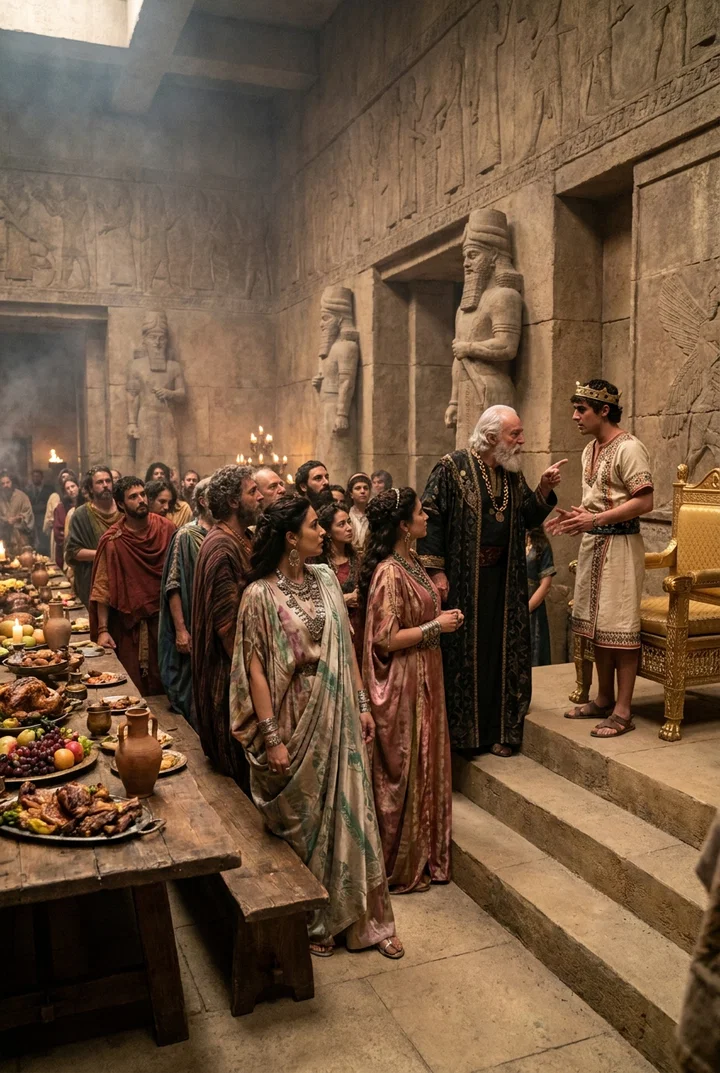
Then Daniel answered and said before the king, Let thy gifts be to thyself, and give thy rewards to another; yet I will read the writing unto the king, and make known to him the interpretation.
Translations
Then Daniel answered and said before the king, Let your gifts be to yourself, and give your rewards to another; yet I will read the writing to the king, and make known to him the interpretation.
King James Version, KJV Cambridge Paragraph Bible
Then Daniel answered and said before the king, Let thy gifts be to thyself, and give thy rewards to another; yet I will read the writing unto the king, and make known to him the interpretation.
Then Daniel answered and said before the king, Let thy gifts be to thyself, and give thy rewards to another; yet I will read the writing to the king, and make known to him the interpretation.
Revised Version, American Standard Version
Then Daniel answered and said before the king, Let thy gifts be to thyself, and give thy rewards to another; nevertheless I will read the writing unto the king, and make known to him the interpretation.
Then hath Daniel answered and said before the king, 'Thy gifts be to thyself, and thy fee to another give; nevertheless, the writing I do read to the king, and the interpretation I cause him to know;
Then Daniel answered and said before the king, Let thy gifts be to thyself, and give thy rewards to another; yet will I read the writing to the king, and make known to him the interpretation.
Then spake Daniel, and said before the king, As for thy gifts, thine own let them remain, and, thy presents, on another, bestow,—howbeit, the writing, will I read to the king, and, the interpretation thereof, will I make known to him.
Berean Standard Bible, Majority Standard Bible
In response, Daniel said to the king, “You may keep your gifts for yourself and give your rewards to someone else. Nevertheless, I will read the inscription for the king and interpret it for him.
Then Daniel answered before the king, “Let your gifts be to yourself, and give your rewards to another. Nevertheless, I will read the writing to the king, and make known to him the interpretation.
Then Daniel made answer and said to the king, Keep your offerings for yourself, and give your rewards to another; but I, after reading the writing to the king, will give him the sense of it.
Then Daniel answered, and sayd before the King, Keepe thy rewards to thy selfe, and giue thy giftes to another: yet I will reade the writing vnto the King, and shew him the interpretation.
Douay-Rheims (Challoner revision)
To which Daniel made answer, and said before the king: Thy rewards be to thyself, and the gifts of thy house give to another: but the writing I will read to thee, O king, and shew thee the interpretation thereof.
Pictures
Cross-references 20 of 21
- Daniel 5:25-28
And this is the writing that was written, MENE, MENE, TEKEL, UPHARSIN.
The writing Daniel agrees to interpret announces the king’s judgment and the kingdom’s division.
- Daniel 5:30-31
In that night was Belshazzar the king of the Chaldeans slain.
The announced sentence is carried out that night, and the kingdom passes to the Medes.
- Daniel 4:32
And they shall drive thee from men, and thy dwelling shall be with the beasts of the field: they shall make thee to eat grass as oxen, and seven times shall pass over thee, until thou know that the most High ruleth in the kingdom of men, and giveth it to whomsoever he will.
Nebuchadnezzar’s humiliation taught that the Most High rules human kingdoms, a lesson Belshazzar failed to learn.
- Daniel 5:1
Belshazzar the king made a great feast to a thousand of his lords, and drank wine before the thousand.
Describes Belshazzar’s feast and revelry before Babylon’s fall.
- Daniel 5:5-6
In the same hour came forth fingers of a man’s hand, and wrote over against the candlestick upon the plaister of the wall of the king’s palace: and the king saw the part of the hand that wrote.
The writing appears and terrifies the king, confronting him with judgment.
- Daniel 5:22-23
And thou his son, O Belshazzar, hast not humbled thine heart, though thou knewest all this;
Daniel continues his rebuke after refusing the king’s gifts.
- Daniel 5:7
The king cried aloud to bring in the astrologers, the Chaldeans, and the soothsayers. And the king spake, and said to the wise men of Babylon, Whosoever shall read this writing, and shew me the interpretation thereof, shall be clothed with scarlet, and have a chain of gold about his neck, and shall be the third ruler in the kingdom.
Daniel refuses the king’s offer of scarlet, gold, and third rulership.
- Daniel 5:10-12
Now the queen, by reason of the words of the king and his lords, came into the banquet house: and the queen spake and said, O king, live for ever: let not thy thoughts trouble thee, nor let thy countenance be changed:
The queen urges Belshazzar to summon Daniel to explain it.
- Daniel 5:29
Then commanded Belshazzar, and they clothed Daniel with scarlet, and put a chain of gold about his neck, and made a proclamation concerning him, that he should be the third ruler in the kingdom.
Daniel receives the third-place rank he had declined as a reward.
- Daniel 2:27-30
Daniel answered in the presence of the king, and said, The secret which the king hath demanded cannot the wise men, the astrologers, the magicians, the soothsayers, shew unto the king;
Both accounts credit God with revealing the interpretation, not Daniel’s own wisdom.
- Daniel 2:48-49
Then the king made Daniel a great man, and gave him many great gifts, and made him ruler over the whole province of Babylon, and chief of the governors over all the wise men of Babylon.
Daniel’s earlier promotion enabled him to serve and represent God.
- Daniel 5:26
This is the interpretation of the thing: MENE; God hath numbered thy kingdom, and finished it.
The writing declares that God has numbered and finished the kingdom.
- Matthew 10:8
Heal the sick, cleanse the lepers, raise the dead, cast out devils: freely ye have received, freely give.
Those who receive freely are to give freely.
- Daniel 5:2-3
Belshazzar, whiles he tasted the wine, commanded to bring the golden and silver vessels which his father Nebuchadnezzar had taken out of the temple which was in Jerusalem; that the king, and his princes, his wives, and his concubines, might drink therein.
Misuse of the temple vessels brings the writing of judgment.
- 1 Corinthians 4:7
For who maketh thee to differ from another? and what hast thou that thou didst not receive? now if thou didst receive it, why dost thou glory, as if thou hadst not received it?
Everything a person has is received, leaving no ground for pride.
- Numbers 22:7
And the elders of Moab and the elders of Midian departed with the rewards of divination in their hand; and they came unto Balaam, and spake unto him the words of Balak.
Balaam accepts rewards for prophetic service, while Daniel refuses them.
- Numbers 22:17
For I will promote thee unto very great honour, and I will do whatsoever thou sayest unto me: come therefore, I pray thee, curse me this people.
Balaam is offered great rewards to curse Israel.
- Isaiah 13:19-22
And Babylon, the glory of kingdoms, the beauty of the Chaldees’ excellency, shall be as when God overthrew Sodom and Gomorrah.
Babylon’s prophesied doom began that night.
- Daniel 2:19-23
Then was the secret revealed unto Daniel in a night vision. Then Daniel blessed the God of heaven.
Daniel receives wisdom from God to reveal and explain the king’s secret.
- Daniel 5:28
PERES; Thy kingdom is divided, and given to the Medes and Persians.
Interprets the kingdom’s division and transfer to the Medes and Persians.
Commentary
Each commentary is drawn from primary sources: the writings of Ellen G. White and Adventist pioneers and periodicals. Each commentary is separate. Its own words are not a quotation; follow the references to read the source passages.
Ellen G. White
12 sources
Daniel's answer to Belshazzar joins two things together: a refusal to keep the king's gifts and rewards for himself, telling the king to keep them or give them to another, and a promise that he will still read the writing to the king and make known its interpretation.Lt 51a, 1897, par. 19–20PK 522.1PK 529.1 The refusal is absolute, yet the service is freely offered, for he will read and explain what God has written.Lt 51a, 1897, par. 19–20PK 522.1PK 529.1
He stands before the king as a servant of God and of the Most High, speaking with quiet dignity.5T 244.4–5PK 529.1 He is unmoved by royal promises and offers of favor, and he is not intimidated by the king.Lt 51a, 1897, par. 19–20PK 529.1 He gives no flattery but speaks plainly, holding the king accountable for his sin and for failing to learn from the history of Nebuchadnezzar.Lt 51a, 1897, par. 19–20PK 529.1 In that plainness he pronounces doom upon Belshazzar and his thousand lords.5T 244.4–5
His place in Babylon is most critical and trying, for he does his assigned work faithfully as a statesman while plainly refusing any work that would militate against God or cheapen mind and character.Ms 47a, 1898, par. 2–5Lt 109a, 1898, par. 5–8Ms 168, 1898, par. 1–3 That faithful course provokes discussion, and by God's providence always at work in human affairs it brings him into reasoning relation with the king of Babylon to present the light God has for him.Ms 47a, 1898, par. 2–5Ms 168, 1898, par. 1–3 What he brings is reading in the light of the living oracles rather than dreams and fancies, concerning prophecies against Babylon and other kingdoms, with light that exalts Jehovah as more powerful than any other kingdom.Ms 47a, 1898, par. 2–5Ms 168, 1898, par. 1–3
The setting of this witness is Belshazzar's wine-besotted idolatrous feast and revelry with his thousand lords, when wine has beclouded reason, and the fall of Babylon comes in that very hour of feasting and revelry.Lt 40a, 1878, par. 6–12Ms 47a, 1898, par. 2–5Lt 109a, 1898, par. 5–8Ms 168, 1898, par. 1–3 In that feast the king forgets God and makes light of what God chose as sacred by profaning the consecrated golden vessels of Jehovah, praising the idols and gods of silver and gold.5T 244.4–5Lt 40a, 1878, par. 6–12 God as an unseen witness observes the desecration and the unholy scene, though the revelers do not know He is there.5T 244.4–5SLP 10.1–13.1 In the midst of sacrilegious mirth a bloodless hand traces mysterious characters on the palace wall over against the wall, unintelligible to the revelers.5T 244.4–5SLP 10.1–13.1Lt 40a, 1878, par. 6–12 The terrified king and courtiers then hear their doom as Daniel reads the writing in the light of the living oracles rather than dreams and fancies.5T 244.4–5Ms 47a, 1898, par. 2–5
The interpretation is a message of doom: God has numbered Belshazzar's kingdom and brought it to an end, has weighed his motives, character, life and soul in the balances of His sanctuary and found him wanting, and has divided his kingdom between the Medes and Persians, a record that will stand when the books of heaven are opened.Lt 51a, 1897, par. 19–20PK 529.1Lt 40a, 1878, par. 6–12 Daniel's reading thus exalts Jehovah as more powerful than any other kingdom.Ms 168, 1898, par. 1–3 It shows Babylon's coming calamity and fall resulted from disregard of heaven-sent light, including the light given to Nebuchadnezzar, because its rulers forgot God and credited human achievement with the kingdom's honor and glory.Lt 51a, 1897, par. 19–20Lt 201, 1899, par. 3–4Ms 168, 1898, par. 1–3RH Feb 6, 1900
God gives such lessons to lead people to reform, and neglecting and failing to practice them brings judgment.Lt 201, 1899, par. 3–4 In presumption and defiance people may go beyond the limits of God's forbearance, until blasphemy and disobedience exhaust His patience and bring divine intervention.Lt 201, 1899, par. 3–46MR 391.1–3 Daniel could speak for God as an unseen witness in that hour because he had purposed not to eat luxuries or taste wine at fashionable resorts, making God his strength through total abstinence.Lt 40a, 1878, par. 6–12 The same hand that wrote on Belshazzar's wall keeps faithful record of every act of injustice or oppression committed against God's people, so tracing words of calumny and falsehood against the servants Christ purchased by His blood is a worse profanation than profaning soulless vessels, and God witnesses it.5T 244.4–5 As Babylon's fall came at an hour of feasting and reveling, so will it be at the end of the world, when only the wise virgins with oil in their vessels with their lamps will be prepared to meet the Bridegroom.Ms 168, 1898, par. 1–3
Sources
Pioneers and periodicals
81 sources
Daniel answered Belshazzar at his feast by refusing his offered gifts and rewards, telling him to keep them or give them to another, while promising to read the mysterious writing on the wall and make its meaning known.ST Sep 6, 1899ST Sep 20, 1905ST Jun 28, 1899ST May 20, 1913RH Jul 6, 1868 He would not interpret for pay like the soothsayers and astrologers who had failed, because the wisdom he used was God's free gift to be shared freely for God's glory.RH May 11, 1869RH Jun 12, 1900ST Jun 28, 1899ST Jul 10, 1901RH Jun 12, 1900 The reading he gave pronounced Babylon's doom in the words Mene, God had numbered the kingdom and finished it, Tekel, the king was weighed in the balances and found wanting, and Peres, the kingdom was divided and given to the Medes and Persians.ST Jan 15, 1880ST Sep 6, 1899RH Nov 26, 1857ST Feb 13, 1907ST Apr 23, 1912 That sentence was fulfilled that same night when Belshazzar was slain and Darius the Median took the kingdom, ending Babylon after its allotted time was complete.ST Jan 15, 1880RH Nov 26, 1857STST May 20, 1897RH Sep 2, 1909 The warning reaches beyond Belshazzar to every reader weighed in God's scales of moral worth, calling each to test himself lest he also be found wanting.ST Jan 15, 1880RH Nov 26, 1857STST
Feast and Historical Setting
The verse was spoken at Belshazzar's great feast to a thousand lords, when drinking wine from the gold and silver vessels Nebuchadnezzar had taken from God's temple at Jerusalem while praising gods of gold and silver and brass and iron and wood and stone brought the sudden appearance of part of a man's hand writing mysterious characters on the wall.ST Jan 15, 1880RH Nov 26, 1857ST Apr 23, 1912 The king's countenance changed, his loins were loosed and his knees smote together, and his conscience was smitten in the midst of drunken, idolatrous revelry in the most apparent security while the king and the whole city gave themselves to feasting and drunkenness.ST Jan 15, 1880RH Nov 26, 1857RH Nov 26, 1857ST Jan 15, 1880 In that hour the visible hand of an otherwise invisible agent wrote the sentence Daniel promised to read and make known, and the setting was a feast at which Belshazzar was intoxicated while the Persian army entered the city and Belshazzar and his princes were killed amid the celebration.ST Apr 23, 1912
Nebuchadnezzar, called father in the chapter, was Belshazzar's grandfather, father being the usual style for any ancestor and son for any descendant.ST Jan 15, 1880 Belshazzar was son of Nabonadius or Nabonidus and grandson of Babylon's mightiest king Nebuchadnezzar, reigning conjointly with his father who held the first and second places, so that the third rank with royal clothing and a gold chain was the highest a subject could receive.RH Jul 6, 1868STST Sep 13, 1899ST May 20, 1913ST Dec 27, 1905 One account describes him as reigning jointly with his father Evil Merodach, who was absent from the city when Babylon fell.ST Aug 13, 1896
The account is true history and not a Hebrew legend built around a mythical character, for Belshazzar was a real king of Babylon.RH Aug 17, 1905 Babylonian inscriptions confirm its details by identifying Belshazzar as the king's son left in command of the city, and a prayer of Nabonidus naming Bel-shar-usur as his son and joint ruler supports the Bible's account of the setting and the early date of Daniel's account.ST Jul 23, 1885ST Oct 23, 1901 The feast is said to have taken place in a hall uncovered among the ruins of Babylon.RH Apr 6, 1911
Belshazzar was associated with his father as king about B.C. 540, and his third year was B.C. 538, his last year when he was slain and Babylon was overthrown by Medo-Persia under Darius and Cyrus in 538 B.C.ST Dec 24, 1894RH Jun 27, 1878RH Nov 11, 1862 Babylon stood upon the river Euphrates running directly through it, secured by river walls and brass gates, and after a siege of nearly two years Cyrus took it by stratagem during an annual festival given to mirth and revelry.STRH Nov 26, 1857 He diverted the river into a trench and lake, leaving its channel almost dry, so his soldiers marched up the emptied channel and entered through the two-leaved river gates left open in drunken carelessness and the confusion of a night of festival into the heart of the city, fulfilling the prophecy that the two-leaved gates would be opened and the gates would not be shut when Babylon's mighty men forbore to fight and became as women.STRH Nov 26, 1857RH Nov 11, 1862ST Feb 22, 1877
Belshazzar was the last king of rich, proud, luxurious and voluptuous Babylon, pleasure-loving while his father gave his last days to religious devotions and temple-building and left grave affairs of state to him.STST He was weak, dissolute, sacrilegious and pusillanimous, in whom is seen the lion with its wings plucked and a man's heart given to it.ST Mar 5, 1912ST May 3, 1877 Babylon reached her zenith under Nebuchadnezzar who raised it by rapid conquests to ruling power, and the empire came to an end under Belshazzar when God cast down a great world power from its height.ST Mar 5, 1912ST May 3, 1877
He is the same Belshazzar in whose first year Daniel had the dream and visions upon his bed recorded in Daniel 7:1.ST Apr 5, 1877 Chronologically Daniel 7 follows Daniel 4, with the historical part of the book standing by itself and the prophetical part beginning with Daniel 7 so that it is not interrupted by historical writings.ST Apr 5, 1877
Daniel Refuses Royal Rewards
Daniel told Belshazzar to keep his gifts to himself and give his rewards to another, refusing what the king offered while still agreeing to read the writing and make its meaning known to the king.ST Sep 6, 1899ST Sep 20, 1905ST Jun 28, 1899ST Jun 28, 1899ST Sep 17, 1885 The refusal was not a refusal to serve, for he would read and explain the writing even as he declined payment for doing so.RH May 11, 1869RH Jun 12, 1900ST May 20, 1897 The kingdom was already completing its allotted time, so the announcement beginning here was also a sentence of doom upon Babylon as weighed and found wanting.ST Sep 6, 1899
He made clear that he did not undertake the interpretation for pay and was not moved by the motives that govern soothsayers and astrologers.RH May 11, 1869 The wisdom and understanding he used were gifts from God, not something to sell or make a source of profit, and what God gives freely is to be shared freely to His glory.RH Jun 12, 1900RH Jun 12, 1900 He cared for God's glory rather than personal gain, and God had given him wisdom to explain mysteries.ST Jun 28, 1899
The rewards had little value because the kingdom was about to end and any honor the king could grant would be short-lived.ST Sep 20, 1905ST Sep 20, 1905 Becoming a ruler in a kingdom already nearing its end would bring him no advantage, and unlike under Nebuchadnezzar the position would not enable him to represent God and His truth to an empire.ST Jan 23, 1912 He may even have known that Cyrus's army would enter Babylon that very night, with the fall to the Medes and Persians coming in 538 B.C.ST May 20, 1897ST Sep 20, 1905 The highest honor Belshazzar could bestow, scarlet clothing and a gold chain and place as third ruler, was only second rank in itself, and Daniel did not value honor in a kingdom about to pass out of existence.ST Oct 5, 1904
His response shows that he sought no reward or favor and did his duty to make the message known.ST Jun 28, 1899ST Jul 10, 1901 He put spiritual ends above earthly gain and selfish desires, choosing to tell the meaning without being bribed.ST Jun 1, 1882 He feared God and therefore had courage to deliver an unwelcome message and to tell the king an unwelcome truth.ST Jun 28, 1899ST Jun 28, 1899 His loyalty to truth meant that royal favor and the danger of displeasing the king did not soften or hinder his delivery of God's message.ST Nov 24, 1898
In this he differed from Balaam, who was willing to act against Israel for promised rewards.ST Jun 28, 1899 It is not the mission of God's prophets to labor for such baubles.ST His appearance before Babylon's last king at the godless feast helped establish his greatness and became known to Darius.ST Jan 30, 1912 Serving God before a foreign king in Babylon, his example is a model for God's workers in the world's closing act.RH Dec 20, 1906
Daniel Promises True Interpretation
Daniel was called in to explain the mystery after the astrologers, wise men, Chaldeans and soothsayers who were loudly called could not read the writing or make known its interpretation, just as they had been foiled before on Nebuchadnezzar's dream.ST Jan 15, 1880RH Nov 26, 1857ST Sep 10, 1885 Aged Daniel was called at last through Nebuchadnezzar's widow and came in and boldly answered before the king.ST Jan 15, 1880RH Nov 26, 1857ST He stood there as a captive of Judah immediately before the king's death and the fall of his kingdom.RH Mar 8, 1915ST
Belshazzar had promised that whoever could read the writing would be clothed royally and given a gold chain and made the third ruler in the kingdom if he could read it.ST May 20, 1913RH Jul 6, 1868ST Sep 13, 1899 The third rank was the highest a subject could receive, because Nabonadius shared rule with his son Belshazzar who held the second place of honor, so Belshazzar and his father were the two kings.RH Jul 6, 1868ST Oct 5, 1904ST Sep 13, 1899 Although the reading pronounced the doom of Babylon, Belshazzar kept his promise by commanding Daniel to be clothed with purple with a chain of gold about his neck and proclaimed third ruler in the kingdom.ST May 20, 1913ST Sep 13, 1899
Daniel confidently told the king that he would read the writing unto the king and make known its interpretation, quickly understanding its meaning when the learned men could not as Babylon's final doom approached in the banquet hall.ST May 20, 1913ST Jul 20, 1915RH Jun 19, 1900 His ability depended on the Spirit of Prophecy, for unlike Babylon's wise men he could see the completed sentences and their meaning through the Spirit's guidance and not merely read the letters.RH Jun 19, 1900 The verse places Daniel before the king as the messenger who makes known God's message, faithful and ready to speak as an interpreter of God's message.ST Dec 1, 1914RH Feb 20, 1900RH Feb 27, 1900 His example shows that a true messenger explains God's providential dealings with people and ages, reading God's hand in the course of events, exposing character and speaking faithfully, as Daniel's interpretation exposed Belshazzar's character and announced the fall of his kingdom.RH Feb 20, 1900RH Feb 27, 1900
After the refusal Daniel rebuked Belshazzar by rehearsing how God gave Nebuchadnezzar dominion and authority over all kingdoms.ST Jan 23, 1912ST Oct 5, 1904ST Aug 13, 1896 Pride brought humbling with loss of throne and seven years of insanity and exile until he knew that the Most High rules in the kingdom of men and appoints over it whomsoever He will.ST Jan 23, 1912ST Oct 5, 1904ST Aug 13, 1896 The attempt to force God's loyal servants to worship the great golden image on the plain of Dura utterly failed, with the death of the king's warriors who executed his sentence and the miraculous preservation of God's servants in the furnace of fire.ST Aug 13, 1896 Belshazzar had not humbled his heart though he knew all this as matters of public record, but lifted himself against the Lord of heaven and did not glorify the God in whose hand his breath is and whose are all his ways.ST Oct 5, 1904ST Aug 13, 1896 For that reason the part of the hand was sent.ST Oct 5, 1904
Judgment Pronounced on Babylon
Daniel agreed to read the writing and make it known as MENE, God has numbered the kingdom and finished it; TEKEL, thou art weighed in the balances and art found wanting; PERES, the kingdom is divided and given to the Medes and Persians.ST Jan 15, 1880RH Nov 26, 1857ST Apr 23, 1912 With that reading the verse begins the announcement that Babylon had completed its allotted time and was doomed.ST Sep 6, 1899ST Feb 10, 1898 The kingdom is declared numbered and finished, weighed in the divine balances of justice and found wanting, and divided between the Medes and Persians, which no human power or wealth can avert for a nation that sows error and corruption.ST Feb 13, 1907ST Dec 1, 1914ST Jan 23, 1912
The chapter reveals God as Judge who uses a nation while it can serve His purpose, then sets it aside and raises another.ST Jan 23, 1912 In long-suffering mercy He does not overthrow nations or peoples until their transgressors have come to the full and their iniquity is full with no more hope of good from them.ST Feb 10, 1898
The cause was presumption in using the holy vessels at a riotous feast, an act that brings sure and sore consequences.ST Mar 18, 1903 It was rejection of prophetic warnings and insult to the worship of the King of Heaven.ST Nov 26, 1912 Babylon had captured Jacob's posterity and kept them in bondage, and while at a drunken feast triumphing over the Hebrews and insulting their God, Belshazzar when heated with wine commanded the gold and silver vessels taken from the temple at Jerusalem to be brought so that king and princes, wives and concubines could drink from vessels dedicated to the only true God while praising idol gods of gold and silver and brass and iron and wood and stone.ST Apr 23, 1912 Babylon passed away because its rulers forgot God and credited human achievement with the kingdom's honor and glory.RH Feb 6, 1900 Belshazzar the bold, blasphemous king set himself against God and His work, and for more than two thousand years he was known only because the Bible told of him through his opposition to the work of God, in which he dashed himself against the Rock of Ages and was utterly broken, showing that the rock of God's enemies is not as our Rock, even enemies themselves being judges.ST Aug 13, 1902
Belshazzar, Nebuchadnezzar's grandson, should have learned from Nebuchadnezzar's experience that God rules over human kingdoms and is due homage from kings.ST Oct 18, 1905 He knew the facts that should have taught him a lesson from history but failed to heed them.ST He persisted in sin despite seeing how God had punished the Jews.ST Jun 21, 1883 He had the privilege of learning useful lessons of life and the opportunity to know them as matters of public record yet did not take them to heart: that the God of heaven gave Nebuchadnezzar his kingdom as declared in Daniel's interpretation of his dream, that Nebuchadnezzar's attempt to force God's loyal servants to worship the great golden image on the plain of Dura utterly failed with the death of the king's warriors who executed his sentence and the miraculous preservation of God's servants in the furnace of fire, and that the proud monarch was humbled when he exalted himself against God with seven years of insanity and exile until restored to his kingdom to acknowledge that the God of Israel does according to His will in the army of heaven and among the inhabitants of earth and is able to abase those who walk in pride.ST Aug 13, 1896
Fall Fulfilled That Night
While the sentence stood before the guilty king, the Medes and Persians were pouring in through the two-leaved gates of the river walls to its execution, met at the palace, forced their way in, surprised the guards, and slew Belshazzar that same night.ST Jan 15, 1880RH Nov 26, 1857ST Belshazzar died valiantly fighting for his life amid the celebration, intoxicated with his princes while the Persian army entered the city, and the warning of the handwriting came too late for him and his kingdom passed away.RH Nov 26, 1857STST May 22, 1907 Cyrus took the city by stratagem during an annual festival given to mirth and revelry, turning the Euphrates aside and marching soldiers up its emptied channel into the city while the brass river gates were left open in drunken carelessness.ST Jan 15, 1880RH Nov 26, 1857ST That night Belshazzar king of the Chaldeans was slain, and Darius the Median, about sixty-two years old, took the kingdom.ST Jan 15, 1880RH Nov 26, 1857ST
The meaning of the handwriting was clearly explained and the prediction of Babylon's overthrow was soon fulfilled.ST May 20, 1897RH Sep 2, 1909 Babylon and the Babylonish empire ended in B.C. 538 by the Medes and Persians under Darius and Cyrus.RH Nov 26, 1857ST May 20, 1897RH Jun 27, 1878 In that taking was fulfilled the prophecy that the two-leaved gates would be opened and the gates would not be shut, when Babylon's mighty men forbore to fight, remained in their holds, lost their might, and became as women.RH Nov 11, 1862
By that memorable transfer of power the Almighty opened the way for the restoration of His chosen people to liberty and their religious privileges.ST Apr 23, 1912 Through association with Daniel and through that overthrow, Cyrus came to recognize the true God as a great God over all others, though not necessarily as God alone.ST Dec 19, 1892
The verse stands where God casts down a great world power from its height, breaks down its mighty walls and opens its invulnerable gates because it would not be used by Him, with the day of each great world power reckoned from its certain dominance to its decline.ST Mar 5, 1912 Luxury, vice, feasting and drunken revelry had weakened Babylon before the Medes and Persians took its place as the ruling power.ST Sep 5, 1911 On the fatal night of the impious feast the two-leaved gates were left open so the army of Cyrus gained easy access to the beleaguered city, which was only weakly defended by drunken soldiers and overconfident and abandoned officers, with slack allegiance to a ruler who lacked qualities essential to successful military leadership and who is seen as weak, dissolute and sacrilegious.RH Oct 11, 1915ST Mar 5, 1912
The historical account of ancient Babylon's fall serves as a prophecy of modern Babylon.RH Oct 11, 1915 Its fall came at a time when it expressed contempt for its enemies and confidence that its power would last, and that experience is also expected in modern Babylon.RH Oct 11, 1915 The chapter's lesson for the present depends on the biblical meaning the Lord gives the name Babylon.RH Jul 31, 1900
Belshazzar remained in the city feasting with his lords rather than driving away his enemies on the fatal night he was compelled to hand over his kingdom to Darius the Mede.RH Feb 8, 1870ST May 19, 1898 His abandoned and debauching feast shows men indifferently calling vast military preparation peace while ruin marches up with noisy parade, voluntarily closing all the senses to hide its approach instead of heeding its portent.ST May 19, 1898 The story belongs to the last years of the Babylonian kingdom and the captivity experiences of Daniel and his companions, studied in connection with the gospel message about living temples and the continuance of the kingdom through justification by faith.RH Jul 1, 1902RH Jul 2, 1901
Warning and Present Application
The sentence pronounced over the king, that he had been weighed in the balances and found wanting, reaches beyond Belshazzar himself to everyone who is weighed in the scales by which God estimates moral worth.ST Jan 15, 1880RH Nov 26, 1857 It stands as a warning to every reader to test his own moral worth by God's scales, lest he also be found wanting.ST Jan 15, 1880RH Nov 26, 1857
The fall of Belshazzar, the last of the kings of rich, proud, luxurious and voluptuous Babylon, furnishes a most striking lesson for the present.STST What was written aforetime was written for learning, so that account is truth for today and profitable to study.STSTST It is a lesson from the past that is preeminently applicable now.STST
The feast is held up as a warning that people who know what is right but love wealth more may face God's judgment.RH Feb 20, 1908 The writing on the wall and its interpretation are set forth as an image of impending doom for the liquor business.ST Jul 13, 1915 The Chaldean kingdom under Belshazzar is presented as an example of a nation that lost its existence through strong drink and intemperance.ST Feb 20, 1901 In the same way the handwriting on the wall serves as an image of conscience bringing guilt into view and awakening remorse.RH Aug 9, 1864 It also serves as an image for a message that can be read wrongly, as when Job's words are shown bringing darkness because he misunderstood what his trials meant.ST Aug 24, 1915
Sources