Daniel 5:25
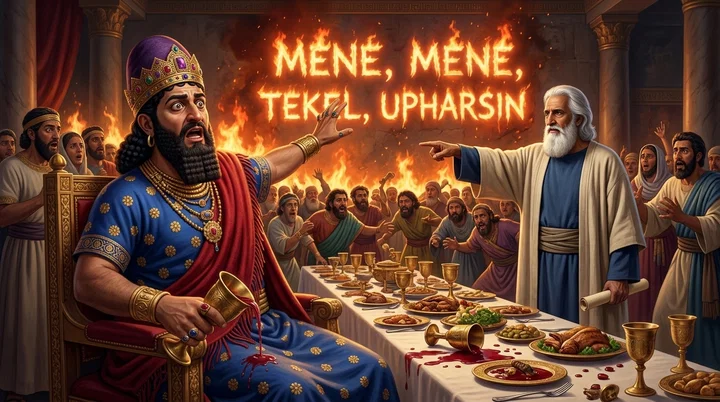
And this is the writing that was written, MENE, MENE, TEKEL, UPHARSIN.
Translations
American King James Version, King James Version, KJV Cambridge Paragraph Bible, Webster Bible
And this is the writing that was written, MENE, MENE, TEKEL, UPHARSIN.
And this is the writing that was inscribed, MENE, MENE, TEKEL, UPHARSIN.
And this is the writing that was inscribed: MENE, MENE, TEKEL, UPHARSIN.
and this [is] the writing that is noted down: Numbered, Numbered, Weighed, and Divided.
And this is the writing that is written: MENE, MENE, TEKEL, UPHARSIN.
And this is the writing which was inscribed, M’ne, M’ne, T’kel, u-Pharsin.
Berean Standard Bible, Majority Standard Bible
Now this is the inscription that was written:MENE, MENE, TEKEL, PARSIN.
“ This is the writing that was inscribed: ‘ MENE, MENE, TEKEL, UPHARSIN.’
And this is the writing which was recorded, Mene, tekel, peres.
And this is the writing that he hath written, MENE, MENE, TEKEL UPHARSIN.
Douay-Rheims (Challoner revision)
And this is the writing that is written: MANE, THECEL, PHARES.
Pictures


Cross-references
- Daniel 5:30-31
In that night was Belshazzar the king of the Chaldeans slain.
The writing’s warning is fulfilled that night as Babylon falls and the kingdom passes to Darius.
- Daniel 5:5-6
In the same hour came forth fingers of a man’s hand, and wrote over against the candlestick upon the plaister of the wall of the king’s palace: and the king saw the part of the hand that wrote.
The mysterious writing on the wall terrifies Belshazzar.
- Daniel 4:30-37
The king spake, and said, Is not this great Babylon, that I have built for the house of the kingdom by the might of my power, and for the honour of my majesty?
Nebuchadnezzar’s pride and humiliation warn Belshazzar, who disregarded God’s rule.
- Daniel 5:1-5
Belshazzar the king made a great feast to a thousand of his lords, and drank wine before the thousand.
Introduces Belshazzar’s profane feast, during which the writing appeared.
- Daniel 5:29
Then commanded Belshazzar, and they clothed Daniel with scarlet, and put a chain of gold about his neck, and made a proclamation concerning him, that he should be the third ruler in the kingdom.
Daniel receives the promised honors and third position after interpreting the writing.
- Isaiah 45:1-2
Thus saith the LORD to his anointed, to Cyrus, whose right hand I have holden, to subdue nations before him; and I will loose the loins of kings, to open before him the two leaved gates; and the gates shall not be shut;
Foretells Cyrus’s conquest and the opening of Babylon’s gates.
- Isaiah 13:19-22
And Babylon, the glory of kingdoms, the beauty of the Chaldees’ excellency, shall be as when God overthrew Sodom and Gomorrah.
Foretells Babylon’s overthrow and lasting desolation.
- Daniel 5:7-8
The king cried aloud to bring in the astrologers, the Chaldeans, and the soothsayers. And the king spake, and said to the wise men of Babylon, Whosoever shall read this writing, and shew me the interpretation thereof, shall be clothed with scarlet, and have a chain of gold about his neck, and shall be the third ruler in the kingdom.
Wise men could not read the writing, and Daniel was offered third place in the kingdom.
- Genesis 41:32
And for that the dream was doubled unto Pharaoh twice; it is because the thing is established by God, and God will shortly bring it to pass.
Repetition emphasizes that the announced judgment is certain and will soon come to pass.
- Daniel 5:5
In the same hour came forth fingers of a man’s hand, and wrote over against the candlestick upon the plaister of the wall of the king’s palace: and the king saw the part of the hand that wrote.
A hand writes on the palace wall, announcing divine judgment to Belshazzar.
- Daniel 5:3-4
Then they brought the golden vessels that were taken out of the temple of the house of God which was at Jerusalem; and the king, and his princes, his wives, and his concubines, drank in them.
The king’s use of the temple vessels precedes the writing on the wall.
- Daniel 7:1
In the first year of Belshazzar king of Babylon Daniel had a dream and visions of his head upon his bed: then he wrote the dream, and told the sum of the matters.
Both texts name Belshazzar.
- Daniel 5:16
And I have heard of thee, that thou canst make interpretations, and dissolve doubts: now if thou canst read the writing, and make known to me the interpretation thereof, thou shalt be clothed with scarlet, and have a chain of gold about thy neck, and shalt be the third ruler in the kingdom.
Daniel is promised the third rank in the kingdom.
- Daniel 5:18-21
O thou king, the most high God gave Nebuchadnezzar thy father a kingdom, and majesty, and glory, and honour:
Nebuchadnezzar’s humiliation shows God’s rule over kings.
- Daniel 4:34-37
And at the end of the days I Nebuchadnezzar lifted up mine eyes unto heaven, and mine understanding returned unto me, and I blessed the most High, and I praised and honoured him that liveth for ever, whose dominion is an everlasting dominion, and his kingdom is from generation to generation:
Nebuchadnezzar accepts correction, humbles himself, and returns to worshiping God.
- Isaiah 47:11
Therefore shall evil come upon thee; thou shalt not know from whence it riseth: and mischief shall fall upon thee; thou shalt not be able to put it off: and desolation shall come upon thee suddenly, which thou shalt not know.
Foretells Babylon’s sudden desolation and loss of her kingdom.
- Daniel 4:25
That they shall drive thee from men, and thy dwelling shall be with the beasts of the field, and they shall make thee to eat grass as oxen, and they shall wet thee with the dew of heaven, and seven times shall pass over thee, till thou know that the most High ruleth in the kingdom of men, and giveth it to whomsoever he will.
Nebuchadnezzar’s experience teaches that God rules over human kingdoms.
- Daniel 4:32
And they shall drive thee from men, and thy dwelling shall be with the beasts of the field: they shall make thee to eat grass as oxen, and seven times shall pass over thee, until thou know that the most High ruleth in the kingdom of men, and giveth it to whomsoever he will.
Nebuchadnezzar learned that God appoints rulers over kingdoms.
Commentary
Each commentary is drawn from primary sources: the writings of Ellen G. White and Adventist pioneers and periodicals. Each commentary is separate. Its own words are not a quotation; follow the references to read the source passages.
Ellen G. White
35 sources
The writing appeared on the palace wall in the midst of Belshazzar's sacrilegious feast, when he and his lords drank from the vessels consecrated to God and gave themselves to idolatry, revelry and blasphemy.CTBH 20.1–21.2Ms 50, 1893, par. 7–9Lt 8, 1893, par. 14–15 The repeated MENE declares that God had numbered the kingdom and brought it to an end, TEKEL declares that the king had been weighed and found wanting, and UPHARSIN declares that the kingdom would be divided and given to the Medes and Persians.CTBH 20.1–21.2Ms 79, 1908, par. 8–12RH Sep 24, 1908 That verdict came because of pride and independence of God, forgetting God and crediting human achievement for Babylon's glory, and refusing to humble himself and heed warning despite knowing how God had humbled Nebuchadnezzar.Ms 79, 1908, par. 8–12RH Sep 24, 1908Lt 51a, 1897, par. 19–20 God was present at the feast as an unseen witness, and the same hand still writes everywhere and keeps faithful record in heaven of every act, word and motive, by which men are weighed in the balances of infinite justice and truth.5T 244.4–5SLP 10.1–13.1Lt 40a, 1878, par. 6–12Lt 120, 1899, par. 18–20 Babylon's sudden fall in an hour of feasting pictures what will happen at the end of the world when many are unprepared, yet one whose heart is awakened to the meaning of God's law is convicted and roused to plead for mercy in Jesus, and God does not send the penitent away comfortless.PK 522.2PK 5224T 14.2Ms 168, 1898, par. 1–321MR 386.4–387.2
Setting and Interpretation
The inscription appeared on the palace wall in the midst of Belshazzar's sacrilegious feast with his thousand lords, when they drank wine from the vessels consecrated to Jehovah, praised the gods of gold and silver, and gave themselves to music, dancing, feasting, sparkling wine and blasphemy.Ms 50, 1893, par. 7–9Lt 8, 1893, par. 14–155T 244.4–5SLP 10.1–13.1Lt 40a, 1878, par. 6–12 Wine had beclouded reason and led them to forget God and profane the God of heaven, even while God was present as an unseen witness making a history to testify against the revelers to the close of time.SLP 10.1–13.1Lt 40a, 1878, par. 6–12 The revelers could not understand the words, but their consciences recognized them as a denunciation.SLP 10.1–13.1Lt 40a, 1878, par. 6–12
The words were traced by a bloodless hand in few fiery characters, mysterious and unintelligible to king and courtiers.Lt 51a, 1897, par. 8–125T 244.4–5SLP 10.1–13.1ST Jan 14, 1913Lt 22, 1872, par. 25–26 Their appearance showed that God's power was present, and the sight filled the king, his princes and his courtiers with condemnation and terror as doom was pronounced by the servant of the Most High.Lt 51a, 1897, par. 8–125T 244.4–5SLP 10.1–13.1ST Jan 14, 1913 That writing reveals a person's true condition as fearfully wanting, though men judge by appearance.Lt 22, 1872, par. 25–26
The repeated MENE means God has numbered the kingdom and brought it to an end, TEKEL means Belshazzar has been weighed in the balances and found wanting, and UPHARSIN or PERES means the kingdom will be divided and given to the Medes and Persians.CTBH 20.1–21.2Ms 79, 1908, par. 8–12RH Sep 24, 1908Ms 50, 1893, par. 7–9Lt 51a, 1897, par. 19–20 Daniel explained the meaning as God's testimony against the king's sacrilege and idolatry, declaring the king weighed and found wanting and his kingdom divided and given to the Medes and Persians.CTBH 20.1–21.2Ms 50, 1893, par. 7–9Lt 8, 1893, par. 14–15 The writing means Belshazzar was weighed in the balances of God's sanctuary in motives, character, life and soul and pronounced wanting, and his record will stand so when the books of heaven are opened and the great Judge searches to see whose names are written there.Lt 40a, 1878, par. 6–12
The verdict came because of pride and defiance and failure to learn from Nebuchadnezzar's experience, for Belshazzar refused to humble himself and heed warnings despite knowing how God had humbled Nebuchadnezzar.Ms 79, 1908, par. 8–12RH Sep 24, 1908Lt 51a, 1897, par. 19–20 Its rulers regarded themselves as independent of God and credited the kingdom's glory to human achievement, forgetting God.Lt 40a, 1878, par. 6–12PK 501.3 By disregarding and rejecting the light God had given Nebuchadnezzar, Belshazzar forfeited the benefits obedience could have brought, for God gives lessons to instruct and reform His people and neglecting them brings judgment.Lt 201, 1899, par. 3–4 The performance in that palace that night brought the figures of his evil works to their full measure.Lt 23a, 1890, par. 9–10
The sentence was fulfilled in Babylon's sudden fall, which came in an hour and on a night of feasting and revelry.PK 522.2Lt 109a, 1898, par. 5–8Ms 47a, 1898, par. 2–5 When the measure was full Belshazzar was no longer to be protected and shielded by God and the restraining power no longer warded off evil; he was to fall, his kingdom was to pass into other hands, and his body was to be slain.Lt 23a, 1890, par. 9–10 Babylon was shattered and sentenced to be swept with destruction, until left desolate in its ruined state with fallen towers and barren plain.PK 522PK 501.3 The writing on the wall thus announced judgment on the king and his kingdom whose fall was soon to come, and the divine hand wrote Belshazzar's doom and the end of the Babylonian kingdom.PK 522.212MR 392.1–3
Unseen Witness Weighs
Belshazzar feasted with his princes, drinking wine from the vessels consecrated to Jehovah while praising the gods of gold and silver, and in the midst of music, dancing, feasting, sparkling wine and blasphemy, with wine beclouding reason and making him forget God and profane the God of heaven, God was present as an unseen witness and holy Watcher making a history to testify against the revelers to the close of time.SLP 10.1–13.1Lt 40a, 1878, par. 6–1220MR 286.4Lt 113, 1893, par. 23–28Lt 70, 1893, par. 22–23 A messenger from heaven watched his every movement that night in the palace, seeing the revelry and the profaning of sacred things, so that every deception practiced, every false word uttered, and every unholy action had a watcher from whom no one can hide.Lt 113, 1893, par. 23–28Lt 23a, 1890, par. 9–10Lt 70, 1893, par. 22–23 At the height of the feast a bloodless hand wrote words of doom on the banquet-hall wall, announcing judgment against the king and showing that God takes account of human actions and that judgment comes upon those who dishonor Him.20MR 286.4Lt 113, 1893, par. 23–28Lt 70, 1893, par. 22–23
The same hand that traced the mysterious characters still writes everywhere, declaring that God is present in every place and keeping faithful record in the books of heaven of every word, transaction, plan, action and hidden motive.5T 244.4–5Lt 120, 1899, par. 18–20Ms 99, 1902, par. 6ST Jan 14, 1913Lt 70, 1893, par. 22–23 Every denial of self and every grasping, covetous act is registered there, and every act of injustice or oppression committed against God's people is faithfully recorded.5T 244.4–5Ms 99, 1902, par. 6ST Jan 14, 1913 A holy Watcher notes every word and action of life, observes conduct openly, and weighs every motive that prompts action.Lt 120, 1899, par. 18–20Ms 99, 1902, par. 6Lt 70, 1893, par. 22–23
To be weighed is to be weighed in the balances of God's sanctuary and of infinite justice and truth in motives, character, life and soul, with all words, plans and secret motives brought into the balances.Lt 40a, 1878, par. 6–12Lt 120, 1899, par. 18–20Ms 99, 1902, par. 6 That record will stand when the books of heaven are opened and the great Judge searches to see whose names are written there.Lt 40a, 1878, par. 6–12Lt 22, 1872, par. 25–26 The writing is God's judgment revealing a person's true condition as wanting, fearfully wanting, though men judge by appearance.Lt 40a, 1878, par. 6–12Lt 22, 1872, par. 25–26
That record warns in particular those who trace words of calumny and falsehood against the servants of Christ, for God is witness of their deeds and their slanderous touch profanes not soulless vessels but characters purchased by Christ's blood.5T 244.4–5ST Jan 14, 1913 False statements and misrepresentation are recorded, and deeds will appear in their true character in the judgment.5T 244.4–5ST Jan 14, 1913Lt 12a, 1893, par. 5 The record of Belshazzar's condemnation shows that neglect and unfaithfulness are also recorded, and those who fail to meet their God-given obligations face the same judgment of being weighed and found wanting.MYP 228.3–229.1 People are accountable for how they use or misuse the opportunities and abilities God gives them, for selfishness and covetousness are recorded just as surely as self-denial.Lt 120, 1899, par. 18–20Ms 99, 1902, par. 6 Those who rely on their own ideas and wisdom without reckoning with God will reap the consequences of their folly.Lt 65, 1895, par. 8–9
Belshazzar's example shows that people may persist in presumption and defiance until they cross the limits of God's forbearance, and that blasphemy and disobedience can exhaust the patience of the longsuffering God, after which God intervenes to end human insolence.6MR 391.1–3Lt 23a, 1890, par. 9–10 The performance in that palace that night brought the figures of his evil works to their full measure, and when the measure was full he was no longer to be protected and shielded by God.Lt 23a, 1890, par. 9–10 Then the restraining power no longer warded off evil, he was to fall, his kingdom was to pass into other hands, and his body was to be slain.Lt 23a, 1890, par. 9–10
Warning and Gospel Link
The writing on the palace wall stands as a warning that all who join in sacrilegious revelry are likewise weighed in God's balances and found wanting.CTBH 20.1–21.2 People who disregard sin and turn away from divine warnings may, like Belshazzar, remain blind to their danger until it is too late to repent, understanding their peril only when the handwriting is made plain.RH Nov 18, 1902 This danger rests upon churches and institutions as well, which need a direct message to awaken those who are spiritually asleep.RH Nov 18, 1902
Babylon fell suddenly in an hour of feasting and reveling, and that fall pictures what will take place at the end of the world in this period of peculiar and momentous importance.Ms 168, 1898, par. 1–3 Many will then take the position that the Lord delays His coming and that all things remain as they were from the beginning of creation, while only the wise virgins with oil in their vessels with their lamps will be prepared to go forth to meet the Bridegroom.Ms 168, 1898, par. 1–3 The same God who was present as a silent witness at Belshazzar's godless feast and traced the characters with His own hand is present now where people think no eye sees, beholding hidden pollution of soul and body.21MR 386.4–387.2 His judgments are abroad in the earth, Christ is coming, the Judge of all the earth stands before the door, and every case must pass in solemn review before Him.21MR 386.4–387.2 Those who harden conscience by continuing in sin will at last hear their course fixed forever.21MR 386.4–387.2
As Belshazzar was confronted with the Almighty's handwriting, so a person whose heart is awakened by the Spirit to the full meaning of God's law understands the warning and is convicted.4T 14.2 God's word rouses such a sinner from spiritual dullness to plead for mercy in Jesus.4T 14.2 That plea God hears, and He does not send the penitent away comfortless.4T 14.2
The hand that wrote words of doom on Belshazzar's wall and ended the Babylonian kingdom is the same hand that acted when Christ died.COS 164.1–165.112MR 392.1–3Ms 41, 1887, par. 22–23 It judged the Jewish nation unchurched and rent the temple veil from top to bottom.12MR 392.1–3 That rending was done by a bloodless, divine hand, opening access to God for everyone, Jew and Gentile, without priest or ruler.12MR 392.1–3Ms 41, 1887, par. 22–23
Sources
Pioneers and periodicals
98 sources
The inscription announced that God had numbered Belshazzar's kingdom and brought it to its end, weighed him in the balances and found him wanting, and divided his kingdom to give it to the Medes and Persians.ST Jan 15, 1880ST Sep 10, 1885ST Sep 6, 1899 The repetition stressed that the allotted days were certainly completed, and the final word pointed both to division and to the Persians who would receive the rule.ST Jan 23, 1912ST Oct 23, 1901 It was written by an angel's hand in letters of fire on the palace plaster during Belshazzar's drunken feast from the vessels of God's temple, when his face changed and his knees knocked with terror.ST Jan 15, 1880RH Nov 26, 1857ST May 20, 1897 That same night the sentence was executed when Belshazzar was slain and Darius the Median took the kingdom, as Cyrus and his forces entered through the dried riverbed and open gates.ST Jan 15, 1880ST Sep 17, 1885ST Jun 28, 1899 The writing reveals God as Judge who rules in the kingdom of men, measures nations and persons in righteous balances, and sets a power aside only when its iniquity is full and it can no longer serve His purpose.ST Jan 23, 1912RH Sep 11, 1900
Words of the Inscription
The inscription consists of four words, MENE, MENE, TEKEL, UPHARSIN, meaning numbered, numbered, weighed, divisions.ST Jun 28, 1899RH May 11, 1869ST Jun 28, 1899ST Sep 20, 1905 MENE declares that God has numbered Belshazzar's kingdom and finished it and brought its course and rule to an end while it appeared prosperous.ST Jan 15, 1880ST Jun 28, 1899RH May 11, 1869ST Jun 28, 1899ST Sep 20, 1905 TEKEL declares that he has been weighed in the balances and found wanting.ST Jan 15, 1880ST Jun 28, 1899RH May 11, 1869ST Jun 28, 1899ST Sep 20, 1905 UPHARSIN, interpreted as PERES from the root PERES, declares that his kingdom is divided and given to the Medes and Persians.ST Jun 28, 1899ST Sep 20, 1905RH May 11, 1869ST Jun 28, 1899ST Sep 20, 1905
The repetition of MENE emphasizes certainty that the allotted days were completed.ST Jan 23, 1912ST Oct 23, 1901ST Oct 23, 1901 Peres is another form of Upharsin meaning divided, and by wordplay also points to the Persians.ST Jan 23, 1912ST Oct 23, 1901 Repeated numbered means Babylon's allotted days had been completed, weighed means judged and found wanting, and divided foretells the breaking up of the kingdom and its transfer to the Medes and Persians.ST Jan 23, 1912ST Oct 23, 1901ST Oct 23, 1901 The heading of the writing is numbered, weighed, divided, announcing judgment on Babylon.ST Feb 13, 1907
The verse belongs to the Aramaic portion of Daniel running from 2:4 through the end of chapter 7.ST Oct 21, 1908 Chapters 1-6 are commonly grouped as narrative, though every chapter in Daniel has a prophetic aspect.ST Oct 21, 1908 Chapter 5 stands in the historical part while chapter 7 begins the prophetical part, and in chronological order chapter 7 follows chapter 4.ST Apr 5, 1877 Its Belshazzar king of Babylon is the same Belshazzar named in 7:1, and the account is Bible history and not myth.ST Apr 5, 1877RH Aug 17, 1905 The writing on the wall stands among the prophecies of Daniel beginning with the captivity of Judah, in sequence alongside Nebuchadnezzar's dream, his golden image, and his proclamation.ST May 24, 1910
The writing was sent from before God by a hand sent from God, part of a man's hand tracing the sentence on the plaster of the palace wall.ST Jan 15, 1880RH Nov 26, 1857ST Aug 13, 1896 It was written in letters of fire and light by a bloodless hand that then vanished, mysterious characters the guilty king knew portended evil.ST Jan 15, 1880RH Nov 26, 1857ST Aug 13, 1896 Unlike the Ten Words written directly by God, this mysterious writing came through the intervention of an angel, written by the angel on the night Babylon fell.ST May 20, 1897RH Aug 2, 1870 The same hand later rent the temple veil at Christ's death.ST Jan 15, 1880ST Aug 13, 1896 Its interpretation is that God numbered and ended Belshazzar's kingdom, weighed him and found him wanting, and divided his kingdom between the Medes and Persians, fulfilled that very night when Belshazzar was killed and Darius the Mede received the kingdom.ST May 20, 1897ST Jan 23, 1912ST Aug 13, 1896
Feast and King
The writing appeared while Belshazzar held a great feast for a thousand of his lords in apparent security, with drunken revelry and sun worship and praise to gods of gold and silver and brass and iron and wood and stone while wine was drunk from the gold and silver vessels taken from God's temple at Jerusalem.ST Jan 15, 1880RH Nov 26, 1857ST Dec 18, 1893ST Aug 13, 1896ST Sep 17, 1885 The sight of a hand tracing the sentence changed the king's countenance, loosened his loins and made his knees knock, struck him and the revelers with terror, sobered him with a sense of retribution, and astonished his lords before they understood what it meant.ST Jan 15, 1880RH Nov 26, 1857ST Sep 17, 1885RH Dec 6, 1853ST
Belshazzar was Nebuchadnezzar's grandson, the eldest son of Nabonidus who left him in command of the city while away fighting the Persians and given to religious devotions and temple-building.ST Jul 23, 1885ST Oct 18, 1905ST Sep 17, 1885RH Jul 6, 1868ST He reigned conjointly with his father, who is called Evil Merodach in one account, holding the second place so that Daniel's reward for reading could only be third ruler with clothing in purple and a gold chain and proclamation.ST May 20, 1913RH Jul 6, 1868ST Babylonian inscriptions, a cuneiform cylinder from about 556-539 B.C. preserving Nabonidus's prayer to the moon-god for Belshazzar, and the throne hall and plaster-covered palace audience hall conjectured as the feast site concur with Scripture as a twofold non-collusive witness to the history.ST Jul 23, 1885RH May 13, 1909RH Oct 29, 1908
The sentence came because in presumption he profaned the holy vessels, lifted himself against the Lord of heaven, and failed to glorify the God in whose hand his breath was and whose were all his ways.RH Sep 24, 1908ST Sep 10, 1885ST Dec 18, 1893ST Aug 13, 1896ST He refused to humble his heart though he knew how God had humbled Nebuchadnezzar's pride with seven years of insanity and exile, and he disregarded the public records of the dream giving the kingdom to Nebuchadnezzar, the failure to force worship of the Dura image and the preservation in the furnace, and the acknowledgment that God does His will and abases the proud.RH Sep 24, 1908ST Aug 13, 1896ST He continued in sin and cruelty to the Jews, turned back to apostasy after Nebuchadnezzar had returned to true worship, openly insulted God, forgot God and credited human achievement, and took his last step across a hidden boundary beyond return when iniquity was full.ST Dec 18, 1893ST Aug 13, 1896ST Jun 21, 1883ST Jul 6, 1915ST
The fall occurred in 538 B.C., the last year of Belshazzar whose reign began in 549 B.C., ending the Babylonish empire after two hundred and nine years.RH Nov 26, 1857ST May 20, 1897ST Dec 24, 1894ST Jul 10, 1901RH Oct 29, 1908 It marked the end of the seventy years of Babylonian servitude over the Jews, though not the end of the desolations of Judea and Chaldea.RH Apr 28, 1853 The verse belongs to the last years of the kingdom and to the weak, cowardly last king fulfilling the lion with plucked wings and a man's heart.ST
Sentence Pronounced
The inscription was God's handwritten sentence against Belshazzar traced on the palace wall, declaring that God had numbered his kingdom and finished it, that he himself had been weighed in the balances and found wanting, and that his kingdom was divided and given to the Medes and Persians.ST Jan 15, 1880ST Sep 10, 1885ST Jun 28, 1899ST Sep 17, 1885 The single terms stand for full short sentences, with the first meaning numbered, the second weighed, and the last, from the root Peres, divided.RH May 11, 1869ST Jan 23, 1912 The kingdom's time had been numbered and brought to an end, the king had been weighed and found wanting, and the kingdom would be divided and given to the Medes and Persians.ST Sep 10, 1885ST Jun 28, 1899ST Sep 17, 1885 The writing announced Babylon's judgment that its allotted time was completed, that it was weighed and found wanting, and that it was doomed.ST Sep 6, 1899
The numbering declares that the kingdom had completed its allotted days and its reckoned course from dominance to decline, held in God's hands and brought to an end while it still appeared prosperous.ST Sep 6, 1899RH May 11, 1869ST Jan 23, 1912 Repeated numbering means the allotted days were completed, weighing means judged and found wanting, and dividing foretells the breaking up of the kingdom and its transfer to the Medes and Persians.ST Jan 23, 1912 It broke in upon proud thoughts that Babylon and its defenses would last forever, coming during swift decline after Nebuchadnezzar's death to declare the kingdom finished and another inferior kingdom to arise.RH May 20, 1915 It is a judgment that days are numbered and the end has come for what is unfit to survive.ST Jun 9, 1890 The message also teaches that God has a purpose for each accountable person and allows time for response to His opportunities and appeals, but when these are persistently rejected the time of mercy ends and judgment follows.ST Jan 23, 1912
The mysterious writing could be read by Daniel alone, announcing that Belshazzar's kingdom was ending, with the last term related to Peres meaning divided.ST Sep 20, 1905 The wise and learned could not discern its significance, but Daniel read and interpreted it without hesitation.ST Jul 20, 1915 Reading its words only was not enough, for Daniel through the Spirit of Prophecy recognized the full sentences behind them and could give their interpretation, showing that understanding what God has written requires the Spirit's wisdom and revelation and not merely knowledge of the letter.RH Jun 19, 1900 He focused on the message's meaning rather than the wall, the hand that wrote it, or other details of how it was delivered, and applied the truth it revealed.ST Jul 20, 1915ST Jul 20, 1915 In this God's providences convey messages for His children's present and future good.ST Jul 20, 1915
Fall That Night
The sentence was executed that very night, for Belshazzar king of the Chaldeans was slain and Darius the Median took the kingdom.ST Jan 15, 1880ST Sep 17, 1885ST Jun 28, 1899RH Nov 26, 1857ST May 20, 1897 The writing announced that God had numbered and finished the kingdom, weighed the king and found him wanting, and divided the realm to the Medes and Persians, and that division was fulfilled when Babylon fell in 538 B.C.ST Sep 17, 1885ST Jun 28, 1899ST Feb 10, 1904ST May 20, 1897ST Oct 23, 1901 With his death his father ceased to be king, and the proud heart was humbled in the overthrow.ST Jan 15, 1880RH Nov 26, 1857ST Feb 10, 1904 The account directs attention to the chapter and the events that fulfilled the prediction concerning the Babylonian Empire.RH Jan 9, 1900ST Oct 23, 1901
While the sentence was being written before the guilty king, the Medes and Persians under Cyrus were already pouring in through the open two-leaved river gates to execute it.ST Jan 15, 1880RH Nov 26, 1857 Babylon stood on the river Euphrates, with high brick walls on each side of the river and brass gates with steps to the water at every street.RH Nov 26, 1857ST Jan 15, 1880 After a siege of nearly two years Cyrus took it by stationing men at the river entrance and exit above and below, breaking the embankment to the forty-mile-square artificial lake west of the city and opening his trench to dry the channel.RH Nov 26, 1857RH Nov 26, 1857ST Jan 15, 1880 His troops then marched down the emptied bed on the night of an annual festival of feasting, drunkenness and revelry in apparent security, when the defenders did not fight and in the confusion the huge brass river gates were all left open.ST Jan 15, 1880RH Nov 26, 1857ST Jan 15, 1880 They found free entrance into the heart of the city, sped with drawn swords to the palace, met at the palace and slew the king, mingling amid the crowd at midnight.RH Nov 26, 1857ST May 20, 1880ST Sep 22, 1890 Though those on the walls mocked the besiegers, the city was captured, fulfilling the promise to open before Cyrus the two-leaved gates and break in pieces the gates of brass, with the prophecies of perpetual sleep and opened gates.ST Jan 15, 1880ST May 20, 1880ST Sep 22, 1890
That night ended Babylon the head of fine gold, the first of the four universal kingdoms.ST Sep 17, 1885ST Aug 17, 1904ST Oct 29, 1885 She became corrupt under the kings who succeeded Nebuchadnezzar and could no longer be used for God's glory, so she was cast down from her height with walls broken and invulnerable gates opened.ST Aug 17, 1904ST May 20, 1880 The breast and arms of silver, the empire of Media and the Medo-Persian kingdom with universal sway, succeeded it, identified as Babylon's successor when Darius the Mede took the kingdom.ST Sep 17, 1885RH Oct 30, 1856ST Aug 17, 1904ST Oct 29, 1885 Her river proved false and her gods of stone were heedless and could not save her, and she was swept away desolate with no memorial but darkness and ruin where Babylon was.ST Aug 17, 1904ST May 20, 1880
God as Judge
The chapter makes known God as Judge of nations and of every person, who weighs kingdoms in the balances of His righteous purposes and ends the rule of Babylon because its kings took all glory to themselves.ST Jan 23, 1912ST Apr 9, 1896 The Most High rules in the kingdom of men and gives it to whomever He will, using powers even in wrath and rebellion while they serve His purpose and removing them when they do not.ST Apr 9, 1896 When a nation can no longer be used for His glory He sets it aside and raises up another, as He wrought for His people in overthrowing Babylon and bringing Cyrus to recognize the true God as a great God over all others.ST Jan 23, 1912ST Dec 19, 1892 In long-suffering mercy He does not overthrow a nation or people until its iniquity is full, till there is no more hope of good from them.ST Feb 10, 1898 The writing publicly announced the time when Babylon as a nation crossed the line of probation.RH Sep 11, 1900
It was not chance or an arbitrary decree but came after judicial investigation, when God Himself regarded the course of affairs in Babylon and noted that the limit was reached, the cup of iniquity was full, and the end had come.RH Jun 19, 1900 No definite date in heaven's calendar fixed the fall; when the balances of the sanctuary where character is weighed showed that all the essential elements of kingship were wanting in the king, the numbered kingdom was finished.RH Jun 19, 1900 The words announced judgment after the king profaned the holy vessels in sun worship: God had numbered Babylon's kingdom and brought it to an end, weighed the king and found him wanting, and divided the kingdom and given it to the Medes and Persians.ST Dec 18, 1893 Another kingdom inevitably succeeded, because the city fell only because the men inside had already fallen beyond hope of recovery.RH Jun 19, 1900 That message declaring Babylon numbered, weighed and found wanting warns each person and the church to examine themselves, to cast out sin and turn from Babylon's corrupt feasting to God's life-giving truth now, and to be ready clothed in the righteousness of Jesus Christ.ST Oct 23, 1901
Daniel bore the witness that condemned Belshazzar, because though he knew all of God's dealings with Nebuchadnezzar he did not humble his heart and did not glorify the God in whose hand his breath is and whose are all his ways, but lifted up himself against the Lord of heaven.RH Jun 19, 1900 In doing so he rejected the gospel of the kingdom and the eternal principles of truth and righteousness that glorify God and save men, and when those principles are rejected there is no further hope and the sentence of destruction is written.RH Jun 19, 1900RH Jun 19, 1900 The writing was a Gospel sermon proclaiming the true God, His majesty and His power to give rule in the kingdom of men to whomever He chooses, with blessing attached to obedience of His will and futility in all effort to defy Him.ST Oct 5, 1904 It was a merciful warning sent in advance when judgment was near to the king and his companions in revelry, before the executioner came, a final warning of overthrow whose meaning was clear to Daniel the Hebrew seer.ST Oct 5, 1904RH Jan 23, 1855 That same story of God's dealings with Nebuchadnezzar must now be made known to all the earth as the distinct message for this time when the history of Babylon is being repeated, being the fullness of the message summarized in Revelation 14:6-12, so that wherever it is told men make their final choice either to glorify God or to lift up themselves against the Lord of heaven, unlike Nebuchadnezzar who heeded and Belshazzar who was lost.RH Jun 19, 1900ST Oct 27, 1898
Daniel exemplifies the messenger who reads God's hand in events and speaks faithfully in interpreting God's providential dealings with the Babylonian king.RH Feb 20, 1900 He was ready to explain God's message at the decisive hour when the writing appeared that announced Belshazzar's test and the coming ruin of his nation.RH Feb 27, 1900 Called in through Nebuchadnezzar's widow when the guilty king and his astrologers and soothsayers and Chaldeans were blind to its meaning, he refused the king's rewards and gifts because God's prophets do not labor for such baubles.ST Aug 13, 1896ST He fearlessly revealed God's pointed message to Belshazzar and did not let the royal setting or fear of the king's displeasure soften it, accepting the cost of doing what was right.ST Nov 24, 1898 His reading of TEKEL written during the impious feast turned the scene of pleasure and mirth into one of accountability before God, charging Belshazzar with knowing how God had humbled Nebuchadnezzar's pride yet not humbling his own heart, lifting himself against God and profaning God's holy things while not glorifying the God in whose hand his breath was.ST Aug 13, 1896STRH Oct 23, 1900
Prophecy and Present Application
The predicted overthrow followed swiftly after the writing appeared, shattering Babylon's confidence that she would remain the lady of kingdoms and bringing desolation and loss.ST Feb 4, 1886RH Sep 2, 1909 The handwriting is legible when history is viewed in the light of Bible prophecy, as a sign of God's hand in history. It cannot be comprehensively understood apart from the history of Babylon beginning with Nimrod and the tower of Babel and the earlier prophecies concerning Babylon.RH Jul 30, 1908 Knowledge of that historical Babylon is also necessary to avoid fanciful interpretations of the prophecies and their applications to modern or spiritual Babylon.RH Jul 30, 1908
Ancient Babylon's fall came while she was expressing contempt for her enemies and confidence that her rule would last, and that fall serves as a historical prophecy of modern Babylon to be repeated in the same kind.RH Oct 11, 1915 Just as ancient Babylon profaned God's sacred temple vessels with its wine, modern Babylon misuses God's commandments to promote Sunday observance, and the writing's message of Babylon's fall is linked to the message God sends in the present age.RH May 14, 1914 The danger of renewed church-state union and compromise must be read boldly as a prophetic warning, for such union brings disaster.ST Feb 28, 1911 The chapter's lesson and present-day meaning depend on the biblical application of the name Babylon.RH Jul 31, 1900 The spread of the gospel is the handwriting on the wall of time, showing that God has numbered the earthly kingdoms and that their end is near and they will soon be finished.RH Nov 11, 1915 The handwriting that announces the end of Babel's kingdom is applied to the fall of latter-day Babylon.ST Feb 8, 1899
Being weighed in the balances and found wanting is God's measure of moral worth, applying not to Belshazzar alone but to every reader and to mankind.ST Jan 15, 1880RH Nov 26, 1857 God weighs character, and each person must face the end of life and choose whether the future will be with Him, for the kingdom had completed its allotted time, was weighed and found wanting, and was doomed.ST Sep 6, 1899 God has a purpose for each accountable person and allows time for response to His opportunities and appeals, but when these are persistently rejected the time of mercy ends and judgment follows.ST Jan 23, 1912 God judges nations and every person, and sinful impenitent people will face His sentence, so each person and the church is called to examine themselves, cast out sin and Babylon's idolatry and corrupt feasting, and be ready for judgment by being clothed in Christ's righteousness. The divine message declares that great Babylon is weighed in the balances of justice and found wanting.ST Dec 1, 1914
The writing warns rulers who feast for universal peace while God's unseen sentence of sudden destruction is written, as a thousand souls sat down to eat and drink and be merry in palatial hotels with lavish splendor and the cry of peace went out over land and under sea in all languages to all nations, yet when they shall say peace and safety then sudden destruction comes upon them and they shall not escape, and like Belshazzar's company they see the writing too late, for that night Belshazzar died and his kingdom passed away.ST May 22, 1907 It appears to a proud city whose great men heap up gold and fill cellars with costly wines and sit at wine till dawn, meaning judgment has arrived and is followed at once by surge and topple and fall, then dust and darkness, then burning light.ST Apr 19, 1910 It comes as God's red handwriting on the wall as exposure and warning that follows sin and shame and feasting and ends in a fall, when people despise His daughter and mock His Son and keep on in wallowing while wine runs like a stream.ST Apr 19, 1910 Its warning as a mysterious sentence is invoked in connection with afflictions that come upon people while they persist in sin. It plainly announces on the Roman palace wall that the existing world order is passing away and a new earthly administration is coming, marking international unrest, preparation and impending revolution as fulfillment of God's predictions.RH Apr 8, 1875 People who ignore sin and divine warnings may understand their danger only when it is too late to repent, remaining blind to peril until the handwriting is made clear, and this applies to churches and institutions which need a direct message to awaken those spiritually asleep.RH Nov 18, 1902
TEKEL marks profession weighed and found wanting in judgment, where high-sounding words and outward religious appearance cannot hide guilt and the truth exposes the hireling priest.ST Jul 23, 1874 Every profession is tested, with the false sifted away from the genuine, for high words and outward appearance cannot protect hypocrites.RH Jul 9, 1867 The Bible is likewise the rule by which character will be tested in the final judgment, being truth while other professed sacred books are judged wanting beside it.RH Apr 2, 1867 God's written verdict upon things weighed in the scale of truth and found wanting is a sentence of divine rejection declared over false doctrinal positions about Israel being God's chosen people, the ten commandments belonging exclusively to the Jews, the cutting off of that nation, the perishing of the old law and the introduction of a new law, when those positions are tested and fail.RH Jul 17, 1860 MENE, TEKEL, UPHARSIN mean weighed, found wanting and false, condemned and finished, applied by some to declare the Old Testament judged and set aside as imperfect, out of date and void of inspiration.RH Sep 8, 1853RH Feb 24, 1859
Refusal to obey a law of the Medes and Persians was exonerated because government had overstepped the bounds of its civil authority set by God, showing duty to God paramount to duty to man.ST Apr 14, 1898 Belshazzar gathered his lords in a great numbered assembly, a royal company so large that the gathering of papal bishops at Rome nearly equals it in number at the time judgment sits.RH Mar 15, 1870 A captive from Judah reads and explains the message of judgment during the blasphemous feast, and Belshazzar dies as the Persians capture the city that night.RH Mar 8, 1915 The capture occurred on the night of the feast, when the city's defenders did not fight and their strength failed.RH Nov 11, 1862 The fall of Belshazzar, last king of rich, proud, luxurious, voluptuous Babylon reigning conjointly with his father given to religious devotions and temple-building, is a most striking lesson written aforetime for learning and pre-eminently applicable today.ST While the king indulged in luxurious revelry Babylon's defenses failed and the Medes and Persians took the empire.ST Sep 5, 1911
Further points
The inscription on the wall functioned as a warning to Belshazzar that his peril was already at hand.ST Sep 17, 1885 The warning came too late to avert the overthrow, for Babylon was even then falling.ST Sep 17, 1885 Terror seized the king so that he was left powerless to act while the Persians entered and took the city.ST Sep 17, 1885
Sources