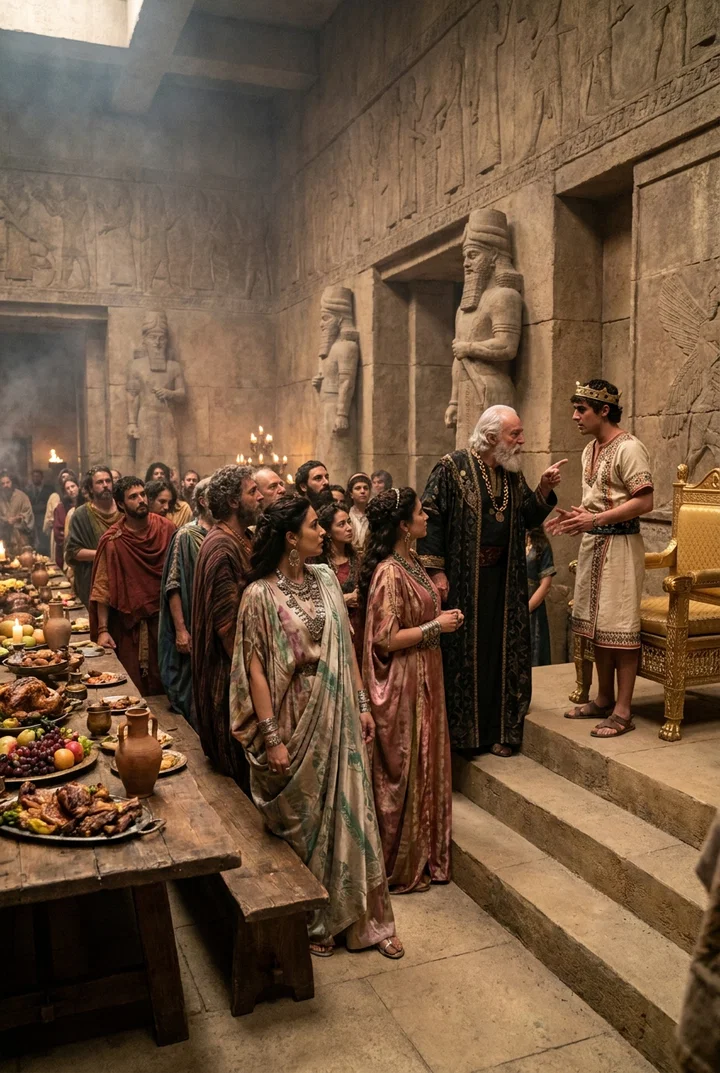
Daniel 5:18
O thou king, the most high God gave Nebuchadnezzar thy father a kingdom, and majesty, and glory, and honour:
Translations
O you king, the most high God gave Nebuchadnezzar your father a kingdom, and majesty, and glory, and honor:
King James Version, KJV Cambridge Paragraph Bible
O thou king, the most high God gave Nebuchadnezzar thy father a kingdom, and majesty, and glory, and honour:
O thou king, the most high God gave Nebuchadnezzar thy father a kingdom, and majesty, and glory, and honor:
Revised Version, American Standard Version
O thou king, the Most High God gave Nebuchadnezzar thy father the kingdom, and greatness, and glory, and majesty:
thou, O king, God Most High, a kingdom, and greatness, and glory, and honour, gave to Nebuchadnezzar thy father:
O thou king, the Most High God gave Nebuchadnezzar thy father the kingdom, and greatness, and glory, and majesty;
As for thee, O king, the Most High God, gave, kingship and greatness and honour and majesty, unto Nebuchadnezzar thy father;
Berean Standard Bible, Majority Standard Bible
As for you, O king, the Most High God gave your father Nebuchadnezzar sovereignty and greatness, glory and honor.
“ To you, king, the Most High God gave Nebuchadnezzar your father the kingdom, and greatness, and glory, and majesty.
As for you, O King, the Most High God gave to Nebuchadnezzar, your father, the kingdom and great power and glory and honour:
O King, heare thou, The most high God gaue vnto Nebuchad-nezzar thy father a kingdome, and maiestie, and honour and glory.
Douay-Rheims (Challoner revision)
O king, the most high God gave to Nabuchodonosor thy father a kingdom, and greatness, and glory, and honour.
Pictures
Cross-references 20 of 38
- Daniel 4:17
This matter is by the decree of the watchers, and the demand by the word of the holy ones: to the intent that the living may know that the most High ruleth in the kingdom of men, and giveth it to whomsoever he will, and setteth up over it the basest of men.
same truth that Most High gives kingdoms
- Daniel 4:30-32
The king spake, and said, Is not this great Babylon, that I have built for the house of the kingdom by the might of my power, and for the honour of my majesty?
Nebuchadnezzar’s pride brought the loss of the greatness God had given him.
- Daniel 5:22-23
And thou his son, O Belshazzar, hast not humbled thine heart, though thou knewest all this;
Belshazzar knew Nebuchadnezzar’s lesson yet exalted himself and dishonored God.
- Daniel 5:30-31
In that night was Belshazzar the king of the Chaldeans slain.
Belshazzar dies, and Babylon’s kingdom passes to the Medes and Persians.
- Daniel 2:37-38
Thou, O king, art a king of kings: for the God of heaven hath given thee a kingdom, power, and strength, and glory.
God gave Nebuchadnezzar his kingdom, power, and glory.
- Daniel 5:25-28
And this is the writing that was written, MENE, MENE, TEKEL, UPHARSIN.
God judges Belshazzar, ends his kingdom, and divides it.
- Daniel 5:2-4
Belshazzar, whiles he tasted the wine, commanded to bring the golden and silver vessels which his father Nebuchadnezzar had taken out of the temple which was in Jerusalem; that the king, and his princes, his wives, and his concubines, might drink therein.
The king profaned the temple vessels and praised idols.
- Daniel 4:34-37
And at the end of the days I Nebuchadnezzar lifted up mine eyes unto heaven, and mine understanding returned unto me, and I blessed the most High, and I praised and honoured him that liveth for ever, whose dominion is an everlasting dominion, and his kingdom is from generation to generation:
Nebuchadnezzar testifies to God’s rule after his affliction.
- Daniel 4:25
That they shall drive thee from men, and thy dwelling shall be with the beasts of the field, and they shall make thee to eat grass as oxen, and they shall wet thee with the dew of heaven, and seven times shall pass over thee, till thou know that the most High ruleth in the kingdom of men, and giveth it to whomsoever he will.
Nebuchadnezzar learns that the Most High rules over kingdoms.
- Daniel 3:1
Nebuchadnezzar the king made an image of gold, whose height was threescore cubits, and the breadth thereof six cubits: he set it up in the plain of Dura, in the province of Babylon.
Nebuchadnezzar uses his God-given kingdom to set up an image representing his glory.
- Jeremiah 27:7
And all nations shall serve him, and his son, and his son’s son, until the very time of his land come: and then many nations and great kings shall serve themselves of him.
It describes Nebuchadnezzar’s rule and its limit after his dynasty.
- Daniel 4:30-31
The king spake, and said, Is not this great Babylon, that I have built for the house of the kingdom by the might of my power, and for the honour of my majesty?
Nebuchadnezzar’s claim to glory is followed by God taking away his kingdom.
- Daniel 4:33
The same hour was the thing fulfilled upon Nebuchadnezzar: and he was driven from men, and did eat grass as oxen, and his body was wet with the dew of heaven, till his hairs were grown like eagles’ feathers, and his nails like birds’ claws.
Both texts occur in Daniel, which is taught as a special study.
- Psalms 75:7
But God is the judge: he putteth down one, and setteth up another.
God judges rulers, bringing one low and raising another.
- Jeremiah 25:1-12
The word that came to Jeremiah concerning all the people of Judah in the fourth year of Jehoiakim the son of Josiah king of Judah, that was the first year of Nebuchadrezzar king of Babylon;
Both show Babylon’s rule ordained by God.
- Isaiah 13:19-22
And Babylon, the glory of kingdoms, the beauty of the Chaldees’ excellency, shall be as when God overthrew Sodom and Gomorrah.
Babylon’s glory is followed by its fall and desolation.
- Daniel 5:28
PERES; Thy kingdom is divided, and given to the Medes and Persians.
Babylon’s kingdom is divided and given to the Medes and Persians.
- Daniel 5:29
Then commanded Belshazzar, and they clothed Daniel with scarlet, and put a chain of gold about his neck, and made a proclamation concerning him, that he should be the third ruler in the kingdom.
Daniel is clothed and proclaimed third ruler in the kingdom.
- Daniel 2:39
And after thee shall arise another kingdom inferior to thee, and another third kingdom of brass, which shall bear rule over all the earth.
Predicts an inferior kingdom replacing Babylon.
- Daniel 3:25
He answered and said, Lo, I see four men loose, walking in the midst of the fire, and they have no hurt; and the form of the fourth is like the Son of God.
The Son of God appeared with faithful servants unharmed in the fire.
Commentary
Each commentary is drawn from primary sources: the writings of Ellen G. White and Adventist pioneers and periodicals. Each commentary is separate. Its own words are not a quotation; follow the references to read the source passages.
Ellen G. White
17 sources
The Most High God gave Nebuchadnezzar his kingdom and his majesty and glory and honor, so his authority and greatness were received as gifts and not gained by himself.Ms 79, 1908, par. 8–12RH Sep 24, 1908Ms 50, 1893, par. 27–30 Daniel spoke this to Belshazzar while he ruled with absolute power and indulged pride, when at his feast with his lords he profaned the sacred vessels and praised his idols until a hand wrote his doom on the palace wall.Lt 8, 1893, par. 14–155T 244.4–5Lt 40a, 1878, par. 6–12 He reminded Belshazzar of this well-known history because it should have taught him humility and submission to God, but he refused to learn it.Ms 79, 1908, par. 8–12RH Sep 24, 1908PK 522.2 God gives such light to lead to reform, and when in prosperity rulers forget Him and ascribe the glory of the kingdom to human achievement, neglect of that light brings judgment and the kingdom is broken.Ms 50, 1893, par. 27–30PK 501.3Lt 201, 1899, par. 3–4RH Feb 6, 1900 Babylon fell suddenly in an hour of feasting and revelry, and that fall will be repeated at the end of the world, while the same hand still records every act of injustice and oppression against His people for certain punishment.5T 244.4–5Lt 109a, 1898, par. 5–86MR 391.1–3Ms 168, 1898, par. 1–3
Context and Plain Meaning
The Most High God gave Nebuchadnezzar his kingdom and majesty and glory and honour, so his royal authority and power and greatness and status were not his own but gifts from God, who rules over human kingdoms.Ms 79, 1908, par. 8–12RH Sep 24, 1908Ms 50, 1893, par. 27–30Lt 51a, 1897, par. 19–20PK 522.2 Daniel recalled this gift before Belshazzar as history the king already knew but had failed to learn, history that should have taught him humility and submission to God.Ms 79, 1908, par. 8–12RH Sep 24, 1908PK 522.2 Belshazzar had seen the light God revealed through Nebuchadnezzar's experience yet chose to disregard it and follow his own way, and the reminder of God's gift stood as warning and judgment against him for his feast and misuse of the temple vessels.Ms 50, 1893, par. 27–30Lt 8, 1893, par. 14–15
The account stands near the close of Daniel's life, after Nebuchadnezzar's death, when his successors ruled unwisely and the kingdom was moving toward dissolution.PK 522.1 Nebuchadnezzar's rule had begun Babylon's universal sway and the seventy-year captivity, which continued through his descendants until Belshazzar's reign, when Babylon fell to the Medes and Persians.RH Jan 23, 1908
The words were spoken when Belshazzar held absolute rule with everything to flatter pride and indulge passion, with the property of lords and nobles at his command, with princes as servants, and with his will as law.Lt 40a, 1878, par. 6–12 At his feast with his thousand lords he profaned the golden vessels of Jehovah with sacrilegious mirth and praised the idols of Babylon, while the God they defied witnessed the unholy scene.Lt 8, 1893, par. 14–155T 244.4–5Lt 40a, 1878, par. 6–12 Though under wine his reason was beclouded and he forgot God and dishonored Him by using vessels consecrated to Jehovah and praising gods of gold and silver and profaning the God of heaven, God did not forget him but weighed his motives and character and life and soul in the balances of His sanctuary.5T 244.4–5Lt 40a, 1878, par. 6–12 In the midst of the feast a bloodless hand traced mysterious characters upon the palace wall, and king and courtiers in terror heard their doom pronounced by the servant of the Most High, as Daniel recalled God's gift to Nebuchadnezzar.Lt 8, 1893, par. 14–155T 244.4–5
Sovereignty, Warning, and Judgment
The Most High God gave Nebuchadnezzar his kingdom, majesty, glory, and honor, so that royal power, greatness, and status come from God, who rules over human kingdoms.Ms 79, 1908, par. 8–12RH Sep 24, 1908PK 522.2 Daniel reminded Belshazzar of this familiar history because he already knew it and it should have taught him humility and submission to God, but he had failed to learn that lesson.Ms 79, 1908, par. 8–12RH Sep 24, 1908PK 522.2 Belshazzar had seen the light God revealed through Nebuchadnezzar's experience but chose to disregard it and follow his own way.Ms 50, 1893, par. 27–30Lt 201, 1899, par. 3–4 God gives such lessons to lead people to reform, and neglecting and failing to practice them brings judgment on Babylon.Lt 201, 1899, par. 3–4
God gave Nebuchadnezzar his kingdom and greatness by coming into close contact even with an idolater's mind for a purpose, giving light through Daniel including things foretold against Babylon and other kingdoms, with the interpretation of the dream exalting Jehovah as more powerful than earthly kings.Ms 47a, 1898, par. 2–5 Nebuchadnezzar perverted that light by reading it through his own idolatrous mind and ambitions, turning it into a golden image representing himself and his kingdom's glory in hope of converting all nations to its worship.Ms 47a, 1898, par. 2–5 After Christ walked in the fiery furnace with the three who would not bow, Nebuchadnezzar was moved to acknowledge God and His superior power, showing that all must read dreams in the light of the living oracles and not read Scripture and providence in the light of dreams and fancies.Ms 47a, 1898, par. 2–5
In prosperity Babylon's rulers regarded themselves as independent of God, forgot Him, and ascribed the glory of the kingdom to human achievement, and therefore Babylon was at last shattered, broken, and passed away.PK 501.3RH Feb 6, 1900 Its truth is beheld in the literal fulfillment of divine prophecy in the history of nations.PK 501.3 Belshazzar's presumption and defiance in feasting and revelry, despite the earlier encounter with God's power and instruction, show that people can persist in blasphemy until they pass the limits of God's forbearance, and Babylon's fall came in that hour of feasting and revelry.Lt 109a, 1898, par. 5–86MR 391.1–3
Babylon's sudden fall in an hour of feasting and reveling will be repeated at the end of the world.Ms 168, 1898, par. 1–3 The present time is one of peculiar momentous importance in which students of God's Word must work away from the customs and appointments of the world's great counselors, must not say the Lord delays His coming and that since the fathers fell asleep all things remain as they were from the beginning, and must be as the wise virgins prepared with oil in their vessels with their lamps to go forth to meet the Bridegroom.Ms 168, 1898, par. 1–3 In the midst of Belshazzar's feast with his thousand lords, while they profaned the golden vessels of Jehovah with sacrilegious mirth and praised the idols of Babylon, the God they defied witnessed the unholy scene and a bloodless hand traced mysterious characters upon the palace wall, so that king and courtiers in terror heard their doom pronounced by the servant of the Most High.5T 244.4–5 The same hand that wrote on Belshazzar's wall keeps faithful record of every act of injustice or oppression committed against God's people, so that defaming by calumny and falsehood the characters of those Christ purchased is a greater profanation than profaning soulless vessels and will meet certain punishment.5T 244.4–5
Sources
Pioneers and periodicals
78 sources
Daniel reminded Belshazzar that the supreme God above all had given his ancestor Nebuchadnezzar the kingdom with royal greatness and splendor, not as his own achievement but as a gift that left no ground for pride.ST Sep 20, 1905RH May 11, 1869RH Jun 12, 1900RH Dec 5, 1854 Father here means forefather, for Nebuchadnezzar was Belshazzar's grandfather, and Belshazzar himself ruled jointly with his own father Nabonidus in second place, which is why the third rulership he offered was the highest honor open to another.RH May 11, 1869RH Nov 26, 1857ST Jan 15, 1880ST May 20, 1897ST Sep 17, 1885 The verse teaches that the Most High rules in the kingdom of men and gives it to whom He will, raising up rulers and setting them aside, so all power is held only as delegated trust under bounds set by God.ST Jan 23, 1912ST Oct 18, 1905ST Apr 14, 1898ST Feb 10, 1898 Nebuchadnezzar was stripped of throne and glory for pride until he acknowledged that rule, and Belshazzar fully knew that public history yet refused to humble himself, honor God, or learn from the example left for Babylon's kings.RH Sep 24, 1908ST Jan 23, 1912STRH Feb 18, 1904 That refusal ripened at his idolatrous feast, when he profaned the vessels of God's house and praised idols, and that same night he was weighed in God's balances and found wanting, slain while Darius the Median took the kingdom and closed Babylon's rule.RH Nov 26, 1857ST Jan 15, 1880ST Sep 6, 1899ST Feb 13, 1907ST Apr 23, 1912
Words and Family Ties
Daniel addresses Belshazzar as though Nebuchadnezzar were his father, but father is used here in the broad scriptural sense of ancestor, for any ancestor is called father and any descendant is called son.RH May 11, 1869RH Nov 26, 1857ST Jan 15, 1880ST Sep 20, 1905 Nebuchadnezzar was in fact Belshazzar's grandfather, Babylon's mightiest king, who had taken vessels of gold and silver from the temple of God at Jerusalem.RH Nov 26, 1857ST Jan 15, 1880STST Sep 20, 1905 Daniel recalls before Belshazzar how the Most High God gave that grandfather his kingdom and majesty and glory and honor, making royal power and honor a gift from God.RH May 11, 1869ST Sep 17, 1885ST Sep 20, 1905 That gift is set against Belshazzar's feast to a thousand lords, when he drank wine from those holy vessels with his princes, wives, and concubines while praising gods of gold and silver, until Daniel was called to read MENE, TEKEL, PERES and that night Belshazzar king of the Chaldeans was slain and Darius the Median took the kingdom.ST Jan 15, 1880
Belshazzar was not sole king of Babylon but reigned conjointly with his own father Nabonidus, also called Nabonadius.ST May 20, 1897ST Sep 17, 1885ST Nabonadius spent his last days in religious devotions and temple-building and left the affairs of state to the pleasure-loving Belshazzar, who was in charge of Babylon when the Medes and Persians threatened the city.ST Sep 17, 1885ST Belshazzar therefore held second place, with Nabonadius sharing rule with his son during the last three years of Babylon's reign, and the third rulership he offered Daniel for interpreting the writing was the highest rank open to a subject.RH Jul 6, 1868 His reign is reckoned as beginning in 549 B.C., so that his third year was 538 B.C., when he was overthrown and succeeded by Darius and the kingdom was given to the Medes and Persians.ST May 20, 1897ST Jul 10, 1901
The title Most High God expresses supremacy, belonging to the invisible God alone and distinguishing the Father from the Son.RH Dec 5, 1854
God Gives Kings Power
The Most High God gave Nebuchadnezzar his kingdom and majesty and glory and honour, his royal power and greatness and splendor coming as gifts and not as independent achievements.ST Sep 20, 1905RH May 11, 1869RH Jun 12, 1900ST Sep 10, 1885RH Jan 9, 1900 That bestowal left no ground for pride or self-glorification, for royal power and honour come from God.RH May 11, 1869RH Jun 12, 1900ST Sep 10, 1885RH Jan 9, 1900ST Sep 20, 1905 Daniel recalled this gift before Belshazzar, Nebuchadnezzar's son in the broad sense of male descendant and in fact his grandfather, as the basis for the lesson that such splendor is received from God.ST Sep 20, 1905RH May 11, 1869ST Sep 10, 1885RH Jan 9, 1900ST Sep 20, 1905
The gift made Babylon universal in scope, mistress of the world, with dominion over all the kingdoms of earth and over peoples and nations.RH Jan 23, 1908RH Jan 31, 1856RH Oct 30, 1856ST Sep 20, 1905ST Oct 5, 1904 Under Nebuchadnezzar Babylon reached its zenith of certain dominance through rapid conquests and ruling power, marking the beginning of her universal sway and the seventy-year captivity, a sway that continued through his descendants until Belshazzar's reign when Babylon fell to the Medes and Persians.RH Jan 23, 1908RH Jan 31, 1856RH Oct 30, 1856ST Mar 5, 1912 When a state will not be used by God He casts it down from its great height, breaks down its mighty walls, and opens its invulnerable gates.ST Mar 5, 1912
The verse teaches that the Most High rules in the kingdom of men and gives it to whom He will, raising up and setting aside rulers and appointing them over human kingdoms.ST Jan 23, 1912ST Oct 18, 1905ST Apr 9, 1896ST Jan 23, 1912RH Nov 20, 1900 Kingdoms belong to God to give and to take away, and what a person has is received from God.ST Apr 9, 1896 Nebuchadnezzar's pride in God-given power led to his removal from the throne and loss of glory until he recognized that rule, learning through chastisement and humility that a king owes God homage and recording it in a royal proclamation that the kings of Babylon should have known and followed.ST Jan 23, 1912ST Oct 18, 1905 Belshazzar knew from his grandfather's experience that God so rules, yet failed to humble himself and glorify God, and Babylon was judged and given to the Medes and Persians under Cyrus in B.C. 538 when, having taken all glory to herself, the day of her humiliation came and she was weighed in the balances of God's righteous purposes and found wanting.ST Feb 10, 1898ST Apr 9, 1896RH Nov 20, 1900 God in long-suffering mercy does not overthrow nations or peoples until their iniquity is full and there is no more hope of good from them, a rule that applied to Grecia as well as to Babylon.ST Feb 10, 1898
Because kingdoms are given by the Most High, civil government holds only delegated authority from God with set bounds.ST Apr 14, 1898 When government commands in matters of duty to God it oversteps those bounds, duty to God is paramount to duty to man, and God's servants who refuse obedience to such a civil mandate are exonerated from censure.ST Apr 14, 1898 Babylon's position as mistress of the world came from God, and its rise reflected the failure of God's people through apostasy to receive the position intended for them.ST Sep 20, 1905
Nebuchadnezzar Humbled Belshazzar Warned
The Most High gave Nebuchadnezzar his kingdom and greatness and glory and majesty and honor, and that gift made peoples and nations fear him.RH Sep 24, 1908ST Jan 23, 1912RH Feb 18, 1904 Pride in that God-given power led to his removal from the throne and loss of his glory until he recognized that God rules human kingdoms and appoints their rulers.ST Jan 23, 1912RH Feb 18, 1904 He took the glory to himself, became proud, and was brought down and stripped of his glory, then God gave him another opportunity to acknowledge that He rules over heaven and earth and that kings and nations owe Him allegiance.ST Jan 23, 1912 Royal power came from God, and pride and refusal to glorify Him brought the king's humiliation and Babylon's downfall.RH Feb 18, 1904 Babylon's lion imagery reflects the kingdom's glory and its monarchs' pride, and the plucking of the lion's wings may point to Nebuchadnezzar's humiliation or to Belshazzar's cowardice and death, after which the kingdom passed to the Medes and Persians.RH Feb 8, 1870
Through chastisement and humility Nebuchadnezzar learned that God rules over human kingdoms and that a king owes Him homage.ST Oct 18, 1905 He recorded that lesson in a royal proclamation, so the kings of Babylon had an example they should have known and followed.ST Oct 18, 1905
Daniel reminded Belshazzar of this familiar history because it should have taught him humility, that royal power comes from God who rules over human kingdoms.RH Sep 24, 1908RH Aug 22, 1907ST Oct 18, 1905 The recital was a rebuke and warning that earthly power stands under God's rule and obliges a ruler to humble himself before God, and failure to heed that lesson helped bring Babylon's fall.RH Sep 24, 1908RH Aug 22, 1907ST Oct 5, 1904 Belshazzar knew the facts of God's dealings with Nebuchadnezzar from public record and his grandfather's experience, how God had exalted and then humbled his pride, and that lesson he should have heeded.RH Sep 24, 1908STRH Aug 22, 1907ST Oct 18, 1905 Yet he ignored it, did not take it to heart, did not humble himself, and did not honor or glorify God, but sinned against the light he had received.RH Sep 24, 1908STST Oct 18, 1905 Here father means ancestor in the customary broader sense, for Nebuchadnezzar was Belshazzar's grandfather, and the reminder of the gift and of the humiliation that followed exposed Belshazzar's presumption in profaning the sacred vessels to insult the God who had humbled his ancestor.ST Jun 28, 1899
Belshazzar inherited his predecessor's kingdom and glory and riches and power and palaces but had earned none of them himself, and that inherited greatness fostered pride that helped lead him to exalt himself against God.RH Mar 8, 1915 Babylon's later rulers forgot God and credited human achievement for its glory, and the kingdom passed away.RH Feb 6, 1900 Nebuchadnezzar's successors should have heeded the lessons of his experience and example in recognizing true wisdom in administering governmental affairs, and because they did not the golden kingdom came to an inglorious end.ST Oct 5, 1904
Feast Writing and Fall
Daniel 5:18 belongs to the message delivered to Belshazzar on the night Babylon fell, when in apparent security the king and the whole city gave themselves to feasting, drunkenness and revelry.ST Feb 13, 1907ST Jan 15, 1880RH Nov 26, 1857 Belshazzar made a great feast to a thousand of his lords and drank wine with his princes, his wives and his concubines.ST Jan 15, 1880ST May 20, 1913ST May 20, 1913 At that idolatrous feast a hand came forth and wrote the doom of Babylon upon the wall.ST Feb 13, 1907ST May 20, 1913 Belshazzar was weak, dissolute, riotous and idolatrous, a blasphemer of God and a worshiper of Babylon and her deities, holding high festivals over Babylon's greatness.ST Feb 13, 1907
Nebuchadnezzar, Belshazzar's grandfather, had taken vessels of gold and silver from the temple of the great God at Jerusalem.RH Nov 26, 1857ST Jan 15, 1880 At the feast Belshazzar, heated with wine and triumphing over the Hebrews, commanded those golden and silver vessels to be brought that he and his princes, wives and concubines might drink therein.ST Jan 15, 1880ST Apr 23, 1912 While drinking out of vessels dedicated to the only true God as if in triumph over Him, they praised idol gods made of gold and silver, brass, iron, wood and stone.ST May 20, 1913ST Apr 23, 1912 So profaning God's holy things, he insulted the God in whose hand his breath was.ST Apr 23, 1912
After Nebuchadnezzar only one king of Babylon is named in Scripture, the weak, dissolute, sacrilegious Belshazzar, under whom the empire came to an end.ST Mar 5, 1912 He is portrayed as the last bold, blasphemous king who opposed God and was utterly broken, illustrating the ruin of those who set themselves against God.ST Aug 13, 1902 Babylon's empire ultimately died apostate under later kings after Nebuchadnezzar had accepted God's correction and returned to true worship.ST Jul 6, 1915
While he drank, a shining hand wrote upon the banquet wall a doom whose meaning was clearly explained.ST Feb 13, 1907RH Sep 2, 1909 The inscription was MENE, God hath numbered thy kingdom and finished it; TEKEL, thou art weighed in the balances and art found wanting; PERES, thy kingdom is divided and given to the Medes and Persians.ST Jan 15, 1880ST Feb 13, 1907 In that hour the visible hand of an otherwise invisible agent wrote that numbering, weighing and dividing.ST Apr 23, 1912 Daniel made known that interpretation when the king's wise and learned men could not read or understand the divine message.ST Feb 13, 1907ST Jul 20, 1915
That same night Belshazzar king of the Chaldeans was slain and Darius the Median took the kingdom.ST Jan 15, 1880ST May 20, 1913 So closed the Babylonian empire, with power given to the Medes and Persians and Babylon's sudden conquest showing the fall of the kingdom God had granted.ST Sep 6, 1899STST May 20, 1897 Before Belshazzar rose from the banquet messengers cried Babylon is taken on every quarter and the people raised Babylon is fallen, is fallen.ST Feb 13, 1907
The capture came suddenly after a siege of nearly two years, when Cyrus turned the Euphrates from its channel through the city into a trench and an artificial lake.RH Nov 26, 1857 His soldiers entered the dried riverbed on the night of an annual festival, finding the brass river-gates left open and gaining easy access to the beleaguered city.RH Nov 26, 1857RH Oct 11, 1915 The palace gates were opened, and Belshazzar and his princes were killed as the Persian army entered while he feasted drunk. The city was only weakly defended by drunken soldiers and overconfident and abandoned officers, with a considerable part of Belshazzar's army holding only slack allegiance because he lacked the qualities essential to successful military leadership.RH Oct 11, 1915 That night literally fulfilled the prophecy that the two-leaved gates would be opened before Cyrus and not be shut, and that the mighty men of Babylon would forbear to fight, remain in their holds, fail in might and become as women.RH Nov 11, 1862
Daniel was called to explain the event and deliver God's message at the right time, ready to interpret God's providential dealings with the Babylonian king.RH Feb 20, 1900RH Feb 27, 1900 The wise men of Babylon could not go beyond the letter because they were not in the current of God's revelation and had no experience of the Spirit of wisdom and revelation, but Daniel through the Spirit of prophecy saw the completed sentences from which the words were taken and so could read the writing and make known the interpretation.ST Jul 20, 1915RH Jun 19, 1900 Speaking plainly without softening the message, he read the inscription and told its interpretation.ST May 20, 1913 Although it pronounced the doom of Babylon, Belshazzar commanded that Daniel be clothed with purple, a chain of gold put on his neck, and proclamation made that he should be the third ruler in the kingdom.ST May 20, 1913 That offer of third place reflected the kingdom's arrangement in which Belshazzar held second place, so third place was the highest rank available to a subject.RH Jul 6, 1868
Dates Prophecy and History
Belshazzar's final year was 538 B.C., when he was slain on the night Babylon fell and was succeeded by Darius, and the kingdom was given to the Medes and Persians.ST May 20, 1897ST Dec 24, 1894ST Sep 17, 1885 His reign is reckoned as beginning in 549 B.C., so that his third year was 538 B.C., marking the close of Babylon's reign and of the Babylonian empire.ST Jul 10, 1901 He ruled jointly with his father Nabonidus during the last three years of Babylon's reign, after the glorious reign of Nebuchadnezzar his grandfather, and his doom was announced on the night the city fell.ST May 20, 1897ST Jul 10, 1901 The end of Babylonian rule came in keeping with the Lord's declaration through Jeremiah that Babylon's power would end in the generation after Nebuchadnezzar.ST Oct 23, 1901
That night literally fulfilled the prophecies about Babylon's capture, that the two-leaved gates would be opened before Cyrus and the gates would not be shut.RH Nov 11, 1862ST Sep 17, 1885 It fulfilled also that the mighty men of Babylon would forbear to fight, remain in their holds, fail in might, and become as women, for Belshazzar feasted and drank while the Persian army entered the city, the palace gates were opened, and he and his princes were killed.RH Nov 11, 1862 Babylon's lion imagery reflects the kingdom's glory and its monarchs' pride.RH Feb 8, 1870 The lion's eagle-like wings picture Nebuchadnezzar raising Babylon to the height of its power by rapid conquests and ruling power.RH Feb 8, 1870ST May 3, 1877 Their plucking points to his humiliation, or to the weak, pusillanimous last king Belshazzar's cowardice and death, when a man's heart was given to it and the kingdom passed to the Medes and Persians.RH Feb 8, 1870ST May 3, 1877
The Belshazzar of this history is the same Belshazzar named in Daniel 7:1.ST Apr 5, 1877 Chronologically Daniel 7 follows Daniel 4, but the historical part of Daniel stands by itself and the prophetical part by itself so that prophecy is not interrupted by history.ST Apr 5, 1877 Daniel is narrative interspersed with prophecy showing the world's career from Daniel's time to the time when God shall set up His everlasting kingdom.ST Dec 1, 1909 This narrative chapter is more or less prophetic and conveys practical lessons for the rulers and nations of earth.ST Oct 21, 1908
The account is historically accurate and confirmed by Babylonian inscriptions concerning the circumstances surrounding Belshazzar and the fall of Babylon, and by other archaeological evidence.ST Jul 23, 1885ST Oct 23, 1901 Its truth is confirmed by a prayer of Nabonidus naming Belshazzar as his son and joint-ruler of Babylon.ST Oct 23, 1901 Critics had disputed Belshazzar as a mythical figure in the story of Babylon's overthrow.RH Aug 17, 1905 Babylon had completed its allotted career near the Jews' return to Jerusalem; weighed in God's judgment, it was found wanting and doomed.ST Sep 6, 1899
The feast occurred in the hall where Nebuchadnezzar had been enthroned.RH Apr 6, 1911 It was held in a city thought secure behind its mighty walls, but its apparent safety did not last.ST Aug 25, 1914RH Apr 6, 1911 The history leading to ancient Babylon's fall is prophecy in outline: Babylon rejected the true gospel taught to Nebuchadnezzar, and its king set himself above God, and the fall followed that rejection.RH Oct 11, 1915
Judgment Doctrine and Application
The gift of kingdom and majesty and glory and honor made the king accountable to the God who gave it, and the God who ruled over Babylon still reigns so that rulers remain accountable to Him and tyranny and injustice carry a penalty under coming judgment.ST Oct 23, 1901 Nebuchadnezzar's humiliation taught that God rules human kingdoms, and Belshazzar knew that lesson yet ignored it, exalting himself against the God on whom he depended for life until Daniel recalled it as a warning before judgment fell.ST Oct 23, 1901 God in long-suffering mercy does not overthrow nations or peoples until their iniquity is full and no more hope of good remains from them.ST Feb 10, 1898 Belshazzar reached God's limit of mercy at his feast with his lords and his wives and his concubines, drinking wine in the sacred vessels of the Lord's house and praising gods of silver and gold, and the same rule that proved true for Babylon applied also to Grecia.ST May 20, 1913ST Feb 10, 1898
The verse begins the reckoning in which Babylon was weighed in the balances of God's righteous purposes and found wanting, for kingdoms belong to God to give and to take away and when her rulers took all glory to themselves the day of humiliation came and Medo-Persia under Cyrus overthrew her in B.C. 538.ST Apr 9, 1896 Babylon had completed its allotted career near the Jews' return to Jerusalem, and being weighed in God's judgment it was found wanting and doomed, with God shown as the Judge whose justice weighs kingdoms.ST Sep 6, 1899ST Dec 1, 1914 The same weighing in the scales by which God estimates moral worth tests all, so each person's character will soon be weighed, and the account of being found wanting shows God as vindicator.ST Jan 15, 1880ST Sep 6, 1899ST Jan 23, 1912 Men must be taught to know that the Most High rules in the kingdom of men and gives it to whom He will, and if nations even in wrath and rebellion serve His purpose it is well, but otherwise their days are numbered.ST Apr 9, 1896
The history serves as a pattern for modern Babylon, for pride and refusal to glorify God led to the king's humiliation and Babylon's downfall.RH Feb 18, 1904 The events of that night explain the cause of its fall, and the present application of the lesson depends on Scripture's meaning for the name Babylon.RH Jul 31, 1900 Babylon rejected the true gospel taught to Nebuchadnezzar and its king set himself above God, and the fall followed that rejection as prophecy in outline.RH Oct 11, 1915 The account of Belshazzar's fall is a striking lesson from the past with special relevance to the present and given for our learning.ST
God worked through the overthrow of Babylon for His people, and this witness to His sovereignty was part of that working.ST Dec 19, 1892 Through Daniel's association with Cyrus it helped lead Cyrus to recognize the true God, not perhaps as God alone but as a great God over all others.ST Dec 19, 1892 The rich and powerful Babylonian government that captured the posterity of Jacob and kept them in bondage was suddenly destroyed in the midst of greatest security as signal proof of Jehovah's displeasure against governments that treat His righteous praying people with cruelty.ST Apr 23, 1912 By that memorable transfer of power, when Belshazzar was slain in the same night the hand wrote and Darius the Median took the kingdom, the Almighty opened the way for the restoration of His chosen people to liberty and their religious privileges.ST Apr 23, 1912
The setting makes luxury and vice and revelry the forerunner of a nation's downfall, with Belshazzar's luxurious feast the scene for Babylon's defenses crumbling and the Medes and Persians taking its place.ST Sep 5, 1911 Strong drink helped bring the nation to ruin in the history of Belshazzar and the fall of Chaldea.ST Feb 20, 1901 Belshazzar's feast stands as a warning that God judges injustice, and the destruction of San Francisco is likened to the judgment that fell at that feast.RH Feb 20, 1908 Judgments that do not lead people to repentance harden them and prepare the way for greater divine displeasure.RH Feb 20, 1908 The story exposes the self-deception of calling great military preparation peace, for voluntarily closing the senses to a foe plainly marching up with noisy parade brings ruin that turns pity into astonishment, and the last days are a time when the nations are angry and a military spirit such as the world has never before known is seen and heard and felt.ST May 19, 1898
God punished Babylon's king for continuing in sin even though he had seen God punish the Jews.ST Jun 21, 1883 The verse belongs to the handwriting on the wall in the last years of the Babylonian kingdom and shows that the Most High rules, and it stands with the account of the captivity of Judah and the experiences of Daniel and his companions in Daniel 1-2 for study of the gospel message about living temples found in Babylon.RH Jul 1, 1902
Sources