Daniel 8:1
In the third year of the reign of king Belshazzar a vision appeared unto me, even unto me Daniel, after that which appeared unto me at the first.
Translations
In the third year of the reign of king Belshazzar a vision appeared to me, even to me Daniel, after that which appeared to me at the first.
King James Version, KJV Cambridge Paragraph Bible, Revised Version
In the third year of the reign of king Belshazzar a vision appeared unto me, even unto me Daniel, after that which appeared unto me at the first.
In the third year of the reign of king Belshazzar a vision appeared to me, even to me, Daniel, after that which appeared to me at the first.
In the third year of the reign of king Belshazzar a vision appeared unto me, even unto me, Daniel, after that which appeared unto me at the first.
'In the third year of the reign of Belshazzar the king, a vision hath appeared unto me — I Daniel — after that which had appeared unto me at the beginning.
In the third year of the reign of Belshazzar the king, a vision appeared unto me, [ even] to me Daniel, after that which appeared unto me at the first.
In the third year of the reign of Belshazzar the king, a vision, appeared unto me Daniel, after that which appeared unto me at the beginning.
Berean Standard Bible, Majority Standard Bible
In the third year of the reign of King Belshazzar, a vision appeared to me, Daniel, subsequent to the one that had appeared to me earlier.
In the third year of the reign of King Belshazzar, a vision appeared to me, even to me, Daniel, after that which appeared to me at the first.
In the third year of the rule of Belshazzar the king, a vision was seen by me, Daniel, after the one I saw at first.
In the thirde yeere of the reigne of King Belshazzar, a vision appeared vnto mee, euen vnto me Daniel, after that which appeared vnto mee at the first.
Douay-Rheims (Challoner revision)
In the third year of the reign of king Baltasar, a vision appeared to me. I Daniel, after what I had seen in the beginning,
Pictures
Cross-references 20 of 31
- Daniel 7:1
In the first year of Belshazzar king of Babylon Daniel had a dream and visions of his head upon his bed: then he wrote the dream, and told the sum of the matters.
Daniel’s earlier vision precedes the vision recorded in Daniel 8.
- Daniel 8:14
And he said unto me, Unto two thousand and three hundred days; then shall the sanctuary be cleansed.
Gives the 2,300-day period and the sanctuary’s cleansing.
- Daniel 2
And in the second year of the reign of Nebuchadnezzar Nebuchadnezzar dreamed dreams, wherewith his spirit was troubled, and his sleep brake from him.
Its outline of successive empires is expanded in Daniel 8 and points to God’s kingdom.
- Daniel 9:21-23
Yea, whiles I was speaking in prayer, even the man Gabriel, whom I had seen in the vision at the beginning, being caused to fly swiftly, touched me about the time of the evening oblation.
Gabriel returns during Daniel’s prayer to give understanding of the earlier vision.
- Daniel 8:16
And I heard a man’s voice between the banks of Ulai, which called, and said, Gabriel, make this man to understand the vision.
Gabriel was charged there to explain this vision
- Daniel 8:27
And I Daniel fainted, and was sick certain days; afterward I rose up, and did the king’s business; and I was astonished at the vision, but none understood it.
Daniel remains astonished and does not understand the vision.
- Daniel 8:20-21
The ram which thou sawest having two horns are the kings of Media and Persia.
Identifies the ram and goat in the vision.
- Daniel 10:1
In the third year of Cyrus king of Persia a thing was revealed unto Daniel, whose name was called Belteshazzar; and the thing was true, but the time appointed was long: and he understood the thing, and had understanding of the vision.
A later dated vision continues the explanations associated with Daniel 8.
- Daniel 5:16
And I have heard of thee, that thou canst make interpretations, and dissolve doubts: now if thou canst read the writing, and make known to me the interpretation thereof, thou shalt be clothed with scarlet, and have a chain of gold about thy neck, and shalt be the third ruler in the kingdom.
Belshazzar’s offer to make Daniel third ruler implies he was second ruler, explaining the dating.
- Daniel 2:31-45
Thou, O king, sawest, and behold a great image. This great image, whose brightness was excellent, stood before thee; and the form thereof was terrible.
Both visions trace successive world kingdoms and their end.
- Daniel 9:24-27
Seventy weeks are determined upon thy people and upon thy holy city, to finish the transgression, and to make an end of sins, and to make reconciliation for iniquity, and to bring in everlasting righteousness, and to seal up the vision and prophecy, and to anoint the most Holy.
Gabriel further explains Daniel’s vision, including the portion left unexplained.
- Daniel 9:21
Yea, whiles I was speaking in prayer, even the man Gabriel, whom I had seen in the vision at the beginning, being caused to fly swiftly, touched me about the time of the evening oblation.
Daniel identifies Gabriel as the angel he had seen in the earlier vision.
- Daniel 5:30-31
In that night was Belshazzar the king of the Chaldeans slain.
Belshazzar’s death and Babylon’s conquest mark the year assigned to Daniel 8:1.
- Daniel 2:19
Then was the secret revealed unto Daniel in a night vision. Then Daniel blessed the God of heaven.
A previous night vision is distinguished from the vision in Daniel 8.
- Daniel 8:26
And the vision of the evening and the morning which was told is true: wherefore shut thou up the vision; for it shall be for many days.
Affirms the evening-and-morning vision and says it concerns a distant time.
- Daniel 8:17
So he came near where I stood: and when he came, I was afraid, and fell upon my face: but he said unto me, Understand, O son of man: for at the time of the end shall be the vision.
Gabriel says the vision concerns the time of the end.
- Daniel 9:1
In the first year of Darius the son of Ahasuerus, of the seed of the Medes, which was made king over the realm of the Chaldeans;
Daniel’s next vision and study occur in Darius’s first year, after the earlier vision.
- Daniel 7:4-7
The first was like a lion, and had eagle’s wings: I beheld till the wings thereof were plucked, and it was lifted up from the earth, and made stand upon the feet as a man, and a man’s heart was given to it.
same lion, bear, leopard kingdoms confirmed
- Daniel 7:28
Hitherto is the end of the matter. As for me Daniel, my cogitations much troubled me, and my countenance changed in me: but I kept the matter in my heart.
Daniel kept the troubling vision in his heart before receiving another vision.
- Daniel 5:1
Belshazzar the king made a great feast to a thousand of his lords, and drank wine before the thousand.
Belshazzar is identified as the king in both texts.
Commentary
Each commentary is drawn from primary sources: the writings of Ellen G. White and Adventist pioneers and periodicals. Each commentary is separate. Its own words are not a quotation; follow the references to read the source passages.
Ellen G. White
6 sources
The vision was given to Daniel in the third year of the reign of king Belshazzar, after that which had appeared to him at the first, as a vision received from God.GC 687.4LS 45.2–3Ms 142, 1901, par. 6RH Mar 21, 1907 That third year was 553 B.C., 53 years after Jerusalem was taken and the 70-year captivity began and 35 years after the city and temple were destroyed.LS 45.2–3 It came before the fall of Babylon and before Daniel studied Jeremiah's prophecies in the first year of Darius.RH Mar 21, 1907
It opens one of the wonderful prophecies given to reveal the mysteries of ages to come, seen by the Ulai.PK 547.1Ms 142, 1901, par. 6 It includes the prophecy of the 2,300 days and the cleansing of the sanctuary.RH Mar 21, 1907 Its symbols apply to Rome and its historical actions, and its little horn is Rome, not Antiochus Epiphanes.LS 67.3–69.3
Even Daniel himself did not fully understand it, for with the prophecies of chapters seven to twelve it was ordered to be shut up and sealed until the time of the end.PK 547.1 The unexplained 2,300-day period troubled him, and he could not see how it related to the promised seventy-year captivity and restoration.LS 45.2–3RH Mar 21, 1907 Mistakenly supposing it ended with the seventy years, as the captivity neared its end he prayed for Jerusalem and its desolate sanctuary.LS 45.2–3 Chapters eight and nine contain prophetic periods whose reckoning begins in 457 B.C.GC 687.4 Its full understanding belongs to the closing period of this world's history as prophetic light given especially for the last days, whose foretold events are now being fulfilled and will soon come to pass, with the assurance that Daniel would rest and then stand in his lot and place at the end of the days.PK 547.1Ms 142, 1901, par. 6
Sources
Pioneers and periodicals
243 sources
In the third year of Belshazzar a vision was given to Daniel himself, coming after the first vision of Daniel 7 given in Belshazzar's first year.RH Dec 23, 1852RH Oct 6, 1863RH Mar 21, 1854 With Babylon's rule ending it is left out, and the vision begins with Medo-Persia then at hand, portraying only the three remaining universal kingdoms as the two-horned ram, the he-goat from the west, and the little horn waxing exceeding great.ST Aug 8, 1878ST Dec 24, 1894ST Dec 24, 1894 The ram is Media and Persia, the rough goat is Grecia with its great horn Alexander succeeded by four kingdoms, and the little horn is Rome in pagan and papal phases standing against the Prince of princes.ST Aug 8, 1878RH Mar 10, 1874RH Oct 6, 1863 The 2,300 days are not literal days but 2,300 years, with the seventy weeks cut off from them so both begin together with Artaxerxes' decree in 457 BC and the longer period reaching to 1844.RH Dec 23, 1852RH Mar 17, 1853ST Feb 7, 1884RH Nov 24, 1910RH Dec 29, 1863 The cleansing then begun is Christ's entrance into the most holy place of the heavenly sanctuary for the investigative judgment in final atonement before He comes, whose time Gabriel left unexplained in Daniel 8 until his return in Daniel 9.RH Dec 23, 1852RH Mar 21, 1854RH Mar 17, 1853ST Aug 14, 1893ST Jun 20, 1916
Date and Historical Setting
The verse dates the vision to the third year of King Belshazzar as a vision given to Daniel himself, coming after the earlier or first vision, which is the vision of Daniel 7 given in Belshazzar's first year.RH Dec 23, 1852RH Oct 6, 1863RH Mar 21, 1854RH Oct 3, 1912 On one reckoning that third year is 553 BC.LS 45.2–3ST Nov 17, 1881RH Jun 21, 1870RH Dec 31, 1857 This was fifty-three years after Jerusalem was taken and the seventy-year captivity began, and thirty-five years after the city and temple were destroyed.LS 45.2–3RH Dec 31, 1857 Daniel was then about seventy-three years old, if taken to Babylon at about twenty in 606 BC.ST Nov 17, 1881RH Jun 21, 1870
On another reckoning the third year is Belshazzar's third and last year in 538 BC, the year Babylon fell to Medo-Persia and met her doom.ST Dec 24, 1894ST Dec 24, 1894RH May 12, 1910ST Jul 27, 1915 It stood near the beginning of Darius the Mede, whose first year followed.RH Nov 25, 1902 Belshazzar was not Nabonadius but Nabonadius's eldest son and bodily offspring, associated with his father as co-sovereign king in Babylon's last years.RH May 12, 1910ST Jul 10, 1901RH Apr 4, 1912RH Oct 11, 1915 His reign began in 549 BC, and his third year was 538 BC, when he was overthrown and succeeded by Darius.ST Jul 10, 1901
The old reckoning that made Belshazzar another name for Nabonadius, who took the throne in 555 BC and reigned seventeen years with the third year in 553 BC fifteen years before the fall, rested on mistaken identity and on his absence from Greek and Persian secular history.RH May 12, 1910RH Apr 4, 1912 Buried clay books and libraries unearthed from the ruins of Chaldea and Assyria confirm a distinct Belshazzar as king and confirm the verse.RH May 12, 1910RH Apr 4, 1912 Clay cylinders from Mugheir couple Nabu-nadid and Bel-shar-uzur together in a way proving the son's co-sovereignty, and inscriptions pray for Nabo-nid and his eldest son Bel-sar-ussur, asking long life for the father and that awe be fixed in the son's heart, that he never fall into sin and his glory endure.RH May 12, 1910 Mention of the third year fixes that joint kingship to no later than 540 BC in the fifteenth year of Nabonadius.RH May 12, 1910RH Apr 4, 1912 With the first two years credited to his father, Belshazzar was in Babylon alone in the third year, which fits the historical record.ST Nov 27, 1884
On the older view there was a gap of fifteen or sixteen years to Gabriel's coming and the instruction about the seventy weeks in Daniel 9 in Darius's first year in 538 BC.RH Aug 23, 1870RH Dec 6, 1853RH Feb 12, 1861ST Feb 9, 1882RH Aug 16, 1870 On that dating the vision stood nineteen years before Daniel's vision in Cyrus's third year and four years before Daniel 9.RH Dec 20, 1870 On the revised co-regency view only a short time passed, a few months or weeks in the same year 538 BC to Daniel 9 in Darius's first year less than two years later.ST Dec 24, 1894ST Jul 28, 1909ST Mar 11, 1889ST Mar 26, 1912 It was no more than three or four years and possibly only one, and the exact interval cannot be settled positively and does not affect interpretation.RH May 12, 1910RH May 12, 1910RH Apr 4, 1912
In vision Daniel stood in the palace at Shushan in Elam beside the Ulai waters.ST Aug 17, 1882ST Feb 10, 1898 Elam was still a Babylonian province, which helps establish that it later broke away to Persia with Susa as capital of the Medo-Persian Empire. Daniel's standpoint was thus the rising Persian power rather than Babylon, whose rule was ending, so Medo-Persia is the first kingdom shown.ST Dec 24, 1894ST Dec 24, 1894 The vision was given two years after Daniel 7 while Israel was still captive in Babylon just as Babylon was passing away.ST Feb 20, 1912ST Feb 10, 1898ST Jul 10, 1901 It has a twofold aspect concerning the kingdoms themselves and the spiritual experience of God's people, and focuses on the later outworking of ancient Babylon's principles in modern Babylon.ST Feb 20, 1912
The verse gives each vision a definite year and interval to be fixed in mind in sequence after Daniel 7 and before Daniel 10.RH Feb 27, 1900 It opens the historical-to-prophetic transition after the captivity accounts.RH Jul 1, 1902 It marks the resumption of Hebrew to the end of the book after the Aramaic section from Daniel 2:4 through chapter 7, with Daniel's formal personal introduction as writer fitting the restoration of the Jews, while Aramaic through chapter 7 fits its likeness to chapter 2 and court proceedings.RH Nov 25, 1873
Place Among Daniel's Prophecies
Babylon is omitted because its rule was ending and past, to be overthrown in Daniel's day, so the vision repeats Daniel 2 and 7 with variation, beginning with Medo-Persia then at hand and portraying only the three remaining universal kingdoms of Medo-Persia, Grecia, and Rome until earthly empire is broken without hand.ST Dec 24, 1894ST Aug 14, 1893STST Sep 21, 1882 Daniel's standpoint was Shushan, the capital of the rising Persian power, rather than Babylon, whose rule was ending as Medo-Persia took over in the third and last year of Belshazzar in 538 B.C., the year Babylon fell; accordingly Babylon is not represented and Medo-Persia is the first kingdom represented.ST Dec 24, 1894ST Dec 24, 1894 The vision begins as Babylon's world rule has ended and Medo-Persia is about to succeed it, opening the vision of the ram that stands for Media and Persia, matching the silver of the statue in Daniel 2 and the bear in Daniel 7, which overthrew Babylon and took its dominion but softened by ease and made weak by plenty fell beneath the sword of the forcible Greek kingdom.STST Sep 21, 1882 Its dating places it in the same year as the vision of Daniel 9, only a few months apart, supporting that Daniel 9 explains the time introduced in Daniel 8, and its principal burden is the sanctuary and its cleansing covering the solemn scenes of the great day of atonement and judgment reaching to the appointed time of the end.ST Dec 24, 1894
It is the third time Daniel is shown at one glance the whole succession of world empires down to the time when the last is broken without hand to make room for the everlasting kingdom of God on earth.ST Jul 27, 1915ST Jul 27, 1915 The vision covers the same ground as the earlier visions and confirms them, yet is not mere repetition but brings new aspects of history and new elements in the age-lasting battle between truth and error.ST Jul 27, 1915ST Jul 27, 1915 It omits Babylon then on the verge of disappearing and begins with Medo-Persia named by its historic name, so believing Jews in the besieged city knew the city would soon fall to the besiegers, with Daniel eighty-six years old and shut inside the doomed city in 538 B.C. in the third year of Belshazzar the last successor of Nebuchadnezzar when Babylon fell to Medo-Persia.ST Jul 27, 1915 It is the third of four prophetic lines tracing the rise and fall of earthly kingdoms to the end: the ram, the goat, and the little horn that grew exceedingly great represent the line of Babylon, Persia, Greece, and Rome.ST Apr 15, 1875 It begins one of four great prophetic dramas of the rise and fall of empire, with Daniel 2, Daniel 7, and Daniel 10-11 joined to Daniel 9 enacting in another phase the same great drama of Babylon, Medo-Persia, Grecia, and Rome, showing the transitory nature of earthly dominion and bringing God's children through all earthly troubles to the glorious consummation of His eternal, unchangeable, ever glorious and supremely happy kingdom of righteousness, focusing with other lines in Revelation and the Gospels in the present day at the time of the end and the second coming of Jesus the Messiah.ST Oct 20, 1909
The third line beginning with Medo-Persia after Babylon had passed as a world power, unlike Daniel 2 and Daniel 7 which begin with Babylon, covers Medo-Persia, Grecia, the little-horn power, and the two thousand three hundred days, and runs parallel and supplementary to Daniel 10-12 on the kings of the north and south and the reign of Michael, covering the same great field from Medo-Persia onward and closing at the same time with the violent end of final apostasy and the eternal kingdom.ST Apr 9, 1912 The first fourteen verses are explained from Daniel 8:15 through the end of chapter 12 apart from Daniel's prayer and Gabriel's introductory remarks, with the prophetic periods in that explanation including the seventy weeks as divisions of the great period in the vision and links in one connected prophetic chain.RH Jan 17, 1856 The vision of the ram and he-goat left Daniel sad and perplexed because its only assurance of eventual triumph was that the great apostate power would be broken without hand; Daniel 9 is a further explanation revealing the cutting off of Messiah and the destruction of Jerusalem yet leaving Daniel desiring light on the ultimate issue, and Daniel 10-12 is a comment, explanation and minute development filling up its great outline, so Daniel 11 covers the same ground, deals with the same powers, and reaches the same end as Daniel 8.ST Apr 9, 1912
Unlike Daniel 11 given mostly in plain language, this chapter is clothed in figures and symbols like Daniel 2 and 7, and Daniel 11 comments on and explains it bringing to view many signal events of world history from Daniel's days to the end of the world.ST Jan 10, 1878ST Apr 6, 1882 Daniel 10-12 forms one vision further explaining Daniel 8, dating to a further vision following the earlier one in Belshazzar's third year.ST Apr 16, 1912 It belongs with Daniel 2, Daniel 7, and Daniel 9 as the prophecy of the four kingdoms and the four universal monarchies, concerning the sanctuary and the 2,300 days, with Daniel 8 and 9 belonging together as one vision and its explanation.RH Dec 24, 1867RH Feb 26, 1867RH May 5, 1868RH Jun 11, 1857RH Mar 19, 1867 It opens another series of prophetic symbols distinct from Daniel 2 and Daniel 7 requiring more particular attention because it relates more directly to the judgment, with interpretation given in plain unmistakable terms.ST Feb 7, 1884 Arranged chronologically alongside Daniel 2 and Daniel 7 it has no symbol for Babylon, so filling the resulting blank with the symbol of the Apostate Church along with the United States illustration is out of chronological order.RH Oct 8, 1908
Ram Goat and Succession
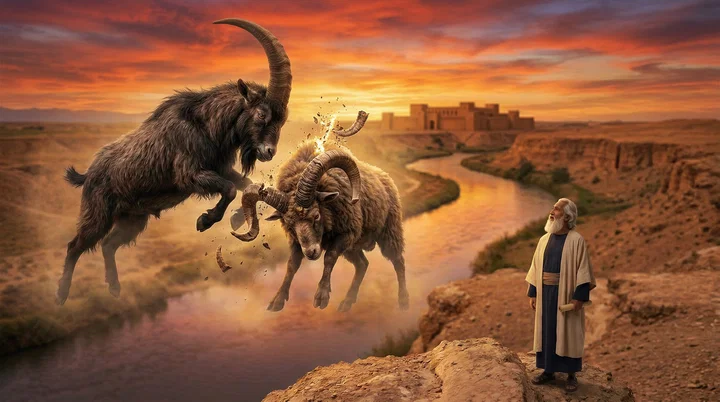
The vision presents successive empires also shown as silver, brass and iron in Daniel 2 and as bear, leopard and ten-horned beast in Daniel 7: the two-horned ram is Media and Persia, the rough shaggy he-goat from the west is Grecia, and the little horn waxing exceeding great is Rome, with the question how long and the answer of 2,300 days until the sanctuary is cleansed.ST Aug 8, 1878RH Mar 10, 1874STRH Nov 12, 1908 The same sequence shows the Medes and Persians as a two-horned ram and Greece as a goat whose great horn is its first king, the broken horn followed by four kingdoms, a little horn growing powerful to attack the holy people and the Prince of princes and prosper while crushing truth, the 2,300 days ending with cleansing of the sanctuary, and the fierce king ultimately broken without human hand.ST Aug 8, 1878RH Mar 10, 1874RH Nov 12, 1908ST Jan 8, 1880 The first part uses symbols in which the two-horned ram is Medo-Persia, the rough goat is Grecia, the notable horn is Alexander the Great, the four horns are the four divisions of his empire, and the little horn which waxed exceeding great is Rome in the entirety of its career, beginning small and expanding through craft and conquest.STRH Nov 12, 1908ST Jan 8, 1880
In vision the ram pushes westward, northward and southward so that none can stand before it, then the he-goat comes from the west so swiftly as if not touching the earth with a notable horn between its eyes, smites and stamps the ram, grows greater until the great horn breaks and four notable horns rise toward the four winds, then a little horn comes from one of them.ST Oct 13, 1909 This order fixes the sequence and application of Daniel 8:9-12 as Medo-Persia, then Greece under its first king who conquered Persia, then its fourfold division after his death, then Rome when the transgressors are come to the full.RH Nov 12, 1908ST Oct 13, 1909
Horns are rulers civil or ecclesiastical, and the ram's two high unequal horns are the kings of Media and Persia and the two divisions of Medes and Persians.ST Jan 22, 1880RH Mar 21, 1854RH May 19, 1851 The higher came up last because regal power was first vested in Darius the Median while Cyrus as commander subdued Babylon and then placed Darius on the throne, and only afterward Cyrus married Darius's daughter, succeeded to Persia, received Media in reversion, and became absolute monarch of the whole.ST Jan 22, 1880
The two-horned ram shows the kingdom had two peoples with the Persian element rising later and becoming dominant, explaining the bear raised up on one side.ST Sep 29, 1881ST Aug 18, 1881ST May 3, 1877 Its two nationalities correspond to the two arms of the image and are a feature shared with the bear symbol of Daniel 7, presenting the same Medo-Persian power represented by the bear.ST Sep 29, 1881ST Aug 18, 1881ST May 3, 1877 The ram of chapter 8 shows Medo-Persia with the Persian element ascendant, while the goat of chapter 8 shows Greece and its division into four parts after Alexander's death.RH Sep 13, 1915ST Sep 4, 1879ST May 3, 1877
The goat's notable great horn is its first king Alexander the Great, who took dominion of the whole earth from Persia, with Grecia under Alexander and its kingdom divided among four generals after his death.STRH Nov 12, 1908ST Jan 8, 1880 After it is broken the four horns replacing it are the four kingdoms or divisions among four generals after his death, namely Macedon, Thrace, Syria and Egypt.STRH Nov 12, 1908ST Jan 8, 1880ST Jan 22, 1880 This explains the leopard with four wings for rapid conquest and four heads for fourfold division.ST May 3, 1877
The he-goat corresponds to the leopard of Daniel 7.RH Mar 18, 1862 Its acts take place before its notable horn is broken and the empire is divided, and after the division actions belong to the kingdoms represented by the horns, not to the original beast.RH Mar 18, 1862
The chapter continues the book's use of object lessons to teach future events with two beasts for kingdoms and a greatly growing horn, where living creatures symbolize mighty nations.ST May 27, 1908RH Apr 29, 1909 The ram represents Medo-Persia and the goat represents Greece, with a horn growing greatly also appearing, and these symbols of ram, he-goat and little horn have been fulfilled in history and carried out the actions described.ST May 27, 1908RH Apr 29, 1909RH Dec 15, 1863RH Dec 15, 1904 In symbolic prophecy days represent years.RH Dec 15, 1904
Its great subject is Rome, central in Daniel's last half as Babylon is in the first, and Rome coming upon the stage of action establishes the vision.RH May 29, 1900 The vision brings the empires of earth in review before Daniel concerning a definite work and a definite time: Medo-Persia passes and Grecia stands, Grecia in turn passes to make way for Rome, and Rome is seen in both its phases in a supreme effort to crush the church of Jesus Christ and to destroy the truth.RH May 29, 1900ST Dec 21, 1915
Little Horn Against Christ
The little horn that succeeds Grecia is Rome in the entirety of its career through its pagan and papal periods, covering the same span as the fourth beast and all its horns in Daniel 7 and reaching to its end-of-the-world phase with features applying specifically to modern papal Rome.ST Nov 19, 1885RH Apr 10, 1900 The little horn of Daniel 7 represents the papacy during only part of Rome's history, while the little horn of Daniel 8 represents Rome throughout, and the two horns are distinct and must not be made identical.ST Nov 19, 1885RH Jan 10, 1871 Those who held a differing interpretation taught that the little horn here is Mahometanism proved by its place of origin and sphere of influence, while the little horn of Daniel 7 is the Roman Catholic hierarchy, with the cleansing of the sanctuary referring to affairs on earth at the destruction of Mahometanism.RH Apr 15, 1873
The vision begun here and continuing through Daniel 8:23 identifies Rome and no other power but Rome as the king of fierce countenance understanding dark sentences, whose power is mighty but not by his own power and who shall be broken without hand.ST Feb 19, 1894 It shows Rome as one undivided power and denotes no division into two great parts corresponding to the Eastern and Western Empires, agreeing in this with the iron legs of the image and with the great and terrible beast of Daniel 7, which also represent Rome without such a twofold division.RH Mar 16, 1869 In this vision the daily represents Rome in its pagan form and the transgression of desolation represents Rome in its papal form, with paganism as the power that withheld the manifestation of the papacy until taken out of the way.RH Feb 15, 1870
Roman power is identified because it destroys God's holy people and stands up against the Prince of princes, putting Him to death at the crucifixion.ST Aug 8, 1878RH Mar 10, 1874ST Oct 22, 1874ST May 11, 1876 The prophetic history runs from the rise of the Persian Empire to the final destruction of earthly kingdoms by God, with the ram for Media and Persia, the goat for Greece under Alexander with its kingdom divided among four generals after his death, and the little horn growing from one of the divisions to become imperial Rome, which put Jesus to death through Pilate.ST Aug 8, 1878RH Nov 12, 1908 The field of vision covers the power that puts saints to death and stands up against the Prince of princes, including how many are slain, how the standing is done, what the fate of the power is, what clear reference that fate contains, and when its destruction takes place, which facts together prove the scope of the vision beginning here.RH Oct 6, 1863
The prophecy applies to the Roman power, pagan and papal, not to Antiochus Epiphanes.LS 67.3–69.3RH Dec 23, 1852RH Dec 10, 1857 Antiochus was a Syrian king who could not resist the mandates of Rome, Daniel 8 does not bring Antiochus into view, and that interpretation is rejected as an attempt to break the evidence for the prophetic application.RH Dec 23, 1852RH Jan 31, 1871RH Jul 19, 1864
Antiochus cannot fit because the horn waxed exceeding great beyond Persia which is called great and Grecia which is called very great.ST Feb 12, 1880 Antiochus was only the eighth in order of twenty-six kings of the Syrian horn and could not at the same time be another remarkable horn, was not the most illustrious but vile and extravagant in folly so that Epiphanes the Illustrious was changed to Epimanes the Madman, was subject to Rome which exacted tribute and territory and took him as hostage, enlarged his dominion only by temporary conquests in Egypt which he relinquished at Rome's command for Ptolemy and then vented disappointed ambition on the Jews, and died 164 years before Jesus Christ who is the Prince of princes against whom the power stands up.ST Feb 12, 1880
The specifications apply partly to pagan Rome and fully to Rome in its religious falling away, with pagan Rome picturing papal Rome.ST Mar 12, 1912 The power arising in the latter time of the four kingdoms that succeeded Alexander, described as the king of fierce countenance understanding dark sentences, is the same as the fourth beast with its ten horns and little horn, which is Rome.
The little horn is linked with the little horn of Daniel 7, the woman of Revelation 17, the man of sin of 2 Thessalonians 2, the beast of Revelation 13, and the power mentioned in Daniel 9:26, as papal Rome.ST Jun 20, 1900RH Jul 31, 1900RH Jun 6, 1912ST Dec 21, 1882 It is an ecclesiastical power arising in the era of the fourth kingdom and developing among the divided kingdoms of Rome, exalting itself and speaking great things.RH Jul 31, 1900RH Jun 6, 1912 With Daniel 7 it exposes the mystery of iniquity, the attempt to establish a worldwide spiritual rule by enthroning a man as the professed vicar of Christ to take the worship and allegiance due to God in Christ, putting the church on guard against its deceivableness of unrighteousness.RH Sep 13, 1915 The transgression of desolation is the symbol of this same power, rising to take the place of the daily after opposing the Prince and casting down part of the host understood as the church and the stars understood as the apostles.ST Jun 20, 1900ST Jun 20, 1900
The vision brings to view the rise and fall of Babylon, Medo-Persia, Grecia, and Rome, the division of Rome into ten parts accomplished in the first few centuries of the Christian era, and the rise of the papacy with its warfare against God and truth and its time of great authority from 538 to 1798 A.D.RH Nov 24, 1910 Its specifications are fulfilled in the papacy, identified as the great apostasy, with emphasis on the papal phase of the little horn representing Rome in its pagan and papal phases.RH Sep 13, 1915 The prophecy is fulfilled by the papacy's replacement of Christ's mediation with human mediation, and its symbolic horns show the ram's horns as the kings of Media and Persia, the goat's great horn as its first king, and the little horn as the papal church later clothed with civil power.RH Apr 10, 1916RH Dec 23, 1851
The fierce king is ultimately broken without human hand, which represents its destruction at the second coming of Christ.ST Jan 8, 1880 The prophecy reaches to the end of this dispensation and is fulfilled except for its very closing specifications, foreshowing the successive arising and passing away of Babylon, Medo-Persia, Grecia, and Rome, after which the fifth universal empire which is God's everlasting kingdom is immediately impending.ST Aug 2, 1877 All that remains to be accomplished is the breaking without hand of the little horn which waxed exceeding great, with its predicted events otherwise described as having been fulfilled in history.ST Aug 2, 1877RH Dec 11, 1856ST Apr 9, 1912RH Dec 13, 1853
Daily Sanctuary and Apostasy
The vision shows the little horn succeeding Greece as Rome taking away the daily, where the daily is paganism in its pagan form and the transgression of desolation is Rome in its papal form.ST Sep 9, 1880RH Jan 28, 1858RH Jan 28, 1858RH Feb 15, 1870 They are two successive desolating powers that have desolated God's people, with the power changing from paganism to papacy and paganism later changing into papal opposition to God's work.ST Sep 9, 1880RH Jan 28, 1858RH Feb 15, 1870 Paganism was the power that withheld the manifestation of the papacy until taken out of the way.RH Feb 15, 1870
The continual taken away is organized paganism taken away in A.D. 508 to make room for setting up the abomination that makes desolate thirty years before the 1260 years beginning in 538, so that both the 1260 and the 1290 years end in 1798.ST Sep 21, 1915 Paganism's sanctuary was the Pantheon in Rome, whose place was cast down when Constantine transferred the imperial capital to Constantinople.RH Jan 28, 1858 That power rises to take the place of the daily after opposing the Prince of princes and casting down part of the host, understood as the church, and the stars, understood as the apostles, the same transgression of desolation identified with Daniel 7's little horn and the man of sin in 2 Thessalonians 2.RH Jan 28, 1858ST Jun 20, 1900
The vision foretells a power that would take away the continual service, causing it to cease for a time, the shekinah glory to depart, and God's house to become desolate.RH Nov 25, 1902 Rome is that power which profaned the sanctuary, removed Christ's continual leadership, and set up the abomination that makes desolate.RH Nov 25, 1902ST Apr 23, 1912 The same power as in 2 Thessalonians 2 exalts itself against Christ, casts truth down, and takes away the continual ministry of salvation represented in the sanctuary.RH Oct 29, 1903 Removing Christ's continuing ministry through the heavenly sanctuary destroys the sanctuary's work as God's means of salvation, and the message restores the true sanctuary teaching and gives Christ His proper place.RH Oct 29, 1903
The continual means more than the continual burnt-offering, covering the permanent essence of the whole sanctuary service, that which alone makes the worship of sinful beings acceptable to God whether offered with or without ritual service and with or without typical temple and typical sacrifices. That essence is a present Christ, the Lamb slain from the foundation of the world, as the living sacrifice for a fallen world, requiring union between Christ and the believer so that the believer himself in Christ becomes priest, becomes temple, becomes offering. This union of divinity and humanity is the mystery of godliness whereby the church becomes the body of Christ and each individual a member. To take away the continual is therefore to have a temple without Christ in it, a priesthood without Christ, a sacrifice without Christ, and a church without Christ, which changes the worship of God into idolatry and substitutes paganism for Christianity while retaining the names and forms of Christianity, which is just what the little horn, the papacy, has done.
The vision foretold the later apostasy in which an earthly religious power would establish a priestly ministry and earthly altars, obscure the heavenly sanctuary's truths, and exalt itself against the Prince of the host and the sanctuary, and its developments were fulfilled in history.RH Jun 6, 1912 The chapter defines what is included under the continual, exposes the result of taking it away, shows how the worship of God is thereby changed and what is substituted for Christianity, and points to the power that fulfills these specifications. Its entire force applies to the heavenly sanctuary, for there are two sanctuaries revealed in Scripture, an earthly and a heavenly, the former with all its services a type or figure of the latter, and the latter the pattern of the former.ST Oct 13, 1909 The continual comprehends the entire service of the earthly sanctuary as ordained of God — the morning and evening sacrifices offered for the whole congregation every day of the year, the showbread, the lamps burning, the perpetual incense, and the high priest bearing the judgment of the children of Israel before the Lord — and, since the earthly in all its appointments and services is but a figure of the heavenly sanctuary, the term applies with equal force to the sanctuary above.ST Oct 13, 1909 Because the earthly sanctuary with its priesthood had ended its operations before the power portrayed in the prophecy began its operations, the entire force of the prophecy applies there.ST Oct 13, 1909
The word sanctuary cannot properly mean the earth, the land of Canaan, or the church.RH Feb 6, 1900 The vision covers the earthly sanctuary with its service by which sin was transferred to it and its cleansing ceremony, the heavenly sanctuary with Christ's priestly service and its cleansing, the development of the Roman power, and the history of the earthly sanctuary from the erection of the tabernacle in the wilderness to the final destruction of the temple at Jerusalem.RH Feb 6, 1900 The sanctuary and its host correspond to Jerusalem and the Lord's people, with their appointed time and the removal of iniquity connected with their comfort and deliverance.RH Oct 14, 1852 The sanctuary is in heaven, not on earth, and the host means the worshipers, who never enter the sanctuary itself but worship outside while the priest alone goes inside on their behalf. The treading under foot does not require wicked men to enter heaven, but is done from earth against heavenly things, just as earthly apostates crucify afresh and tread under foot the Son of God while He ministers in the heavenly sanctuary.
Twenty-Three Hundred Days Explained
The 2,300 days are not literal days of twenty-four hours but prophetic years, each day standing for a year, for literal days would compress Persia, Greece and Rome into little more than six years and could not span the empires portrayed in the vision.ST Feb 7, 1884RH Dec 29, 1863RH Jan 7, 1858ST Aug 9, 1910 The symbols themselves represent governments, and the time period is part of that symbolic vision belonging to a line of prophecy about nations as enemies of the gospel.ST Aug 9, 1910 It is the longest prophetic period, forming the basis for the messages of Christ's first and second appearing.RH Mar 17, 1853 As a revelation it must have an ascertainable beginning and ending, showing the ram, the goat and the little horn as Media-Persia, Greece, and Rome succeeding Greece, made clear by Gabriel's divinely commanded explanation.RH Mar 17, 1853ST Feb 7, 1884
The seventy weeks, or 490 years, are cut off from those 2,300 days, so both periods begin together and the longer extends 1,810 years beyond the shorter.RH Mar 17, 1853RH May 26, 1853SMV 25.1RH Jan 20, 1853 They cannot be separated, nor can the seventy weeks be moved forward thirteen years.RH Dec 23, 1852RH Mar 17, 1853 The period begins with the decree of Artaxerxes to restore and rebuild Jerusalem in 457 B.C. in Ezra 7, when Ezra began the work, reckoned from autumn 457.RH Mar 17, 1853RH Jun 4, 1857RH Feb 17, 1853 In sections it reaches to the finishing of the wall in 408 B.C., the baptism of Christ in A.D. 27, His crucifixion in A.D. 31, and the giving of the gospel to the Gentiles in A.D. 34 at the end of the seventy weeks, reckoned by some to A.D. 33.RH Nov 24, 1910SMV 25.1RH Feb 17, 1853
With 1,810 years remaining after A.D. 34 the 2,300 years end in autumn 1844, or 1843 on the earlier reckoning, for the cleansing of the sanctuary and justification of God's people.RH Mar 17, 1853SMV 25.1RH May 20, 1909RH Jun 4, 1857 The time fixing the cleansing is as exact as the sixty-nine weeks to Christ's ministry, the sixty-nine and a half weeks to His death, and the seventy weeks to the Gentiles, so to insert twelve years between the end of the 2,300 days and the cleansing would be as fatal as adding twelve years in Daniel 9 to proving Jesus the Messiah.RH Feb 21, 1856 The seventy weeks as the first 490 years test the prophecy's accuracy and establish its correct application.RH Oct 4, 1870 Together with Daniel 9 the chapters predict besides the work of civil persecuting powers the very time of Messiah's first advent, the length of His ministry, the time of His death, and the time of the beginning of the judgment.ST Nov 8, 1905RH Oct 4, 1870
The 2,300 days span nearly the whole field of the vision and reach through the present age to its end, belonging together with Daniel 2 and Daniel 7 as one exposition and parallel lines of the four kingdoms.ST Aug 12, 1875RH Apr 23, 1867 Of the 2,300-year period 400 years belong to the earthly sanctuary and the first covenant until the Saviour completes His earthly ministry and confirms the new covenant, and 1,810 years later the sanctuary of the new covenant with its priestly ministry is cleansed.RH Oct 2, 1856 The vision as carried out and explained in Daniel 9-12 contains four prophetic periods, the 2,300, 1,260, 1,290 and 1,335 days, with the 2,300 days as the principal and longest period and the others as intermediate parts and subdivisions of it.RH Jul 18, 1871ST Jul 27, 1882 Hence the promise that Daniel shall stand in his lot at the end of the days, without naming which period, points back to the principal longest period, the 2,300 days.RH Jul 18, 1871
Gabriel explained the ram, the he-goat and the little horn but left the time element unexplained, because Daniel fainted, was sick certain days and could bear no more, closing astonished without understanding.RH Mar 21, 1854RH Jul 14, 1863RH Nov 12, 1908 The symbols of beasts and horns were explained at the height of Medo-Persian power, but the period and the sanctuary were not explained in this vision, leaving Gabriel's commission unfulfilled until his return in Daniel 9 to take up the omitted time.RH Dec 23, 1852RH Mar 21, 1854RH Dec 31, 1857 The vision seen at the beginning in Daniel 9 is the same chapter 8 vision, with no other vision intervening, and its missing time is what Gabriel then explains.RH Dec 31, 1857ST May 17, 1877RH Jul 21, 1863 Daniel's prayer was answered by the command to understand the matter and consider the vision, recalling chapter 8's unclear features, and Gabriel begins with that omitted matter by declaring seventy weeks cut off from the 2,300 days, so wherever the seventy weeks commence the 2,300 days begin.ST May 17, 1877RH Dec 8, 1915ST Mar 26, 1912
As the seventy years of captivity neared their end Daniel mistakenly connected the cleansing with the end of the captivity and the rebuilding of the sanctuary, supposing the 2,300 days ended with the seventy years after learning Jeremiah's promise in Darius's first year.RH Mar 21, 1907RH Aug 23, 1870ST Oct 18, 1877ST Apr 1, 1880ST Feb 9, 1882 Gabriel's later instruction corrected that timing, given about fifteen years after the vision.RH Aug 23, 1870ST Feb 9, 1882 Yet how long the host would be trodden under foot remained unanswered, and Daniel had not yet learned what would happen to his people at the end of the indignation until further light.RH Jan 10, 1856 The chapter formed the main basis of William Miller's calculations, whose period and dates were correctly understood, but the sanctuary was not the earth to be cleansed by the fires of the last day, for the biblical sanctuary means a sacred place, first the Jewish tabernacle and then the greater heavenly tabernacle where Christ ministers.RH Mar 11, 1875
Cleansing Judgment and Advent
The cleansing at the end of the 2,300 days began in 1844, in the autumn, on October 22, as Christ's entrance into the most holy place of the heavenly sanctuary to begin the investigative judgment in final atonement preparatory to coming without sin unto salvation.RH Mar 17, 1853ST Jun 20, 1916RH May 20, 1909 The 2,300 days are prophetic years beginning with Artaxerxes' decree in 457 B.C., with the 70 weeks or 490 years cut off from them and ending in A.D. 33 or 34, leaving 1,810 years to bring the whole period to autumn 1844, first reckoned to spring and then after further study to October 22.RH Mar 17, 1853SMV 25.1RH May 20, 1909 The time was exact, as exact as the sixty-nine weeks to Christ's ministry, the sixty-nine and a half to His death, and the seventy to the Gentiles, so that to insert twelve years between the end of the days and the cleansing would be as fatal as adding twelve years in Daniel 9 to proving Jesus the Messiah.RH Feb 21, 1856 The time was right but the sanctuary was mistaken for the earth to be cleansed by fire at the second coming, and the failure of Christ to come in 1843 or 1844 showed the sanctuary is not the earth.RH Mar 17, 1853ST Jun 20, 1916SMV 25.1
The vision centers on Jesus Christ, pointing out the time of His manifestation as Messiah, how long His earthly ministry would last, when His priesthood would begin, and the very year He would enter the closing work of that priesthood.ST Aug 14, 1893 That closing work is the cleansing of the heavenly sanctuary or investigative judgment determining the worthiness or unworthiness of those who once entered God's service.ST Aug 14, 1893 It began in 1844 and according to the type is comparatively brief and will soon be over, and then Christ will come.ST Aug 14, 1893 It is the mighty judgment work of the righteous carried on in the sanctuary in heaven, entirely removed from the eyes of men, now going on and working down through the centuries until it reaches the living in their ordinary occupations to choose them for immortality and eternal life.ST Oct 28, 1913ST Aug 25, 1914
The judgment is a prolonged season during which the books of record in heaven were opened and each case of the righteous passes in review before God preparatory to the call to immortality at the first resurrection at Christ's second appearing.ST Aug 25, 1914 Naming the ram as Medo-Persia and the he-goat as Grecia with its four horns as the fourfold division after Alexander reveals that God's great judgment with thrones placed and books opened began its sittings in 1844 at the beginning of the closing of Christ's work. The long periods were sealed until the time of the end, when the first angel's message proclaimed the judgment hour and that prophetic time would be no longer.RH Jun 4, 1857 The cleansing of the sanctuary in 1844 is thus connected with the later breaking of the little horn, when the seventh angel began to sound.RH Jun 4, 1857
The 2,300 days encompass both the earthly sanctuary of the first covenant and the heavenly sanctuary of the new covenant.RH Jan 20, 1853 The seventy weeks are cut off for the earthly sanctuary, and at their end the true heavenly tabernacle, its anointing, sacrifice, and ministry are introduced.RH Jan 20, 1853 The transfer occurs when the shadow ceremonies cease at Christ's death, as animal offerings give way to Christ's sacrifice, the Levitical priesthood to the priesthood of Melchizedek, and the earthly holy places to the true holy places in heaven.RH Jan 20, 1853 Gabriel left the days and sanctuary unexplained here to explain them in Daniel 9.RH Jan 20, 1853 That cleansing is not limited to one prophetic day but requires several prophetic days, proportioned to the length of Christ's ministry in the first apartment and to the mighty ministration in the holiest of all.RH Apr 28, 1853
The cleansing refers to the heavenly sanctuary, since the earthly sanctuary had already been destroyed and the prophecy reaches to the last days.RH Apr 28, 1853ST May 1, 1879 The full vision is not the same as the 2,300 symbolic days within it, for its events are not all covered by that period.RH Jun 4, 1857RH Jun 4, 1857 The 2,300 days began with the decree to restore Jerusalem in 457 B.C. and ended in fall 1844, but the vision itself extends to the destruction of earthly powers, including the breaking of the little horn which had not yet occurred, so the period's ending does not require the horn broken at the same time.RH Jun 4, 1857RH Jun 4, 1857 The prophecy reaches to the end of this dispensation and is fulfilled except for its very closing specifications, foreshowing the successive arising and passing of Babylon, Medo-Persia, Grecia, and Rome, after which God's everlasting fifth universal kingdom is immediately impending.ST Aug 2, 1877
Its symbols are fulfilled, its prophetic days long since ended, and the cleansing of the sanctuary — the investigative judgment and finishing of God's mystery — is already in progress and possibly near completion, with only the little horn remaining to be broken without human means.ST Sep 14, 1882 These developments are signs that Christ's coming may be near.ST Sep 14, 1882 The vision concerns the three last universal powers, Medo-Persia, Grecia, and Rome, the persecution of God's people, and Christ's work as prophet and sacrifice and priest, including the 2,300 days as years reaching to 1844, after which the last and next event in its line is the coronation of Jesus Christ as coming King.ST Jul 8, 1897 It asks how long apostasy will trample God's truth and gives the 2,300-day period, after which the sanctuary is cleansed and the final work begins in heaven.ST Nov 28, 1895RH Apr 4, 1912
It foretold Grecia's rise to world power about 200 years beforehand, contains the 2,300-year period beginning in 457 B.C. and ending in 1844 when the investigative judgment began in heaven, and has no definite prophetic time extending beyond that date.ST Nov 28, 1895 It belongs to the main prophetic portion given hundreds of years before the Christian era, answering human origins, individual future, and the world's fate.ST Nov 24, 1914 Its prophecy is definite and dependable, fulfilled with minute accuracy through long centuries, giving absolute certainty about the outcome of the world and the future of the race.ST Nov 24, 1914 Nearly all its contents are strikingly fulfilled with great accuracy, marking the present as near the destruction of all earthly governments and the setting up of God's everlasting kingdom at the second advent, with final events nearing consummation.ST Jun 27, 1878RH Apr 3, 1866RH Nov 17, 1910
It is not limited to Antiochus Epiphanes' persecution and temple desecration but concerns Christ's coming and the everlasting kingdom, while its fulfilled delineations of the great kingdoms confirm that the promised final events will surely come.RH May 15, 1856ST Jun 27, 1878 Daniel's prophecies must be fulfilled before Christ comes.ST Feb 4, 1913 It is included among the prophetic sequences spanning history whose final links show the world near Christ's second coming, one of several timelines converging toward that coming.ST Nov 28, 1900RH Mar 11, 1875 Its great symbols give evidence that Christ will come soon, that the last generation has been reached, and that many now living will see the heavens disclose the Son of man in power and glory, combining with other fulfilling prophecies and worldwide movements to point to the King of kings as near, though the definite day and hour are not revealed.RH Aug 28, 1913 Its periods point to about the time of the second coming, locating it within a few years of the present.RH Mar 27, 1866RH Apr 26, 1864
How to Study and Apply
The vision was given to disclose future events rather than to hide them, employing both new and familiar symbols in a combination of literal and figurative language, with its meaning unfolded by inspiration and the interpretation immediately following the vision, standing as one of five symbolic prophecies in Daniel afterward fully interpreted which together supply the Bible's own key for interpreting other prophecies by comparing scripture with scripture.RH Sep 2, 1909 It is one of the more important prophecies whose definite interpretation is laid down in the sacred Book itself, so its meaning is plain and certain without need for speculation or mistake, and like Daniel 2 and Daniel 7 it has been accurately and literally fulfilled, giving sure ground for knowing the power and coming of the Lord Jesus Christ and showing that message is not a cunningly devised fable.RH Mar 8, 1915ST Jun 30, 1914 Its symbols are understood first by studying the other parts of that same prophecy, then by comparing related prophecies and the history of the powers that fulfill them.RH Jan 23, 1913 The visions in Daniel 7 to 12 expand the outline of world empires and Christ's everlasting reign given in Daniel 2 with further details and new features, repeating the same coming things by different visions and in different figures, and all must be combined into one to be understood.ST Oct 8, 1896ST Apr 29, 1903RH Feb 18, 1873
It is a symbolic prophecy whose prediction is contained only in symbols rather than in the words expressing it, distinct from verbal prophecy and from figures because unlike figures the person, place, or thing illustrated is not expressed, using beasts and horns to symbolize kingdoms and days to represent years.RH May 8, 1916RH Jun 12, 1855 The marvelous prophecy of Daniel 8 and 9 unfolds the plan of salvation in its types, shadows, and reality, to be studied as a whole, with the sanctuary question introducing present-dispensation truth and the sanctuary service presented as a type explaining Christ's work in the present dispensation.RH Feb 6, 1900 Together with Daniel 7 it teaches the judgment, the cleansing of the sanctuary, and other prominent features of present truth.RH Sep 23, 1902 Together with Daniel 9 it belongs as one exposition distinctly pointing out the commencement and termination of the 2300 days, showing what the sanctuary is and the nature of its cleansing, thereby explaining the disappointment of the Advent people in regard to time and the true position of those now waiting for their Lord.RH Feb 14, 1856
The vision must be examined again with care because it contains the Bible subject of the sanctuary, which holds the most important facts connected with the disappointment and is worthy of serious attention by all who wait for the consolation of Israel, beginning with the first thing set before the prophet's eye.RH Dec 23, 1852 Its exposition explains the 2300 days, the sanctuary and its cleansing, and the Advent people's disappointment over the time, dating the vision to the third year of Belshazzar's reign as following the earlier one and connecting it with the 2300 days and the sanctuary's cleansing.RH Jan 17, 1856 In connection with Daniel 8 and 9 it belongs to the prophetic setting for the 2300 days, the sanctuary, its cleansing, and the Advent expectation of the Lord.RH May 8, 1856 The sanctuary discussed is a sacred place, a dwelling place of God, and the earth or any part of it has not been such a place since humanity left Eden.RH Dec 5, 1854
It opens one of the latter-day visions given to Daniel as a latter-day prophet, revealing and making plain present-day occurrences and what shall be in the latter days, with the second coming of Christ and the setting up of the everlasting kingdom of God as focal point amplified and explained in the surrounding chapters.RH Jan 20, 1910 Together with Daniel 7 and with Revelation as the complement of Daniel it calls for special study and teaching at the present time, although from Eden until now there has been only one way of personal salvation through personal faith in a personal Saviour.RH Sep 23, 1902 It belongs with Daniel 2, Daniel 7, and the revelation of Jesus Christ to John as prophecy on which new light has dawned in the latter days, after being a sealed book which the learned cannot read because sealed and the unlearned cannot because unlearned, now unsealed and made plain upon tables that he who reads may run.RH Dec 9, 1873 This light is present truth requiring daily self-denial, earnest imitation of Christ as Pattern, unwearied well-doing to reap in due season, and close following of Christ to realize His power against Satan.RH Dec 9, 1873
Its exposition alongside Daniel 2 and 7 traces the course of empires and shows that God is about to set up His kingdom, standing among plain and thrilling prophecies concerning the Second Advent completed in the present generation and harmonizing with the judgment-hour warning and worldwide proclamation of the kingdom.RH Apr 23, 1867RH Jul 2, 1867RH Mar 26, 1867RH Mar 10, 1868RH Jun 18, 1867 It presents a panorama from Daniel's time and the rise of Persia to the final destruction of earthly kingdoms by God, with earthly kingdoms as beasts and a prophetic period reaching to the latter days of direct present importance, foreshowing successive powers after which God's everlasting fifth universal kingdom is immediately impending with only the breaking without hand of the little horn remaining.ST Aug 8, 1878RH Oct 3, 1912RH Mar 10, 1874RH Dec 30, 1915ST Oct 22, 1874 Beginning at a different point and carrying to Christ's consummation, like Daniel 2, 7, and 10-11 it closes not with conversion but with violence followed by Michael's reign, teaching destruction of the present order by tremendous power with every particular to date fulfilled.ST Aug 8, 1878RH Mar 10, 1874
It is named among prophetic lines reaching culmination in the present days, reviewed among signs of Christ's second coming, with closing scenes enacted in the last generation showing the world in the closing years nearing the second coming.ST Nov 1, 1910RH Nov 17, 1904RH May 11, 1916ST Sep 10, 1894 Its sanctuary subject and prophetic periods extend near the end to an event associated with the sanctuary, guiding servants to warn the last generation and prepare for coming though not reaching the appearing itself, and marking the time of the end as starting point toward the second coming.ST Jun 4, 1874ST Dec 24, 1912 It reveals the great controversy between good and evil and belongs to the prophetic delineation of Romanism and the Papacy setting scriptural context for protest against aggression and picturing papal utterances.RH Jun 6, 1912RH May 15, 1913ST Sep 8, 1909 Its testimony cannot be broken, for Alexander's conquests were in harmony with it while his attempt to rebuild Babylon opposed it and failed.ST Feb 13, 1912
It begins teaching about true and false ministry with great lessons for the present time, concerning the worship of God and what that worship means to powers opposed to God.ST Oct 24, 1911 Its persecutions of the righteous are distinct from the later time of trouble falling on the wicked through the plagues of God's wrath.ST May 7, 1912 Daniel received it from God while serving as prime minister despite kingdom business, teaching that business cares need not separate from God or prevent close communion.ST Jul 1, 1886 Its Shushan palace setting presents an example of God using the country for solitude and communion.RH May 18, 1905
Here Daniel first saw Gabriel, whom Christ commanded to make Daniel understand the vision and bring instruction to earth, and Gabriel obeyed at once without parleying, coming swiftly as soon as the commandment came forth, showing how God's will is done in heaven by angels doing His commandments as pattern for earth through immediate fully surrendered obedience.ST Apr 2, 1894 In the vision Daniel beholds Gabriel, fears and falls on his face in reverent veneration for God's glory, unable to gather strength until Gabriel's touch restores him, modeling commendable holy reverence giving God His rightful place and molding true worship away from careless irreverence.RH Mar 15, 1870 The vision was set apart from historical narrative because including it there would have interrupted the account. It is one of the symbolic prophecies with Daniel 2, 7, and 9 foretelling events through symbols whose beasts represent earth's great kingdoms, distinguished from Daniel 11 which uses no symbols and is literal.RH Dec 28, 1911RH Dec 12, 1912
Its scope includes persecution and apostasy under the king who defiled the temple with cleansing and restored worship three years later, showing how low worship had fallen, which Daniel 9 does not mention but Daniel 10 reveals concerning Daniel's people.ST Apr 23, 1912 It portrays prophetic developments toward the republic's ruin and coming crisis followed by Christ's everlasting kingdom, belonging to announcements Belshazzar failed to heed while insulting Heaven.ST Jul 4, 1911ST Jul 4, 1900ST Nov 26, 1912 It is an example of prophetic revelation giving knowledge of times and seasons, a vision of ram, he-goat, and little horn forming one of Scripture's clearest chains, revisiting earlier powers with further features and presenting again the last three of four kingdoms before God's kingdom, offering profitable study on three world powers.ST Jan 17, 1884RH Oct 30, 1866RH Aug 1, 1865ST May 28, 1912
The vision is treated in works on Daniel's prophecies, the 2300 days, and the sanctuary, including brief expositions covering these chapters.RH Jun 25, 1857RH Aug 12, 1858 Daniel 10:16 refers back to this earlier far-reaching vision of 2300 years not literal days, and Daniel 8 is invoked as prophetic witness in the call to hear what the Spirit says to the churches.RH Apr 14, 1853RH Dec 27, 1870 It opens a distinct prophecy for study apart from Nebuchadnezzar's dream, national history, papal work, and 2300-day cleansing.RH Jan 7, 1904 The visions begun here follow Daniel 7 on four monarchies, ten kingdoms from broken Rome never reunited, the ecclesiastical horn subduing three, and the eternal kingdom soon succeeding earthly rule.ST Jul 20, 1915
It marks the third great line given just before Babylon's doom in 538 B.C., not fully understood and leaving Daniel solicitous for his people, return, and Jeremiah's fulfillment, with even Daniel 9:24-27 leaving him without hope showing the holy city destroyed and the Prince cut off, so God sent comfort in Daniel 10-12.ST Apr 9, 1912 Its broad outlines were later explained further in Daniel 9 as Daniel still sought fuller understanding of future church events.RH Dec 20, 1870 It opens the vision whose time is addressed in Daniel 8:14, teaching what the sanctuary is and its cleansing, belonging with Daniel 9 and the 2300 days, beginning at a distinct point and carrying to Christ's consummation, with 457 B.C. when Ezra was commissioned important for the seventy weeks and 2300 days and with ram and he-goat as symbols.RH Sep 4, 1856ST May 9, 1906RH Nov 26, 1857ST Nov 18, 1903
It contains the plain little-horn description and 2300-day period of which the seventy weeks are a part, with distinct commencement and termination revealing the sanctuary and its cleansing, explaining disappointment about time and showing the true position of waiters, concerning the sanctuary's cleansing time already arrived or near and answering How long with 2300 years ending in 1844 when heaven's judgment begins.RH Feb 28, 1854ST Oct 28, 1908RH Jun 12, 1856RH Nov 8, 1864RH Feb 3, 1916 Its time and sanctuary meaning left unclear in chapter 8 is supplied later, to be studied alongside Daniel 2 and 7 with its 2300 days requiring its own study.ST Oct 7, 1913 Placed in Belshazzar's third year as Babylon's final year before Darius's first, followed only months later by Daniel 9, it led Daniel to connect it with his people's suffering and restoration and to seek God in prayer.ST Mar 26, 1912 Given before Babylon's fall and before Daniel studied Jeremiah in Darius's first year, Daniel could not reconcile the 2300 days and cleansing with Jeremiah's seventy-year restoration, thinking both ended together, until further instruction corrected him fifteen years after the vision when he prayed over Jerusalem's desolation.RH Mar 21, 1907ST Feb 9, 1882
While Israel was still captive in Babylon the vision announced events affecting Israel's future and helped focus attention on Jerusalem's return and restoration and its message of 2300 days and cleansing.ST Jul 10, 1901 In Belshazzar's third year the Lord showed the coming great apostasy as moving pictures with Medo-Persia following Babylon, then Grecia, then fierce stern soldiers possessing the pleasant land as Rome following Grecia and annexing the Holy Land.RH Mar 28, 1912 It is compared with Revelation 10-11 and Ezekiel 2-3 because some matters appear similar though their meaning cannot be explained.
Further points
In the third year of Belshazzar a further vision was given to Daniel after the first one.RH May 1, 1856 Within that vision the 2,300 days were reckoned as half-days, making 1,150 literal days in all.RH May 1, 1856 Those 1,150 days were fulfilled by Antiochus Epiphanes.RH May 1, 1856
Sources