Daniel 3:6
And whoso falleth not down and worshippeth shall the same hour be cast into the midst of a burning fiery furnace.
Translations
And whoever falls not down and worships shall the same hour be cast into the middle of a burning fiery furnace.
And whoso falleth not down and worshippeth shall the same hour be cast into the midst of a burning fiery furnace.
KJV Cambridge Paragraph Bible, Revised Version, American Standard Version
and whoso falleth not down and worshippeth shall the same hour be cast into the midst of a burning fiery furnace.
And whoever shall not fall down and worship shall the same hour be cast into the midst of a burning fiery furnace.
and whoso doth not fall down and do obeisance, in that hour he is cast into the midst of a burning fiery furnace.'
and whosoever doth not fall down and worship shall that same hour be cast into the midst of a burning fiery furnace.
and, whosoever shall not fall down and adore, shall, instantly, be cast into the burning furnace of fire.
Berean Standard Bible, Majority Standard Bible
And whoever does not fall down and worship will immediately be thrown into the blazing fiery furnace.”
Whoever doesn’t fall down and worship shall be cast into the middle of a burning fiery furnace the same hour.”
And anyone not falling down and worshipping will that same hour be put into a burning and flaming fire.
And whosoeuer falleth not downe and worshippeth, shall the same houre bee cast into the middes of an hote fierie fornace.
Douay-Rheims (Challoner revision)
But if any man shall not fall down and adore, he shall the same hour be cast into a furnace of burning fire.
Pictures
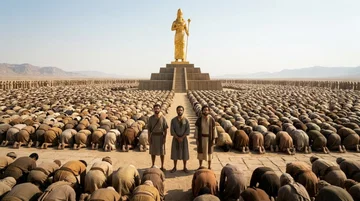
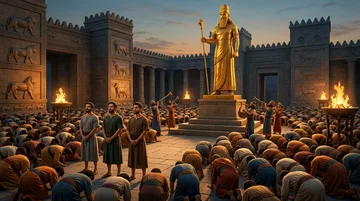
Cross-references 20 of 29
- Daniel 3:16-18
Shadrach, Meshach, and Abed-nego, answered and said to the king, O Nebuchadnezzar, we are not careful to answer thee in this matter.
The three Hebrews refuse to worship the image despite the threatened furnace.
- Revelation 13:15
And he had power to give life unto the image of the beast, that the image of the beast should both speak, and cause that as many as would not worship the image of the beast should be killed.
An image’s worship is enforced under threat of death.
- Daniel 3:25
He answered and said, Lo, I see four men loose, walking in the midst of the fire, and they have no hurt; and the form of the fourth is like the Son of God.
A fourth figure, like the Son of God, walks with the three men unharmed in the fire.
- Acts 5:29
Then Peter and the other apostles answered and said, We ought to obey God rather than men.
God must be obeyed when a human ruler’s command conflicts with His will.
- Exodus 20:4-5
Thou shalt not make unto thee any graven image, or any likeness of any thing that is in heaven above, or that is in the earth beneath, or that is in the water under the earth:
The commandment forbids bowing down to and worshiping images.
- Daniel 3:28
Then Nebuchadnezzar spake, and said, Blessed be the God of Shadrach, Meshach, and Abed-nego, who hath sent his angel, and delivered his servants that trusted in him, and have changed the king’s word, and yielded their bodies, that they might not serve nor worship any god, except their own God.
The king acknowledges that God delivered his servants who refused to worship another god.
- Jeremiah 27:6
And now have I given all these lands into the hand of Nebuchadnezzar the king of Babylon, my servant; and the beasts of the field have I given him also to serve him.
God calls Nebuchadnezzar his servant and grants him rule.
- Daniel 3:19
Then was Nebuchadnezzar full of fury, and the form of his visage was changed against Shadrach, Meshach, and Abed-nego: therefore he spake, and commanded that they should heat the furnace one seven times more than it was wont to be heated.
The king intensifies the furnace and carries out the threat against those who refuse to worship.
- Revelation 14:9-10
And the third angel followed them, saying with a loud voice, If any man worship the beast and his image, and receive his mark in his forehead, or in his hand,
Both warn of judgment for refusing or giving false worship.
- Daniel 3:27
And the princes, governors, and captains, and the king’s counsellors, being gathered together, saw these men, upon whose bodies the fire had no power, nor was an hair of their head singed, neither were their coats changed, nor the smell of fire had passed on them.
The threatened fiery punishment had no effect on the faithful men.
- Matthew 4:10
Then saith Jesus unto him, Get thee hence, Satan: for it is written, Thou shalt worship the Lord thy God, and him only shalt thou serve.
Only God is to be worshiped, contrasting Babylon’s demand.
- Daniel 3:12
There are certain Jews whom thou hast set over the affairs of the province of Babylon, Shadrach, Meshach, and Abed-nego; these men, O king, have not regarded thee: they serve not thy gods, nor worship the golden image which thou hast set up.
The three Jews refuse the king’s command to worship the image.
- Daniel 3:15
Now if ye be ready that at what time ye hear the sound of the cornet, flute, harp, sackbut, psaltery, and dulcimer, and all kinds of musick, ye fall down and worship the image which I have made; well: but if ye worship not, ye shall be cast the same hour into the midst of a burning fiery furnace; and who is that God that shall deliver you out of my hands?
The king enforces worship with a furnace threat and challenges God to deliver them.
- Daniel 3:29
Therefore I make a decree, That every people, nation, and language, which speak any thing amiss against the God of Shadrach, Meshach, and Abed-nego, shall be cut in pieces, and their houses shall be made a dunghill: because there is no other God that can deliver after this sort.
The decree honors God for delivering the three men from the furnace.
- Hebrews 11:34
Quenched the violence of fire, escaped the edge of the sword, out of weakness were made strong, waxed valiant in fight, turned to flight the armies of the aliens.
The three Hebrews’ faith quenched the violence of fire.
- Daniel 3:1
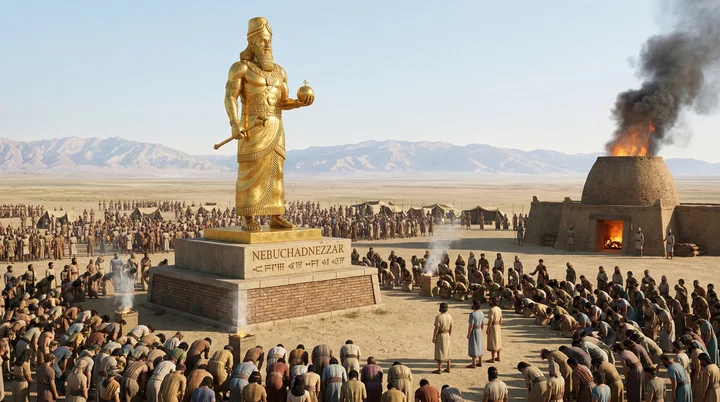
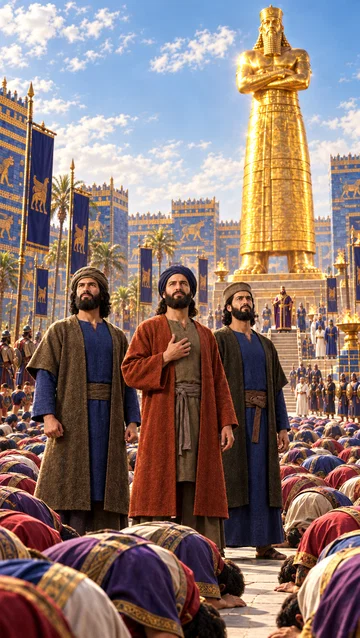
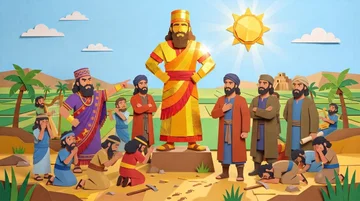
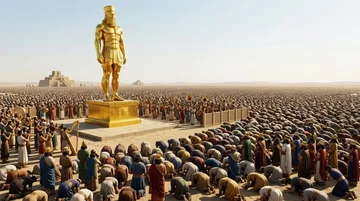
Nebuchadnezzar the king made an image of gold, whose height was threescore cubits, and the breadth thereof six cubits: he set it up in the plain of Dura, in the province of Babylon.
The golden image on Dura is the object of the enforced worship.
- Revelation 13:8
And all that dwell upon the earth shall worship him, whose names are not written in the book of life of the Lamb slain from the foundation of the world.
The beast’s demand for worship is compared with Babylon’s demand.
- Daniel 2:31
Thou, O king, sawest, and behold a great image. This great image, whose brightness was excellent, stood before thee; and the form thereof was terrible.
The golden image echoes the great image in the king’s vision.
- Isaiah 43:2
When thou passest through the waters, I will be with thee; and through the rivers, they shall not overflow thee: when thou walkest through the fire, thou shalt not be burned; neither shall the flame kindle upon thee.
God promises to protect his people as they walk through fire.
- Jeremiah 25:9
Behold, I will send and take all the families of the north, saith the LORD, and Nebuchadrezzar the king of Babylon, my servant, and will bring them against this land, and against the inhabitants thereof, and against all these nations round about, and will utterly destroy them, and make them an astonishment, and an hissing, and perpetual desolations.
Nebuchadnezzar was God’s servant, yet issued an idolatrous decree.
Commentary
Each commentary is drawn from primary sources: the writings of Ellen G. White and Adventist pioneers and periodicals. Each commentary is separate. Its own words are not a quotation; follow the references to read the source passages.
Ellen G. White
41 sources
Nebuchadnezzar set up a golden image to exalt himself and Babylon and commanded by herald that at the sound of music all peoples must fall down and worship it or be cast the same hour into the midst of a burning fiery furnace.ST Sep 2, 1897BS 31.2–3Lt 132, 1901, par. 7–15 Such bowing was worship belonging to God alone as Creator and Sovereign, here made compulsory by civil power joined to false religion to compel conscience under threat of death.21MR 59.1–60.1Ms 84b, 1897, par. 9–1112MR 218.2–220.114MR 93.1–94.1Lt 90, 1897, par. 13–18 The three Hebrews refused to give an idol the honor due God and, though cast into the furnace for loyalty to His law, were preserved unharmed because Christ Himself walked with them in the fire.21MR 59.1–60.1Ms 84b, 1897, par. 9–11ST Dec 24, 1912Lt 109a, 1898, par. 5–8 The same test will be repeated in the last days when a rival man-made rest day, the first day exalted for universal observance, is enforced by human law against those who keep God's seventh-day Sabbath memorial of creation.PK 512.119MR 243.1–4Ms 32, 1898, par. 11–1211MR 354.2–355.1Lt 21, 1902, par. 10–11 Then as now God's people must obey God's law rather than human law, refusing all concession to false worship even under imprisonment and death, and God will intervene for His loyal commandment-keeping people.Ms 168, 1898, par. 1–313MR 71.1–72.1Ms 78, 1897, par. 40
Historical Setting and Decree
Daniel 3:6 belongs to Nebuchadnezzar's renewed idol worship after light direct from Heaven had shone upon him in his dream and for a little time moved him with the fear of God.BS 31.2–3PK 503.2ST Oct 19, 1882 A few years of prosperity filled his heart with pride, and without putting away worldly ambition and self-exaltation he forgot his acknowledgment of the living God and returned to idol worship with increased zeal and bigotry.BS 31.2–3PK 503.2ST Oct 19, 1882
From treasures taken in war he made a golden image copying the one seen in his dream, about ninety feet high and nine feet wide, exceedingly costly and magnificent.BS 31.2–3ST Oct 19, 188213MR 60.1–61.2 Most imposing and majestic in idolatrous eyes, it was set up in the plain of Dura to appear imposing and majestic.BS 31.2–3ST Oct 19, 188213MR 60.1–61.2 The image represented himself and the kingdom of Babylon and magnified the king who ruled over it, representing its glory and excellency.Lt 132, 1901, par. 7–15Ms 168, 1898, par. 1–313MR 60.1–61.2Ms 47a, 1898, par. 2–5 This was because he read the interpretation of his dream of the head of gold through his own idolatrous mind and ambition and perverted the light given to fit it, encouraged by heathen counselors who flattered him, with the hope of exalting Babylon and converting all nations to its worship.Ms 168, 1898, par. 1–313MR 60.1–61.2Ms 47a, 1898, par. 2–5
By proclamation through a herald he assembled all rulers and people and all the officers of the kingdom for the dedication of the image.BS 31.2–3Lt 132, 1901, par. 7–15ST Oct 19, 1882 He commanded that at the sound of the cornet, flute, harp, sackbut, psaltery, dulcimer, and all kinds of music, all peoples, nations, and languages must fall down and worship the golden image he had set up.BS 31.2–3Lt 132, 1901, par. 7–15ST Oct 19, 1882 Anyone who would not fall down and worship was to be cast the same hour into the midst of a burning fiery furnace, with immediate execution in a furnace of fire for refusal.ST Sep 2, 1897BS 31.2–3Lt 132, 1901, par. 7–15ST Oct 19, 1882 This made worship of the image the country's established state religion and a public test of supreme loyalty to Babylonian power, when the music sounded the assembled peoples bowed and worship appeared set to become part of Babylon's state religion.ST Dec 24, 1912PK 506.1 Such idolatry threatened to hinder God's purpose to bless the nations through captive Israel.PK 506.1
Nature of Required Worship
Bowing down before the golden image at the appointed signal was not mere civil respect but an act of worship and homage that belongs to God alone.21MR 59.1–60.1Ms 84b, 1897, par. 9–11 Worship and such homage belong to Him alone as Creator and Sovereign, and He alone is the true God and the only proper object of worship.21MR 59.1–60.1Ms 84b, 1897, par. 9–11ST Nov 5, 1896 Shadrach, Meshach, and Abed-nego refused the king's command because to give the idol the honor owed to God would dishonor Him, accepting the immediate threat of death in the furnace rather than make any concession to idolatry.21MR 59.1–60.1Ms 84b, 1897, par. 9–11ST Nov 5, 1896 No concern, even the preservation of life itself, should lead to such concession.ST Nov 5, 1896 Though cast into the furnace for their refusal, they suffered no harm because Christ Himself came and walked with them through the fire.21MR 59.1–60.1Ms 84b, 1897, par. 9–11 Their loyalty and deliverance made known to the idolatrous nation that God alone is true.ST Nov 5, 1896
The decree made worship compulsory under law, threatening anyone who would not fall down and worship with being cast the same hour into the midst of a burning fiery furnace.12MR 218.2–220.114MR 93.1–94.1Lt 90, 1897, par. 13–18 It shows how civil power joined to religious authority can enforce false worship and turn people from loyalty to God.12MR 218.2–220.1 Rulers in this way claim power over conscience that belongs to God alone, using oppression and coercion to compel worship that dishonors God rather than allowing people to remain faithful to Him.14MR 93.1–94.1Ms 78, 1897, par. 40 The demand to honor a humanly appointed day, Sunday as sacred in place of the Sabbath of the fourth commandment, is the modern counterpart to that decree, with human law seeking to compel worship and displace God's Sabbath.12MR 218.2–220.1Lt 90, 1897, par. 13–18 Those who make such cruel laws to destroy God's people bring destruction upon themselves, but God will intervene for His loyal, commandment-keeping people.12MR 218.2–220.1Ms 78, 1897, par. 40
False religion works against the commandments of God by depending on position and authority to compel those who acknowledge God as Creator and Sovereign to bow to human enactments without question, threatening punishment for refusal.12MR 220.2–3 It also depends on outward display, outward beauty, parade, ceremonies, and charming music to influence the senses and conceal inward spiritual poverty and apostasy.12MR 220.2–3 The great golden image was impressive and attractive, yet it did honor to the prince of darkness.12MR 220.2–3 Churches that depend on ornaments, shrines, embroidered altars, and magnificent architecture instead of Christ follow the same course.12MR 220.2–3
Faithfulness and Divine Deliverance
Shadrach, Meshach, and Abed-nego cherished the knowledge of the true God and when commanded to bow to the golden image were forced to choose between human law and God's law.ST Dec 24, 1912ST Sep 2, 189713MR 60.1–61.2 They refused to dishonor the God of heaven by giving an idol the worship and homage that belong to God alone.21MR 59.1–60.1Ms 84b, 1897, par. 9–11ST Dec 24, 1912ST Sep 2, 1897 They accepted the immediate threat of death in the furnace rather than make any concession to idolatry.ST Nov 5, 1896ST Sep 2, 1897Lt 109a, 1898, par. 5–8 Their loyalty shows that no concern, even the preservation of life, should lead to such concession.ST Nov 5, 1896
The decree that whoever refused should the same hour be thrown at once into a blazing furnace put their integrity to the test.21MR 59.1–60.1Ms 84b, 1897, par. 9–11BS 29.1 That test made their faithfulness, and the power and faithfulness of Israel's God, visible before an idolatrous nation.BS 29.1 The history of that wonderful deliverance of the three Hebrew worthies teaches important principles regarding the working out of the Lord's purpose for the children of obedience and the children of disobedience.Lt 118, 1910, par. 2
For loyalty to the God of heaven they were cast into the burning fiery furnace.Ms 168, 1898, par. 1–313MR 60.1–61.2Ms 47a, 1898, par. 2–5 Yet Christ Himself came and walked with His three faithful servants through the fire and manifested Himself to them.21MR 59.1–60.1Ms 84b, 1897, par. 9–11Lt 109a, 1898, par. 5–8Ms 168, 1898, par. 1–313MR 60.1–61.2 He preserved them from all harm, so they suffered nothing and came through unharmed.21MR 59.1–60.1Ms 84b, 1897, par. 9–1113MR 60.1–61.2Ms 47a, 1898, par. 2–5
Their faith and deliverance made known to the nation that He alone is the true God and the only proper object of worship.ST Nov 5, 1896 The miracle so wrought upon Nebuchadnezzar's heart that he believed in God and acknowledged Him.Ms 168, 1898, par. 1–3Ms 47a, 1898, par. 2–5 He was convinced that the God of the three Hebrews was the living God with superior power over every kingdom.Ms 168, 1898, par. 1–313MR 60.1–61.2Ms 47a, 1898, par. 2–5
Prophetic Pattern for Last Days
The death sentence attached to refusal to worship will be repeated in the last days.PK 512.119MR 243.1–4Ms 24, 1891, par. 18–21 Innocent servants of God, especially those who keep the Sabbath of the fourth commandment, will be handed over to humiliation and abuse by men inspired by Satan and filled with envy and religious bigotry, until at last a universal decree declares them deserving of death.PK 512.1 The command for all peoples to honor the image serves as a model for a future demand for universal worship enforced by human laws.19MR 243.1–4 In that final conflict laws opposed to God's law are exalted like the image, and human laws are elevated above God's laws through threats to people's rights and protection.19MR 243.1–4Ms 24, 1891, par. 18–21
The exalted golden image then stands for the now-exalted rival spurious sabbath.Ms 32, 1898, par. 11–1211MR 354.2–355.1Lt 21, 1902, par. 10–11 It is the first day of the week presented as sacred and holy and exalted for universal observance in place of God's seventh-day Sabbath.Ms 32, 1898, par. 11–1219MR 183.1–2Ms 127, 1897, par. 20–21 It is a humanly created idol rest day and man-made religious requirement promoted by Satan, having no sanctity, with God's Word nowhere commanding reverence for the first day and not one text of Scripture for its authority.Lt 21, 1902, par. 10–11Ms 7a, 1896, par. 15–1719MR 183.1–2 It is connected with churches worshipping the image of the beast and receiving its mark and exalting the world's sabbath.Ms 32, 1898, par. 11–1211MR 354.2–355.1
As refusal then meant being cast the same hour into the burning fiery furnace, so all who will not observe the false sabbath and refuse to reverence it will be placed under oppressive laws.Ms 32, 1898, par. 11–1214MR 90.3–91.4 While remaining faithful to God's Sabbath they will face imprisonment, bruising, binding, condemnation, the chain gang, and death.14MR 90.3–91.4Ms 7a, 1896, par. 15–17Ms 7a, 1896, par. 6–7Ms 71, 1896, par. 10 This coercion tramples the seventh-day Sabbath, God's memorial of creation, makes the memorial of God of none effect, and seeks to compel conscience and suppress religious liberty.Ms 32, 1898, par. 11–12Ms 7a, 1896, par. 6–7Ms 71, 1896, par. 10
The ceremony and formalism, vainglory, oppression, and trampling of Jehovah's law seen in Nebuchadnezzar are repeated.Ms 32, 1898, par. 11–1212MR 218.2–220.1 Persecutors are filled like Cain with bitterness against Abel because God's people will not reject God's law for man's day.Ms 136, 1899, par. 14–16 Those who do this persecuting work because they cannot compel God's chosen ones to be untrue to God are not following the Lamb whithersoever He goeth but are following another leader, the one expelled from heaven and from Eden, developing the attributes of Satan and having guile in their mouths, and if they had opportunity and power they would repeat Nebuchadnezzar's coercion.Ms 7a, 1896, par. 15–17 Those who make cruel laws to destroy God's people bring destruction upon themselves, and God will act in judgment against those who so compel conscience.12MR 218.2–220.1Ms 71, 1896, par. 10
Sabbath Controversy and Response
Daniel 3:6 is forced idol worship, and the same compulsion is repeated when men set aside God's holy Sabbath, which He sanctified and blessed as His memorial of creation, and exalt a rival rest day of their own creation and try to force their fellow men to worship it.Ms 136, 1899, par. 14–16 That setting aside of God's authority for a humanly established form of worship parallels the command to worship the image, for both exalt man's requirement in place of God's Sabbath, which is His sign of sanctification and of His creation.Ms 27, 1900, par. 32–34 Those who persist in this coercion are filled with bitterness like Cain against Abel because God's people will not reject God's law for man's day.Ms 136, 1899, par. 14–16
Loyalty to God must not be given up when human law commands disobedience to His law.13MR 71.1–72.1 This is the pattern for duty when truth is overborne by falsehood, when the law of God is made void by a national act and Sunday is exalted and sustained by law so that keeping the seventh day as the Sabbath is counted disloyal.13MR 71.1–72.1 Then God's people will manifest the same principle as the three Hebrews who would not bow the knee to the idolatrous image representing Babylon and the king himself, with increased zeal and love for the commandments, vindicating the sacredness of the law as a rule of conduct without railing accusation against the nations.Ms 168, 1898, par. 1–313MR 71.1–72.1 In that momentous period students of God's Word must work away from the customs of the world's counselors, reject the saying that the Lord delays His coming, and remain prepared like wise virgins with oil in their vessels with their lamps to go forth to meet the Bridegroom.Ms 168, 1898, par. 1–3 Human demands for worship cannot change God's law, though rulers claim power over conscience that belongs to God alone and Sunday is presented as sacred and honored by all in place of God's Sabbath, and God will intervene for His loyal, commandment-keeping people when civil authority compels worship contrary to God's law and laws restricting religious liberty seek to compel worship.Ms 78, 1897, par. 40Ms 88, 1897, par. 19–20Ms 15, 1896, par. 33–34
The same decision for or against the commandments of God against commanded false worship will come in the Southern States.Lt 35, 1895, par. 1–3 That time must not be forced by haphazard work or presumptuous teaching, and counsel must never encourage defiance and resistance even under threat of the chain gang, lest it bring great evil and suffering and close the way to untouched fields.Lt 35, 1895, par. 1–3 Believers must resist not evil, pray for those who treat them evilly, and better go to other cities or countries.Lt 35, 1895, par. 1–3 The episode is a pattern for a future test over Sabbath observance, when oppressive laws will punish as an act of worship those who refuse to honor a rival sabbath, calling for loyalty to God and His commandments rather than submission to coercion.Ms 110, 1904, par. 58–61 Those who obey God's command will not face self-condemnation in the judgment for rejecting that sign.Ms 27, 1900, par. 32–34
Sources
Pioneers and periodicals
131 sources
The decree ordered that everyone must bow down to the golden image when the music sounded, and anyone who refused would at once be thrown into the middle of a burning furnace, so worship was made compulsory on pain of immediate death.RH Oct 25, 1864ST Jan 9, 1912ST Dec 16, 1897 It was enforced religion, seeking by fear what true worship requires as free love and devotion, and it commanded what God forbids by requiring bowing to and serving an image in violation of the second commandment.ST Jan 29, 1908RH Apr 13, 1869ST Oct 9, 1901RH Jun 8, 1916ST Jan 23, 1901 The king in this went beyond the rightful work of civil power to keep order and took God's place by directing worship, but when human law commands what God forbids, loyalty to God requires disobedience while meekly suffering the penalty.ST Jan 23, 1901ST Jul 11, 1911ST Jul 24, 1884ST Mar 6, 1907ST Dec 3, 1896 The three Hebrews stood erect alone though they knew refusal meant death, and God stood by them in the fire so that it had no power upon their bodies, turning their deliverance into a witness that forced even the king to acknowledge the true Deliverer above him.ST Jun 3, 1913ST Jul 27, 1904ST Jun 21, 1905RH Apr 25, 1912ST Jan 9, 1907 The trial foreshadows the last-day test over the image of the beast, when a spurious sabbath will again be set up for all peoples and enforced by a worldwide decree with threat of death, and only the God of the three Hebrews can deliver His faithful from the fire.ST May 6, 1897RH May 1, 1855ST Oct 5, 1882RH Aug 27, 1908ST Sep 10, 1912
Words and Historical Setting
A herald proclaimed that at the sound of the music every person must fall down and worship the golden image, and whoever refused would in that same hour be thrown into the middle of a blazing furnace, so that worship was made compulsory under immediate threat of death.ST Jan 9, 1912ST Dec 16, 1897ST Jan 29, 1908ST Oct 11, 1905RH Aug 6, 1908 The command was universal, laid upon officers and upon all peoples, nations and languages, and the crowd obeyed when the instruments sounded.ST Jan 9, 1912ST Dec 16, 1897ST Jan 9, 1912 The penalty fell upon the faithful few who stood erect instead of bowing.RH Oct 25, 1864ST Jun 3, 1913
The phrase for immediacy uses the hour, the Bible’s first mention of dividing time into hours, which was probably a Chaldean invention.RH Apr 13, 1869 The threat joined fear of pain to the attraction of music and public ceremony in order to compel worship.RH Apr 13, 1869
The image had been set up in the plain of Dura, made entirely of gold from treasures taken in war, about ninety feet high and nine feet broad, most imposing and majestic in idolatrous eyes.ST Oct 19, 1882ST Dec 16, 1897ST Jan 29, 1908 It represented the image seen in the previous vision, yet altered to declare that Babylon’s dynasty and glory would continue supreme forever and would not be succeeded by another kingdom.ST Dec 16, 1897ST Jun 3, 1913ST Dec 3, 1912ST May 8, 1907RH Nov 3, 1910 By having it dedicated as a universal deity the king sought to add to the security of his kingdom and to prove false the revelation that after Babylon another kingdom would arise.ST Dec 16, 1897ST Jun 3, 1913
The setting lies about twenty years after the events of the preceding vision, during a period when the kingdom had grown in power through conquest and successful administration.RH Aug 6, 1908 After light direct from Heaven had shone upon the king in his dream and influenced him for a little time through fear of God, a few years of prosperity filled his heart with pride until he forgot his acknowledgment of the living God and resumed idol worship with increased zeal and bigotry.ST Oct 19, 1882 He then issued a proclamation calling all the officers of the kingdom to assemble at the dedication, and at the sound of cornet, flute, harp, sackbut, psaltery, dulcimer and all kinds of music to bow down and worship, with the whole world represented in a worldwide proclamation of the greatness and power of Babylon as supreme.ST Oct 19, 1882ST Dec 16, 1897RH Apr 24, 1900 No opportunity for choice was given, and all but four fell down and worshiped.RH Apr 24, 1900ST Jan 9, 1912
The decree was the king’s own act, and he himself was not inspired as Daniel and the other prophets were, so his words in the decree were not inspired even though the word that records them is inspired and correct.ST Jul 16, 1912 He afterward came to see that God was just and right and his own ways evil, submitted to God, and sent out his own great conception of God’s goodness and power.ST Jul 16, 1912 The account belongs to real history in Babylon, confirmed by records dug from old Babylon that silence critics, including an inscribed cylinder of Nebuchadnezzar describing his restoration of the tower and his building of the edifices in Babylon.RH May 13, 1909
The verse belongs to the Lord’s dealings with Nebuchadnezzar, to be considered alongside the accounts in the preceding and following chapters.RH Aug 22, 1907RH Jan 2, 1900 The golden image presents men’s idea of the kingdom of men, in contrast with the image shown in the previous chapter as God’s idea of the kingdoms of men.ST Jan 9, 1912 The chapter’s lesson is that Jehovah is Deliverer, forcing even the great king to acknowledge that the God of the Hebrews is a Deliverer above all other gods, able to deliver those who remain faithful amid threats against worship.ST Jan 9, 1912ST Jul 16, 1912ST Aug 9, 1910
Nature of Enforced Worship
The decree made worship a matter of enforced religion, where the king stood as the one law and his image as the one god for the occasion, exalting the creature to the throne of the Creator.ST Jan 29, 1908 Like all gods of human devising it was a god of force whose splendor could compel admiration but not the voluntary love and devotion that are essential to true service and worship, so what was lacking was supplied by fear made through force.ST Jan 29, 1908ST Oct 9, 1901 At first attraction was tried through music and outward show and public ceremony, and when those inventions failed the hungry flames of the furnace stood ready to consume, with refusal to fall down at the sound punished by immediate casting into the midst of a burning fiery furnace.ST May 6, 1897RH Apr 13, 1869 Fear of pain was thus joined to attraction as the means of compelling worship, making fear and force substitutes for love and willing devotion.RH Apr 13, 1869ST Oct 9, 1901
The command violated the second commandment, which forbids making images and bowing down to and serving them, and it was therefore religious, idolatrous, and persecuting in character.RH Jun 8, 1916ST Jan 23, 1901 It placed the king's command in direct conflict with God's prohibition of image worship, so that obedience to God necessarily took precedence when civil law commanded what God forbade.ST Jan 23, 1901ST Nov 28, 1895 Obedience to both was impossible, for no one can worship the idol and the true God at the same time or serve two masters, and keeping the second commandment required standing while the crowd worshiped even at the cost of the furnace.ST Feb 24, 1881RH Jan 15, 1867ST Dec 10, 1885 Refusal in such a case is firm noncompliance while submitting to the penalty, which is not anarchy and not resisting the powers that be, whereas bowing would have been sin against God.ST Nov 28, 1895ST Mar 12, 1896
The dedication was a deification of the kingdom of Babylon itself, the state as embodied in the king under whom it had reached the pinnacle of greatness, proclaimed worldwide as supreme in power and glory.RH Apr 17, 1900RH Apr 24, 1900 Religion was thereby prescribed by the state and made to consist simply in acknowledging the greatness of the state and its right, as represented by the king, to undisputed control over both the bodies and the souls of men.RH Apr 24, 1900 In that order the people were allowed neither conscience nor free will, the right of the individual to life, liberty, and the pursuit of happiness apart from state dictation was wholly ignored, and the king became keeper of the conscience of the people.RH Apr 24, 1900 Refusal to fall down and worship was therefore treated as high treason against the state to be punished with death, turning a contest over worship into a contest between the king's authority and God's authority over which kingdom would endure.RH Apr 17, 1900RH Apr 24, 1900 The purpose revealed was to make duty to God secondary and to exalt man in the place of God, demanding recognition that rulers are not servants of God but are gods themselves, wholly contrary to the principles of the gospel of the kingdom.RH Jul 3, 1900 That demand also made the image a test of the relative power of Babylon's gods against the Creator worshiped by the three Hebrews, since victory in such contests was taken as proof that Babylon's adopted gods were stronger than any gods brought against them.ST Oct 11, 1905ST Dec 12, 1911
The demand was religious in substance though civil in form, framed according to the majority and claimed for the good of the people and the stability of the realm.ST May 12, 1890 Calling it a civil law did not make its religious demand or its coercion any less real, for it compelled an act of worship repugnant to conscience.ST Sep 9, 1889ST May 12, 1890 It did not forbid worship of the true God but required added worship of the image, yet keeping faith while obeying it as a merely civil ordinance was impossible.ST May 12, 1890RH Jul 3, 1900 A law commanding false worship does take away liberty to worship the true God even when it claims it does not, for worship of God forbids worship of anything besides Him.ST Dec 10, 1885ST Dec 5, 1895 As no one can bear the badge of two opposing powers at once, have the seal of God and receive the mark of the beast at the same time, or observe Sunday and keep the fourth commandment, so no one could worship the idol and keep the second commandment.ST Dec 10, 1885ST Dec 5, 1895
The worship demanded meant exaltation of human and national power and losing sight of the divine.ST Oct 13, 1909 It sprang from pride and exaltation of self, the same spirit as Lucifer and Nimrod, producing a legal creed backed by religious persecution.ST Dec 24, 1896 Apparent religious zeal in the decree was a demand for submission to the king's own will and his own god, warning that zeal can disguise the urge to force others to accept one's beliefs and worship.ST Oct 10, 1895 That same Babylonian worship is modernized when Britons hold to rule forever regardless of moral right, when Americans toast their country right or wrong above moral right, and when ultra patriots of every nation put their own country above moral right.ST Oct 13, 1909 Such earthly governments, founded because of human selfishness, develop and harden as the nation ages until the selfishness that once restrained men becomes tyranny and ends in destruction.ST Oct 13, 1909
The commingling of the sacred and the secular formed a false theocracy in which despotism was fortified by superstition and priesthood and state ruled together to keep their feet upon the necks of the people, with ruinous effect upon morality and spirituality.RH Nov 9, 1911 Civil government thereby left its God-given place as servant to restrain evil and preserve civil order, took God's place, and directed and controlled worship by punishing dissenters with the burning fiery furnace.ST Jul 1, 1903 Babylonian religion united with the state to enforce worship, enlisting the state to supply by law the power lost by disconnection from God.ST Dec 24, 1896 The heathen religion thus united to the Babylonian government used civil power to persecute, proving that the church-and-state principle of enforcing religion by law and coercing conscience always leads to persecution for conscience' sake.ST Jul 1, 1903ST Dec 12, 1895
Civil Power and Conscience
Nebuchadnezzar as civil ruler was God's servant to restrain evil and preserve civil order, but in decreeing how worship must be done and punishing with the burning fiery furnace all who would not worship as he commanded, he went beyond his legitimate sphere to direct and control worship and coerce conscience.ST Jul 11, 1911ST Dec 3, 1896ST Jul 1, 1903 In so doing he left his God-given place and took God's place, claiming the prerogative of religious head.ST Jul 11, 1911ST Dec 3, 1896ST Jul 1, 1903 Though chosen by God as a ruler, he exceeded his civil authority when he directed God's people to worship an image, making a law directly contrary to God's law against setting up and worshiping graven images, which was not abolished to make the king's law the ordinance of God.ST Mar 6, 1907ST Dec 3, 1896ST Mar 12, 1896 The decree displays his pride and refusal to accept that the kingdoms of the world would decline, and it was not religious liberty because it compelled people rather than allowing them to speak against Daniel's God.RH Oct 22, 1901 For this usurpation of directing worship and enforcing religion by law, a union of church and state that always leads to persecution for conscience' sake, God humbled him and proud Babylon with him.ST Jul 11, 1911ST Dec 3, 1896ST Jul 1, 1903
The decree put the king's command in direct conflict with God's prohibition against worshiping images, recording the penalty that anyone who refused to worship the golden image was to be thrown at once into a blazing furnace.ST Jan 23, 1901ST Jul 24, 1884ST Nov 28, 1895 When a civil law commands what God forbids, obedience to God takes precedence, and the three Hebrew captives' refusal shows that such a command did not have to be obeyed and that God approved and justified their refusal by protecting them in the fiery furnace.ST Jan 23, 1901ST Mar 6, 1907ST Dec 21, 1888 Being subject to earthly rulers does not require disobeying God, and refusing such a religious law is not anarchy and not resisting the powers that be, but firm noncompliance while submitting to the penalty.ST Jul 24, 1884ST Nov 28, 1895ST Dec 21, 1888 The faithful rightly refuse while meekly suffering the penalty without violent rebellion against civil authorities, and the threat of punishment does not make disobedience to God right.ST Jul 24, 1884RH Mar 1, 1860ST Nov 28, 1895 Obedience to civil government is thus limited to civil things, and civil powers have no rightful authority to be obeyed when they meddle in religious things contrary to the second commandment not to make images nor bow to them.ST Nov 28, 1895
Refusal to bow to the golden image was an offense and crime under human law punishable by being thrown into a fiery furnace, but it was not sin against God, while bowing would have been sin.ST Jun 11, 1912ST Jan 20, 1898ST Aug 6, 1896ST Jul 23, 1912 To refuse was crime against human government, but to bow down was sin against God, so Meshach, Shadrach, and Abednego were criminals before men but not sinners before God.ST Jan 20, 1898ST Aug 6, 1896ST Jul 23, 1912 Their refusal to worship the image was obedience to God, and God vindicated them despite people seeking to punish them.ST Jun 11, 1912ST Jan 23, 1912 Obeying a human law that puts human authority in God's place would have been sin, and loyalty to God required disobedience to the evil decree rather than disobeying God by obeying the king instead.ST Jan 23, 1912ST Jan 20, 1898ST Jun 24, 1897
Civil authority using the threat of death to compel worship must not take the place of conscience or God, for conscience and conviction cannot rightly be forced by the sword.ST Apr 23, 1912ST Jan 9, 1912 Governments should protect people equally as persons, not interfere in religion or compel worship, and faithful people may not always be spared earthly death but remain in God's keeping with life and immortality awaiting beyond the grave, in contrast between human kingdoms which pass away and Christ's kingdom which is forever.ST Jan 9, 1912 The king had no more right to enforce idol worship than to compel his subjects to worship the true God, since even worship of God must not be imposed by human authority.ST May 13, 1897ST Feb 27, 1912ST Apr 23, 1912 His decree against idol worship was no more just than a decree against worshiping God, for compulsion itself in worship is without right.ST May 13, 1897ST Feb 27, 1912
The golden-image decree demanded worship and threatened those who refused with immediate death in a fiery furnace, establishing idolatry in direct opposition to God's law, possibly aimed at the Hebrews.RH Sep 23, 1862RH Oct 21, 1862RH Oct 14, 1862 It illustrates direct religious coercion, distinct from a government calling citizens to military service for defense or other government requirements that unintentionally conflict with God's law and are not designed to persecute people for their beliefs, where motives matter when judging moral actions.RH Sep 23, 1862RH Oct 21, 1862RH Oct 14, 1862 The punishment was not meant to change ideas but to force submission to an unrighteous law, which is religious persecution done under the excuse of punishing lawbreakers.RH Jun 10, 1909ST Jan 21, 1903 Those enforcing a wrongful law, rather than the innocent people punished for resisting it, are guilty, and rulers who enforce such a law must give an account to God.RH Jun 10, 1909ST Jan 21, 1903
The chapter teaches statesmen about respecting the rights of other people.ST Jan 29, 1908 Civil government must not direct or control religious faith and worship, for each person is responsible to God and should be free to follow conscience, a lesson taught by the Hebrews' refusal and God's miraculous deliverance from the civil penalty of the fiery furnace.ST Jan 29, 1908ST Jun 18, 1912 Daniel's three companions upheld their individual right to worship according to their faith even though refusal violated the ruler's decree, and God made them victorious over the threat of death used to enforce worship of the king's image.ST Jun 18, 1912ST May 21, 1912 Every person has the right and duty to serve God, and civil power has no right to interfere with that duty or take God's place, so Christians are to obey civil government when it does not usurp God's authority.ST Jun 18, 1912ST May 21, 1912RH Jul 14, 1904
Faithfulness and Divine Deliverance
Shadrach, Meshach and Abednego stood erect while the crowd around them bowed to worship, daring alone to refuse obedience though they held high office and knew refusal meant the furnace heated seven times hotter than usual.ST Jun 3, 1913ST Jul 27, 1904ST Feb 24, 1881ST Jun 3, 1913 They would not give even the appearance of bowing, and would not bow on the plea that they could still pray to God while bowing, because the outward act would publicly acknowledge the image as a proper object of worship and compromise loyalty to the only true God.RH Oct 21, 1862ST May 20, 1889 Bound for their disobedience they were cast into the seething fire, yet the fire produced no effect upon them.ST Feb 24, 1881ST Jun 3, 1913
They chose obedience to God and his commandments rather than serve the king's gods or worship the image, accepting the furnace rather than disloyalty to God and his divine precepts.ST Jul 27, 1904RH May 9, 1871 They feared the true God and would not worship a false one, and neither threat of pain nor death could turn them from duty.ST Sep 10, 1885RH May 9, 1871 They accepted the consequences without knowing they would be delivered, trusting God to honor their faithfulness whether by deliverance in this life or in eternal life.ST Sep 10, 1885RH Oct 21, 1862RH Oct 21, 1862
God stands by his faithful servants as they stand by him, delivering them from the fire and from the king's hand.ST Jul 27, 1904ST Jan 9, 1907 He loosed them in the midst of the fire and walked with them, for Jesus was with them during that trying hour and the Son of God was with them, so they had no hurt and the fire had no power upon their bodies.ST Jun 3, 1913ST Jul 27, 1904ST Not a hair was singed and not even the smell of smoke remained upon their garments, while the king's warriors who carried out the sentence died in executing it.ST Jun 3, 1913ST Jul 27, 1904ST
Their loyalty showed that no concern, even preservation of life, should lead to concession to idolatry, and their deliverance unharmed became a witness to the true and living God.ST Nov 5, 1896ST Jan 9, 1907 By it God made his truth known through Gentile rulers when Israel failed to carry it, helping make the true God known beyond Babylon and carrying his message to peoples throughout the world.ST Jun 21, 1905RH Nov 11, 1902 The experience convinced Nebuchadnezzar that a King stood above him, forced him to acknowledge the Deliverer, moved the nation, and offered Babylon the same salvation and healing he had given the Hebrews.ST Nov 5, 1896RH Apr 25, 1912ST Nov 26, 1912ST Nov 11, 1886
The chapter thus shows God's power to deliver his faithful servants from the same-hour threat of the burning furnace, and that he is able and willing to deliver from sin all who trust in him.ST Oct 21, 1908RH Aug 15, 1907 Their endurance of the fiery furnace shows that God's people can endure the final fiery test, while those who are unworthy perish.ST Dec 1, 1914 Prayer was their shield, for they prayed with faith to their God, and their refusal preached the gospel by obeying God rather than men, honoring God who honored them whether deliverance came in this life or in the life to come.RH Jul 3, 1900ST Nov 11, 1886RH Oct 21, 1862
Prophecy of Final Crisis
The refusal to worship under threat of being cast the same hour into the burning fiery furnace will return in the most literal way when the image to the beast is made, placing believers of this day in the same place as the three Hebrew captives.RH May 1, 1855ST Oct 5, 1882RH Aug 27, 1908RH Jul 14, 1863 Refusal to worship that image will again bring threat of death, and the coming sharp trial and near conflict will require the spirit of martyrs, for woe will come on whoever does not bow down, especially whoever is bound by the higher law of God.RH May 1, 1855ST Oct 5, 1882RH Nov 14, 1854ST Apr 7, 1881 The image will be completed before the mass of people know the use to which it will be put, and then faith will be tried by persecution and brought to terrible extremity, with God's people pressured to worship and forced to cry to Him for help.ST Oct 5, 1882RH Jul 14, 1863RH Nov 14, 1854 As God directly intervened to save the three Hebrews, so He has promised to intervene for His people during the final time of trouble, but only after they are brought to that point, and the conflict will soon be over and victory will turn to the faithful who will stand with the Lamb on Mount Zion.RH May 1, 1855ST Oct 5, 1882RH Nov 14, 1854 The whole armor of God must therefore be put on now to be able to withstand in the evil day and having done all to stand, while warning rests also on those who make or worship the image and face judgment.RH Nov 14, 1854ST Apr 7, 1881
As the image at Babylon was set up to be worshiped by all nations and tongues and peoples, the first day of the week, a common working day with no sanctity, will be set up as a spurious sabbath to make of no account the day instituted by God as a memorial of creation.ST May 6, 1897ST Sep 10, 1912 A worldwide decree enforcing worship of that day is to go forth, and in a limited degree has already gone forth where the civil power speaks with the voice of a dragon just as the heathen king spoke to the Hebrew captives.ST May 6, 1897 Trial and persecution will come to all who in obedience to the Word of God refuse to worship this false sabbath, and those who refuse to honor Sunday will be treated as enemies of the church and government and judged worthy of death under Sunday laws used as instruments of persecution.ST May 6, 1897ST Sep 10, 1912ST Oct 15, 1896 Force is the last resort of every false religion: at first it tries attraction, as the king of Babylon tried the power of music and outward show, and when those attractions invented by men inspired by Satan fail, the hungry flames of the furnace are ready to consume, and so it will be now as the Papacy has compelled men to obey her and will continue to do so.ST May 6, 1897 A law commanding false worship does take away liberty to worship the true God even when it claims it does not, for no one can worship the idol and the true God at the same time, no one can serve two masters or bear the badge of two opposing powers at once, no one can have the seal of God and receive the mark of the beast at the same time, and no one can observe Sunday and keep the fourth commandment.ST Dec 5, 1895RH Apr 27, 1911 To try to do both shows lack of intelligent faith, and the final issue will be the same demand to give up the Sabbath under threat of death, with human authority demanding worship contrary to God's law as the golden image set up by Nebuchadnezzar is compared with Sunday being placed before people as sacred.ST Dec 5, 1895RH Apr 27, 1911
Ancient Babylon claimed universal spiritual jurisdiction and enforced worship by demanding submission under pains and penalties, with refusal punished by death by fire in the same hour, and this same coerced worship backed by threatened punishment and civil penalty is revived by modern Babylon.ST Sep 8, 1914RH Apr 10, 1916ST Oct 7, 1913 It is an example of what the beast power always demands: service and obedience to its laws even when those laws are contrary to God's laws.ST Oct 7, 1913 The decree illustrates national religion enforced by law and the coercive spirit of religious legislation, applied to the apostate Christian church identified with Babylon in later prophetic conditions as part of a historical pattern pointing to modern Babylon persecuting those who refuse its religious demands.ST Sep 8, 1914ST Aug 24, 1904RH Oct 11, 1915 In both ancient and spiritual Babylon human authority is exalted above God and worship is enforced in a way that involves idolatry, with the number six marking opposition to God, so that true worshipers of the King of heaven must refuse such a decree.RH Aug 6, 1908
The final application is reversed: then those who did not worship were consigned to the furnace, but in the last day those who do worship will perish in fire, because the whole earth will become a burning fiery furnace reserved for the day of judgment and destruction of ungodly men.RH Aug 27, 1908 The God of Shadrach, Meshach, and Abednego alone is able to deliver from that universal conflagration, and that deliverance must first be known as salvation from sin.RH Aug 27, 1908 Faithfulness like theirs, learned now in continual service and loyalty with steadfast, single-eyed loyalty to God, enables passing safely through the final crisis, with reward not loss of life and position but promotion in the kingdom of heaven.ST May 6, 1897RH Aug 27, 1908
The principle applies in the latter days to those loyal to God facing conflict with an apostate civil government and a test of devotion, as an example of the persecution and forced worship that God's faithful people will face in the last days.RH Jul 14, 1904ST Nov 1, 1905 A corrupt church using civil power punishes refusal to worship with death, and it will be repeated when Protestant churches in the United States gain power to enforce their agreed religious rites by civil law through penal statutes.RH Feb 22, 1870 That union of church and state is the image to the first beast, which was the Papal union of church and state ruling over kings, and when the image is made it will speak with the same threat of death against non-worshipers, so the lamb-like government speaks as a dragon and exercises all the power of the first beast.RH Feb 22, 1870 People must choose between obeying God and facing human wrath, or submitting to the imposed worship and incurring God's wrath, when human authorities legislate religious worship.RH Apr 25, 1871 This is seen in the national Sunday-closing law exalting the counterfeit Sabbath, where those who observe the genuine Sabbath and warn others against the error refuse to bow to sophistry, tradition and popularity and are therefore persecuted, arrested and jailed as criminals for working on Sunday while others who use Sunday as they please are not molested, showing religious bigots now are the same as in the Dark Ages and that such enforced worship is a curse bringing baleful evil on all nations.ST Jan 9, 1893
The golden image represents the religious system set up at Rome, and the martyrs who would not bow to it were persecuted and killed for their loyalty to the gospel.RH May 28, 1872 Nebuchadnezzar stood as one of the Babylonian pontiffs of old, exercising kingly and priestly authority over worship, and his office passed to the pagan Roman pontiff vested in the emperors after Caesar and held by Constantine through his life, and then to the papal supreme pontiff as evident successor.ST May 14, 1896 Rome is a continuation of Babylon, and the pope still perpetuates the costume of the Babylonian kings with the ring, the slipper kissed by tributary kings, the white cassock to the feet, the white cloak open to the shoulder, the high round cape with pendant fillets, and attendants in scarlet with chains of gold about the neck.ST May 14, 1896
Courage for Daily Living
The verse sets the choice between fearing man and fearing God, between seeking approval from men even kings and seeking approval from God.RH May 17, 1860 Man at his worst can only destroy the body, while God can destroy both body and soul in hell, so it is better a thousand times to be hurled into a fiery furnace with the favor of God and a good conscience than to live in a palace with the flatteries of kings. The governing principle of life is not what is popular but what is right, for numbers decide neither right nor wrong and majorities are seldom right.ST Mar 6, 1893 Convenience, fashion, and fear of punishment are no reasons to disobey God, and patriotic motives and majority support do not make an imposed worship right even when all Babylon stands against the refusers.RH May 17, 1860ST Jun 25, 1912
The majority knelt before the image while the faithful few refused and stood alone on the unpopular side.RH Jan 15, 1867ST Mar 6, 1893ST Jan 17, 1911 Through faith they quenched the violence of fire, proving that one with the Lord is stronger than all hosts against them and that when God is for His people all rage against them is in vain.ST Mar 6, 1893 God's servants must therefore not fear being in a minority or standing alone, must fear nobody but God and nothing but sin, and must stand for the right and the true and the Lord while expecting the majority to be wrong today as then.ST Mar 6, 1893 The three Hebrews obeyed God's law rather than the king's command even though they stood alone among the crowd and faced the furnace, refusing to violate the second commandment, and a person can remain faithful to God even when all Babylon bows to human commands despite threat of punishment.RH Jan 15, 1867ST Jan 17, 1911
The same stand belongs in everyday Christian living in relation to truth and error, keeping free from the spirit of compromise, the spirit of the world and of the multitude, from worldliness and dead worship burdened with endless ritualism.ST Feb 27, 1901 No power on earth can compel a true Christian to break the Sabbath, and demands for religious laws such as a Sunday law to prop up rest and religious profession show a religion of policy, feeling, and nerveless sentimentalism rather than principle, needing the arm of civil law to supply the place of moral courage. The principle binds those who keep the Sabbath of the Lord as taught in Scripture and kept by Christ and refuse to bow to Sunday as a rival and usurping sabbath and, when enforced by civil law, the sign of the apostasy, just as it binds those refusing to uncover before the Holy Sacrament, since to bow would be idolatry and false worship against conscience, not a matter of human courtesy or expediency, and violence, fine, or imprisonment for such refusal is an abridgment of religious liberty and religious persecution.ST Aug 29, 1895 The same coercion appears when Roman Catholic processions carry the cross, the image of the virgin Mary, and the host through the streets and thousands kneel at the sound of a gong as on the plain of Dura to worship the wafer god, while the few who refuse are treated as offenders and coerced by civil power as when a policeman enforces kneeling by knocking off hats.ST Jun 11, 1896 The frenzied devotion of gold speculators before gold evokes the same danger of giving gold the devotion that belongs to God, and ignoring a state idol to teach a higher, purer conception of right living brings the charge of bringing in new gods and corrupting the youth and death, as with Socrates at Athens, where superstition and bigotry idolize the symbol of the cross while withholding the words of Christ in the language of the common people.RH Feb 7, 1865ST May 5, 1909
The furnace gave a woman facing a like threat for obeying God courage to trust that He could deliver her or receive her into heaven if she died, and she was delivered when her husband repented and turned to God.RH Oct 25, 1864 The account of threatened immediate execution in the fiery furnace encouraged three young men preparing for baptism.RH Jul 2, 1908 The burning furnace is also an image of severe affliction through which the speaker has passed, and the faithful may suffer severe trials but those trials are outweighed by the eternal glory awaiting them.RH Aug 6, 1857RH Dec 17, 1857
Those who refused to bow and worship faced being thrown bound into a burning furnace heated seven times hotter than usual, and Shadrach, Meshach, and Abednego chose obedience to God and His commandments rather than serve the king's gods or worship the image, accepting the furnace rather than disloyalty to God and His divine precepts.ST Jul 27, 1904 Every true child of God will do the same, obeying God rather than men even at the cost of the fiery furnace, and reading the chapter is connected with standing up for principle.RH Aug 24, 1916ST Jul 27, 1904 The chapter teaches the duty to remain faithful to God when a ruler's command conflicts with religious duty, providing the example of a time when decisions for or against God's commandments must be made, yet believers should not act presumptuously or needlessly make their work harder before that time comes.RH Jan 9, 1900RH Apr 13, 1911 Daniel's life in Babylon is presented as an example of how God's workers should serve in the world's closing events.RH Dec 20, 1906
The chapter shows God's power to deliver and teaches lessons about religious liberty that apply in every age, for He delivers faithful, righteous people who stand against rulers and worship that exalt worldly patriotism and human ambition above God.ST Dec 1, 1914ST Aug 9, 1910 Compelled acts of reverence turn a symbol into an instrument of religious oppression and violate freedom of conscience, as when threat of immediate punishment forces worship of an image, even with a symbol like the flag.ST Jul 9, 1912 The message proclaimed in Babylon was a saving message of righteousness by faith offered before the kingdom's destruction, and the threefold message through Daniel 2, 3, and 4 led Nebuchadnezzar to acknowledge that God can humble the proud.RH Aug 22, 1907 The setting up of a golden image and demanding universal worship is akin to Darius being flattered as though he were above all gods.ST Oct 19, 1904
Sources