Daniel 7:26
But the judgment shall sit, and they shall take away his dominion, to consume and to destroy it unto the end.
Translations
But the judgment shall sit, and they shall take away his dominion, to consume and to destroy it to the end.
King James Version, KJV Cambridge Paragraph Bible, Revised Version
But the judgment shall sit, and they shall take away his dominion, to consume and to destroy it unto the end.
But the judgment shall sit, and they shall take away his dominion to consume and to destroy it to the end.
But the judgment shall be set, and they shall take away his dominion, to consume and to destroy it unto the end.
'And the Judge is seated, and its dominion they cause to pass away, to cut off, and to destroy — unto the end;
And the judgment shall sit, and they shall take away his dominion, to consume and to destroy it unto the end.
but, Judgment, will take its seat,—and, his dominion, will they take away, to destroy and make disappear unto an end.
Berean Standard Bible, Majority Standard Bible
But the court will convene, and his dominion will be taken away and completely destroyed forever.
“‘But the judgment will be set, and they will take away his dominion, to consume and to destroy it to the end.
But the judge will be seated, and they will put an end to his authority, to overcome it and send complete destruction on it.
But the iudgement shall sit, and they shall take away his dominion, to consume and destroy it vnto the ende.
Douay-Rheims (Challoner revision)
And judgment shall sit, that his power may be taken away, and be broken in pieces, and perish even to the end.
Pictures
Cross-references 20 of 40
- Daniel 2:44
And in the days of these kings shall the God of heaven set up a kingdom, which shall never be destroyed: and the kingdom shall not be left to other people, but it shall break in pieces and consume all these kingdoms, and it shall stand for ever.
God’s everlasting kingdom replaces and destroys the earthly kingdoms.
- Daniel 7:11
I beheld then because of the voice of the great words which the horn spake: I beheld even till the beast was slain, and his body destroyed, and given to the burning flame.
The beast is slain and given to the burning flame.
- Daniel 7:14
And there was given him dominion, and glory, and a kingdom, that all people, nations, and languages, should serve him: his dominion is an everlasting dominion, which shall not pass away, and his kingdom that which shall not be destroyed.
The Son of man receives an everlasting dominion and kingdom after judgment sits.
- Daniel 7:8
I considered the horns, and, behold, there came up among them another little horn, before whom there were three of the first horns plucked up by the roots: and, behold, in this horn were eyes like the eyes of man, and a mouth speaking great things.
The little horn’s power is the dominion that judgment later removes.
- Daniel 7:21-22
I beheld, and the same horn made war with the saints, and prevailed against them;
The horn persecutes the saints until judgment ends its power and they receive the kingdom.
- Daniel 7:9-10
I beheld till the thrones were cast down, and the Ancient of days did sit, whose garment was white as snow, and the hair of his head like the pure wool: his throne was like the fiery flame, and his wheels as burning fire.
Describes the heavenly judgment that sits.
- Daniel 2:34-35
Thou sawest till that a stone was cut out without hands, which smote the image upon his feet that were of iron and clay, and brake them to pieces.
The image’s kingdoms are broken together as God’s kingdom is established.
- 2 Thessalonians 2:8
And then shall that Wicked be revealed, whom the Lord shall consume with the spirit of his mouth, and shall destroy with the brightness of his coming:
Christ destroys the little horn at his coming.
- Daniel 7:7
After this I saw in the night visions, and behold a fourth beast, dreadful and terrible, and strong exceedingly; and it had great iron teeth: it devoured and brake in pieces, and stamped the residue with the feet of it: and it was diverse from all the beasts that were before it; and it had ten horns.
The fourth beast bears ten horns and represents the kingdom whose dominion is taken away.
- Revelation 11:15
And the seventh angel sounded; and there were great voices in heaven, saying, The kingdoms of this world are become the kingdoms of our Lord, and of his Christ; and he shall reign for ever and ever.
The kingdoms of the world become Christ’s everlasting kingdom at the seventh trumpet.
- Revelation 13:5-8
And there was given unto him a mouth speaking great things and blasphemies; and power was given unto him to continue forty and two months.
Describes the beast’s authority and its persecution of the saints.
- Daniel 7:18
But the saints of the most High shall take the kingdom, and possess the kingdom for ever, even for ever and ever.
The saints possess the everlasting kingdom after beastly dominion ends.
- Revelation 19:19-20
And I saw the beast, and the kings of the earth, and their armies, gathered together to make war against him that sat on the horse, and against his army.
At Christ’s coming, the beast and false prophet are cast into the lake of fire.
- Daniel 7:21
I beheld, and the same horn made war with the saints, and prevailed against them;
The little horn persecutes the saints until judgment brings its power to an end.
- Daniel 8
In the third year of the reign of king Belshazzar a vision appeared unto me, even unto me Daniel, after that which appeared unto me at the first.
Daniel 8 is arranged in parallel with Daniel 7.
- Daniel 7:6
After this I beheld, and lo another, like a leopard, which had upon the back of it four wings of a fowl; the beast had also four heads; and dominion was given to it.
The four-headed leopard represents the third kingdom, Greece, in the succession of kingdoms.
- Daniel 7:12
As concerning the rest of the beasts, they had their dominion taken away: yet their lives were prolonged for a season and time.
Other beasts lose dominion while their lives continue for a time.
- Matthew 25:31-34
When the Son of man shall come in his glory, and all the holy angels with him, then shall he sit upon the throne of his glory:
Both place the saints’ inheritance of the kingdom at the Son of man’s coming.
- Revelation 20:4
And I saw thrones, and they sat upon them, and judgment was given unto them: and I saw the souls of them that were beheaded for the witness of Jesus, and for the word of God, and which had not worshipped the beast, neither his image, neither had received his mark upon their foreheads, or in their hands; and they lived and reigned with Christ a thousand years.
The saints receive judgment and reign with Christ for a thousand years.
- Daniel 7:17
These great beasts, which are four, are four kings, which shall arise out of the earth.
The four beasts represent successive kingdoms.
Commentary part 1 of 3
Each commentary is drawn from primary sources: the writings of Ellen G. White and Adventist pioneers and periodicals. Each commentary is separate. Its own words are not a quotation; follow the references to read the source passages.
Ellen G. White
9 sources
Daniel 7:26 belongs to prophecies of events still to come, which Daniel himself did not fully understand and which were to remain sealed until the time of the end.PK 547.1 It is part of what was recorded for coming generations, showing through figures and symbols the history of this world till the close of time.PK 484.3 The events it portrays lead toward the close of earth's history and are to be read in their proper order and understood through their historical fulfillment.Ms 31, 1896, par. 1–2
Daniel was taught to read the mysteries of the future and given understanding in all visions and dreams because he clung to God with unwavering trust and honored God with firmness, self-denial, and purity of motive.PK 484.3 The chapter presents four successive empires, and the power held by those empires in turn is inherited by the beast of Revelation 13.4SP 502.2–3 The apocalyptic beasts it depicts arise from the union of church and state and cruelly crush those who oppose them.DA 837.3–4
When the judgment sits, the dominion of the little horn, which is the papal power, is taken away and consumed and destroyed unto the end.LS 66.1–67.2GC88 439.1 That taking away was fulfilled at the close of the 1260 days in 1798, when the papacy was abolished and the pope was taken captive by the French army.LS 66.1–67.2GC88 439.1 In that fulfillment, on February 10, 1798, French General Berthier entered and took Rome, and on February 15 the pope was taken prisoner and confined in the Vatican.LS 66.1–67.2
The sitting of the judgment is a future reckoning in which each person meets the record of their life, with angels now writing the history of every life and character being built for eternity.GW92 451.1 At that sitting each receives according to the deeds done in the body, so the record must be one to meet without shame, because the influence of words and acts lives on and decides the destiny of souls.GW92 451.1 In that judgment setting the great Judge pronounces approval and the faithful receive immortal glory.
God's judgment sitting will also bring the power of secret associations to an end, when the books are opened and their unchristlike character is revealed. The sitting is a reckoning for unfaithful parents, upon whom the curse of God rests for failing to restrain and correct their children, planting thorns that wound them here and meeting their own unfaithfulness there.RH Apr 11, 1871 False sympathy and blind love that excuses faults and passes them by without correction leaves children lost, and in that judgment many children will rise up and condemn their parents, charging them with their destruction, with the blood of their souls resting upon the parents.RH Apr 11, 1871
Sources
Pioneers and periodicals
597 sources
The judgment sits after the little horn has risen and finished its appointed work of persecution, and before the Son of man receives the kingdom and the saints possess it.ST Mar 13, 1884RH Dec 13, 1853ST Feb 21, 1878 The little horn is the papal power, Papal Rome as a religio-civil power following pagan Rome.ST May 10, 1877RH Jan 17, 1871RH May 1, 1913 Its appointed time, times and half a time are 1260 prophetic years of supremacy and persecution from its establishment with civil power in 538 to 1798, when its civil dominion was taken and the pope was taken prisoner.RH Apr 3, 1855RH Jul 23, 1872ST Apr 16, 1894 The taking away is distinct from final destruction, for the special dominion over the saints is taken at the end of the period and then gradually consumed until the end, when it is utterly destroyed at the second coming by the spirit of His mouth and the brightness of His coming.ST Nov 3, 1881ST May 4, 1876RH Jan 24, 1856 That removal clears the way for Christ to receive the kingdom from the Father and give the kingdom and dominion under the whole heaven to the saints as a real and everlasting kingdom over all the earth.GSAM 54.1–2RH Jul 11, 1854RH Nov 6, 1916
Vision Language and Setting
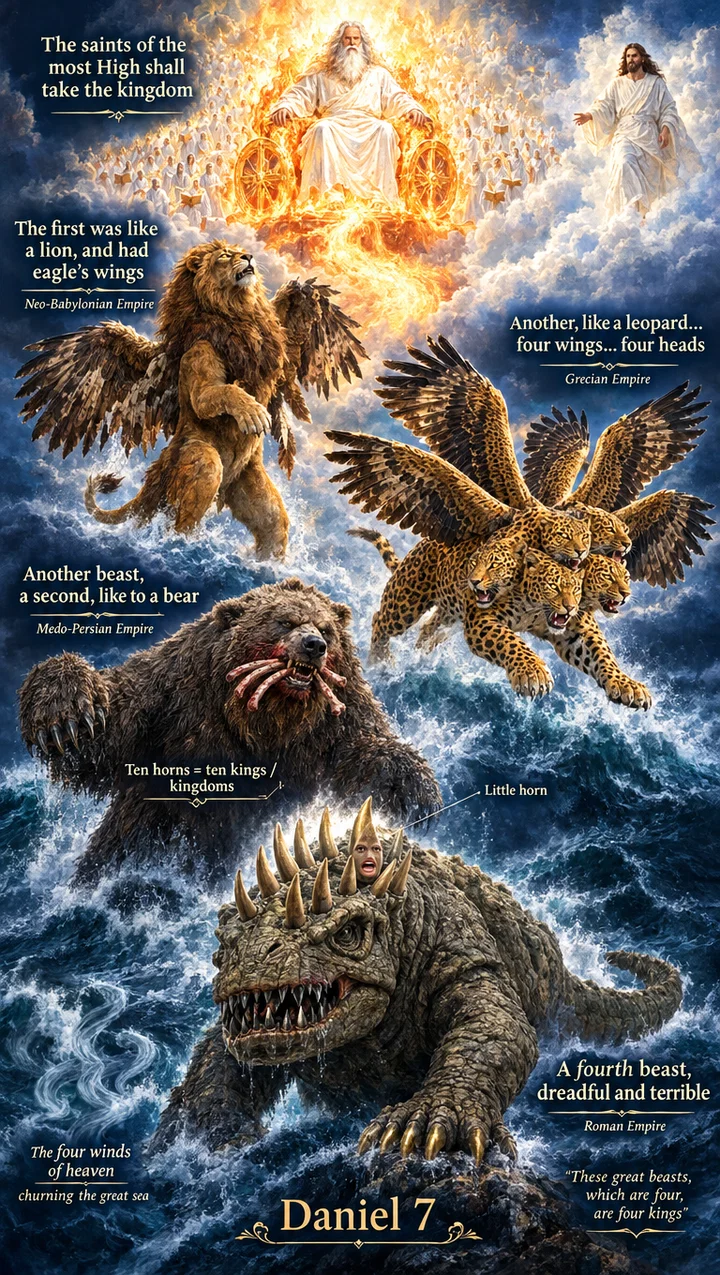
The verse stands in Daniel's first vision in the reign of Belshazzar after Nebuchadnezzar's death, when Daniel was no longer young and stood alone looking seaward from a wild shore under a lowering sky with tempest-lashed billows running high.ST Jul 20, 1882 It was revealed to Daniel in a dream in which four beasts rose from the sea before him.ST Jul 20, 1882RH Apr 23, 1867 They were a lion with eagle-like wings made to stand unfeathered and disheartened on the sand, a one-sided bear tasting blood and devouring much flesh, a four-headed leopard with four spreading pinions hastening to mighty dominion, and a dreadful terrible monster stronger than its opponents that treads down the former beasts with its feet and eats the whole earth with great iron teeth, wearing ten horns which Daniel considered with care.ST Jul 20, 1882
It stands in the Aramaic or Chaldee portion of Daniel that begins at Daniel 2:4 and ends with the close of Daniel 7.ST Oct 21, 1908RH Nov 25, 1873 That court language fits speeches at court and proceedings there, was understood by the Jews generally, and suits a writing for the common people during the Babylonian captivity.RH Nov 25, 1873 The sameness of subject between Daniel 7 and Daniel 2 carries the Chaldee through chapter 7, before Hebrew is resumed in Daniel 8 with the personal introduction of Daniel and the record of the restoration of the Jews and God's future dealings with them.RH Nov 25, 1873 That Aramaic portion is distinctively prophetic, and like the rest of Daniel it gives the rulers and nations of earth great practical lessons of life.ST Oct 21, 1908
Kingdoms are symbolized by beasts and horns and days stand for years, the same kind of symbolism as the great image of a man in Daniel 2 tracing the leading nations from Nebuchadnezzar to the end of the world and as in some of the visions of John in Revelation.RH May 8, 1916 The vision is clothed in figures and symbols, not in plain language.ST Jan 10, 1878ST Apr 6, 1882 This is unlike Daniel 11, which presents future events mostly in plain language and is described as a literal prophecy explaining the vision in Daniel 8.ST Jan 10, 1878RH Dec 28, 1911
The four beasts rise as the four winds strive upon the great sea.RH Jun 25, 1857RH Jan 15, 1861 The sea means peoples, nations and multitudes, and the winds are not literal winds but commotions among peoples that make the sea rage, namely aggressive wars.RH Jun 25, 1857 By such aggressive wars the four kingdoms arose, as powers established through conflict and the overthrow of their predecessors.RH Jun 25, 1857RH Jan 15, 1861 Their rise out of the sea by strife is the opposite of a kingdom coming up out of the earth without striving winds, as with the United States rising in previously unoccupied territory rather than through such upheaval.RH Jun 25, 1857RH Jan 15, 1861
Living creatures represent mighty nations.RH Apr 29, 1909 A wild beast in prophecy is the symbol of a cruel persecuting power antagonistic to God and His work, a beast of prey that uses force for its own advantage against the truth and God's people as Satan's agent.ST Mar 30, 1915ST Nov 3, 1914 The beasts of Daniel 7 are Babylon, Medo-Persia, Grecia, and Rome, pictured as a lion, a bear, a leopard, and a great composite monster.ST Mar 30, 1915 The kingdoms of this world thus compared to hideous beasts of prey stand in contrast with the kingdom to come.RH Jul 24, 1855 Final judgment against such a persecuting power belongs to God in the last day, not to the church now, for Christ came not to judge the world but to save the world and the word He spoke shall judge rejecters in the last day, so the true church when properly enlightened will never persecute.ST Mar 30, 1915
God uses beasts, nations and other animate and inanimate things to instruct and forewarn His people where they stand on the stream of time and about their entrance into eternity.RH Apr 2, 1857 Its interpretation is given in the Bible itself, making its meaning definite rather than speculative.ST Jun 30, 1914 Daniel's prophecies have been accurately and literally fulfilled, with the beasts representing changes among the world empires, especially ruling powers that shaped religion and civilization.ST Nov 28, 1895ST Jun 30, 1914 The evidence of fulfillment grows cumulatively, as later developments add to earlier evidence even when progress appears temporarily level or uneven.ST Oct 7, 1913
Daniel 7 is the pattern after which all visions of beasts and horns are framed and by whose explanation all study of beasts and horns must be guided.RH Sep 30, 1873 It introduces the church of Rome under the symbol of the little horn before that church had received any civil power or was directly united with the state, showing that a horn can represent a church as well as a kingdom or civil authority even before its union with the state.RH Sep 30, 1873ST Jun 19, 1884 The 1290 years mark the supremacy of that church over other churches, while the 1260 years mark the beginning of its alliance with civil authority.RH Sep 30, 1873
The four-beast prophecy must not be taken by itself alone but compared and combined with other prophecies and other symbols, for only so is the unity of prophecy established and held.ST Feb 25, 1913RH Feb 18, 1873 Figures in prophecy represent future things, times and events, and visions revealing the same things must be read together.RH Mar 31, 1868RH Feb 18, 1873
Four Kingdoms and Ten Horns
The four beasts are four great universal earthly kingdoms corresponding to the gold, silver, brass and iron of Daniel 2.RH Nov 2, 1905ST May 3, 1877 The winged lion is Babylon under Nebuchadnezzar, the bear with three ribs in its mouth is Medo-Persia under Darius, the four-headed four-winged leopard is Greece under Alexander, and the great dreadful terrible iron-toothed beast that treads down the former beasts and eats the whole earth is Rome from Augustus onward, complete with the little horn.RH Nov 2, 1905ST Dec 24, 1912ST Dec 22, 1881 The judgment removes the fourth beast's dominion and brings its rule to final destruction, while the other kingdoms also have their dominions taken away but their lives prolonged until the same final destruction together at Christ's coming, referring to continuing powers and not to resurrection of dead rulers.ST May 3, 1877 The chapter's beasts therefore represent successive kingdoms in prophetic sequence, and its horn represents a kingdom or power whose diverse persecuting dominion is taken away and completely destroyed when the judgment sits.ST Dec 24, 1912ST Dec 22, 1881
Babylon held world sovereignty from 603 B.C. to 538 B.C., then the Medes and Persians ruled till 331 B.C.ST Nov 28, 1895RH Dec 31, 1914 Then the Greeks became undisputed rulers after Arbela in 331 B.C. and continued till 168 B.C., with Greece succeeding Medo-Persia under Alexander the Great.ST Nov 28, 1895RH Dec 31, 1914ST Jun 21, 1905 Then the Romans followed as the fourth and last universal kingdom strong as iron, fully established after Pydna in Macedonia in 168 B.C., continuing as a united kingdom till A.D. 351 and as a divided empire continuing until now.ST Nov 28, 1895RH Dec 31, 1914ST Jun 21, 1905 In the days of these last divided kings, the fragments of the Roman kingdom existing today, God sets up the eternal kingdom of Christ at His second coming.ST Nov 28, 1895ST Jun 21, 1905
Rome is kept as one undivided power with no division answering to the Eastern and Western Empires, like the iron legs of the image and the little horn of Daniel 8 proving the two legs do not denote the late east-west split.RH Mar 16, 1869 Rome proper lay west of Grecia, in the territory of the Western Empire, and there the ten kingdoms arose.RH Oct 20, 1874RH Mar 16, 1869 The fourth kingdom, Rome, strong as iron, would be divided and replaced on exactly the same territory by ten kingdoms after its breaking by northern barbarian invasions from A.D. 395 to the establishment of the Herulian kingdom of Italy in A.D. 476.ST Mar 30, 1915ST Mar 30, 1915ST Aug 13, 1902 Its four beasts represent Babylon, Medo-Persia, Greece, and Rome, pictured as a lion, a bear, a leopard, and a great composite monster acting as Satan's agent, with the horn arising in the fourth beast's later phase extending to its temporary overthrow by the French in 1798.ST Mar 30, 1915ST Mar 30, 1915
Where Daniel 2 foretells the breaking of Rome into fragments, Daniel 7 specifies the exact number as ten kingdoms, and adds beyond Daniel 2 an eleventh ecclesiastical kingdom arising among the ten, with detail about what that church power would do.ST Jul 6, 1915ST Feb 26, 1880 Its ten horns represent ten kings who arose from the empire, corresponding to the ten toes of Daniel 2.ST Jul 6, 1915ST Feb 26, 1880 The ten horns occupy all the territory Rome embraced, so no notable government formed in Europe can be outside them, and a distinct prophetic beast cannot arise from their territory in Europe but must be looked for elsewhere, as with the United States arising at the right time outside that dominion.RH Oct 20, 1874RH Mar 12, 1857ST Jun 18, 1885
Ten kingdoms existed in Western Rome between A.D. 476 and 493, and the ten divisions of the Roman Empire are dated between A.D. 351 and 476.ST May 26, 1909ST Jan 30, 1896ST Aug 13, 1902 The Heruli, Vandals, and Ostrogoths were the three kingdoms plucked up, respectively in Italy in 493, Africa in 533, and Italy in 538.ST May 26, 1909RH Aug 14, 1900 After the Western Empire was destroyed seven remained, and their days are the time when God sets up His fifth kingdom, which shall stand forever, meaning its setting up comes after A.D. 476 and before the overthrow of these ten kingdoms, with its time more definitely fixed by other prophecies.RH Aug 14, 1900ST Jan 30, 1896ST Aug 13, 1902
The prophecy definitely foretold by decree of God that Rome would be divided into ten kingdoms, and the division did take place.ST Apr 16, 1894 The dignitaries of the Papal Church refused to admit the fact because it contradicted their held belief in the universality and eternity of Rome.ST Apr 16, 1894 They set to work to bring about another universal empire under the old name and to reunite the divided Roman world in opposition to the word of God.ST Apr 16, 1894
The ten horns remain in the prophecy because they represent divisions existing when God sets up His kingdom, and the symbols may continue to represent the divided kingdoms of Rome until the end even after three of the ten were destroyed.RH Apr 15, 1862RH Nov 19, 1901 They continue during the little horn's period of persecution and its 1,260 years of dominion dated from 538 to 1798, until the Son of man comes in the clouds to establish His kingdom and the symbolic image is suddenly destroyed, with the destruction of those powers and the setting up of God's everlasting kingdom still future to 1798.RH Apr 15, 1862RH Sep 30, 1862 Upon Rome's ruin arose the strong nations of Western Europe that are the principal powers of today.RH Nov 19, 1901RH Sep 25, 1900
The first three kingdoms serve only as stepping stones to reach and locate the fourth kingdom, which is the objective point and main theme of the vision.ST Oct 1, 1902 The fourth beast with its ten horns and little horn represents Rome, and the little horn is closely identified with the fourth beast and yet has an independent history and work.ST Oct 1, 1902 Its career is opposition to the establishment of the fifth kingdom, the kingdom of the Most High, which the judgment vindicates by ending its dominion.ST Oct 1, 1902
The fourth beast, including its ten horns and little horn, represents Rome, and the little horn's counterpart in Daniel 8 represents Rome in both its pagan and papal phases. The prophecy keeps the third beast distinct from the fourth beast and reaches even to the First Advent.RH Mar 2, 1852 The fourth beast has its own symbolized existence with its ten horns and brazen nails, and is not absorbed by a head of the third beast.RH Mar 2, 1852
Identity of Little Horn
The little horn is the papal power, the Papacy or Romanism, the Catholic Church under the pope, Papal Rome as a religio-civil state-recognized power, the papal sovereigns and later form of Rome produced by union of the apostate church with the Roman state following pagan Rome.ST May 10, 1877RH Jan 17, 1871RH May 1, 1913RH Aug 9, 1915ST May 8, 1907 The judgment sits and takes away that oppressive ruler's dominion to consume and destroy it unto the end, ending its complete career of persecution and bringing the overthrow before the kingdom is given to the people and the oppressed enter the everlasting inheritance.ST May 10, 1877RH Jan 17, 1871RH May 1, 1913RH Aug 9, 1915ST Jun 20, 1900
The beast denotes Rome in its pagan phase and the little horn Rome in its papal phase, with identity and characteristics continuing in the horn until Rome's career ends.RH Apr 10, 1900ST Jun 19, 1884ST Jun 19, 1884 After the horn arises the beast denotes Rome under the popes, the horn diverse from the civil kingdoms as an ecclesiastical power receiving its seat in the city of Rome and civil authority from paganism, from the dragon.RH Apr 10, 1900ST Jun 19, 1884 That dominion taken away belongs to papal Rome identified with the first beast, a blasphemous power making war with the saints through the forty-two months which are the 1260 prophetic days allotted to the little horn, its loss of power to war compared with the beast overcome by the sword.ST Jun 19, 1884ST Jun 19, 1884
It is an eleventh ecclesiastical kingdom arising among the ten after Rome's division, from the ruins of the Western Empire and the Western Roman Empire, combining priestly and kingly offices with narrow temporal territory.RH Aug 31, 1869RH Oct 7, 1915RH Feb 24, 1874ST Feb 17, 1909ST Dec 14, 1882 It is the great apostasy in the Latin Empire after its division into ten kingdoms, an antichristian blasphemous persecuting power speaking against the Most High, wearing out the saints, claiming to change times and laws, rising after three opposing powers are plucked up, completing its career and decline with destruction remaining at Christ's second advent when the everlasting kingdom is established over the whole earth.RH Aug 31, 1869RH Feb 24, 1874ST Feb 17, 1909ST Dec 14, 1882RH Mar 24, 1874 Its fourth beast is Rome with its second phase representing the papacy, holding supremacy for 1260 years ending in the late eighteenth-century events that gave it a deadly wound, with loss of papal civil power marking fulfillment when the Ancient of Days sits.RH Oct 7, 1915RH Feb 24, 1874RH Mar 24, 1874
It is a horn symbolizing an ecclesiastical power, here the Roman Catholic church diverse from the other horns, the Papacy as a system and as a state-recognized religio-civil power with spiritual domination over the Roman Empire during the Dark Ages, not the sincere Christians in its folds, and also Rome during only part of its career.ST Nov 29, 1905ST Oct 1, 1902RH Nov 26, 1857ST Nov 19, 1885 Its civil dominion was taken away by Victor Emmanuel in 1870, following the 1,260-year spiritual domination that began in 538 and was effectually broken in 1798 by the capture of Pius VI, so the Papacy is forever doomed and none should unite with the lost cause seen forging again into religious and political power in Spain, Italy, Ireland and South America.ST Nov 29, 1905ST Oct 1, 1902
It represents a succession of rulers extending from rise until judgment and kingdom, in sequence of Roman powers as the papal form of Roman supremacy preceding the seventh head.RH Feb 14, 1856RH May 27, 1873ST Sep 9, 1875ST Oct 25, 1883 The dominion removed is not one person only but impious tyranny by succession causing great misery and ruin, as empires governed by successions of kings are denoted by single emblems such as part of an image, a single beast, or a horn, and as the man of sin likewise represents a succession rather than one individual, with Daniel 7:25 describing a succession of rulers.ST Sep 9, 1875ST Oct 25, 1883 It represents a succession of priest-kings lasting until judgment and kingdom, presuming to change commandments and persecuting the people, but the verse does not say they actually change God's law; it only thinks to change the law, for that is all he is able to do.ST Jun 28, 1877RH May 27, 1873RH May 27, 1873
It is the same as the beast of Revelation 13 with ten horns and likeness of leopard, bear and lion, and the same as Paul's man of sin or the Wicked, arising from falling away or apostasy in the church.RH Dec 11, 1856RH May 10, 1870ST Jun 22, 1882RH Jun 30, 1874ST Jan 30, 1879 Like the beast it is blasphemous speaking great words and blasphemies against God with a mouth speaking great things, thinking to change times and laws including expunging the second commandment and changing Sabbath to Sunday, making war with the saints and prevailing against and overcoming them, succeeding the pagan form of Rome, continuing the same 1260 years of time, times and dividing of time, and meeting the same fate of losing dominion.RH May 10, 1870ST Jan 30, 1879ST Jul 31, 1879 After its allotted period judgment removes its dominion and brings its power and practice to an end, linked to the Lord consuming and destroying the Wicked with His brightness at Christ's coming when priesthood closes and dominion over enemies is given to the Son of man at the seventh trumpet, which could not come next in Paul's day but only after the horn arose and performed its work.RH Dec 11, 1856ST Jun 22, 1882RH Jun 30, 1874
It is identical with the beasts of Revelation 13 and 17, with the transgression of desolation in Daniel 8 and the man of sin in 2 Thessalonians 2, and with the despotic monarchy of antichrist developed in place of Christ's future kingdom, their rise being synchronous.ST Oct 8, 1902ST Jun 20, 1900ST Jun 30, 1914RH May 21, 1914 Daniel 7 supplies symbols making the composite Revelation 13 beast joining past to future, the fourth beast being Rome, its ten horns the ten kingdoms of division, and the little horn among them with three falling before it being Roman papacy.ST Jan 30, 1879RH Oct 24, 1871 At the end of time, times and half a time its dominion is taken away in the leopard beast's political downfall and captivity at the end of the same forty-two months or 1,260 years, the leading into captivity fulfilled when Buonaparte captured the Pope in 1798 in temporary overthrow.RH Oct 24, 1871
The same Roman power continues as the leopard beast with leopard's body, bear's feet, lion's mouth, seven heads and ten crowned horns, to which the dragon, pagan Rome controlled by the devil ruling all the earth at the opening of the Christian dispensation, gave its seat in the city of Rome with power and great authority, namely the Papacy.ST Nov 25, 1880RH Mar 31, 1874 Like the little horn it makes war with and overcomes the saints and opens its mouth in blasphemy, rising from peoples, multitudes, nations and tongues after the three earlier beasts passed, ruling forty-two months or 1260 years from establishment in 538 until wounded to death and for a time suppressed in 1798 when Berthier took the Pope prisoner into exile where he died, with the wound afterward healed when Bonaparte restored the Papacy but not to former power.ST Nov 25, 1880 That dragon stood before the woman to devour her child as soon as born, attempting it through Herod, while Christ was delivered and caught up to God and His throne.RH Mar 31, 1874
The little-horn prophecy fits the Papacy in chronology, duration, character and work and no other power, the eleventh horn being the Papacy that would change times and laws, the same blasphemous persecuting power as Revelation 13 whose symbols combine Daniel 7's symbols.ST Nov 28, 1892ST Sep 11, 1879RH Aug 31, 1905RH Apr 10, 1916 The fourth beast's eleventh horn is identified with the leopard beast of Revelation 13 and represents the papacy, pointing to its history as fulfillment.ST Sep 11, 1879RH Aug 31, 1905RH Apr 10, 1916
The little horn of Daniel 7 is the Roman Catholic hierarchy, distinct from the little horn of Daniel 8 which is Mahometanism, proved by respective places of origin and spheres of influence.RH Apr 15, 1873 In the parallel vision the little horn of Daniel 7 represents the papacy while Daniel 8's horn represents Rome through both its pagan and papal phases, with a heavenly judgment sitting to remove the little horn's dominion to complete destruction.ST May 10, 1877RH Apr 15, 1873
The little horn cannot be Antiochus Epiphanes, king of Syria, but is identified with Rome in both its pagan and papal forms whose dominion is taken away.RH Dec 10, 1857ST Feb 12, 1880 He was only eighth of twenty-six kings of the Syrian horn and not another remarkable horn, not most illustrious but called Epimanes the Madman for vile folly, subject to Rome after his father gave him as hostage paying tribute and territory for peace, never enlarging dominion except temporary Egyptian conquests abandoned at Rome's command before venting rage on Jews, cannot be called exceeding great when Persia ruling 127 provinces is only called great and still more extensive Grecia called very great, and died 164 years before Jesus was born so could not stand against the Prince of princes who is Jesus Christ.ST Feb 12, 1880
The beasts are earthly powers whose territories and characteristics are combined in the papal power, whose dominion extended over nearly all territory of earlier powers.ST Jun 29, 1904ST Jul 4, 1911ST Oct 2, 1884 The lion, bear, leopard and ten-horned beast are separate distinct empires carrying one satanic church-and-state system from Babylon at the captivity through Medo-Persia, Grecia and pagan Rome, under which Jesus the Man Child born of the woman conquered Satan in the crucifixion and was caught up to God, appearing in Revelation 13 as one continued composite wild beast of seven successive heads and ten contemporaneous horns with Satan behind every persecuting power, the head following pagan Rome being papal Rome exercising power 1,260 years.ST Jul 4, 1911 That professedly Christian power inherits characteristics of Babylon, Medo-Persia, Grecia and Rome and wages relentless warfare against truth until its dominion is removed to go alive into the lake of fire.ST Jun 29, 1904
The post-division rise of the little horn as the papacy is objected to conflict with historical testimony that churches already observed Sunday before Rome's fall, challenging the Sabbath-change application.RH May 27, 1873 If the little horn represents the papacy rising after division into ten kingdoms, the alleged change of the Sabbath law would have occurred after Rome's fall, while testimony holds Christian churches already observed Sunday before then.RH May 27, 1873
Appointed Time of Dominion
The days in connected time prophecies stand for years, so time, times and half a time and time, times and dividing of time are 1,260 prophetic days as years when the saints, times and law are given into the little horn's hand, parallel to Revelation's periods and not three and a half literal days or years.ST Feb 21, 1878RH Jul 23, 1872RH Dec 29, 1863RH Jan 23, 1855ST Aug 9, 1910 The appointed time is time, times, and a half, meaning 1,260 prophetic days, or 1,260 years, of civil rule of the Roman church holding civil power in its hands.ST Feb 21, 1878RH Jul 23, 1872GSAM 79.2–3 The forty-two months at thirty days to a month are 1,260 prophetic days as 1,260 years of papal supremacy.ST Feb 21, 1878RH Jul 23, 1872
The 1,260-year papal supremacy and persecution ran from establishment with civil power in 538 to 1798, when civil dominion was taken, the pope taken prisoner, and it received the deadly wound.RH Apr 3, 1855RH Jul 23, 1872ST Apr 16, 1894ST Nov 3, 1914RH Mar 20, 1855 After 1,260 years of triumph no comparable oppression occurred.RH Apr 3, 1855RH Jul 23, 1872 The judgment sits when the papal dominion is taken away in 1798, marking the beginning of the trial of the dead.RH Jul 23, 1872RH Mar 20, 1855RH Feb 8, 1870
The period began when the pope was made head over churches by Justinian after Rome divided into ten and three opposing kingdoms were subdued including fall of Ostrogoths, and ended when French forces under Berthier entered Rome, abolished papal government, deprived pope of civil authority and carried him captive to France.RH May 10, 1870RH Feb 21, 1865RH Nov 7, 1871RH Apr 26, 1870RH Nov 6, 1866 The verse's removal of dominion is linked to Revelation's picture of the leopard beast being led into captivity; both are applied to the papacy and to its capture in 1798, at the end of the 1260 years.RH Apr 26, 1870RH Nov 6, 1866ST Nov 28, 1895 The verse marks the end of the Papacy's power after its 1,260 years of religious and political domination, dated from A.D. 538 to 1798.RH May 10, 1870RH Nov 7, 1871ST Nov 28, 1895
Preliminary history includes Justinian's edict in A.D. 533 making the Bishop of Rome head of churches, ten kingdoms from 476 to 493, plucking up of Heruli in 493, Vandals in 534 and Ostrogoths in 538, reckoning 1,260 years from March 538 when Ostrogoths were subdued to 1798 when papal throne was overturned, opening indefinite time of the end.RH Jun 20, 1854ST Oct 29, 1902RH Jul 23, 1872 The power was to wear out the saints and hold them in its hand, and Justinian's edict is the act that placed the saints under that power.RH Jun 20, 1854RH Jul 23, 1872 The dominion began with Justinian's letter to the Bishop of Rome in 535 taking effect in 538, and continued 1,260 years to 1798.RH Jul 23, 1872ST Dec 22, 1881ST May 25, 1882
The papacy was clothed with power by Justinian's decree of 533 and letter in 535 taking effect in 538, but exercise was blocked by Ostrogoths, last of three horns, until they raised siege of Rome in March 538 and retired broken; from 538 saints, times and laws were in pope's hands in fact as well as purpose.RH Jul 23, 1872ST Dec 22, 1881ST May 25, 1882 The three horns plucked up are three opposing kingdoms, the last Ostrogoths rooted out of Rome in 538 after siege of 537-538; with obstacle removed the pope could exercise supremacy conferred by Justinian's decree, so 538 is the year the abomination was set up.RH Jul 23, 1872ST May 25, 1882RH Mar 7, 1871 The little horn as Papacy as Head of all Churches and Corrector of Heretics was given place when Arian Ostrogoths, last of three kingdoms, fell in A.D. 538.ST May 25, 1882ST Nov 5, 1894RH Mar 7, 1871 The plucking up of the last horn does not itself mark beginning of papal supremacy in one view.ST Nov 5, 1894RH Apr 28, 1910
The 1290 years mark supremacy of that church over other churches, while the 1260 years mark beginning of alliance with civil authority.RH Sep 30, 1873 Daniel 7 introduces the church of Rome under the symbol of the little horn before that church had received any civil power or was directly united with the state, showing that a horn can represent a church even before its union with the state.RH Sep 30, 1873 Only after this period can the judgment be preached as immediately impending; the sitting comes after the horn's appointed time, times and dividing of time dated 538 to 1798, and takes away dominion.ST Feb 21, 1878RH Jul 23, 1872RH Jan 23, 1855RH Apr 15, 1862 The ten kingdoms that arose from the Roman Empire were to remain until after the little horn's 1,260 years of dominion dated from 538 to 1798.RH Jul 23, 1872RH Jan 23, 1855RH Apr 15, 1862 The verse places judgment after the 1260-year reign, so judgment could not have begun in the twelfth century in Peter Waldo's day, at least six centuries still having to pass, nor at Christ's ascension.RH Jan 23, 1855RH Sep 2, 1851RH Dec 10, 1872
Judgment That Sits
The sitting of the judgment and the taking away of dominion come in order after the little horn has risen and done its work of persecution through its appointed time, and before the end, before the Son of man comes to receive the kingdom, before the saints receive the kingdom, and before the final destruction and burning of the beast in flame.ST Mar 13, 1884RH Dec 13, 1853ST Feb 21, 1878RH Nov 14, 1854RH Jun 19, 1860 The special dominion over the saints for time, times and half a time, that is 1,260 prophetic days as years, is taken away at the end of that period, while the remaining power is afterward consumed and destroyed unto the end, so taking is distinguished from destroying.ST Feb 21, 1878RH Dec 11, 1860ST Jun 22, 1882ST Aug 24, 1882RH Apr 26, 1870 The horn as papal power lasts until the day of judgment when its dominion is taken and destroyed, and this judgment precedes the everlasting kingdom of God rather than belonging to Pentecost.RH Jun 19, 1860RH Dec 11, 1860RH Jun 30, 1874RH Mar 5, 1867RH Nov 30, 1869
The judgment sits only after the fourth empire has been divided into ten kingdoms and the horn has arisen and completed its period of power, so it could not have been immediately impending before that course had run.ST Jun 22, 1882ST Jun 22, 1882RH Apr 26, 1870ST Oct 10, 1878 It is the next major event when the final nations have come onto the stage, following the 1,260-year rule, and its specifications stand in a successive series reaching from Daniel's time to the judgment and the setting up of the everlasting kingdom.ST Jun 22, 1882RH Apr 26, 1870ST Oct 10, 1878ST For this reason it could not come next in Paul's day, but only after the little horn, which is the Man of Sin, should arise in its place in the series and perform its predicted work of speaking and prevailing.ST Jun 22, 1882ST Jun 22, 1882RH Apr 26, 1870
The judgment scene belongs to the heavenly tribunal of the Ancient of Days before Christ returns to earth, not a session on earth at His second coming.RH Jun 30, 1874RH Mar 5, 1867RH Nov 30, 1869ST Mar 28, 1878 There the Son receives the kingdom from the Father, Christ's priesthood at the Father's right hand closes, cases are examined and decided from the books, His people are acquitted and counted worthy of the world to come and the resurrection to immortality, their sins are blotted out, and He is crowned King to execute the judgment.RH Jun 30, 1874RH Nov 30, 1869ST Mar 28, 1878RH Dec 14, 1869 That closing of priestly work and coronation comes at the closing up of this dispensation, under the seventh trumpet at Christ's coming in glory, when the saints enter and inherit the kingdom, and while probation still offers the final angelic messages to men.RH Jun 30, 1874ST Mar 28, 1878RH Dec 14, 1869
It is a session in the heavenly temple, especially its second apartment, where Christ finishes His high-priestly work of atonement for the dead and the living before changing from priest to king.ST May 16, 1878RH Jan 4, 1870RH Jan 11, 1870ST Jun 6, 1878RH Jan 11, 1870 The Father enters the second apartment to sit, the Son presents Himself before the Father's tribunal, the righteous are acquitted, their sins blotted out, and they are accounted worthy of eternal life and God's kingdom.ST May 16, 1878RH Jan 4, 1870RH Jan 11, 1870ST Jun 6, 1878RH Jan 11, 1870 The judgment begins with the righteous dead while probation still remains for the righteous living, so that after the hour of God's judgment has come the third angel still proclaims the latest message of mercy to mankind.ST Jun 6, 1878 When the sins of the righteous dead have been blotted out and the righteous living have been prepared by the work of the third angel for the close of their probation, the Son terminates His priesthood and takes His place as king upon the great white cloud.ST Jun 6, 1878
The Father's session reaches its close when the Son is crowned king to carry out its decision.RH Feb 15, 1870RH Jan 26, 1860 At that point Christ's priestly rule on His Father's throne ends and He takes His own throne to execute the judgment by making the acquitted righteous immortal and destroying the rest, destroying the kingdoms of the earth at His coming and bringing the dominion of the fourth beast in its divided Roman setting to an end.RH Feb 15, 1870RH Jan 26, 1860
The judgment that sits is the same investigative heavenly judgment with books opened in Daniel 7:9-10, which began at the termination of the 2300 years in the fall of 1844 and continues in the records of human lives, nearing completion before Christ comes, not a different judgment.ST Nov 3, 1881ST Oct 4, 1910ST Nov 26, 1896RH Jun 23, 1910 During this judgment the papal dominion has been waning, driven from its capital in 1848 and stripped of temporal dominion in 1870, and renewed study of Scripture has brought out the sanctuary truth, exposed God's law which antichrist sought to change, led many to accept the altered commandment, and raised a Bible-alone people to spread the Gospel.ST Nov 3, 1881ST Oct 4, 1910 They who take away the dominion are the other horns, or the governments they represent, and the taking applies specifically to civil or temporal rule granted under Pepin in 755, progressively reduced through revolts and annexations from 1848 to 1860 and ended in 1870 when Victor Emmanuel removed the last temporal dominion, distinct from the end of 1,260-year spiritual domination in 1798.ST Jul 4, 1911ST Nov 26, 1896
In a national and political sense the judgment is also God's providential overthrow of papal supremacy beginning in 1798, when its supremacy was broken and a consuming decline began unto the end.ST May 10, 1877ST Nov 3, 1881RH Jun 15, 1869RH Jun 15, 1869ST Apr 26, 1877 It means loss of national recognition, support and power as earthly ruler, while the papacy persists until Christ appears with only a shadow of former prestige, to be consumed by the spirit of His mouth and destroyed by the brightness of His coming, without ending individual devotion to it.ST May 10, 1877ST Nov 3, 1881RH Jun 15, 1869 This national judgment in 1798 is different from the heavenly investigative judgment with books opened in Daniel 7:9-10, from the judgment involving the saints in Daniel 7:22, and from the investigative judgment begun in 1844, being like the judgment on Egypt at the Exodus, with papal supremacy closing shortly before the investigative judgment begins.ST May 4, 1876ST Aug 14, 1893ST May 10, 1877 The 1,260 years ran from 538, when Berthier's entry into Rome in 1798 took the pope prisoner and temporarily abolished papal rule, after which former civil privileges were never regained and the last temporal power was removed in 1870, pointing to final destruction at the second coming and signaling the end near.ST May 4, 1876ST Aug 14, 1893ST May 10, 1877
The sitting is God's providential judgment against the Papacy taking away dominion as the first blow leading to final destruction and to the saints' later judgment and possession.RH Jun 15, 1869ST Apr 26, 1877RH Apr 22, 1858 Judgment was brought and had begun before dominion was taken in 1798 and continues in consuming unto the end as the avenging of the martyrs' blood, beginning when the Papacy lost its dominion.RH Jun 15, 1869ST Apr 26, 1877RH Apr 22, 1858 One position holds this taking of civil authority is a present work begun at the end of the 2300 days in 1844 preceding the advent, when every case is decided and character fixed while Christ remains advocate until a favorable decision, applied to loss of civil power after the council declaring the pope infallible.RH Oct 20, 1874 Another holds the heavenly judgment sat first before the horn's end, then dominion was taken and consumed and destroyed in 1870.ST Mar 3, 1890
The exact order at the end is first the judgment shall sit, which is the investigative judgment beginning in 1844, second his dominion shall be taken away, which is the waning and removal of temporal dominion when Rome surrendered to Victor Emanuel's troops September 20, 1870, and third the beast destroyed, yet future by the brightness of Christ's coming into the lake of fire.RH May 6, 1873 With the first two steps fulfilled in close proximity to the end, the next thing is the end.RH May 6, 1873 By contrast, those who hold the verse belongs to the second of two distinct judgments in Daniel 7 teach it is not the investigative judgment of the righteous begun in 1844 but the executive judgment upon the wicked at the end of the thousand years.ST Oct 21, 1930 Others place it in the future close of a vision covering the entire gospel dispensation and beyond, not the introduction of the gospel, with possession still promise and hope because mortal flesh and blood cannot inherit the incorruptible everlasting kingdom that shall stand forever and not be left to others.ST Mar 13, 1884ST Oct 21, 1930
The judgment is at the Father's tribunal before the resurrection and the coming, investigating the cases of all men to determine character whether righteous or wicked, while the living are still on probation, the present being the judgment of the dead and the antitype of the Day of Atonement revealed by the heavenly sanctuary and its prophetic periods.ST Aug 15, 1878RH Feb 8, 1870RH Sep 5, 1871 The proposed beginning in 1798 at the end of the 1260 years is presented only as suggestion, not as settled timing or clear identification of its time and place.ST Aug 15, 1878RH Feb 8, 1870 The Son then descends to execute that judgment.RH Sep 5, 1871
The judgment sits during the later history of the horn even while it still speaks, and takes away kingly rule to consume completely unto the end.STST Aug 24, 1882ST Oct 1, 1902ST Jun 19, 1884ST Jul 1, 1897 It is the taking of place as court with the Ancient of Days sitting as judge, marking after the appointed period the end of dominion that prospered longer than other persecuting powers in speaking against God, persecuting saints and setting aside law.ST Aug 24, 1882ST Aug 9, 1910ST Oct 1, 1902ST Jun 19, 1884ST Jul 1, 1897 This precedes the destruction of earthly powers and the reward of God's people, with Christ's reign as the next event in prophecy whose symbolic day-year periods lead to the second coming and everlasting kingdom.ST Aug 9, 1910ST Jul 1, 1897
Daniel 7:23-27 describes a judgment removing dominion and therefore concerns decisive overthrow, not the end of human probation, Christ's visible second coming, the resurrection, or physical destruction of the world at the close of the 2300 days.RH Apr 5, 1870 The claim that Revelation 14:7 announces judgment on the papacy is rejected; instead it announces the start of the heavenly sanctuary judgment at the close of the 2300 days in 1844, while Daniel 7:26 describes the sitting that takes away papal dominion and brings it to an end.RH Nov 29, 1864RH Apr 5, 1870 The judgment sits when papal dominion is taken in 1798, marking the beginning of the trial of the dead, which raises the question whether the trial of the dead began in 1798 as compared with the scene in Daniel 7:9-10.RH Feb 8, 1870ST Aug 15, 1878
The judgment closes with ten thousand times ten thousand standing before God and the books opened, when these prophecies fulfilled show the Judge standing at the door.RH Jun 8, 1911 It reveals events appalling in nature and eternal in consequence, pointing beyond earthly perils to the eternal home of the blessed.RH Jun 8, 1911 Like the rest of prophecy it is a light shining in a dark place, showing the stepping-stones between the sufferings of Christ and the glory to follow, between Calvary and the marriage supper of the Lamb.RH Jun 8, 1911
Sources