Daniel 7:12
As concerning the rest of the beasts, they had their dominion taken away: yet their lives were prolonged for a season and time.
Translations
American King James Version, King James Version, KJV Cambridge Paragraph Bible, Webster Bible
As concerning the rest of the beasts, they had their dominion taken away: yet their lives were prolonged for a season and time.
Revised Version, American Standard Version
And as for the rest of the beasts, their dominion was taken away: yet their lives were prolonged for a season and a time.
and the rest of the beasts have caused their dominion to pass away, and a prolongation in life is given to them, till a season and a time.
As for the rest of the beasts, their dominion was taken away; but their lives were prolonged for a season and a time.
As concerning the rest of the beasts, their dominion, was taken away,—but, a lengthening of life, was given to them, until time and season.
Berean Standard Bible, Majority Standard Bible
As for the rest of the beasts, their dominion was removed, but they were granted an extension of life for a season and a time.
As for the rest of the animals, their dominion was taken away; yet their lives were prolonged for a season and a time.
As for the rest of the beasts, their authority was taken away: but they let them go on living for a measure of time.
As concerning the other beastes, they had taken away their dominion: yet their liues were prolonged for a certaine time and season.
Douay-Rheims (Challoner revision)
And that the power of the other beasts was taken away: and that times of life were appointed them for a time, and time.
Pictures
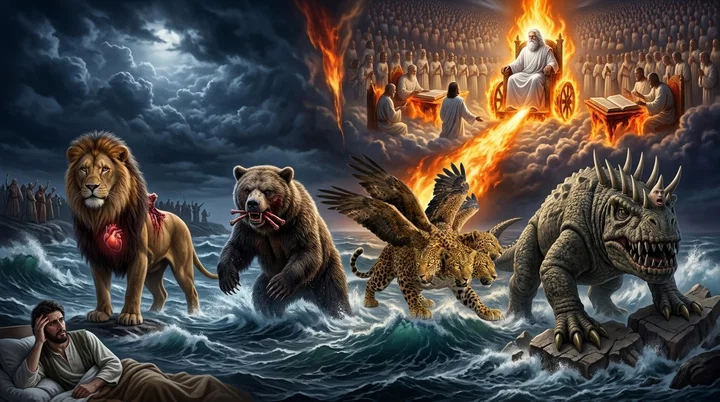
Cross-references 20 of 26
- Daniel 2:31-45
Thou, O king, sawest, and behold a great image. This great image, whose brightness was excellent, stood before thee; and the form thereof was terrible.
Both prophecies trace successive world empires to God’s everlasting kingdom.
- Daniel 7:25-27
And he shall speak great words against the most High, and shall wear out the saints of the most High, and think to change times and laws: and they shall be given into his hand until a time and times and the dividing of time.
The little horn’s allotted rule ends, its dominion is taken away, and the saints receive the everlasting kingdom.
- Daniel 7:7-8
After this I saw in the night visions, and behold a fourth beast, dreadful and terrible, and strong exceedingly; and it had great iron teeth: it devoured and brake in pieces, and stamped the residue with the feet of it: and it was diverse from all the beasts that were before it; and it had ten horns.
The fourth beast and little horn represent Rome and its successive phases.
- Daniel 7:26-27
But the judgment shall sit, and they shall take away his dominion, to consume and to destroy it unto the end.
Judgment removes the beast’s dominion and gives the everlasting kingdom to the saints.
- Daniel 7:26
But the judgment shall sit, and they shall take away his dominion, to consume and to destroy it unto the end.
The judgment takes away the little horn’s dominion and brings its rule to an end.
- Daniel 7:17-18
These great beasts, which are four, are four kings, which shall arise out of the earth.
The beasts are explained as kingdoms, and the saints ultimately possess the kingdom.
- Revelation 11:15
And the seventh angel sounded; and there were great voices in heaven, saying, The kingdoms of this world are become the kingdoms of our Lord, and of his Christ; and he shall reign for ever and ever.
The kingdoms of the world become Christ’s at the trumpet.
- Daniel 7:4-6
The first was like a lion, and had eagle’s wings: I beheld till the wings thereof were plucked, and it was lifted up from the earth, and made stand upon the feet as a man, and a man’s heart was given to it.
Identifies the lion, bear, and leopard as the first three beasts whose dominion ended.
- Revelation 12:14
And to the woman were given two wings of a great eagle, that she might fly into the wilderness, into her place, where she is nourished for a time, and times, and half a time, from the face of the serpent.
Both texts use the prophetic period of a time, times, and half a time.
- Daniel 7:18
But the saints of the most High shall take the kingdom, and possess the kingdom for ever, even for ever and ever.
The saints take and possess the everlasting kingdom.
- Daniel 8:20-25
The ram which thou sawest having two horns are the kings of Media and Persia.
The ram and goat identify empires in the same prophetic succession as Daniel’s beasts.
- Daniel 2:34-35
Thou sawest till that a stone was cut out without hands, which smote the image upon his feet that were of iron and clay, and brake them to pieces.
The image’s destruction and the Stone-Kingdom parallel Daniel 7’s outcome for the empires.
- Revelation 13:1-2
And I stood upon the sand of the sea, and saw a beast rise up out of the sea, having seven heads and ten horns, and upon his horns ten crowns, and upon his heads the name of blasphemy.
The first beast combines the earlier beasts’ features and power.
- Daniel 7:4-5
The first was like a lion, and had eagle’s wings: I beheld till the wings thereof were plucked, and it was lifted up from the earth, and made stand upon the feet as a man, and a man’s heart was given to it.
The lion and bear illustrate kingdoms succeeding one another.
- Daniel 7:3
And four great beasts came up from the sea, diverse one from another.
The beasts whose dominion was taken away rise from the sea.
- Daniel 2:21
And he changeth the times and the seasons: he removeth kings, and setteth up kings: he giveth wisdom unto the wise, and knowledge to them that know understanding:
Both describe God’s authority over rulers and appointed times.
- Daniel 7:22
Until the Ancient of days came, and judgment was given to the saints of the most High; and the time came that the saints possessed the kingdom.
Judgment is given to the saints after the little horn’s persecution.
- Revelation 13:5
And there was given unto him a mouth speaking great things and blasphemies; and power was given unto him to continue forty and two months.
Its forty-two months match the little horn’s time, times, and half a time.
- Daniel 7:8
I considered the horns, and, behold, there came up among them another little horn, before whom there were three of the first horns plucked up by the roots: and, behold, in this horn were eyes like the eyes of man, and a mouth speaking great things.
The little horn arises among the beasts, which represent kingdoms.
- Daniel 12:7
And I heard the man clothed in linen, which was upon the waters of the river, when he held up his right hand and his left hand unto heaven, and sware by him that liveth for ever that it shall be for a time, times, and an half; and when he shall have accomplished to scatter the power of the holy people, all these things shall be finished.
Repeats the prophetic period associated with the beasts’ dominion.
Commentary
Each commentary is drawn from primary sources: the writings of Ellen G. White and Adventist pioneers and periodicals. Each commentary is separate. Its own words are not a quotation; follow the references to read the source passages.
Ellen G. White
8 sources
The four beasts are symbols of the successive empires of Babylon, Persia, Greece, and Rome.4SP 502.2–3 In this prophecy a horn can represent a church, and the little horn represents the Roman Church before it held civil power.4SP 502.4–6 The papal power inherits the power previously held by those empires in succession.4SP 502.2–3
The taking away of dominion applies historically to the end of papal dominion at the close of the 1260 days in February 1798, when Berthier entered Rome on February 10 and the pope was taken prisoner on February 15.LS 66.1–67.2 The verse belongs to the symbolic record given to Daniel to write for coming generations, which sets forth through figures and symbols events covering the history of this world till the close of time and traces historical events in order toward the close of earth's history.PK 484.3Ms 31, 1896, par. 1–2 Its details must be applied carefully rather than used to support mistaken theories.Ms 31, 1896, par. 1–2
The revelation came while Daniel clung to God with unwavering trust, and God approved his firmness, self-denial, and purity of motive and gave him knowledge, skill, and understanding in all visions and dreams, with the spirit of prophetic power resting upon him even while he was receiving instruction from men in the duties of court life.PK 484.3 God takes the dominion of the earlier kingdoms away to abase human pride and lay human glory in the dust, casting down one mighty ruler and setting up another.16MR 333.2–3Lt 57, 1896, par. 4–7Ms 35, 1890, par. 9 Though their dominion is taken away, their lives are prolonged for an appointed season and time, so they hold only a limited, merely human place under God while their place in history is still traced point by point through statesmen, councils, and powerful armies.16MR 333.2–3Ms 35, 1890, par. 9
God alone is great in the verse, revealed as monarch of the universe, the Ancient of Days, the living and omnipotent God, the Most High above all things, the Source of all wisdom, the Ruler of the present and Revealer of the future, controlling all kingdoms and ruling the destinies of all men, about to set up His everlasting kingdom, willing His purposes and accomplishing them.16MR 333.2–3Lt 57, 1896, par. 4–7Ms 35, 1890, par. 9 By His might and power He exalts whom He will to carry out His purposes, while monarchs and statesmen, even the highest and most learned, are as dust in the balance before Him.Ms 35, 1890, par. 9 The verse teaches that the human agent is to be kept out of sight, hid in Christ, and God and His law are to be exalted, since man is poor, frail, short-lived, erring, and guilty in lifting up his soul unto vanity.16MR 333.2–3Lt 57, 1896, par. 4–7 The light was given especially for the last days and is now in process of fulfillment, with all the events foretold soon to come to pass.Lt 57, 1896, par. 4–7
Sources
Pioneers and periodicals
213 sources
As concerning the rest of the beasts, the lion, the bear and the leopard are Babylon, Medo-Persia and Greece, which lost their ruling power in succession to each conquering kingdom without their peoples and territories being destroyed.RH Feb 17, 1874ST Nov 12, 1885RH Nov 14, 1854 To lose dominion is to cease to rule as a prophetic kingdom, while to continue in life is for the people and territory to remain, merged and absorbed under the succeeding power.ST Apr 1, 1889ST Oct 22, 1894RH Jul 15, 1873 In contrast, the fourth beast, Rome, is not succeeded by another mortal government but remains alive until the end and is then slain and given to the burning flame at the revelation of Jesus.RH Feb 17, 1874RH Jun 8, 1869ST Apr 19, 1877 This is why the iron, clay, brass, silver and gold of Daniel 2 are all still present to be broken together when the stone strikes, for the earlier kingdoms were not destroyed one by one but live on with dominion concentrated in the last kingdom until all are destroyed together at Christ's coming.RH Jan 31, 1856ST Dec 17, 1885 The taking away takes place at the judgment scene of Daniel 7:9-14, when the Ancient of Days sits with opened books in the heavenly sanctuary and dominion over all peoples, nations and languages is taken from the kingdoms of this world and given to the Son of man and then to the saints.RH Jan 1, 1867ST Feb 21, 1878RH Nov 30, 1869RH Oct 25, 1870ST Aug 5, 1889
Vision Symbols and Setting
The verse belongs to a symbolic prophecy in which prediction is given through symbols rather than plain language, unlike Daniel 11 where it is stated directly in words.RH Jan 23, 1913RH Jun 12, 1855ST Jun 30, 1914 It stands in the Aramaic section running from Daniel 2:4 through the close of Daniel 7, distinctively prophetic though in Hebrew reckoning placed among the Hagiographa and not among the prophets, while all of the book including the narrative chapters is more or less prophetic.ST Jun 30, 1914ST Oct 21, 1908 Its symbols, including the beasts, are explained within prophecy itself and must be compared with other prophecies and with the history of the nations and powers that fulfilled them, with each later presentation adding features.RH Aug 1, 1865RH Jan 23, 1913RH Mar 8, 1915 The beasts represent ruling powers that shape the world's religion and civilization, and their fierce, devouring forms portray those powers as cruel and rapacious.ST Nov 28, 1895
In the symbolism a beast is an earthly government, kingdom, empire or nation, and the symbol does not by itself judge character apart from its use.ST Dec 22, 1881RH Mar 12, 1857RH Nov 26, 1857 Horns are kingdoms or civil, religious and ecclesiastical powers within them, and king and kingdom can be used interchangeably.ST Dec 22, 1881RH Jun 9, 1874 The great sea is peoples and multitudes and nations and kings of the earth, and the striving winds are wars and the stirring up of the people to strife and bloodshed through ungoverned passion, the wars, strife and commotions by which kingdoms arise and their dominion is exercised.ST Oct 1, 1885RH Jun 9, 1874 Literal winds and waters do not produce real kingdoms, so the beasts, heads and horns are symbols to be treated with care and never derided.RH Aug 1, 1865ST Oct 1, 1885
The vision shows four winds striving upon the great sea and four diverse great beasts coming up from the sea.RH Jun 20, 1854RH Apr 15, 1909 The first is like a lion with eagle's wings, the second like a bear with three ribs in its mouth, the third like a leopard with four wings and four heads, and the fourth dreadful and terrible and exceeding strong with great iron teeth and ten horns.RH Jun 20, 1854RH Apr 15, 1909ST Jul 15, 1913 Another little horn comes up among the ten and plucks up three, having eyes like a man and a mouth speaking great things.RH Jun 20, 1854ST Mar 11, 1903 Then appears the Ancient of Days on a throne of fiery flame with ten thousand times ten thousand standing before him, where the judgment is set and the books are opened, and one like the Son of man comes in the clouds of heaven to receive universal and everlasting kingdom and dominion.RH Jun 20, 1854RH Apr 15, 1909ST Mar 11, 1903
Daniel 7 is a consecutive, interpreted outline of world history from Daniel's day to the end, through four universal empires and the division of the fourth into ten kingdoms with remaining changes until Christ's second coming, when the Lord breaks them and establishes God's heavenly kingdom.RH Nov 14, 1854ST Aug 2, 1877 It reaches to the end of this dispensation and is fulfilled except the very closing destruction, showing the successive arising and passing away of Babylon, Medo-Persia, Grecia and Rome as foreshown, with only the slaying of the beast remaining before God's everlasting kingdom comes as the fifth universal empire immediately impending.ST Aug 2, 1877ST Jul 23, 1874ST Aug 30, 1905 It shows the course of earthly powers within the long contest between the kingdom of heaven and the outward worldly kingdom, while the kingdom of God endures, and belongs to the sequence of waymarks preceding the judgment and the setting up of the everlasting kingdom and pointing also to the New Earth.RH Nov 14, 1854RH Aug 7, 1900ST Jul 23, 1874ST Aug 30, 1905
The vision parallels Nebuchadnezzar's image in Daniel 2 over the same empires and endpoint, Babylon answering to gold, Medo-Persia to silver, Greece to brass, and Rome to iron, resuming the subject of Daniel 2 with many additional facts.RH Jan 20, 1853ST Jun 30, 1914RH Aug 1, 1865 It is the second of four lines carrying history to the end of the Christian age, trouble, second coming and resurrection, covering the same ground as Daniel 2 while showing further developments in medieval and modern times, especially concerning the papacy.ST Jun 13, 1878ST Jun 30, 1914ST Jun 30, 1914 It portrays those kingdoms as fierce beasts rather than as dynasties to show their character and opposition toward God, His law, His people and His truth, and its specifications are more definite and particular with facts more clearly pointed out and identified in past history.ST Jun 13, 1878ST Nov 29, 1905 The little horn, with its diverse ecclesiastical kingdom arising after the ten on Roman territory, has no place in Daniel 2.ST Jun 30, 1914ST Dec 22, 1881
The verse is often included as part of the beasts, judgment and kingdom sequence, the four kingdoms with Daniel 8 and 9 and the sanctuary and 2300 days, the ten kingdoms, the United States, or Christ receiving dominion, without separately explaining its detail about dominion removed while lives are prolonged.RH Jan 20, 1853ST Dec 24, 1912ST Aug 14, 1893ST Jun 24, 1897ST May 22, 1879 In those settings it belongs to the prophecy of the kingdoms' fall and the later giving of the kingdom to the saints of the Most High, and to the vision of heavenly judgment before Christ's return with its decisions and later destruction of the beast.ST Aug 14, 1893ST May 22, 1879 It belongs to a definite prophecy whose interpretation is given in the Bible and whose predictions have been fulfilled accurately and literally, not a fable or basis for uncertain speculation.RH Mar 8, 1915ST Jun 30, 1914
Four Kingdoms Identified
The four beasts are four successive universal earthly kingdoms, the same as the four parts of the metallic image, with Babylon as the lion, Medo-Persia as the bear showing the union of the Medes and Persians, Greece as the leopard whose four heads are its fourfold division, and Rome as the great and terrible fourth beast and last universal monarchy.RH Jan 20, 1853ST Dec 24, 1912ST Jun 27, 1878ST May 18, 1915RH Nov 2, 1905 The winged lion is Babylon under Nebuchadnezzar, the bear with three ribs in its mouth is Medo-Persia under Darius, the four-headed leopard is Greece under Alexander, and the beast with the little horn is Rome under Augustus, already understood as world kingdoms when their symbols were engraved in stone over the portals of the Nurnberg city hall in 1617.RH Nov 14, 1854RH Nov 2, 1905 They symbolize kingdoms antagonistic to God and His truth, tracing the rise and fall of world powers before Christ's kingdom is established, with Rome later breaking into fragments and the vision ending with the everlasting kingdom given to the saints of the Most High.ST Dec 24, 1912ST May 18, 1915
World sovereignty passed in one unbroken course from Babylon, founded in 612 B.C. and holding rule from 603 B.C. until Belshazzar was slain and Babylon fell in 538 B.C., to the Medes and Persians, then to Greece by Alexander's victory at Arbela in 331 B.C., then to Rome fully established by victory at Pydna in 168 B.C. after ruling over the Grecian Empire.RH Dec 31, 1914ST Aug 13, 1902 Their rule lasted about 700, 200, and 175 years respectively, with the lion as the Chaldean empire under Nebuchadnezzar, the bear as Persia which succeeded Babylon in 538 B.C., and the leopard as the Grecian empire erected by Alexander on the ruins of Persia.RH Feb 3, 1853 The Chaldeans remained a distinct people under Persian and Parthian rule after Babylon fell, and Greece continued in four divisions under Alexander's successors, with Rome succeeding Greece and then dividing into ten kingdoms between A.D. 351 and A.D. 476 in whose days God would set up His fifth kingdom which shall stand forever.ST Nov 12, 1885RH Dec 31, 1914ST Aug 13, 1902
Rome continued in its divided form after losing unity, divided within its own western territory west of Greece, not in the eastern territories of the earlier beasts.ST Feb 26, 1880ST Nov 12, 1885 Its ten horns and the ten toes are ten kingdoms arising from the Western Roman Empire by northern barbarians between A.D. 351 and 476, completed by A.D. 483 before the end of the fifth century, among them France, England, Germany and Italy.ST Sep 30, 1880RH Jan 10, 1871ST Jul 15, 1913RH Dec 31, 1914ST Aug 13, 1902 Although their number changed as kingdoms fell and rose, they retained the prophetic identity of the ten kingdoms, with the little horn's rise placed after that division was completed and the pope's elevation to power in the early sixth century identified with it.ST Nov 9, 1882ST Sep 30, 1880 The Greek Empire centered at Constantinople belonged to the third beast, not to the body and horns of the fourth confined to Europe west of Greece.ST Jul 15, 1913ST Feb 26, 1880
The first three continued as later nations and territories, so that all four remained represented: the Chaldeans and Assyrians as the first beast, the Medes and Persians as the second, and the nations of Macedonia, Greece, Thrace, Asia Minor, Syria and Egypt as the third.RH Dec 17, 1857ST Feb 26, 1880 The fourth beast continued in the nations of Europe west of Greece, its body and horns not including the eastern territories belonging to the earlier beasts, so its horns are found there and not among Rome's former territories in Africa or Asia.RH Dec 17, 1857ST Feb 26, 1880 Babylon is extinct as a kingdom though its principles continue to influence later powers, Medo-Persia and Greece survive only as small states, and Rome has passed away as a unity but remains in a divided form. The four beasts also represent empires arising from distinct territories, each different from the others, and after the fourth beast is destroyed the earlier kingdoms lose dominion while their peoples continue to live.ST Nov 12, 1885
The dreadful and terrible beast before the rise of the little horn is pagan Rome, more strictly paganism having its seat in Rome, identical with the great red dragon of Revelation 12 and Revelation 13.RH Apr 10, 1900ST Jun 19, 1884 It is the power that sought to put the man child to death as soon as He was born, Jesus of Bethlehem whom the Roman governor tried to kill in infancy, who was caught up to God and to His throne.ST Jun 19, 1884 The fourth beast including its ten horns and little horn is Rome in pagan and papal phases, presenting Rome first as the great beast in its pagan form and then, after that phase falls, as the little horn in its papal form, showing Rome continues in essential character through the little-horn phase until its destruction at the end rather than the little horn alone.RH Apr 10, 1900RH Dec 15, 1863 The little horn in Daniel 8 also represents Rome in both its pagan and papal phases, with pagan Rome serving as a picture of papal Rome, not Antiochus Epiphanes who was only eighth of twenty-six kings of the Syrian horn.
Because the two-horned beast is not described as emerging from one of Rome's horns it cannot be located in Europe but in the Western Hemisphere, since the ten horns represent ten kingdoms that arose from Rome and occupied its territory.RH Jan 15, 1861RH Mar 12, 1857 The United States stands outside the dominion of the four beasts, arising separately from them.ST Jun 18, 1885 The four powers arose successively as governments were overthrown, unlike the two-horned beast which arose in previously unoccupied territory.RH Jan 15, 1861
Dominion Taken Life Continued
As concerning the rest of the beasts, the lion, the bear and the leopard are Babylon, Medo-Persia and Grecia, and they had their dominion as ruling powers taken away in succession without their peoples being destroyed.RH Feb 17, 1874ST Nov 12, 1885RH Nov 14, 1854RH Jun 8, 1869RH Apr 23, 1857 Loss of dominion or end of rule is distinguished from final destruction or end of existence, for when a beast loses dominion it ceases to rule and to function as a prophetic symbol although people and territory remain.RH Feb 17, 1874RH Nov 14, 1854RH Jun 8, 1869RH Jan 31, 1856RH Apr 23, 1857 Babylon lost dominion when Belshazzar was slain, Medo-Persia when Alexander conquered it, and Greece when Rome became master of the world, yet the beasts were not destroyed one by one as their rule ended.ST Nov 12, 1885RH Nov 14, 1854RH Jun 8, 1869RH Jan 31, 1856RH Apr 23, 1857 This explains how the vision agrees with Daniel 2:35, where the iron, clay, brass, silver and gold representing the kingdoms are broken together at the end, and it does not conflict with Revelation 13:3 concerning the deadly wound of the beast being healed.RH Feb 17, 1874RH Jan 31, 1856
Babylon's people and territory remained under Persia after its king was slain, Persia under Greece, and Greece under Rome, ruling power passing to the succeeding kingdom while the earlier peoples were merged, blended, absorbed and continued under the conquering power.RH Nov 14, 1854ST Apr 1, 1889RH Jul 15, 1873ST Apr 20, 1915ST Nov 14, 1906 Their kingdoms were set aside gradually as one power blended into another, not overthrown immediately, and the wicked earthly powers remain in existence and continue to hold sway during the judgment even after losing their former dominion.ST Apr 1, 1889RH Jul 15, 1873ST Apr 20, 1915 Their lives being prolonged means their characteristics survived in Rome, so that the seven-headed ten-horned beast of Revelation 13 appears having the mouth of a lion, the feet of a bear and the body of a leopard, proving that power reaches back through Grecia and Medo-Persia to Babylon.ST Oct 22, 1894ST Nov 14, 1906ST Oct 8, 1902 Its seven heads are successive and not contemporaneous while its ten horns are contemporaneous belonging to the last agencies, so that while the Babylonian head flourished the beast was Babylonian, and so with Medo-Persia and Grecia, and after Grecia came pagan Rome, with Medo-Persia, Grecia and pagan Rome no more as existing dominant powers but merged in their successor through whom the Babylonian mouth still speaks.ST Oct 22, 1894ST Nov 14, 1906
The phrase for a season and time, explained by the prolonging in life given them, means continued existence for a limited period and not a particular definite period.ST Apr 20, 1915RH Apr 10, 1916RH Sep 29, 1863ST Oct 7, 1913ST Jun 19, 1884 Season denotes an appointed time, and the Hebrew zemawn or zeman means a definite appointed occasion set by God or by people, not specifically a feast, coming from a different word than times.ST Apr 20, 1915 Babylon, Persia and Greece each lost power while continuing to exist for a time, and the earlier empires precede the beast power of Revelation 13 which succeeds Grecia and shares features with Daniel's beasts before the coming of the Son of man and the setting up of God's kingdom.RH Apr 10, 1916RH Aug 17, 1905RH Sep 29, 1863ST Oct 7, 1913ST Jun 19, 1884
When Rome became dominant the earlier kingdoms continued in diminished form, Persia and Greece remaining as greatly diminished recognizable kingdoms of little consequence, while Babylon's influence endured through its mythology, astrology, divinations and secret worship.ST Jan 27, 1898ST Jan 27, 1898 Their customs and forms of worship endured after political rule ended, passing through pagan nations and into papal Rome, with sun worship and Sunday observance given as examples of this survival.ST Jan 27, 1898ST Oct 18, 1883ST Jan 27, 1898 Their former universal sway did not mean they had occupied the whole earth but that they had been pre-eminent because other powers could not resist them, and their continued existence is part of the prophecy's picture of former empires being brought to an end together when God's kingdom is established.ST Jan 27, 1898ST Jan 27, 1898
The continued life also means paganism revived from the dead and began its new career under its new papal form, for after the western empire was broken up the ten barbarian kingdoms formed in Europe all adopted in the sixth century the faith emanating from Rome, and the papacy established its influence over the ten sovereignties of the western empire.RH Sep 18, 1900RH Sep 22, 1874 The powers that arose upon the ruin of the Roman Empire in the division of the fourth kingdom still live on as the great nations of today, with the powers of Western Europe as the strong ones of that division forming the principal powers involved in the Eastern question alongside Russia, the United States and Japan.RH Sep 22, 1874RH Sep 25, 1900 The life of the earlier beasts is prolonged in the religious organizations of the present day, which constitute no small portion of Babylon to be thrown down with violence and found no more at all, and some of which most strikingly resemble the little horn in animosity against the doctrine of Christ's soon coming.RH Sep 18, 1900RH May 28, 1901 Dominion taken away yet life prolonged means the pride, self-exaltation and arbitrary power that marked Babylon of the Chaldees reappear, with the paganism that rose at the tower of Babel taking the place of Christianity and the human substituted for the divine, and the principles that make the papacy what it is are not confined to that organization but often show themselves outside it, so salvation from the sure results of departing from the gospel requires keeping clear not only of the papal organization but of its principles wherever found, by an individual relation with God determined by fruits in the life rather than mere connection with an outward organization.RH Sep 18, 1900RH May 28, 1901
Beasts represent nations or kingdoms continuing through successive changes and revolutions, while their horns represent the civil governments of those nations, even their civil and religious powers.RH May 19, 1851RH May 19, 1851ST Oct 25, 1883ST Feb 26, 1880RH Apr 3, 1855 When dominion was taken away the nations they represented continued to exist for a time even though their rule had ended, as illustrated by the Eastern Roman Empire continuing after papal supremacy in the West and the papal government continuing after supremacy was taken away, and by sin remaining but no longer reigning in one dead with Christ.RH May 19, 1851RH May 19, 1851ST Feb 26, 1880RH Apr 3, 1855 The verse is thus part of the account of the fourth beast's power and its eventual loss of dominion, supporting the distinction between the end of that dominion and the continued existence of the divided empire, with the fourth beast later slain in the judgment and the kingdom under heaven given to the saints of the Most High to possess without end.RH May 19, 1851ST Feb 26, 1880
The first three beasts lost dominion successively to each conquering power, the first beast losing its dominion to the second while its life is spared and the pattern continuing as each succeeding beast takes dominion from the one before it, not all together at the final judgment of the Ancient of Days.RH Jun 8, 1869RH Jan 31, 1856ST Feb 21, 1878 Whereas the little horn's dominion over the saints ends at the close of the 1,260 prophetic days before the judgment, its power is then consumed and destroyed until its final destruction when Christ comes.ST Feb 21, 1878
Fourth Beast Different Fate
Unlike the first three beasts, the fourth beast Rome does not pass its rule to another mortal earthly government after losing dominion but remains in existence until its judgment comes at the second coming, when it is slain and destroyed and given to the burning flame in the lake of fire at the revelation of Jesus, its carcass left as ashes with no continued existence until the second death.RH Feb 17, 1874RH Jun 8, 1869ST Apr 19, 1877ST Oct 6, 1881RH Jul 23, 1872 Babylon, Medo-Persia and Grecia had their dominion as ruling powers taken away in succession, Babylon when Belshazzar was slain, Medo-Persia when Alexander conquered it, and Greece when Rome became master of the world, yet their peoples and territories were not exterminated but continued under the succeeding kingdoms, Babylon under Persia, Persia under Greece, and Greece under Rome.RH Feb 17, 1874RH Jun 8, 1869ST Apr 19, 1877ST Dec 17, 1885RH Jul 23, 1872 When a beast loses dominion it ceases to rule and to function as a prophetic symbol though people and territory remain, while the fourth beast retains dominion until its destruction, ending human government without passing under other ruling heads and leaving nothing of earthly rule to mix with Christ's stone kingdom.RH Jan 31, 1856ST Dec 17, 1885RH Jul 23, 1872RH Apr 22, 1858
Their lives being prolonged explains how Daniel 2:35 shows the iron, clay, brass, silver and gold all still present to be broken to pieces together when the stone strikes in the days of the ten divisions of Rome.RH Jan 31, 1856ST Dec 17, 1885RH Apr 22, 1858ST May 28, 1885 The earlier kingdoms were not destroyed one by one as each successor took power but continued to exist with dominion concentrated in the final kingdom, the three combined with the fourth to meet their end together when it is destroyed at Christ's coming, so that the final destruction falls at once on all that remains of every preceding kingdom.RH Jan 31, 1856ST Dec 17, 1885RH Apr 22, 1858RH Jan 31, 1856 Their continued lives refer to the persistence of those powers, not to the resurrection of the nations or of individual rulers, and do not require Nebuchadnezzar to be raised since he represented Babylon and died before the Medes and Persians took the kingdom, nor do they refer to the destruction of the wicked after the thousand years.RH Apr 22, 1858ST May 28, 1885 This continued life does not conflict with Revelation 13:3, for the deadly wound to the beast is healed.RH Jan 31, 1856
The fourth beast and the little horn retain their character and blasphemies until that destruction, with the little horn's blasphemous words spoken while the investigative judgment is taking place and shortly before the beast's destruction, exemplified by the Vatican Council of 1870 and its decree of papal infallibility.RH Feb 17, 1874ST Apr 19, 1877 Therefore the verse rules out a worldwide triumph of the gospel or temporal millennium before Christ comes and any further probation or mixed millennium after He comes in which immortal saints evangelize mortal sinners.RH Feb 17, 1874ST Apr 19, 1877ST Oct 6, 1881RH Jul 11, 1854 The man of sin, the wicked persecuting little horn, abides upon the earth till Christ comes again, so righteous and wicked continue together till the end and the world is not converted before Christ returns, blasphemous and persecuting powers having to arise before the second advent as part of the events that must occur before Christ returns.RH Jul 11, 1854ST Oct 3, 1878ST Nov 21, 1895 With Daniel 2 cited, their national power and identity will end without reappearing as nations, though the wicked dead will later be raised as individuals.RH Feb 17, 1874ST Apr 19, 1877ST Oct 6, 1881
Because their lives were prolonged, their traits and dominion continue together in a later power, transferred from symbol to symbol into the dragon of Revelation 12 and the beasts of Revelation 13 and 17 as the agent of the dragon infused with persecuting energy.ST Dec 17, 1885ST Aug 24, 1882RH Oct 25, 1870ST Oct 22, 1894ST Jun 26, 1879 The lion's mouth, bear's feet, leopard's body and the fourth beast's horns live on combined in the seven-headed ten-horned beast of Revelation 13, whose seven heads are successive and ten horns contemporaneous, proving succession after them and identity with Rome reaching back through Grecia and Medo-Persia to Babylon.ST Dec 17, 1885ST Aug 24, 1882ST Oct 22, 1894ST Jun 26, 1879ST Jun 19, 1884 Babylon, Persia and Greece represented by the lion, bear and leopard had passed away by the time of John's vision leaving only Rome represented by the terrible beast with ten horns, yet their lives were prolonged in that Rome is successor to their power and territory and occupies the same dominion as the four monarchies.ST Aug 24, 1882ST Jun 26, 1879ST Jun 19, 1884 That composite beast is the last form of the Roman Empire under papal rule commencing in A.D. 538, with its forty-two months or time, times and a half extending to the captivity of the pope by the French in 1798, each conquering universal empire simply taking over territory and subjects so that the world only changed rulers while the character of the conquered nation modified the conqueror.ST Dec 17, 1885RH Oct 25, 1870ST Jun 26, 1879 The legs and horns therefore continue onward, with the ten horns not appearing until A.D. 483, so the stone which is Christ could not have smitten the image at His first advent before the feet existed nor during the rule of the papacy symbolized by the woman carried by the beast, but smites at His coming when the beast and kings of the earth make war against Him on the white horse in Revelation 19, after the judgment of Daniel 7:9-10 when the Son of man takes dominion and glory and an everlasting kingdom in Daniel 7:14 and then breaks the nations with a rod of iron.RH Oct 25, 1870
Heavenly Judgment and Kingdom
The taking away of dominion while lives continue belongs to the judgment scene of Daniel 7:9-14, which comes before the second coming and centers on the destruction of the fourth beast and the giving of dominion to Christ and the saints.RH Jan 1, 1867ST Feb 21, 1878RH Nov 30, 1869ST Sep 24, 1902 In that scene the Father as Ancient of Days sits as Judge on a fiery throne with angels and opened books, not as an earthly tribunal but in the second apartment of the heavenly sanctuary by the ark, identified with the cleansing of the sanctuary.RH Mar 10, 1874RH Dec 30, 1873 The Son of man comes to the Father, not to earth, to receive an everlasting kingdom, distinct from His later return in clouds to earth.ST Feb 21, 1878RH Nov 30, 1869RH Mar 10, 1874 The other beasts besides the ten-horned beast lose their dominion there while their lives are prolonged for a limited season and time.RH Jan 1, 1867ST Feb 21, 1878RH Nov 30, 1869ST Sep 24, 1902
In that scene Christ closes His priestly work of intercession and atonement and is crowned King upon His own throne, receiving dominion, glory and a kingdom from the Father.ST Mar 28, 1878ST Mar 14, 1878ST Jan 21, 1903RH Dec 28, 1869ST Mar 14, 1878 This marks the passage from priestly office on His Father's throne to kingly office preparatory to return, when priesthood gives way to kingship and He receives enemies destined for destruction after intercession is finished.ST Mar 28, 1878ST Mar 14, 1878ST Mar 14, 1878 This coronation was not at ascension, when the Father did not sit in judgment and Christ ministered in the first apartment as at Pentecost, nor at the second advent, when He already comes as King, but under the seventh trumpet after the prophetic periods.RH Dec 30, 1873 It was fulfilled from the end of the 2300 days in 1844, when first-apartment service gave way to most holy service in the second apartment by the ark of God's testament.RH Dec 30, 1873
At that tribunal the question is determined who has overcome, the cases of the righteous are examined before God, sins are blotted out, and those found worthy are acquitted for the coming world, first resurrection and immortality.RH Dec 30, 1873RH Dec 14, 1869RH Dec 7, 1869 The examination begins with the righteous dead while the living remain on probation under the third angel's message and are prepared for the end of probation, this being the time of the dead that they should be judged, preceding the resurrection of the just, announced by the proclamation that the hour of judgment is come.RH Dec 30, 1873RH Dec 14, 1869ST May 2, 1878 The Father decides each case before sending the Son to execute judgment by giving immortality to those acquitted and destroying the rest, which work He shares with the saints, and after the dead are judged and the living prepared probation closes, salvation is certain, and Michael stands up to deliver them.ST Aug 29, 1878ST May 2, 1878ST Oct 17, 1878 This concluding once-for-all work of Christ's priesthood in the second apartment finishes human probation and is the cleansing of the sanctuary.RH Dec 30, 1873RH Dec 7, 1869
Verses 9-12 concern the investigative judgment of the righteous in heaven, while verses 21, 22 and 26 concern the executive judgment of the wicked at the end of the thousand years.ST Oct 21, 1930 When judgment is taking place earthly powers are still active because the other beasts have lost dominion but lives continue, so judgment occurs before Jesus comes.ST Mar 3, 1909 The horn continues to speak against God and war against the saints during the judgment until judgment is given to them at Christ's advent, when Christ returns to earth and destroys it by the brightness of His coming and gives it to the burning flames.RH Nov 30, 1869 The earlier beasts lose dominion successively to the powers following them while lives continue, distinct from the little horn whose rule over the saints lasts 1260 prophetic days and is then taken away, with a further period passing before it is consumed and destroyed.RH Nov 30, 1869
The notice fits the sequence before Christ's kingdom is given: the judgment sits first, then dominion over peoples, nations and languages is taken from the kingdoms of this world and given to the Son of man and then to the saints.ST Mar 13, 1884RH Nov 30, 1869ST Jul 1, 1897 Before Christ returns to take vengeance, break the nations with a rod of iron, destroy earthly powers and establish His everlasting kingdom ruling the whole earth forever, at the close of His priestly work the kingdom is given and He comes to execute judgment on the guilty world.RH Oct 25, 1870ST Aug 5, 1889 The stone, which is Christ, could not have smitten the image at His first advent before feet and horns existed, nor during the papacy, but smites at His coming when the beast and kings make war against Him on the white horse in Revelation 19, after the judgment of Daniel 7:9-10 when the Son of Man takes dominion and glory and an everlasting kingdom in Daniel 7:14.RH Oct 25, 1870 In the chapter's prophetic sequence the beasts are successive earthly empires, and after judgment begins and the little horn's history ends, earthly powers are destroyed and God's people receive reward with Christ's reign next, the earthly kingdoms ultimately giving way to Christ's everlasting kingdom.RH Nov 11, 1915ST Jul 1, 1897
The judgment would not begin in Peter Waldo's twelfth-century day because the little horn's 1260-year reign required at least six centuries more before the Ancient of Days sat.RH Sep 2, 1851 The end of papal supremacy in 1798, when the pope's temporal power was overthrown, was the last important event before the judgment, after which the proclamation that God's judgment is come could be given without prematurity.RH Feb 8, 1870ST Jun 22, 1882 The session commences in 1798 at the end of the 1260 years, carried on in the heavenly sanctuary before the ark, its time marked by the prophetic periods and the oath and made known by the angel's proclamation, showing the present is the time of the dead that they should be judged and the antitype of the day of atonement calling for affliction of soul and confession.RH Feb 8, 1870 The great judgment scene at the very close of the line of four successive universal kingdoms — Babylon, Medo-Persia, Grecia, and Rome with fuller detail on papal Rome to Christ's coming in glory — is the last work before His coming to earth and preparatory to it, going on in heaven while the last generation still lives to whom the worldwide proclamation is made, establishing that the proclamation of the coming kingdom and hour of judgment has already gone worldwide as the finishing of the gospel before the end.RH Nov 5, 1908RH Dec 9, 1851RH Feb 6, 1855
The transfer marks the end of earthly kingdoms as ruling powers within restoration of the dominion humanity lost through sin, accomplished through Christ the second Adam.RH Apr 12, 1915 After Christ's priestly work ends nothing restrains the outpouring of divine wrath or the winds of war and strife, and in that coronation He gives kingship for execution of judgment and exalts His immortal people to share kingly dignity in determining punishment for the wicked.RH Mar 1, 1870 In that scene the Father gives the Son kingdom and glory, Christ comes to the Father to receive them and later descends to earth as King, bearing King of kings at His coming to destroy enemies, with resurrection and change at His coming and full possession on the renewed new earth at the end of the thousand years as in Matthew 25, when mortal heirs become incorruptible, the thief's paradise having its capital there.RH Nov 30, 1869ST Feb 21, 1878 The Father makes decision of every case before sending the Son to execute it, so the saints have no part in judgment until the Lord's coming.ST Oct 17, 1878
The coming of one like the Son of man with clouds to the Ancient of Days shows Jesus came out from God into this world and when He left returned to God, being brought near before Him.ST Oct 8, 1902 This proves God the Father is a personal being with an abiding place and throne as the center of the universe, whom Jesus came to represent.ST Oct 8, 1902
Little Horn Papal Career
Daniel 7 carries history past the division of Rome where Daniel 2 stops, showing the image complete with toes developed by A.D. 483 and then nothing until the stone, while Daniel 7 shows ten horns as the ten primary kingdoms as they first came up by A.D. 483 and then another little horn rising among them.ST Jun 5, 1884RH Mar 18, 1862GSAM 54.1–2 That little horn is small at first with a Christian bishop at its head, diverse from the others because it is an ecclesiastical kingdom, with eyes like a man denoting cunning and far-seeing watchfulness, with a mouth speaking great things even great words against the Most High denoting arrogance and blasphemy by assuming the titles and prerogatives of God and legislating upon the Bible, and with a look more stout than its fellows denoting greater strength when it assumed control of civil affairs so that no king dared resist it.ST Jun 5, 1884RH May 19, 1874 It is the papacy and man of sin, political Rome before it and Rome under the popes afterward, the papal Antichrist warring against God, His law and His saints, identical with the leopard beast of Revelation 13 because arising at the same time, occupying the same territory, sharing the same character and work, continuing the same length of time and meeting the same fate.ST Jun 5, 1884RH Nov 6, 1866GSAM 54.1–2RH Jan 18, 1870RH May 19, 1874 The beast itself acts before the division, while later acts after the ten kingdoms arise from the empire are attributed specifically to the little horn, which arises after the fourth kingdom is divided, subdues three parts and rules amid the divided kingdoms until the Ancient of Days comes and Christ receives the kingdom to give it to the saints.RH Mar 18, 1862GSAM 54.1–2RH Jan 18, 1870
Its supremacy was guaranteed by position in the chief city and gradually by civil authority through the Council of Nice in A.D. 325, Constantine conferring magisterial rank and removing to Constantinople, and Justinian's decree of 535 carried into effect in 538.ST Jun 5, 1884 Dominion was taken from three Arian horn-powers between A.D. 493 and 538 to make way for it, the ten kingdoms having arisen in the territories of the Western Roman Empire between A.D. 351 and 476.ST Oct 17, 1906ST Oct 29, 1902RH May 27, 1875 The Heruli holding Rome were exterminated in A.D. 493 by the Ostrogoths under Theodoric at the encouragement of Zeno, and Theodoric ruled Italy thirty-eight years as an Arian.RH May 27, 1875 The Vandals in Africa were conquered, their king taken captive to Constantinople, stripped of his scarlet robe and denied promised dignities because he would not renounce Arianism.RH May 27, 1875 The Ostrogothic kingdom, the last of the three, fell to Justinian's general Belisarius entering Rome in triumph in A.D. 536, its whole nation gathered to the siege of Rome in March 537 and melting away in combats under the walls until in March 538 they raised the siege and retired with numbers scarcely sufficient to preserve existence as a nation or identity as a people.ST May 25, 1882RH May 27, 1875ST May 9, 1878 With nothing hindering, the pope laid hold of civil power in A.D. 538 and exercised the supremacy conferred by Justinian's decree of 533, with saints, times and laws in his hands not in purpose only but in fact, marking the placing of the abomination and the point from which to date the predicted 1260 years.ST May 25, 1882RH May 27, 1875ST May 9, 1878
The little horn speaks great words against the Most High, wears out the saints by persistent relentless warfare century after century until many millions were slain, and thinks to change times and laws.ST Jun 5, 1884ST Jun 28, 1877RH Oct 28, 1862 That attempted change is the change of the Sabbath alone, setting aside the second commandment altogether and changing the Sabbath of the Lord from the seventh day to Sunday, the festival of the day of the sun, openly claimed by that power as the mark of its authority.ST Jun 5, 1884ST Jun 28, 1877RH Jul 21, 1874RH Jan 9, 1872 To attribute the change to Christ would make Christ fill the office of the blasphemous power and make the prophecy fail, for Daniel 7 foretells the only change ever to be made in the law of God would be made by the little horn which is the papal power, the man of sin and Antichrist of Rome, and Christ did not make it.RH Jul 21, 1874RH Jan 9, 1872 Its rise through union of the apostate church with the Roman State transformed a power that had been a republic into an imperial power.ST Jul 24, 1879RH Jun 5, 1900
It was to rule and persecute for time, times and dividing of time as 1260 prophetic days or years of papal supremacy and temporal power from 538 upon the Ostrogoths' overthrow to 1798, arising at the indicated time and place and remaining prominent until the Ancient of Days comes.RH Dec 13, 1853RH Dec 11, 1860RH Oct 7, 1915RH Aug 9, 1915RH Jan 23, 1855 The little horn must first arise after the ten horns when the fourth empire was divided into ten kingdoms about five hundred years after Christ, then have power to wear out the saints for that period before the judgment could be preached as immediately impending, which lays out the successive events to the judgment and gives the original of Paul's argument in 2 Thessalonians 2 that Christ's day was not at hand.RH Jan 23, 1855RH Jan 23, 1855 Its forty-two months given in 538 lasted until the pope was carried captive and power abolished, synchronizing with the abomination and 1290 years with the 1335 days reaching to 1843.RH Dec 13, 1853RH Jan 23, 1855 These predictions of four kingdoms, division of Greece into four and Rome into ten, rise of the papal horn subduing three and continuing its allotted time have been fulfilled, while the judgment and giving of the kingdom to the saints remain future.RH Dec 13, 1853RH Dec 11, 1860
The taking away of dominion is the fall at the close of the 1260 days, when Berthier took Rome February 10, 1798 and the pope was taken prisoner February 15, temporarily overthrowing and permanently crippling supremacy and ending power to wear out saints and make war.LS 66.1–67.2RH Jan 18, 1870ST Feb 7, 1878RH Oct 24, 1871ST Jun 19, 1884 Its period of supremacy began in 538 and its power was then overthrown, its limited dominion connected with the papal capture in 1798 as the leopard beast of Revelation 13 identified with the little horn.LS 66.1–67.2RH Jan 18, 1870RH Oct 24, 1871 Though reestablished afterward that persecuting power was not restored, and its spiritual domination ended in 1798 fixing the time of the end and ending the Two Witnesses in sackcloth.ST Jun 19, 1884RH Dec 23, 1851 As the other beasts lost dominion while lives continued for a limited period, so the papal power had dominion taken away in 1798 at the end of the 1260 years but continued to exist and make war until the judgment.RH Dec 23, 1851
The same taking away is loss of civil power in 1798 after 1260 years, when the French army's actions dealt a fatal blow to papal sovereignty and a deadly wound, partly healed in 1800 and restored in 1815 after Napoleon's fall like the prolonged beasts, yet as a church living on with more territory and children and existing stripped of civil power until destroyed by brightness of His coming and cast alive into the lake of fire.RH Feb 10, 1874RH Jan 31, 1856RH Feb 24, 1874 The other horned powers take it away while its religious organization continues, progressively consumed after judgment began in 1844 with states reduced 1848 to 1860 and last temporal power swept away in 1870 when the Papal States and Rome passed to the kingdom of Italy leaving the pope without temporal rule, also dated as loss in 1870, the dominion to be consumed and destroyed to the end.RH Feb 24, 1874ST Oct 14, 1889ST Aug 19, 1880RH Jan 10, 1865 Its 1260-year period ran from 538 to 1798 when civil dominion was taken away, its power then continuing to decline to be finally destroyed at Christ's coming, the next event in the prophecy, for loss of earthly rule does not terminate its career and every vestige of its power as earthly ruler will be removed yet it continues as persecutor until judgment is put in the hands of His people.ST Oct 14, 1889ST Aug 19, 1880RH Jan 10, 1865 When each earlier beast lost dominion to its successor its life continued and the beasts were not destroyed one by one as rule ended, which agrees with Daniel 2:35 where the metals are broken together at the end and does not conflict with Revelation 13:3 where the deadly wound is healed.RH Jan 31, 1856
That consuming is seen in humbling of former strong supporters Spain, Naples absorbed into Italy, Austria, and France which kept the pope in Rome and then fell to Prussia, leaving the pope a captive in his own capital with no territory while Rome is ruled by an excommunicated king.RH Nov 7, 1871 Former supremacy rejected by Spain and Portugal illustrates the setting, and prolonged life without dominion with only a little spell of seeming triumph for the harlot church before her end proves the end near, for the body of the beast will soon be given to the burning flame and next the kingdom under heaven to the saints.ST Oct 14, 1889RH Nov 7, 1871 The kingdoms lost dominion while lives continued for a limited period, the papal power consumed after its prophetic period with final destruction at Christ's second coming when God's everlasting kingdom is established, losing strength through a deadly wound but continuing until Christ appears.ST Oct 28, 1875ST Jun 20, 1900 Though three horns were later destroyed, the prophecy still portrays the ten divisions as continuing until God establishes His kingdom, and ten specifications are fulfilled with another expected when the papacy again becomes the world's dominating power.ST Jun 24, 1897RH Nov 19, 1901
The blasphemous words are spoken while investigative judgment is taking place and shortly before the beast's destruction, exemplified by the Vatican Council of 1870 and its decree of papal infallibility.RH Feb 17, 1874 Unlike the earlier beasts whose peoples and territories continued under succeeding kingdoms, Babylon under Persia, Persia under Greece and Greece under Rome, the fourth beast does not pass into another mortal government but is destroyed in the fire, retaining character and blasphemies until that destruction.RH Feb 17, 1874 Its rise and work must be accomplished before judgment could be preached as impending and before Christ consumes the Wicked with His brightness, its career and decline completed with remaining events its destruction at the second advent and beginning of the everlasting kingdom over the whole earth.RH Aug 31, 1869RH Dec 11, 1860RH Jan 23, 1855 The vision places the divided state as continuing until Christ comes, its supremacy lasting 1260 years ending in the last decade of the eighteenth century that dealt it a deadly wound.RH Oct 7, 1915RH Aug 9, 1915
Prophetic Links and Assurance
When the iron power reached the feet and toes of iron mixed with clay there was no further extension of the image, yet the stone kingdom did not at once strike and dash it to pieces to become a mountain filling the earth.RH Sep 30, 1862 More than twelve hundred years have passed since that terminus of extension was reached, but not the terminus of period or time, for dominion is taken away while lives are prolonged for a season and time.RH Sep 30, 1862 The fourth kingdom is therefore continued long in its divided and diverse toe condition, persisting in tenfold division until the little-horn power comes up after and among the ten horns, plucking up three, waxing great with a look more stout than its fellows, before its destruction by the stone kingdom.RH Sep 30, 1862
The 2300-day prophecy spans nearly the whole field of vision through the present dispensation to its end, so it cannot end at Christ's ascension without forcing the parallel lines of Daniel 2, 7 and 8 largely into the former dispensation.ST Aug 12, 1875 The verse belongs to exposition of the four kingdoms and the 2300 days, in which the other beasts lost dominion while their lives continued for a limited period.RH Apr 23, 1867 Daniel 7:9-14 shows the overthrow of Turkish dominion in Asia before the first plague falls, which does not begin the Armageddon battle but begins a time of trouble for the nations continuing until the sixth plague dries up the Euphrates power and ending in the Armageddon battle.RH Jul 24, 1913
The chapter does not establish that the kingdom was set up during the Roman Caesars, but its establishment is linked to the future time when the kingdoms of the world become Christ's at the sounding of the seventh trumpet.RH Jun 12, 1860 The phrases Son of man and kingdom of God have their origin here, where one like a Son of man comes with clouds and multitudes of heavenly hosts to the Ancient of Days, who invests Him with dominion and glory and a kingdom that all peoples, nations and languages should serve Him, an everlasting dominion that shall not pass away and a kingdom that shall not be destroyed, set up during the reign of those kings to break in pieces and consume all other kingdoms and stand forever.RH Jul 23, 1872 The verse stands within the treatment of the setting up of the everlasting kingdom and the hour of judgment as part of restoring the dominion lost in Adam.ST Dec 5, 1892 It belongs to the vision in which Christ receives His kingdom from the Ancient of Days rather than establishing an earthly kingdom immediately at His first coming.ST Jan 10, 1900ST Jan 10, 1900 The people at His first coming expected a prince to set up a kingdom then and there, but He came lowly, not even born in a house, laboring among laborers and refusing to be made king, because His kingdom was to be received at the hand of the Ancient of Days, and being Abraham's seed gave no share without repentance unto remission of sins, for preparation for that kingdom is spiritual.ST Jan 10, 1900
The prophecy is a consecutive chain commencing in the remote past and reaching to Christ's coming, the judgment, the close of probation and the everlasting kingdom given to the saints, introducing the same number of kingdoms with marks of identity as Daniel 2, the four great kingdoms of the world by the four parts of the image and the kingdoms of Europe by the ten toes, the great Roman Empire divided by northern barbarians into modern kingdoms in whose last division mankind has long lived so that God's kingdom is near.ST Jul 11, 1878 In that outline the four beasts are successive kingdoms from Babylon to God's everlasting kingdom, the other beasts losing dominion while their lives continue for a limited period.RH Oct 1, 1914 In the judgment scene the cruel earthly kingdoms that persecuted God's people lose dominion though their lives continue a limited time, a sentence against oppressors and apostate governments that ravaged His vineyard.ST Nov 29, 1905 Fulfilled details of kingdoms, blasphemy, persecution, attack on law, appointed dominion and decline assure that God will give the kingdom, and rise and fall confirmed by events fulfills prediction without which it cannot serve as evidence.ST Aug 16, 1905ST Aug 2, 1910 The message warns against evil systems and their consequences rather than against individual persons, for submission to such a system can lead even conscientious people to do evil.ST Nov 13, 1901
Four Gentile kingdoms have allotted time until the Son of man comes in clouds to receive a universal everlasting kingdom, the period of Gentile rule or times of the Gentiles lasting until Christ's coming and destruction of the wicked.RH May 23, 1854 The vision traces the world's course from Daniel's time until God establishes His everlasting kingdom, directing attention to the end of all earthly things and the ushering in of God's kingdom.ST Dec 1, 1909ST Dec 30, 1903 The prophecies of the four great kingdoms have been fulfilled and the everlasting kingdom is near, with only the destruction of earthly kingdoms and establishment of that kingdom remaining.RH Apr 19, 1870 The kingdoms represented by beasts succeed one another to the everlasting kingdom given to the saints of the Most High, the coming fifth monarchy. The chapter belongs to God's view of the nations and the sure word of prophecy concerning Christ's coming.RH Sep 28, 1905
The great line portrays earthly powers by character and attitude toward God, His laws and His people as fierce beasts rather than as the dynasties of the image, with Babylon as lion, Medo-Persia as bear, Greece as leopard and Rome as great beast, kingdoms antagonistic to God and His truth.ST Dec 24, 1912ST Nov 29, 1905 It reveals when and where a great apostasy would arise, in the Latin Empire soon after its division into ten kingdoms, afflicting the church for many ages until Christ's second coming.ST Dec 14, 1882 It warns against evil systems and their consequences, not individual people, since submission to a system founded on evil principles can lead even conscientious people to do evil.ST It covers the same powers by prophetic days as years leading to the second coming and everlasting kingdom, viewing nations in opposition to the gospel.ST Aug 9, 1910 Its climax is the third angel's loud warning against worship of the beast and image and for keeping the commandments and faith of Jesus, bringing the final test so plain the common mind can understand, comforting the persecuted, exposing the mystery of iniquity counterfeiting godliness to gain worship through the papacy as modern Babylon, and showing the Catholic Church is not the true church nor National Reform union of church and state the way to subjection to Christ.ST Dec 14, 1882ST Aug 9, 1910
Together with Daniel 2, 8, Matthew 24, Revelation 6, 8, 9, 11, the periods of Daniel 8, 12 and Revelation 9, 13, and the signs of Matthew 24, Luke 21 and 2 Timothy 3, it gives weighty testimony establishing as fact that proclamation of the coming kingdom and that the hour of judgment is come has already gone through the world as the last great work and finishing of the gospel of the kingdom before the end.RH Dec 9, 1851 With Daniel 2, 8, 11, 12 and the Lord's description in Matthew 24, Mark 13 and Luke 21, its accomplishment in the present generation proves the gospel of the kingdom has been heard over the whole world, the sign of the end has appeared, the kingdom is at hand and the hour of judgment is come, a message from heaven of the speedy advent.RH Feb 6, 1855 It is one of eleven long chains spanning the whole Christian dispensation, some reaching back ages before Christ, bringing the reader link after link to the last link on the verge of the day of God from a different standpoint with ten other like chains, making certain the nearness of the personal coming to punish the ungodly, reward saints and bring peace, redemption and restitution.RH Mar 11, 1875 It is named among chains locating the advent within a few years and pointing to its approximate time.RH Apr 26, 1864RH Mar 27, 1866 Its beast symbols cover the same history as the image and add later events to the close of the eighteenth century, helping show where events stand on the way to the Lord's coming, though not revealing how long remains or when He will come.ST Feb 7, 1884
The vision covers the entire gospel dispensation and beyond, so its kingdom prophecies do not refer merely to the gospel and church in the present age, for to deny this extended scope denies judgment and future rewards.ST Mar 13, 1884 Possession is promise and hope to saints who in mortal state are only heirs, and since the kingdom is everlasting and shall not be left to others, mortal perishable flesh and blood cannot inherit it lest they die and leave it to successors, but saints inherit when made incorruptible and then heirship ceases.ST Mar 13, 1884 The lines of Daniel 7 to 12 expand in detail what is not told in the image, bringing many new features completed by Revelation, especially Revelation 12 to 22.ST Apr 29, 1903 The prophecy of Daniel 2 and 7 is complemented and continued by the first four trumpets describing Rome's fall and breakup into ten parts as ten toes and ten horns.RH Sep 29, 1874 These visions agree with Nebuchadnezzar's vision and John's visions in outline and in days assigned, together pointing to the nearness of Christ's coming. Successive powers including Medo-Persia, Greece and Rome in imperial, divided, pagan and papal forms have place in this outline of world history.ST Aug 1, 1911
The prophecy traces today's great powers including Assyria to Rome's division and the United States with parts in the Eastern question and coming conflict to coronation of the King of kings, while those kings rule God sets up His kingdom and earthly rule gives way to the eternal.RH Dec 11, 1856RH Mar 3, 1874 It is part of the kingdoms preceding Christ's glorious fifth monarchy to be established at His appearing near the end of the present dispensation.RH Mar 3, 1874ST Nov 2, 1882 Cited as showing the course of empires, it presents that the God of heaven is about to establish His kingdom.RH Jul 9, 1867RH Jun 25, 1867RH Apr 19, 1870 All except the very closing destruction and setting up of God's fifth universal empire still await Christ's coming as the next event, with the dreadful beast identified as Rome fulfilling the ten horns and little horn's rule and pointing to destruction by fire as next.RH Dec 11, 1856
The third and fourth beasts are distinct and successive, the fourth having its own existence with ten horns and brazen nails, so merging them by making a Syrian head of the third absorb the whole fourth destroys order and cuts the prophecy short so it does not reach even to the First Advent.RH Mar 2, 1852 Its little horn as Roman Catholic hierarchy holding civil power for 1260 years proves the cleansing concerns earth at destruction of Mahometanism symbolized by the little horn of Daniel 8.RH Apr 15, 1873 Its teaching about the little horn confronts religious error calling for decision, at first provoking anger and opposition then leading to conversion to God and keeping commandments.ST Sep 27, 1877 Its explanation was not completed in Daniel 9, for Daniel had not yet learned from Daniel 8 or 9 what would befall his people at the last end of the indignation.RH Jan 10, 1856
The verse belongs to the sure word of prophecy of Daniel and John set forth in pictorial illustration and to another great line outlining world history after Nebuchadnezzar's dream concerning the great monarchies giving bearings for nations.RH Jun 18, 1867RH May 7, 1867 Expanded in Daniel 7 and 11 whose main subject is God's people and Messiah, it predicts ten states in 476 to 493 while later Europe changed.RH Jul 30, 1867RH Apr 21, 1868 Together with Daniel 2 and 8 it traces empire to show God is about to set up His kingdom, a plain and thrilling prophecy of the course of empires.RH Jan 29, 1867RH Feb 19, 1867RH Jul 30, 1867RH Apr 21, 1868
Sources