Daniel 7:8
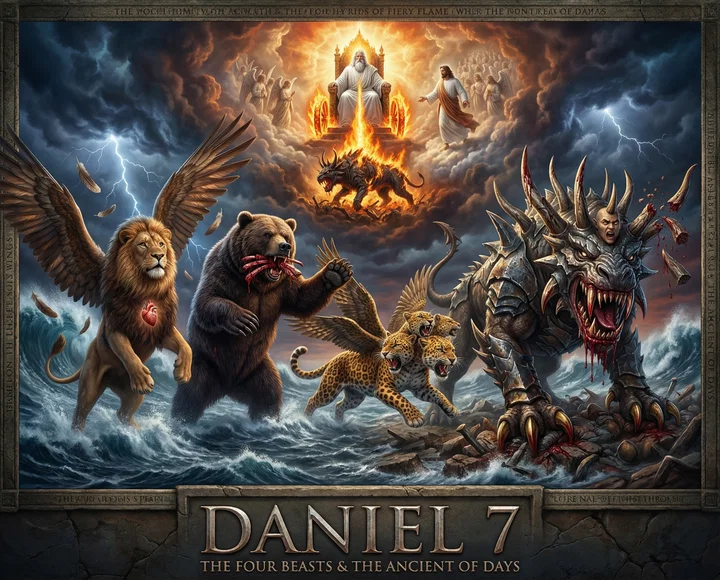
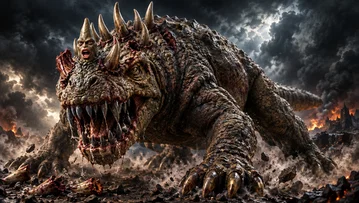
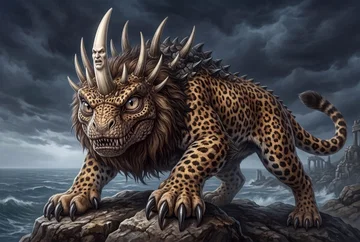
I considered the horns, and, behold, there came up among them another little horn, before whom there were three of the first horns plucked up by the roots: and, behold, in this horn were eyes like the eyes of man, and a mouth speaking great things.
Translations
American King James Version, King James Version
I considered the horns, and, behold, there came up among them another little horn, before whom there were three of the first horns plucked up by the roots: and, behold, in this horn were eyes like the eyes of man, and a mouth speaking great things.
I considered the horns, and behold, there came up among them another little horn, before whom there were three of the first horns pluckt up by the roots: and behold, in this horn were eyes like the eyes of man, and a mouth speaking great things.
I considered the horns, and behold, there came up among them another little horn, before whom there were three of the first horns plucked up by the roots: and behold, in this horn were eyes like the eyes of a man, and a mouth speaking great things.
Revised Version, American Standard Version
I considered the horns, and, behold, there came up among them another horn, a little one, before which three of the first horns were plucked up by the roots: and, behold, in this horn were eyes like the eyes of a man, and a mouth speaking great things.
'I was considering about the horns, and lo, another horn, a little one, hath come up between them, and three of the first horns have been eradicated from before it, and lo, eyes as the eyes of man [are] in this horn, and a mouth speaking great things.
I considered the horns, and behold, there came up among them another, a little horn, before which three of the first horns were plucked up by the roots; and behold, in this horn were eyes like the eyes of a man, and a mouth speaking great things.
I was considering the horns, when lo! another horn, a little one, came up among them, and, three of the former horns, were uprooted from before it,—and lo! eyes, like the eyes of a man, in this horn, and, a mouth, speaking great things.
Berean Standard Bible, Majority Standard Bible
While I was contemplating the horns, suddenly another horn, a little one, came up among them, and three of the first horns were uprooted before it. This horn had eyes like those of a man and a mouth that spoke words of arrogance.
“ I considered the horns, and behold, there came up among them another horn, a little one, before which three of the first horns were plucked up by the roots; and behold, in this horn were eyes like the eyes of a man, and a mouth speaking arrogantly.
I was watching the horns with care, and I saw another coming up among them, a little one, before which three of the first horns were pulled up by the roots: and there were eyes like a man's eyes in this horn, and a mouth saying great things.
As I considered the hornes, beholde, there came vp among them another litle horne, before whome there were three of the first hornes pluckt away: and behold, in this horne were eyes like the eyes of man, and a mouth speaking presumptuous things.
Douay-Rheims (Challoner revision)
I considered the horns, and behold another little horn sprung out of the midst of them: and three of the first horns were plucked up at the presence thereof: and behold eyes like the eyes of a man were in this horn, and a mouth speaking great things.
Pictures
Cross-references 20 of 47
- Daniel 7:24-25
And the ten horns out of this kingdom are ten kings that shall arise: and another shall rise after them; and he shall be diverse from the first, and he shall subdue three kings.
Describes the little horn’s rise, persecution, and allotted period.
- Revelation 13:5-7
And there was given unto him a mouth speaking great things and blasphemies; and power was given unto him to continue forty and two months.
The beast’s blasphemous speech and war on the saints parallel the little horn’s authority.
- Daniel 7:24
And the ten horns out of this kingdom are ten kings that shall arise: and another shall rise after them; and he shall be diverse from the first, and he shall subdue three kings.
The little horn is another king who subdues three kings.
- Daniel 2:41-44
And whereas thou sawest the feet and toes, part of potters’ clay, and part of iron, the kingdom shall be divided; but there shall be in it of the strength of the iron, forasmuch as thou sawest the iron mixed with miry clay.
Both prophecies trace successive kingdoms and the division of the final kingdom before God's kingdom.
- Daniel 8
In the third year of the reign of king Belshazzar a vision appeared unto me, even unto me Daniel, after that which appeared unto me at the first.
Daniel’s visions also refer to the little horn.
- Daniel 7:20
And of the ten horns that were in his head, and of the other which came up, and before whom three fell; even of that horn that had eyes, and a mouth that spake very great things, whose look was more stout than his fellows.
Adds that the horn looked stronger than its fellows and describes its eyes.
- Daniel 7:26-27
But the judgment shall sit, and they shall take away his dominion, to consume and to destroy it unto the end.
The little horn loses its dominion, and the saints receive the everlasting kingdom.
- Daniel 7:21-22
I beheld, and the same horn made war with the saints, and prevailed against them;
The little horn makes war on the saints until judgment gives them the kingdom.
- Revelation 13:1-2
And I stood upon the sand of the sea, and saw a beast rise up out of the sea, having seven heads and ten horns, and upon his horns ten crowns, and upon his heads the name of blasphemy.
The ten-horned beast combines Daniel’s beast imagery and persecuting power.
- Daniel 7:13-14
I saw in the night visions, and, behold, one like the Son of man came with the clouds of heaven, and came to the Ancient of days, and they brought him near before him.
The Son of man receives everlasting dominion after the earthly powers.
- Daniel 7:17
These great beasts, which are four, are four kings, which shall arise out of the earth.
The four beasts are the kingdoms among which the little horn rises.
- Revelation 17:12-14
And the ten horns which thou sawest are ten kings, which have received no kingdom as yet; but receive power as kings one hour with the beast.
The ten horns are ten kings who unite to give their power to the beast.
- Daniel 7:27
And the kingdom and dominion, and the greatness of the kingdom under the whole heaven, shall be given to the people of the saints of the most High, whose kingdom is an everlasting kingdom, and all dominions shall serve and obey him.
The saints receive the everlasting kingdom after the horn’s rule.
- Daniel 8:23-25
And in the latter time of their kingdom, when the transgressors are come to the full, a king of fierce countenance, and understanding dark sentences, shall stand up.
The fierce king’s might, policy, and persecution parallel Daniel 7’s little horn.
- Revelation 17:3
So he carried me away in the spirit into the wilderness: and I saw a woman sit upon a scarlet coloured beast, full of names of blasphemy, having seven heads and ten horns.
The scarlet beast’s ten horns share the little horn’s prophetic beast imagery.
- 2 Thessalonians 2:3-4
Let no man deceive you by any means: for that day shall not come, except there come a falling away first, and that man of sin be revealed, the son of perdition;
The man of sin exalts himself against God, paralleling the little horn’s proud claims.
- Revelation 13:6-7
And he opened his mouth in blasphemy against God, to blaspheme his name, and his tabernacle, and them that dwell in heaven.
The beast blasphemes God and makes war against the saints, matching the little horn’s character.
- Revelation 12:3
And there appeared another wonder in heaven; and behold a great red dragon, having seven heads and ten horns, and seven crowns upon his heads.
The dragon’s ten horns share the symbolism of Daniel’s fourth beast and its horns.
- Daniel 7:23
Thus he said, The fourth beast shall be the fourth kingdom upon earth, which shall be diverse from all kingdoms, and shall devour the whole earth, and shall tread it down, and break it in pieces.
Identifies the fourth beast as the fourth kingdom in the vision.
- Daniel 8:5-8
And as I was considering, behold, an he goat came from the west on the face of the whole earth, and touched not the ground: and the goat had a notable horn between his eyes.
The goat’s horn and its successors parallel Daniel’s beastly horns as symbols of rulers and kingdoms.
Commentary part 1 of 2
Each commentary is drawn from primary sources: the writings of Ellen G. White and Adventist pioneers and periodicals. Each commentary is separate. Its own words are not a quotation; follow the references to read the source passages.
Ellen G. White
11 sources
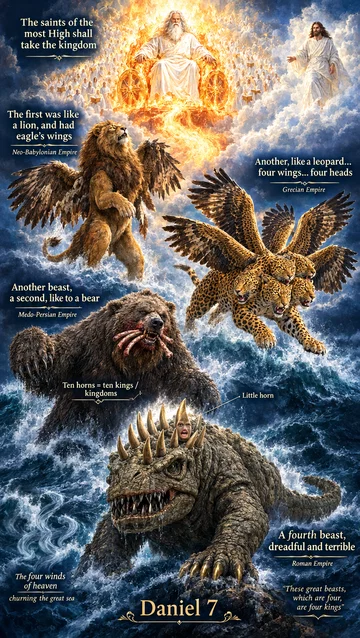
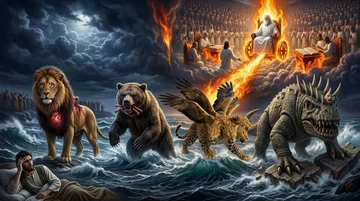
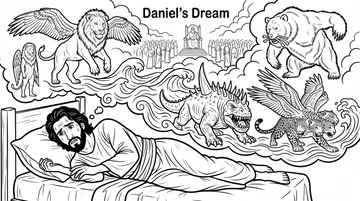
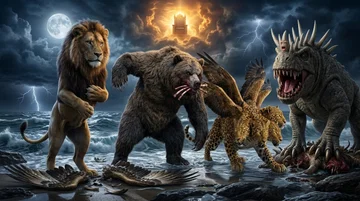
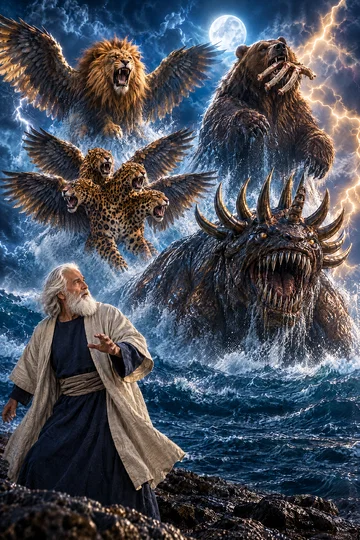
In its setting the four beasts are symbols of the successive empires of Babylon, Persia, Greece, and Rome.4SP 502.2–3 Among the ten horns of the fourth beast there rises another little horn, which is the Papacy, also called the Roman Church, whose work is represented in this four-beast prophecy.LS 41.1–42.1LS 66.1–67.24SP 502.4–6GC88 439.1GC 438.1–439.2 That it appears as a horn shows that a church can be represented in this way even before it has civil power.4SP 502.4–6
Before this horn three of the first horns were plucked up by the roots, namely the Heruli, the Vandals, and the Ostrogoths, which were overthrown in 493, 534, and 538 to make way for papal power.LS 41.1–42.1 Its rise begins in 538, and its rule over the saints, times, and laws lasts 1,260 years, reckoned as 1,260 days, ending in 1798, when its dominion was taken away.LS 41.1–42.1LS 66.1–67.2GC 438.1–439.2 That end came when French forces entered Rome and abolished the papal government: on February 10 Berthier entered and took Rome, on February 15 the pope was taken prisoner and confined in the Vatican, he was taken captive by the French army and later died in exile, and the papal power received its deadly wound.LS 41.1–42.1LS 66.1–67.2GC 438.1–439.2 It has not regained its former power.LS 41.1–42.1
The mouth speaking great things is boastful, blasphemous speech with claims against God.GC88 439.1GC 438.1–439.2 The little horn matches the leopard-like beast in Revelation 13, which has features of all four of Daniel's beasts and receives and inherits the authority and power once held in succession by them, including that once held by pagan Rome.GC88 439.1GC 438.1–439.24SP 502.2–3 The prophecy is of apocalyptic beasts that arise from the union of church and state, and such powers persecute, crush, make war on, and oppress those who oppose them and God's people.GC88 439.1DA 837.3–4GC 438.1–439.2 In this application the Papacy exalts itself above God by establishing a spurious rest day, and Sunday observance is identified as the mark of the beast.Lt 356, 1906, par. 2–5
The verse belongs to the wonderful prophecies of Daniel 7-12, which are revelations of the mysteries of ages to come, delineating historical events fulfilled in their order and leading to the close of earth's history, with the scenes associated with the man of sin among the last features plainly revealed.PK 547.1Ms 31, 1896, par. 1–2 Its full meaning was not understood even by Daniel himself, for like the rest of his prophetic writings it was shut up and sealed until the time of the end, relating to the closing period of this world's history, when Daniel will stand in his lot and place.PK 547.1 The visions were given to Daniel because he honored God with firmness, self-denial, purity of motive, and unwavering trust; God put the spirit of prophetic power upon him, taught him to read the mysteries of the future, and gave him to record for coming generations in figures and symbols events covering the history of this world till the close of time.PK 484.3
Sources
Pioneers and periodicals
282 sources
Daniel considered the ten horns of the fourth beast when another little horn came up among them, and three of the first horns were plucked up by the roots before it, and the new horn had eyes like a man's and a mouth speaking great things.RH Aug 7, 1900ST Dec 7, 1882ST May 3, 1877 The ten horns are ten contemporaneous kingdoms arising from the division of Rome, and the little horn diverse from them is papal Rome, a religio-political church kingdom.ST Jun 30, 1914ST Feb 19, 1894ST Jun 30, 1914ST Oct 22, 1894ST Jul 11, 1878 The three horns removed to make way for it were the Heruli, the Vandals and the Ostrogoths, overthrown in 493, in 533 or 534, and in 538.ST Apr 19, 1877ST Jul 23, 1874ST Sep 29, 1881ST Oct 29, 1902ST Nov 13, 1901 Its human eyes denote far-seeing shrewdness, cunning and planning beyond brute force, and its mouth denotes proud blasphemous words against the Most High, claiming God's titles, authority and worship.STST May 18, 1915ST Dec 24, 1912RH Sep 18, 1900ST Jun 20, 1900 Rising among and after the ten on Roman territory, it held appointed dominion for time, times and dividing of time, 1260 years from 538 to 1798, after which comes judgment and the everlasting kingdom given to the saints.RH Aug 7, 1900RH Nov 14, 1854RH Feb 10, 1874RH Jan 20, 1853ST May 18, 1915
Prophetic Place and Scope
Daniel 7:8 belongs to a consecutive prophecy that takes up successive governments from Daniel's day and carries down to the coming of the everlasting kingdom of Jesus Christ, delineating four successive world kingdoms — Babylon, Medo-Persia, Greece, and Rome — running through division, judgment, the second coming, and the everlasting kingdom given to the saints.ST Jun 30, 1914ST Jun 13, 1878ST Nov 29, 1905RH Jun 20, 1854ST Jun 27, 1878 The vision covers the same ground as Daniel 2 while showing developments in medieval and modern times, with the papacy as its central figure arising among the kingdoms of Rome's division.ST Jun 30, 1914ST Jun 13, 1878RH Jun 20, 1854 Its predictions are to be identified in past history by knowledge of history, with more definite and particular specifications that point out facts more clearly than Daniel 2.ST Jun 13, 1878RH Jun 20, 1854ST Jun 27, 1878 The ten horns represent Rome's division into ten kingdoms, and the little horn rising among them represents the papacy, which rose to power among those kingdoms and spoke blasphemous words against God.ST Jun 30, 1914ST Jun 27, 1878ST Apr 19, 1877 Its persecution of the saints and attempt to change times and laws fulfilled the prophecy; its allotted time has expired, and its destruction by the judgment remains.ST Jun 27, 1878ST Apr 19, 1877
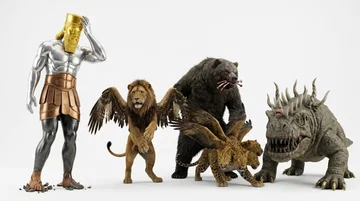
The vision portrays the kingdoms of humanity by their character as cruel beasts rather than by their glory and endurance as metals, tracing four successive world empires and their changes to the end, with the little horn arising later on the fourth beast to dominate the other horns and the beast.ST Jun 30, 1914ST Jun 13, 1878ST Nov 29, 1905 The beasts correspond to the image's kingdoms of gold, silver, brass and iron, and the beasts' horns correspond to its toes.ST Jun 30, 1914 Daniel 7 uses new symbols to show features of those historical movements that the metals in Daniel 2 were not suited to express.ST Nov 29, 1905 Each later vision adds to what came before, Daniel 2 stopping with the completed image and toes until the kingdom of God, while Daniel 7 adds this power arising after the ten horns, which is why it is not shown in Daniel 2.ST Jun 30, 1914ST Jun 5, 1884 The vision's account of the beasts' dominion ending while their lives continue means that the powers represented can remain until their eventual destruction without requiring a resurrection of the nations they represented.
The vision of the four beasts was given in a dream in Belshazzar's first year.RH Apr 23, 1867ST Jul 6, 1915 It stands in the Aramaic portion of Daniel that begins at Daniel 2:4 and ends with the close of Daniel 7, which is distinctively prophetic and gives rulers and nations great practical lessons of life.ST Oct 21, 1908RH Apr 23, 1867 It is symbolic prophecy expressed through symbols rather than through predictions stated directly in words like Daniel 11, with empires represented by symbols and with symbolic time in which a prophetic day represents a year.RH Aug 1, 1865ST Aug 9, 1910RH Jun 12, 1855 Its beasts, heads and horns are symbols chosen by the Holy Spirit and profitable for study, given both in Daniel's description and in interpretation by a heavenly being, whose astonishing fulfillment repays step-by-step study.RH Aug 1, 1865ST Jul 6, 1915 So interpreted in the Bible itself it is definite and a pattern for later beast and horn visions, resuming Daniel 2 with many additional facts and presenting the four kingdoms again under four great beasts.RH Aug 1, 1865ST Aug 9, 1910ST Jul 6, 1915
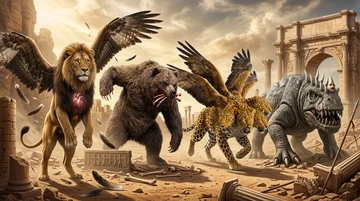
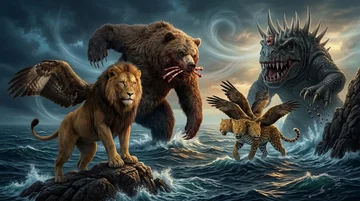
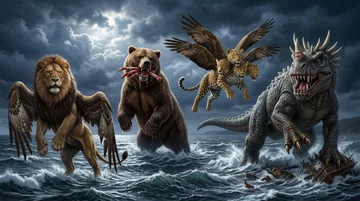
The four beasts are the winged lion as Babylon to 538 B.C., the bear with three ribs as Medo-Persia to 331 B.C., the four-headed leopard as Greece to 168 B.C., and the dreadful terrible beast as Rome from 161 B.C., dreadful and terrible and exceedingly strong, devouring and breaking in pieces and stamping with its feet, strong as iron and corresponding to the iron legs, including pagan and papal phases.ST Feb 19, 1894RH Aug 7, 1900RH Jan 20, 1853ST May 18, 1915ST Apr 19, 1877 The ten horns are ten kings or kingdoms arising out of Rome, namely the Huns, Ostrogoths, Visigoths, Franks, Vandals, Suevi, Burgundians, Heruli, Anglo-Saxons, and Lombards.RH Jan 20, 1853ST Apr 19, 1877 The little horn coming up among them, at first little but afterward more stout than its fellows, is the Papacy, thrusting itself up to find a place and usurping the places of others by plucking up three of the first horns, namely the Heruli, the Ostrogoths, and the Vandals, which were not destroyed but retired from the field before papal claims to seek territorial limits elsewhere.RH Jan 20, 1853ST May 18, 1915ST Apr 19, 1877 The eyes like the eyes of man and mouth speaking great things denote the shrewdness, penetration, cunning, foresight, and arrogant claims of the bishop of Rome, with humanlike eyes and boastful mouth distinguishing it from a beast and portraying a power capable of understanding and making great claims against God.STST Apr 19, 1877 By 1617 the series including the little horn was engraved over Nurnberg city hall.RH Aug 7, 1900
Fulfilled predictions for Babylon, Medo-Persia, Greece and Rome prove the prophecy definite and reliable, so the remaining prophetic declarations can also be trusted.ST Nov 24, 1914ST Aug 2, 1877RH Aug 9, 1915 All is fulfilled except the closing specifications of the stone smiting the image upon the feet, the beast slain and his body given to the burning flame, and the little horn which waxed exceeding great broken without hand, which remain until Christ's second coming.ST Aug 2, 1877ST Aug 9, 1910 The prophecy of Daniel 7 reaches to the end of this dispensation, outlining world history from literal Babylon to the end of time, when spiritual Babylon, a tyrant over consciences, is judged and punished and its victims receive the everlasting inheritance, with the fifth universal empire, God's everlasting kingdom, immediately impending.ST Aug 2, 1877RH Aug 9, 1915 Those kingdoms arising from the breakup of the fourth empire into ten kingdoms would undergo changes and remain until the Lord of glory breaks them at the establishment of His heavenly kingdom, whose reign begins at Christ's second coming.ST Aug 9, 1910RH Nov 11, 1915
The last world monarchy would be divided and remain divided until the end of time.ST Jun 30, 1914RH Jan 31, 1856RH Sep 30, 1862 The horns did not come up until A.D. 483, so Christ symbolized by the stone could not have smitten the feet of the image at His first advent because the feet did not then exist.RH Oct 25, 1870RH Sep 30, 1862 The divided kingdom continues for a long time before that destruction, with the little-horn power arising after the fourth kingdom is divided into ten horns yet among those horns, uprooting three, growing great and more imposing, before the fourth kingdom is destroyed and the stone kingdom fills the world.RH Oct 25, 1870RH Jan 31, 1856RH Sep 30, 1862 The beast and the little horn are to be destroyed and cast into the burning flame together at Christ's second coming, after the judgment of Daniel 7:9-10 when the Son of Man receives everlasting dominion, glory, and a kingdom.RH Oct 25, 1870RH Jan 31, 1856ST Sep 14, 1882 That kingdom was not set up in the days of the Caesars or on the day of Pentecost, with no Old Testament prophecy locating its setting up at Pentecost and the New Testament showing it still future after Pentecost.RH Oct 25, 1870
The symbols of the image and the beasts could be understood before 1798, while the beginning and ending of the 2300 days could not yet be known because the seventy weeks had not yet been seen as the key to the 2300 days.GSAM 84.3
Meaning of Symbols
In prophetic symbolism a beast stands for a kingdom, a persecuting church-and-state government, a horn stands for a kingdom, power or nation and can denote a church or ecclesiastical power, a king stands for a succession of rulers, heads denote kingdoms, and a prophetic day stands for a year.STST Jun 5, 1884ST Oct 17, 1906ST Apr 19, 1877ST Jun 3, 1897 The verse pictures another little horn coming up among the earlier horns, with three of the first horns plucked up by the roots before it as it becomes established, having eyes like a man's and a mouth speaking great things, without in itself explaining those features.RH Aug 7, 1900ST Dec 7, 1882ST May 3, 1877RH Sep 9, 1915 The vision belongs to a symbolic account of successive earthly kingdoms in which the fourth beast is Rome, and it develops the history introduced in Daniel 2 by using new symbols to show features the metals were not suited to express.ST Dec 7, 1882ST May 3, 1877RH Sep 9, 1915RH May 29, 1900
The little horn starts small and seemingly insignificant, rises gradually and almost imperceptibly among and after the ten inside Roman territory, then increases above the others, becomes more stout and imposing than its fellows, dominates them, and represents systems rather than one man.RH Apr 15, 1862RH Jun 30, 1874RH Sep 30, 1862ST Sep 17, 1902ST Feb 3, 1898 Though small in territory it becomes worldwide in power, thrusting itself up to find a place and usurping the places of others, bringing them under its control, differing from the civil horns as an ecclesiastical power and arising before the fourth kingdom is destroyed.ST Apr 19, 1877ST Jun 20, 1900RH Sep 30, 1862ST Sep 17, 1902ST Feb 3, 1898 Its 1,260-year dominion began when it was fully established in 538 and ended in 1798, while the ten horns representing the divisions of Rome remain through that period and continue until the Son of man comes.RH Apr 15, 1862RH Jun 30, 1874
The eyes like a man's denote superior far-seeing shrewdness, cunning, sagacity, vigilance, foresight and planning for distant conquest across generations, in contrast to the blind brute-force horns that plot only for the present, showing a thinking human-like power.ST Dec 24, 1912ST Jun 5, 1884ST Jul 7, 1914ST Oct 17, 1906ST Apr 19, 1877 They distinguish it from a beast and portray a power capable of understanding and making great claims, with remarkable wisdom, penetration, extraordinary insight, and presumptuous words against the Most High marking it as man-made and antichristian.STST Dec 24, 1912ST Oct 17, 1906ST Jun 3, 1897ST Jun 20, 1900 They signify shrewd human diplomacy inherited from the Roman Senate and exercised through the confessional, celibacy of the clergy, Jesuitism, worldwide orders and unbroken papal succession, which give intimate access to the common people and continuity of schemes from generation to generation.ST Jul 7, 1914ST Jul 13, 1915 Those who held other explanations took the eyes as a seer-overseer or bishop, as greed and insatiable desire in the sense of Proverbs 27:20 shown in ambition to control nations, offices and even the policy of heaven, as quickness to seize the opening after 508, as craft to conceal history, and as astuteness about socialism while other horns are blind.ST Feb 17, 1909RH Aug 9, 1915RH Jan 23, 1908RH Jun 19, 1860
The eyes and mouth are features within the horn itself, not a separate head placed on top of it, portraying claims to divine authority; the chart therefore places a man's features in the horn.RH Oct 8, 1908RH Oct 8, 1908 The mouth speaking great things means proud, arrogant, boastful and blasphemous words against the Most High, assuming God's titles, powers, worship and prerogatives, magnifying itself above God, perverting His word, warring on truth and saints and substituting human authority and pagan principles for the divine gospel.RH Sep 18, 1900ST Jun 20, 1900ST Nov 28, 1895RH Nov 21, 1871 Its great words are presumptuous speech against God identifying it with the man of sin, compared with Peter's denial through oaths and curses, made possible by removal of three opposing powers, and equal to the forty-two months of Revelation 13:5 ending in 1798 when the papal power goes into captivity.ST Jun 20, 1900ST Nov 28, 1895RH Jan 23, 1900
Its boastful commanding speech claims to be Christ's vicar with His whole authority, holy father, most holy father, sovereign pontiff, head of the church, the only name in the world, arbiter of heaven, lord of earth, master of the universe, father of kings, light of the world, Lord God the Pope, infallible supreme judge, with power to forgive sins, keep consciences, control conscience, create by transubstantiation, depose emperors, exalt papal power over kings as the sun over the moon, require princes to kiss its feet, annul decrees, absolve allegiance, and enforce bulls, anathemas, crusades and Sunday laws.ST Jun 5, 1884ST Jul 7, 1914RH Aug 9, 1870 It acknowledges the true God Jehovah yet assumes the titles and prerogatives of God the Father and Jesus Christ alone and legislates upon the Bible, uttering claims over earthly rulers no other man has dared to make, which makes the claimant a blasphemer.ST Jun 5, 1884ST Jul 7, 1914 It speaks against God, persecutes the saints, seeks to change times and laws, and when it assumed control of civil affairs ruled over the strongest kingdoms so no king dared resist it.ST May 18, 1915ST Jun 5, 1884ST Jan 21, 1889ST Jul 7, 1914
The climax of the great words was the Ecumenical Council vote of July 14, 1870, or 1869 declaration that Pius IX is infallible and the church never errs and can never officially teach false doctrine or immorality, called the most blasphemous decree ever voted and linked to loss of civil dominion.RH Oct 20, 1874RH Aug 9, 1870RH Aug 4, 1904ST May 10, 1883RH Apr 15, 1875 The proclamation of papal infallibility as supreme and infallible arbiter of faith, keeper of consciences and ruler of temporal affairs added the greatest of the names of blasphemy, displayed the identification unmistakably, and placed the utterance close to destruction by devouring fire.RH Aug 9, 1870RH Aug 4, 1904ST Jun 15, 1882 The terrific thunderstorm over Rome that drowned out the reading of the decision was God thundering against their blasphemy, foreshadowing their soon-coming loss and the end of their confident boasting, after which civil dominion is taken away and supports fall away as signs the end is near.RH Oct 20, 1874ST Jun 15, 1882ST May 10, 1883RH Apr 15, 1875
Ten Horns Identified
The ten horns are ten contemporaneous independent kingdoms arising out of the division of the Roman Empire upon its own territory, corresponding to the feet and ten toes of Daniel 2 and occupying all that Rome embraced, continuing in the modern kingdoms and European states until the coming of the Son of man when the beast is destroyed and God's kingdom is set up.ST Oct 22, 1894ST Jul 11, 1878RH Apr 15, 1862RH Sep 8, 1874RH Jun 30, 1874 Unlike the seven heads which are successive, the horns belong together as the last agencies and display at once upon the fourth beast, which is Rome, after Babylon, Persia and Greece.ST Nov 14, 1906RH Sep 8, 1874RH Jun 30, 1874 The division was brought about by northern barbarian incursions and invaders coming down from the north into the declining dominion, and the little horn rises among them to become stronger than the others and to dominate as a spiritual power.ST Oct 22, 1894ST Jul 11, 1878RH Apr 15, 1862
The ten are the Huns, Ostrogoths, Visigoths, Franks, Vandals, Suevi, Burgundians, Heruli, Anglo-Saxons or Saxons and Angles, and Lombards.ST Apr 19, 1877ST Jul 23, 1874RH Feb 17, 1874 In variant reckoning Alemanni stands for the Huns, with Alans and Turingi or Thuringi named, as the Franks, Alemanni, Burgundians, Vandals, Suevi, Visigoths, Anglo-Saxons, Ostrogoths, Lombards and Heruli.ST Jul 23, 1912ST Nov 28, 1895 They all exist together at the same time in the Western Empire before any are removed to make room for the little horn, reckoned as the Huns in Hungary in 356, the Ostrogoths in Mysia in 377, the Visigoths in Pannonia in 378, the Franks in France in 407, the Vandals in Africa in 407, the Sueves and Alans in Gascoigne and Spain in 407, the Burgundians in Burgundy in 407, the Heruli and Rugii or Thuringi in Italy in 476, the Saxons and Angles in Britain in 476, and the Lombards in Germany in 483.RH Jun 20, 1854
Rome as united continued till 351 and was then broken by northern invaders from Alaric in 395, divided between 351 and 476 and between 351-356 and 476-483, complete in 476 or by 483 with the ten primary kingdoms appearing by 483.ST Jun 5, 1884ST Oct 17, 1906ST Nov 13, 1901 The ten kingdoms existed intact from 476 to 493, continuing till 493 when the little horn was seen arising.ST Oct 29, 1902ST Nov 28, 1895ST Jul 3, 1893RH May 27, 1875 The division is past and was not present at Christ's first advent or at the cross, for the feet did not then exist.RH Apr 15, 1862 Imperial Rome proved universal since the whole world was taxed at its command, rising in the west after Greece to take the place of brass and the leopard with iron rule as the dreadful and terrible beast, and after being broken it becomes ten kingdoms among which the fierce little horn appears in the west.ST Sep 21, 1882
The tenfold division is true to history, shown by the seven trumpets with the first four trumpets as complement and continuation describing the manner of the breakup through wars and great political commotions among the nations.RH Sep 29, 1874RH Sep 22, 1874 The horns retain the prophetic designation ten from their original number even though numbers, names and boundaries change, kingdoms fall and rise and successors replace them.ST Nov 9, 1882RH Nov 19, 1901RH Apr 7, 1874 After three earlier horns are removed seven of the original horns and the new horn remain in view, making eleven horns seen before the uprooting, yet without ending identity as the ten kingdoms represented by the horns and toes contemplated as continuing until God sets up His kingdom.RH Apr 7, 1874RH Apr 7, 1874ST Nov 9, 1882 The later ten powers of the end need not have the same names or boundaries as the first kingdoms but may be European states reorganized into a union, and unlike the first ten which did not unite in lifting the power to supremacy, the later powers will unite in support of church-state union.ST Jul 23, 1912
France was one of the old Roman horns and therefore one of the horns of the Roman beast, and since head and horn are distinct symbols it cannot also be the wounded head of John's beast though the horns in John's beast are the same kingdoms.RH Jan 10, 1871 The ten horns occupy all the territory Rome originally embraced so that no government of note formed in Europe falls outside one of the ten at the time of their rise, and none of those horns turns by metamorphosis into another distinct beast.RH Mar 12, 1857 The United States arose westward outside and beyond the dominions of the four beasts at the right time, rising peacefully from the earth and not by subduing sea-born powers, so the two-horned beast cannot be located on the continent of Europe but must be sought elsewhere in this hemisphere, being a distinct power and not another form of the papal power which would require the ten to be uprooted for two new horns.ST Jun 18, 1885RH Mar 12, 1857RH Aug 19, 1851RH May 19, 1851 The ten-horn division was visible in Europe for twelve to thirteen hundred years, and the great Western European nations of today are the strong ones of those horns that arose from that division, partly strong and partly brittle as iron amid clay with power still felt wherever it lives among the kings of earth.RH Sep 25, 1900RH Apr 14, 1853 Later varying numbers including thirteen states lying within the empire's natural northward extension do not erase identity.ST Apr 13, 1915
Little Horn Identified
The little horn is the papacy, papal Rome, the Roman Catholic Church under the pope, the great antichristian power and man of sin.ST Jun 30, 1914ST Feb 19, 1894RH Feb 10, 1874RH Jan 20, 1853ST May 18, 1915 It is a religio-civil church kingdom diverse from the civil horns, an eleventh ecclesiastical kingdom arising among the ten kingdoms into which the fourth empire was broken, representing the church kingdom that rose among them with human-like power to persecute in the interests of religion while opposing God's work.ST Jun 30, 1914ST Jun 30, 1914RH Jan 20, 1853ST May 18, 1915ST Jul 7, 1914 Fully established in A.D. 538 and holding supremacy for 1260 years until 1798, when its dominion was taken away by the French army entering Rome, the Roman Republic proclaimed February 15, 1798, the pope captured and papal government abolished, it spoke against God, persecuted the saints, and exercised dominion from about 538 to 1798.RH Feb 10, 1874RH Jan 20, 1853ST May 18, 1915 Because of the voice of the great words which the horn speaks, when thrones are cast down and the Ancient of Days sits and judgment is set and books are opened, the beast is slain and his body destroyed and given to the burning flame, which proves this church will perish without hand, that is without the hand of man, by the hand of God.ST Feb 19, 1894
It is Rome continuing in a different form, closely identified with the fourth beast so that when the horn is destroyed the beast is destroyed.ST Feb 19, 1894RH May 29, 1900ST Sep 24, 1902RH Apr 10, 1900ST Nov 21, 1900 The beast alone is pagan Rome and with the horn is Rome under the popes, carrying on the beast's identity and character and retaining self-exaltation until burned.ST Feb 19, 1894RH May 29, 1900RH Apr 10, 1900ST Jun 19, 1884 When its great words draw attention Daniel also observes the beast being slain and its body burned, for though its kingly rule is eventually taken away its persecuting and blasphemous character continues until Christ comes.ST Sep 24, 1902ST Oct 1, 1902ST Nov 21, 1900 This Roman power continues in history and prophecy until the coming of the Lord and the end of the world.ST Nov 21, 1900
It comes up among and after the ten, inside Roman territory taking the Roman name, after the empire is broken into ten kingdoms about five hundred years after Christ.RH Jun 19, 1860RH Oct 7, 1915ST Dec 20, 1883ST Jun 22, 1882ST Jun 20, 1900 The beast's actions belong to its undivided period while later actions are attributed specifically to the little horn, which appears at Rome soon after the beginning of the sixth century, speaks great words and blasphemies, wars against the saints and overcomes them, and has dominion for 1,260 years.ST Dec 20, 1883ST Jun 22, 1882RH Mar 18, 1862 Its full supremacy lasts 1260 years, counted from the setting up of papal supremacy in the days of Justinian to the events of the last decade of the eighteenth century that gave the papacy a deadly wound, and it must complete its period of triumph before Christ comes to destroy it after carrying out its predicted work before the judgment.RH Jun 19, 1860RH Oct 7, 1915ST Jun 22, 1882 Its rise is synchronized with the rise of the powers described as the transgression of desolation in Daniel 8 and the man of sin in 2 Thessalonians 2.ST Jun 20, 1900
It is an eleventh distinct priest-king with both political and religious authority located in Rome and Italy, diverse as a religious power exalting itself in the church.ST Jun 30, 1914ST Jul 7, 1914RH Aug 9, 1915ST Nov 13, 1901RH Jun 6, 1912 It claims spiritual and temporal dominion by church-state union after long apostasy, rising gradually among the ten kingdoms after the Latin Empire is divided and overthrowing or subduing three of them to establish itself as spiritual ruler over them all.RH Aug 9, 1915ST Nov 13, 1901GSAM 54.1–2 The three horns uprooted before it to make room for it are the Heruli, Vandals, and Ostrogoths, with their removal culminating in A.D. 538 when a decree made the bishop of Rome head over the churches and corrector of heretics, and it continues in the divided and brittle state of the fourth kingdom for 1260 years reaching toward the time when Christ receives the kingdom from His Father and gives it to the saints to bear rule forever.RH Aug 9, 1915ST Nov 13, 1901GSAM 54.1–2 Its humanlike eyes signify sagacity, policy, vigilance and extraordinary insight, and its mouth speaking great things represents its proud, commanding, threatening and cursing words marking its authority and rise.ST Jul 7, 1914RH Aug 9, 1915
It is not Antiochus Epiphanes, Caligula, Christ, Napoleon III, or Turkey.RH May 27, 1873ST Jun 28, 1877ST May 27, 1875RH Dec 23, 1852RH Jan 10, 1871 Antiochus died long before the ten and cannot be the horn because he was only the eighth of twenty-six kings of the Syrian horn of Grecia and not another distinct horn, was not the most illustrious but was called madman for vile folly, and was subject to Rome, carried to Rome as hostage for his father Antiochus the Great, paying tribute and abandoning his Egyptian conquests at Rome's command while venting rage on the Jews.RH May 27, 1873ST May 27, 1875RH Dec 23, 1852ST Feb 12, 1880 The horn waxed exceeding great, while Persia reigning over one hundred twenty-seven provinces is only called great and Grecia still more extensive is called very great, so Antiochus was not exceeding great in comparison, and the horn stands against the Prince of princes who is Jesus Christ, but Antiochus died 164 years before Christ was born.ST Feb 12, 1880 Caligula reigned briefly before the ten, and the horn arises after divided Rome and meets all other specifications which they do not, with its mouth speaking great things speaking great words against the Most High, wearing out the saints and thinking to change times and laws meaning it can only think to change God's law, fulfilled in nothing but the change of the Sabbath.RH May 27, 1873ST Jun 28, 1877ST May 27, 1875 Identifying Napoleon III with it is a false application, for it arises among the ten horns of the Roman beast with three earlier horns uprooted before it.RH Jan 10, 1871
It began working secretly in apostolic days but was hindered from full development until the hindrance was taken away, then developed fully among the lesser kingdoms as the Western Roman Empire broke up.RH Jun 6, 1912 It rose simply as a church after 312 then became supreme and more stout than his fellows, ruling over kings after receiving the dragon's civil power, the seat of the city of Rome, and great authority in the primacy given to the bishop of Rome.ST Jun 4, 1885RH Oct 24, 1871ST Jun 19, 1884 Elevated to power and headship of the church at the beginning of the sixth century, it is associated with Rome, the former seat of imperial power, after the empire's seat moved to Constantinople, succeeding the pagan form of the Roman empire and occupying its seat in the city of Rome.ST Sep 30, 1880RH Oct 24, 1871ST Jun 19, 1884 It is the same power described by Paul and shown in Daniel 8, fulfilled in history by the papacy building an ecclesiastical empire that in some respects took the place of the old empire, distinct from pagan Rome represented by the beast before the horn's rise, after which the beast represents Rome under the popes.RH Jun 6, 1912ST Jun 19, 1884 In this horn are blasphemy and persecution, wearing out the saints into whose hand they are given for 1260 years, which proves the application because no other power ruled God's people so long or so literally wore them out, quenching the lives of fifty millions of Christians in blood by merciless torture from 538 when Justinian's decree was made effectual by the overthrow of the Goths until 1798 when its power was overthrown by the French.ST Jun 4, 1885RH Oct 24, 1871ST Jun 19, 1884
Its locality and identity are known only when a power fulfills the specifications of time, territory, office, work and duration.RH Oct 28, 1902ST Sep 30, 1880ST Dec 14, 1882ST Nov 28, 1892RH Jan 24, 1865 The prophecy supplies its own interpretation to be examined with history, identifying when and where this power would arise, the office it would hold, its work, and how long it would rule over God's people, arising in the territory of the Latin monarchy after the invasions as a Roman apostasy.RH Oct 28, 1902ST Sep 30, 1880ST Dec 14, 1882 The angel's interpretation says it is a king unlike the first ten, who subdues three kings, speaks against the Most High, persecutes the saints, and seeks to change times and laws.ST Dec 14, 1882 These features and the related characteristics in Daniel 7:20, 21, and 25 fit the papacy and no other power, including chronology, duration, character and work, with the pope's triple crown as emblem of the three kingdoms uprooted to make room for it, and no other kingdom fulfills them all in the appointed time and place.ST Nov 16, 1888ST Nov 28, 1892RH Jan 24, 1865
It becomes the most important and distinctive power in the vision, speaking against God, persecuting the saints, setting aside God's law, and prospering longer than any other persecuting power in the series.ST Jun 19, 1884 Daniel 7:7-8 is the objective point and main theme, adding this power to the facts represented in Daniel 2, while Revelation 13 presents the same symbols and powers while also bringing another persecuting power into view.ST Jun 19, 1884 Arising from pagan Rome and sustained through ties to civil governments, it wages war against Christ's church until the saints possess the kingdom, and just before Michael stands up to deliver them it again speaks great words, its power to act in Europe depending on aid from France or another powerful nation.RH Jan 20, 1853 The horns represent kingdoms or powers including civil and religious power, and the little horn's rise marks the papacy's assumption of authority over the saints and its attempt to change God's times and laws for 1260 years, after which its dominion is taken away, clothed with power to put God's saints to death and resuming persecution with renewed force during the Reformation across several European countries, linked with Paul's man of sin and outlining its supremacy as a spiritual power and reign of terror during the Inquisition.RH Dec 23, 1851RH Apr 3, 1855ST Jan 5, 1915
It is a future antichrist power to arise in connection with the beginning of the setting up of Christ's everlasting kingdom.ST
Three Horns Uprooted
Exactly three of the first horns are uprooted before the little horn to make way and yield its place at the end of the fifth and beginning of the sixth century.ST Apr 19, 1877ST Jul 23, 1874ST Jul 13, 1915ST Feb 17, 1909ST Jul 7, 1914 They are the Heruli, the Vandals and the Ostrogoths.ST Apr 19, 1877ST Jul 23, 1874ST Sep 29, 1881ST Jul 13, 1915 They were Arian powers opposed to Trinitarian Rome, restricting the bishops and standing against papal supremacy and alliance with the state.ST Nov 29, 1905ST Oct 13, 1881ST Feb 13, 1912RH Aug 9, 1915ST Jun 13, 1900 They were not annihilated but retired from the field before papal claims to seek territorial limits elsewhere.ST Apr 19, 1877ST Jul 23, 1874ST Sep 29, 1881ST Feb 17, 1909
The three fell in 493 for the Heruli, in 533 or 534 for the Vandals, and in 538 for the Ostrogoths as the last, culminating in 538.LS 41.1–42.1ST Oct 29, 1902ST Nov 13, 1901ST Nov 29, 1905ST Jul 7, 1914 The Ostrogoths were broken near Rome under Belisarius after his December 536 entry and the March 537 to March 538 siege, then retired.LS 41.1–42.1ST Nov 13, 1901RH Jul 23, 1872ST Sep 30, 1886ST Nov 29, 1905 Their removal cleared the way for Justinian's decree making the bishop of Rome head over the churches and corrector of heretics to take effect, and for saints, times and laws to fall into papal hands.ST Nov 13, 1901RH Jul 23, 1872ST Nov 29, 1905ST Feb 13, 1912RH Aug 1, 1865 The ten kingdoms existed from 476 to 493, were complete in 476, and the first was uprooted on March 5, 493 and the last in March 538.ST Oct 29, 1902ST Nov 13, 1901ST Sep 30, 1886ST Feb 13, 1912ST Jul 3, 1893
Variant reckonings place the Heruli conquest in 498, the Vandals in 533-534 at Catholic request in Africa, and the Ostrogoths driven from Rome in 538 but nationally extinct about 553-554.RH Jun 20, 1912RH Aug 1, 1865RH Aug 9, 1915ST Jul 3, 1893 Establishment is thus traced running March 5, 493 to March 538, with defeat between 493 and 538 and final uprooting in 552-554.ST Sep 30, 1886RH Jun 20, 1912ST Apr 13, 1915ST Feb 13, 1912RH Aug 9, 1915 In one reckoning the Vandals were uprooted in 493 and the Ostrogoths suffered decisive defeat in 538, while the last of the ten Western kingdoms had been established in 476.RH Jun 20, 1912ST Apr 13, 1915ST Feb 13, 1912RH Aug 1, 1865
Plucked up by the roots means complete removal and possession by Rome, different from weakening or tributary rule, even a cessation of existence and subduing of those three kings.ST Apr 19, 1877ST Sep 29, 1881ST Jul 3, 1893RH May 27, 1875 Only three are removed, leaving seven continuing as Britain, France, Germany, Switzerland, Spain, Portugal and Italy.RH Nov 19, 1901RH Apr 7, 1874RH Apr 7, 1874ST Apr 13, 1915ST Jul 3, 1893 The pope's triple crown is taken as emblem of the three kingdoms supplanted, with crowns named as Odoacer, Theodoric and Alboin.ST Dec 21, 1882ST Oct 13, 1881ST Jul 7, 1914ST Nov 16, 1888ST Nov 28, 1892 Odoacer took Italy in 476 and in 483 restrained a papal election through his representative annulling it and ordering it begun again, illustrating restraint before Arian kingdoms were overthrown for spiritual dominion.ST Dec 21, 1882ST Oct 13, 1881ST Nov 16, 1888ST Nov 28, 1892RH Jan 24, 1865
Alternative identifications name the three as Heruli, Ostrogoths and Lombards, or Heruli, Lombards and Ostrogoths.ST Dec 21, 1882RH Jul 28, 1874ST Jan 7, 1889ST Jun 13, 1900ST Jan 7, 1889 Others count them as Ravenna, the Lombards and the Senate, with the Senate counted as part of Ravenna rather than as a separate one of the ten, or link the Senate's overthrow by Charlemagne in 800 to beginning 1,260 years to 2060.ST Jan 7, 1889RH Apr 28, 1910RH Jul 28, 1874ST Jan 7, 1889ST Jan 7, 1889 These are challenged because three originals had already fallen before those dates.ST Dec 21, 1882RH Apr 28, 1910RH Jul 28, 1874ST Jan 7, 1889ST Jun 13, 1900 The verse does not make the plucking up of the last horn mark the beginning of the papal period of supremacy.ST Dec 21, 1882ST Jan 7, 1889RH Apr 28, 1910ST Jan 7, 1889ST Jan 7, 1889
The details that the horn arose among existing horns with three earlier ones uprooted are essential to a consistent explanation.ST Jan 7, 1889ST Nov 14, 1906RH Nov 19, 1901RH Apr 7, 1874ST Oct 1, 1885 The ten horns existed at the same time as contemporaneous divisions, not successive kingdoms, and the little horn arose after them and subdued three, so that there are eleven before three are uprooted, leaving seven originals and the little horn.ST Nov 14, 1906RH Nov 19, 1901RH Apr 7, 1874ST Oct 1, 1885RH Apr 7, 1874 The prophecy can still count ten because seven plus the new horn retain identity like the toes, and changing number, names and boundaries does not erase identity.ST Nov 14, 1906RH Nov 19, 1901RH Apr 7, 1874ST Oct 1, 1885RH Apr 7, 1874 The division occurs well before the end, with the ten divisions contemplated as continuing until God sets up His kingdom.ST Jan 7, 1889RH Nov 19, 1901RH Apr 7, 1874ST Oct 1, 1885RH Apr 7, 1874
Sources