Daniel 7:11
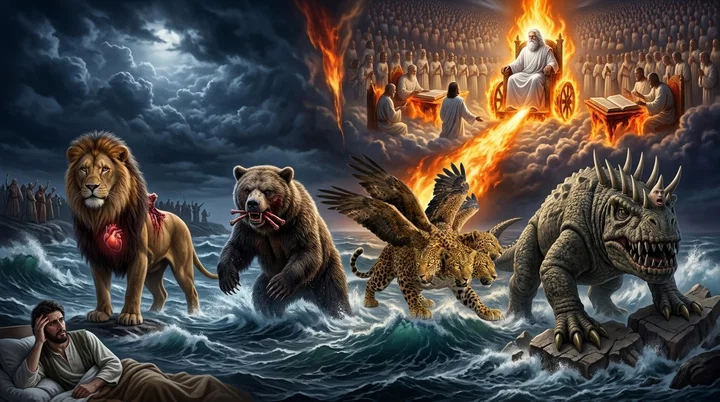
I beheld then because of the voice of the great words which the horn spake: I beheld even till the beast was slain, and his body destroyed, and given to the burning flame.
Translations
American King James Version, Webster Bible
I beheld then because of the voice of the great words which the horn spoke: I beheld even till the beast was slain, and his body destroyed, and given to the burning flame.
King James Version, KJV Cambridge Paragraph Bible
I beheld then because of the voice of the great words which the horn spake: I beheld even till the beast was slain, and his body destroyed, and given to the burning flame.
I beheld at that time because of the voice of the great words which the horn spake; I beheld even till the beast was slain, and his body destroyed, and he was given to be burned with fire.
I beheld at that time because of the voice of the great words which the horn spake; I beheld even till the beast was slain, and its body destroyed, and it was given to be burned with fire.
'I was seeing, then, because of the voice of the great words that the horn is speaking, I was seeing till that the beast is slain, and his body hath been destroyed, and given to the burning fire;
I beheld therefore, because of the voice of the great words that the horn spoke; I beheld till the beast was slain, and its body destroyed, and it was given up to be burned with fire.
I continued looking, then because of the sound of the great words which the horn was speaking, I continued looking, until that the wild beast, was slain, and his body destroyed, and given to the burning of the fire.
Berean Standard Bible, Majority Standard Bible
Then I kept watching because of the arrogant words the horn was speaking. As I continued to watch, the beast was slain, and its body was destroyed and thrown into the blazing fire.
“ I watched at that time because of the voice of the arrogant words which the horn spoke. I watched even until the animal was slain, and its body destroyed, and it was given to be burned with fire.
Then I saw — because of the voice of the great words which the horn said — I saw till the beast was put to death, and its body was given to destruction, and the beast was given to the burning of fire.
Then I behelde, because of the voyce of the presumptuous wordes, which the horne spake: I behelde, euen till the beast was slaine, and his body destroyed, and giuen to the burning fire.
Douay-Rheims (Challoner revision)
I beheld because of the voice of the great words which that horn spoke: and I saw that the beast was slain, and the body thereof was destroyed, and given to the fire to be burnt:
Pictures
Cross-references 20 of 43
- Daniel 7:25
And he shall speak great words against the most High, and shall wear out the saints of the most High, and think to change times and laws: and they shall be given into his hand until a time and times and the dividing of time.
The little horn blasphemes, persecutes the saints, and holds power for a limited prophetic period.
- Daniel 7:26-27
But the judgment shall sit, and they shall take away his dominion, to consume and to destroy it unto the end.
Judgment removes the horn’s dominion, and the kingdom is given to the saints.
- Daniel 2:31-45
Thou, O king, sawest, and behold a great image. This great image, whose brightness was excellent, stood before thee; and the form thereof was terrible.
Both visions trace successive world kingdoms to God’s everlasting kingdom.
- Revelation 13:5-7
And there was given unto him a mouth speaking great things and blasphemies; and power was given unto him to continue forty and two months.
The beast speaks boastfully and blasphemously, like Daniel’s little horn, and makes war on the saints.
- Daniel 7:27
And the kingdom and dominion, and the greatness of the kingdom under the whole heaven, shall be given to the people of the saints of the most High, whose kingdom is an everlasting kingdom, and all dominions shall serve and obey him.
The beast’s destruction is followed by the kingdom being given to the saints.
- Daniel 7:21-22
I beheld, and the same horn made war with the saints, and prevailed against them;
The horn wars against the saints until judgment is given in their favor.
- Revelation 19:20
And the beast was taken, and with him the false prophet that wrought miracles before him, with which he deceived them that had received the mark of the beast, and them that worshipped his image. These both were cast alive into a lake of fire burning with brimstone.
The beast is cast into the lake of fire at Christ’s victory.
- 2 Thessalonians 2:8
And then shall that Wicked be revealed, whom the Lord shall consume with the spirit of his mouth, and shall destroy with the brightness of his coming:
Christ destroys the opposing power at his coming.
- Daniel 7:18
But the saints of the most High shall take the kingdom, and possess the kingdom for ever, even for ever and ever.
The saints possess the kingdom forever after the beast’s destruction.
- Daniel 7:24
And the ten horns out of this kingdom are ten kings that shall arise: and another shall rise after them; and he shall be diverse from the first, and he shall subdue three kings.
The ten horns represent kings arising from the fourth kingdom, followed by another power.
- Daniel 7:7
After this I saw in the night visions, and behold a fourth beast, dreadful and terrible, and strong exceedingly; and it had great iron teeth: it devoured and brake in pieces, and stamped the residue with the feet of it: and it was diverse from all the beasts that were before it; and it had ten horns.
The beast in verse 11 is the fourth beast introduced here.
- Daniel 7:20
And of the ten horns that were in his head, and of the other which came up, and before whom three fell; even of that horn that had eyes, and a mouth that spake very great things, whose look was more stout than his fellows.
The horn’s mouth speaks great words and boasts of its power.
- Revelation 13:1-2
And I stood upon the sand of the sea, and saw a beast rise up out of the sea, having seven heads and ten horns, and upon his horns ten crowns, and upon his heads the name of blasphemy.
The composite beast gathers Daniel’s beast imagery into one system empowered by the dragon.
- Daniel 7:17
These great beasts, which are four, are four kings, which shall arise out of the earth.
The four beasts represent four kings or kingdoms.
- Daniel 8
In the third year of the reign of king Belshazzar a vision appeared unto me, even unto me Daniel, after that which appeared unto me at the first.
Its prophetic line is parallel to Daniel 7 and linked to the 2300 days.
- Daniel 2:35
Then was the iron, the clay, the brass, the silver, and the gold, broken to pieces together, and became like the chaff of the summer threshingfloors; and the wind carried them away, that no place was found for them: and the stone that smote the image became a great mountain, and filled the whole earth.
The image’s kingdoms are destroyed as God’s kingdom is established.
- Revelation 15:2
And I saw as it were a sea of glass mingled with fire: and them that had gotten the victory over the beast, and over his image, and over his mark, and over the number of his name, stand on the sea of glass, having the harps of God.
Shows the victors over the beast, its image, and its mark standing on the sea of glass.
- Revelation 17:12-14
And the ten horns which thou sawest are ten kings, which have received no kingdom as yet; but receive power as kings one hour with the beast.
The ten horns become kings who join the beast in war against the Lamb, who overcomes them.
- Daniel 7:2-3
Daniel spake and said, I saw in my vision by night, and, behold, the four winds of the heaven strove upon the great sea.
The four beasts rise from the sea amid winds.
- Daniel 7:23
Thus he said, The fourth beast shall be the fourth kingdom upon earth, which shall be diverse from all kingdoms, and shall devour the whole earth, and shall tread it down, and break it in pieces.
The fourth beast is identified as a kingdom that devours and breaks the earth.
Commentary part 1 of 2
Each commentary is drawn from primary sources: the writings of Ellen G. White and Adventist pioneers and periodicals. Each commentary is separate. Its own words are not a quotation; follow the references to read the source passages.
Ellen G. White
14 sources
Daniel watches because of the boastful, arrogant and blasphemous words spoken by the little horn, which is the papacy, until the beast representing Rome is judged and slain and its body destroyed and given to the burning flame.LS 66.1–67.2LS 41.1–42.1GC88 439.1DA 837.3–44SP 502.2–3 Its end is sudden destruction by fire following those words, not a gradual growing gentle to make way for a temporal millennium, with the horn's loss of dominion reaching a historic turning point when Rome was taken and the pope made prisoner in February 1798.LS 66.1–67.2LS 41.1–42.14SP 502.2–3 The scene belongs to the vision of the heavenly throne and judgment at the end of the 2300 days, when the Father moves into the most holy place and Jesus ministers there as High Priest before receiving the kingdom.EW 46.1EW 45.2 It reveals God alone as great, the Ancient of Days and monarch of the universe, Ruler of the present and of the destinies of men and Revealer of the future, who controls all kingdoms and will set up His everlasting kingdom.Lt 57, 1896, par. 4–716MR 333.2–3Ms 35, 1890, par. 9 He works by His might to abase human pride and lay human glory in the dust, showing monarchs and statesmen and the highest and most learned to be as dust in the balance, exalting whom He will and casting down one mighty ruler and setting up another.Lt 57, 1896, par. 4–716MR 333.2–3Ms 35, 1890, par. 9
Beast, Horn and Fire
The great words that hold Daniel's gaze are the boastful, arrogant, blasphemous words spoken by the little horn.LS 66.1–67.2LS 41.1–42.1GC88 439.1 That little horn is the papacy, representing the Roman Church even before it gained civil power.GC88 439.14SP 502.4–6 Its working as the man of sin is among the last features plainly revealed in earth's history, set within a prophecy to be studied carefully as a figurative outline of events leading to the close of earth's history.Ms 31, 1896, par. 1–2
The beast in whose destruction the vision ends represents Rome, the last of the four empires, whose power passes through successive empires to its final destruction.4SP 502.2–3 It is an apocalyptic beast power associated with a union of church and state that cruelly persecutes and crushes those who oppose it.DA 837.3–4 Daniel watches because of the horn's words until the beast is judged and slain, its body destroyed and given to the burning flame.LS 66.1–67.2LS 41.1–42.14SP 502.2–3
Its end is destruction by fire, not a gradual becoming gentle or making way for a temporal millennium.LS 41.1–42.1 The loss of dominion by the little horn is applied historically to February 1798, when Berthier took Rome and the Pope was taken prisoner.LS 66.1–67.2
God's Sovereign Judgment
The verse stands in the vision of the heavenly throne and judgment opened at the end of the 2300 days.EW 45.2 There the Father and the Son are seen, the scene turning on the Father's moving into the most holy place and Jesus' ministry there as High Priest.EW 46.1EW 45.2 After that ministry Jesus goes to the Father to receive the kingdom.EW 45.2 That judgment vision is joined to God's judgments as warnings to people, given so that some will heed the warning and be converted.Ms 129, 1908, par. 8–10
The vision exalts God alone as great, the Most High above all things.Lt 57, 1896, par. 4–716MR 333.2–3Ms 35, 1890, par. 9 He is the monarch of the universe, the Ancient of Days, the living and omnipotent God.Lt 57, 1896, par. 4–716MR 333.2–3Ms 35, 1890, par. 9 He is the Source of all wisdom, the Ruler of the present and of the destinies of all men, the Revealer of the future, controlling all kingdoms.Lt 57, 1896, par. 4–716MR 333.2–3Ms 35, 1890, par. 9 He is about to set up His everlasting kingdom, and He wills and accomplishes His purposes.Lt 57, 1896, par. 4–716MR 333.2–3Ms 35, 1890, par. 9
By this He works to abase human pride and lay human glory in the dust.Lt 57, 1896, par. 4–716MR 333.2–3 Divine agency is unfolded as above all, while human agencies are merely human and limited and are to be kept in their proper place.Ms 35, 1890, par. 9 Man in lifting up his soul unto vanity is exposed as poor, frail, short-lived, erring, and guilty.Lt 57, 1896, par. 4–716MR 333.2–3 Even monarchs and statesmen, the highest and most learned, are as dust in the balance.Ms 35, 1890, par. 9 All human authority is still to be treated respectfully, but it occupies only its own place, for God alone is Ruler of the destinies of all men.Ms 35, 1890, par. 9
By His might and power to carry out His purposes, He exalts whom He will.Lt 57, 1896, par. 4–716MR 333.2–3Ms 35, 1890, par. 9 He casts down one mighty ruler and sets up another in his place.Lt 57, 1896, par. 4–716MR 333.2–3Ms 35, 1890, par. 9
Study for the Last Days
Daniel 7:11 stands among the wonderful prophecies recorded in Daniel 7-12, given to Daniel as God's ambassador to reveal the mysteries of ages to come.PK 547.1 Even Daniel himself did not fully understand what was shown him, for the vision was to be shut up and sealed even to the time of the end.PK 547.1 With it came the blessed assurance that Daniel would rest and then stand in his lot and place at the end of the days, in the closing period of this world's history.PK 547.1
The light contained in Daniel was given directly from God especially for these last days, is now in process of fulfillment, and all the events foretold will soon have come to pass.Lt 57, 1896, par. 4–7 It is to be studied carefully as a figurative outline of events leading to the close of earth's history, in which the working of the man of sin appears among the last features plainly revealed.Lt 57, 1896, par. 4–7Ms 31, 1896, par. 1–2
In presenting this vision the human agent is to be kept out of sight, hid in Christ, while the Lord God of heaven and His law are exalted.Lt 57, 1896, par. 4–716MR 333.2–3 Less is to be said about the Roman power and the papacy, and more attention called to what the prophets and apostles wrote under inspiration of the Spirit of God.Lt 57, 1896, par. 4–716MR 333.2–3 The history of the kingdoms there represented, with statesmen, councils, and powerful armies, is to be called up point by point, and Daniel and Revelation are to have attention as never before.16MR 333.2–3
Sources
Pioneers and periodicals
328 sources
Daniel watches while the heavenly judgment is in session, and because of the boastful words the horn is speaking at that time he keeps watching till the beast is slain, its body destroyed and given to the burning flame.ST Apr 19, 1877ST Feb 21, 1878ST Feb 21, 1878 The dreadful fourth beast is Rome, different from Babylon, Medo-Persia and Grecia, continuing through its divided ten-horn phase to the end, and the little horn speaking the great words is the papal power, the same Roman power in ecclesiastical form.RH Mar 7, 1871RH May 29, 1900ST Oct 17, 1906ST Dec 14, 1882 Those great words are blasphemous claims against the Most High, exalting human authority above God and His law, climaxing while judgment is going forward in the 1854 declaration of Mary's sinlessness and the 1870 decree of papal infallibility.RH Mar 7, 1871ST Oct 17, 1906RH May 24, 1870ST Apr 19, 1877RH Feb 17, 1874 The sitting court is the investigative judgment begun in 1844 at the end of the 2300 days, when the Son of man comes to the Ancient of Days to close priestly work and receive dominion, glory and a kingdom.RH Dec 8, 1915ST Jan 21, 1889ST Feb 21, 1878ST Jan 21, 1903RH Dec 30, 1873 The slaying and burning is not the 1798 taking away of civil dominion after the 1260 years from 538, but the final destruction of Rome with all earthly kingdoms at Christ's second coming in flaming fire, when unlike the earlier beasts whose lives were prolonged its very body is utterly destroyed, and the everlasting kingdom under the whole heaven is given to the saints.ST Dec 14, 1882RH Feb 10, 1874ST May 18, 1915RH Oct 7, 1915
Words and Vision Setting
The words then and till mark a particular time and an interval while the investigative judgment is going forward in heaven in session. ST Apr 19, 1877ST Feb 21, 1878ST Feb 21, 1878ST Feb 21, 1878 Just before its destruction the horn utters its greatest boastful, blasphemous words against the Most High, holding millions in blind superstition and claiming the prerogative of God, as heard in the 1870 Vatican Council decree that the occupant of the papal throne, the man of sin, is infallible and cannot err when defining doctrine, showing the power is near its burning. ST Apr 19, 1877 Daniel watches because of the voice of those great words until the beast is slain, its body destroyed and given to the burning flame, which is its destruction not its conversion, disproving a thousand years of gospel triumph over the world before the Lord comes and any probation or mixed millennium where immortal saints preach to mortal sinners after He comes. ST Apr 19, 1877ST Feb 21, 1878RH Nov 30, 1869 The destruction does not happen immediately at the judgment, for the interval marked by till includes the Son of man coming before the Father to close priestly work, being crowned King of kings, receiving dominion, glory and a kingdom and kingly authority to judge, then descending to earth in flaming fire at the brightness of His coming, at which advent the great antichristian power on earth is slain, its body destroyed and given to the burning flame. ST Feb 21, 1878ST Feb 21, 1878ST May 22, 1879RH Nov 30, 1869ST Feb 21, 1878 Unlike the lion, bear and leopard, whose dominion was taken away but whose lives, territory and subjects continued under the next kingdom, the fourth beast keeps its character to the end and has no life prolonged after its dominion ends and is succeeded by no mortal government or state, but passes into the lake of fire and the second death. ST Apr 19, 1877
The vision was given in the time of Belshazzar when Daniel stood alone looking sea-ward from a wild shore under a lowering sky with the sea lashed by tempest into high billows. ST Jul 20, 1882 The beast is a dreadful and terrible monster rising out of the surge, stronger than its greatest opponent, treading down the former three beasts with its feet and eating the whole earth with great iron teeth, wearing ten horns on its head which Daniel considered with suitable care. ST Jul 20, 1882 In this symbolic prophecy literal winds and waters do not produce real kingdoms, for the great sea from which the beasts arise represents the peoples, multitudes, nations and kings of the earth. ST Oct 1, 1885RH Nov 26, 1857ST Feb 6, 1893 The blowing and striving of the winds upon the sea indicates wars, the stirring up of peoples through strife and bloodshed and the fierce passions of men, and it is through that commotion and political upheaval that kingdoms and governments arise, in contrast with the two-horned beast which rises peacefully like a plant from the earth. ST Oct 1, 1885RH Jun 9, 1874ST Jan 6, 1887ST Aug 7, 1879
Beasts represent governments, nations, kingdoms or empires continuing through successive rulers and changes, and horns represent kingdoms, powers or nations. ST Dec 22, 1881RH Nov 26, 1857RH Jun 9, 1874ST Feb 6, 1893ST Jan 6, 1887 The lion, bear, leopard and dreadful and terrible beast are Babylon, Medo-Persia, Greece and Rome, the four universal governments since the days of Nebuchadnezzar, and the beast having the characteristics of all the beasts occupies the same dominion of those four monarchies as the last form of the Roman Empire under papal rule commencing A.D. 538. RH Nov 26, 1857 A horn can also represent a church even before union with the state, as with the little horn which is the church of Rome introduced under the symbol of a horn before that church had received any civil power or was directly united with the state, with the 1290 years marking supremacy over other churches and the 1260 years marking alliance with civil authority. RH Sep 30, 1873 A single beast with its horn stands for an empire under a succession of rulers, not one person alone. RH Sep 30, 1873
The section runs in Aramaic from Daniel 2:4 to the close of chapter 7, distinctively prophetic while the whole book is more or less prophetic, giving rulers and nations of earth a great practical lesson of life. ST Oct 21, 1908 The vision of the four beasts was given in a dream in its own year distinct from the visions of the eighth and tenth chapters, with definite intervals between the successive visions to be fixed in mind, two years before the vision in Daniel 8. RH Apr 23, 1867RH Feb 27, 1900 It is clothed in figures and symbols like Daniel 2 and Daniel 8, unlike Daniel 11 given mostly in plain language, and its prediction is conveyed through the symbols of the vision rather than only through the words describing it. RH Jun 12, 1855 It presents events as if they were present when Daniel saw them, although some of those events were not fulfilled then and remain unfulfilled still, where wind means war and the waters of the sea mean nations so the four great kingdoms come up by wars among the great nations through political strife, commotion, upheavals, revolution and war. ST May 24, 1883RH Nov 14, 1871ST Mar 23, 1915
The meaning was made clear within the chapter itself by one standing by, for the Bible itself gives its interpretation and its prophetic statements have been fulfilled accurately and literally, giving careful students certainty rather than grounds for speculation. RH Mar 8, 1915ST Jun 30, 1914 Leading events are told three times as emblems seen, inquiry, and divine explanation each ending with the triumph of the saints, and the predicted events occur in consecutive order so that when one event is fulfilled the next can be known. RH Jan 21, 1909 Without the history of the kingdoms it describes the prophecy cannot serve to show its fulfillment, yet it is divinely interpreted so predictions can be compared with history to confirm reliability, and it is the pattern after which all visions of beasts and horns are framed and by whose explanation all study of beasts and horns must be guided. RH Sep 30, 1873RH Jan 13, 1852RH Mar 8, 1915
The fourth beast receives more attention than the other three beasts because it is the vision's chief subject, and after the judgment scene the prophet's attention was next drawn by the voice of the great words spoken by the horn. ST Sep 24, 1902RH May 29, 1900 Daniel watches because of the little horn's boastful words, which strike him with their violence, pride and malice, identified with the pope's threats, commands, anathemas and words of pride and violence resounding through history for about 1,200 years, drawing attention from heaven to earth. ST Jul 30, 1902ST Dec 21, 1882 The judgment following those words, in which Daniel watches until the beast is slain, its body destroyed and given to the burning flame, supplies vivid details of the momentous day of the Lord's coming repeated by Jesus. ST Sep 14, 1882ST Feb 4, 1889
By itself the verse does not explain the destruction or the flame. RH Feb 21, 1865RH Mar 18, 1862RH Dec 14, 1869ST Jan 28, 1889ST Dec 22, 1881 It belongs to the prophecy of the blasphemous, persecuting power represented by the little horn and beast identified with the papacy and Romanism as a church power claiming authority to alter God's law and release people from its claims, fulfilled in its rise among and after the ten horns after Rome was divided into ten kingdoms, acting before the empire is divided with further actions afterward attributed specifically to the little horn. RH Feb 21, 1865RH Mar 18, 1862ST Jan 28, 1889ST Dec 22, 1881 It belongs to the judgment scene that closes Christ's priesthood and crowns Him King of kings, in which cases for the righteous dead are examined while the living righteous are prepared for the close of probation and the investigative judgment. RH Dec 14, 1869 It belongs to the vision whose purpose is to reveal the location of the territory, the time of the rise, the duration of the supremacy and the nature of the work of the little horn, which meets all specifications as no other power in history does, arising at the indicated time, securing the declared territory, reigning over kings for the specified length of time and doing the foretold work, shown as a kingdom with limited territory because it is a little horn and the pope as a king among kings. RH Oct 28, 1902
The sitting of the heavenly court while the horn is heard is unknown to the inhabitants of the earth and is the judgment beginning at the house of God, making up the list of the loyal subjects of the Son of man whose kingdom is soon to be ushered in. ST Jul 14, 1914 Communion with the Ancient of days involves seeing God's kind, gentle and loving character revealed in His Son, without which revelation people could not be fit for such communion. RH Jun 2, 1859
Four Beasts and Ten Horns
The four beasts are four successive universal earthly kingdoms, the same as the gold, silver, brass and iron of Nebuchadnezzar's image but shown by cruel character rather than glory.ST Oct 17, 1906ST Dec 14, 1882ST May 18, 1915RH Jan 31, 1856 The winged lion is Babylon with power, ferocity, soaring pride and self-exaltation, the bear is Medo-Persia, the four-headed leopard is Grecia divided into four kingdoms, and the dreadful terrible beast with iron teeth and bronze claws is Rome, last of the four, different from the others and breaking and subduing nations across the earth.ST Oct 17, 1906ST Dec 14, 1882ST May 18, 1915RH Jan 31, 1856 The fourth beast retains dominion until its final destruction after the horn's great words, while the other kingdoms lose dominion earlier but their lives continue for a time, and its destruction belongs to the final removal of earthly powers before the everlasting kingdom is given to the saints at Christ's second coming.ST Dec 14, 1882ST May 18, 1915RH Feb 24, 1874RH Jan 31, 1856
Rome is the kingdom that followed Greece and became dominant from 168 B.C., the same as the iron legs in Daniel 2.ST Nov 29, 1899ST Jul 15, 1913ST Oct 29, 1885ST Nov 19, 1885ST May 20, 1897 Its course runs as Babylon till B.C. 538, Medo-Persia till B.C. 331, Grecia till B.C. 168, and Rome as a united kingdom till A.D. 351 and as a divided empire continuing onward to make way for Christ's kingdom at His coming.ST Jul 15, 1913ST Nov 28, 1895ST May 20, 1897 It was different because while a republic it subdued and trampled peoples, and because it arose west of Greece in territory of its own.ST Nov 29, 1899ST Jul 15, 1913ST May 20, 1897 Rome that followed Greece is distinguished in this connection from Daniel 8's horn, while Daniel 7's little horn is a separate symbol.ST Nov 28, 1895ST Nov 19, 1885
The ten horns are ten kings, kingdoms or divisions arising from divided Rome and occupying its former territory in Western Europe.ST Jun 22, 1882ST Aug 24, 1882RH Jan 23, 1855ST Jul 24, 1879ST Jan 30, 1879 They are the same as the ten toes of Daniel 2 and the ten horns of the dragon in Revelation 12 and of the beasts in Revelation 13 and 17.ST Aug 24, 1882RH Oct 25, 1870ST Jan 30, 1879 They did not arise until the fifth century, given as A.D. 483, so the feet did not exist to be smitten at the first advent.ST Jun 22, 1882RH Jan 23, 1855RH Oct 25, 1870 The little horn speaking great words arises after and among the ten, about five hundred years after Christ, wears out the saints for time, times and dividing of time, and after its period judgment follows and the beast is slain and burned.ST Jun 22, 1882ST Aug 24, 1882RH Jan 23, 1855ST Jul 24, 1879ST Jan 30, 1879
The division was brought about by northern barbarian incursions between A.D. 351 and 476, also given as A.D. 351 to 493, A.D. 353 to 483, and A.D. 476 to 493, beginning with the Visigoths under Alaric in A.D. 395 until the Herulian kingdom of Italy in A.D. 476, and pictured by the first four trumpets.ST Jun 30, 1914ST Oct 1, 1902ST Nov 9, 1882ST Oct 22, 1894 The ten are listed as Alemanni, Franks, Burgundians, Vandals, Suevi, Visigoths, Saxons, Ostrogoths, Lombards and Heruli.ST Jun 30, 1914ST Oct 29, 1902ST Oct 22, 1894 Variants give Ostrogoths, Visigoths, Allemani, Franks, Vandals, Suevi, Burgundians, Heruli, Anglo-Saxons and Lombards, and Huns, Turingi, Angles and others, with France as one of them.ST Oct 1, 1902ST Oct 29, 1902ST Oct 22, 1894 Three kingdoms later plucked up were the Heruli in 493, the Vandals in 534, and the Ostrogoths in 538.ST Oct 29, 1902ST Oct 22, 1894
The number ten has flexible application and can continue to the end even though three kingdoms were later destroyed, and the number of kingdoms could vary over time without changing their identity as the ten foretold.RH Apr 7, 1874RH Nov 19, 1901RH Mar 12, 1857 Its ten horns are ten kings or kingdoms arising out of Rome and occupying all territory Rome once embraced, so that no government of note formed in Europe falls outside one of those horns at their rise.RH Apr 7, 1874RH Nov 19, 1901RH Mar 12, 1857 No horn was to become by metamorphosis another distinct beast, so the two-horned beast cannot be located on Europe but must be sought westward in this hemisphere, arising in previously unoccupied territory rather than through nations overthrowing one another, in contrast to the four beasts arising amid striving winds upon the great sea.RH Jan 15, 1861RH Oct 20, 1874ST Jun 19, 1884RH Mar 12, 1857 That contrast distinguishes the sea beasts, arising from multitudes and nations, from the earth beast, and accepting the United States as the two-horned beast clarifies the last-day prophecies.RH Jan 15, 1861RH Oct 20, 1874ST Jun 19, 1884
The chapter is a consecutive outline of world history from Daniel's day to the end, resuming Daniel 2 with many additional facts and more definite specifications identified in past history.ST Oct 11, 1905ST Jun 30, 1914ST Nov 29, 1905RH Jun 20, 1854 It adds medieval and modern developments with special reference to the papacy, and with Daniel 8 reaches through the present dispensation to the end rather than being confined to the former dispensation.ST Jun 30, 1914RH Aug 7, 1900RH Jun 20, 1854 It presents earthly powers as fierce beasts revealing their character and attitude toward God, His law and His people, warns of tyranny to the loyal and comforts them that God knows earth's course, and shows a dreadful power trying to crush truth while the gospel brings victory.ST Oct 11, 1905ST Nov 29, 1905RH Aug 7, 1900 The judgment is the next important event when the final nations come into view, following the little horn's rise and work.ST Oct 1, 1902RH Apr 26, 1870
The course of empires with Daniel 2 and 8 shows God is about to set up His kingdom, sheds light on present movements, proves the proclamation of the coming kingdom and that the judgment hour is come, and presents events as waymarks toward the final city, the New Earth and the eternal kingdom.RH Feb 3, 1853ST Aug 30, 1905ST Aug 9, 1910RH Apr 26, 1870 Its successive beasts and horns serve as waymarks marking progress through history, extending from the distant past through history to that kingdom and pointing also to the New Earth.RH Feb 3, 1853ST Aug 30, 1905 Its prophetic periods use days to represent years, its vision shares the same powers and endpoint as the book's other lines in Christ's second coming and the everlasting kingdom, and all specifications are fulfilled except the crowning event of the Son of man's coming.ST Aug 9, 1910RH Apr 26, 1870ST Oct 10, 1878 The little horn is the same power as Paul's man of sin, whose predicted period must pass before judgment can be immediately expected.ST Aug 9, 1910RH Apr 26, 1870
The beast's seven heads are successive forms of government in the Roman Empire with the papal form as the seventh and last, which was wounded in 1798.RH Jan 10, 1871 The division continues in the present great nations of Western Europe that arose on Rome's ruin and are involved in the Eastern question, the strong ones of those kingdoms after the ruin of the Roman Empire.RH Jan 10, 1871RH Sep 25, 1900 The outlines give large mention to Babylon and its successors because of Babylon's origin beginning with Nimrod and Semiramis from principles born in the heart of Lucifer, its connection with the people and work of God, and its strong molding influence upon the world religiously, educationally and politically.ST Aug 1, 1911 The verse stands with Medo-Persia, Grecia and Rome in both imperial and divided form and in both pagan and papal phases, alongside many other powers such as Assyria, Egypt, Tyre, Midian, Moab, Ammon, Syria, Edom and Ethiopia.RH Jan 10, 1871RH Sep 25, 1900ST Aug 1, 1911
Little Horn Identity and Work
The little horn is the papal power, papal Rome and ecclesiastical Rome, the Roman apostate church, the Catholic power, the man of sin and mystery of iniquity, the same character as the blasphemous beast known by great words against God.ST Oct 17, 1906ST Jun 5, 1884RH Oct 7, 1915 It arose among and after the ten horns after the empire was divided, about five hundred years after Christ, at the beginning of the sixth century, before that church had received civil power.RH Oct 7, 1915 Its ecclesiastical kingdom appears immediately following the division of the empire into the ten kingdoms, rising in the field of the Roman Empire and taking the name Roman.RH Oct 7, 1915
The beast and the little horn represent the same power in different forms, for pagan Rome is the dreadful beast and papal Rome is the little horn rising from it.RH May 29, 1900ST Jun 19, 1884 The little horn continues the beast's character, spirit and power, and when the horn's power ends the beast is destroyed without handing its place to another beast.RH May 29, 1900RH Apr 10, 1900 Although the little horn represents papal Rome, the beast is named as the one slain and burned, showing that Rome continues in essence and characteristics under the little-horn phase and that the beast's destruction marks the end of Rome's course.RH Apr 10, 1900 After the little horn arises, the beast represents Rome under the popes.
Rome continues in essence under the little-horn phase through the union of the apostate Christian church with the Roman state, changing its form.RH Jun 5, 1900 The beast is Rome from beginning to end in pagan and papal phases, professed Christian Rome and the Latin Empire of ten monarchies in the interest of the Latin Church to which the dragon transferred dominion when pagan persecution gave way to papal persecution.ST Nov 28, 1892 Its specifications of chronology, time of continuance, character and work are fully met in the papacy and in no other power, and its end is utter ruin.ST Nov 28, 1892 The horn will speak great words again just before Michael stands up to deliver the saints, and its power will end when the saints possess the kingdom, a future event in Europe requiring France's aid or a confederacy with another powerful nation.RH Jan 20, 1853
The horn is a cruel church-and-state apostasy centered in the papacy that opposes God and truth, persecutes and wears out the saints, makes war with them, and seeks to change God's times and law.ST Dec 24, 1912ST Jun 28, 1877 This prophecy of thinking to change the law is fulfilled in nothing but the attempted change of the Sabbath, in thinking to alter the Sabbath to another day and claiming authority to release people from the law.ST Jun 28, 1877RH May 27, 1873RH May 19, 1874 It is a blasphemous power like the successor of pagan Rome given its seat Rome and its civil authority for forty-two months containing 1260 year-days allotted to make war on the saints, prospering longer than other persecuting powers and meeting all specifications of territory, time of rise, duration and work as no other power does.ST Jun 19, 1884ST Jun 19, 1884ST Nov 28, 1892
The great words are boastful, presumptuous, arrogant and blasphemous utterances against the Most High, exalting human authority against God's, presuming to oppose and control Him.RH May 24, 1870ST Apr 19, 1877ST Jun 5, 1884 They arrogate powers, titles, offices and worship due only to God, exalting decrees above God's, including claims to change bread and wine, to forgive sin and pronounce sentence, to be supreme judge and director of consciences of peasant and prince and of private household and lawmaking legislature and sole last supreme judge of right and wrong, and to contain the whole church of God so that where the head acts all act with him.RH May 24, 1870 Nearly one hundred and eighty-six millions receive such words as the voice of God, and they continue till very near utter destruction at the second coming, with the same presumption that marked the blackest period of the Dark Ages still uttered in an age of light and freedom.RH May 24, 1870
Those words include the declaration on December 8, 1854 that Mary was immaculate and sinless and the Vatican Council decree on July 18, 1870 under Pius IX that the pope is infallible and cannot err when defining doctrine.RH Mar 7, 1871ST Apr 19, 1877RH Feb 17, 1874 They were heard while the investigative judgment is going forward in heaven, dated to 1844 at the end of the 2300 years, with the word then marking that particular time just before destruction.RH Mar 7, 1871ST Apr 19, 1877RH Feb 17, 1874 This claims God's prerogative of one who cannot err for mortal man, the man of sin, shows millions held in blind superstition, and marks the climax and most blasphemous words as a sign the power is near its burning in the fires of the last day.ST Apr 19, 1877RH Feb 17, 1874RH Jul 23, 1872ST May 3, 1877
The horn's greatest words come in the closing part of its career near the end of earthly dominion just before judgments are executed, repeating Dark-Ages presumption.ST Feb 13, 1912ST Nov 13, 1901 The dogma of the immaculate conception in 1854 and the declaration of papal infallibility in 1870 are partial fulfillments, and still greater claims are expected as the logical result of the papal system and its perverted gospel.ST Feb 13, 1912 Renewed claims with imprisonment for circulating Scripture show it speaking them again, and its final greater assumptions follow the earlier claims until its power is consumed and destroyed in the judgment before Christ's coming.RH Jan 20, 1853 The anticipated proclamation of exalted claims shortly before overthrow is linked to the declaration of papal infallibility.RH Jun 21, 1870
The horn's speaking at the time judgment sits shows it goes farther in its guilty course instead of repenting, humbling herself and renouncing her past.ST Jul 14, 1914 This culminated in the 1870 Vatican Council decree of papal infallibility over learned protest, and then regaining some lost prestige to again use it for suppression of the saints.ST Jul 14, 1914 This unrepentant course marks the climax when it only remains for God to take part in the conflict in favor of His downtrodden people and truth, and the verse is cited as evidence that the horn speaks boastfully against God.ST Jul 14, 1914ST Oct 31, 1906
Three of the first horns are plucked up before it, meaning cessation of existence, between A.D. 493 and 538.RH May 27, 1875 The Heruli were exterminated in 493 by the Ostrogoths under Theodoric at Zeno's encouragement, the Vandals conquered in Africa by Belisarius with their king taken to Constantinople and denied favor for refusing to renounce Arianism, and the Ostrogoths fell to Justinian's general when Belisarius entered Rome in triumph in 536 and raised the siege in March 538.RH May 27, 1875 All were Arian powers restricting the pope, and they fell by the policy of the spiritual power coming up, so with nothing in the way it laid hold of civil power in 538 and became the noted little horn, reaching papal spiritual dominion with actual power over saints, times and laws.ST May 9, 1878RH May 27, 1875ST Oct 13, 1881 In the reckoning that dates the subduing to 493, 534 and 552-553, the Heruli were overthrown in 493, the Vandals subdued in 534, and the Ostrogoths defeated in 552-553.RH Jun 20, 1912
In a differing futuristic position the little horn is a future anti-Christian power arising in connection with the beginning of Christ's everlasting kingdom.ST Apart from that, Protestant writers identify it with the papacy rather than Antiochus Epiphanes, associating its great words against God with the papal rulers.RH May 27, 1873 The horn is not Antiochus Epiphanes, who was only eighth of twenty-six Syrian kings, not another remarkable horn, a vile madman called Epimanes carried as hostage to Rome.ST Feb 12, 1880 He enlarged dominion only by temporary Egyptian conquests relinquished at Rome's command, never exceeding Persia reigning over one hundred and seven and twenty provinces or still more extensive Grecia, dying 164 years before Christ the Prince of princes was born and therefore unable to stand against Him, so the prophecy must not be shifted from Rome pagan and papal to Antiochus, whom Daniel 7 does not bring into view.ST Feb 12, 1880RH Nov 21, 1854RH Jul 19, 1864
The little horn of Daniel 7, the papacy-only symbol, is distinguished from the little horn of Daniel 8.ST May 10, 1877ST Nov 19, 1885RH Apr 15, 1873 In one position the little horn of Daniel 8 is Mahometanism whose destruction on earth is the cleansing of the sanctuary, identified by place of origin and sphere of influence as distinct from the Roman Catholic hierarchy of Daniel 7.RH Apr 15, 1873 Rome that followed Greece and completed the sequence of four successive universal kingdoms is identified with Daniel 8's horn as distinct from Daniel 7's.ST Nov 19, 1885 The beast's seven heads are successive forms of government in the Roman Empire with the papal form as the seventh and last, which was wounded in 1798.RH Jan 10, 1871
One objection argues that if the horn is the papacy its rise and alleged Sabbath change must date after the tenfold division, whereas Christian writers testified to first-day observance centuries earlier.RH May 27, 1873
Prophetic Times and History
Prophetic days represent years, so the time, times and dividing of time is 1,260 prophetic days or years, forty-two months.RH Jun 20, 1854ST Aug 9, 1910RH Dec 29, 1863 The saints being given into the horn's hand is dated to A.D. 533, when Justinian made the Bishop of Rome head of the churches and head of all bishops.RH Jun 20, 1854ST May 25, 1882 Its exercise of that power was blocked while Rome was held by the Arian Ostrogoths, and when the last of the three horns was plucked up in the siege of Rome raised in March 538 nothing stood in the way of the pope exercising the power conferred five years before, so saints, times and laws came into his hands in fact and not in purpose only.ST May 25, 1882 That year is the placing or setting up of the abomination and the point from which to date the predicted 1,260 years of supremacy that run before the beast is slain and its body destroyed and given to the burning flame.ST May 25, 1882
The horn's full supremacy as a persecuting and civil power lasted 1,260 years from its setting up in 538 in Justinian's days when made head over churches and corrector of heretics to 1798, when its dominion was taken away, it received a deadly wound, and was led captive.RH Feb 10, 1874ST May 18, 1915RH Oct 7, 1915RH Jan 17, 1871RH Aug 31, 1869 That taking away was fulfilled in February 1798 when Berthier entered Rome with the French army, the Roman Republic was proclaimed February 15, the pope was taken prisoner and his embassy refused, giving the fatal blow to papal sovereignty and temporal existence.RH Feb 10, 1874 This ended spiritual domination and persecution and its power to persecute.ST May 18, 1915ST Aug 19, 1880 Its destruction represents the final consuming and destruction of papal power, completed at Christ's coming, with the everlasting kingdom under the whole heaven then beginning.RH Aug 31, 1869ST Aug 19, 1880
The historical outline depicts Babylon, Medo-Persia, Greece and Rome, Rome's division into ten parts, and the papacy's great authority from 538 to 1798.RH Jun 23, 1910RH Nov 24, 1910ST Jun 19, 1884 Daniel 7 fixes the time of the end to 1798 at the close of the 1,260 days, the last important event before the judgment, marked by the overthrow of papal temporal power.RH Jan 23, 1855RH Apr 26, 1870ST Jun 22, 1882 After that point the judgment-hour message can be proclaimed as immediately impending.RH Jan 23, 1855ST Mar 3, 1909 The prophecy thus recapitulates world history through 1798 and then proceeds to the setting up of God's kingdom.RH Jun 23, 1910ST Jun 19, 1884
After 1798 judgment sits to consume and destroy dominion unto the end.RH Nov 7, 1871RH Jan 15, 1867RH May 13, 1875 This was fulfilled in the weakening of papal supporters, with Spain reduced, Naples absorbed into Italy under excommunicated Victor Emmanuel, Austria humbled and opened to other churches, and France fallen before Prussia after keeping the pope in Rome eighteen years.RH Nov 7, 1871 The pope was left captive in his own capital with no territory despite claims of infallibility, and the burning of the body is still future but very near and cannot go backward, with the kingdom and dominion under the whole heaven given to the saints of the Most High next.RH Nov 7, 1871 The periods ending in 1798 brought the prophecy to that last phase, to be consumed by the spirit of Christ's mouth and destroyed by the brightness of His coming.RH Feb 11, 1873RH Jun 26, 1856RH May 13, 1875
Its civil dominion is taken away a little before the end, and from that time it consumes away in a present enfeebled dying state unto the end of the gospel age at the second coming of Christ.RH Apr 15, 1875RH Aug 1, 1865 Stripped of civil power, Rome as a church continues with greater extent than before until Christ comes, when the beast is slain and its body destroyed and given to the burning flame by being cast alive into the lake of fire and destroyed by the brightness of Christ's coming at His descent to take vengeance on His foes and save His people.RH Apr 15, 1875RH Aug 1, 1865 The 1798 overthrow was temporary, not the final slaying, with revival and brief activity before destruction at His appearing, the horn continuing even after losing power through its deadly wound until Christ appears.ST Nov 28, 1895ST Nov 28, 1895ST Jun 20, 1900 This proves the great antichrist exists to the day of Christ and the world cannot be converted before the advent, with the kingdom of God then established and that power utterly destroyed from under heaven.RH Aug 1, 1865
In a differing position the slaying and burning itself is the 1798 overthrow by French arms after temporal power from 538 to 1798, when persecuting power and spiritual domination were destroyed and no longer acknowledged.RH Feb 10, 1874RH Mar 29, 1864RH Oct 24, 1871ST Nov 5, 1894 The change in the horns of the same terrible beast shows the rise and work of the papacy continuing from 538 to 1798, with the slaying and destruction of the beast as the overthrow of the papacy in 1798.RH Mar 29, 1864 That end came at the close of forty and two months counted as 1,260 years from A.D. 538, when the Arian Ostrogoths fell before Justinian's army as the last of the three kingdoms plucked up to make place for the little horn.ST Nov 5, 1894
Apart from that position the beast is slain and burned only at Christ's second coming by God without human hand, the papacy continuing until then.ST Dec 14, 1882ST Jun 5, 1884RH Jan 31, 1856ST Feb 19, 1894 The fourth beast represents Rome and retains dominion until its final destruction, while the other kingdoms lose dominion earlier though their lives continue for a time, and the fourth empire divided into ten kingdoms remains with changes until the Lord of glory destroys them when He establishes His heavenly kingdom.RH Jan 31, 1856 The fall of papal dominion is placed shortly before the investigative judgment and the giving of the kingdom to the saints, near the time of Christ's coming.ST Aug 14, 1893 Its last temporal power was swept away when Rome surrendered September 20, 1870 to Victor Emanuel's troops, signaling nearness but not the final burning.ST Feb 13, 1912RH May 6, 1873
One position dates the taking away of dominion to 1870 with slaying afterward when the Son receives the kingdom and ceases to be priest.ST Mar 3, 1890RH Oct 20, 1874 The judgment is set before the papal power represented by the little horn comes to its end, and the slaying of the beast and giving of its body to the burning flame follows afterward when its dominion is taken away.ST Mar 3, 1890 The horn's civil dominion being taken away after the papal council declared the pope infallible connects its great words with later destruction.RH Oct 20, 1874
The judgment was placed in 1844 at the end of the 2300 years when the Ancient of Days called the court, and the horn's great words are spoken after it is set.ST Jul 16, 1896RH May 6, 1873 The order is first the judgment shall sit as the investigative judgment that began in 1844, second dominion shall be taken away as the removal of temporal dominion when Rome surrendered September 20, 1870, and third the beast is slain and his body destroyed and given to the burning flame as still future destruction by the brightness of Christ's coming into the lake of fire, fulfilled in part by the decrees of December 8, 1854 that Mary was sinless and July 18, 1870 that the pope is infallible.RH May 6, 1873 With no definite prophetic date beyond 1844 the giving of the kingdom of the earth to Christ and His true followers is next and near, following the end of papal spiritual domination in 1798.ST Jun 22, 1882ST Sep 4, 1879 The little horn's civil dominion was then progressively consumed until its last temporal power was swept away in 1870.ST Feb 13, 1912
Ten specifications are fulfilled while the remaining one points to the papacy's future return as the world's dominating power.ST Jun 24, 1897 Just before its utter and eternal ruin, like a failing wick giving a sudden glare before sinking into darkness, it will receive civil aid for a short time during the troubles of the coming day.RH Apr 14, 1874 The beast representing the papacy survives attacks and regains influence among the nations but is ultimately destroyed.ST May 2, 1916
In another application the verse belongs to the seventy weeks of 490 years from B.C. 457 to A.D. 34 set apart upon the Jews as God's special people.ST That period ended when the nation as a nation had rejected Him and He could use that people as a people no longer, marked by the second rejection of Christ in His servant Stephen as recorded in Acts 7, repeating by their actions when Stephen was stoned, His blood be upon us and upon our children.ST After that His people were scattered abroad winning souls from other peoples wherever they went, with Peter preaching to Cornelius the centurion about seven years later.ST
Heavenly Judgment Session
Daniel 7:11 belongs to the opening scene of the final judgment in heaven before Christ's advent, where the Ancient of Days presides with angels as ministers and witnesses, and the beast is judged and destroyed after the horn's great words are heard.RH Dec 8, 1915ST Jan 21, 1889ST Feb 21, 1878RH Nov 30, 1869ST Feb 21, 1878 That assembly is not all humanity gathered, and the distinct figures of Father and Son show God and Christ to be personal beings with a throne as the center of the universe.ST Feb 21, 1878RH Nov 30, 1869RH Jun 20, 1854 The destruction occurs in that judgment scene before the Son of man receives dominion and a kingdom from the Father, and while the horn continues speaking against God its dominion taken earlier is finally ended in burning flame at Christ's advent after He receives the kingdom and returns to earth.ST Jan 21, 1889ST Feb 21, 1878RH Jun 20, 1854
There the Son of man comes before the Ancient of Days to close His priestly work in the second apartment, to be crowned King of kings and receive dominion, glory and a kingdom.ST Feb 21, 1878RH Nov 30, 1869RH Jun 20, 1854ST Aug 15, 1878ST Oct 22, 1874 He ends the priesthood on the Father's throne held since ascension as High Priest after the order of Melchisedec and assumes His own throne to judge, marking the transition from priestly to kingly office.ST Aug 15, 1878ST Oct 22, 1874RH Mar 10, 1874RH Dec 30, 1873 That tribunal is the investigative judgment, identical with the cleansing of the sanctuary, fulfilled when the heavenly temple is opened at the appointed time, while the later execution of judgment is committed to Christ when He comes to earth.RH May 11, 1869RH Mar 10, 1874ST Nov 27, 1879 One holding places the burning here as the execution committed to Christ distinct from the investigative judgment in the sanctuary.ST Nov 27, 1879
It is the first of two distinct judgments, the investigative judgment of the righteous, not fulfilled at ascension but begun at the end of the 2300 days in 1844 when Christ entered within the second veil into the most holy place as antitype of the day of atonement.RH Dec 30, 1873RH Dec 14, 1869RH Jan 4, 1870RH Jan 11, 1870 It investigates the righteous dead before the resurrection while the living are still on probation, distinct from executive judgment on the wicked at the end of the thousand years, with a 1798 commencement suggested but not established.RH Dec 30, 1873RH Dec 14, 1869ST Mar 14, 1878RH Jan 4, 1870 Each case is examined before God and sins are blotted out, which is the cleansing of the sanctuary announced by the proclamation that the hour of God's judgment is come and marked by the ending of the prophetic periods.RH Dec 30, 1873RH Dec 14, 1869RH Jan 4, 1870 The righteous are acquitted, accounted worthy of eternal life and the first resurrection, their overcoming perfected and number made up, while Christ as priest confesses names from the record of lives so names are retained in the book of life and all who have only partially overcome are stricken out.ST Jan 21, 1903ST Mar 14, 1878RH Dec 7, 1869RH Jan 4, 1870 When the people of God have thus passed the investigative judgment their probation is closed forever with no further salvation for sinners.ST Mar 14, 1878RH Dec 7, 1869
Christ does not approach the Father in this manner at His ascension, for the Father did not then sit in judgment, nor at the second advent, for the Father is not on earth when the Son descends and the Son already comes as King.RH Dec 30, 1873 The giving of dominion over peoples, nations and languages, that is the kingdoms of this world becoming Christ's under the seventh trumpet, happens just before Christ returns the second time to take vengeance on His foes, not when He first ascended on high, and the setting up of the kingdom belongs with the second advent, not the first.RH Jul 21, 1874 The session takes place in the days of the seventh angel at the beginning of his voice, in the space of time employed in closing up human probation.RH Dec 28, 1869ST May 2, 1878RH Dec 28, 1869ST May 2, 1878 It is the time when the living righteous conclude probation and are accounted worthy to stand before the Son of man, and the time of the dead that they should be judged, meaning the righteous dead are accounted worthy of a part in the first resurrection.ST May 2, 1878RH Dec 28, 1869ST May 2, 1878 When Jesus leaves His work as Priest, nothing restrains the outpouring of God's wrath or the winds of war and strife upon the earth, and probation then closes with no further salvation available.ST Mar 14, 1878ST May 2, 1878
The change of God's presence from holy to most holy in 1844, with Christ closing service in the first apartment and entering service in the second, is a decisive epoch made known by the judgment message linked with the sanctuary cleansing, the Lord's coming to His temple and the bridegroom's coming, so believers know what Christ is doing and saying in heaven and can worship intelligently in spirit and in truth.RH May 5, 1903ST Jun 28, 1905 God the Father decides every case before He sends His Son to carry out the judgment, and the saints have no part in the work of judgment until that coming.ST Oct 17, 1878RH Mar 15, 1870 The execution belongs to the Son, and when He receives His own throne and power over the nations He shares that work of execution with His saints, acquitting His people and granting immortality while the rest are destroyed.ST Oct 17, 1878ST Mar 14, 1878RH Jan 11, 1870RH Jan 11, 1870 The heavenly decision about who receives immortality is thus made before Christ returns, in the second apartment where priesthood concludes and sins are blotted out, associated with coronation and wrath.RH Jan 11, 1870RH Jan 11, 1870
The slaying at the time the judgment is set and the books are opened means the destruction of Christ's enemies at the close of the present dispensation under the seventh trumpet, at judging the dead and rewarding servants at the resurrection of the just when the kingdoms of this world become the Lord's and His Christ's and He reigns as King of kings.ST Nov 16, 1882RH Jun 8, 1911RH Apr 14, 1874 Placed in 1844 before He begins His kingdom at the second coming, the beast is burned before the kingdom is given to saints, after the little horn's 1260-year reign preceding the judgment.RH Sep 2, 1851RH Apr 14, 1874ST Mar 14, 1878RH Dec 7, 1869 Christ remains priest until intercession is finished, then in answer to His request the Father gives Him His enemies for destruction with a rod of iron and commits judgment into His hands.ST Mar 14, 1878RH Dec 7, 1869 Earthly events continue while judgment progresses, with the horn still speaking boastfully and the beast eventually slain; its dominion was taken away earlier at the end of the 1260 prophetic days but it wars until the advent when judgment is given to saints and it is destroyed by fire.RH Nov 30, 1869ST Mar 31, 1909ST Sep 27, 1910
Sources