Esther 3:10
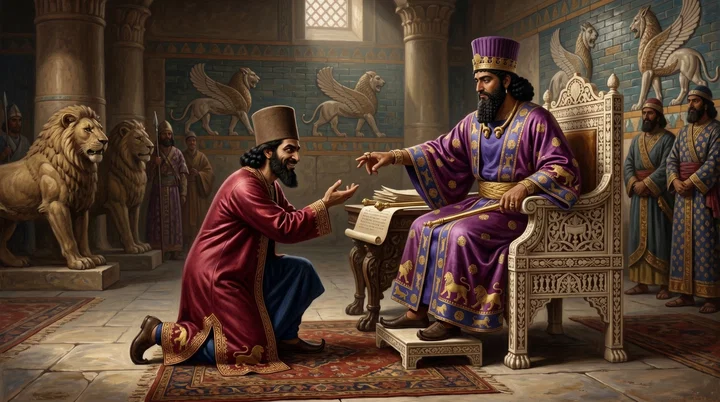
And the king took his ring from his hand, and gave it unto Haman the son of Hammedatha the Agagite, the Jews’ enemy.
Translations
And the king took his ring from his hand, and gave it to Haman the son of Hammedatha the Agagite, the Jews’ enemy.
King James Version, KJV Cambridge Paragraph Bible, Revised Version, American Standard Version
And the king took his ring from his hand, and gave it unto Haman the son of Hammedatha the Agagite, the Jews’ enemy.
And the king took his ring from his hand, and gave it to Haman the son of Hammedatha the Agagite, the Jews enemy.
And the king turneth aside his signet from off his hand, and giveth it to Haman son of Hammedatha the Agagite, adversary of the Jews;
And the king took his ring from his hand, and gave it to Haman the son of Hammedatha the Agagite, the Jews' enemy.
So then the king took his signet-ring from off his hand, and gave it unto Haman son of Hammedatha the Agagite, the adversary of the Jews;
Berean Standard Bible, Majority Standard Bible
So the king removed the signet ring from his finger and gave it to Haman son of Hammedatha, the Agagite, the enemy of the Jews.
The king took his ring from his hand, and gave it to Haman the son of Hammedatha the Agagite, the Jews’ enemy.
And the king took his ring from his hand and gave it to Haman, the son of Hammedatha the Agagite, the hater of the Jews.
Then the King tooke his ring from his hand and gaue it vnto Haman the sonne of Hammedatha the Agagite the Iewes aduersarie.
Douay-Rheims (Challoner revision)
And the king took the ring that he used, from his own hand, and gave it to Aman, the son of Amadathi of the race of Agag, the enemy of the Jews,
Pictures
Cross-references
- 1 Samuel 15:2
Thus saith the LORD of hosts, I remember that which Amalek did to Israel, how he laid wait for him in the way, when he came up from Egypt.
Haman’s Agagite identity links him to Amalek, Israel’s enemy.
- Esther 8:8
Write ye also for the Jews, as it liketh you, in the king’s name, and seal it with the king’s ring: for the writing which is written in the king’s name, and sealed with the king’s ring, may no man reverse.
The king’s ring authorizes a new decree after Haman’s plot against the Jews.
- Esther 7:10
So they hanged Haman on the gallows that he had prepared for Mordecai. Then was the king’s wrath pacified.
Haman is executed on the gallows he prepared for Mordecai.
- Esther 3:1
After these things did king Ahasuerus promote Haman the son of Hammedatha the Agagite, and advanced him, and set his seat above all the princes that were with him.
Haman is promoted above the princes.
- Deuteronomy 25:17-19
Remember what Amalek did unto thee by the way, when ye were come forth out of Egypt;
It recalls Amalek’s attack on Israel and the command to remember it.
- Esther 3:6
And he thought scorn to lay hands on Mordecai alone; for they had shewed him the people of Mordecai: wherefore Haman sought to destroy all the Jews that were throughout the whole kingdom of Ahasuerus, even the people of Mordecai.
Haman’s hatred of Mordecai leads him to plot against all the Jews.
- 1 Samuel 15:8
And he took Agag the king of the Amalekites alive, and utterly destroyed all the people with the edge of the sword.
Agag’s survival is presented as the ancestry behind Haman’s hostility.
- Esther 8:11
Wherein the king granted the Jews which were in every city to gather themselves together, and to stand for their life, to destroy, to slay, and to cause to perish, all the power of the people and province that would assault them, both little ones and women, and to take the spoil of them for a prey,
The Jews receive means to defend themselves against the decree.
- Exodus 17:8-14
Then came Amalek, and fought with Israel in Rephidim.
Haman’s hostility connects him with the Amalekites who attacked Israel.
- Esther 9:1
Now in the twelfth month, that is, the month Adar, on the thirteenth day of the same, when the king’s commandment and his decree drew near to be put in execution, in the day that the enemies of the Jews hoped to have power over them, (though it was turned to the contrary, that the Jews had rule over them that hated them;)
The threatened destruction is reversed, and the Jews prevail over their enemies.
- Esther 5:14
Then said Zeresh his wife and all his friends unto him, Let a gallows be made of fifty cubits high, and to morrow speak thou unto the king that Mordecai may be hanged thereon: then go thou in merrily with the king unto the banquet. And the thing pleased Haman; and he caused the gallows to be made.
Haman prepares a gallows for Mordecai.
- Esther 4:7-8
And Mordecai told him of all that had happened unto him, and of the sum of the money that Haman had promised to pay to the king’s treasuries for the Jews, to destroy them.
Mordecai reveals Haman’s decree to destroy the Jews and urges Esther to intervene.
Commentary
Each commentary is drawn from primary sources: the writings of Ellen G. White and Adventist pioneers and periodicals. Each commentary is separate. Its own words are not a quotation; follow the references to read the source passages.
Ellen G. White
4 sources
The handing over of the signet ring gave Haman full royal authority to carry out his proposal and decree against the Jews.Ms 39, 1910, par. 28–335T 450.1ST Feb 22, 1910Ms 51, 1899, par. 25–26 In granting it the king was blinded to what would follow and was about to bring suffering and oppression upon a people who acknowledged and served the Lord.Ms 39, 1910, par. 28–33 The decree itself sprang from Haman's malice toward Mordecai, who refused to give to a human being the reverence belonging to God alone.5T 450.1ST Feb 22, 1910Ms 51, 1899, par. 25–26 It was secured through false pretenses and misrepresentation, by falsely representing the Jews to the king and urging false claims upon him.5T 450.1ST Feb 22, 1910Ms 51, 1899, par. 25–26
Behind the plot Satan was at work through Haman and other wicked men to attack and destroy God's people who preserved the knowledge of the true God and to rid the earth of them.Ms 39, 1910, par. 28–335T 450.1ST Feb 22, 1910Ms 51, 1899, par. 25–26 Yet God's protecting power defeated the plot through angels, the enemy's purpose was thwarted, and the plans of the enemies were turned back upon themselves.Ms 39, 1910, par. 28–33ST Feb 22, 1910 The account stands as an ancient example and pattern of a future decree against God's people over Sabbath observance and refusal of false worship.5T 450.1ST Feb 22, 1910Ms 51, 1899, par. 25–26 As Mordecai did, Sabbathkeepers by their fidelity rebuke those who reject God's law, and for that reason their opponents seek to remove them out of the way.5T 450.1
In that future time Satan will work through deceptive religious and political powers to condemn those who refuse false worship.Ms 51, 1899, par. 25–26 As in Mordecai's time, God's people can trust that Satan's plans will be defeated.Ms 51, 1899, par. 25–26 The verse thus teaches the lesson that God's subjects must remain true to Him whatever the cost.Ms 39, 1910, par. 28–33
Sources
Pioneers and periodicals
29 sources
The king took his signet ring from his own hand and placed full royal authority in Haman's hands to act in his name, and its seal made his empire-wide decree against the Jews official and unalterable.ST Sep 20, 1899ST Sep 20, 1899ST Apr 23, 1902ST May 17, 1905 Haman was the son of Hammedatha the Agagite, the Jews' enemy and likely a descendant of Agag of the Amalekites, whose malice toward Mordecai for refusing him the reverence due only to God moved him to secure the decree by false claims.RH Aug 11, 1863ST Dec 20, 1899ST Jun 16, 1909ST Jan 20, 1898RH Mar 13, 1913 Behind Haman, Satan instigated the attempt under Ahasuerus to destroy all of God's people who preserved the knowledge of the true God, but God frustrated it by protecting power, reversed the decree, delivered the Jews, and hanged Haman on the gallows made for Mordecai.RH Aug 11, 1863ST Jun 27, 1911ST Nov 19, 1896ST Feb 27, 1893ST Jun 16, 1909 That decree is an ancient model for a very similar future decree that will denounce those who hallow the Sabbath of the fourth commandment as deserving death and give liberty after a certain time to put them to death unless they give up the Sabbath and observe the first day of the week.ST Feb 22, 1910ST Aug 20, 1896ST Oct 26, 1904RH Jan 16, 1908RH Mar 18, 1915 Sabbathkeepers are the Mordecai in the gate, whose reverence for God's law rebukes tramplers of His Sabbath and marks them to be put out of the way by similar means, yet God will deliver His people when religious and civil powers unite to enforce Sunday observance.ST Aug 20, 1896ST Oct 26, 1904RH Jan 16, 1908RH Mar 18, 1915ST May 19, 1914
Ring and Royal Authority
Ahasuerus took his own signet ring from his hand and gave it to Haman, thereby authorizing him to act with the king's authority in carrying out the decree against the Jews.ST Sep 20, 1899ST Sep 20, 1899ST Apr 23, 1902ST Apr 23, 1912ST Jun 16, 1909 The gift put full royal authority in the hands of a subordinate to act in the king's name, granting him power to issue a royal decree and turn his murderous scheme into an empire-wide command.ST Sep 20, 1899ST Apr 23, 1902ST Apr 23, 1912ST Jun 16, 1909ST Mar 23, 1882 Haman thus received the king's authority to carry out his design, leaving God's people in grave danger and making Esther's duty to seek their deliverance urgent.ST Sep 20, 1899ST Jun 16, 1909ST Mar 23, 1882
The ring was the king's official ring bearing the royal seal, and its transfer conveyed royal authority to carry out the plot.ST May 17, 1905ST Sep 20, 1899ST Sep 20, 1899 A king's ring could authenticate a document and give it authority, illustrating what a seal is.ST May 17, 1905ST Sep 20, 1899 The signet could stamp authority onto legal documents, making a decree official and unalterable, and so illustrates how a ruler's sign or seal gives authority to law.ST May 17, 1905ST Sep 20, 1899
The act reflected Ahasuerus's characteristic rashness and folly in favoring Haman's cause and enabling his wicked plot.ST Sep 20, 1899ST Mar 23, 1882ST Sep 20, 1899 The king had promoted Haman above the other princes, and the grant of the ring marked the conferral of authority by which Haman secured a decree for the destruction of the Jews.ST Sep 20, 1899ST Mar 4, 1886ST Sep 20, 1899 That sanction was unwitting, given by the king to Haman as the enemy of God's people for a plot whose true nature he did not discern.ST Sep 20, 1899ST Mar 4, 1886RH Feb 2, 1911 The verse shows a king working his hostile purpose toward the Jews through an empowered agent, as when Seleucus Philopator sent his treasurer Heliodorus to seize the treasures of the temple at Jerusalem and despoil the glory of the kingdom.ST Apr 23, 1912
Plot Against the Jews
Haman is named as the son of Hammedatha the Agagite, the Jews' enemy, and his designation as an Agagite marks him as probably a descendant of King Agag of the Amalekites, which accounts for his enmity toward the Jews.ST Jun 16, 1909ST Jan 20, 1898 He lived about five and one-half centuries after Saul, but the number of generations between him and Agag is unknown because no genealogy is preserved.ST Jan 20, 1898 The giving of the ring put authority in his hands to carry out his plot, bringing the threatened destruction that belongs to the account of the Jews' affliction before deliverance and honor.RH Aug 11, 1863ST Jun 16, 1909
The decree sprang from Haman's malice and envy toward Mordecai, and from the revenge of Haman and his friends against Mordecai and the Jews.ST Feb 22, 1910ST Nov 8, 1899RH Mar 13, 1913ST May 19, 1914 Mordecai had refused to bow to Haman and would not give to a man the reverence due only to God.ST Feb 22, 1910ST Nov 8, 1899RH Mar 13, 1913 The decree was secured and obtained through false claims and false pretenses about the Jews.ST Feb 22, 1910ST Nov 8, 1899RH Mar 13, 1913 After twelve months of casting lots for a favorable time, the king consented and the decree went out for the destruction of all the Jews under Ahasuerus, or Xerxes.ST Dec 20, 1899
Haman induced Xerxes to make the decree against the Jews, receiving the king's authority to carry out his design.ST Dec 20, 1899ST Feb 27, 1893ST Mar 23, 1882 That grant left God's people in grave danger and great affliction before they received deliverance and honor.RH Aug 11, 1863ST Mar 23, 1882 It made Esther's duty to seek their deliverance urgent.ST Mar 23, 1882
The attempt under Ahasuerus in Medo-Persia was to destroy all of God's people, the people through whom the promised Man-child, the Man Child, would come.ST Jun 27, 1911ST Nov 19, 1896 They were the people who preserved knowledge of the true God.ST Feb 22, 1910ST Nov 8, 1899RH Mar 13, 1913 Satan instigated the plot and used it to try to destroy them.ST Feb 22, 1910ST Nov 19, 1896RH Mar 13, 1913 But God frustrated that purpose by His protecting power through angels, turned the enemies' plans back on them, reversed the decree, and delivered the Jews from threatened destruction to eventual deliverance.ST Feb 22, 1910ST Nov 8, 1899ST Jun 27, 1911ST Jun 16, 1909RH Mar 13, 1913 Haman was hanged upon the gallows erected for Mordecai.ST May 19, 1914
End-Time Persecution Foreshadowed
The handing of the royal signet to Haman to authorize action against the Jews stands as an ancient example, object lesson, pattern and model for a decree yet to go forth against God's people near the end, which will be very similar to it.ST Feb 22, 1910ST Oct 26, 1904RH Jan 16, 1908RH Mar 18, 1915RH May 13, 1915 It belongs to the decree secured from Ahasuerus through false claims and springing from Haman's malice toward Mordecai, who would not give to a man the reverence due only to God, a plot instigated by Satan to destroy those who preserved knowledge of the true God but defeated by God's protecting power through angels turning the enemies' plans back on them.ST Feb 22, 1910 The account is thus connected both with a future effort to put to death those who refuse to keep the Sabbath according to human command and with the assurance that God will deliver His people.ST Aug 20, 1896
As the Persian edict gave the people liberty after a certain time to put the Jews to death, so the coming decree will denounce those who hallow the Sabbath of the fourth commandment as deserving the severest punishment, including death, and will give liberty after a certain time to put them to death unless they yield their peculiar faith, give up the Sabbath, and observe the first day of the week.ST Aug 20, 1896RH Jan 16, 1908RH Mar 18, 1915 Religious and civil powers will unite to enforce Sunday observance, and Sabbathkeepers will face severe punishment including death.ST Jul 6, 1904 That decree will be secured when legislators yield to the demand for a Sunday law to secure popularity and patronage, bringing the last great conflict of the controversy between truth and error, because those who fear God cannot accept an institution that violates a principle of the Decalogue.RH Mar 18, 1915
Sabbathkeepers correspond to Mordecai in the story.ST Oct 26, 1904 The little company keeping the Sabbath are a Mordecai in the gate, whose character and conduct expressing reverence for the law of God are a constant rebuke to those trampling His Sabbath.RH Jan 16, 1908 Promoters of compulsory Sunday religion will see them as a Mordecai in the gate and as troublers of Israel as Elijah was to Ahab, will feel toward them as Haman did toward Mordecai, and will take similar means to get rid of them as an unwelcome intruder that must by some means be put out of the way.RH Jan 16, 1908RH Mar 18, 1915
The Persian king's grant of his ring to Haman, the Jews' enemy, authorizing a decree for their destruction, is an example of Medo-Persia acting as a persecuting power against God's people.ST Oct 15, 1894 It is part of the Persian government's plan to destroy God's people and illustrates the persecution that results when religion is joined to state power.ST Dec 12, 1895 Moved with envy against Mordecai and the Jews, Haman and his friends secured from Ahasuerus a decree to put the whole body of the Jews to death, which was religious persecution of unoffending citizens who stood for religious freedom, and by the providence of God the decree was reversed and Haman was hanged upon the gallows erected for Mordecai, in which God defended the right to religious freedom.ST May 19, 1914
Sources