Translations
American King James Version, King James Version, KJV Cambridge Paragraph Bible, Webster Bible, Revised Version, American Standard Version
Then came Amalek, and fought with Israel in Rephidim.
And Amalek cometh, and fighteth with Israel in Rephidim,
And Amalek came and fought with Israel in Rephidim.
Then came in Amalek,—and fought with Israel, in Rephidim.
Berean Standard Bible, Majority Standard Bible
After this, the Amalekites came and attacked the Israelites at Rephidim.
Then Amalek came and fought with Israel in Rephidim.
Then Amalek came and made war on Israel in Rephidim.
Then came Amalek and fought with Israel in Rephidim.
Douay-Rheims (Challoner revision)
And Amalec came, and fought against Israel in Raphidim.
Pictures
Cross-references
- Deuteronomy 25:17-18
Remember what Amalek did unto thee by the way, when ye were come forth out of Egypt;
Recalls Amalek’s attack on Israel’s weary rear guard.
- 1 Samuel 15:2-3
Thus saith the LORD of hosts, I remember that which Amalek did to Israel, how he laid wait for him in the way, when he came up from Egypt.
Samuel recalls Amalek’s attack and commands Saul to destroy them.
- Exodus 17:14-16
And the LORD said unto Moses, Write this for a memorial in a book, and rehearse it in the ears of Joshua: for I will utterly put out the remembrance of Amalek from under heaven.
God commands a memorial and declares continuing war against Amalek.
- Numbers 24:20
And when he looked on Amalek, he took up his parable, and said, Amalek was the first of the nations; but his latter end shall be that he perish for ever.
Balaam foretells Amalek’s eventual destruction.
- 1 Chronicles 4:43
And they smote the rest of the Amalekites that were escaped, and dwelt there unto this day.
Reports the destruction of the surviving Amalekites.
- Exodus 17:16
For he said, Because the LORD hath sworn that the LORD will have war with Amalek from generation to generation.
Amalek’s opposition is declared to be against the Lord’s throne.
- Exodus 19:1-3
In the third month, when the children of Israel were gone forth out of the land of Egypt, the same day came they into the wilderness of Sinai.
It places Israel's arrival at Sinai after their stay at Rephidim.
- 1 Samuel 30:1
And it came to pass, when David and his men were come to Ziklag on the third day, that the Amalekites had invaded the south, and Ziklag, and smitten Ziklag, and burned it with fire;
David's defeat fulfills ongoing war
- Numbers 14:45
Then the Amalekites came down, and the Canaanites which dwelt in that hill, and smote them, and discomfited them, even unto Hormah.
cited as war with Amalek
- 1 Samuel 27:8
And David and his men went up, and invaded the Geshurites, and the Gezrites, and the Amalekites: for those nations were of old the inhabitants of the land, as thou goest to Shur, even unto the land of Egypt.
David's defeat fulfills ongoing war
- Esther 3:1
After these things did king Ahasuerus promote Haman the son of Hammedatha the Agagite, and advanced him, and set his seat above all the princes that were with him.
Haman the Agagite is presented as Amalek’s later enemy.
- 2 Samuel 8:12
Of Syria, and of Moab, and of the children of Ammon, and of the Philistines, and of Amalek, and of the spoil of Hadadezer, son of Rehob, king of Zobah.
David's defeat fulfills ongoing war
- Esther 3:5-6
And when Haman saw that Mordecai bowed not, nor did him reverence, then was Haman full of wrath.
Haman’s descent from Agag is linked to his plot against the Jews.
Commentary
Each commentary is drawn from primary sources: the writings of Ellen G. White and Adventist pioneers and periodicals. Each commentary is separate. Its own words are not a quotation; follow the references to read the source passages.
Ellen G. White
19 sources
Amalek came and fought with Israel at Rephidim in an unprovoked assault upon a weak, weary, faint and defenseless people, especially those fallen behind, as the first nation to make war on Israel in the wilderness.PP 298.4SG4 72.1–73.22T 109.1PP 299.3–300.1 It came immediately after Israel murmured and rebelled in unbelief over thirst for water, and God permitted the attack to humble them, test whether they would trust Him in hardship, and show them where their strength came from.Ms 2, 1868, par. 7–11SG3 257.1–258.22T 107.11SP 229.1 Israel prevailed while Moses held his hands stretched toward heaven with God's rod, and Amalek prevailed when they fell, until Aaron and Hur stayed up his hands and the enemy was put to flight.SG3 257.1–258.22T 107.14T 530.3–531.2 Those uplifted hands represented Israel's trust, dependence and prayer toward the living God, revealing that help and victory were in God and not in Moses, his rod or human power, for Jesus Christ led them in the pillar of cloud and God fought for them by His angels.Ms 125, 1909, par. 6–10SG3 257.1–258.22T 107.1 Divine strength worked together with human effort as Joshua and his men actively fought below while Moses interceded above, teaching that believers overcome only by looking to God continually under Prince Emmanuel, using their available means, and holding up God's workers by intercessory prayer.Ms 125, 1909, par. 6–104T 530.3–531.2GW92 31.3–32.2PP 299.1–2Ms 75, 1903, par. 17
Setting of the Attack
Amalek came and fought with Israel in Rephidim immediately after Israel murmured, complained and rebelled in unbelief and lack of trust over thirst for water, even complaining against the leaders God had appointed.Ms 2, 1868, par. 7–112T 107.11SP 229.1PP 298.42T 106.2 That murmuring against the Lord directly preceded the attack, which followed their unbelief over their needs.SG3 257.1–258.22T 107.11SP 229.1PP 298.4 God permitted the enemy to make war against them to humble them, to test whether they would trust and glorify Him in hardship, and to lead them to seek Him in distress.Ms 2, 1868, par. 7–112T 106.2SG3 256.1 The purpose was to show them where their strength came from rather than from their own power, for while they trusted God and sought His help Israel prevailed, and when they relied on their own power Amalek gained ground.SG3 257.1–258.21SP 229.1SG3 256.1 It came amid repeated trials to show whether they had learned to trust God, repent of disobedience, and recognize that the power and care they had witnessed came from Him, and their continued unbelief and rebellion showed they were not yet ready to enter Canaan and honor Him there.Ms 2, 1868, par. 7–112T 106.2
The attack was unprovoked and struck a weak, weary, faint and defenseless people, especially those who had fallen behind and were lagging.PP 298.42T 109.1PP 299.3–300.1 It was a crime because it took advantage of their vulnerability to trouble, confuse and discourage them.2T 109.1PP 299.3–300.1 Amalek acted from hostility toward Israel after they came up from Egypt and from defiance of the God who had delivered them.SG4 72.1–73.21SP 361.3–362.1PP 299.3–300.1 Amalek threatened to destroy Israel and mocked God's power to save them, despising their fear and His deliverance.SG4 72.1–73.21SP 361.3–362.1 That defiance even boasted that its own wise men and magicians could match those wonders and that Israel's God could not save them.1SP 361.3–362.1
The Amalekites were the first to wage war against Israel in the wilderness, attacking them at Rephidim and beginning a history of cruelty toward Israel.SG4 72.1–73.21SP 361.3–362.1PP 627.3 Together with their defiance of God and idolatry, the assault was an assault on God that sealed their doom.1SP 361.3–362.1PP 299.3–300.1PP 627.3 God remembered the assault and appointed destruction as judgment, a sentence to be carried out later by the very people they had despised.SG4 72.1–73.21SP 361.3–362.1PP 627.3 So the nations would see the end of their pride and power.1SP 361.3–362.1
Trust Gives Victory
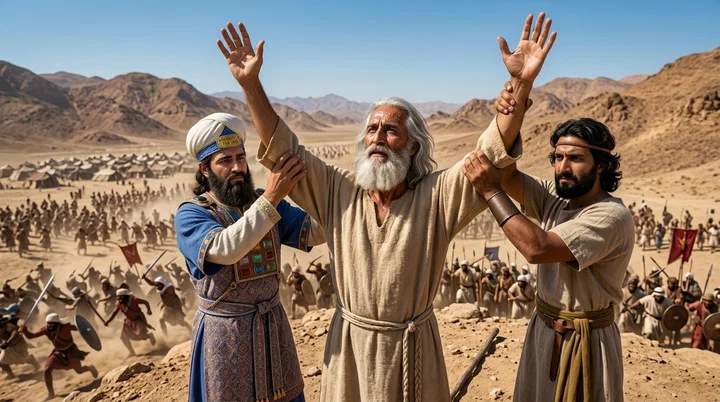
Israel prevailed while Moses held his hands stretched toward heaven holding God's rod, and Amalek prevailed when his hands fell from weariness.SG3 257.1–258.24T 530.3–531.21SP 229.1GW92 31.3–32.2PP 299.1–2 Aaron and Hur stayed up his hands, with Aaron helping, until the enemy was put to flight and Israel won.SG3 257.1–258.24T 530.3–531.2GW92 31.3–32.2PP 299.1–2PP 425.4 Moses sent Joshua and the soldiers to meet the enemy, and Israel's prevailing rose and fell with Moses' uplifted hands toward heaven.2T 107.14T 530.3–531.2GW92 31.3–32.2
Those uplifted hands represented Israel's trust in, dependence on, and prayer to the living God.Ms 125, 1909, par. 6–10SG3 257.1–258.21SP 229.1PP 299.1–2 They revealed even to enemies and onlookers that Israel's help, strength, destiny, and victory were in God and not in Moses, his rod, or human power.2T 107.1PP 299.1–2Ms 179, 1901, par. 9–10 Jesus Christ was their leader guiding them in the pillar of cloud, God fought for His people, and the victory was given by the angels of God.Ms 125, 1909, par. 6–10SG3 257.1–258.24T 530.3–531.2Ms 179, 1901, par. 9–10
Divine strength worked together with human effort, for while Moses prayed and interceded above, Joshua and his men actively fought below and did their best.4T 530.3–531.2GW92 31.3–32.2PP 299.1–2 God's people must therefore use their available means, do their part, and press the battle to the gate as though having something to do.4T 530.3–531.2PP 299.1–2Ms 179, 1901, par. 9–10 Aaron and Hur's support of Moses' hands showed the people's duty to sustain him as he received God's word.PP 299.1–2
Lessons for Believers
The battle with Amalek was a test of trust in God, who was guiding Israel in the pillar of cloud and leading them through the wilderness under Jesus Christ as their leader, and Israel was to follow His directions and depend on Him rather than treat its journey as chance.Ms 125, 1909, par. 6–10 Moses kept his hands stretched toward heaven holding the sign of trust in the living God, and as long as they were stretched upward the enemies were driven back and Israel obtained the victory.Ms 125, 1909, par. 6–10Ms 179, 1901, par. 9–10 His uplifted hands revealed even to the enemies and to all around that Israel's help and strength were in God, and while looking to God in this way Israel had strength of vitality and strength of power.Ms 179, 1901, par. 9–10 The victory was given by the angels of God, principalities and powers, showing that believers are not kept by their own power and can be led, guided, and brought through difficulty only by looking to Him if they expect to overcome their enemies, gain victory, or be translated.Ms 125, 1909, par. 6–10Ms 179, 1901, par. 9–10 No one is to take glory to self, but to look to God and trust in God continually while still pressing the battle to the gate as though having something to do, showing as those under the banner of Prince Emmanuel that power is granted to overcome all corruptions in the world through lust by being partakers of the divine nature.Ms 179, 1901, par. 9–10
The battle was won by intercessory prayer, for Moses holding up his hands toward heaven was praying for Israel's success.Ms 75, 1903, par. 17 Israel prevailed while his hands reached upward but the enemy prevailed when his hands were lowered from weariness.Ms 75, 1903, par. 17 When Moses grew weary Aaron and Hur stayed up his hands until the enemy was put to flight.Ms 75, 1903, par. 17 So God's workers who go into the harvest field succeed when those who remain at home hold up their hands by prayer, and this supporting prayer must not be neglected.Ms 75, 1903, par. 17
Amalek's attack was a crime because it struck when the people were weak and weary and took advantage of their vulnerability to trouble, confuse, and discourage them.2T 109.1 Watching for the weaknesses, failures, and sins of God's afflicted people in order to expose them to their enemies does the same work of troubling, confusing, and discouraging the weak, weary, and afflicted.2T 109.1 Doing so is Satan's work, not God's.2T 109.1
Sources
Pioneers and periodicals
30 sources
Amalek attacked Israel at Rephidim on the wilderness journey toward Canaan after provision of manna and water from the smitten rock and before reaching Sinai.ST Nov 7, 1895 The assault was unprovoked and treacherous, falling upon the faint and weary stragglers at the rear of the marching column by a bitter idolatrous kinsman descended from Esau.ST Apr 15, 1880ST Aug 24, 1882ST Feb 11, 1913ST Apr 23, 1902ST Apr 30, 1902 Joshua led the fighting men in the valley while Moses stood on the hill with Aaron and Hur, and Israel prevailed while his hands and rod were held up in trust and prayer but lost ground when they sank, until his arms were supported to sunset and Amalek was overthrown.ST Apr 15, 1880ST Oct 7, 1897 The attack was treated as opposition to the Lord and His throne, bringing a sworn war from generation to generation until the remembrance of Amalek should be utterly blotted out from under heaven.ST Jan 20, 1909RH Sep 15, 1874ST Apr 30, 1902ST May 23, 1911 Its place in the record from Exodus 16-19 shows the Sabbath already understood and binding a month before Sinai, and its battle teaches dependence on God in answer to prayer, with Moses mediating like Jesus interceding in heaven while Amalek represents constant assaults of temptation upon the heart.ST May 17, 1883RH Jan 12, 1860RH Oct 21, 1851RH Feb 19, 1861
Setting and Battle Course
Amalek came and fought with Israel in Rephidim during the wilderness journey from Egypt toward Canaan, after provision had been made for guidance and sustenance with manna and water from the smitten rock.RH Sep 15, 1874 It was the same place where Israel lacked water and murmured against Moses over that lack.ST Apr 15, 1880ST Nov 7, 1895 The battle stands in the itinerary after the Wilderness of Sin and at Rephidim before Israel continued on to the desert of Sinai.ST Apr 23, 1902RH Oct 21, 1851 The Lord was with Israel in the wars they met on the way, and this encounter displayed His sovereign power over the nations met on the way.ST Feb 11, 1913ST Aug 31, 1888
Amalek was a bitter foe and an idolatrous people, descended from Esau, who first attacked Israel soon after the exodus.ST Aug 24, 1882ST Feb 11, 1913ST Feb 25, 1889 As kinsmen they should have helped their Israelite relatives instead of attacking them.ST Feb 25, 1889 They may have acted from resentment over Jacob's birthright and blessing, and because the Israelites were camped in territory the Amalekites regarded as their own.ST Apr 15, 1880ST Feb 25, 1889 The attack was unprovoked and treacherous, an ambush of the marching column that cruelly struck the rear where the weak, feeble, faint, exhausted and weary had fallen behind.ST Aug 24, 1882ST Apr 23, 1902ST Apr 30, 1902ST Feb 9, 1915 Israel's murmuring against God had also brought this conflict upon them.ST Apr 15, 1880
Joshua first appears here as leader of the fighting men under Moses, leading the Israelite forces in the valley and on the plain while Moses stood on a hill with Aaron and Hur.ST Jun 18, 1885RH Sep 14, 1916 Israel prevailed while Moses held up his hands and his rod in trust in God's help and in prayer, but Amalek prevailed when weariness let them fall and Israel relied on human strength.ST Apr 15, 1880RH Dec 7, 1911 Aaron and Hur supported Moses' arms until sunset, and then Amalek was defeated, fled, and overthrown.ST Apr 15, 1880ST Jun 18, 1885 The battle belonged to the Lord, who approved the work of both Moses and Joshua. The work was divided between physical and spiritual duty, with Joshua wielding the sword below and Moses holding the rod above as mediator for Israel.ST Jul 19, 1883RH Feb 19, 1861 Joshua's hand never grew weary with the sword, but Moses' hand grew weary holding the rod, showing that the more spiritual the duty the more apt people are to tire of it.ST Jul 19, 1883
Aaron and Hur acted as Moses' chief assistants and supporters in the battle, and for that reason were fitting deputies when Moses was absent.ST Mar 25, 1889ST Oct 7, 1897 Aaron was of the tribe of Levi, in which the priesthood was vested and which belonged to God, so he stood as chief priest.ST Mar 25, 1889 Hur was probably the chief prince of the tribe of Judah, an eminent and good man, and Judah was the tribe of the royal line and of the Saviour, so he stood as chief prince.ST Mar 25, 1889 His descendants included the skillful man chosen to build the most sacred vessels.ST Mar 25, 1889
Judgment Against Amalek Declared
The same chapter that records the attack at Rephidim also holds a prophecy concerning Amalek.ST Jan 20, 1909 The assault on Israel was treated as opposition to the Lord and His people, His work, and His throne and authority established among Israel and displayed in bringing them out of Egypt.ST Aug 24, 1882ST Apr 30, 1902
God commanded that the judgment against Amalek be recorded and told to Joshua, and Moses memorialized it in the altar named The Lord my banner as a sign that the Lord would lead His people against Amalek.ST Apr 30, 1902ST May 23, 1911 The promise was of sworn war with Amalek from generation to generation until the remembrance of Amalek is utterly blotted out from under heaven.RH Sep 15, 1874ST Apr 30, 1902ST May 23, 1911 That blotting out means not scattering among the nations nor mere abasement but complete extinction, with the last of the nation ceasing from the earth.RH Sep 15, 1874
Amalek's cruelty toward kindred was a greater sin and brought the sentence of utter destruction.ST Feb 25, 1889 God determined to vindicate His authority and to make the judgment a warning to future generations.ST Aug 24, 1882 The promise of continuing war gave His people grounds for confidence in deliverance.ST Apr 30, 1902
After the attack God granted the Amalekites four hundred years to seek Him and make matters right, until they filled the cup of iniquity and became a curse to themselves and a menace to surrounding nations.ST Feb 9, 1915 The later command to Saul to destroy them utterly was love, to prevent the eternal destruction of many souls through their baneful influence, slaying hundreds to save thousands.ST Feb 9, 1915
The sworn war was fulfilled through continued conflict in which a remnant survived for a time.RH Sep 15, 1874 David defeated them on several occasions, and they were finally blotted out by the Simeonites in the time of Hezekiah.RH Sep 15, 1874 This attack began the Amalekites' treacherous hostility toward Israel, which Saul's later destruction answered, and Haman, described as a descendant of King Agag and the last of the race mentioned in Scripture, continued that same hostility and perished in conflict with the Jews when God overruled his plot and brought salvation.ST Apr 23, 1902RH Sep 15, 1874
Sabbath Proof and Christian Lessons
Exodus 17:8 stands in the wilderness record of Exodus 16-19 that proves the Sabbath was already understood and binding thirty days, or one month, before Israel reached Mount Sinai.ST May 17, 1883RH Jan 12, 1860RH Oct 21, 1851 It comes after the giving of manna in the Wilderness of Sin on the fifteenth day of the second month, when a double portion was gathered on the sixth day for the sixth day and the Sabbath that followed, when the seventh day was kept as the rest of the holy Sabbath unto the Lord with none to gather, and when those who went out to gather were reproved by Jehovah for refusing to keep His commandments and laws.ST May 17, 1883 Its place in the itinerary, with Israel traveling to Rephidim before continuing to the desert of Sinai and before coming to the mount from which the Ten Commandments were proclaimed, proves the Sabbath was not first instituted at Sinai.ST May 17, 1883RH Oct 21, 1851
The words madest known in Nehemiah therefore do not mean the Sabbath was first revealed at Sinai but mean its special promulgation by the voice of God with the other nine commandments.ST May 17, 1883RH Jan 12, 1860 The passage gives one of the memorials of the Bible that begin with the events commemorated by them, establishing the rule that a memorial starts with its event, so the Sabbath which commemorates Creation must have been instituted at Creation and not in the wilderness of Sin.RH Feb 3, 1852
Israel's victory while Moses held up his hands and defeat when through weariness they sank illustrates dependence on the Lord rather than human strength, with trust in God's help bringing prevailing and reliance on human strength bringing faltering.ST Apr 15, 1880RH Dec 7, 1911 The outcome turned on sustained prayer, showing that God works in answer to prayer and that continued prayerful support is needed in spiritual conflict.RH Dec 7, 1911RH Mar 30, 1911RH Nov 9, 1911 Aaron and Hur supported Moses' arms until sunset while Joshua led the fighting men below, so that faith, effort, united reliance on God, and works with the Lord's help bring victory, even in work such as gathering children into the Sabbath school where difficulties need not stop the work.ST Apr 15, 1880ST Jul 8, 1880
Moses acting as mediator for Israel in that conflict is compared with Jesus interceding in heaven while His people are engaged in spiritual warfare.RH Feb 19, 1861 The Amalekites represent assaults of temptation threatening to overrun and destroy spiritual life and the constant attacks in keeping the heart free from sin.RH Oct 2, 1856ST Apr 14, 1914ST Jul 20, 1904 Keeping watch over the heart is a constant work never done till life is ended, with no time or condition in a Christian's life suffering an intermission, for even intermitting the watch for a few minutes lets corruption break loose and prevail at cost of many sad days and nights as with David and Peter.RH Oct 2, 1856 These battles need not defeat or discourage the believer but can drive the Christian to Jesus Christ for victory.ST Apr 14, 1914ST Jul 20, 1904
The verse supplies a figurative use of the name Amalekite for an alien or opponent of the people of God, as one who fights Israel.RH Dec 9, 1858
Sources