Exodus 15:8
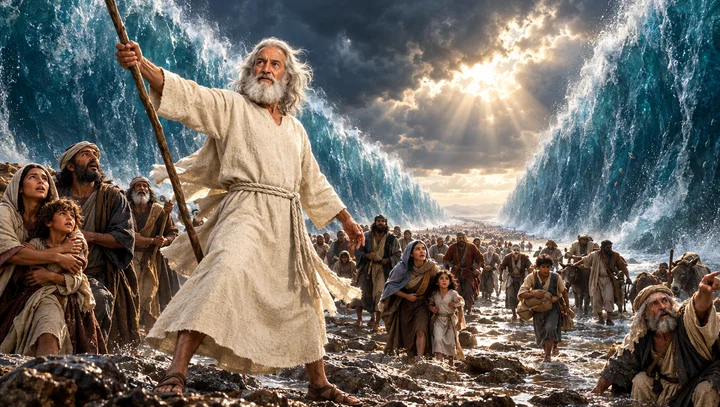
And with the blast of thy nostrils the waters were gathered together, the floods stood upright as an heap, and the depths were congealed in the heart of the sea.
Translations
And with the blast of your nostrils the waters were gathered together, the floods stood upright as an heap, and the depths were congealed in the heart of the sea.
And with the blast of thy nostrils the waters were gathered together, the floods stood upright as an heap, and the depths were congealed in the heart of the sea.
And with the blast of thy nostrils the waters were gathered together,
The floods stood upright as a heap,
And the depths were congealed in the heart of the sea.And with the blast of thy nostrils the waters were collected, the floods stood upright as a heap, and the depths were congealed in the heart of the sea.
And with the blast of thy nostrils the waters were piled up, The floods stood upright as an heap; The deeps were congealed in the heart of the sea.
And with the blast of thy nostrils the waters were piled up,
The floods stood upright as a heap;
The deeps were congealed in the heart of the sea.And by the spirit of Thine anger Have waters been heaped together; Stood as a heap have flowings; Congealed have been depths In the heart of a sea.
And by the breath of thy nostrils the waters were heaped up; The streams stood as a mound; The depths were congealed in the heart of the sea.
And with the blast of thy nostrils, heaped up are the waters, Upreared like a mound, are the flowing waves,—Roaring deeps are congealed in the heart of the sea.
Berean Standard Bible, Majority Standard Bible
At the blast of Your nostrils
the waters piled up;
like a wall the currents stood firm;
the depths congealed in the heart of the sea.With the blast of your nostrils, the waters were piled up.
The floods stood upright as a heap.
The deeps were congealed in the heart of the sea.By your breath the waves were massed together, the flowing waters were lifted up like a pillar; the deep waters became solid in the heart of the sea.
And by the blast of thy nostrels the waters were gathered, the floods stoode still as an heape, the depthes congealed together in the heart of the Sea.
Douay-Rheims (Challoner revision)
And with the blast of thy anger the waters were gathered together: the flowing water stood, the depth were gathered together in the midst of the sea.
Pictures
Cross-references 20 of 23
- Exodus 14:21-22
And Moses stretched out his hand over the sea; and the LORD caused the sea to go back by a strong east wind all that night, and made the sea dry land, and the waters were divided.
The wind divides the sea, piling up the waters as Israel crosses on dry ground.
- Revelation 15:3
And they sing the song of Moses the servant of God, and the song of the Lamb, saying, Great and marvellous are thy works, Lord God Almighty; just and true are thy ways, thou King of saints.
The victorious sing Moses’ song of deliverance alongside the song of the Lamb.
- Exodus 14:27-28
And Moses stretched forth his hand over the sea, and the sea returned to his strength when the morning appeared; and the Egyptians fled against it; and the LORD overthrew the Egyptians in the midst of the sea.
The returning waters overwhelm and bury the Egyptian army.
- Hebrews 11:29
By faith they passed through the Red sea as by dry land: which the Egyptians assaying to do were drowned.
Israel crossed the Red Sea by faith.
- Exodus 14:15-16
And the LORD said unto Moses, Wherefore criest thou unto me? speak unto the children of Israel, that they go forward:
God commands Israel to go forward as he divides the sea for their passage.
- Psalms 78:13
He divided the sea, and caused them to pass through; and he made the waters to stand as an heap.
Both describe God dividing the sea and making its waters stand as a heap.
- Psalms 33:7
He gathereth the waters of the sea together as an heap: he layeth up the depth in storehouses.
Describes God gathering the sea waters into a heap and storing the depths.
- Exodus 14:30-31
Thus the LORD saved Israel that day out of the hand of the Egyptians; and Israel saw the Egyptians dead upon the sea shore.
Israel’s rescue and the Egyptians’ defeat precede the song.
- Joshua 3:16
That the waters which came down from above stood and rose up upon an heap very far from the city Adam, that is beside Zaretan: and those that came down toward the sea of the plain, even the salt sea, failed, and were cut off: and the people passed over right against Jericho.
Jordan stands like a wall like the sea
- Exodus 14:13
And Moses said unto the people, Fear ye not, stand still, and see the salvation of the LORD, which he will shew to you to day: for the Egyptians whom ye have seen to day, ye shall see them again no more for ever.
Moses urged Israel to trust God before the sea crossing.
- 2 Samuel 22:16
And the channels of the sea appeared, the foundations of the world were discovered, at the rebuking of the LORD, at the blast of the breath of his nostrils.
parallel word likewise rendered blast
- Psalms 66:6
He turned the sea into dry land: they went through the flood on foot: there did we rejoice in him.
Recalls God turning the sea into dry land.
- Exodus 14:16
But lift thou up thy rod, and stretch out thine hand over the sea, and divide it: and the children of Israel shall go on dry ground through the midst of the sea.
Moses divides the sea so Israel can cross on dry ground.
- Exodus 14:23-25
And the Egyptians pursued, and went in after them to the midst of the sea, even all Pharaoh’s horses, his chariots, and his horsemen.
God disables the pursuing Egyptians’ chariots as they enter the sea.
- Exodus 14:29
But the children of Israel walked upon dry land in the midst of the sea; and the waters were a wall unto them on their right hand, and on their left.
Recounts Israel’s passage through the sea.
- Exodus 15:1
Then sang Moses and the children of Israel this song unto the LORD, and spake, saying, I will sing unto the LORD, for he hath triumphed gloriously: the horse and his rider hath he thrown into the sea.
The song praises God’s triumph over Egypt at the sea.
- Psalms 77:19-20
Thy way is in the sea, and thy path in the great waters, and thy footsteps are not known.
God makes a path through the sea and leads Israel to safety.
- Exodus 15:20-21
And Miriam the prophetess, the sister of Aaron, took a timbrel in her hand; and all the women went out after her with timbrels and with dances.
Miriam leads the women’s rejoicing after the crossing.
- Jonah 2:5
The waters compassed me about, even to the soul: the depth closed me round about, the weeds were wrapped about my head.
Cited alongside Exodus 15:8 for the biblical use of “depths” for the sea.
- Psalms 107:29
He maketh the storm a calm, so that the waves thereof are still.
God commands raging waters to become calm.
Commentary
Each commentary is drawn from primary sources: the writings of Ellen G. White and Adventist pioneers and periodicals. Each commentary is separate. Its own words are not a quotation; follow the references to read the source passages.
Ellen G. White
14 sources
With the blast of His nostrils God by His own command and power over nature gathered the waters together into heaps that stood upright like walls, and made the depths firm and still and congealed in the heart of the sea.PP 287.5–288.1Ms 38, 1898, par. 19Lt 134, 1910, par. 12–14 That gathering opened a path through the midst of the sea so Israel could pass on dry ground, with the waters held back from overflowing the passage until the whole vast company had crossed safely without loss.PP 287.5–288.1Ms 38, 1898, par. 19Lt 134, 1910, par. 12–14 The same divided sea became the means of overwhelming and destroying Pharaoh's pursuing Egyptian army when its piled-up walls rushed together upon them.PP 287.5–288.1Ms 38, 1898, par. 19Lt 49a, 1896, par. 2–4 The verse belongs to the song of triumph and grateful praise sung by the whole host of Israel with voices ringing out over the waters after the Lord led them to the sea, parted it, and delivered them.Ms 125, 1909, par. 14–16Lt 49a, 1896, par. 2–4SG3 236.1–238.1 As an act of God it gives reason to praise Him and to trust Him for deliverance, and it was formed into song by God's command so the people would teach its history to their children and remember His power and care, with their united singing lifting their thoughts above trial, calming the restless spirit, strengthening faith, and bringing them into closer touch with God and with one another.PP 287.5–288.1Lt 134, 1910, par. 12–14ST Nov 2, 1915Lt 33, 1890, par. 7–9
God Divides the Sea
The blast of the nostrils is God's command and His power over nature, by which the waters of the Red Sea were gathered together into heaps.PP 287.5–288.1Ms 38, 1898, par. 19Lt 134, 1910, par. 12–14ED 162.1SG3 236.1–238.1 At that command the floods stood upright as a heap, rising like walls on either hand, and the depths were made firm and still and congealed in the heart of the sea.PP 287.5–288.1Ms 38, 1898, par. 19Lt 134, 1910, par. 12–14ED 162.1SG3 236.1–238.1 The sea was thus held back by miracle so that its waters stood like walls and did not overflow the passage.PP 287.5–288.1Ms 38, 1898, par. 19Lt 134, 1910, par. 12–14Ms 21, 1897, par. 12–15
That gathering opened a path so that Israel could pass through on dry ground, with the depths held back in the middle of the sea until the people had passed.PP 287.5–288.1Ms 38, 1898, par. 19Lt 134, 1910, par. 12–14Ms 21, 1897, par. 12–15ST Apr 1, 1880 The whole vast company crossed safely without loss, kept from the waters on either side while the way remained open for them.PP 287.5–288.1Ms 38, 1898, par. 19Ms 21, 1897, par. 12–15Ms 21, 1897, par. 16–17 While they passed, the angelic host was on the field of battle with them.PP 287.5–288.1Ms 21, 1897, par. 16–17
The same divided sea became the means of overwhelming the pursuing Egyptian army of Pharaoh.PP 287.5–288.1Ms 38, 1898, par. 19SG3 236.1–238.11SP 210.1–212.1ST Apr 1, 1880 Its piled-up walls rushed together upon the pursuers and destroyed them, so that Israel escaped while their enemies were overcome and drowned.Ms 38, 1898, par. 19Lt 49a, 1896, par. 2–4SG3 236.1–238.11SP 210.1–212.1ST Apr 1, 1880
Song of Triumph Remembered
Exodus 15:8 belongs to the song of triumph and grateful praise sung by the whole host of Israel after the Lord led them to the sea, parted it, and delivered them from Pharaoh's army.Ms 125, 1909, par. 14–16SG3 236.1–238.1ST Nov 2, 1915Ms 21, 1897, par. 16–17ST Feb 27, 1896 That song, recorded in Exodus 15:1-21, gave glory to God for His power and help on their behalf, with the people's voices ringing out over the waters in praise of their deliverance through the Red Sea and the drowning of the pursuing army.Ms 125, 1909, par. 14–16Lt 49a, 1896, par. 2–4SG3 236.1–238.1ST Feb 27, 1896 It was sung after God opened a path through the sea for Israel's escape and then brought its piled waters down upon the Egyptians to destroy them, while the angelic host was on the field of battle.SG3 236.1–238.1Ms 21, 1897, par. 16–17ST Feb 27, 1896 The division of the sea set forth in the verse is thus an act of God that led Israel to praise Him and gives reason to trust Him for deliverance.PP 287.5–288.1Lt 134, 1910, par. 12–14 At His command the waters gathered into walls and heaps, the depths stood firm and held back in the heart of the sea, the way opened for Israel to pass through on dry ground, and the pursuing army was overwhelmed.PP 287.5–288.1Lt 134, 1910, par. 12–14
Moses was commanded to form this deliverance into the song of Exodus 15 so the people could teach its history to their children and remember God's power and care.Lt 33, 1890, par. 7–9 God used that song to fix precious lessons in their minds for the journey through the wilderness.ST Nov 2, 1915 Singing it lifted their thoughts above the trials and difficulties of the way, soothed and calmed the restless, turbulent spirit, implanted principles of truth in the memory, and strengthened faith.ST Nov 2, 1915 Joining voices together in praise while keeping step to instrumental music taught order and unity and brought the people into closer touch with God and with one another.ST Nov 2, 1915
Sources
Pioneers and periodicals
70 sources
With the powerful blowing of his breath God gathered the sea together and made the water stand upright like a heap on either side, hardening the depths in the middle of the sea into firm walls that held back while Israel crossed on dry ground.ST Feb 11, 1889RH Feb 13, 1913RH Sep 8, 1904ST Jan 20, 1909RH Sep 8, 1904 It was a direct act of his mighty power in nature, holding back water from seeking its level to open a path and then letting it return to destroy Pharaoh's pursuing army.ST Jul 30, 1894RH Oct 7, 1902RH Jan 15, 1914 The sea opened only as his people obeyed and went forward in faith, and that faith is what makes unstable water stand like a solid wall.RH Sep 8, 1904RH Feb 24, 1916RH Oct 15, 1903RH Sep 8, 1904 That deliverance from the strongest earthly power of the time is a type of the final deliverance of God's people, when the redeemed will sing the song of Moses and the Lamb over the beast and all earthly foes.STST Nov 8, 1899RH Feb 10, 1859RH Dec 21, 1869ST Jan 30, 1912 As Moses trusted God before the sea opened as well as after, God's people now can trust him and sing of victory even while the conflict still looks hopeless.RH Apr 20, 1911ST Jun 23, 1898RH May 18, 1876RH Feb 24, 1916ST Nov 29, 1905
Setting in the Song
The verse belongs to the song of Moses in Exodus 15:1-21, which celebrates the march to the Red Sea, the miraculous crossing on dry ground, and the destruction of Pharaoh's host and the Egyptian army.RH Apr 20, 1911ST Oct 11, 1899ST Feb 4, 1913ST Jul 13, 1915 It is Israel's song of deliverance and triumph after being brought through the sea, recalling how the waters were held back as a heap and the depths stood firm while Israel crossed safely and the returning waters buried the Egyptians.ST Oct 11, 1899ST Feb 4, 1913ST Jul 13, 1915ST Dec 18, 1901 The song came after deliverance, though the victory had been just as certain before it occurred, and it stands as a tribute of praise to the Lord for delivering Israel from bondage.RH Apr 20, 1911ST Dec 18, 1901
It was sung in triumph on the farther shore after Israel went through the sea, following the first Passover and the leading by fire and by cloud.RH Jan 20, 1916ST Jan 30, 1912RH Dec 31, 1861 It stands at the end of the passage from oppression and bondage, with the whole power of Egypt set against them, to deliverance, showing a mighty work in saving a nation such as was never done for any other nation.ST Jan 30, 1912RH Dec 31, 1861 At God's command Moses stretched out his rod, the water divided, Israel crossed through, and Pharaoh and his host trying to follow were lost, celebrating deliverance from hard bondage and coming out with spoil.RH Dec 31, 1861ST May 26, 1914 The foretold emancipation was fulfilled when the appointed cloud moved, the tribes marched, and the sea retired before God's word to break servitude and lead them with a high hand and outstretched arm to a land flowing with milk and honey.RH Dec 31, 1861ST May 26, 1914 Israel had been hemmed in by sea, mountains and Egyptians with every avenue closed, yet commanded to go forward until the dark sea divided, and what happened was written for learning so that the same dividing of the sea and the same song of victory on the other shore belong to those who now rise up and go forward.RH Dec 31, 1861RH Feb 25, 1875
The song exalts Jehovah the true God, crediting Him with rescue from the Egyptians as Moses and Miriam sang with Israel in remembrance of His works.ST Jul 28, 1909ST Aug 31, 1888RH Apr 24, 1900 It recounts His deliverance at the Red Sea and praises His justice, faithfulness and love as a song of thanksgiving and praise for deliverance from bondage.ST Mar 10, 1881ST Aug 31, 1888RH Apr 24, 1900 It celebrates complete deliverance from earthly foes, enslavement and oppression by the strongest earthly power of the time.ST Aug 22, 1911RH May 8, 1916ST Jan 25, 1910 It is a triumph poem over Pharaoh's pursuing forces and their experience of rescue from wicked men who sought to destroy them, recording wonderful deliverance from earthly power.ST Jan 18, 1916ST Jan 25, 1910ST Jan 24, 1911 That deliverance from earthly power is distinct from victory over sin, which Israel did not attain by escape from Egypt.ST Aug 22, 1911
The verse belongs to the history part of Exodus, chapters 1 to 18, which tells Israel's great deliverance from bitter bondage where the family settled in Genesis had grown mightier than the Egyptians.RH Jan 20, 1916 It shows how they became a nation with organization, leadership, laws and worship under Moses, whose life from rescue in infancy through work as chosen leader is of absorbing interest, and the name Exodus means going out and refers to the departure from Egypt.RH Jan 20, 1916 The song is called the Song of Moses because it expresses the experience and faith of Moses rather than the mass of Israel.ST Jul 21, 1898 Moses believed God before the sea opened and on both sides of the sea, so he could be trusted with the message to go forward, while Israel joined only after the trial was over, which was sight and not faith, and it can be made the believer's own by living faith that believes before the passage as well as sings after the danger is past.ST Jul 21, 1898
The song was sung not by Moses and Miriam alone but by Moses and Miriam with all the hosts and the whole host of Israel in thanksgiving after safe passage.RH Jan 9, 1908RH Jan 21, 1875RH Mar 25, 1873 Moses in humility gave God the glory, after bidding the people stand still and see the salvation of the Lord when pursued with no visible means of escape, and after safe passage joining them in singing deliverance to God.RH Dec 17, 1901RH Mar 25, 1873 It shows a special occasion of joy following great trouble and danger when God delivers His people, praising God for triumphing over the Egyptian army after they were destroyed.RH Dec 17, 1901RH Jan 21, 1875 The whole host sang aloud with joyful noise so loudly that desert and sea rang and mountains re-echoed that Jehovah hath triumphed gloriously.RH Jan 9, 1908 It was repeated often on the wilderness journey to cheer hearts and kindle faith, bidding God's children today to gladden their pilgrim life by sacred song.RH Jan 9, 1908
Words and Waters
The word rendered blast is the Hebrew roo-agh or roo-ogh, which has more than one sense, such as wind, breath, spirit, smell, mind and air, and does not denote an immaterial immortal part of man.ST Mar 14, 1878ST Feb 13, 1879RH Sep 1, 1859 In this verse it denotes a powerful blowing, the wind or breath of God's nostrils.ST Mar 14, 1878RH Sep 1, 1859 The depths are the sea or ocean.RH Oct 3, 1871
By the blast of His nostrils the waters were gathered together, the floods stood upright as a heap, and the depths were congealed in the heart of the sea.ST Feb 11, 1889RH Feb 13, 1913ST Jan 20, 1909 They formed walls on either side of the crossing as God opened a dry path and held the waters in place by His power while Israel passed through.ST Apr 1, 1880ST Feb 11, 1889RH Feb 13, 1913ST Jan 20, 1909ST Jul 18, 1916 The depths became solid and the waters piled up like walls like ice, protecting Israel as they passed through on dry land.RH Sep 8, 1904RH Sep 8, 1904 They were held back firm in the middle of the sea until the people had passed, and then rushed together to overwhelm the pursuing army.ST Apr 1, 1880RH Sep 8, 1904
The wind that gathers the waters is the direct working of God in nature, showing that the forces and events of the visible world reveal His power.RH Oct 7, 1902 He congealed the waters by His word and by a mighty wind beyond the ordinary workings of nature, gathering them to overwhelm His people's enemies.RH Jan 15, 1914RH May 19, 1910 The power of God's word piled the waters upright as a heap on either side of the marching hosts, holding them back from seeking the level that water continually seeks. It is the same power that gathered the creation waters to one place and that still holds the ocean piled up by decree, and when withdrawn the waters sought their former place and drowned the Egyptians.
How the waters were hardened, thickened or congealed is not known.ST Feb 11, 1889ST Feb 11, 1889 The width of the sea at the crossing is generally held to have been eight to twelve miles.ST Feb 11, 1889 The image of waters standing in a heap forming a passage supplies a picture for imagining the Atlantic held back to expose the remains of enslaved Africans who died during the forced passage across the ocean.ST Apr 29, 1875
Divine Power and Faith
The blast of God's nostrils gathered the waters and made them stand as a heap with the depths congealed in the heart of the sea, opening the Red Sea by wondrous and mighty power to deliver His people from Egypt while the Egyptians were destroyed and Pharaoh's pursuing army sank below, showing His justice and the truth of what He had foretold through Moses.ST Jul 30, 1894 That saving of Israel was a mighty work with creative power made manifest over again, such a work in saving a nation as was never done for any other nation, shielding Israel while He plagued the Egyptians in fulfillment of the promise to Abraham.ST Jan 30, 1912ST Feb 25, 1886RH Apr 3, 1879 The God who held back that raging flood and made it stand upright still helps people who are helpless.RH May 18, 1876 He gives hope and courage to all who are afflicted that He can open the most difficult way when escape to the mountains or defeat of enemies or fording the sea is impossible.RH Feb 24, 1916
The sea parted only when God's people obeyed His command to go forward in faith and trusted in Jehovah and moved forward.RH Sep 8, 1904RH Feb 24, 1916RH Sep 8, 1904 Then the sea that would otherwise have destroyed them became a way through and a protection, their difficulties vanished and their enemies suffered defeat, after which they praised God for blessings received.RH Sep 8, 1904RH Feb 24, 1916RH Sep 8, 1904 Faith was the human factor that made the unstable water stand like a solid wall.RH Oct 15, 1903 Faith trusts God regardless of outward appearances and produces steady progress rather than mere commotion.RH Oct 15, 1903
Israel's victory was just as certain before deliverance as after, so the song could have been sung in faith while still on the enemy's land and on the nearer shore before the waters opened just as truly as on the farther shore after they closed.RH Apr 20, 1911ST Nov 29, 1905ST Nov 29, 1905 Moses could sing because he trusted God before deliverance as well as after, teaching that God's people can trust Him and sing of victory even in apparently hopeless conflict and will sing again after final deliverance.RH Apr 20, 1911ST Jun 23, 1898 The opening of the sea was a pledge that God would fulfill every promise and a sign that He could deliver His people when they had no human help.RH Feb 24, 1916ST Feb 11, 1889 Conditions make no difference with God, who can overrule in all conditions to bring victory to those loyal to Him to His honor and glory, so faithfulness in trial gives Him a chance to act, and the greater the trial or affliction the greater the opportunity for God to bring glory to His holy name and for His people to gain wonderful victory.RH Feb 24, 1916
That deliverance showed that the God who divided the sea could also provide water and other necessities in the wilderness, so Israel's later complaints, lament at the spies' report about falling by the sword, question whether to return to Egypt, reproach of Moses for taking them away to die for lack of graves, restiveness over water and supplies, and soon forgetting His works showed failure to remember His power and trust His care.ST Aug 13, 1902ST Feb 25, 1886RH Apr 3, 1879RH Jan 21, 1875 That joyful praise at the overthrow of Pharaoh should have continued in praising God and praying for help, but becoming restive, fretful, and murmuring at the dreary prospect, want of water, and poor prospect for supplies shows that a joyful spirit in God's service prevents reaction and backsliding, while weariness and languor in God's work precede apostasy ending in dislike.RH Jan 21, 1875 The generation that joined in that song of deliverance after the Egyptian hosts were overthrown later died in the wilderness, except Caleb and Joshua, who fully followed the Lord.RH May 7, 1872
Prophecy of Final Victory
Israel's deliverance from Egypt is a type of God's people being delivered from the dark Egypt of earth, celebrated in the triumphal song sung after deliverance from Egypt, and that song serves as a type of the final deliverance of God's people.STST Nov 8, 1899 The song of Moses does not belong to the Jewish people alone but points forward to the final victory, when the Israel of God will sing not only the song of Moses but the song of the Lamb.ST Feb 4, 1903 Those who will sing that song of triumph then must learn to sing it now, for it is the song celebrating redemption completed, to be sung together with the song of the Lamb when Christ comes to redeem His people.ST Feb 4, 1903ST Mar 31, 1887
Its pattern points to a future deliverance from the beast's power and from persecutors, when the redeemed will sing a similar song of victory called the song of Moses and the Lamb.RH Feb 10, 1859RH Dec 21, 1869 That coming song will celebrate deliverance from earthly foes and from sin, just as the song of Moses celebrated triumph over earthly foes at the sea.RH Feb 10, 1859ST Jan 30, 1912 As Moses and Israel sang after complete victory over Pharaoh, who demanded their service and refused God's command to let Israel go to serve Him, so those who overcome the beast will be delivered after long warfare.RH Sep 29, 1863 That warfare with Pharaoh brought ten plagues of wrath upon Egypt, then pursuit with soldiers into the midst of the sea, overthrow of horse and rider by the returning waters, and safe deliverance for Israel; likewise after hundreds of years of warfare between God and the beast, God will prove Himself the victor, the beast and those who worship him will be cast into the lake of fire burning with brimstone, and the delivered overcomers will sing, Alleluia, the Lord God omnipotent reigneth.RH Sep 29, 1863 The song of exultation over a defeated enemy who sank like lead in the mighty waters will thus be repeated by Israel and the church after God's final judgment and deliverance.RH Sep 29, 1863RH Apr 7, 1863
The song of Moses' own experience and deliverance shows what the song of the 144,000 is: the song of their own experience and deliverance, which no other company can join or learn because no other company has an experience like theirs.RH Nov 18, 1862 The song is prophetic, looking beyond Egypt to Israel being planted in God's sanctuary and removed no more with the Lord reigning forever, to the joyful scenes of Eden restored in Zion fully realized.RH Feb 3, 1853RH Sep 2, 1852 It presents Christ as Israel's invisible and invincible leader, who would have guided them in His strength to His holy habitation and planted them in the mountain of His inheritance where He would reign forever. Had Israel remained faithful, God would have led them from victory to victory until the world was conquered and filled with the knowledge of the Lord.
The foretold emancipation following the Passover, which taught Christ, was fulfilled when the cloud appeared and moved by appointment, the tribes marched, and the sea retired before God's word.ST May 26, 1914 That word broke the bands of servitude and led them with a high hand and an outstretched arm to a land flowing with milk and honey, the ancient home of their fathers, showing that God's word accomplishes what He pleases and prospers in the thing to which He sends it.ST May 26, 1914 The triumph over all earthly foes that God gave to Moses, Christ Jesus will give to those in whom He has first wrought perfect triumph over every inward sin when body and soul and spirit are laid upon His altar and filled with His fullness.ST Jun 23, 1898
Pattern for Worship and Life
The song belongs to the sacred songs of deliverance that cheered the way of Israel, and it gives a pattern for God's children today to lighten pilgrim life by song.RH Sep 3, 1908 Such songs have power to transform lives, so the principles of music should be studied so they are sung with harmony approaching that of the heavenly choirs.RH Sep 3, 1908 The victory song of Moses was sung by the prompting of the Holy Spirit and lifts souls in glorious praise of the Creator. With all the songs of the Bible from Moses to John's closing vision, it is given to shape the praise of God's people on earth, to be followed in manner and spirit rather than copied word for word.
God used the song of triumph sung by the whole host at deliverance from Pharaoh's army to fix precious lessons in their minds through the wilderness journey.ST Nov 2, 1915 Singing it lifted thoughts above trials and difficulties of the way, soothed and calmed the restless turbulent spirit, implanted principles of truth in memory, and strengthened faith.ST Nov 2, 1915 Joining voices together in praise while keeping step to instrumental music taught order and unity and brought the people closer to God and to one another.ST Nov 2, 1915 Thanksgiving like that at the Red Sea is not confined to looking back over the past year but looks forward to far greater things in God's unfailing promises, showing His loving-kindness every morning and His faithfulness every evening.ST Nov 29, 1905ST Nov 29, 1905 That thanksgiving could have been sung in faith on the nearer shore before the waters opened just as truly as on the farther shore after they closed, because the victory of faith is just as sure in prospect as in retrospect.ST Nov 29, 1905ST Nov 29, 1905
Israel's faith and song of triumph could have continued through the obstacles of the pilgrimage, making the journey to Canaan a short succession of victories, and losing that faith and song cost them dearly.ST Sep 17, 1894 The same lesson applies to each person's spiritual pilgrimage.ST Sep 17, 1894 The song marked joy and triumph at God's intervention in bringing them out of Egyptian servitude, though rejoicing in success did not itself show whether they would keep trusting Him in hardship. That joyful praise at the overthrow of Pharaoh and destruction of the Egyptians, when all the hosts praised the Lord, should have continued in praising God and praying for help.RH Jan 21, 1875 Instead Israel soon became restive, fretful and homesick and murmured at the dreary prospect in the desert, the want of water and the poor prospect for supplies, showing that a joyful spirit in God's service prevents reaction and backsliding, while weariness and languor in His work precede and accompany backsliding and apostasy ending in positive dislike.RH Jan 21, 1875
The song records a special occasion of joy following great trouble and danger when God delivers His people after the Egyptians were destroyed.RH Jan 21, 1875 The Red Sea had been a place of danger and darkness, but when God divided it He brought deliverance from Egypt and escape from Pharaoh's pursuing army, and on the far shore Israel sang in triumph in light and safety.RH Aug 21, 1856 What happened was written for learning: hemmed in by sea, mountains and Egyptians with every avenue closed, Israel was commanded to go forward, and as they went forward the dark and forbidding sea divided before them, and deliverance through the divided waters issued in the song of victory on the other shore.RH Feb 25, 1875 The same dividing of the sea and the same song of victory belong to those who now rise up and go forward.RH Feb 25, 1875 That same deliverance means fleeing all bondage to be free in Christ, passing through this world's wilderness of woe under cloud by day and fire by night toward Canaan, with Jordan standing like a wall and Jericho falling, until the morning of eternity.RH Dec 31, 1861
At God's command Moses stretched out his rod, the water divided, Israel crossed through and reached the other shore, Pharaoh and his host trying to follow were lost, and the song celebrates deliverance from hard bondage and coming out with Egypt's spoil.RH Dec 31, 1861 God opened and congealed the sea so His people passed through dry shod, gathering the waters to stand like a heap with the depths held firm so they could cross on dry ground.ST Jul 18, 1916 He lives and reigns unchanged, longing to help His people and give them the victory. His act at the Red Sea proves His power to mightily help in this time of great spiritual dearth and stands recalled as a sign of His power and deliverance.ST Jul 18, 1916
Sources