Exodus 16:18
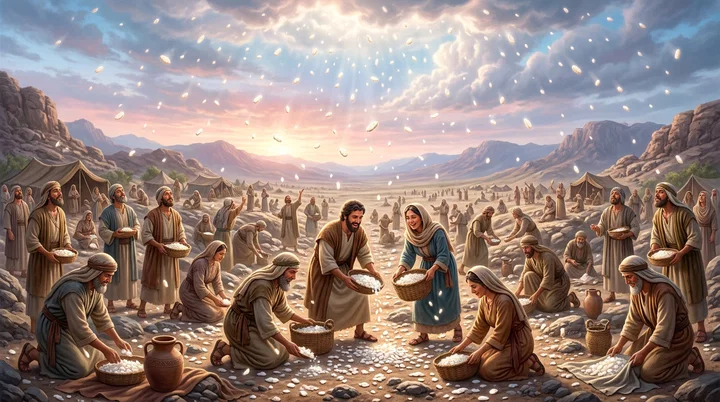
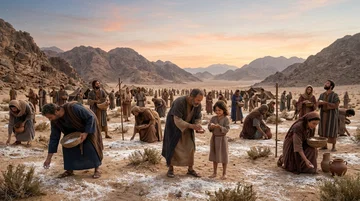
And when they did mete it with an omer, he that gathered much had nothing over, and he that gathered little had no lack; they gathered every man according to his eating.
Translations
American King James Version, King James Version, KJV Cambridge Paragraph Bible, Revised Version
And when they did mete it with an omer, he that gathered much had nothing over, and he that gathered little had no lack; they gathered every man according to his eating.
And when they measured it with an omer, he that gathered much had nothing over, and he that gathered little had no lack: they gathered every man according to his eating.
And when they measured it with an omer, he that gathered much had nothing over, and he that gathered little had no lack; they gathered every man according to his eating.
and they measure with an omer, and he who is [gathering] much hath nothing over, and he who is [gathering] little hath no lack, each according to his eating they have gathered.
And they measured with the omer: then he that gathered much had nothing over, and he that gathered little wanted nothing: they had gathered every man according to the measure of his eating.
and when they measured it with the omer, he who had gathered more had nothing over, and he who had gathered less had no lack: each man what he needed for eating, did they gather.
Berean Standard Bible, Majority Standard Bible
When they measured it by the omer, he who gathered much had no excess, and he who gathered little had no shortfall. Each one gathered as much as he needed to eat.
When they measured it with an omer, he who gathered much had nothing over, and he who gathered little had no lack. They each gathered according to his eating.
And when it was measured, he who had taken up much had nothing over, and he who had little had enough; every man had taken what he was able to make use of.
And when they did measure it with an Omer, hee that had gathered much, had nothing ouer, and he that had gathered litle, had no lacke: so euery man gathered according to his eating.
Douay-Rheims (Challoner revision)
And they measured by the measure of a gomor: neither had he more that had gathered more: nor did he find less that had provided less: but every one had gathered, according to what they were able to eat.
Pictures
Cross-references 20 of 39
- Exodus 16:23-30
And he said unto them, This is that which the LORD hath said, To morrow is the rest of the holy sabbath unto the LORD: bake that which ye will bake to day, and seethe that ye will seethe; and that which remaineth over lay up for you to be kept until the morning.
The sixth-day double portion and absence of manna on the seventh mark the Sabbath.
- Exodus 16:4-5
Then said the LORD unto Moses, Behold, I will rain bread from heaven for you; and the people shall go out and gather a certain rate every day, that I may prove them, whether they will walk in my law, or no.
God provides manna daily and extra manna before the Sabbath, testing Israel’s obedience.
- 2 Corinthians 8:14-15
But by an equality, that now at this time your abundance may be a supply for their want, that their abundance also may be a supply for your want: that there may be equality:
The manna account illustrates sharing abundance to supply others’ needs and achieve equality.
- Exodus 16:26-30
Six days ye shall gather it; but on the seventh day, which is the sabbath, in it there shall be none.
Manna ceased on the seventh day, when the people were to rest.
- Exodus 20:8-11
Remember the sabbath day, to keep it holy.
The Sinai commandment confirmed the Sabbath day identified in Exodus 16.
- Exodus 16:22
And it came to pass, that on the sixth day they gathered twice as much bread, two omers for one man: and all the rulers of the congregation came and told Moses.
The people gather a double portion of manna on the sixth day before the Sabbath.
- Exodus 16:5
And it shall come to pass, that on the sixth day they shall prepare that which they bring in; and it shall be twice as much as they gather daily.
The sixth-day gathering provided a double portion for the Sabbath.
- Exodus 16:1
And they took their journey from Elim, and all the congregation of the children of Israel came unto the wilderness of Sin, which is between Elim and Sinai, on the fifteenth day of the second month after their departing out of the land of Egypt.
Dates Israel’s arrival in the wilderness of Sin before the manna week.
- Numbers 11:4-6
And the mixt multitude that was among them fell a lusting: and the children of Israel also wept again, and said, Who shall give us flesh to eat?
Israel complains about manna and longs for other food.
- Exodus 16:29
See, for that the LORD hath given you the sabbath, therefore he giveth you on the sixth day the bread of two days; abide ye every man in his place, let no man go out of his place on the seventh day.
God identifies the Sabbath during the manna account as the seventh day.
- 2 Corinthians 8:15
As it is written, He that had gathered much had nothing over; and he that had gathered little had no lack.
Manna’s equal provision illustrates proportional giving.
- John 6:31-35
Our fathers did eat manna in the desert; as it is written, He gave them bread from heaven to eat.
Jesus recalls the manna and identifies himself as the true bread from heaven.
- Exodus 16:35
And the children of Israel did eat manna forty years, until they came to a land inhabited; they did eat manna, until they came unto the borders of the land of Canaan.
Manna sustained Israel throughout forty years in the wilderness.
- Matthew 6:11
Give us this day our daily bread.
Manna illustrates trusting God for daily bread.
- Acts 4:34-35
Neither was there any among them that lacked: for as many as were possessors of lands or houses sold them, and brought the prices of the things that were sold,
Resources were distributed according to need so that no one lacked.
- Psalms 78:24
And had rained down manna upon them to eat, and had given them of the corn of heaven.
Both describe God providing manna from heaven for Israel.
- Deuteronomy 8:3
And he humbled thee, and suffered thee to hunger, and fed thee with manna, which thou knewest not, neither did thy fathers know; that he might make thee know that man doth not live by bread only, but by every word that proceedeth out of the mouth of the LORD doth man live.
Manna in the wilderness taught Israel dependence on God.
- Exodus 16:33-34
And Moses said unto Aaron, Take a pot, and put an omer full of manna therein, and lay it up before the LORD, to be kept for your generations.
The manna account preserves an omer before the Testimony.
- John 6:12
When they were filled, he said unto his disciples, Gather up the fragments that remain, that nothing be lost.
After providing food for the crowd, Jesus told the disciples to gather the leftovers.
- Matthew 6:34
Take therefore no thought for the morrow: for the morrow shall take thought for the things of itself. Sufficient unto the day is the evil thereof.
Daily manna illustrates Jesus’ command not to worry about tomorrow.
Commentary
Each commentary is drawn from primary sources: the writings of Ellen G. White and Adventist pioneers and periodicals. Each commentary is separate. Its own words are not a quotation; follow the references to read the source passages.
Ellen G. White
17 sources
When measured with an omer, the manna gave each person exactly what was needed to eat, so that the one who gathered much had nothing left over and the one who gathered little had no lack.1SP 224.1–225.1Ms 156, 1901, par. 23–27PP 295.2 It teaches equality, that those who have abundance are to supply what those in need lack, so that plenty and need are shared and neither side is eased by burdening the other.PP 295.2PP 294.3–295.1Ms 101, 1906, par. 20–24 Applied to Christian giving, this means offerings are to be willing and according to what a person has rather than beyond means, with even the poor denying self to help those whose need is greater.Ms 101, 1906, par. 20–24Ms 28, 1894, par. 7–9 The miraculous supply also confirmed the seventh-day Sabbath hallowed at creation, testifying continually to the commandment given in Eden before it was proclaimed at Sinai.Ms 19, 1894, par. 10–12Ms 63, 1897, par. 1–3 Even in providing food God sought Israel's highest good, giving manna fitted to build physical, mental, and moral strength, so that there was not a feeble one in all their tribes.ST Nov 2, 1915
Manna Measured for Each
When measured with an omer, the manna left each person with exactly what was needed to eat, so that the one who gathered much had nothing over and the one who gathered little had no lack, each gathering according to his eating.1SP 224.1–225.1Ms 156, 1901, par. 23–27PP 295.2Lt 192, 1901, par. 9–104T 469.1 After measuring there was no surplus for the large gatherer and no shortage for the small gatherer, for the provision was fitted to need.1SP 224.1–225.1Ms 156, 1901, par. 23–27PP 295.2Lt 192, 1901, par. 9–10PP 294.3–295.1 The manna was given by miracle under the leadership of Christ enshrouded in the pillar of cloud, leading as a mighty General over a vast host of more than a million people with angels on either side so that no harm could come to them.Ms 21, 1897, par. 12–15 That giving belongs to the same history as the Red Sea standing as walls, the passage through on dry ground, and the cloud as light to Israel and darkness to the Egyptians.Ms 21, 1897, par. 12–15
Even in providing food the highest good was sought, and the manna measured to each was of a nature to promote physical, mental, and moral strength.ST Nov 2, 1915 All habits of life were included in that education, with everything concerning well-being under divine care and law, so that despite the hardships of wilderness life there was not a feeble one in all their tribes.ST Nov 2, 1915 The portion provided was sweet and nourishing for body and soul when the people were content with it, while dissatisfaction brought corruption instead.Lt 121, 1904, par. 14–16
The miraculous provision sustained the validity of the seventh-day Sabbath hallowed at creation.Ms 19, 1894, par. 10–12 It testified continually to the Sabbath commandment given in Eden before it was proclaimed at Sinai.Ms 63, 1897, par. 1–3 The blessing was shared even with strangers among Israel who met the conditions, including honoring God's Sabbath, for the manna from heaven was provided for the people according to their needs.Ms 14, 1901, par. 6–12
Equality Shared in Practice
When measured by the omer, what was gathered in different amounts became exactly enough for each eater, with no surplus to the one who gathered much and no shortage to the one who gathered little, and this equalizing of need and plenty teaches that abundance is to supply lack so that equality is created without easing one party by burdening another.PP 295.2PP 294.3–295.1Ms 101, 1906, par. 20–24Ms 28, 1894, par. 7–9 Giving under this rule is to be willing and according to what a person has, not beyond means, and ministers bear responsibility to educate the churches to abound in liberality.Ms 101, 1906, par. 20–24Ms 28, 1894, par. 7–9 Even the poor are included in this giving, denying self to relieve need more pressing than their own, and churches are to give to meet the necessity of poorer churches, with the blessing withheld until neglect is sensed and duty is performed with a willing mind according to what is possessed.Ms 28, 1894, par. 7–9
Applied to the shared interests of the divine work, the same provision forbids arrangements by which some restrict or control the access of others to its benefits, since the supply was for the whole people according to need.Lt 192, 1901, par. 9–10 Although every necessity for religious service could have been furnished without human aid, the wilderness provision required each person to cooperate in gathering, illustrating shared responsibility in which all contribute according to ability.4T 469.1 The supplying of temporal necessities in this way shows that divine blessings are to be passed on to those who have less, and that providing food for the body belongs to care for body and soul together.Ms 101, 1906, par. 42–43
The account further shows that knowledge and skill concerning food are not to be concentrated in one person or group while others remain ignorant, for understanding can be given to others also.Ms 156, 1901, par. 23–27 The light already given and still to be given on the food question stands to the present people as manna stood to Israel, to be gathered and prepared in many places as health foods suited to each country, not turned into financial speculation for personal gain, by combining the products of the earth into simple foods to take the place of flesh meat and by using that wisdom unselfishly to teach others and help poor brethren so that the poor do not suffer for the necessities of life.Ms 42, 1902, par. 1–5 The daily gathering itself pictures the need to seek fresh spiritual nourishment and divine enlightenment morning and evening instead of relying on past blessings.5T 486.2
Sources
Pioneers and periodicals
132 sources
When measured with an omer, the portion came out equal, with no surplus for the one who gathered much and no lack for the one who gathered little, because each had gathered according to need at the rate of an omer for every person.ST Mar 7, 1906RH Dec 17, 1861
The equality came because abundance was shared to supply lack, not because God miraculously shrank and enlarged what was gathered, though those who held the other view teach that God by miracle decreased and increased the unequal heaps to make each an omer.RH Feb 3, 1852ST Jun 17, 1889ST Jan 3, 1884RH Sep 24, 1872ST Jul 15, 1889
It was each person's privilege and duty to gather all he could, with the strong gathering for their households and the surplus held in trust for needier neighbors rather than selfishly kept, since hoarded surplus did no good but spoiled.ST Jun 17, 1889ST Jan 3, 1884RH Apr 17, 1900
So present abundance should supply present want that there may be equality, and God gives day by day to teach daily trust rather than hoarding for security.RH Feb 3, 1852RH Jan 18, 1870ST Jun 17, 1889ST Jan 3, 1884RH Jul 22, 1902
The daily rate was given to prove whether Israel would walk in His law, and by the weekly miracle of double manna on the sixth day and none on the seventh God pointed out the definite seventh-day Sabbath already known and binding long before Sinai.RH Jun 2, 1851ST Jul 22, 1880RH Dec 17, 1861ST Aug 18, 1909
Equal Measure Meaning
When measured with an omer, what had been gathered in unequal amounts came out equal, so that the one who gathered much had nothing over and the one who gathered little had no lack, every person having according to his eating, an omer for each person according to the number in his tent as a daily rate sufficient for need.ST Mar 7, 1906RH Dec 17, 1861RH Aug 14, 1868 This equal measure belonged to the constantly occurring daily miracle by which God proved whether Israel would walk in His law, a law already having the Sabbath commandment in it since it was over the Sabbath that He proved them.RH Dec 17, 1861 For forty years this provision fixed the seventh day, since manna kept for other days bred worms and stank but kept sweet over the seventh day, and none could be found in the field on the seventh day. The account also shows clear directions about manna and the Sabbath repeatedly disregarded, with the rebuke How long marking persistent disobedience especially concerning the Sabbath.ST Mar 7, 1906 The same care assures the faithful and obedient that God will supply what is needed, and it teaches against overworking to the destruction of health.RH Jan 18, 1870
The greater weight holds that this equality came not by God miraculously shrinking what the strong gathered and enlarging what the weak gathered, but by sharing in which one person's abundance supplied another's lack so that each had according to his eating.RH Feb 3, 1852ST Jan 3, 1884RH May 6, 1852RH Jul 22, 1902RH Feb 3, 1852 Equality of supply was not equality of ability or gathering, for some gathered much and some little, yet when measured every man had an omer daily, no more and no less.ST Jun 17, 1889ST Jan 3, 1884 It was every man's privilege and duty to gather all he could, so the strong might gather ten omers for a family of five while the feeble gathered only five for ten, the surplus not belonging to the gatherer but held in trust to be sent or given to the needier neighbor when called for.ST Jun 17, 1889 Selfishly kept surplus did no good but only bred worms, teaching brotherly love in which abundance supplies want and restraining hoarding because God would provide again the next day.ST Jun 17, 1889ST Jan 3, 1884 Those with abundance should therefore help those in want in the trust that need may later be met in return, since hoarded wealth cannot secure against loss or the end of life and a person can use only a small portion of what he owns.ST Jan 3, 1884RH Jul 22, 1902
Those who held the other teaching held that God Himself by miracle produced equality out of unequal gathering, decreasing the heap of the greedy and enlarging the heap of the indolent so that each measured portion became an omer.RH Sep 24, 1872ST Jul 15, 1889 On this understanding He made each person's gathering measure an omer on the first five days and two omers on the sixth, which the people did not know until they measured it.RH May 6, 1852 Gathering more than the commanded omer for one day was thus useless and showed lack of faith in the promised certain daily rate, putting self-provision above God's care whether gathering millions or living in deep poverty. The same miraculous supply teaches Christian liberality, that giving is accepted according to what a man has and not according to what he has not, so that present abundance supplies present want and there is equality without easing others by burdening givers.ST Jul 15, 1889 By miracle God will even make up willing offerings, so that weekly offerings are an institution owned and approved by God with the promise that none will be poorer in this life for following it.ST Jul 15, 1889
Receiving the provision still required doing one's part, for God supplied the manna but each had to gather enough for his own need and prepare it for food, the manna falling on the ground and not into mouths or vessels, calling for human effort and cooperation.RH Apr 17, 1900RH Jul 23, 1901 The ordinary daily gathering so measured was an omer, distinct from the extraordinary double supply of the sixth day when God made the measure two omers.RH May 6, 1852RH Dec 4, 1856 That sixth-day ordinance was given in the most arbitrary and tentative manner to prove whether Israel would walk in God's law and to prepare them for the giving of the law before the Sabbath was permanently legislated with its proper reasons at Sinai.RH Sep 24, 1872
Wilderness Setting History
In the wilderness of Sin in the month after the passage through the Red Sea, Israel murmured for bread for fear of falling by the way, and God rained bread from heaven, sending quails at night and manna in the morning for six days to be gathered at a certain rate every day.RH Dec 17, 1861ST Apr 24, 1879ST Nov 7, 1895RH Oct 31, 1871RH Jun 27, 1912 They journeyed from Elim and came at night into the wilderness of Sin, where that night quails were sent and the next morning manna began to fall and fell for six successive days, the seventh day being marked out as Sabbath by the manna not falling.ST Apr 24, 1879RH Jun 27, 1912 Their first outbreak of unbelief after leaving Egypt was there, where having no bread they murmured against Moses and Aaron, which was really complaint against Christ who was leading them through those leaders and failure to trust Him to provide.ST Nov 7, 1895 The first cessation of the manna, designating the Sabbath by six days of gathering followed by rest, came after the triumph and song of deliverance on the east shore of the Red Sea and completed the change begun there, resting on departure from Rameses on the fifteenth day of the first month.RH Oct 31, 1871
Israel came to the wilderness of Sin on the fifteenth day of the second month, thirty days after leaving Egypt, and reached the desert of Sinai on the fifteenth day of the third month.RH Apr 11, 1854RH Dec 9, 1851RH Mar 1851 The Sabbath was therefore kept in the wilderness of Sin thirty to thirty-three days before the law was spoken at Sinai, thirty-two days before the ten commandments were proclaimed amid thunder and cloud after sanctification and bounds set against the third day.RH Jul 14, 1874RH Sep 19, 1854RH Jul 17, 1866RH Mar 1851 God took the Sabbath commandment as the test of obedience to His law there, proving it was known and kept more than a month beforehand and not first made at Sinai.RH Jul 14, 1874RH Apr 11, 1854RH Dec 9, 1851 The chapter names the sixth day of the week three times and the seventh day four times, and because only thirty-three days passed the names given to the days then still applied when the Sabbath law was spoken, with no change in language or custom.
Israel traveled by divine direction from Elim to the wilderness of Sin in one day, and the seventh day after those six days of manna is named the Sabbath, the stopping of the manna making known the rest day to be observed.RH May 7, 1857RH Nov 15, 1864 The host that marched numbered 600,000 adults besides children, with a mixed multitude and flocks and herds, even very much cattle, tramping under the direction of the angel and the cloud.RH Dec 20, 1864 The sixth day there is the sixth day of the week without reference to the fall of the manna, not a sixth day counted from the first falling, and no preceding five days are named in the record.RH Nov 15, 1864RH Dec 20, 1864 The proposed chronology that would make the first gathering fall on the Sabbath or make the march itself a Sabbath violation is rejected, since obedience to God's command to march is not doing one's own work forbidden by the Sabbath law, no more than marching around Jericho forty years later, and God would not command travel and then forbid it on pain of death.RH May 7, 1857RH Dec 20, 1864ST May 1, 1879RH Dec 20, 1864
God gave the certain daily rate to prove Israel whether they would walk in His law, with the Sabbath as the chosen test of loyalty and a moral test of whether they regarded God.RH Dec 17, 1861ST Aug 18, 1909RH Jun 10, 1862RH Sep 24, 1872 The equal measure, when measured with an omer he that gathered much had nothing over and he that gathered little had no lack, every man according to his eating, was part of that constantly occurring miracle every day, right over the Sabbath itself.RH Dec 17, 1861 The ordinance was given as arbitrarily as possible, of tentative character, to prepare the people for the giving of the law and for Canaan, before the Sabbath was permanently legislated with its proper reasons at Sinai.RH Sep 24, 1872 Every detail of the gathering directions was connected with keeping the Sabbath, which proves God already had a law before Sinai and that the law had the Sabbath commandment in it, since it was the Sabbath over which He proved them.ST Aug 18, 1909
God had given clear directions about the manna and the Sabbath, yet the people repeatedly disregarded them, and the question How long refuse ye to keep My commandments and My laws indicates disobedience, especially concerning the Sabbath, had persisted.ST Mar 7, 1906RH Oct 29, 1914 Having become habitual Sabbath-breakers through compulsion and idolatrous customs in Egyptian bondage, they needed a test of obedience, and the chapter upholds the Sabbath and bears no testimony against it.RH Jun 10, 1862 The events show the Israelites knew the Sabbath obligation before reaching Sinai, about thirty days before seeing Mount Sinai, and some violated it and were reproved by the Lord.RH Oct 29, 1914ST Mar 11, 1875RH Mar 25, 1875RH Aug 19, 1873 This shows the Sabbath was not a Jewish institution unknown until proclaimed from Sinai, and its observance before Sinai establishes the perpetuity of the law of God including the fourth commandment.RH Aug 19, 1873
The history in Exodus 1 to 18 records Israel growing mighty in Egypt, going out with great deliverance from bitter bondage, and becoming a nation with thorough organization, efficient leadership under Moses, a complete code of laws and an established form of worship.RH Jan 20, 1916 The manna could be boiled or baked and melted in the sun, sustaining them daily six days a week for forty years, and its weekly provision for forty years testified publicly to the Sabbath.ST Dec 17, 1912RH Jan 7, 1862 It became an ordinary event to the Israelites, and they even murmured against the bread sent from heaven.RH Jan 7, 1862 The Hebrews understood the days in the manna instruction as ordinary twenty-four-hour solar days, and the fall of manna confirmed the ordinary-day meaning of the Sabbath commandment by which the Sabbath was measured.ST Nov 19, 1912ST Jun 28, 1905
The chapter contrasts Israel's murmuring with God's provision, teaching that people quickly forget God's benefits when present difficulties arise and remember the past selectively, recalling its comforts while forgetting its hardships.ST Jul 30, 1902 After deliverance from Egypt God reminded Israel of the Sabbath and provided for their needs in the wilderness, giving freedom to serve God and keep His commandments with both the opportunity and the power to obey.ST Mar 31, 1898
Sabbath Known Before Sinai
The Sabbath in Exodus 16 is spoken of as already definite, known and generally observed, not as a newly introduced day.ST May 17, 1883ST Jun 10, 1880RH Mar 3, 1863RH May 7, 1857ST May 17, 1883 Moses mentions tomorrow is the rest of the holy Sabbath unto the Lord and the seventh day which is the Sabbath without giving any new precept respecting it.RH Mar 3, 1863RH May 7, 1857RH Apr 28, 1874 The people of their own accord and without direction, until after they had acted, gathered a double portion on the sixth day in anticipation of the Sabbath.RH Mar 3, 1863RH May 7, 1857RH Apr 28, 1874 That voluntary gathering showed their knowledge of the Sabbath and their regard for the existing law, and proved the reckoning of the weeks had been correctly kept up to that time.RH Mar 3, 1863RH May 7, 1857RH Apr 28, 1874 The manna was withheld on that day because it was already the Sabbath, and God honored His already-known law and showed its sacredness by miracles.ST Jun 10, 1880RH May 7, 1857
Israel knew, observed and rested on the Sabbath in the camp between Elim and Sinai about a month before Sinai, proving a day was kept long before the law was written by Moses on Mount Sinai.RH Apr 11, 1854RH Dec 23, 1851ST Oct 31, 1906RH May 6, 1852RH Jul 14, 1874 The account of events in the wilderness of Sin shows the people gathering manna for six days, resting on the seventh, and being rebuked when some went out to gather on that day.RH Dec 23, 1851ST Oct 31, 1906 God's words that He had already given them the Sabbath show the Sabbath commandment existed before the people came to Sinai.RH Dec 23, 1851 The chapter records the keeping of the Sabbath thirty-two days before the ten commandments were spoken in Exodus 20, and records that its violation was rebuked by God.RH Sep 19, 1854 This proves the Sabbath was kept and binding before Sinai, so that absence of a recorded command to Adam does not prove Adam did not keep it, and if kept thirty-two days before the commandment it may have been kept 2500 years before.RH Sep 19, 1854
The chapter contains no institution of the Sabbath, no facts on which such an institution is based, no statement of its meaning and intent, and no reason assigned why it should be observed.RH Feb 3, 1852RH Nov 15, 1864RH Mar 31, 1859RH Apr 21, 1868 It gives no account of how the day became the Sabbath, no enactment for its observance, and none of its general requirements and characteristics.RH Mar 31, 1859RH Apr 21, 1868 The Sabbath is mentioned before any express precept for its observance, and observance there was already part of God's law, not originated or newly incorporated as a precept.RH Feb 3, 1852RH Jun 3, 1862 Its duty grows out of God's prior blessing and sanctifying at creation, not from Sinai or the wilderness.RH Feb 3, 1852RH Feb 3, 1852 The sixth day there is the sixth day of the week without reference to the fall of the manna, not a sixth day counted from the first falling, and no preceding five days are named in the record.RH Nov 15, 1864
On another teaching, the Sabbath was instituted in the wilderness for Israel as a new and test commandment demanding plainness.ST Mar 13, 1879RH Oct 29, 1872RH Mar 15, 1864 On this view all the rulers were ignorant of a Sabbath to follow until Moses made it known to them, with the rulers told the day before and the people told on the seventh day itself, the day beginning with the evening.RH Oct 29, 1872 The Hebrew at first mention lacks the definite article, which shows the Sabbath was then being instituted and was not known before, and the English version wrongly supplies the article.RH Nov 12, 1872 The patriarchal Sabbath ordained in Paradise at the close of creation fell a different day, the day after the Hebrew Sabbath observed one month after the exodus.ST Apr 24, 1879 There was on this view neither command, precept, nor example for any man to set apart or respect any set day as sacred until about twenty-five hundred years from creation, and God would not have directed the march of 600,000 adults besides children with a mixed multitude and flocks and very much cattle from Elim only seventy-five days out of Egypt on the seventh day if He had already bidden all men to keep it holy.RH Dec 20, 1864RH Mar 15, 1864
The long silence about the Sabbath between Genesis 2 and Exodus 16 does not prove it was unknown or unobserved, but is due to the concise purpose of sacred history.ST Jun 28, 1883ST Sep 3, 1896 The arrival date alone does not prove that manna began falling the next day, so the account cannot by itself establish that the Sabbath was moved.ST Aug 27, 1885 The making known of the holy Sabbath at Sinai was a making known again by public proclamation and writing to people who had lost knowledge, not a first bringing to knowledge.RH Jun 30, 1859RH Dec 15, 1874 That making known implies the Sabbath already existed beforehand, and revealed its true moral unchangeable character as the other nine precepts, founded on creation and made a memorial of God's creative power.ST Jan 30, 1896 It is the next mention of the Sabbath after man's apostasy, given in the wilderness of Sin.RH Mar 3, 1863
One position holds the chapter gives no indication that the Sabbath was a revival of an older institution, nor that it had been neglected or suspended before then, treating first-institution as an argument based on that silence. The opposite holds that showing the seventh-day Sabbath and the obligation to keep it holy existed before the proclamation at Sinai does not prove that people were obligated to observe it from creation.RH Aug 6, 1872 On that opposite reckoning Exodus 16 stands as one of three Old Testament grounds together with Deuteronomy 5 and Nehemiah 9 against inferring creation obligation from the plain order of Genesis 2:3 that God blessed and sanctified the seventh day.RH Sep 24, 1872 The same setting is invoked for the claim that stated religious occasions began only then, while questioning whether there were no earlier days of worship, praise, and rest.RH Dec 2, 1862
Sabbath Day Identified
God Himself pointed out the true seventh day to Israel by the manna, giving a certain quantity every day, a double portion on the sixth day, and none on the seventh, while what was gathered on the sixth kept good over the Sabbath.RH Jun 2, 1851ST Jul 22, 1880ST Feb 26, 1894 This was a threefold weekly miracle, in some reckonings counted as four: manna fell on six days contrary to nature, a double portion fell on the sixth day, none fell or could be found on the seventh, and what was laid up from the sixth kept sweet over the Sabbath while manna kept on other days bred worms and stank.RH Jun 2, 1851ST Jul 22, 1880ST Feb 26, 1894RH Aug 19, 1915 The equal measure when meted with an omer, he that gathered much having nothing over and he that gathered little having no lack, was part of this constantly occurring miracle every day right over the Sabbath itself, by which God proved Israel whether they would walk in His law. This weekly working continued for forty years, reckoned from 1491 to 1451 B.C., during Israel's wilderness sojourn after murmuring for bread, making the Sabbath's identity unmistakable.RH Jun 2, 1851ST Feb 26, 1894RH Aug 19, 1915
The miracle proves the Sabbath is a definite seventh day and not an indefinite seventh part of time left to human caprice, custom or convenience.RH Aug 19, 1915RH Apr 28, 1874ST Oct 23, 1893 The sixth day and the seventh day occur in fixed order, with the Sabbath immediately following the sixth day, as ordered numbered days of the week rather than intervals counted independently as proportions of time.RH Aug 19, 1915RH Nov 28, 1871ST Jan 30, 1879 There could be no mistaking that a certain day was the Sabbath and the other six days were not, for Israel knew from experience that God Himself had fixed the day, and only one day could be His Sabbath.RH Apr 28, 1874ST Oct 23, 1893
The reckoning thus fixed was the same seventh day from creation, whether Israel had preserved knowledge of it or not, now made certain and preserved from that time through the Old Testament by inspired men who blessed its observers and cursed its desecrators, and through the New Testament to the present by unbroken weekly reckoning.RH Jun 2, 1851ST Aug 30, 1905ST Apr 4, 1906 The seventh day without qualifying term and the Sabbath specifically pointed out the last day of the week, because the days of the week were known only by their numbers and had no names except the seventh, which was named the Sabbath or day of rest, any other seventh having to be specified as of the month. That order has continued without variation to the present, endorsed by Jesus by His practice and teaching at His first advent, with the united testimony of the Jews and the agreement of all nations, so that the day now commonly called Saturday is the seventh day, independent of calendar changes.RH Aug 19, 1915ST Jun 28, 1905ST Apr 4, 1906 God did not there reset the week, begin a new Sabbath week from the first manna, shift the day, change the seventh to the first, or institute a different Jewish Sabbath against the ancient Sabbath, but miraculously established the identity of the week and the order of the days spanning creation to the exodus and guarded it by a holy commandment placed in the heart of the unchangeable law.RH Aug 19, 1915ST Aug 30, 1905
The manna account therefore fixes the preparation day as the sixth day of the week immediately before the seventh-day Sabbath, the order to prepare food on that day for the coming Sabbath showing preparation is the day before the Sabbath.ST May 1, 1884 That Sabbath is the seventh day enjoined in the commandment, the same day God rested when He made heaven and earth, and the only weekly Sabbath ever given from the Lord.ST May 1, 1884
Sabbath Origin And Law
The Sabbath met in the wilderness is not new but primeval and divine, going back to the close of creation about twenty-five hundred years before the exodus, when God rested on the seventh day, blessed it and sanctified it, setting it apart to sacred and religious use for man's happiness.ST Apr 25, 1906ST May 17, 1883RH Sep 24, 1872ST Jun 10, 1875RH Jun 27, 1912 It is the same creation rest-day instituted in Genesis 1-2 and commanded in the decalogue in Exodus 20, not a new cycle or a new day first made known in Arabia, and it was ordained in Eden, handed down from family to family and generation to generation, with knowledge of it and of the true God kept alive in the hearts and experience of God's people.ST Apr 25, 1906ST May 17, 1883RH Sep 24, 1872RH Jun 27, 1912ST Dec 18, 1907 Moses therefore does not present it as a new law but speaks of it as perfectly well known and generally observed, reminding the people that the morrow is the rest of the holy Sabbath unto the Lord and that the seventh day is the Sabbath, a recognized established institution only renewed and strictly enforced because Israel in an unsettled state might have supposed themselves exempt.ST Apr 25, 1906ST May 17, 1883RH Sep 24, 1872ST Jun 10, 1875ST Dec 18, 1907 Three weekly miracles in connection with the manna were instituted to guard the day against further desecration during the journey, and with no record of repeal of the original Sabbath law the provision weeks before Sinai proves the Sabbath law remained binding and continuous from Eden to Sinai.ST Apr 25, 1906ST May 17, 1883RH Sep 24, 1872RH Jun 27, 1912ST Dec 18, 1907 It is a memorial of creation and of the Creator's rest, not a memorial of flight from Egypt or of the manna, and not made for Hebrews alone.ST Apr 25, 1906ST May 17, 1883ST Jun 10, 1875RH Jun 27, 1912ST Dec 18, 1907
Rest on the seventh day is commanded there only because God already had a law requiring it, even before the manna was given and long before that law was spoken on Sinai.ST Jun 10, 1875ST May 18, 1882ST Nov 16, 1876ST Jun 10, 1875ST May 18, 1882 The chapter gives no reason for the consecration of the Sabbath, no explanation why such a law was enacted, and no reason why sanctity was placed on the seventh day in preference to any other day or when and by what act it was instituted.ST Jun 10, 1875ST May 18, 1882ST Nov 16, 1876ST Jun 10, 1875ST May 18, 1882 The reason and origin must therefore be learned from other scriptures, in the work of creation and God's resting on the seventh day and sanctifying it, the same reason given at its institution in Genesis 2:3 and when the law is given in Exodus 20.ST Jun 10, 1875ST Dec 18, 1907ST May 18, 1882ST Nov 16, 1876ST Jun 10, 1875
The daily rate of manna was given to prove whether Israel would walk in His law, and every detail of the gathering directions was connected with keeping the Sabbath, making the Sabbath over which He proved them the test of obedience to His law.RH Jul 14, 1874RH Mar 3, 1863ST Aug 18, 1909RH Jun 10, 1862 When measured with an omer, he that gathered much having nothing over and he that gathered little having no lack, every man according to his eating, this equal measure belonged to the constantly occurring miracle every day right over the Sabbath itself for forty years, fixing the seventh day unchangeably, since manna kept on working days bred worms and became foul but kept sweet through the seventh day, and none could be found in the field on the seventh day.RH Jul 14, 1874RH Mar 3, 1863ST Aug 18, 1909RH Aug 6, 1872 This proves God already had a law before Sinai and that the law had the Sabbath commandment in it, with the seventh day stated to be the Sabbath and abstaining from secular labor enjoined, the Sabbath recognized and enforced in the wilderness, not instituted there.RH Jul 14, 1874RH Mar 3, 1863RH Jun 10, 1862RH Aug 6, 1872 What the people did of their own accord on the sixth day shows their knowledge and proves the reckoning of weeks had been correctly kept, and Israel well understood the Sabbath a month and three days before Sinai, needing rebuke and test because they had become habitual Sabbath-breakers through compulsion and idolatrous customs in Egypt.RH Jul 14, 1874RH Mar 3, 1863ST Aug 18, 1909RH Jun 10, 1862RH Aug 6, 1872 So understood, the Sabbath is inseparably connected with the whole moral law as its key and golden link uniting duties to God and man, universal and perpetual, binding on all mankind from creation long before Jew and Gentile distinction, not merely Jewish, not created by the old covenant and not removed with it, and its observance before Sinai establishes perpetuity including the fourth commandment.RH Jul 14, 1874RH Mar 3, 1863RH Jun 10, 1862RH Aug 6, 1872
The chapter first recognizes the command enforcing Sabbath observance as the law of God, showing the Sabbath already God's law before Sinai and distinct from the Levitical law.RH Mar 3, 1853ST Aug 20, 1902ST Nov 4, 1886ST Jul 29, 1889 The seventh-day Sabbath so observed before the law was given at Sinai was therefore not the rest later given by Joshua when Israel took peaceful possession of Canaan.RH Mar 3, 1853ST Aug 20, 1902ST Nov 4, 1886ST Jul 29, 1889 Only one day was and could be His Sabbath, proving the institution inseparable from the day itself, for the Sabbath of the Decalogue takes in only the weekly Sabbath fixed from Genesis to Revelation to one day only, the seventh day of the seven, not covering the yearly sabbath days.RH Mar 3, 1853ST Aug 20, 1902ST Nov 4, 1886ST Jul 29, 1889 God rested upon one day only, blessed but one day, sanctified but one day, and fixed the day from the beginning because He knew the need of uniformity and order, instituting it to commemorate creation and requiring literal obedience in actually keeping the seventh day itself rather than obedience to an idea of its spirit on another day or in another way.RH Mar 3, 1853ST Aug 20, 1902ST Nov 4, 1886ST Jul 29, 1889
The Sabbath there is the Sabbath of Eden and Sinai and of the fourth commandment, strongly and plainly taught, with Hebrew text and grammar upholding the seventh day and giving no ground against it and full assurance of faith.ST Apr 5, 1883ST Jan 11, 1905ST Oct 22, 1894 Its restoration to Israel after leaving Egypt shows it as instituted by God and as the Lord's day and the test of the ages, bearing on the later change of the Sabbath and on the relation of the gospel of Christ to the Sabbath.ST Apr 5, 1883ST Jan 11, 1905ST Oct 22, 1894 God marked the sacred hours of the seventh-day Sabbath for forty years by a threefold weekly miracle, proving how carefully He regarded His holy day and how jealous He was for it, so that choosing another day would require equally marked tokens of divine regard, a formal blessing and sanctifying of the new day, and its formal placement in the heart of the moral law in place of the discarded day.ST Apr 5, 1883ST Jan 11, 1905ST Oct 22, 1894
Sabbath Keeping Practice
Israel was to boil and bake the sixth day's portion in advance and keep it for the Sabbath, so that no such cooking work would be done on the seventh day.ST Apr 19, 1877ST Apr 28, 1909 Ordinary work and cooking were not to be done during its sacred hours, but were to be prepared beforehand so the people could rest.ST Apr 19, 1877ST Apr 28, 1909 That instruction was given in the warm climate of the Arabian peninsula, and its general principle remains, while cold weather or a family member's need for warm food may call for limited preparation on the Sabbath. God made no manna on the seventh day, manifesting His creative power in feeding Israel, and told them to prepare on the sixth day so they could rest on the Sabbath.ST Apr 28, 1909
Gathering manna was work prohibited on the Sabbath, and the people were to gather during the six days and not gather on the seventh.ST Jul 1, 1908ST May 1, 1879RH Jun 18, 1901ST Dec 8, 1881 The direction to gather a certain rate every man according to his eating every day applied only to lawful working days and did not authorize gathering on the seventh, so every day need not include the Sabbath.RH Aug 5, 1852RH Sep 24, 1872RH Jun 18, 1901ST Dec 8, 1881 In secular matters indifferent in a religious view, every day does not include the holy Sabbath of the Lord, and the order belonged to the law of God then in force with the Sabbath precept as the part chosen by which to test loyalty.RH Sep 24, 1872 No manna was in the field then and none could be found, and gathering on the forbidden day treated the set-apart day of the Lord as an ordinary day, profaned the sanctified day, and incurred disapproval as a violation.RH Aug 5, 1852ST Jul 1, 1908ST May 1, 1879RH Jun 18, 1901ST Dec 8, 1881 The sixth-day double amount did not negate the daily direction, for the people gathered it voluntarily before being told to do so, and the Sabbath exception was stated as the Sabbath drew near.RH Aug 5, 1852
The command to abide in one's place explains that Israelites were not to leave their places to gather manna on the Sabbath. For forty years Israel kept a definite, rigid Sabbath, which proves that keeping the same Sabbath time is physically possible always, because God's command guarantees it can be performed.ST Nov 3, 1881ST Dec 19, 1892 During those forty years manna was gathered for six days, none was provided on the seventh, and the people rested that day.ST Dec 19, 1892 Its observance is reckoned from sunset to sunset as the day enjoined on humanity.ST Dec 19, 1892
Provision Sharing Application
Present abundance is to supply present want so that there may be equality, not that others be eased and givers burdened, but that want on both sides be met in turn.RH Feb 3, 1852ST Jul 15, 1889ST Aug 5, 1897 When measured with an omer, he that gathered much had nothing over and he that gathered little had no lack, every man having according to his eating, an omer daily no more and no less.ST Jun 17, 1889ST Jul 15, 1889ST Aug 5, 1897 Equality of supply is not equality of ability or gathering, for some gathered much and some little, yet the strong took no advantage over the slow or weak.ST Jun 17, 1889ST Jan 3, 1884 It was every man's privilege and duty to gather all he could, so the strong might gather ten omers for a family of five while the feeble gathered only five for ten, and the surplus did not belong to the gatherer but was held in trust to be sent or given to the needier neighbor when called for.ST Jun 17, 1889ST Jan 3, 1884RH Jul 22, 1902 Selfishly kept surplus did no good but only bred worms, while shared surplus taught brotherly love, mutual sympathy, and Christian liberality in weekly offerings and in church members sharing means so all have a portion.ST Jun 17, 1889ST Jan 3, 1884RH Jul 22, 1902ST Jul 15, 1889
The weight of the passages holds that this equality came not by miraculous shrinking of what the strong gathered and enlarging of what the weak gathered, but by those with more sharing with those with too little.RH Feb 3, 1852ST Jan 3, 1884RH Jul 22, 1902 Those who held it otherwise taught that God by miracle produced equality out of unequal gathering, decreasing and increasing the heaps so each measured portion became an omer.ST Jul 15, 1889ST Aug 5, 1897 Giving is accepted by a willing mind according to what a man has and not according to what he has not, and hoarded wealth cannot secure against loss or life's end since a person can use only a small portion of what he owns.ST Jan 3, 1884ST Jul 15, 1889
God provides what is needed day by day and deliberately gave daily portions instead of a year's supply to keep His children coming to Him daily.RH Jul 22, 1902RH Aug 1, 1912 Like a father who gives his son only one day's need so daily want leads him to seek his father daily, rather than taking a yearly allowance and going away on his own pleasure until the year ends, the wise royal Father withholds tomorrow's food today lest people grow content away from Him and gives love new each morning.RH Aug 1, 1912 Gathering more than the commanded omer for one day was useless and showed lack of faith in the promise to supply a certain rate every day, putting self-provision above divine care. Israel with no chance to build wealth depended on daily care, teaching trust whether gathering millions or living in deep poverty, giving in the same proportion and returning to God His rightful portion rather than trusting in self.ST Jan 3, 1884 God's mercies fall in the same way, some more and some less but some to all, so none should wish to have more than his friend or sadly compare with his neighbor, because each has enough to last to the end.ST Apr 29, 1897
The provision shows tender care assuring the faithful and obedient that need will be supplied, and supports not overworking and destroying health.RH Jan 18, 1870 It reveals Him as Creator and Redeemer making Himself a glorious name by creative power in furnishing the manna together with redemption, the greatest manifestation of creative power since the earth came from His hand.ST Sep 10, 1902 It was therefore supremely fitting that He should there also make known His Sabbath as memorial of creation and sign of redemption and sanctification, His weekly constant pledge of His everlasting covenant to redeem.ST Sep 10, 1902
Manna illustrates that spiritual life also depends on receiving fresh nourishment from God day by day, for yesterday's supply cannot sustain today's life.ST Apr 1, 1889ST Apr 1, 1889ST Mar 6, 1907 It must be gathered afresh each morning for that day's use to be useful as food, feeding on God's word made one's own by faith and conduct.ST Apr 1, 1889ST Mar 6, 1907 Morning time with God is that picture and must be gathered early before the day's demands pass and the opportunity fades away.ST Nov 21, 1911RH Sep 3, 1908 The testimonies are that same daily manna now, to be read daily as from God and not from an erring mortal, while highly esteeming His accredited agent and worshiping the God who inspired them, because a day's neglect makes work for repentance.RH Oct 6, 1868
The manna was simple life-giving food without flesh meat, God's original provision without animal food, flesh being permitted later in the wilderness only after murmuring.ST May 4, 1904RH Jun 25, 1914ST Jan 2, 1912 It was part of preparing the people for Canaan and proving them through the Sabbath and the food law, weaning them physically for the promised land.RH Jan 6, 1910ST Oct 11, 1899 It sustained them daily, six days a week for forty years, could be boiled or baked and melted in the sun, was of a nature to promote physical, mental and moral strength, and shows vegetables, grains, fruits and nuts with a plain unstimulating diet as man's primitive and best diet.ST Dec 17, 1912ST Oct 11, 1899 God miraculously provided daily bread sufficient for every person according to his eating, standing as an Old Testament parallel to Jesus feeding the five thousand.ST Jun 6, 1900 It belongs among the instructions and cleansing experiences given to ancient Israel not to be abandoned, that God's people be prepared as clean vessels to receive the latter rain.RH Nov 3, 1868 Heavenly food given day by day was valued little by constant use even while Israel ate it and murmured and rebelled, teaching that God's most valuable blessings are seldom appreciated until withheld, and that time continued day by day with lengthened probation is such a blessing not to be undervalued nor let escape without repentance but improved to set feet in the straight and narrow path leading to glory, immortality and unspeakable happiness in the presence of God, Jesus Christ, angels and the just made perfect.ST Oct 7, 1880
Sources