John 6:12
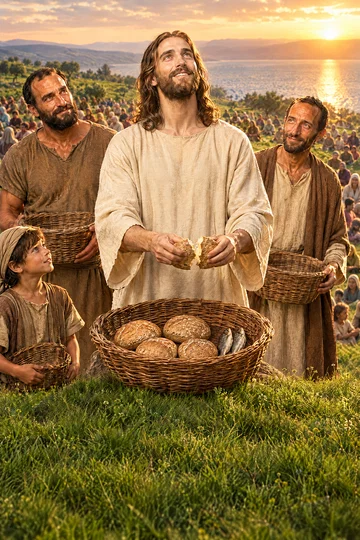
When they were filled, he said unto his disciples, Gather up the fragments that remain, that nothing be lost.
Translations
When they were filled, he said to his disciples, Gather up the fragments that remain, that nothing be lost.
King James Version, KJV Cambridge Paragraph Bible
When they were filled, he said unto his disciples, Gather up the fragments that remain, that nothing be lost.
When they were satisfied, he said to his disciples, Gather the fragments that remain, that nothing may be lost.
Revised Version, American Standard Version
And when they were filled, he saith unto his disciples, Gather up the broken pieces which remain over, that nothing be lost.
And when they were filled, he saith to his disciples, 'Gather together the broken pieces that are over, that nothing may be lost;'
And when they had been filled, he says to his disciples, Gather together the fragments which are over and above, that nothing may be lost.
And, when they were well-filled, he saith unto his disciples—Gather up the broken pieces left over, that nothing be lost.
Berean Standard Bible, Majority Standard Bible
And when everyone was full, He said to His disciples, “ Gather the pieces that are left over, so that nothing will be wasted.”
When they were filled, he said to his disciples, “ Gather up the broken pieces which are left over, that nothing be lost.”
And when they had had enough, Jesus said to his disciples, Take up the broken bits which are over, so that nothing may be wasted.
And when they were satisfied, he said vnto his disciples, Gather vp the broken meat which remaineth, that nothing be lost.
Douay-Rheims (Challoner revision)
And when they were filled, he said to his disciples: Gather up the fragments that remain, lest they be lost.
Pictures
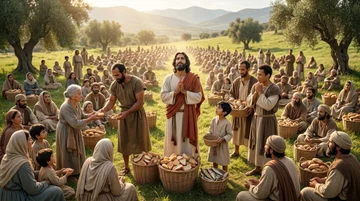
Cross-references 20 of 29
- Matthew 14:19-20
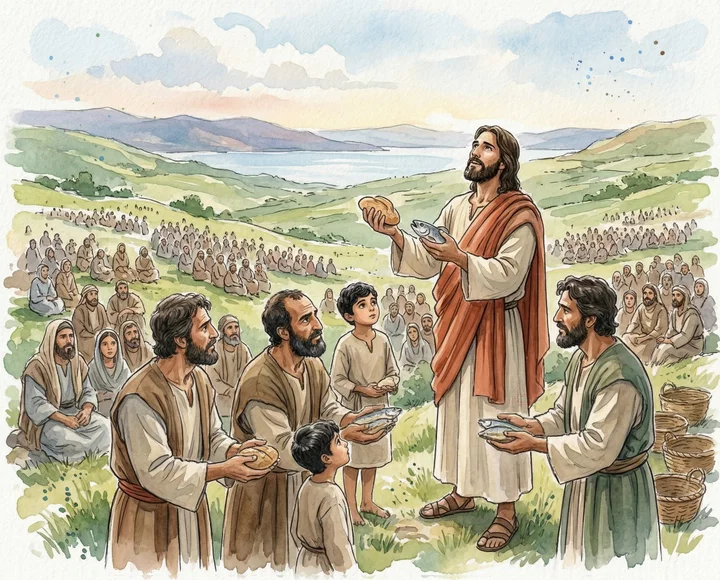
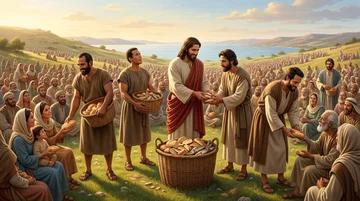
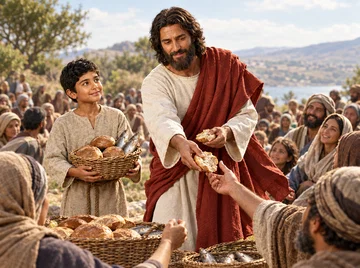
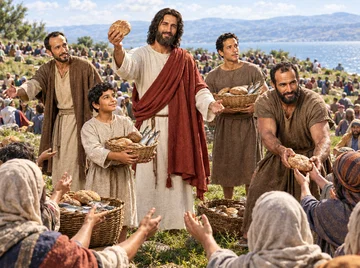
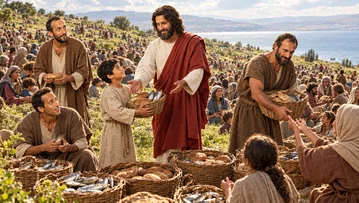
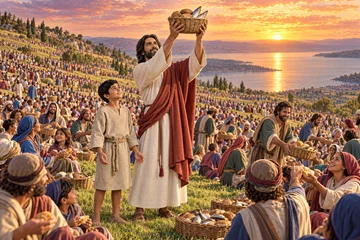
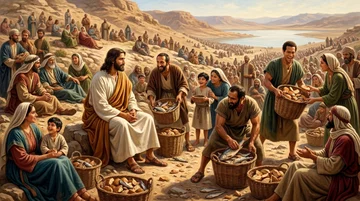
And he commanded the multitude to sit down on the grass, and took the five loaves, and the two fishes, and looking up to heaven, he blessed, and brake, and gave the loaves to his disciples, and the disciples to the multitude.
Jesus feeds the crowd and gathers the remaining fragments.
- Mark 6:43
And they took up twelve baskets full of the fragments, and of the fishes.
The parallel account records the fragments gathered after the meal.
- Luke 9:17
And they did eat, and were all filled: and there was taken up of fragments that remained to them twelve baskets.
Both describe the crowd filled and the remaining fragments gathered.
- John 6:35
And Jesus said unto them, I am the bread of life: he that cometh to me shall never hunger; and he that believeth on me shall never thirst.
same feeding narrative continued with bread teaching
- John 6:26
Jesus answered them and said, Verily, verily, I say unto you, Ye seek me, not because ye saw the miracles, but because ye did eat of the loaves, and were filled.
Jesus says the crowd sought him because they had eaten and been filled.
- Exodus 16:14-18
And when the dew that lay was gone up, behold, upon the face of the wilderness there lay a small round thing, as small as the hoar frost on the ground.
Both show God providing bread that people must gather.
- Mark 6:38
He saith unto them, How many loaves have ye? go and see. And when they knew, they say, Five, and two fishes.
Jesus asks what food is available before feeding the crowd.
- John 6:51
I am the living bread which came down from heaven: if any man eat of this bread, he shall live for ever: and the bread that I will give is my flesh, which I will give for the life of the world.
The living bread is Christ, whose flesh gives life to the world.
- John 6:32-33
Then Jesus said unto them, Verily, verily, I say unto you, Moses gave you not that bread from heaven; but my Father giveth you the true bread from heaven.
Jesus identifies himself as the true bread from heaven who gives life to the world.
- Matthew 16:9-10
Do ye not yet understand, neither remember the five loaves of the five thousand, and how many baskets ye took up?
recalls baskets of fragments
- John 6:5-7
When Jesus then lifted up his eyes, and saw a great company come unto him, he saith unto Philip, Whence shall we buy bread, that these may eat?
Jesus asks Philip how to feed the crowd, and Philip calculates the cost.
- 2 Kings 4:42-44
And there came a man from Baal-shalisha, and brought the man of God bread of the firstfruits, twenty loaves of barley, and full ears of corn in the husk thereof. And he said, Give unto the people, that they may eat.
Both accounts show God multiplying a small food supply to feed a crowd.
- Exodus 16:4
Then said the LORD unto Moses, Behold, I will rain bread from heaven for you; and the people shall go out and gather a certain rate every day, that I may prove them, whether they will walk in my law, or no.
God provided food for Israel in the wilderness as he fed the crowd.
- Matthew 14:16
But Jesus said unto them, They need not depart; give ye them to eat.
Jesus tells the disciples to provide food for the multitude.
- John 6:39
And this is the Father’s will which hath sent me, that of all which he hath given me I should lose nothing, but should raise it up again at the last day.
Christ will lose none of those given to him and raise them at the last day.
- John 21:9-13
As soon then as they were come to land, they saw a fire of coals there, and fish laid thereon, and bread.
The risen Jesus provides food for his disciples by the sea.
- Psalms 78:25
Man did eat angels’ food: he sent them meat to the full.
The crowd’s food recalls God providing manna in the wilderness.
- John 6:16-21
And when even was now come, his disciples went down unto the sea,
same feeding narrative continued with walking on water
- Mark 6:37
He answered and said unto them, Give ye them to eat. And they say unto him, Shall we go and buy two hundred pennyworth of bread, and give them to eat?
Jesus tells the disciples to give the crowd food.
- Mark 6:52
For they considered not the miracle of the loaves: for their heart was hardened.
Names the event as the miracle of the loaves.
Commentary part 1 of 2
Each commentary is drawn from primary sources: the writings of Ellen G. White and Adventist pioneers and periodicals. Each commentary is separate. Its own words are not a quotation; follow the references to read the source passages.
Ellen G. White
144 sources
After the multitude had eaten and were filled from the five loaves and two fishes, Jesus told the disciples who had shared the food to gather up what remained so that nothing would be wasted, and they filled twelve baskets.MH 48.1CH 283.1–2Lt 9, 1902, par. 1–7RH Jan 18, 1912Lt 302, 1907, par. 3–6 Though He had all heaven's resources at command and could create more in a moment, He required the leftovers to be carefully saved.CH 283.1–2Lt 9, 1902, par. 1–7Ms 156, 1902, par. 6–76T 451.3RH Jan 7, 1909 The command teaches the duty of economy in all things, saving money, time, strength, and opportunity so as to give, and it is not stinginess but the generous thrift that makes true liberality possible.MH 48.1CH 283.1–2COL 352.2MC 54.2–55.1GW92 346.2–347.1 It has a twofold meaning, for the same carefulness required for temporal blessings applies to spiritual blessings, so that every word of Christ and every ray of light concerning eternal life is to be treasured, practiced, and shared so none is lost.MH 48.1Ms 142, 1903, par. 133–136Ms 16, 1902, par. 22–25Lt 252, 1906, par. 2–6ST Aug 15, 1916 Christ placed the provision in His followers' hands to distribute as channels who receive from Him, and as they emptied their hands in giving He gave more, so that food and truth multiplied in distribution until the small supply satisfied all and left a surplus.21MR 138.2–3RH Jan 18, 1912Ms 47, 1894, par. 3–5Ms 5, 1901, par. 8–12Lt 5, 1895, par. 24–27
Miracle Setting and Details
After the multitude had eaten and were filled from five barley loaves and two small fishes, Jesus told the disciples who had distributed the food to gather up the fragments that remained so that nothing would be lost or wasted.MH 48.1Lt 9, 1902, par. 1–7Ms 142, 1903, par. 133–136Ms 156, 1902, par. 1–5Lt 302, 1907, par. 3–6 The command came after miraculous multiplication had satisfied the hungry thousands, directing that every leftover piece be carefully collected rather than squandered.CH 283.1–2Lt 9, 1902, par. 1–7Ms 142, 1903, par. 133–136Ms 156, 1902, par. 1–5Lt 302, 1907, par. 3–6 The fragments gathered filled twelve baskets, showing abundance after all were satisfied, with the remainder greater than the supply at the start.RH Jan 18, 1912Lt 302, 1907, par. 3–617MR 252.1Ms 188, 1907, par. 10Lt 304, 1906, par. 6–13 That surplus is described in one account as five or seven bushels left after the five thousand had been fed.Lt 302, 1907, par. 3–617MR 252.1Ms 188, 1907, par. 10Lt 304, 1906, par. 6–13Lt 268, 1903, par. 21–24
The crowd numbered five thousand men besides women and children, who had eaten as much as they wanted from the five loaves and two small fish.Lt 268, 1903, par. 21–24Ms 73, 1909, par. 20–21Lt 24a, 1896, par. 22–24Ms 124, 1909, par. 21ST May 20, 1886 It included pilgrims traveling toward Jerusalem near the time of Passover, who had followed Him on foot from place to place and were weary and hungry from listening.Lt 268, 1903, par. 21–24Ms 73, 1909, par. 20–21DA 364.1Ms 124, 1909, par. 21ST May 20, 1886 They were seated on the grass in companies of fifty and one hundred beside the sea, and the little food multiplied under His hands through the disciples until all had sufficiency.Lt 268, 1903, par. 21–24Ms 73, 1909, par. 20–21Lt 24a, 1896, par. 22–24Ms 124, 1909, par. 21ST May 20, 1886
Jesus ministered to both spiritual and bodily need, meeting spiritual need by teaching the way of salvation and also addressing bodily needs in the feeding that followed.DA 364.2RH Apr 4, 1907ST May 20, 1886ST May 10, 1883DA 368.2–3 He healed the sick and suffering brought to Him, bringing relief, joy and gladness, before providing food abundantly rather than sending the people away hungry.DA 364.2RH Apr 4, 1907ST May 20, 1886ST May 10, 1883DA 718.2 This was done when there was no apparent food or means at hand in the wilderness, depending on the heavenly Father for provision.Lt 24a, 1896, par. 22–24Ms 124, 1909, par. 21RH Apr 4, 1907ST May 20, 1886DA 368.2–3
The feeding occurred on one day, with the multitude fed on the barren shore and leaving Him there knowing no boat remained by which He could depart.ST Dec 29, 18872SP 270.23RED 63.2 The crowd returned the next morning to seek Jesus, with news of the miracle spreading far and near so that crowds arrived early by land and water in large numbers and then went on to Capernaum still seeking Him.ST Dec 29, 18872SP 270.23RED 63.2 After the feeding Jesus held a private interview with His disciples in which they received much precious instruction before searching people interrupted them.ST Dec 29, 18872SP 270.2
Christ's Power and Care
After the hungry thousands had eaten and were satisfied, the command to gather what remained so that none would be wasted shows tender care for bodily need and practical necessity, pitying hunger and providing a simple meal that was sufficient for all.CH 283.1–2Lt 9, 1902, par. 1–7Ms 182, 1907, par. 21–23MH 207.44T 572.3 The twelve baskets collected after everyone had eaten display that same care, for the abundance left over was one of the works through which the Father's power and care were shown.CH 283.1–2RH Jan 7, 1909Ms 71, 1911, par. 5–8 That careful use of what remains is a duty for all, and those in leading positions are to set the example, while lovers of humanity are to avoid needless expenditure when multitudes suffer from famine, violence, fire, and disease, refusing to gamble or grasp what belongs to others and standing ready to share what God has given.CH 283.1–2Ms 182, 1907, par. 21–23MH 207.44T 572.3
The fragments themselves were as much evidence of miraculous divine power as the food that satisfied the crowd, testifying to abundance after need was met.Ms 142, 1903, par. 133–136Ms 16, 1902, par. 22–25Ms 71, 1911, par. 5–8 That same creative power that multiplied the loaves works continually in the growth of seed and in the earth's harvest that feeds millions, so the daily provision is constantly supplied.Ms 67, 1901, par. 17–18ED 107.3 Human labor in caring for grain and making bread can obscure divine agency, and gifts can be used selfishly, so kindness is to be recognized and gifts received as blessings, a lesson joined to leading children to Him.Ms 67, 1901, par. 17–18ED 107.3
Though all heaven's resources and infinite power were at command, and more food could have been created in a moment to feed more than five thousand, the leftovers were required to be carefully gathered and not a morsel lost, so that nothing would be wasted.Lt 9, 1902, par. 1–7Ms 156, 1902, par. 6–76T 451.3Lt 20a, 1893, par. 43–45Ms 63, 1890, par. 2–4 This was a lesson deliberately foreseen to be needed through the centuries, showing by example in industry and frugality that the bounties of Providence are not to be squandered or used in an aimless, wasteful manner, since all are dependent on God for life, food, health, and even the very air breathed.Ms 156, 1902, par. 6–76T 451.3MC 54.2–55.1 Such economy is not stinginess, narrowness, or meanness, but is consistent with generous, broad-minded service, using resources wisely so gifts can feed those who lack food and bring them spiritual nourishment.6T 451.3MC 54.2–55.1Lt 20a, 1893, par. 43–45 What was received came from the Father, and dependence on the heavenly Father met the crowd's need though no apparent food or means was at hand.DA 368.2–3MH 49.1 In working miracles there is intelligent action from necessity to satisfy hunger, never to exalt power, giving no example of using miraculous work for self-glory or to lessen personal burdens, even though full divine power was possessed while daily manual toil supported the family.DA 370.421MR 139.2CT 276.3–4
The small supply remained undiminished until the hungry multitude was satisfied, showing that God can multiply what is wisely and economically used in His service to sustain the work and enable the bread of life to be given to others.MH 49.2–4DA 370.4 The fragments were precious food supplied from heaven, and after the people's needs had been supplied, Jesus and the disciples themselves ate from what God had provided.DA 369.2–4ST Jan 22, 1902DA 369.1ST Aug 19, 1897 Placed in His hands, the five small barley loaves sufficed, becoming sufficient for all as He as source passed provision through the disciples as channels to the people.MH 49.2–4ST Jan 22, 1902 The miracle thus shows the Lord as Provider and Keeper, whose food and the knowledge needed to produce it are for all and are not to be restricted to a favored few, and no person is to be placed where God should be.Lt 199, 1901, par. 18–20
Economy and Faithful Stewardship
After the crowd had eaten their fill from the miraculously multiplied food, the remaining pieces were ordered to be collected so that nothing useful would be lost or thrown away.MH 48.1CH 283.1–2Ms 156, 1902, par. 6–7Ms 142, 1903, par. 133–136Ms 156, 1902, par. 1–5 The instruction was deliberate and far-seeing, meant to teach careful use of gifts received from God's hand through all coming centuries.Ms 156, 1902, par. 6–7Ms 142, 1903, par. 133–136Ms 156, 1902, par. 1–5 Even though abundance had been created in a moment for more than five thousand, the bounties of providence were not to be squandered or used in an aimless, wasteful manner.Ms 156, 1902, par. 6–7Ms 142, 1903, par. 133–136Ms 156, 1902, par. 1–5 The leftovers themselves were as much proof of divine power as the meal that satisfied hunger, and the same carefulness was to be shown toward temporal resources used to relieve need and toward spiritual blessings.MH 48.1Ms 142, 1903, par. 133–136 All remain dependent on God for life and food and health and even the very air breathed, and industry and frugality by example teach right use of what He lends.MH 48.1Ms 156, 1902, par. 6–7
Economy of this kind is not stinginess, narrowness, or meanness.MC 54.2–55.1GW92 346.2–347.1Ms 122, 1899, par. 21–222T 292.15T 400.1–2 It is consistent with generous aims and the most broad-minded, liberal service.MC 54.2–55.1GW92 346.2–347.1Ms 122, 1899, par. 21–225T 400.1–2 There can be no true generosity or liberality where economy is not practiced, since saving makes giving possible.COL 352.2Ms 122, 1899, par. 21–225T 400.1–2 Wasteful prodigality is condemned just as surely as a stingy spirit.Ms 122, 1899, par. 21–222T 292.1 Studying economy and the best way to care for fragments is beneath no one, and to neglect and despise it is wrong.Ms 122, 1899, par. 21–22
The lesson reaches money held as a sacred trust, to be used economically and saved so as to give rather than spent lavishly or carelessly.COL 352.2MYP 321.2–322.1ST Dec 15, 1909HRP 47.1 It reaches time, whose wasted moments are a treasure beyond computation because squandered time can never be recovered, with every hour and day and week passing into eternity and leaving its record.MYP 321.2–322.1Ms 117, 1899, par. 10–11 It reaches thought and strength and opportunity and influence, requiring every talent and physical energy to be used to the very best account for God's glory and not allowed to rust through inaction.MYP 321.2–322.1Lt 5, 1884, par. 118MR 389.2–391.3 Youth especially are stewards of God, sowing for time and eternity and reaping as they sow.Ms 117, 1899, par. 10–11
Applied to food, every morsel and crumb and leftover bit is to be saved and put to further use rather than cast into the waste barrel only to require fresh purchase.Lt 105, 1901, par. 9–11Ms 88, 1901, par. 7Lt 87, 1901, par. 25–298MR 389.2–391.38MR 394.2–3 Bits of bread not spoiled can go into puddings, and leftover potatoes and corn and other small remnants into other dishes.8MR 389.2–391.3 Cooks bear a most responsible duty here and are to be trained in habits of economy, teaching helpers both by precept and by example.8MR 394.2–3 Meals in schools and institutions are to be wholesome and sufficient, yet supplies are to be handled without squandering, since waste continued over time can amount to enough to support a family.Lt 105, 1901, par. 9–11Ms 88, 1901, par. 7Lt 87, 1901, par. 25–298MR 394.2–3
Applied to materials and work, even small scraps and waste paper are to be saved and used rather than thrown aside.STPW 24.1STPW91 23.24T 451.2 Little expenses are to be watched, every leak stopped, and reckless, disorderly habits that allow losses and wastes put away as an offense to God.5T 413.3CH 308.1–309.2 Small losses accumulate into large loss, while little things hold the work together as small screws keep machinery from falling to pieces.STPW 24.15T 413.3CH 308.1–309.2 Large enterprises should not be multiplied if small matters must then be left without attention.5T 413.3
Those in leading positions are to set the example in this thrift, and those establishing institutions, schools, sanitariums, missions, and new fields are to preserve resources so that wants can be supplied and the work advanced.CH 283.1–24T 572.3STB 772.1–2CH 304.2–3 Outgoes are to be kept within income, wants restricted, inconvenience accepted rather than debt contracted with interest to pay, and building done simply and without extravagance while still providing room to reach and care for people.Ms 197, 1907, par. 1–4CH 308.1–309.2 Time also is to be saved from wasteful talk, because wasted minutes add up to heavy loss.CH 308.1–309.2 Placing a school and a sanitarium near each other so they share resources and strengthen one another is one way of gathering advantages that would otherwise be lost.Ms 197, 1907, par. 12–13
Faithfulness in gathering fragments means that nothing is too small to be done carefully.Ms 113, 1901, par. 24–27Lt 26, 1899, par. 1015MR 41.1 It calls for attending to little things with self-control, bringing the principles of God's word into every line of work, and doing planting and building and every task carefully, neatly, and exactly.Lt 26, 1899, par. 105T 413.315MR 41.1 Such thoroughness confesses Christ and forms habits of obedience to rules, punctuality, thoroughness, neatness, order, and economy.15MR 41.15T 415.1 Those habits lay the basis for thoroughness, honesty, and integrity for success in business and for the entire future life, since faithfulness in little things leads to due attention to weightier matters.Ms 113, 1901, par. 24–275T 415.1 Saving even small amounts in this way also prevents unnecessary losses and the accumulation of debt.Ms 7, 1902, par. 1
All that people possess is lent to them by God in trust.Ms 156, 1902, par. 12
Treasure Spiritual Truth
The command to gather the fragments carries a twofold meaning that reaches beyond putting bread into baskets.MH 48.1Ms 142, 1903, par. 133–136Ms 16, 1902, par. 22–25ST Aug 15, 1916Ms 156, 1902, par. 21 The same carefulness required for temporal blessings applies to spiritual blessings and to every opportunity for doing good.MH 48.1Ms 142, 1903, par. 133–136Ms 16, 1902, par. 22–25Lt 5, 1884, par. 11Ms 156, 1902, par. 21 Nothing that God has spoken, especially anything concerning eternal salvation, is to be neglected or allowed to go to waste.MH 48.1ST Aug 15, 1916Lt 5, 1884, par. 11 The fragments left after the feeding were as much evidence of divine power as the meal that satisfied the crowd, and they teach careful economy in using the Lord's gifts wisely, wasting nothing that could help people in need while showing the same care in spiritual matters.Ms 142, 1903, par. 133–136Ms 16, 1902, par. 22–25 Every talent, every physical energy, and every bit of influence belongs to God and must be used to the very best account to His glory rather than rusting through inaction, and spiritually this means appreciating and making the best use of every spiritual blessing and gathering up every precious ray of light.Lt 5, 1884, par. 11 Those who do not value and use light become indifferent and inappreciative, blessings are not given to those who do not value them, and God calls everyone to do their best while those who receive truth and its blessings share them with others, especially those who have none, rather than wasting what is entrusted to them.Lt 5, 1884, par. 11Ms 156, 1902, par. 21
Spiritually, every word of Christ, every ray of light, and every truth concerning eternal salvation is to be gathered, treasured, studied, and practiced so that none is neglected, lost, or allowed to fall useless to the ground.MH 48.1ST Aug 15, 1916Ms 63, 1890, par. 5–717MR 20.2–21.4Ms 32, 1896, par. 42–46 Christ's words are spirit and life and must be gathered up and heeded rather than allowed to be lost, with the instruction over the food left after feeding the five thousand applied to preserving and practicing the light God gives in His Word.Ms 63, 1890, par. 5–717MR 20.2–21.4Ms 32, 1896, par. 42–46 This means marking His words, studying the Scriptures, treasuring every ray of light God has given, and carefully gathering up and keeping what God has revealed instead of searching for knowledge of what God has not revealed, letting no truth opened by His Spirit be set aside.17MR 20.2–21.4Ms 32, 1896, par. 42–46 Those who receive instruction are to retain it and repeat it to others who did not hear it, for the fragments also illustrate that Christ's words, the bread of life, are to be treasured and shared even by One who had infinite resources yet would waste no fragment.Lt 252, 1906, par. 2–6 Eating Christ's words means receiving revealed truth, bringing its principles into daily life, assimilating them until they become part of the self, and living by every word necessary for salvation rather than replacing it with human suppositions.CH 400.4–401.1Lt 241, 1903, par. 9–10Lt 253, 1904, par. 6–8Lt 43, 1905, par. 4 The principles revealed in Scripture are to be brought home to the soul and eaten, which means not departing from its precepts but bringing its truths into daily life and grasping the mysteries of godliness.Lt 241, 1903, par. 9–10 Through prayer and communion the mind of God is proved by those seeking eternal life and knowledge of His will, and truth can be revealed only as it is known in Christ, whose words are to be received and assimilated until they become part of the self.Lt 241, 1903, par. 9–10 God has revealed all that is necessary for salvation, though not all, since more could not be borne, and His word is never to be left for the suppositions of men, so men and women are spiritually built up from the food they give the mind and those ministering in word and doctrine must not be dull of understanding nor spend time in reading that hinders spiritual growth but must pray for clearness of understanding to comprehend the bread sent down from heaven contained in the Bible.Lt 241, 1903, par. 9–10Lt 43, 1905, par. 4 This calls for careful study of the chapter that reveals Christ as the Bread of life, reading and studying it, meditating on its truths, eating the bread of life, committing it to memory, keeping unprofitable magazines off the table, and gathering up dimes and dollars that would be lost on worthless reading matter to put in self-denial boxes to help God's cause in the southern field.Lt 343, 1905, par. 9Lt 88, 1900, par. 2Lt 253, 1904, par. 6–8
Those fed are to go out and repeat what they learned, feeding hungry souls with the bread from heaven and the Word of life, digging deep into the mines of truth whose ore is worth more than gold and earthly possessions.Lt 252, 1906, par. 2–6Ms 47, 1894, par. 3–5Ms 81, 1906, par. 2–8Lt 18, 1898, par. 20ST May 7, 1912 No temporal advantage is to be let slip and nothing that would benefit a human being is to be neglected, but everything that will relieve the need of earth's hungry ones is to be gathered up, and those fed by the miracle were to go out and give the needy both physical bread for bodily hunger and the bread from heaven for hunger of soul, repeating what they had learned of the wonderful things of God so that not one word concerning eternal salvation would fall useless to the ground.ST May 7, 1912 Christ gives the Bread of Life through His servants, who receive from Him and pass His gifts on to others, with God's grace and saving truth available to people of every class and nationality and not only to the Jews, so that those who freely receive are to freely give and as they share the light they have received they are supplied with more.Ms 47, 1894, par. 3–5 Gathering the fragments means preserving precious light in clear compact printed form and treasuring every line and even torn fragments of books, papers, pamphlets, and periodicals containing present truth, saving and sharing them because they may influence a seeker.Ms 47, 1894, par. 6–9Lt 200, 1897, par. 6–711MR 270.1RH Aug 27, 1903Ms 127, 1903, par. 10 Every line and even every torn fragment of printed matter containing present truth is a sacred treasure of value, a ray of light from heaven to shine into the highways and hedges upon the pathway of truth, able to influence the heart of a seeker after truth, so all spare books and papers should be saved and shared because someone would be glad to read them, and even a torn page may influence a seeker.RH Aug 27, 1903Ms 127, 1903, par. 10 This calls for preserving precious matter and making writings available to the people so that none of it is lost, publishing it in books and articles for the papers rather than letting any of it be lost, and preserving writings entrusted for their purpose even in case of sudden death.Lt 200, 1897, par. 6–711MR 270.1Lt 161, 1900, par. 3
In ministry the gathering means following up the interest created by meetings, preserving accounts of joy and blessing to encourage others, and retaining converts so souls responding to light are not lost.Lt 18, 1898, par. 20MC 38.4Ms 78, 1900, par. 40–41Lt 140, 1898, par. 3 Those who have received the bread of life are to be set to feed others and to follow up the interest created by meetings, with continued effort after camp meetings gathering people reached by the meetings and helping retain them, securing an estimated forty to fifty converts.Lt 18, 1898, par. 20Lt 140, 1898, par. 3 Accounts of the joy and blessing received in Christian work are to be preserved and shared so others may be encouraged and the reports may bear a wide influence and strengthen the church.MC 38.4Ms 78, 1900, par. 40–41 In preaching, gathering fragments means not giving too much matter at once so as to erase earlier impressions, but reserving material for a later time when hearers are fresh so truth can be received and understood.Lt 40a, 1894, par. 4–5 The fragments are the vital truths hearers need to retain, too much matter at once can erase an earlier impression and exceed what the mind can take in, and reserving material gathers up those fragments so the truth, the bread of life, can be received and understood.Lt 40a, 1894, par. 4–5
Receiving to Impart Ministry
Christ put the supply into the hands of His disciples to carry to those faint with hunger, and in that act He showed that His followers are instruments and channels who receive from Him and pass on to others, taking no glory to themselves.21MR 138.2–3Ms 5, 1901, par. 8–12ST Aug 19, 1897RH Apr 4, 1907ST Apr 24, 1901 He brought them forward before the great numbers to give them standing, so that many would recognize in their workings that they work as He worked, and His deeds of mercy opened a door for them.21MR 138.2–3 The little food multiplied under His blessing in their hands until what remained after all were filled was greater than the supply at the start, the small provision becoming sufficient for all, and the disciples themselves ate with Him after serving the people.RH Jan 18, 1912MH 49.2–4 God's grace and saving truth are thus given through servants to people of every class and nationality, not to a favored few, and those who freely receive are to freely give.Ms 47, 1894, par. 3–5
Nothing can be given apart from Him, for He is the center and source of all strength and power, the Giver of all temporal and spiritual blessings, and without Him nothing can be done.RH Jan 18, 1912Ms 5, 1901, par. 8–12ST Aug 19, 1897RH Apr 4, 1907ST Apr 24, 1901 What the soul needs can be given only as it is received from Him, and He employs human beings as co-workers, giving them a part to act with Him as His helping hand.RH Jan 18, 1912Ms 5, 1901, par. 8–12 Receiving continues only by giving, so as giving to others continues, receiving from Christ continues, and the more that is imparted the more is received, in a constant life of believing, trusting, receiving, and imparting.RH Jan 18, 1912Ms 47, 1894, par. 3–5Lt 5, 1895, par. 24–27 As the disciples emptied their hands in giving to the hungry, Christ gave them more to impart, and food and truth multiplied in distribution until the small supply became sufficient and left a surplus to be carefully gathered so nothing was wasted.Ms 5, 1901, par. 8–12Lt 24a, 1896, par. 22–24RH Aug 27, 1903 As the light received is shared, more is supplied, and as heaven's gifts are used to enrich others, grace and light and truth are given in return to enrich the giver.Ms 47, 1894, par. 3–5Lt 5, 1895, par. 24–27
The miracle is an object lesson for all ages in how to work: receive from Him, not to hoard for self-glorification, but to impart to others, valuing and caring for every soul.Ms 5, 1901, par. 8–12RH Apr 4, 1907Lt 90, 1900, par. 6–7ST Apr 24, 1901Lt 7, 1901, par. 1–3 All glory belongs to the great Master Worker, the servant's work bringing no credit of its own, and those entrusted with serving others are to help and encourage rather than discourage or harm.Ms 5, 1901, par. 8–12RH Apr 4, 1907ST Apr 24, 1901Lt 7, 1901, par. 1–3 The merciful provision for temporal need helped fasten in the minds of the people the gracious words of truth He had spoken, for temporal food supplied to the hungry opened the way to place Him in the chair of instruction and made the occasion long remembered.21MR 138.2–3Ms 5, 1901, par. 8–12RH Apr 4, 1907ST Apr 24, 1901 Following His example, medical missionary work for the hungry, sick, and naked is to be bound up with the ministry of the Word, taking the bread of life and the water of salvation to those longing for spiritual help and, as there is need, feeding the hungry and clothing the naked, thus doing double service in beautiful, symmetrical, harmonious, all-round adaptable and efficient work.Ms 5, 1901, par. 8–12RH Apr 4, 1907ST Apr 24, 1901 Means offered with thanksgiving and prayer are multiplied and blessed in the same way, so that making the best use of what is at hand with nothing wasted enables God to supply needed facilities and to feed multitudes starving for the bread of life.STB 148.2–3STB 119.3–4
Divine provision increases in distribution and leaves more than enough, and the lesson is to cease unbelieving worry over impossibilities and to trust God instead of questioning how needy souls will be fed.Lt 24a, 1896, par. 22–24 There is no need to send elsewhere for revival, to hold long councils, to invent new methods, or to get up entertainments to draw people to church or Sabbath school, but to come to Jesus and give the bread of life to needy souls.Lt 24a, 1896, par. 22–24 The works shown in the present time through the message or through acts of helpfulness are to be valued and credited.Ms 64, 1910, par. 10–11 Even a lad's simple offering of five loaves, placed in Christ's hands, sufficed through His multiplication to feed the multitude and became part of a work of great blessing.MH 49.2–4ED 217.1–2
Responses and Wider Connections
The miracle convinced many that Jesus is the Messiah, the prophet who was to come into the world, the Prince of Life, the promised Deliverer, and the Bread of life come down from heaven.Lt 268, 1903, par. 21–24ST May 20, 1886ST May 10, 18833RED 56.12SP 262.3–263.1 No human power could feed thousands bountifully from five barley loaves and two small fishes, and with teaching that sank into hearts as never heard before, with healing of the sick, comforting of sorrow, and tender benevolence winning hearts, the feeding crowned nearly complete conviction into entire belief.ST May 10, 18833RED 56.12SP 262.3–263.1 He made no effort to win applause and was essentially different from chief priests and rulers ambitious for titles and honor, and fearing He would never claim His right as King of Israel on David's throne in Jerusalem, the people with the disciples uniting with them decided to claim it for Him by force and proclaim Him King of Israel.2SP 262.3–263.1DA 718.2 That plan, discerned by Him, would have defeated His work of instruction and mercy.2SP 262.3–263.1 The food was distributed to the hungry multitude and the sick and suffering were brought and healed, bringing relief, joy and gladness to human hearts.DA 718.2
Judas assisted in distributing the food and in bringing the sick, and had opportunity to see the benefit he could impart to others and felt the satisfaction that always comes in service to God, and might have comprehended Christ's methods.DA 718.2Ms 106, 1903, par. 46 Blinded by selfish desires and by the fixed idea that Christ would reign as an earthly king in Jerusalem, he was first to take advantage of the enthusiasm excited by the miracle of the loaves and set on foot the project to take Christ by force and make Him king, with high hopes and bitter disappointment.DA 718.2Ms 106, 1903, par. 46Ms 28, 1897, par. 10–12 Jesus rebuked the step with greater authority than He usually exercised.Ms 28, 1897, par. 10–12 Judas was not satisfied with the turn affairs took, was provoked by the rebuke, and became more and more separated in feeling and love for Jesus.Ms 28, 1897, par. 10–12
Many sought Jesus not because they saw the miracles as proof to establish faith in Him as the Sent of God, but because He satisfied temporal wants and they thought it profitable to unite with Him if He would keep furnishing bread and serve further temporal necessity and exaltation.ST Nov 3, 1898Lt 17, 1897, par. 6–8ST Jul 21, 1898 They wanted Him to repeat the miracle and hoped to discover how He increased the food, missing the intended lesson to awaken faith and lead them to accept Him as the Son of God and the Bread of life.ST Nov 3, 189813MR 219.4–220.1Lt 73, 1901, par. 16–18 When they heard the conditions of eternal life in His sermon on the bread of life, involving the cross and self-denial and belief on Him whom God sent, many turned away, and piling evidence upon evidence could do no more because they wanted not evidence but an excuse to avoid the cross.ST Nov 3, 1898Lt 17, 1897, par. 6–8 The miracle with twelve baskets gathered after all were satisfied from five loaves and two fishes was sufficient evidence, yet the priests closed their eyes to the light and still cried for a sign.Ms 107, 1897, par. 7–8ST Jan 11, 1899
The feeding stands together with Christ walking on the water to rescue the disciples from the storm, hushing the tempest by His word, healing the sick, and raising the dead, as mighty works and reminders of His words and deeds.14MR 335.1–39MR 242.1DA 809.3ST Jul 21, 1898 It took place on a beach by the Sea of Galilee feeding above ten thousand persons from a few small loaves and fishes, within sight of where the disciples later gathered and not far from Capernaum, and the disciples remembered it when the risen Jesus broke food and shared it with them.DA 809.3DA 810.4 It stands with His declaration that He is the Bread of life, after which some of His disciples turned away from Him.14MR 335.1–39MR 242.1 As temporal bread gives the body strength, so faith in Christ and obedience to His teaching give the soul spiritual vigor and everlasting life.2SP 282.1–283.2
The chapter containing the verse gives instruction meant to cure dissension and produce the unity and love that withstands Satan's attacks, and represents the need to believe and personally receive the Word by taking the living Word into the life as spiritual nourishment.21MR 44.1–2Ms 94, 1899, par. 8–921MR 346.1–3 The bread of life is received in that personal appropriation rather than merely hearing, with the Son of God as the source of that life, His work as the substitute for sin the hope of ancient Israel, and the New Testament shedding light on the Old without setting it aside.21MR 44.1–2 The feeding illustrates God's power in providing the harvest, for the creative power that multiplied the loaves works continually in the growth of seed and feeds millions through the earth's harvest, itself a continual miracle.ED 107.3ST May 7, 1912DA 367.3 Human work in caring for grain and making bread, and natural processes and human labor, can obscure God's agency, and His gifts can be used selfishly instead of being recognized as blessings for which to give Him glory rather than crediting only human effort or natural causes.ED 107.3ST May 7, 1912DA 367.3
Particular applications are drawn from the chapter and verse for older persons as well as younger ones to become acquainted with the Word by reading and studying the chapter, meditating on its truths, eating the bread of life, committing the chapter to memory, keeping unprofitable magazines off the table, and gathering up the dimes and dollars that would be lost on worthless reading matter to put in self-denial boxes to help God's cause in the southern field.Lt 343, 1905, par. 9 The same Christ who fed the five thousand will supply present needs by giving wisdom, skill, talent, ingenuity, tact and understanding to devise means and manufacture necessary, wholesome, inexpensive foods from the wholesome productions of the earth, to feed the hungry, clothe the naked and teach the ignorant, to be sold to the poor at as low a rate as possible and more needed in the Southern states than in any other part of America, with the food business made the subject of earnest prayer as one of God's own instrumentalities to supply necessity for all times and occasions.Lt 27, 1902, par. 17–19Ms 81, 1902, par. 14Ms 14, 1902, par. 4 The verse also defines the righteousness of Christ that must be accepted to have on the wedding garment, the standard of character God has given to be a fit guest at the wedding where humanity is united with divinity, so that measuring character by human ideas, presumption where eternal interests are involved, and continuing in sin brings loss of the soul and hinders God's promise, while taking a firm stand for Christ, surrendering to God what is already His own, and accepting this righteousness meets the standard.Ms 13, 1899, par. 1–2 Even in trials and sacrifice the gathering gives a pattern for valuing God's blessings by remembering tokens of His care and trusting Him and His work.Lt 49a, 1896, par. 7
After the people had eaten, Jesus told the disciples to gather the leftover pieces so that none would be wasted, but the disciples later failed to heed and remember these words when memory of the day's blessings should have strengthened their faith and hope.DA 380.3–4
Sources