Exodus 19:2
For they were departed from Rephidim, and were come to the desert of Sinai, and had pitched in the wilderness; and there Israel camped before the mount.
Translations
American King James Version, King James Version, KJV Cambridge Paragraph Bible
For they were departed from Rephidim, and were come to the desert of Sinai, and had pitched in the wilderness; and there Israel camped before the mount.
For they had departed from Rephidim, and had come to the desert of Sinai, and had pitched in the wilderness; and there Israel encamped before the mount.
And when they were departed from Rephidim, and were come to the wilderness of Sinai, they pitched in the wilderness; and there Israel camped before the mount.
And when they were departed from Rephidim, and were come to the wilderness of Sinai, they encamped in the wilderness; and there Israel encamped before the mount.
and they journey from Rephidim, and enter the wilderness of Sinai, and encamp in the wilderness; and Israel encampeth there before the mount.
they departed from Rephidim, and came [ into] the wilderness of Sinai, and encamped in the wilderness; and Israel encamped there before the mountain.
then was it that they brake up out of Rephidim and came into the desert of Sinai, and encamped in the desert,—yea Israel encamped there before the mountain.
Berean Standard Bible, Majority Standard Bible
After they had set out from Rephidim, they entered the Wilderness of Sinai, and Israel camped there in front of the mountain.
When they had departed from Rephidim, and had come to the wilderness of Sinai, they encamped in the wilderness; and there Israel encamped before the mountain.
And when they had gone away from Rephidim and had come into the waste land of Sinai, they put up their tents in the waste land before the mountain: there Israel put up its tents.
For they departed from Rephidim, and came to the desart of Sinai, and camped in the wildernesse: euen there Israel camped before the mount.
Douay-Rheims (Challoner revision)
For departing out of Raphidim, and coming to the desert of Sinai, they camped in the same place, and there Israel pitched their tents over against the mountain.
Pictures
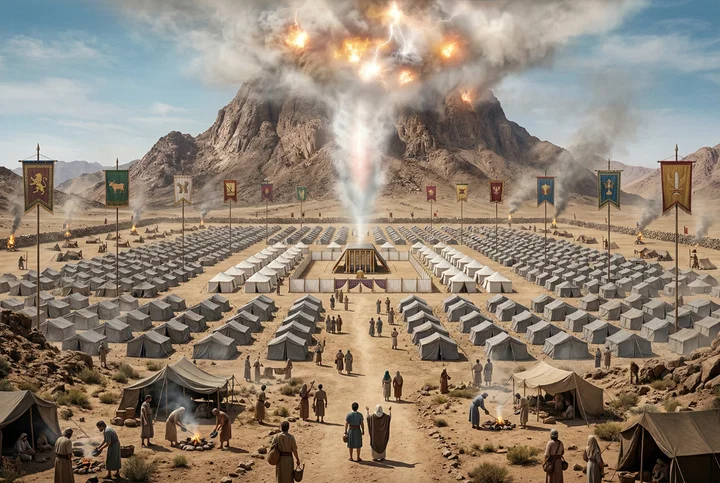
Cross-references 20 of 41
- Exodus 20:1-17
And God spake all these words, saying,
God proclaims the commandments to Israel at Sinai.
- Deuteronomy 5:2-3
The LORD our God made a covenant with us in Horeb.
Identifies the covenant made with Israel at Horeb.
- Exodus 19:7-8
And Moses came and called for the elders of the people, and laid before their faces all these words which the LORD commanded him.
gives Israel's agreement to obey God's voice
- Exodus 24:3-8
And Moses came and told the people all the words of the LORD, and all the judgments: and all the people answered with one voice, and said, All the words which the LORD hath said will we do.
Israel accepts the Sinai covenant, which Moses ratifies with blood.
- Deuteronomy 4:12-13
And the LORD spake unto you out of the midst of the fire: ye heard the voice of the words, but saw no similitude; only ye heard a voice.
God speaks at Sinai and declares the covenant as the Ten Commandments.
- Exodus 19:16-20
And it came to pass on the third day in the morning, that there were thunders and lightnings, and a thick cloud upon the mount, and the voice of the trumpet exceeding loud; so that all the people that was in the camp trembled.
God descends on Sinai amid fire, cloud, thunder, and trumpet, speaking to Moses.
- Deuteronomy 5:22
These words the LORD spake unto all your assembly in the mount out of the midst of the fire, of the cloud, and of the thick darkness, with a great voice: and he added no more. And he wrote them in two tables of stone, and delivered them unto me.
God spoke the commandments to the assembled people at the mount.
- Exodus 24:12
And the LORD said unto Moses, Come up to me into the mount, and be there: and I will give thee tables of stone, and a law, and commandments which I have written; that thou mayest teach them.
God gives Moses the law and commandments on Sinai.
- Exodus 16:1
And they took their journey from Elim, and all the congregation of the children of Israel came unto the wilderness of Sin, which is between Elim and Sinai, on the fifteenth day of the second month after their departing out of the land of Egypt.
Israel reaches the wilderness of Sin about a month before arriving at Sinai.
- Deuteronomy 33:2
And he said, The LORD came from Sinai, and rose up from Seir unto them; he shined forth from mount Paran, and he came with ten thousands of saints: from his right hand went a fiery law for them.
Describes God's coming at Sinai to give the fiery law.
- Galatians 4:24-25
Which things are an allegory: for these are the two covenants; the one from the mount Sinai, which gendereth to bondage, which is Agar.
Hagar represents the covenant from Mount Sinai, which brings bondage.
- Exodus 31:18
And he gave unto Moses, when he had made an end of communing with him upon mount Sinai, two tables of testimony, tables of stone, written with the finger of God.
God gave Moses the stone tablets, written with God’s finger.
- Exodus 19:10-14
And the LORD said unto Moses, Go unto the people, and sanctify them to day and to morrow, and let them wash their clothes,
The people prepare and are sanctified before meeting God at Sinai.
- Exodus 20:1
And God spake all these words, saying,
God speaks the law at Sinai three days after the agreement.
- Exodus 20:19
And they said unto Moses, Speak thou with us, and we will hear: but let not God speak with us, lest we die.
Israel asks Moses to speak for them rather than hear God directly.
- Deuteronomy 10:4
And he wrote on the tables, according to the first writing, the ten commandments, which the LORD spake unto you in the mount out of the midst of the fire in the day of the assembly: and the LORD gave them unto me.
God wrote the Ten Commandments on the tablets at Sinai.
- Jeremiah 31:32
Not according to the covenant that I made with their fathers in the day that I took them by the hand to bring them out of the land of Egypt; which my covenant they brake, although I was an husband unto them, saith the LORD:
Identifies the covenant made when God led Israel out of Egypt.
- Deuteronomy 5:5
(I stood between the LORD and you at that time, to shew you the word of the LORD: for ye were afraid by reason of the fire, and went not up into the mount;) saying,
Moses stood between Israel and the LORD amid their fear of Sinai’s fire.
- Psalms 68:17
The chariots of God are twenty thousand, even thousands of angels: the Lord is among them, as in Sinai, in the holy place.
God is present at Sinai among his angels.
- Exodus 24:15-18
And Moses went up into the mount, and a cloud covered the mount.
Moses ascends Sinai as the cloud and glory of the Lord cover the mount.
Commentary
Each commentary is drawn from primary sources: the writings of Ellen G. White and Adventist pioneers and periodicals. Each commentary is separate. Its own words are not a quotation; follow the references to read the source passages.
Ellen G. White
27 sources
Israel had left Rephidim and come into the desert of Sinai, pitching and camping before the mount in the third month after leaving Egypt, where they remained encamped on the plain beneath the mountain for nearly a year.1SP 232.2Lt 407, 1904, par. 4–51MR 106.2–3Ms 64, 1903, par. 8–9PP 301.2–302.1 There God called Moses up into the cloud to give His covenant message for the house of Jacob, offering to take them into close relation to Himself as His peculiar treasure, a kingdom of priests and a holy nation, if they would indeed obey His voice and keep His covenant.1SP 232.2PP 303.1–3Ms 64, 1903, par. 1Lt 407, 1904, par. 4–51MR 104.1–2 Moses laid the offer before the elders, and the people answered that they would do all the Lord had said, entering a solemn covenant accepting God as their ruler.PP 303.1–3Ms 83, 1907, par. 4–8Ms 125, 1909, par. 20–21 From that same camp God came down in awful grandeur and proclaimed His law in an audible voice, including the Ten Commandments, to reveal His glory and authority and the sacredness of His law for all time.Ms 119, 1903, par. 1–2Ms 65, 1906, par. 6–7Lt 176, 1907, par. 11–12FE 505.2–3RH Sep 5, 1907 What was spoken to Israel at Sinai is spoken as truly now, and must be often repeated and sacredly observed by God's people today, whose individual duty is to understand what God means and do whatever He commands.1MR 119.1–2Ms 84, 1910, par. 3–4Ms 71, 1907, par. 1–4Ms 141, 1906, par. 1–4RH Sep 5, 1907
Arrival at Mount Sinai
They had left Rephidim behind and had come into the desert and wilderness of Sinai, where they pitched and camped before the mount and mountain.1SP 232.2PP 303.1–3Ms 64, 1903, par. 11MR 104.1–2Ms 81, 1903, par. 8–11 That encampment before Sinai was reached in the third month after going out of Egypt, after only about three months of travel and journeying.Lt 407, 1904, par. 4–51MR 104.1–2Ms 71, 1907, par. 1–4Ms 170, 1904, par. 7–8FE 505.2–3
They had followed the cloudy pillar through difficult wilderness terrain and camped on the plain beneath Sinai.PP 301.2–302.1 There they remained nearly a year.PP 301.2–302.1 All that time the cloud rested on the mountain, and the pillar of fire by night showed divine protection over them.PP 301.2–302.1 Sinai itself was a high mountain standing in the barren wilderness and desert.1MR 106.2–3Ms 64, 1903, par. 8–9PP 301.2–302.1
Soon after the encampment Moses went up to God to meet with Him.PP 303.1–31MR 104.1–2 He climbed alone up the steep path into the cloud that marked God's presence.PP 303.1–3
Covenant and Law Proclaimed
The camp in the wilderness of Sinai before the mount, reached after departing from Rephidim, was the setting for God's covenant message to Israel.1SP 232.2Ms 64, 1903, par. 1SG3 261.2 It was there, in the third month after going out of Egypt after only about three months of journeying, that God spoke to Moses concerning His covenant with the people.Ms 64, 1903, par. 1Lt 407, 1904, par. 4–51MR 104.1–2 That message was addressed to the house of Jacob and the children of Israel, grounded in what He had done to the Egyptians and how He had borne Israel on eagles' wings and brought them to Himself, to take them into a close and peculiar relation to Him.PP 303.1–31MR 104.1–2 This was the occasion when God called Israel to be His peculiar people and established them under His covenant.Ms 81, 1903, par. 8–11SG3 261.2
God offered to incorporate them as a church and a nation under His government.PP 303.1–3 He offered to make them a peculiar treasure above all people, a kingdom of priests and a holy nation.PP 303.1–31MR 104.1–2Ms 81, 1903, par. 8–11 The offer was conditional on their indeed obeying His voice and keeping His covenant, which means real obedience and not merely professing to worship God.1MR 104.1–2 It was made on condition of obedience to His commandments.Ms 83, 1907, par. 4–8 If they fulfilled the pledge, He promised to greatly bless them and honor them, to manifest His love and power upon them, and constantly to care for them.1MR 104.1–2
Moses brought the message to the elders of Israel.PP 303.1–3 The people answered that all that the Lord had spoken they would do.PP 303.1–3Ms 83, 1907, par. 4–8Ms 125, 1909, par. 20–21 By that answer they entered into a solemn covenant accepting God as their ruler, making them in a special sense the subjects of His authority.PP 303.1–3
The camp before the mount was also the preparation and setting for hearing God's law.Ms 119, 1903, par. 1–2Ms 65, 1906, par. 6–7Lt 188, 1903, par. 15–20 There the Lord came down before the people and gave them His law, with promises for keeping His commandments, making known the covenant requirements.Lt 176, 1907, par. 11–12Ms 2, 1904, par. 6–19Lt 164, 1910, par. 5–7 There God proclaimed the Ten Commandments to the congregation gathered to hear Him.Ms 65, 1906, par. 6–7FE 505.2–3RH Sep 5, 1907 That law included the law first given in Eden, proclaimed after He had delivered Israel from Egypt despite Pharaoh's opposition so they might keep it and hear Him proclaim it.1MR 106.2–3STB 7.1–2 Obedience to all His commandments given there is the highest education for humanity.Lt 164, 1910, par. 5–7
God chose this mountain to reveal Himself and His glory and to speak His law in audible voice.1MR 106.2–3Ms 64, 1903, par. 8–9PP 301.2–302.1 He manifested Himself in awful grandeur and overwhelming majesty in giving His law, amid scenes whose grandeur displayed His authority and the sacredness and importance of the law.RH Sep 5, 1907Ms 64, 1903, par. 8–9STB 7.1–2 That revelation showed the law's importance for all ages.1MR 106.2–3Ms 64, 1903, par. 8–9 The impressions of that scene were never forgotten by those who beheld it.RH Sep 5, 1907
Call to Obedience Today
What was spoken to ancient Israel at Sinai is spoken as truly now. Ms 71, 1907, par. 1–4RH Sep 5, 1907 The words given when Israel was encamped before the mount, where the Lord manifested Himself in awful grandeur in giving His law, call for obedience to the commandments of God. RH Sep 5, 1907 That instruction in Exodus and Deuteronomy applies to God's Israel for as long as they live on earth. Ms 141, 1906, par. 1–4RH Sep 5, 1907 The record is written for present readers as truly as for the children of Israel, and the impressions of that scene were never forgotten by those who beheld it. Ms 71, 1907, par. 1–4RH Sep 5, 1907
As God brought Israel to Himself at Sinai, He must bring each person to Himself today before He can work through them in the great work of preparing a people to stand in the day of the Lord. 1MR 119.1–2Ms 71, 1907, par. 1–4 It is therefore each person's individual duty to seek to understand what God means and to do whatever He commands. 1MR 119.1–2Ms 71, 1907, par. 1–4 The blessings God gives call for the people to observe and value His instruction for their good and to honor His name. Ms 84, 1910, par. 3–4 Obedience to all God's commandments is the highest education for humanity. Lt 164, 1910, par. 5–7
The instruction in Exodus 19 and 20 is of great importance and must be often repeated and sacredly observed. Lt 168, 1909, par. 16–17 Its setting before the mount shows the Lord as the only true God who demands that His people be obedient to His Word. Lt 168, 1909, par. 16–17 There God made His promise to His people on condition of their obedience to His commandments, the people answered that all the Lord had spoken they would do, and God declared that He would come in a thick cloud so the people would hear when He spoke with Moses and believe Moses forever. Ms 83, 1907, par. 4–8 As He dealt with His ancient people at Sinai, so He will deal with those now who despise the Word of the Lord and refuse to humble their proud hearts before the wisdom and righteousness of God. Ms 83, 1907, par. 4–8 When every device is used to draw people away from truth and righteousness, those who stand on the Lord's side keep holy the memorial of creation established when God wrought the work of creation in six days and blessed and sanctified the seventh day as a day of rest. Lt 168, 1909, par. 16–17
Israel's pledge to God at Sinai is proved when they come into hard places and perplexities. Ms 125, 1909, par. 20–21 Instead of murmuring, complaining, and fretting against the Lord, they should stand the proving by getting down in simplicity on their knees and asking the Lord God of Israel to help them. Ms 125, 1909, par. 20–21 They may ask as He gave them water before to show His great kindness, and the Lord is pleased with that prayerful trust. Ms 125, 1909, par. 20–21
Sources
Pioneers and periodicals
77 sources
Israel left Rephidim and came to the desert of Sinai and camped before the mountain.ST Mar 3, 1914ST May 17, 1883 They arrived in the third month after leaving Egypt.RH Oct 21, 1851RH May 27, 1852RH Dec 9, 1915 The encampment is the setting where God descended and with His own voice proclaimed the Ten Commandments and gave them to Moses.ST Mar 3, 1914RH Mar 4, 1862RH Dec 24, 1861 There God made a conditional covenant with Israel, promising on condition of obeying His voice and keeping His covenant that they would be His peculiar treasure above all people, a kingdom of priests and an holy nation, and all the people answered together that all the Lord had spoken they would do.ST Jul 8, 1875RH Oct 21, 1851ST Aug 13, 1885 The Sabbath had already been made known, enforced and transgressed in the wilderness before Israel saw Sinai, proving it was an ancient institution ordained at creation and not first given at Sinai.ST May 17, 1883ST Mar 11, 1875RH Jan 7, 1862ST May 17, 1883RH Oct 14, 1873
Arrival at Sinai
Israel left Rephidim and came to the desert and wilderness of Sinai, and there camped before the mountain.ST Mar 3, 1914RH Jan 15, 1914ST Sep 17, 1885 That arrival marks the end of the journey to Sinai and the place where the Ten Commandments were to be given.ST Mar 3, 1914RH Jan 15, 1914 They had already received Sabbath instructions in the giving of manna and had violated them about thirty days before reaching the mount, so the encampment came after the Sabbath was already being observed and its violation rebuked.ST May 17, 1883 The surrounding chronology connects the arrival with Sivan 1 and, after days for settling and preparing a covenant, the giving of the law on Sivan 6, identified as Pentecost.RH Jan 15, 1914 At Sinai the proposed covenant was presented, to make them a favored people if they obeyed His voice and kept His commandments, but the commandments and Sabbath already existed before this public presentation and did not first begin there, and the people's later promise to obey did not create their underlying obligation to obey.ST Sep 17, 1885
Horeb is Mount Sinai, the mount of God, with Sinai belonging to Horeb's range and lying near Horeb.RH Oct 21, 1851RH May 2, 1854RH Jan 7, 1862ST Jan 30, 1907ST Sep 10, 1902 Israel came to the desert of Sinai in the third month and camped before the mount as the setting where God made a covenant with them in Horeb.RH Oct 21, 1851RH May 2, 1854RH Jan 7, 1862 That covenant was a mutual agreement between God and His chosen people, with the Ten Commandments as its moral conditions, basis and rule, distinct from the commandments alone, and not made with the fathers the patriarchs but with those alive that day.RH Oct 21, 1851RH May 2, 1854RH Jun 3, 1862 On God's part He reminded them of bringing them out of Egypt unto Himself and promised that if they would obey His voice indeed when He should speak the ten commandments they would be a peculiar treasure above all people and a kingdom of priests and an holy nation, and on the people's part the elders and all answered together that all the Lord had spoken they would do.RH Oct 21, 1851 That covenant did not give existence to any of the ten commandments, for the Sabbath was already ordained at creation and obligatory before they reached Sinai.RH Jan 7, 1862 There they stayed two years in the shadow of Sinai in the vicinity of Horeb learning the law of the Most High by daily manna and water in desert wastes knowing neither rain nor stream, and above all that enduring character is that taught by the precepts of the Decalogue amplified by the sanctuary, for the mountains are places of revelation where God revealed His unchangeable law to the sinner.ST Jan 30, 1907ST Sep 10, 1902
The mountain was sanctified, consecrated and set apart for Jehovah's descent, for sacred use and display of His presence and power in giving His law.RH Jul 26, 1864RH Jul 16, 1861RH Mar 15, 1870 Bounds were set around it because God was about to speak and testify to them, so Israel could not use or occupy it as ordinary common ground.RH Apr 21, 1851RH Jul 26, 1864RH Jul 16, 1861RH Mar 15, 1870 The congregation was sanctified for that speaking, accompanied by thunder, lightning, fire, smoke and shaking mountain in proclamation of the Ten Commandments as God's solemn testimony and royal law.RH Apr 21, 1851
The arrival ends the journey to Sinai and begins the account of the covenant by which the ransomed people are bound to Jehovah, setting the scene for the remarkable events connected with Sinai.RH Mar 10, 1863 It was the fourth encampment after the wilderness of Sin lying between Elim and Sinai in Western Arabia, reached in the third month of the year of release from Egypt.ST Jun 10, 1908 Their stay there was a remarkable, extended stage of the journey from Egypt toward the promised land and provided a vivid object lesson in Israel's history. Sinai is the most celebrated of all earth's mountains because of the majestic scenes it witnessed and the words of power to which it listened, where Israel camped as a lowly, amazed throng and the mountain became a schoolhouse of flame from whose lofty, burning doorway the Teacher of the universe spoke lessons of LIFE if received and obeyed and of DEATH if disobeyed, preparing the way for building the tabernacle there during the year that followed.ST Jun 10, 1908 Their journey through the wilderness, guided by the cloud by day and protected by fire at night, was part of a school in which Christ taught them faith and trust in God, and at Sinai God gathered the people to Himself so He could speak to them, with stark, barren surroundings helping them feel their smallness before His greatness.ST Apr 22, 1880
Date and Duration
Israel arrived in the third month after leaving Egypt, in the third month of the year of release and in the third month after the exodus.RH Oct 21, 1851RH May 27, 1852RH Dec 9, 1915RH Jan 7, 1862ST Jun 10, 1908 The coming to the desert of Sinai and camping before the mount was the fourth encampment after the wilderness of Sin between Elim and Sinai, and it set the place of the covenant at Horeb and the speaking of the Ten Commandments.RH Oct 21, 1851RH May 27, 1852RH Jan 7, 1862ST Jun 10, 1908ST Aug 16, 1910 The timing shows the law was spoken there, yet God had already called Israel to account for breaking His law and Sabbath in the wilderness of Sin during the second month.RH Dec 9, 1915
They left Egypt on the fifteenth day of the first month, reached the wilderness of Sin on the fifteenth day of the second month, and reached Sinai on the fifteenth day of the third month.RH Jan 15, 1914RH Mar 1, 1906 The arrival was about one month after the miracle of the manna in the wilderness of Sin, about thirty days after the manna was first given and after the manna and Sabbath experience of Exodus 16, and thirty-two days before hearing the Ten Commandments.RH Mar 7, 1854ST May 17, 1883RH Oct 14, 1873 The surrounding chronology connects arrival with Sivan 1 and the giving of the law on Sivan 6, identified as Pentecost and as the feast of first-fruits commemorating the giving of the law at Sinai.RH Jan 15, 1914RH Mar 1, 1906 Forty-nine days or seven weeks are counted as sixteen days in the first month plus thirty in the second plus three days of travel in the third month, and fifty days from Passover to Pentecost bear the same relation to Pentecost as the days of the week bear to the Sabbath.RH Mar 1, 1906ST Aug 25, 1909
Israel stayed about two years in the shadow of Sinai near Horeb learning the law of the Most High.ST Jun 10, 1908ST Jan 30, 1907 There they were taught by the daily manna that bread could be supplied where no grain grew and that abundance of water could be furnished in desert wastes knowing neither rain nor stream, and above all that character is enduring and the only right character is that taught by the precepts of the Decalogue, amplified, impressed and enforced by the object-lessons of the sanctuary and service of God.ST Jan 30, 1907 The mountain became a schoolhouse of flame speaking momentous lessons of life if received and obeyed and of death if disobeyed, preparing the way for the building of the wonderful tabernacle at Sinai during the year that followed.ST Jun 10, 1908 In chronological order Exodus 19 through 32 comes first, followed by the sanctuary instruction given to Moses in the mount in chapters 25 to 31, then the building and setting up of the sanctuary in chapters 33 to 40 culminating in the tabernacle being set up.ST Dec 10, 1896
The passage does not show a movable Sabbath changing yearly from the first of the year.ST Apr 3, 1907 Yearly Sabbaths as annual holidays sometimes falling on the seventh day and sometimes on other days are distinct from the weekly Sabbath.ST Apr 3, 1907
Proclamation of the Law
Israel had left Rephidim and camped in the wilderness before the mountain in the desert of Sinai, and that encampment is the setting for the giving of the Ten Commandments.ST Mar 3, 1914RH Mar 4, 1862RH Dec 24, 1861ST Mar 4, 1886ST Jun 13, 1878 There God descended and with His own voice spoke and proclaimed the Ten Words recorded in Exodus 20:1-17 and Exodus 20:3-17, including the Sabbath commandment, engraved them on stone with His own finger on two stone tablets, and gave them to Moses.ST Mar 3, 1914RH Mar 4, 1862RH Dec 24, 1861ST Mar 4, 1886ST Jun 13, 1878 The moral law was thus given and the covenant concerning it solemnly ratified before the ceremonial law concerning sacrifices was set out in the following chapters, with God's voice and commandments distinguished from the other laws.ST Mar 4, 1886ST May 20, 1875
After three days of careful preparation, sanctification of the congregation, and setting of bounds around the mountain, the Majesty of Heaven came down amid grandeur never before witnessed on earth.ST Jun 12, 1907ST Feb 11, 1913RH Apr 21, 1851RH Oct 21, 1851 He spoke the Royal Law, the Ten Words, from Sinai's blazing peak to the assembled thousands, with thunder, lightning, fire, smoke, thick cloud, the shaking mountain stirred to its base, the trump of God, thousands of angels in flaming fire and blazing glory, and the displayed glory of the Son of God.ST Jun 12, 1907RH Mar 9, 1869RH Apr 21, 1851RH Jan 12, 1869RH Apr 21, 1874 It was a sublime manifestation of God's glory and solemn testimony, and those who beheld it never forgot its impression.RH Apr 21, 1851ST Jan 24, 1911RH Jan 12, 1869 In the order of the account this waiting was in order for the commandments to be given, the tabernacle to be erected, and the people to be arranged before entering Canaan.RH Dec 31, 1857
The law there attested is the Royal Law, in itself complete, full, comprehensive and perfect, containing duties to God and pressing the keeping of both its spirit and letter.ST Jun 12, 1907ST Mar 4, 1889RH Apr 21, 1851RH Jan 27, 1916 Its whole code is contained in Exodus 20:3-17, and the Exodus 19 to 22 portion opens with this encampment.ST Mar 4, 1889RH Jan 27, 1916 It formed no part of the ritual or ceremonial system but is the moral rule of life that points out sin, reveals righteousness, exposes inability to attain righteousness by one's own deeds, comprehends all justice, truth and righteousness, and stands as the foundation of God's government and the reflex of His character.ST Mar 4, 1889RH Mar 26, 1861
The law was spoken by God as Elohim the Creator of heaven and earth and not as Jehovah the covenant God of Israel only, so it applies universally to all.ST Jan 24, 1911 The glory that shone at Sinai was the glory of Christ, for He was Jehovah the lawgiver, and the law given there came from God through Christ as good, life-giving, and able to work as grace and truth when received from God.RH Mar 1, 1906ST Jan 24, 1911ST Jan 11, 1905 God gave it in love to draw the people into close fatherly fellowship and to write it on their hearts, so that condemnation would be swallowed up by righteousness and its prohibitions would become enabling acts furnishing power through faith to do what is demanded.ST Jan 24, 1911ST Jan 27, 1909 But Israel was afraid of God's glory and begged that God should not speak to them but that Moses the man should speak to them, so they received it simply through Moses, who had no power to write it in hearts, as condemning outward precept that they could keep only outwardly.ST Jan 24, 1911ST Jan 11, 1905
The giving of the law was the greatest advantage conferred on ancient Israel, taking place about twenty-five hundred years after creation by the personal descent of the Lawgiver.RH Apr 21, 1874 It was not the commencement of the existence of the law of God but its proclamation and committing to Israel.RH Apr 21, 1874
Sabbath Before Sinai
Israel had already received Sabbath instruction in the giving of manna and had violated it about thirty days before reaching the mount.ST May 17, 1883RH Dec 9, 1915ST May 17, 1883RH Oct 14, 1873 Sabbath obligation was already known and enforced before Israel reached the mountain to receive the law there.ST May 17, 1883ST Mar 11, 1875ST Aug 13, 1885 God had already called Israel to account for breaking His law and Sabbath in the wilderness of Sin during the second month, and the journey's timing shows this came before the law was spoken at Sinai in the third month.RH Dec 9, 1915ST Aug 13, 1885RH Oct 14, 1873 The preliminary work of the old covenant at the encampment in the wilderness of Sinai began about a month after the events of Exodus 16, when the Sabbath was already observed.ST May 17, 1883ST Aug 13, 1885RH Oct 14, 1873 The Sabbath was thus understood, transgressed, obeyed, and its violation rebuked by Jehovah in the wilderness of Sin before Israel ever saw Sinai.ST May 17, 1883ST Mar 11, 1875RH Dec 9, 1915ST May 17, 1883
That timing proves the Sabbath was not first given at Sinai.ST May 17, 1883RH Oct 14, 1873RH Oct 21, 1851 Israel did not come to the mount from which the Ten Commandments were proclaimed until thirty days after the manna was first given, about one month after the Sabbath experience in Exodus 16.ST May 17, 1883RH Oct 14, 1873RH Oct 21, 1851RH Feb 23, 1911 The arrival came on the fifteenth day of the third month, one month after coming to the wilderness of Sin on the fifteenth day of the second month after leaving Egypt on the fifteenth day of the first month, thirty days after keeping the Sabbath with the manna and thirty-two days before hearing the Ten Commandments.RH Oct 21, 1851RH Feb 23, 1911 The Sabbath was therefore already an ancient institution when the law was given at Sinai, ordained at creation and obligatory upon the Hebrews before they reached Sinai.RH Jan 7, 1862RH Oct 14, 1873RH Oct 21, 1851 It was already well understood by God, Moses and the people, with God's commandments and laws already existing and observed, and was not made at Horeb when God talked face to face with the people.ST May 17, 1883RH Oct 21, 1851RH Feb 23, 1911
The covenant at Sinai and Horeb was simply an embodiment of the precepts of the moral law with mutual pledges between God and the people, in which the people personally pledged to keep those precepts.RH Feb 3, 1852RH Jan 7, 1862 That covenant set the terms for Israel's keeping of moral duties but did not create those duties and did not give existence to any of the Ten Commandments.RH Feb 3, 1852ST Aug 13, 1885RH Jan 7, 1862 The Sabbath was already in existence before the covenant and already observed before Israel reached Sinai, so it did not owe its existence to the old covenant.RH Feb 3, 1852ST Aug 13, 1885RH Jan 7, 1862 Its mention among the commandments did not make it a rule for Israel alone, and because it was part of that law given at the beginning of Israel's civil and religious life as Jehovah's nation, its significance applied to all humanity.RH Feb 3, 1852RH Jan 7, 1862ST Feb 4, 1886
The account identifies Jehovah as the God whose day is the seventh day, observed from Friday evening until Saturday evening.RH Apr 18, 1854 Coming to the foot of Sinai's awful mount to hear Remember the Sabbath-day settles the question by the law and the testimony.RH Apr 18, 1854 That coming leads to embracing the Sabbath and hailing its weekly return as a delight and as the holy and honorable of the Lord.RH Apr 18, 1854
Covenant Agreement at Sinai
At Sinai God made a conditional covenant, contract and mutual agreement with Israel after reminding them through Moses as mediator of deliverance from Egypt and bringing them unto Himself.ST Jul 8, 1875RH Oct 21, 1851ST Jul 8, 1875RH May 3, 1860 On God's part He promised on condition of obeying His voice indeed when He should speak and keeping His covenant that they would be His peculiar treasure above all people, a kingdom of priests and an holy nation.ST Jul 8, 1875RH Oct 21, 1851ST Jul 8, 1875RH May 3, 1860 On the people's part the elders and all the people answered together that all the Lord had spoken they would do, which Moses returned to the Lord.ST Jul 8, 1875RH Oct 21, 1851ST Aug 13, 1885ST Jul 8, 1875 That covenant is distinct from the Ten Commandments themselves, for the commandments proclaimed a few days later and commanded by God were the agreement's conditions, basis, terms and rule, while the covenant was the people's agreement to do them, later put in writing in the book of the law and dedicated with blood.ST Jul 8, 1875RH Apr 28, 1868ST Aug 13, 1885ST Jul 8, 1875RH May 3, 1860 One covenant was thus based on another covenant, and all the rites and offerings given through Moses belonging to that arrangement rested on that law for their basis, their use and necessity arising from the relation the people sustained to the law.RH Apr 28, 1868RH Feb 3, 1852
The covenant was made three days before the Ten Commandments were spoken, when Israel solemnly pledged to obey God's voice before hearing it in ten precepts, leaving the contract not yet closed.ST Jul 8, 1875ST Aug 13, 1885ST Jul 8, 1875RH Mar 25, 1875RH Mar 25, 1875 Three days afterward God Himself declared the words of the condition from the mount out of the midst of the fire in the hearing of all Israel, without Moses standing between to convey them.ST Jul 8, 1875RH Mar 25, 1875 That pledge was afterward confirmed and ratified after hearing His voice, with the preliminary work in Exodus 19 completed by ratification in Exodus 24, and that old covenant was ratified before God wrote the ten commandments.ST Jan 3, 1878ST Feb 13, 1879 This covenant through Moses is distinct from the covenant commanded in Deuteronomy 5:4 onward given by God Himself without the agency of Moses, since Deuteronomy 5:5 refers not to the arrival and ascent but to the fearful manifestations and speaking from Exodus 19:16 onward and Exodus 20:19.ST Jul 8, 1875RH May 6, 1873RH May 6, 1873
The first covenant's promises were for obedience only and did not embrace forgiveness of sin, required perfect obedience without the clear promises of pardon fallen people needed, and became useless and void because the people did not continue in it and fulfill their agreement.RH Apr 28, 1868RH Mar 25, 1873RH Feb 1851 God therefore regarded them not according to its promise and refused to count a disobedient people holy without denying Himself, so the kingdom promises conditional under the old covenant were forfeited and the transgressions under that covenant needed redemption through Christ's death.RH Mar 25, 1873RH Jan 19, 1860 The fault was with the people, whose promise was the weakest promise, and not with the law, whose nature, authority and perpetuity disobedience does not weaken or change.RH Mar 25, 1873STST Mar 17, 1909 The new covenant keeps the same law as its condition but written on hearts and minds so there is no other desire than to obey, and is established on better and everlasting promises including forgiveness, the covenant given to Abel, Noah, Abraham and Israel, where man's part is simply yielding to God's promises by faith in the gospel of Jesus Christ.RH Apr 28, 1868RH Feb 3, 1852STST Mar 17, 1909ST Apr 22, 1913 A covenant with a nation could not save its individual members, and those relying on their own strength failed whereas those obeying from the heart did so by faith in the coming Christ and received God's righteousness.ST Apr 22, 1913
By a different reading held by some, the first covenant is the Decalogue of Exodus 20 itself, both an agreement and a law-covenant because enacted or legislated, and it expired by limitation rather than becoming useless and void through the people's failure.RH Apr 15, 1873 The weight of teaching holds the Horeb covenant was made not with the fathers the patriarchs but with those alive that day, solemnly taking Israel as a holy nation belonging to Him where obeying His voice and keeping His covenant meant keeping the Ten He uttered.RH Oct 21, 1851RH Dec 24, 1861RH Jun 3, 1862 In self-dependence Israel promised in its own strength to buy blessings by works, bearing children to bondage like Hagar's son born after the flesh through man's working in contrast to Sarah and Isaac born after the Spirit through God's promise and power with man's cooperation by wholly yielding, taking the whole natural seed of Israel as children of the flesh figured by Hagar and Ishmael in contrast to believers as children of promise.ST Aug 22, 1911 It added to Abraham's promises another condition of justification, perfect obedience, made God Israel's husband requiring a mutual contract, concerned Israel's welfare in literal Canaan, contained the first promise of a kingdom to Jacob's descendants regainable only by interest in Jesus as Prince and soon-crowned King, closed the patriarchal dispensation and opened the Levitical dispensation and old covenant before the Levitical priesthood after a reform in which God proved Israel by the Sabbath, and began Israel's civil and religious life as Jehovah's nation.RH Jan 19, 1860ST Mar 15, 1883
Doctrine and Application
The people's later promise to obey did not create their underlying obligation, for they were already bound to obey the voice heard from the mount.ST Sep 17, 1885RH Jan 7, 1862 The covenant made at Sinai set the terms for keeping moral duties but did not create those duties or alter the law.RH Feb 3, 1852RH Feb 3, 1852RH Jan 7, 1862 Whether Israel kept the covenant did not affect the law's continuing force, and the promise that God would put His law in His people's hearts under the new covenant confirms that the law remains rather than being abolished.RH Feb 3, 1852RH Mar 25, 1873 The commandments and the Sabbath already existed before this public presentation, so Sinai was where the covenant was proposed, not where God's law first began.RH Jan 7, 1862 The failure lay with the people who did not continue in the agreement, not with the law, and disobedience does not weaken or change God's moral law in its nature, authority, or perpetuity.RH Mar 25, 1873
Together with Exodus 20 the encampment helps identify the law mentioned in Exodus 24:12 as the Ten Commandments. Exodus 19:1-8 calls Israel to obey His voice as the moral law, distinguished from the other laws including those concerning sacrifices, given and solemnly ratified before the ceremonial law set out in the following chapters.RH Apr 28, 1868ST Mar 4, 1886ST May 20, 1875 The full written presentation covers the moral law and the law of ordinances, with all the rites and offerings given through Moses resting on that law for their basis, their use and necessity arising from the relation the people sustained to the law.RH Apr 28, 1868 The Ten Commandments formed no part of the ritual or ceremonial system but are the holy and perfect rule of life that points out sin, contains the whole duty of man, and comprehends all justice, truth and righteousness as the foundation of God's government and reflex of His character, complete and perfect in itself.RH Apr 28, 1868ST Mar 4, 1889RH Mar 26, 1861 The law itself is distinct from the covenant arrangement and from the present Christian rule given by the apostles, revealing God's righteousness and exposing human sin and inability to attain righteousness by one's own deeds, so that rejection of the law rendered all worship and offerings worthless.RH Apr 28, 1868RH Mar 26, 1861 Compared with Galatians 5:14, the law given there is a law of love, with love for God and neighbor expressed by keeping God's commandments toward God and neighbor.RH Sep 17, 1861
The scene where God descended upon the mountain in fire and displayed His majesty is compared with the future descent of the Son of God in His Father's glory, accompanied by the trumpet of God.RH Jan 12, 1869 Sinai's preparations serve as a type of preparation for entering the heavenly Canaan, for before entering Canaan and overcoming its inhabitants Israel waited in order for the commandments to be given, the tabernacle to be erected, and the people to be arranged.RH Dec 31, 1857 As the law was given at Pentecost the feast of first-fruits in flaming fire and blazing glory to the people chosen as representatives of His truth, so the Holy Spirit was later poured out at Pentecost upon Christ's representatives to proclaim salvation.RH Mar 1, 1906
Israel's gathering before Mount Sinai is instruction on how to approach God with reverence and readiness, as at a camp-meeting.RH Dec 24, 1861 The words of Jehovah spoken to ancient Israel in Exodus and Deuteronomy calling for obedience are spoken as truly now, and those who beheld the giving of the law never forgot its impression.RH Jan 27, 1916 The mountains show revelation of His unchangeable law to the sinner, pressing the question of keeping both the spirit and the letter of the Ten Commandments.RH Jan 27, 1916 Yet the giving of the law as past history could not by itself meet later needs, since truth appears in distinct phases for each time.ST Aug 31, 1882 Israel's striking change from faith and obedience to rebellion and idolatry, its failure to recognize weakness and soon transgression, and its murmuring despite deliverance warn believers who pledge to be led yet fear in trouble to come in simplicity to the same God, to stand strong and of good courage, and to learn that Deuteronomy's hearers belonged to the same nation and people as those who received the covenant there.ST Mar 11, 1913RH Jan 7, 1862
Sources